Substitution with SO and NOT in Modern English

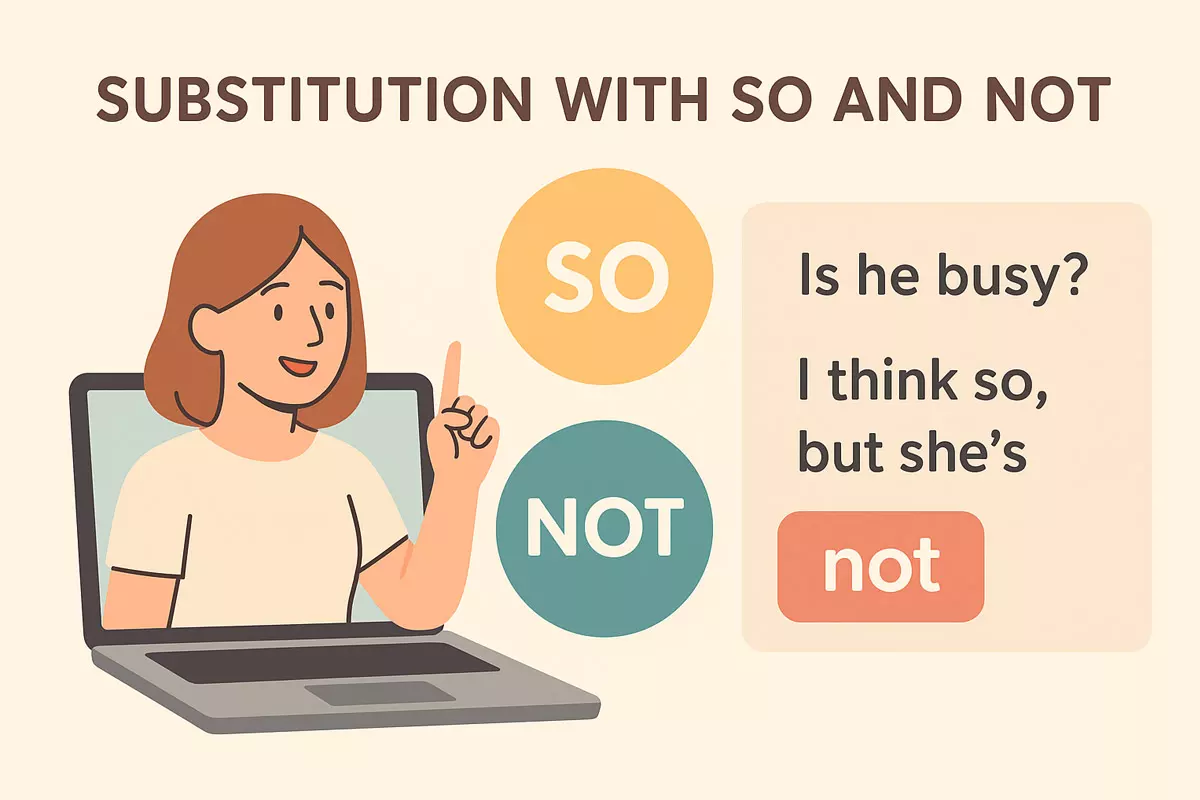 This article explains the grammatical concept of substitution, focusing on how SO and NOT replace entire clauses. It covers their roles in sentences, formal and informal usage, common errors, and includes practice for using them correctly.
Modern English speakers frequently use concise alternatives such as "so" or "not" to replace repeated information within sentences, which helps streamline communication and prevent unnecessary repetition. This linguistic strategy not only makes conversations more efficient but also contributes to the natural flow of spoken language. By adopting these shortcuts, speakers can focus on the most important points without restating information, ultimately shaping the way people interact and enhancing the clarity of everyday exchanges.
What Substitution Means in Grammar
Substitution in grammar refers to replacing a word, phrase, or clause with another element to avoid repetition and make sentences smoother. This tool is especially useful in English for maintaining cohesion in both written and spoken language. Instead of repeating the same information, speakers and writers use substitute words like "so" and "not" to refer back to something already mentioned.
Why Use Substitution?
Avoiding redundancy is the main goal. When the same verb, clause, or idea appears multiple times, substitution lets us refer to it efficiently. This keeps communication concise and prevents awkward repetition.
- Streamlines conversation and writing
- Prevents unnecessary repetition
- Helps clarify what part of a previous statement is being referenced
- Makes longer texts easier to follow
Common Substitutes in Modern English
Words like "so" and "not" often act as substitutes for entire clauses or verb phrases. These words stand in for ideas, actions, or states mentioned earlier, and are especially common after verbs like "think," "hope," "believe," "suppose," and "expect."
Examples of Substitution with "So" and "Not"
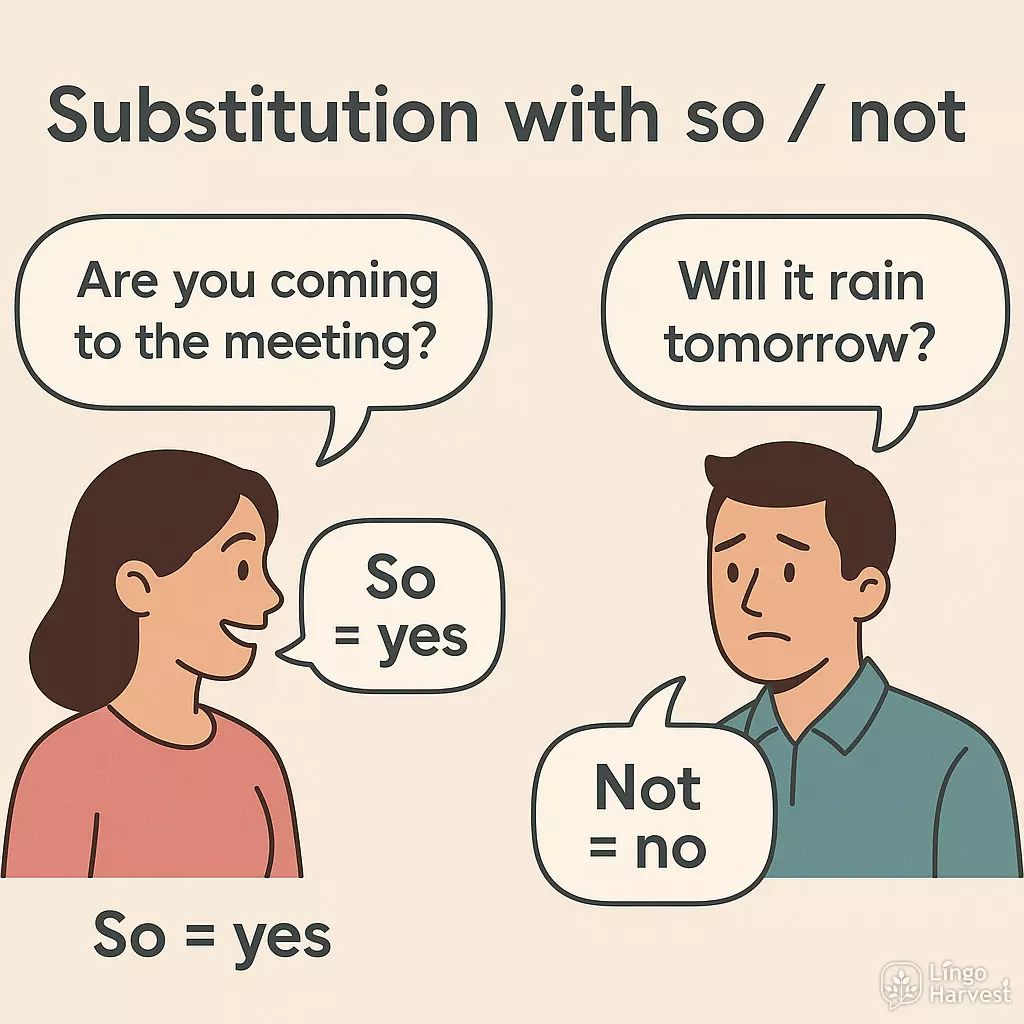
Here are some practical examples where these substitutes help avoid repeating full statements:
- “Are you coming to the meeting?” – “I think so.” (so = I am coming to the meeting)
- “Will it rain tomorrow?” – “I hope not.” (not = it will not rain tomorrow)
- “Did she finish her work?” – “I believe so.” (so = she finished her work)
- “Will they be late?” – “I don’t think so.” (so = they will be late)
- “Are you free tonight?” – “I hope so.” (so = I am free tonight)
- “Has the package arrived?” – “I don’t think so.”
- “Is this the right address?” – “I believe so.”
- “Will you need any help?” – “I don’t think so.”
- “Is the movie worth seeing?” – “I suppose so.”
- “Do you want dessert?” – “I think not.”
- “Will he agree with us?” – “I hope so.”
- “Will you be at home?” – “I believe not.”
- “Did it work?” – “I think so.”
- “Should I call him?” – “I don’t think so.”
- “Is this yours?” – “I hope not.”
How Substitution Differs from Ellipsis
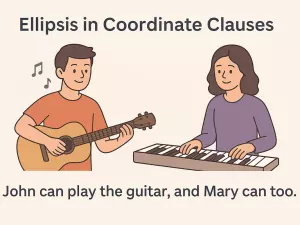
It’s important to distinguish substitution from ellipsis. Substitution involves replacing a word or phrase with another, while ellipsis omits it entirely. For example, in “I think so” the word “so” substitutes for a full clause, but in “I can play the guitar, and she can too,” “can” is left without an object, which is ellipsis.
Summary Table: Substitution vs. Repetition
| Redundant Repetition | Effective Substitution |
|---|---|
| I think she will come to the party. She will come to the party. | I think so. |
| I hope it will not rain tomorrow. It will not rain tomorrow. | I hope not. |
| He believes they are right. They are right. | He believes so. |
| She does not think she can finish on time. She can finish on time. | She does not think so. |
Substitution helps English speakers connect ideas fluidly and avoid clumsy repetition, making conversations and texts more natural and engaging.
Functions of SO in Sentences
The term so serves multiple purposes in modern English, especially when it comes to substitution within sentences. Instead of restating a previous clause or phrase, speakers often use so to avoid repetition, maintain fluency, and refer back to ideas already mentioned. This substitution is common in both spoken and written contexts, especially in conversational or informal styles.
Substitution for Clauses and Verbs
One of the most frequent uses is to stand in for whole clauses or verb phrases. For example, after verbs like think, believe, hope, and say, so can replace what has just been stated or implied. This helps to keep communication concise:
- “Will it rain tomorrow?” – “I think so.” (replaces “I think it will rain tomorrow.”)
- “Are they coming to the party?” – “I hope so.”
- “Did you finish your work?” – “I believe so.”
Patterns and Typical Contexts
The word so often appears after certain verbs, and, less commonly, after adjectives or adverbs. Here’s a list of common verbs and expressions that frequently take so as a substitute:
- think
- suppose
- believe
- guess
- hope
- say
- expect
- imagine
- assume
- fear
- be afraid
- suspect
- reckon
- appear (It appears so.)
- seem (It seems so.)
- do (I told you so.)
Affirmation and Agreement
Another function is to express agreement or confirmation. When someone makes a statement, so can be used to affirm the truth of that statement without repeating it:
- “You’re free this weekend, right?” – “I think so.”
- “They’ve already left.” – “If you say so.”
Comparing SO Substitution Patterns
To illustrate how so fits into different substitution patterns, consider the following comparison of examples showing both the full clause and the substituted form:
| Full Clause | With so Substitution |
|---|---|
| I think it will work. | I think so. |
| She said she would come. | She said so. |
| He believes that’s true. | He believes so. |
| They are going to help. | I hope so. |
| You finished your project. | I suppose so. |
Special Note: Restrictions and Alternatives
It’s important to note that so is not used with every verb or sentence structure. Some verbs and expressions require other forms of substitution, such as using do, it, or repeating the full clause for clarity. Understanding when so is appropriate depends on familiarity with common English patterns and the context of the conversation.
Functions of NOT in Sentences
In contemporary English, not operates as a key tool for expressing negation, forming contrasts, and clarifying meaning within sentences. Its usage extends beyond simply making verbs negative; it also helps in responding to statements, substituting for longer clauses, and emphasizing differences. Understanding how not functions can enhance both clarity and subtlety in communication.
Negation of Verbs and Clauses
The most familiar role for not is to negate verbs. It attaches to auxiliary verbs (such as do, have, be, and modals like can) to create negative statements or questions. This mechanism helps speakers indicate the absence or opposite of an action, state, or possibility.
- She is not ready.
- They do not agree.
- We cannot attend.
- He has not finished.
Contrast and Correction
Another function is to signal contrast or correction, often in response to previous statements. Here, not can be used to directly contradict or clarify, sometimes standing alone or followed by a phrase for emphasis.
- A: You are tired. → B: Not really.
- It was John, not Mary, who called.
- That's not what I meant.
Substitution and Ellipsis
In conversation, not frequently substitutes for entire clauses to avoid repetition. This is especially common after words like think, believe, or hope, and in short answers.
- Will you join us? – No, I will not.
- Do you think it’s true? – I hope not.
- Some people like it. – Not me.
Patterns and Common Uses
Below, find some typical patterns where not appears in modern English sentences:
- Not only... but (also)...
- Not until...
- Not anymore
- Not yet
- Not necessarily
- Not at all
- Not quite
- Not really
- Not even
- Not much/many
- Not sure
- Not bad
- Not always
- Not often
- Not everyone
- Not every day
- Not anymore
- Not for long
Comparison: Full Sentence vs. Substituted NOT
| Full Response | With NOT Substitution |
|---|---|
| I think it will rain. | I think not. |
| She is coming to the party. | Not coming. |
| I want some tea. | Not for me. |
| He likes spicy food. | Not really. |
In sum, not allows speakers to create nuanced negatives, offer concise replies, and highlight contrasts, making it indispensable for clear and flexible English expression.
Replacing Entire Clauses with SO/NOT
In English, it’s common to avoid repeating a whole clause by using short substitutes like so and not. This approach makes conversations more efficient and natural, especially when responding to statements or questions. These words act as stand-ins, allowing speakers to confirm or deny information without restating the full sentence.
How SO and NOT Work as Substitutes
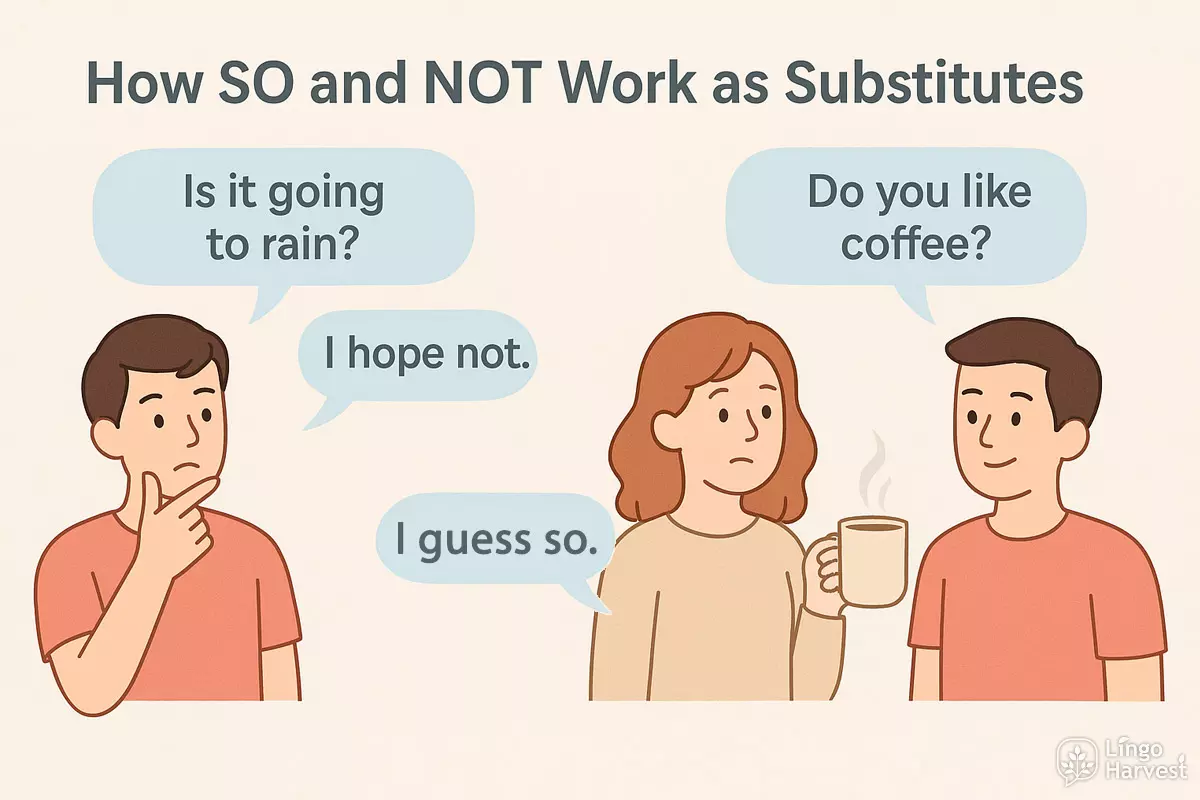
So is typically used to confirm or agree with a positive statement, while not is used to negate or contradict it. This is especially frequent after reporting verbs, such as think, say, hope, and suppose. The structure usually follows the pattern: subject + reporting verb + so/not.
- "Will he come to the meeting?" — "I think so." (Yes, I think he will.)
- "Did she pass the exam?" — "I hope so." (Yes, I hope she did.)
- "Are they joining us?" — "I don't think so." (No, I don't think they are.)
- "Is it going to rain?" — "I hope not." (No, I hope it doesn't.)
- "Will you be at the party?" — "I suppose so." (Yes, I suppose I will.)
- "Do you like coffee?" — "I guess so." (Yes, I guess I do.)
- "Are you coming with us?" — "I think not." (No, I don't think so.)
- "Is she angry?" — "I hope not." (No, I hope she isn't.)
- "Will it work?" — "I believe so." (Yes, I believe it will.)
- "Do they understand?" — "I expect so." (Yes, I expect they do.)
- "Did he finish the report?" — "I don't think so." (No, I don't think he did.)
- "Are you ready?" — "I suppose not." (No, I suppose I'm not.)
- "Will she agree?" — "I doubt it." (No, I doubt she will.)
- "Is the answer correct?" — "I hope so." (Yes, I hope it is.)
- "Are you free tomorrow?" — "I think so." (Yes, I think I am.)
- "Is this the right bus?" — "I believe so." (Yes, I believe it is.)
- "Can we start now?" — "I guess not." (No, I guess we can't.)
- "Will you join us later?" — "I hope so." (Yes, I hope I will.)
- "Is the shop open?" — "I don't think so." (No, I don't think it is.)
- "Are we late?" — "I hope not." (No, I hope we aren't.)
When to Use SO and NOT
You’ll find these substitutes in both spoken and written English, but especially in everyday conversation. They’re most natural after verbs that express opinion, belief, or hope. Using these forms keeps responses brief and avoids unnecessary repetition.
| Full Clause | Substitution with SO/NOT |
|---|---|
| Will she come to the event? — I think she will come to the event. | I think so. |
| Is it going to snow? — I do not think it is going to snow. | I don't think so. |
| Are you hungry? — I hope that I am not hungry. | I hope not. |
| Did they find the answer? — I believe they found the answer. | I believe so. |
| Will you be late? — I suppose I will not be late. | I suppose not. |
Common Pitfalls
It’s important to note that so and not cannot always replace a clause. They’re not used with every verb, and some contexts require the full sentence for clarity. Also, not is never used alone; it always follows an appropriate verb (e.g., I hope not, not just Not). In summary, using these compact forms makes communication smoother and avoids unnecessary repetition, especially in daily interactions.
Formal vs Informal Usage Patterns
Usage of "so" and "not" as substitutes in English varies widely depending on context and register. In academic writing, business correspondence, and official documents, their application is more restricted, whereas casual speech and informal texts often show greater flexibility and creativity.
Patterns in Formal English
In more structured settings, substitutes like "so" and "not" typically follow established grammatical conventions. For example, "so" is often used as a pro-form for clauses, especially after verbs like "think," "believe," or "suppose":
- “Do you think she will come?” — “I think so.”
- “Will they approve the proposal?” — “I hope so.”
- “Is the report finished?” — “I believe so.”
- “Are you attending?” — “I expect so.”
Negative forms such as "I think not" are also acceptable in formal writing, especially in concise responses:
- “Is the data accurate?” — “I think not.”
- “Has the issue been resolved?” — “I believe not.”
Informal and Colloquial Patterns
Conversational English often bends or expands the use of these substitutes. Short responses, sometimes even omitting the main verb, are common in speech and messaging. Here are some typical informal patterns:
- “Will you join us?” — “Hope so!”
- “Are you done?” — “Guess so.”
- “Will it rain?” — “Don’t think so.”
- “She’s coming, right?” — “Think so.”
- “Is it spicy?” — “Don’t think so.”
- “Will they notice?” — “Doubt it.”
- “Are you ready?” — “Suppose so.”
- “Is it broken?” — “Hope not.”
- “Did you like it?” — “Guess not.”
- “Will you be late?” — “Probably not.”
| Context | Typical Substitution Examples | Formality Level |
|---|---|---|
| Academic Writing | I believe so. I think not. |
High |
| Business Email | I expect so. Probably not. |
Moderate to High |
| Casual Conversation | Hope so. Guess so. Don’t think so. |
Low |
| Text Messaging | Think so. Hope not. Guess not. |
Very Low |
Observations and Nuances
Notably, while short forms like “think so” or “hope not” are widely accepted in speech and informal writing, they may be considered too abrupt or imprecise in academic or professional contexts. The choice between "so" and "not" as substitutes is also sensitive to tone—"I think not" can sound more formal or even dismissive, while "don’t think so" is softer and more casual.
In summary, the appropriateness of these substitutions hinges on both the social context and the desired level of formality. Adapting usage accordingly helps maintain clarity and tone in communication.
Common Errors with Substitution
Misusing “so” and “not” as substitutes is a frequent stumbling block, even for advanced speakers. These errors often arise from confusion over context, register, and the specific grammatical structures that allow substitution. Understanding where substitution is appropriate—and where it sounds awkward or incorrect—can make a significant difference in clarity and naturalness.
Typical Mistakes with “So” and “Not”
- Using “so” where “it” or another pronoun is required: “She thinks so is true.” ❌ (Correct: “She thinks it is true.”)
- Replacing entire clauses unnecessarily: “He said he would come, and so.” ❌ (Correct: “He said he would come, and so he did.”)
- Omitting the auxiliary verb: “I hope so.” vs. “I hope do so.” ❌ (“do so” is only used in certain contexts, not after “hope”)
- Confusing positive and negative forms: “I don’t think so not.” ❌ (Correct: “I don’t think so.” or “I think not.”)
- Overusing “so” in direct answers: “Will you be there?” — “So.” ❌ (Correct: “I think so.” or “Yes, I will.”)
- Using “not” alone without necessary support: “Do you want tea?” — “Not.” ❌ (Correct: “I do not.” or “No, thank you.”)
- Applying “so” after verbs that don’t permit it: “She enjoys so.” ❌ (“so” cannot substitute for direct objects)
- Incorrect inversion with “so”: “So do I am.” ❌ (Correct: “So am I.”)
- Using “not” where “so” is expected: “Will it rain? — I think not.” (Acceptable in formal register, but “I don’t think so.” is more common in conversation.)
- Redundant use: “I suppose so yes.” ❌ (Correct: “I suppose so.” or “Yes, I suppose so.”)
- Confusing “so” with “such”: “I hope such.” ❌ (“Such” does not function as a clause substitute.)
- Inserting “not” after “so”: “I think so not.” ❌ (Correct: “I don’t think so.” or “I think not.”)
- Attempting to substitute for questions: “Did you finish the work?” — “So.” ❌ (Correct: “I did.” or “Yes, I finished.”)
- Using “so” in negative responses: “Is he coming?” — “So not.” ❌ (Correct: “I don’t think so.” or “I think not.”)
- Mixing up “so” with “too” or “either”: “I like it, so.” ❌ (Correct: “I like it, too.”)
Comparing Standard and Non-Standard Patterns
| Non-Standard Usage | Standard Alternative |
|---|---|
| “I hope do so.” | “I hope so.” |
| “He is coming, so.” | “He is coming, I think so.” or “He is coming, isn’t he?” |
| “I think so not.” | “I don’t think so.” or “I think not.” |
| “Not.” (as a standalone answer) | “No, I don’t.” or “I do not.” |
| “So do I am.” | “So am I.” |
| “I hope such.” | “I hope so.” |
How to Avoid These Mistakes
Pay close attention to whether the verb naturally allows substitution with “so” or “not.” Practice with common phrases, and listen for how native speakers respond in context. When in doubt, use a full clause or a pronoun (“it,” “that”) rather than risking an awkward substitute. Remember that “so” typically refers to positive statements, while “not” is best reserved for formal or written English. Regular exposure to authentic conversation is the best way to internalize these patterns.
Practice: Respond with SO or NOT
Understanding how to reply using "so" or "not" is essential for concise and natural English responses. This practice section helps you master these short replies in context. Below, you'll find a variety of exercises and examples to reinforce your understanding.
Quick Response Exercise
Read each statement and decide whether you should respond using "so" or "not" to indicate agreement or disagreement. Write your answer after each sentence.
- She thinks the meeting is at 3 o'clock.
- They aren't coming to the party tonight.
- You believe the answer is correct.
- He doesn't trust the new manager.
- We will see them at the conference.
- You didn't call him yesterday.
- Anna will join us later.
- They won't finish the project on time.
- You know the results already.
- He hasn't seen the latest episode.
Show answers
- So
- Not
- So
- Not
- So
- Not
- So
- Not
- So
- Not
Common Patterns: When to Use "So" and "Not"
Short responses with "so" or "not" often follow a reporting verb and a subject, especially in indirect speech. Here are some frequent patterns:
- I think so. / I think not.
- She hopes so. / She hopes not.
- They suppose so. / They suppose not.
- We guess so. / We guess not.
- He believes so. / He believes not.
- You assume so. / You assume not.
- It seems so. / It seems not.
- They say so. / They say not.
- We expect so. / We expect not.
- She fears so. / She fears not.
Comparison Table: Typical Usage Contexts
| Expression | Example Response |
|---|---|
| Positive expectation or confirmation | "Will it rain tomorrow?" – "I think so." |
| Negative expectation or denial | "Are they joining us?" – "I hope not." |
| Reporting someone else’s opinion | "Does she like jazz?" – "She says so." |
| Expressing uncertainty or doubt | "Is he coming?" – "I suppose not." |
Mini-Dialogue Practice
Complete the following dialogues with "so" or "not" as appropriate.
- A: Will John attend the seminar?
B: I hope ____. - A: Did she enjoy the movie?
B: I think ____. - A: Is it going to snow this weekend?
B: I hope ____. - A: Do you believe the news?
B: I believe ____.
Show answers
- so
- so
- not
- not
Practicing these patterns will help you use "so" and "not" naturally in everyday English conversations. Try making your own examples to reinforce your understanding.