May and Might: Probability and Polite Permission Explained

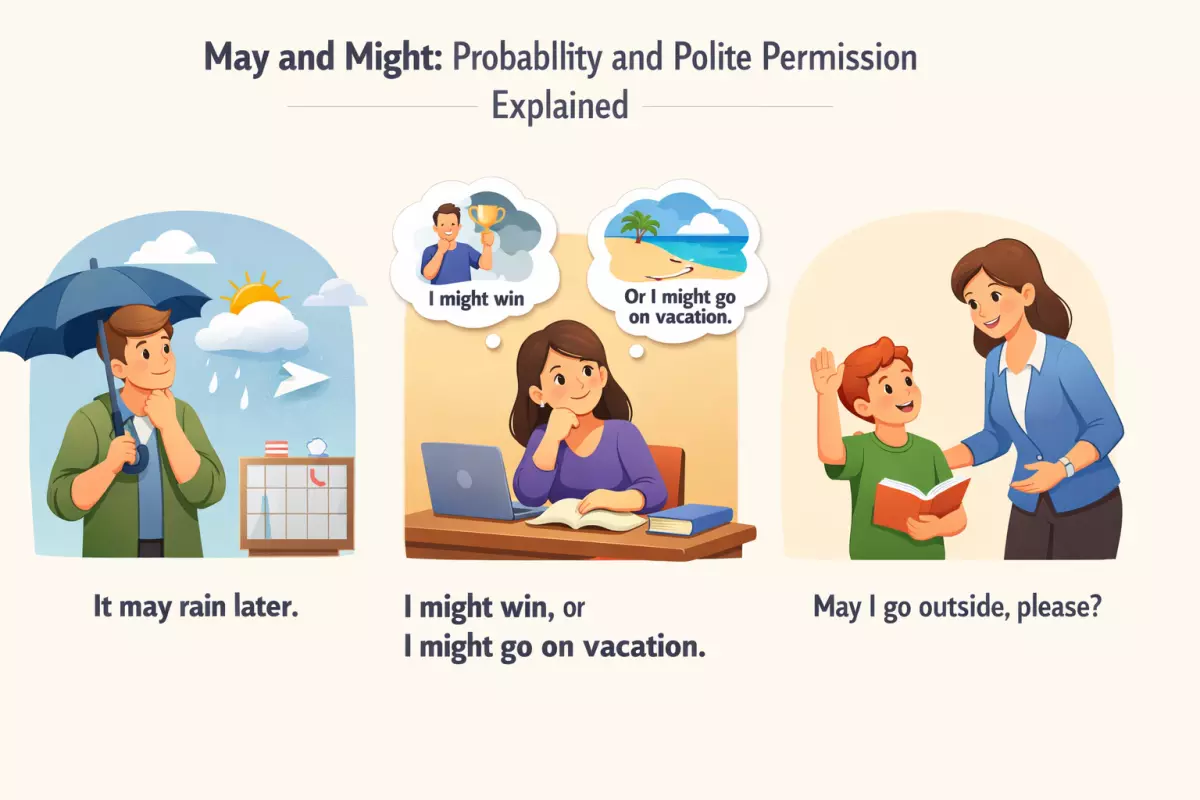 This article explains the basic meanings of may and might, how they express probability and different certainty levels, and how to use them for polite permission and formal requests. It also covers negatives, questions, may have/might have, common mistakes, and homework practice tasks.
In everyday English, may and might help you talk about possibility and ask for permission politely. You’ll hear them at work, in classrooms, and in messages, and choosing the right one can change how confident, cautious, or formal you sound. This guide will help you read the situation so your meaning stays clear and your tone fits the moment.
Basic meanings of may and might
These two modal verbs are used in a few core ways. They most often express uncertainty (a guess about what is true now or what could happen later), and they can also be used for permission. The meaning depends on the context and the structure that follows.
Core uses and typical patterns
- Possibility (present or future): use may/might + base verb to show that something is possible but not certain.
- It may rain later.
- She might arrive early.
- We may need more time.
- The price might go up next month.
- Permission (formal / polite): use May I…? to ask permission, and You may… to give permission.
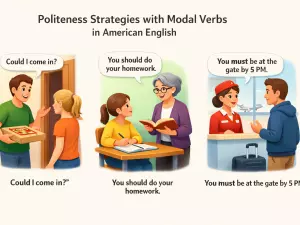
- May I come in?
- You may leave when you finish.
- May we use your phone?
- Students may bring a calculator.
- Weaker possibility / more distance: might often sounds a little less confident than may, or simply more tentative.
- It may be true. (possible)
- It might be true. (possible, slightly more cautious)
- Polite suggestions (indirect): might can soften advice by making it sound less direct.
- You might want to check the address.
- You might try restarting your laptop.
Meaning changes with time: present vs. past
- Present/future possibility: may/might + base verb
- They may cancel the meeting.
- He might call tonight.
- Past possibility (uncertain past): may/might + have + past participle
- She may have missed the train.
- They might have forgotten the deadline.
- The email may have gone to spam.
- He might have left already.
Common patterns you can reuse
- May/Might + be: It may be expensive. / He might be busy.
- May/Might + seem/appear: It may seem strange at first.
- May/Might + need/have to: We might need to reschedule.
- May/Might + not: I may not have time. / They might not agree.
- May I…? (permission request): May I ask a question?
- You may… (permission granted): You may begin now.
- May not (not allowed or uncertain not): You may not park here. / She may not know.
Quick accuracy notes
- After may or might, use the base verb: ✅ She may go ❌ She may goes.
- For past uncertainty, use have + past participle: ✅ He might have left ❌ He might left.
- Permission is most natural with may in careful/formal English; might is usually not used to grant permission.
Talking about probability and possibility

When you use may and might to describe uncertainty, you are making a judgment about how likely something is, based on the information you have. In most everyday contexts, both modals work, but the choice can subtly change the level of confidence or the tone.
General pattern
- May/might + base verb: “She may arrive late.” / “She might arrive late.”
- May/might + be + -ing (possible ongoing situation): “He may be working.” / “He might be working.”
- May/might + have + past participle (possible past situation): “They may have missed the train.” / “They might have missed the train.”
- May/might not + base verb: “It may not rain.” / “It might not rain.”
Typical meaning differences (small but useful)
- May often sounds a little more neutral or slightly more confident: “The results may improve with practice.”
- Might often sounds more tentative or cautious: “The results might improve, but it’s hard to say.”
- In many conversations, the difference is minimal; context and intonation carry most of the meaning.
- In formal writing, may is common for careful claims: “These findings may indicate a trend.”
High-value example set (common situations)
- “I may go to the meeting if I finish early.”
- “I might go to the meeting, but I’m not sure yet.”
- “This may be the best option available.”
- “This might be the best option, but we should compare prices.”
- “She may know the answer.”
- “She might know the answer—ask her.”
- “We may need more time.”
- “We might need more time, depending on the data.”
- “It may take a few days to ship.”
- “It might take longer during holidays.”
- “He may be stuck in traffic.”
- “He might be sleeping—try later.”
- “They may have misunderstood the instructions.”
- “They might have left already.”
- “The file may not open on older devices.”
- “The file might not have saved correctly.”
Common pitfalls to avoid
- ❌ “He may can come.” → ✅ “He may come.” (Use the base verb, not another modal.)
- ❌ “She might to be late.” → ✅ “She might be late.” (No “to” after may/might.)
- ❌ “They may went home.” → ✅ “They may have gone home.” (Use may/might have + past participle for past possibility.)
- ❌ “It may raining.” → ✅ “It may be raining.” (Use “be” for the -ing form.)
Choosing quickly in real communication
- Use may when you want to sound measured and reasonably confident: “This may solve the issue.”
- Use might when you want to sound more cautious or speculative: “This might solve the issue, but we need to test it.”
- If you add a condition, both are natural: “It may/might work if we restart the system.”
- If you want to soften a suggestion, might is especially common: “You might want to double-check the address.”
May vs might: degree of certainty
When you’re talking about possibility (not asking permission), may and might both signal uncertainty, but they often differ in how confident the speaker sounds. In many everyday contexts, the difference is subtle and depends on tone, context, and the kind of evidence you have.
Typical certainty pattern
- May often suggests a slightly stronger possibility: the speaker sees a real chance based on what they know.
- Might often sounds more tentative: the speaker treats it as one possible outcome among several.
- In questions, might can sound especially cautious: “Might it be…?”
- In formal writing (rules, notices, policies), may
- In casual conversation, many speakers use them interchangeably, especially with “maybe” or “I don’t know.”
What affects the choice
- Evidence: Use may when there’s a reason to think it’s likely (a schedule, a forecast, a known pattern). Use might when it’s more speculative.
- Distance: Might can create distance from the claim, making it sound less committed.
- Politeness and softness: Might can soften suggestions and predictions: “It might be better to wait.”
- Formality: May often fits formal announcements; might often fits conversational hedging.
- Time frame: Both work for present/future possibility; for past possibility, both can appear with have + past participle (see examples below).
Common patterns with examples
- Present/future possibility: “It may rain later.” (some basis, forecast) / “It might rain later.” (less sure)
- Cause and effect: “If you skip lunch, you may feel tired.” / “If you skip lunch, you might feel tired.”
- Plans and availability: “I may join you after work.” / “I might join you after work.”
- Uncertain identification: “That may be the right file.” / “That might be the right file.”
- Soft advice: “You may want to back up your data.” / “You might want to back up your data.” (often gentler)
- Possibility among options: “We might take the train.” (one option) / “We may take the train.” (possible plan)
- Formal notices: “Bags may be searched.” (standard official wording)
- Academic/technical caution: “This result may indicate a measurement error.” / “This result might indicate a measurement error.” (either works; might often sounds more cautious)
- Past possibility (uncertain past): “She may have missed the bus.” / “She might have missed the bus.”
- Polite, tentative question: “Might there be another way to do this?” (more tentative than “May there be…?”)
- Contrast with certainty: “He may be late, but he usually arrives.” (possible) vs. “He must be late.” (strong conclusion)
- Negative possibility: “It may not work.” / “It might not work.” (the might version often sounds more unsure)
Quick accuracy notes
- ✅ “It may be true.” / “It might be true.” (both correct; different strength)
- ❌ “It may to be true.” → ✅ “It may be true.”
- ❌ “He might can come.” → ✅ “He might come.”
- After may/might, use the base verb: “may go,” “might help,” “may be,” not “may goes” or “might helped.”
Polite permission and formal requests
When you ask to do something or ask someone else to do something, modal verbs help you control how direct, respectful, or tentative you sound. May is the classic choice for formal permission and polite requests, while might can make a request feel even softer or more indirect (often sounding cautious or tentative rather than strictly “permission-seeking”).
Common patterns with may (permission and polite requesting)
- May I + base verb? (asking permission) ✅ “May I come in?”
- May we + base verb? (group permission) “May we begin the meeting?”
- May I please + base verb? (extra politeness) “May I please speak with Dr. Lee?”
- May I ask + question word...? (polite inquiry) “May I ask why the deadline changed?”
- May I have + noun? (requesting an item) “May I have a copy of the report?”
- May I speak to + person? (formal phone/office request) “May I speak to the manager?”
- May I + base verb + now? (timing) “May I leave now?”
- May I + base verb + for a moment? (brief action) “May I interrupt for a moment?”
- You may + base verb (giving permission) “You may start when you’re ready.”
- May + subject + base verb? (very formal inversion) “May I suggest an alternative?”
- May I confirm + noun/clause? (administrative tone) “May I confirm your appointment time?”
- May I request + noun? (highly formal) “May I request an extension?”
Common patterns with might (softening and indirectness)
- Might I + base verb? (very formal, old-fashioned in some contexts) “Might I ask a quick question?”
- I was wondering if I might + base verb... (indirect and polite) “I was wondering if I might reschedule.”
- Would it be possible for me to + base verb...? (often followed by might in the next clause) “Would it be possible for me to submit it tomorrow, or might that be too late?”
- If I might + base verb... (polite interruption/suggestion) “If I might add something, the budget is still unclear.”
- You might + base verb (gentle suggestion, not permission) “You might want to check the figures again.”
- Might we + base verb...? (tentative proposal) “Might we discuss this after the presentation?”
Choosing the right level of formality
- Use “May I…?” when you want a clear, respectful permission question, especially in professional or official settings.
- Use “Might I…?” when you want to sound especially cautious or deferential, or when you are making a delicate request.
- Use “You may…” to grant permission; it sounds official and can feel strict in casual conversation.
- Avoid using “might” to grant permission in most situations: ❌ “You might leave now” (sounds like a suggestion) → ✅ “You may leave now.”
- For everyday requests, “can/could” is often more natural, but may remains the safest formal option when you need a polite, correct permission form.
Negative forms and questions
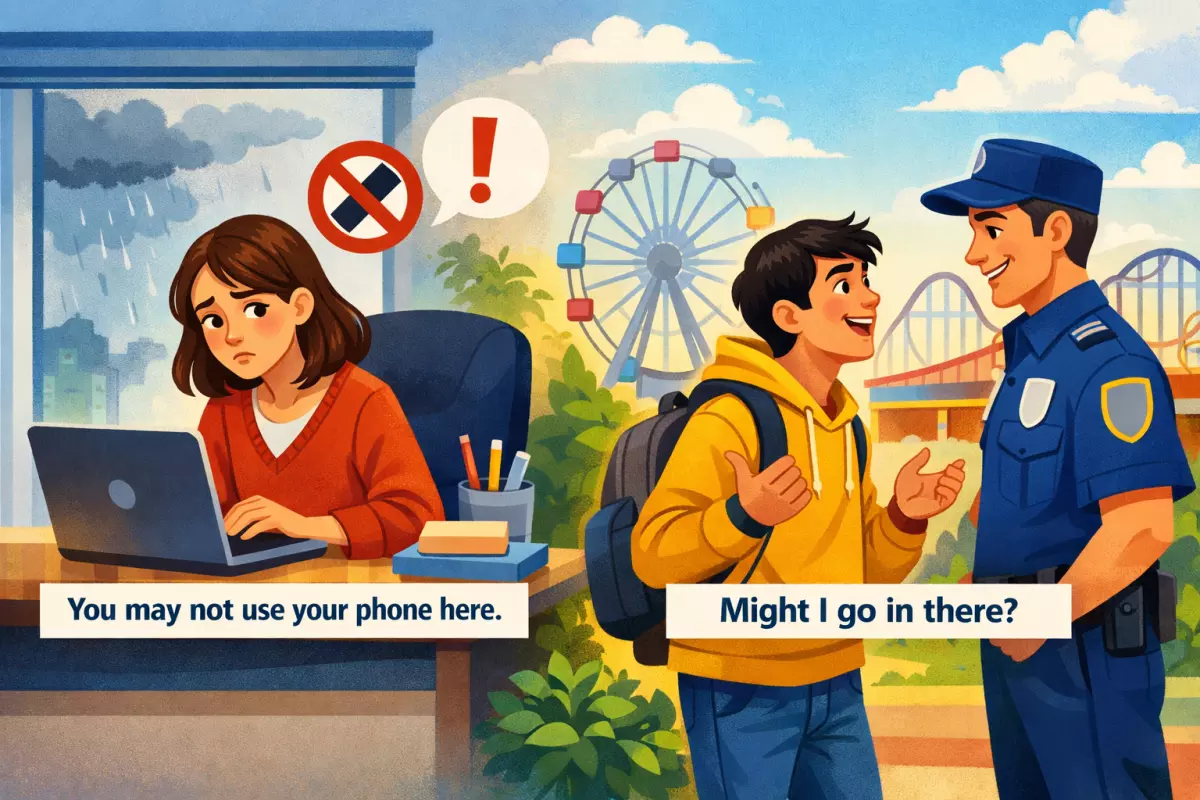
When you negate or ask with may and might, the meaning shifts in predictable ways: negatives often sound more formal or cautious, and questions are common for permission but less common for probability. The form you choose also affects how direct, polite, or certain you sound.
Negative forms: patterns and meaning
- May not usually means “it’s possible that…not” or “it is not allowed.” Context decides which meaning is intended.
- Might not focuses on uncertain possibility: “it’s possible that…not,” often sounding a little more tentative than may not.
- Mayn’t exists but is rare in modern English; avoid it in most writing and speaking.
- For permission, negatives are often clearer with other verbs: “You can’t…” is more direct than “You may not…,” which can sound formal or rule-like.
- For probability, negatives commonly appear with time markers to show uncertainty: “She may not arrive today,” “They might not have heard yet.”
- With perfect forms, the negative goes after the modal: “may not have + past participle,” “might not have + past participle.”
- With continuous forms, the negative stays in the same place: “may not be + -ing,” “might not be + -ing.”
- Avoid double negatives with these modals in standard English: ❌ “He may not never call.” ✅ “He may never call.”
- In short answers, negatives are possible but can sound clipped; full sentences are often clearer: “It might not.” → “It might not be ready.”
Questions: permission vs. probability
- May I…? is a classic permission question and sounds formal or careful: “May I come in?”
- Might I…? is even more tentative and can sound old-fashioned or very polite in modern use: “Might I ask a question?”
- May we…? works for group permission in formal settings: “May we begin?”
- For everyday permission, many speakers prefer Can I…? or Could I…? because they feel more natural in casual conversation.
- Probability questions with may/might are possible but less common; speakers often choose “Do you think…?” or “Is it possible…?” instead.
- When a probability question is used, it often asks about a possible explanation: “Might this be the wrong file?”
- Yes/no answers typically restate the idea rather than just the modal: “May it rain?” → “It might,” “It may,” “It might not.”
- In indirect questions, word order stays normal (no inversion): “Do you think it might be late?” not ❌ “Do you think might it be late?”
Useful example set (form-focused)
- “You may not park here.” (permission: not allowed)
- “He may not know the answer.” (probability: possibly doesn’t know)
- “They might not agree.” (uncertain negative outcome)
- “I may not be able to attend.” (polite, cautious refusal)
- “She might not be working today.” (uncertain present situation)
- “It may not have uploaded correctly.” (uncertain past result)
- “We might not have met before.” (uncertain past experience)
- “May I leave early?” (formal permission request)
- “Might I suggest an alternative?” (very polite suggestion)
- “May we start the meeting now?” (formal group permission)
- “Might this problem be caused by the settings?” (possible explanation)
- “If you’re busy, you might not want to take this on.” (gentle advice)
May have and might have overview
Use may have and might have to talk about a past possibility: you are not stating a fact, but suggesting what was possible based on limited information. Both forms combine a modal verb (may/might) + have + a past participle (done, seen, left, forgotten).
Core meaning and when to choose each
- May have + past participle: a past possibility that can sound slightly more open or plausible in neutral contexts (often used in careful, formal, or written explanations).
- Might have + past participle: a past possibility that often feels a bit more tentative or speculative in everyday speech, though in many situations it is interchangeable with may have.
- In many varieties of English, the difference in probability is small; context and tone usually matter more than a strict percentage.
- Both forms are common in reasoning: you infer a possible past cause from present evidence.
Form patterns (affirmative, negative, questions)
- Affirmative: may/might + have + past participle
→ “She may have missed the bus.” / “She might have missed the bus.” - Negative: may/might + not + have + past participle (not goes after the modal)
→ “He might not have heard you.” - Questions (less common, often replaced by other phrasing): May/Might + subject + have + past participle?
→ “Might they have taken the wrong turn?” - Passive: may/might + have been + past participle
→ “The email may have been deleted.” - Continuous: may/might + have been + -ing (possible ongoing situation in the past)
→ “They might have been waiting outside.”
Common uses with example sentences
- Explaining a missing item: “I may have left my keys at the office.”
- Interpreting silence: “She might have fallen asleep.”
- Speculating about a delay: “The train may have been held at the previous station.”
- Guessing a reason: “He might have forgotten the meeting.”
- Softening a claim: “I may have misunderstood your message.”
- Making a cautious accusation: “Someone might have taken it by mistake.”
- Drawing a conclusion from evidence: “The package may have arrived earlier than expected.”
- Uncertain completion: “They might have finished the report already.”
- Possible past location: “She may have been at the library.”
- Possible past activity: “He might have been driving when you called.”
- Checking a process step: “The file may have been saved in the wrong folder.”
- Medical/technical caution: “The device might have overheated.”
- Polite self-correction: “I might have phrased that badly.”
- Uncertain communication: “They may not have received the update.”
- Uncertain timing: “We might have arrived too late.”
Frequent learner errors to avoid
- ✅ “He may have gone home.” ❌ “He may has gone home.”
- ✅ “They might not have seen it.” ❌ “They might have not seen it.” (possible but less natural in most contexts)
- ✅ “It may have been stolen.” ❌ “It may have stole.”
- ✅ “She might have been working.” ❌ “She might have working.”
- Avoid using these forms for confirmed facts; if you know it happened, use the simple past or present perfect instead.
Common learner mistakes
Learners often mix up probability, permission, and formality when choosing between these two modal verbs. The issues below focus on the most frequent pattern problems and how to correct them in real sentences.
- Using “may” for strong certainty
“May” signals possibility, not a near guarantee. If you mean something is very likely, use “will probably,” “is likely to,” or “must” (logical conclusion).
❌ It may definitely rain tomorrow. → ✅ It will probably rain tomorrow. - Using “might” when you want polite permission
In modern English, “May I…?” is the standard for asking permission politely. “Might I…?” exists, but it can sound overly formal or old-fashioned in everyday situations.
✅ May I leave early? (polite, normal)
✅ Might I ask a question? (very formal) - Answering permission questions incorrectly
“May I…?” asks for permission; the reply should grant/deny permission, not comment on ability.
❌ May I open the window? — Yes, you may. (correct) / Yes, you can. (also common)
Avoid: “Yes, you may” said sarcastically in contexts where “Sure” is more natural. - Confusing “can” (ability) with “may” (permission)
“Can I…?” is common and usually acceptable, but it emphasizes ability more than permission. In formal writing or careful speech, prefer “May I…?” for permission.
✅ May I use your phone? (permission)
✅ Can you swim? (ability) - Forgetting that “might” often sounds more tentative than “may”
Many speakers use both for possibility, but “might” often suggests a smaller chance or more uncertainty, especially in careful writing.
✅ It may snow. (possible)
✅ It might snow. (perhaps less certain / more cautious) - Using “to may” or “to might” after another verb
Modals don’t take “to.” Use a different structure (for example, “be allowed to,” “be likely to,” “it’s possible that…”).
❌ I want to may go. → ✅ I want to be allowed to go. / I want to go, if that’s okay. - Adding -s, -ed, or -ing to modals
Modals don’t change form. Use the base verb after them.
❌ She mays come. → ✅ She may come.
❌ He mighted go. → ✅ He might go. - Using the wrong verb form after the modal
After “may/might,” use the base form (go, be, have), not “to + verb.”
❌ We may to arrive late. → ✅ We may arrive late. - Mixing time markers without adjusting meaning
“May/might” can refer to present or future possibility; for past possibility, use “may/might have + past participle.”
❌ She might be sick yesterday. → ✅ She might have been sick yesterday. - Overusing “maybe” when a modal is needed (and vice versa)
“Maybe” is an adverb; it cannot replace the modal inside the verb phrase.
❌ I maybe go later. → ✅ I may go later. / ✅ Maybe I’ll go later. - Placing “not” in the wrong spot
Negation comes after the modal: “may not / might not.” “Mayn’t” is rare; “mightn’t” exists but is mainly British and informal.
❌ I not may attend. → ✅ I may not attend. - Misreading “may not” as permission rather than possibility
“May not” can mean “it’s possible that… not,” not only “not allowed.” Context decides.
✅ You may not like this movie. (possible you won’t like it)
✅ You may not park here. (not allowed) - Using “might” for permission statements in rules and signs
For rules, policies, and formal permission, “may” is standard because it clearly signals authorization.
✅ Employees may access the database. (permitted)
Less clear: Employees might access the database. (sounds like possibility, not permission) - Trying to form a question by adding “do/does”
Modals form questions by inversion (modal + subject).
❌ Do I may leave? → ✅ May I leave?
❌ Does she might come? → ✅ Might she come? - Using “may” in casual requests where it sounds too formal
In friendly situations, “Can I…?” or “Could I…?” may sound more natural, while “May I…?” can feel stiff. Match the level of formality to the context.
✅ Can I borrow your pen? (everyday)
✅ May I speak with the manager? (polite/formal)
Quick self-check for choosing the right form
- If you mean permission in a formal or careful tone: use “May I…?” / “You may…”
- If you mean possibility and want to sound cautious: “might” often fits well.
- If you are talking about a past possibility: use “may/might have + past participle.”
- If the sentence could be read as either permission or possibility, add context (a rule, a request, a time phrase) to make the meaning clear.
Homework: may and might practice tasks
These exercises focus on choosing the right modal for probability and for polite permission, plus common patterns such as negatives, questions, and perfect infinitives (may/might have + past participle). Pay attention to how confident the speaker sounds and whether the sentence is about asking/allowing rather than guessing.
Task 1: Choose may or might (probability)
Complete each sentence with may or might. Use the modal that best matches the level of certainty.
- It’s getting cloudy. It ______ rain later.
- She’s not answering. She ______ be in a meeting.
- Take an umbrella; the forecast says it ______ rain this evening.
- We ______ see Alex at the conference, but I’m not sure he’s going.
- This key ______ open the back door; try it.
- He ______ know the answer, but he hasn’t studied much.
- If we leave now, we ______ catch the earlier train.
- The package ______ arrive today; tracking hasn’t updated.
- That noise ______ be the washing machine.
- With traffic, we ______ be late.
Show answers
- might
- may
- may
- might
- may
- might
- might
- might
- may
- might
Task 2: Polite permission (ask, give, refuse)
Rewrite each item using may or might. Keep the meaning. Use a question for asking, and a short response for giving or refusing.
- Ask politely: “I want to open the window.”
- Give permission: “Yes, you can sit here.”
- Refuse politely: “No, you can’t park here.”
- Ask very politely: “Is it OK if I leave early?”
- Give cautious permission: “OK, but be careful.” (about using the lab equipment)
- Refuse with a reason: “No, because it’s confidential.” (about seeing the report)
Show answers
- May I open the window?
- Yes, you may.
- No, you may not.
- Might I leave early?
- You may use the lab equipment, but be careful.
- No, you may not see the report because it’s confidential.
Task 3: Fix the mistake (form and meaning)
Each sentence has a problem (wrong modal for the context, incorrect form, or unnatural permission wording). Rewrite each sentence correctly.
- ❌ He may to be late.
- ❌ Might you to help me with this file?
- ❌ May I can borrow your charger?
- ❌ She might is at home.
- ❌ You might not enter. (sign on a door)
- ❌ I may go to the party yesterday.
- ❌ May you pass the salt? (at the dinner table)
- ❌ He may have forgot his password.
Show answers
- ✅ He may be late. / He might be late.
- ✅ Might you help me with this file?
- ✅ May I borrow your charger?
- ✅ She might be at home.
- ✅ You may not enter.
- ✅ I may have gone to the party yesterday. / I might have gone to the party yesterday.
- ✅ Could you pass the salt? / Can you pass the salt?
- ✅ He may have forgotten his password. / He might have forgotten his password.
Task 4: Past possibility (may/might have + past participle)
Complete the sentences using may have or might have + the verb in brackets.
- She’s not here. She ______ ______ (miss) the bus.
- The email isn’t in my inbox. I ______ ______ (delete) it by accident.
- They look tired. They ______ ______ (work) late.
- He doesn’t remember. He ______ ______ (forget) to save the file.
- The lights are off. They ______ ______ (leave) already.
- There’s a strange charge on my card. Someone ______ ______ (use) it.
- The room is very clean. The staff ______ ______ (come) earlier.
- My phone is on silent. I ______ ______ (not hear) your call.
Show answers
- may have missed / might have missed
- may have deleted / might have deleted
- may have worked / might have worked
- may have forgotten / might have forgotten
- may have left / might have left
- may have used / might have used
- may have come / might have come
- may not have heard / might not have heard
Task 5: Mini-dialogues (choose the best option)
Select the best completion (A or B) for each short exchange.
- A: “Where’s Dana?” B: “She ___ be in the lobby; I saw her badge there.” (A) may (B) might
- A: “___ I ask a quick question?” B: “Of course.” (A) May (B) Might
- A: “Do you think the meeting will finish early?” B: “It ___, but the agenda is long.” (A) may (B) might
- A: “___ I use your phone for a second?” B: “Sure.” (A) May (B) Might
- A: “Why is the server down?” B: “There ___ be a power issue.” (A) may (B) might
- A: “Is Liam definitely coming?” B: “He ___ come, but he hasn’t confirmed.” (A) may (B) might
Show answers
- may
- May
- might
- May
- may
- might
Optional checklist (patterns to review while correcting)
- Use may/might + base verb: may be, might go, may arrive (not “to be,” not “is”).
- For past possibility, use may/might have + past participle: may have left, might have forgotten.
- For polite permission, May I…? is standard; Might I…? is more formal and less common.
- For requests at the table or with favors, can/could is usually more natural than may.
- In prohibitions, may not is common in rules/signs; might not usually means “possibly not,” not “not allowed.”