Sentence Rhythm and Stress Patterns for Natural Delivery

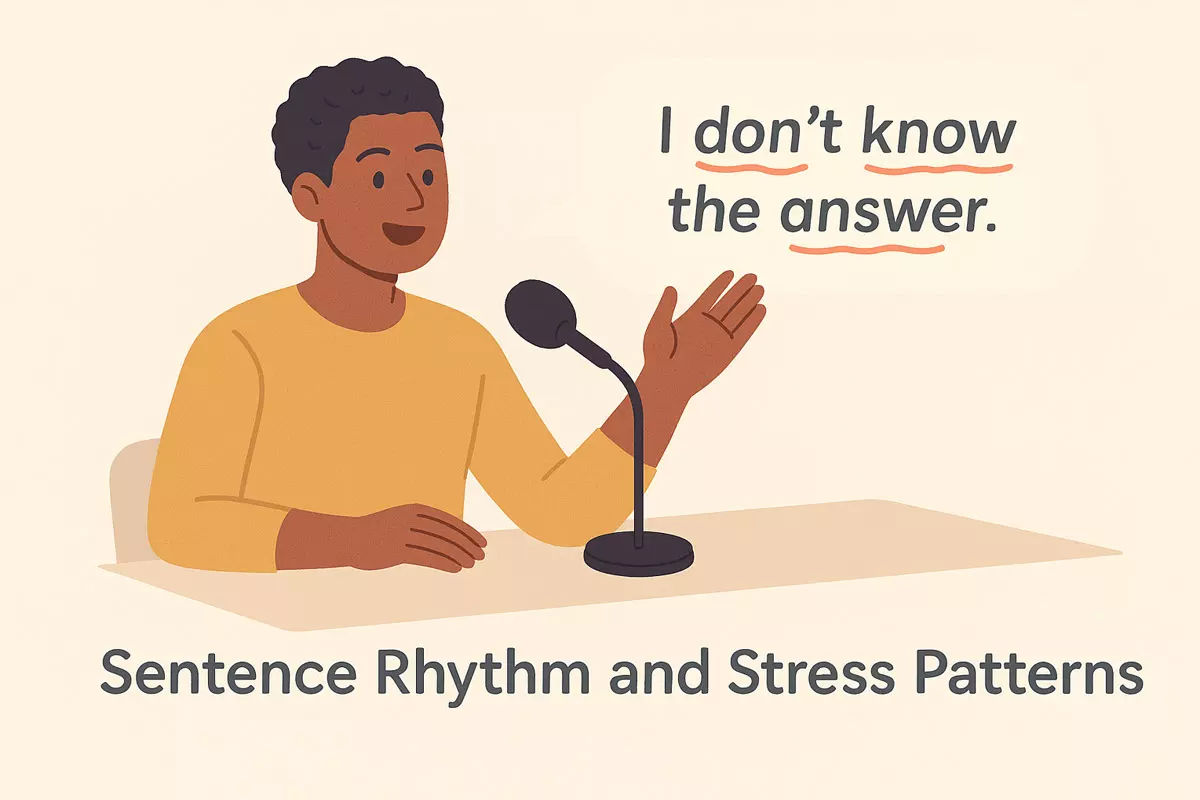 Here we the meaning of rhythm in English, stressing content versus function words, how intonation affects meaning, using pausing and chunking for clarity, typical rhythm patterns, common mistakes, and practical exercises for marking stress.
Captivating listeners relies heavily on how we control the flow and emphasis of our words during speech. By mastering the subtle interplay of timing and accents within sentences, you can transform your delivery and make your communication sound both smooth and engaging. Paying attention to how you stress certain words or pause at key moments helps maintain your audience's interest and ensures your message is clearly understood. With practice, these techniques become second nature, allowing you to connect more effectively with any audience.
What Rhythm Means in English
In English, rhythm describes the pattern of stressed and unstressed syllables as we speak. This natural “beat” shapes how sentences sound and helps listeners follow meaning. Unlike some languages that stress every syllable equally, English organizes speech around strong and weak beats. This is called a “stress-timed” rhythm.
The Role of Stressed and Unstressed Syllables
Native speakers instinctively emphasize certain words or syllables, usually content words like nouns, main verbs, and adjectives. Meanwhile, function words—such as prepositions, articles, and auxiliary verbs—are often said more quickly and quietly. This creates a regular alternation, almost like music, where the strong beats provide the structure.
Common Patterns in English Rhythm
- Content words (e.g., dog, run, happy) get stressed.
- Function words (e.g., the, of, and) are usually unstressed.
- Stressed syllables are longer, louder, and higher in pitch.
- Unstressed syllables are shorter and softer.
- Pauses often fall after stressed syllables or natural breaks in meaning.
- Rhythm helps listeners predict what’s coming next in a sentence.
- Poetry and song lyrics often exaggerate everyday speech rhythm.
- Choppy or “robotic” delivery usually comes from ignoring natural stress patterns.
- Mastering rhythm is crucial for sounding fluent and clear.
- Practice with tongue twisters and sentence drills can improve your sense of rhythm.
Comparing English with Other Rhythms
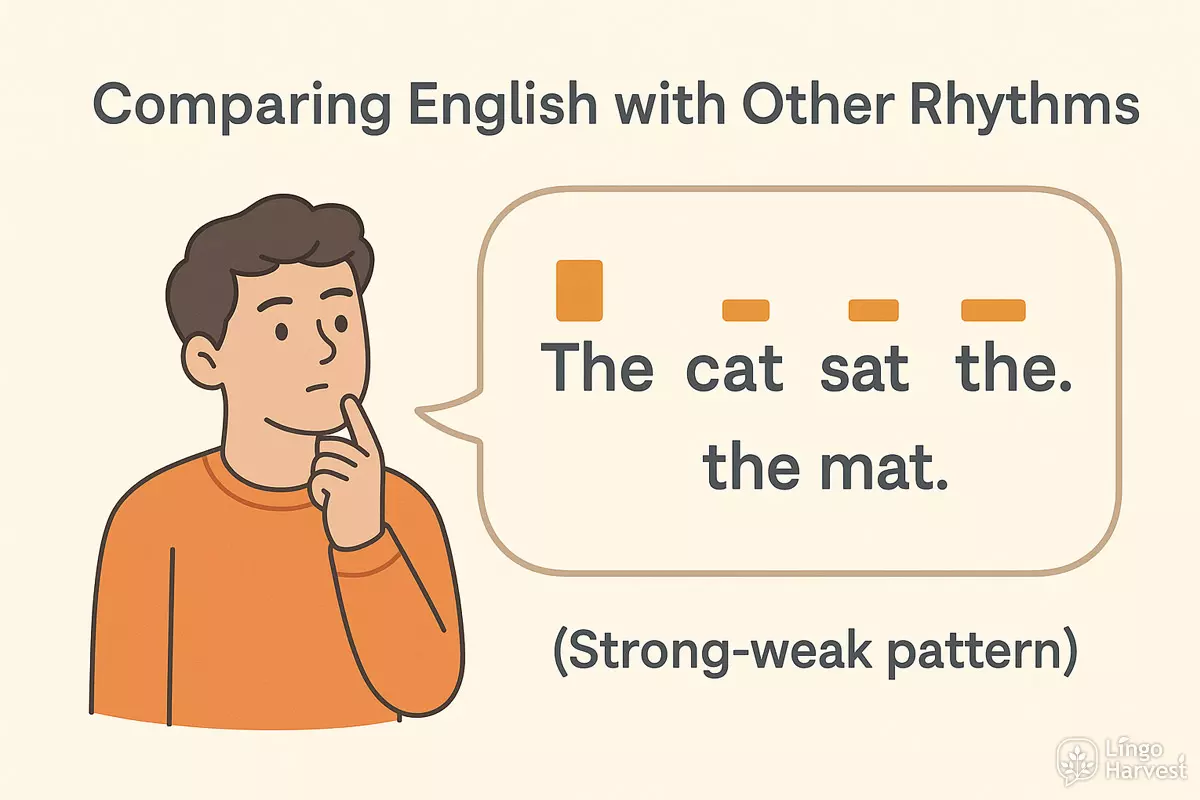
Languages vary in how they handle timing. While English relies on stress-timing, other languages may use syllable-timing, where each syllable takes about the same amount of time. Understanding this difference helps learners adjust their pronunciation and flow.
| Language | Rhythm Type | Example |
|---|---|---|
| English | Stress-timed | “The cat sat on the mat.” (Strong-weak pattern) |
| French | Syllable-timed | Each syllable pronounced evenly: “Je vais à la maison.” |
| Mandarin | Syllable-timed | Consistent syllable lengths: “Wǒ shì zhōngguó rén.” |
| Russian | Stress-timed | Alternation of strong and weak: “Я люблю читать книги.” |
Why Rhythm Matters for Communication
Getting used to the natural pulse of English makes your speech easier to understand and more engaging. It also prevents misunderstandings, since misplaced stress can change meaning or make you sound less confident. For learners, focusing on rhythm is just as important as mastering grammar or vocabulary.
Stress on Content vs Function Words
Understanding which words receive emphasis is essential for sounding natural and clear in spoken English. In typical sentences, not every word is pronounced with equal force. Some words naturally attract more attention, while others blend into the background. This difference is a major factor in the rhythm and flow of speech. Content words—such as nouns, main verbs, adjectives, and adverbs—carry the primary meaning in a sentence. These words are usually stressed, making them stand out to listeners. In contrast, function words (like articles, prepositions, auxiliary verbs, and conjunctions) serve a grammatical role and are usually unstressed or reduced. This contrast creates the characteristic pattern of English sentence rhythm, where prominent beats fall on important words, and the rest are spoken more quickly and quietly.
Examples: Content vs Function Words
Common content words include:
- dog, city, computer (nouns)
- run, think, create (main verbs)
- beautiful, quick, loud (adjectives)
- slowly, happily, never (adverbs)
Typical function words are:
- the, a, an (articles)
- to, at, for, in (prepositions)
- and, but, or (conjunctions)
- is, are, have, do (auxiliary verbs)
- he, she, it, they (pronouns)
How Emphasis Shifts Meaning
Stressing different elements in a sentence can subtly change the listener’s focus. For example, in “She gave him the book,” the main verb “gave” receives stress, highlighting the action. If the sentence is “She gave him the book,” the object becomes the focus.
Recognizing Stressed and Unstressed Words
The table below offers a side-by-side look at how content and function words are typically treated in natural speech:
| Content Words (Stressed) |
Function Words (Unstressed/Reduced) |
|---|---|
| teacher, music, idea | the, a, an |
| write, build, speak | to, for, at, in |
| interesting, old, green | and, but, or, so |
| quickly, often, always | is, am, have, do |
Why This Matters for Natural Delivery
Focusing on the right words helps your speech sound fluid and listener-friendly. Over-stressing grammatical words can make your sentences sound unnatural or robotic. Practicing with real sentences and paying attention to which words are prominent will improve both your comprehension and delivery. Try listening to native speakers and notice how some words are clear and strong while others seem to fade into the background—this is the natural rhythm that gives English its expressive quality.
How Intonation Shapes Meaning
Intonation, or the rise and fall of the voice in speech, plays a crucial role in conveying subtle differences in intent, mood, and emphasis. The same words can express surprise, doubt, certainty, or politeness, all depending on the pitch and melody used. This dynamic element helps listeners interpret not just what is said, but how it is meant.
Why Pitch Movement Matters
Changes in pitch guide listeners through the speaker’s intended message. For example, a rising tone at the end of a sentence often signals a question, while a falling tone tends to indicate a statement or command. These patterns help listeners distinguish between genuine curiosity, irony, or even sarcasm.
Common Functions of Intonation in English
- Marking questions and statements
- Highlighting important words
- Expressing attitudes (e.g., enthusiasm, indifference, annoyance)
- Signaling the end or continuation of a thought
- Indicating contrast or correction
- Showing politeness or formality
- Conveying uncertainty or tentativeness
- Emphasizing agreement or disagreement
- Creating suspense or expectation
- Soften requests or commands
- Clarifying meaning in ambiguous sentences
Examples: How Intonation Alters Interpretation
Consider how these sentences can change meaning with different pitch contours:
- “You’re coming.” (falling tone: statement; rising tone: question)
- “Really?” (high rise: surprise; low rise: polite interest; falling: disbelief)
- “I didn’t say he stole the money.” (emphasis on different words changes the implied meaning)
- “Could you help me?” (gentle rise: polite request; flat: lack of enthusiasm)
Intonation Patterns and Communicative Effects
| Pattern | Typical Effect |
|---|---|
| Rising at the end | Signals a yes/no question or uncertainty |
| Falling at the end | Indicates a statement or command |
| Rise-fall | Conveys surprise, strong feeling, or irony |
| Level/flat | Might suggest boredom, routine, or lack of emotion |
| Mid-rise | Shows politeness, tentativeness, or incomplete thought |
Clarity Through Pausing and Chunking
Good communication depends on more than just word choice or pronunciation. How you break up your sentences—through intentional pauses and strategic grouping of words—directly affects how well your listeners follow your message. When you pause at natural points, you give your audience time to process, which keeps your speech from sounding rushed or monotonous.
Why Pauses Matter
Pausing isn’t just about taking a breath. Well-placed breaks help highlight important information, separate ideas, and signal transitions in your delivery. Natural pauses can:
- Emphasize a key word or phrase
- Give listeners a moment to absorb new information
- Reduce misunderstandings
- Help you manage your own pacing and nerves
Chunking for Better Comprehension
Chunking means grouping words into meaningful units, or “chunks,” rather than speaking in a flat, uninterrupted stream. For example, instead of saying, “We need to finish the project by Friday if we want to meet the deadline,” you can break it into parts: “We need to finish the project by Friday / if we want to meet the deadline.” This makes your speech easier to process and more engaging.
Common Chunking Patterns in English
Speakers often use familiar structures to organize their thoughts. Here are typical ways to group information:
- Prepositional phrases: “In the morning, / I like to read.”
- Lists: “We bought apples, / oranges, / and bananas.”
- Clauses: “When I arrived, / the meeting had already started.”
- Contrast: “She wanted to go, / but he stayed home.”
- Conditionals: “If it rains, / we’ll stay inside.”
- Parenthetical information: “My brother, / who lives in Canada, / is visiting.”
- Transitions: “On the other hand, / we could wait.”
- Direct speech: “He said, / ‘I’ll be back soon.’”
- Questions: “Where are you / going?”
- Instructions: “First, / chop the onions. / Then, / sauté them.”
Comparing Flat and Chunked Delivery
| Approach | Example Sentence |
|---|---|
| Flat Delivery | We need to submit the report by noon otherwise we’ll miss the deadline. |
| Chunked Delivery | We need to submit the report by noon / otherwise / we’ll miss the deadline. |
| Listener Reaction | ❌ Harder to follow, less emphasis ✅ Clearer, more digestible |
Pausing and grouping phrases thoughtfully not only improves understanding but also adds expressiveness to your speech. Practicing this technique helps you sound more natural and confident, making your message stand out.
Common Rhythm Patterns in Speech
Understanding how timing and stress shape spoken language helps speakers sound more natural and engaging. In English, rhythm is created by alternating strong and weak syllables, forming recognizable patterns. These patterns guide listeners and make speech easier to follow.
Types of Rhythm in Sentences
Most utterances in English fall into two broad rhythm categories: stress-timed and syllable-timed. English is typically stress-timed, meaning the intervals between stressed syllables tend to be regular, while unstressed syllables are shorter and less prominent. This differs from languages like French or Spanish, which are more syllable-timed.
Frequent Patterns in Everyday Speech
Speakers use a mix of rhythmic structures to convey meaning, emotion, or emphasis. Some of the most common patterns include:
- Trochaic rhythm (STRESS-unstress): TAble, HAppy
- Iambic rhythm (unstress-STRESS): aWAY, reLAX
- Anapestic rhythm (unstress-unstress-STRESS): underSTAND, in the DARK
- Dactylic rhythm (STRESS-unstress-unstress): ELegant, WONderful
- Alternating stress: A mix of strong and weak beats in a sentence, as in “She DID it aGAIN.”
- Content word emphasis: Nouns, verbs, adjectives, and adverbs receive more stress than function words (the, and, or).
- Function word reduction: Words like “to,” “of,” and “for” are often pronounced quickly and quietly.
- Contrastive stress: Emphasis shifts to highlight differences (e.g., “I said RED car, not blue.”)
- List intonation: Rising tone for each item except the last, which falls (“apples, oranges, and pears.”)
- Question rhythm: Yes/no questions often rise at the end (“Are you coming?”), while wh- questions tend to fall (“Where are you going?”)
- Chanted rhythm: Used for repeated or formulaic expressions (“See you later!”)
- Emphatic rhythm: Extra stress used for strong feelings (“That was amazing!”)
Examples of Rhythm Patterns in Sentences
Below is a comparison of how different stress patterns can alter the rhythm and feel of spoken sentences:
| Pattern | Example Sentence |
|---|---|
| Trochaic (STRESS-unstress) | TAble set, DINner’s done. |
| Iambic (unstress-STRESS) | reLAX and enJOY your meal. |
| Anapestic (unstress-unstress-STRESS) | in the DARK of the NIGHT, |
| Dactylic (STRESS-unstress-unstress) | WONderful things await. |
| Contrastive Stress | I said CAN, not can’t. |
| List Intonation | We need bread, milk, and eggs. |
| Function Word Reduction | I want to go to the store. (spoken: wanna go t’ the store) |
Why Rhythm Patterns Matter
Mastering these rhythmic structures helps speakers sound fluid and natural. Listeners rely on stress and timing cues to interpret meaning, identify new information, and follow the flow of ideas. By becoming familiar with these patterns, you can enhance your delivery and ensure your message is understood as intended.
Mistakes That Reduce Natural Flow
Delivering sentences with a smooth, conversational rhythm can be surprisingly tricky. Many speakers—both native and non-native—fall into common traps that disrupt the natural stress and flow of their speech. These stumbles can make communication sound choppy or unnatural, and they often make it harder for listeners to follow the intended message.
Common Disruptions in Sentence Rhythm
Several habits can interfere with the expected patterns of stress and pacing in a sentence:
- Monotone delivery: Speaking without varying pitch or emphasis makes speech flat and robotic.
- Misplaced stress: Emphasizing the wrong syllable or word can confuse listeners and alter meaning.
- Overusing pauses: Frequent or awkward breaks interrupt the sentence’s momentum.
- Rushing through phrases: Speaking too quickly prevents natural rise and fall in intonation.
- Ignoring weak forms: Pronouncing every word fully, especially function words, creates unnatural emphasis.
- Word-for-word reading: Reading text mechanically rather than grouping words into meaningful chunks.
- Inconsistent pacing: Alternating between speeding up and slowing down without reason confuses listeners.
- Neglecting content words: Failing to highlight important nouns, verbs, or adjectives reduces clarity.
- Overemphasizing minor words: Giving equal weight to articles, prepositions, or conjunctions disrupts flow.
- Flat ending intonation: Dropping pitch abruptly at the end of statements, making speech sound unfinished.
- Excessive filler words: Frequent “um,” “uh,” or “like” breaks the rhythm and distracts from the message.
- Lack of linking: Not connecting words smoothly results in a stilted, unnatural delivery.
Examples: How Rhythm Can Go Wrong
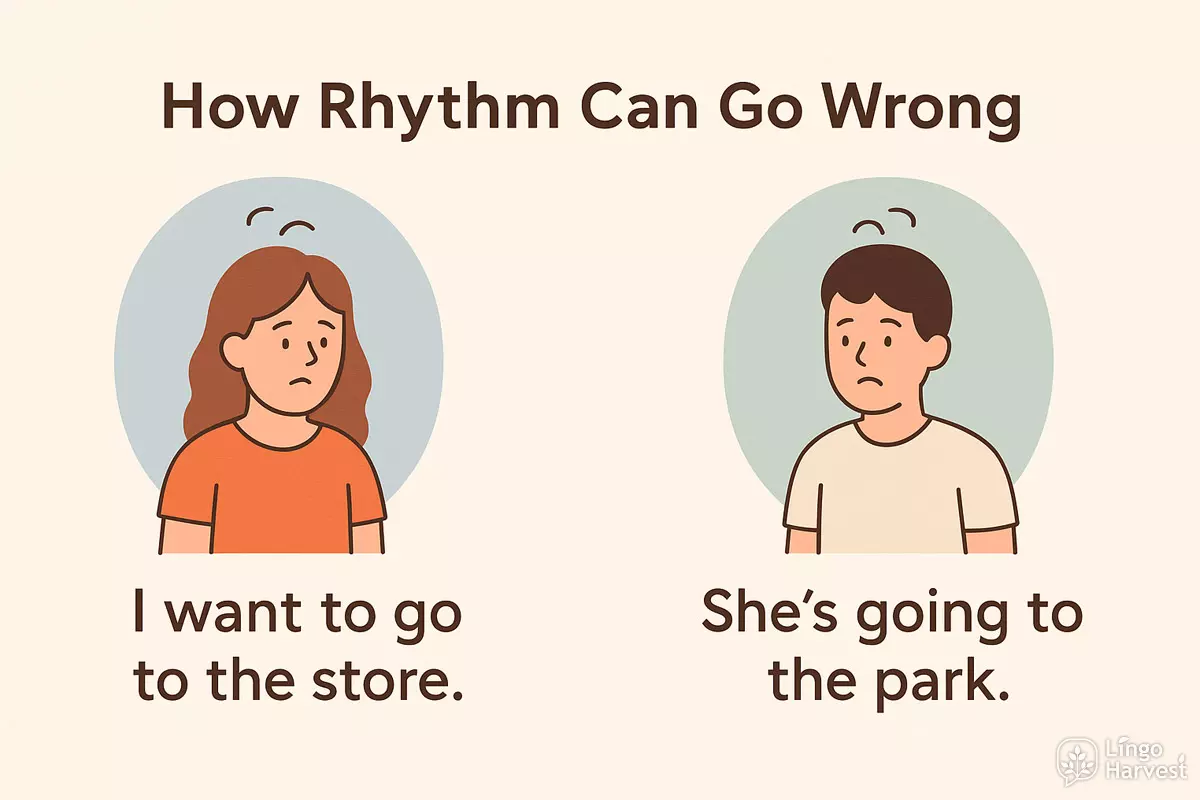
To illustrate, here’s a comparison of problematic versus natural delivery patterns:
| Unnatural Example | More Natural Pattern |
|---|---|
| “I WANT to go to the STORE.” (equal stress throughout) | “I want to go to the store.” (content words stressed, function words reduced) |
| “She is GOING TO the PARK.” (overemphasis on function words) | “She’s going to the park.” (natural reduction and linking) |
| “This is, um, a, uh, test.” (excessive fillers) | “This is a test.” (clean, direct delivery) |
| “Can you HELP me WITH this?” (wrong stress placement) | “Can you help me with this?” (key word receives main stress) |
Why These Issues Matter
Disruptions in natural cadence don’t just sound odd—they can actually obscure meaning, cause misunderstandings, or make your speech hard to engage with. Focusing on stress, pacing, and chunking helps listeners process information more easily and makes your message more memorable. By being aware of these pitfalls, you can adjust your delivery for clearer, more engaging communication.
Practice: Mark Stress in Short Sentences
Understanding which words to stress in a sentence is key for speaking naturally. In English, content words (like nouns, main verbs, adjectives, and adverbs) typically carry the main stress, while function words (such as articles, prepositions, and auxiliary verbs) are usually unstressed. Practicing with short sentences helps you internalize these patterns and improve your delivery.
How to Identify Stressed Words
Begin by reading each sentence aloud. Listen for the words that carry the most meaning—these are usually the ones you naturally emphasize. Try clapping or tapping for every stressed word as you read.
Exercise: Find the Stressed Words
Below are several short sentences. For each, mark or say which words receive the main stress. If you're practicing alone, underline or bold the stressed words.
- She drives to work every day.
- The cat sat on the mat.
- I can't find my keys.
- We went to the park yesterday.
- The phone is ringing.
- He likes chocolate cake.
- It's raining outside.
- Please close the door.
- They live in a big city.
- She speaks three languages.
- Can you help me?
- The movie was interesting.
- He bought a new car.
- I love this song.
- We need more time.
- The train is late again.
- She wrote a letter.
- It's almost midnight.
- The food smells good.
- Please turn off the light.
Show answers
- She drives to work every day. (drives, work, day)
- The cat sat on the mat. (cat, sat, mat)
- I can't find my keys. (find, keys)
- We went to the park yesterday. (went, park, yesterday)
- The phone is ringing. (phone, ringing)
- He likes chocolate cake. (likes, chocolate, cake)
- It's raining outside. (raining, outside)
- Please close the door. (close, door)
- They live in a big city. (live, big, city)
- She speaks three languages. (speaks, three, languages)
- Can you help me? (help)
- The movie was interesting. (movie, interesting)
- He bought a new car. (bought, new, car)
- I love this song. (love, song)
- We need more time. (need, more, time)
- The train is late again. (train, late, again)
- She wrote a letter. (wrote, letter)
- It's almost midnight. (almost, midnight)
- The food smells good. (food, smells, good)
- Please turn off the light. (turn, light)
Tips for Practicing Stress Patterns
- Read sentences aloud and exaggerate the stressed syllables.
- Record yourself and listen for natural rhythm and emphasis.
- Practice with common short sentences until stress placement feels automatic.
- Pair practice with listening to native speakers for comparison.
Mastering the pattern of stressed and unstressed words in short sentences will make your speech sound more fluid and natural. Keep practicing with varied examples to build confidence in your spoken English.