Shadowing Practice with Focus on Adverbs and Linking

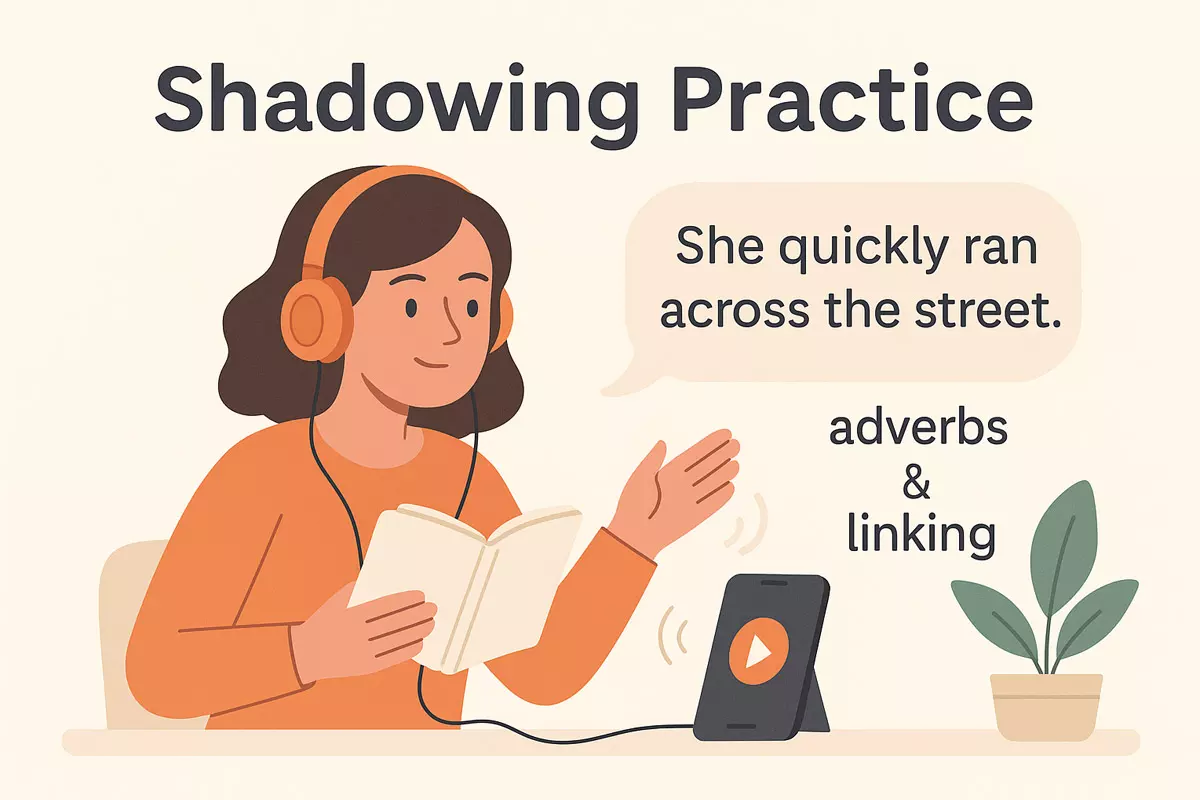 This article explains shadowing practice, why it boosts fluency, and how to notice linking and adverb patterns in real speech. It covers techniques for accurate imitation, using short clips, and includes adverb-focused practice sentences.
To improve your speaking fluency, try practicing by closely imitating native speakers, focusing on how they use adverbs and link their ideas together. By echoing their speech patterns and noticing the subtle ways they express themselves, you can develop a more natural and confident speaking style. This method not only helps you become more expressive but also enables you to understand and use a wider range of vocabulary and sentence structures, making your communication more effective and engaging in real-life conversations.
What Shadowing Practice Is
Shadowing is a language learning technique where you listen to a model audio and speak along with it, imitating both pronunciation and rhythm in real time. This approach helps learners internalize the natural flow of speech, including intonation, stress, and the subtle ways words connect—especially when focusing on elements like adverbs and linking. Rather than silent reading or simple repetition, shadowing requires active engagement and close attention to how native speakers blend words and use adverbs for nuance.
How Shadowing Works
- Choose an audio track with a clear, natural speaker, such as a podcast clip or dialogue.
- Play the audio and speak at the same pace as the speaker, matching their intonation and stress patterns.
- Pay special attention to how adverbs modify verbs and how words are linked together in fast speech.
- Repeat the process several times, gradually improving accuracy and fluency with each attempt.
Why Focus on Adverbs and Linking?
Adverbs are often unstressed and can be tricky to master in fast, connected speech. Linking, or the way words blend across word boundaries, is crucial for sounding natural. Shadowing practice with these elements helps learners notice and reproduce the subtle features of fluent communication, such as how “really interesting” might sound like “reall-yinteresting” in fast speech.
Common Features Practiced in Shadowing
- Placement and pronunciation of adverbs (e.g., “quickly,” “always,” “already”).
- Connecting sounds between words—for example, linking consonants and vowels (“run out” becomes “ru-nout”).
- Stress and rhythm patterns that change meaning or emphasis.
- Reduction of unstressed syllables (e.g., “going to” → “gonna”).
- Intonation patterns in statements and questions.
- Blending auxiliary verbs and adverbs (“She’s already left”).
- Omission or softening of sounds (“next week” → “nex’ week”).
- Handling adverbs that change position (“sometimes I go” vs. “I sometimes go”).
- Echoing the speed and tone of native speakers.
- Adjusting for formal vs. informal speech patterns.
Typical Steps in a Shadowing Session
- Listen once without speaking to catch the overall meaning and flow.
- Shadow the audio, mimicking the speaker as closely as possible.
- Focus on tricky adverbs and linking points: pause, replay, and repeat as needed.
- Record your own voice and compare it to the original to identify differences.
- Gradually increase the length and complexity of the audio as you improve.
Examples of Adverbs and Linking in Practice
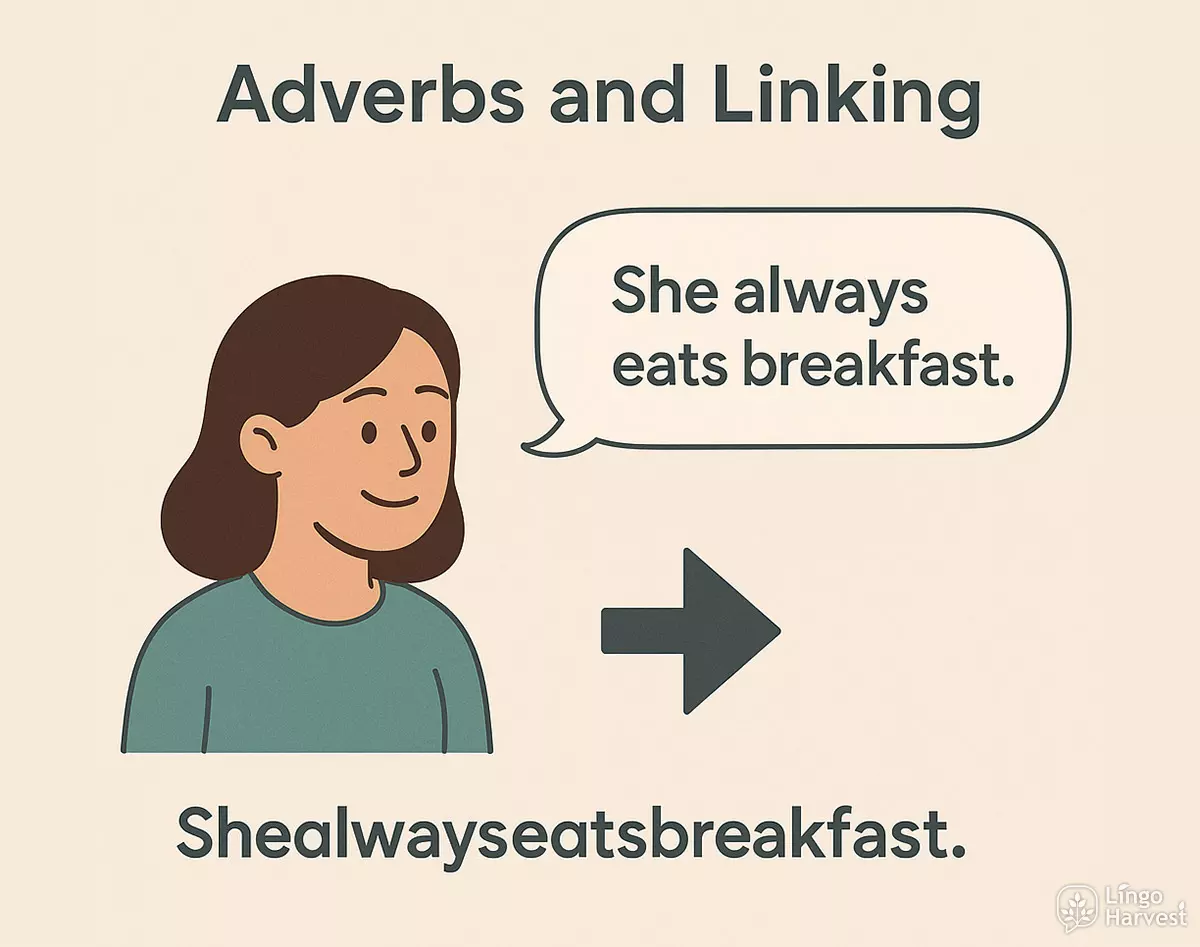
- He quickly finished his work. → “Hequicklyfinishedhiswork.”
- She always eats breakfast. → “Shealwayseatsbreakfast.”
- They really like it. → “Theyreallylikeit.”
- I almost forgot. → “Ialmostforgot.”
- He’s already gone. → “He’salreadygone.”
- We never miss a meeting. → “Wenevermissameeting.”
- You probably know her. → “Youprobablyknowher.”
- She sometimes calls late. → “Shesometimescallslate.”
- I’m just leaving. → “I’mjustleaving.”
- He hardly ever smiles. → “Hehardlyeversmiles.”
- Can you actually do it? → “Canyouactuallydoit?”
- He completely forgot. → “Hecompletelyforgot.”
Benefits of Shadowing for Learners
- Improves listening and speaking skills simultaneously.
- Builds confidence in pronouncing adverbs and linking words naturally.
- Helps internalize authentic speech patterns for real-life conversations.
- Enhances memory and recall of common phrases and structures.
Why Shadowing Improves Fluency
Practicing shadowing—listening and speaking simultaneously with a model speaker—offers unique benefits for language development. This technique helps learners internalize natural speech patterns, especially when focusing on adverbs and linking. By mimicking real pronunciation, rhythm, and intonation, speakers quickly build automaticity, making their spoken English smoother and more natural.
Strengthening Adverb Usage
Shadowing exposes learners to how adverbs are used in authentic speech. Rather than memorizing rules, you experience firsthand how words like “quickly,” “almost,” or “actually” are woven into sentences and how their position can slightly alter meaning or emphasis. This repeated exposure helps you instinctively choose and place adverbs correctly in your own conversations.
- “She quickly finished her homework.”
- “I’ve never seen that movie.”
- “He spoke very softly.”
- “We’re almost there.”
- “It’s actually quite easy.”
- “They always arrive late.”
- “She barely passed the test.”
- “You really should try this.”
- “He usually walks to work.”
- “I can definitely help.”
Mastering Linking for Natural Flow
Linking, or connecting sounds between words, is essential for fluency. Shadowing lets you hear and replicate these connections, making your speech less choppy. You learn to blend sounds, drop unnecessary pauses, and adopt the natural pace of native speakers.
| Linked Phrase | How It Sounds |
|---|---|
| “go on” | /goʊ‿ɑn/ (sounds like “go-won”) |
| “want to” | /ˈwɑːnə/ (“wanna”) |
| “could have” | /kʊdəv/ (“could’ve”) |
| “last hour” | /læs‿taʊər/ (blends “last” and “hour”) |
| “in a minute” | /ɪn‿ə mɪnɪt/ (“in-a-minute”) |
| “give it to me” | /ˈgɪvɪt tə mi/ (“giv-it-to-me”) |
| “not at all” | /ˈnɑːt‿ət ɔːl/ (“not-at-all”) |
| “she is” | /ʃiːz/ (“she’s”) |
Building Confidence Through Repetition
Repeating phrases aloud alongside a native speaker reinforces muscle memory and boosts confidence. The more you practice, the easier it becomes to recall and apply correct patterns, especially with tricky adverb placement or subtle linking. Over time, your responses become faster and more accurate without conscious effort.
Active Listening and Speaking Skills
Shadowing is an active process. You’re not just listening; you’re producing language in real time. This dual engagement strengthens both comprehension and speaking abilities, making it easier to follow conversations and express yourself clearly. Overall, shadowing with a focus on adverbs and linking transforms passive knowledge into practical fluency, providing a foundation for natural, confident communication in everyday situations.
Linking Sounds in Real Speech
When people speak naturally, words often connect so smoothly that it’s hard to tell where one ends and the next begins. This process, known as linking, helps speech sound more fluid and native-like. For English learners, understanding and practicing these connections is essential for both listening and speaking, especially when adverbs and other function words are involved.
Why Do We Link Words?
Linking occurs to make speech faster and more efficient. Native speakers rarely pause between every word; instead, sounds blend together, making sentences flow. This can be challenging to hear at first, but practicing these patterns helps you sound more natural and improves comprehension.
Common Linking Patterns
Certain sound combinations are especially likely to link. Here are some frequent linking scenarios you’ll encounter:
- Consonant + vowel: read it → /ˈriː.dɪt/
- Same consonant: big game → /bɪɡeɪm/
- Vowel + vowel (with a glide): go out → /ɡoʊ.waʊt/
- ‘r’ linking: far away → /ˈfɑːr.əˈweɪ/ (non-rhotic accents)
- Intrusive /w/, /j/, or /r/: see it → /siː.jɪt/
- Adverb + verb: quickly eat → /ˈkwɪk.liːt/
- Adverb + adjective: really interesting → /ˈrɪə.liˈɪn.trə.stɪŋ/
- Preposition + article: in a → /ɪnə/
- Auxiliary + main verb: can I → /kəˈnaɪ/
- Final /t/ or /d/ + vowel: and it → /æn.dɪt/
- Adverb + pronoun: usually it → /ˈjuː.ʒu.ə.li.ɪt/
- Adverb + preposition: almost on → /ˈɔːl.mə.stɒn/
- Final /s/ + vowel: this is → /ðɪ.sɪz/
- Final /n/ + vowel: in order → /ɪˈnɔː.dər/
How Linking Changes Word Boundaries
These connections can make it seem like words are “stuck together” or even create new sounds between words. For example, when an adverb ending in a consonant is followed by a word starting with a vowel, the consonant is pronounced clearly and smoothly transitions into the vowel, as in slowly arrive (/ˈsləʊ.li.əˈraɪv/).
Practical Tips for Shadowing Linked Speech
- Listen for blended sounds, not just individual words.
- Repeat phrases after native speakers, focusing on the flow.
- Record yourself and compare your linking to model sentences.
- Practice with sentences that contain adverbs in different positions.
- Slow down the audio if needed, then gradually increase speed.
- Pay attention to how adverbs connect to verbs, adjectives, or other adverbs.
Examples of Linking with Adverbs
- He quickly answered. → /hiː ˈkwɪk.liˈæn.sərd/
- She nearly always wins. → /ʃiː ˈnɪə.liˈɔːl.weɪz wɪnz/
- They never expected it. → /ðeɪ ˈnev.ərɪkˈspek.tɪd ɪt/
- We almost agreed. → /wiː ˈɔːl.məʊstəˈɡriːd/
- I usually eat early. → /aɪ ˈjuː.ʒu.ə.liːtˈɜː.li/
- He simply ignored me. → /hiː ˈsɪm.pliɪɡˈnɔːrd miː/
- She hardly ever calls. → /ʃiː ˈhɑːd.liˈev.ər kɔːlz/
- You really ought to go. → /juː ˈrɪə.liˈɔːtə ɡəʊ/
- They completely agree. → /ðeɪ kəmˈpliːt.liəˈɡriː/
- She always knows. → /ʃiː ˈɔːl.weɪz nəʊz/
Adverb Patterns to Notice While Shadowing
When practicing shadowing with a focus on adverbs, it’s helpful to pay close attention to how these words interact with verbs, adjectives, and even entire sentences. Noticing where and how adverbs are placed can reveal a lot about natural rhythm and emphasis in spoken English. As you listen and repeat, try to catch both the position and the effect of adverbs on meaning and tone.
Common Adverb Placements
English adverbs often appear in a few predictable spots. As you shadow, notice these patterns:
- Before the main verb: She quickly answered.
- After the verb (especially with intransitive verbs): He speaks fluently.
- At the beginning of a sentence for emphasis: Suddenly, the lights went out.
- Between the auxiliary and the main verb: They have never been there.
- After the object (with some adverbs): She finished her work thoroughly.
Types of Adverbs to Listen For
Shadowing is more effective when you identify different adverb types as you go:
- Frequency: always, usually, often, sometimes, rarely, never
- Manner: slowly, carefully, easily, well, quietly, quickly
- Degree: very, quite, almost, too, enough, completely
- Time: now, soon, already, still, yet, recently
- Place: here, there, everywhere, nearby, outside
Examples of Adverb Position Variations
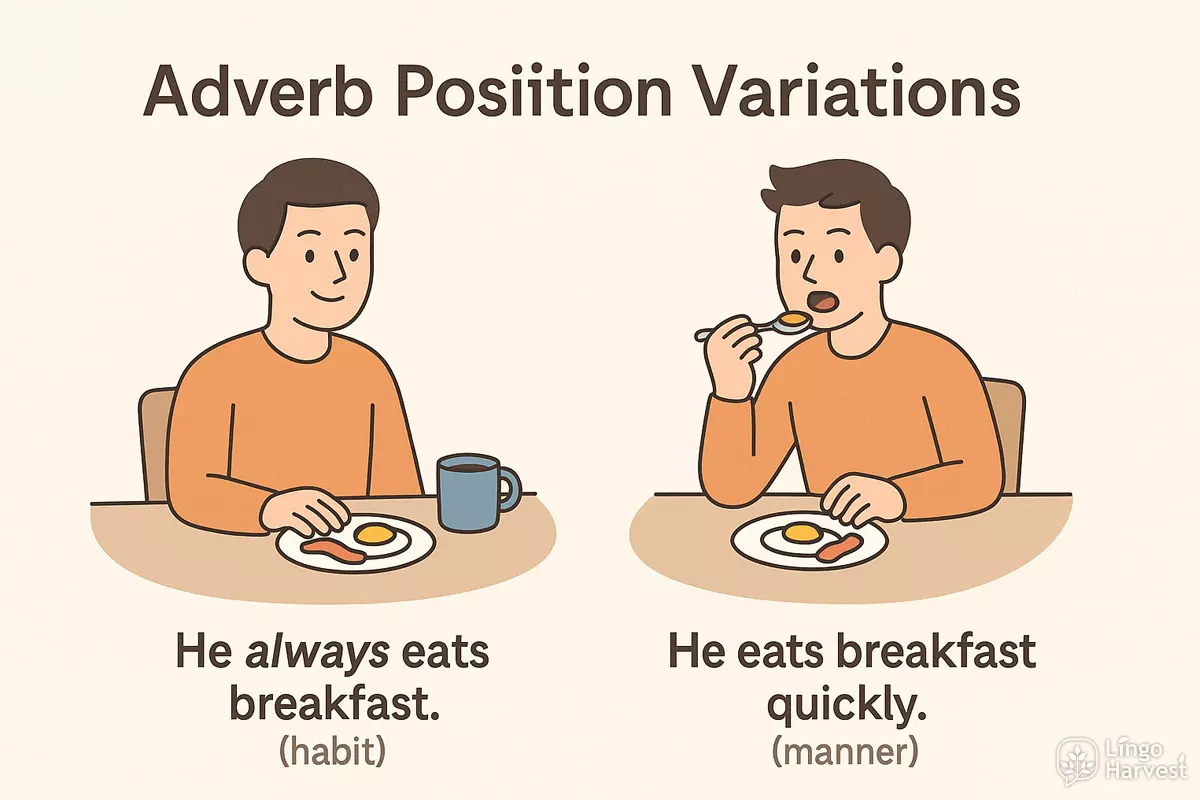
The placement of adverbs can subtly change the meaning or emphasis of a sentence. Here are some common variations to notice as you mimic native speakers:
- He always eats breakfast. (habit)
- He eats breakfast quickly. (manner)
- Sometimes she forgets her keys. (frequency/emphasis)
- They have already left. (time)
- She was almost late. (degree)
- He is completely ready. (degree)
- We will meet outside. (place)
- She can hardly wait. (degree/negative meaning)
- They are still working. (time/continuity)
- He responded immediately. (time/manner)
Comparing Adverb Positions
| Sentence | Adverb Position |
|---|---|
| She usually walks to work. | Before main verb |
| He finished the task quickly. | After object |
| Recently, they moved to a new city. | Sentence initial |
| They have never traveled abroad. | Between auxiliary and main verb |
| She is completely sure. | Before adjective |
Tips for Noticing Adverb Linking
Some adverbs connect ideas or sentences, contributing to cohesion and flow. Listen for linking adverbs such as however, therefore, meanwhile, and otherwise. These often appear at the start of a sentence or clause and can signal a shift or connection in thought. Shadowing with attention to these words can help you sound more natural and organized in your own speech.
Techniques for Accurate Imitation
Developing precision in shadowing, particularly when it comes to adverbs and linking, depends on attentive listening and mindful repetition. By focusing on subtle details in native speech, learners can fine-tune their pronunciation, rhythm, and connected speech patterns.
Active Listening and Chunking
Break down sentences into manageable parts, paying close attention to how adverbs are pronounced and linked to surrounding words. Listen to native speakers and note variations in stress and intonation, especially when adverbs appear at the beginning, middle, or end of a sentence.
- Identify how "quickly," "often," or "rarely" link to verbs.
- Notice reductions, such as "actually" sounding like "act-ually."
- Observe the linking between adverbs and auxiliary verbs (e.g., "He has always been…").
Slow Repetition and Gradual Speed Increase
Start by mimicking short phrases at a slower pace. Focus on the natural blending of sounds, especially in common adverb-verb or adverb-adjective pairings. Gradually increase your speed as you gain confidence, always prioritizing clarity and natural flow.
Contrastive Practice
Compare your own recordings with the original audio. Use the following checklist to spot differences and areas for improvement:
- Is the adverb stressed or reduced?
- Are any sounds dropped or merged at word boundaries?
- Does your intonation match the model?
- Are there any unnatural pauses or breaks?
Common Linking Patterns with Adverbs
Understanding how adverbs connect with other words helps create smoother, more native-like speech. Here are some frequent linking patterns to watch for:
- Consonant + Vowel: "quickly arrived" → "quicklyarrived"
- Vowel + Vowel: "so easily" → "soeasily"
- Adverb + Auxiliary: "never have" → "neverhave"
- Reduced Adverbs: "really" often becomes "rilly"
- Adverb + Pronoun: "usually he" → "usuallyhe"
Expanded Examples: Adverbs and Linking in Context
Practice with a variety of adverbs in different positions and contexts to internalize these patterns. Shadow the following examples, paying attention to linking and stress:
- She always eats breakfast early.
- They quickly left the room.
- He usually goes jogging at night.
- I really appreciate your help.
- We often see him at the park.
- You hardly ever call me.
- The train almost left without us.
- She rarely misses a class.
- He completely forgot the meeting.
- I simply can’t agree with that.
- They just arrived.
- He nearly fell asleep.
- She already finished the project.
- We barely know each other.
- You probably know the answer.
- He clearly misunderstood.
- She honestly tried her best.
- I definitely want to go.
- They certainly made an impression.
- He constantly interrupts.
Self-Monitoring and Feedback
Record yourself shadowing these sentences. Compare your version with a native speaker's model, focusing on the flow and connections. Use a checklist or scoring system to track your progress over time.
Summary Table: Linking Adverbs in Connected Speech
| Adverb + Next Word | Linked Pronunciation Example |
|---|---|
| quickly arrived | /ˈkwɪk.liəˈraɪvd/ → "quicklyarrived" |
| really interesting | /ˈrɪl.iˈɪn.trə.stɪŋ/ → "rillyinteresting" |
| usually eats | /ˈjuː.ʒə.liˈiːts/ → "usuallyeats" |
| often ask | /ˈɒf.tənˈæsk/ → "oftenask" |
| already answered | /ɔːlˈrɛd.iˈæn.sərd/ → "alreadyanswered" |
Consistent, mindful practice with these strategies can significantly boost your ability to sound more natural and fluent when using adverbs and linking in English.
Shadowing with Short Clips
Practicing with brief video or audio segments is a practical way to improve your listening and speaking skills, especially when focusing on the natural use of adverbs and the way words connect in real speech. Short recordings allow you to concentrate on small language units, making it easier to catch subtle pronunciation changes, rhythm, and the placement of adverbials within sentences.
How to Use Short Clips for Shadowing
Begin by selecting a recording that is around 10–30 seconds long. Listen carefully, paying close attention to how adverbs are used and how words flow together. After a few listens, try to repeat the segment aloud, matching the speaker’s timing, intonation, and linking. Repeat this process several times, gradually increasing your accuracy and confidence.
- Choose clips with clear examples of adverbs (e.g., “She quickly responded,” “They always arrive late”).
- Focus on how adverbs are pronounced and positioned within phrases.
- Notice how native speakers link words, especially when an adverb comes between the subject and the verb.
- Pause after each sentence and mimic the speaker’s stress patterns.
- Record yourself and compare your version to the original for self-assessment.
Common Adverbs and Linking in Spoken English
Adverbs often affect sentence rhythm and linking. For example, in “He really likes it,” the words “really” and “likes” are often pronounced together smoothly. Practicing these connections will help your speech sound more natural.
| Adverb Placement | Linked Pronunciation Example |
|---|---|
| She always goes | Sheal-waysgoes |
| He quickly answered | Hequick-lyanswered |
| I really like it | Irea-llylikeit |
| They usually eat early | Theyu-suallyeatearly |
| We just arrived | Wejustarrived |
Sample Short Clip Practice Routine
- Listen to the clip three times without speaking.
- Repeat the segment aloud as you listen, matching the original rhythm and linking.
- Focus on adverbs: identify their position and how they connect to nearby words.
- Record yourself and play it back to spot differences.
- Try to use the same adverbs in your own sentences, keeping the linking and stress patterns.
With consistent practice using concise recordings, you’ll notice improvements in both your understanding and your ability to produce smooth, fluent speech with accurate adverb use.
Practice: Shadow Adverb-Focused Sentences
Shadowing with adverbs helps learners internalize natural rhythm and emphasis in spoken English. By listening and repeating sentences that highlight adverbs, you not only practice pronunciation but also notice how these words modify actions and connect ideas. Below you'll find a range of sentences and activities to help you improve your fluency and confidence using adverbs naturally.
Shadowing Sentences: Focus on Adverbs
Read each sentence aloud while paying attention to the placement and stress of the adverb. Try to match the original speaker’s intonation and pacing.
- She quickly finished her homework before dinner.
- They usually walk to work together.
- He barely noticed the change in temperature.
- We rarely eat out on weekdays.
- The dog immediately ran to the door.
- I honestly didn’t expect to win.
- You can easily solve this problem with practice.
- The meeting finally ended after three hours.
- She always remembers to call her parents.
- He never forgets a birthday.
- We occasionally travel abroad.
- They frequently visit the museum.
- I just finished my project.
- You probably know the answer.
- The train already left the station.
- He simply refused to participate.
- She nearly missed the bus.
- We hardly ever see snow here.
- The students silently entered the classroom.
- I carefully placed the vase on the shelf.
Task: Identify the Adverb
For each sentence below, say it aloud and then identify which word is the adverb. Consider how its placement changes the meaning or flow of the sentence.
- He gently closed the door.
- They often meet for coffee after work.
- We completely forgot about the appointment.
- She almost finished reading the book.
Show answers
- gently
- often
- completely
- almost
Comparing Adverb Placement
Adverbs can sometimes be placed in different positions within a sentence, affecting the focus or emphasis. Practice shadowing both versions and notice the difference in style and meaning.
| Standard Placement | Alternative Placement |
|---|---|
| She always drinks tea in the morning. | Always, she drinks tea in the morning. |
| He rarely eats dessert. | Rarely does he eat dessert. |
| They usually arrive on time. | Usually, they arrive on time. |
| I sometimes watch movies at home. | Sometimes, I watch movies at home. |
Challenge: Make Your Own Sentences
Create five sentences of your own, each featuring a different adverb. Say each one aloud, focusing on the natural rhythm and stress pattern. This will help you transfer the skill to real conversations.