Register Shift: formal / neutral / informal adjective replacements

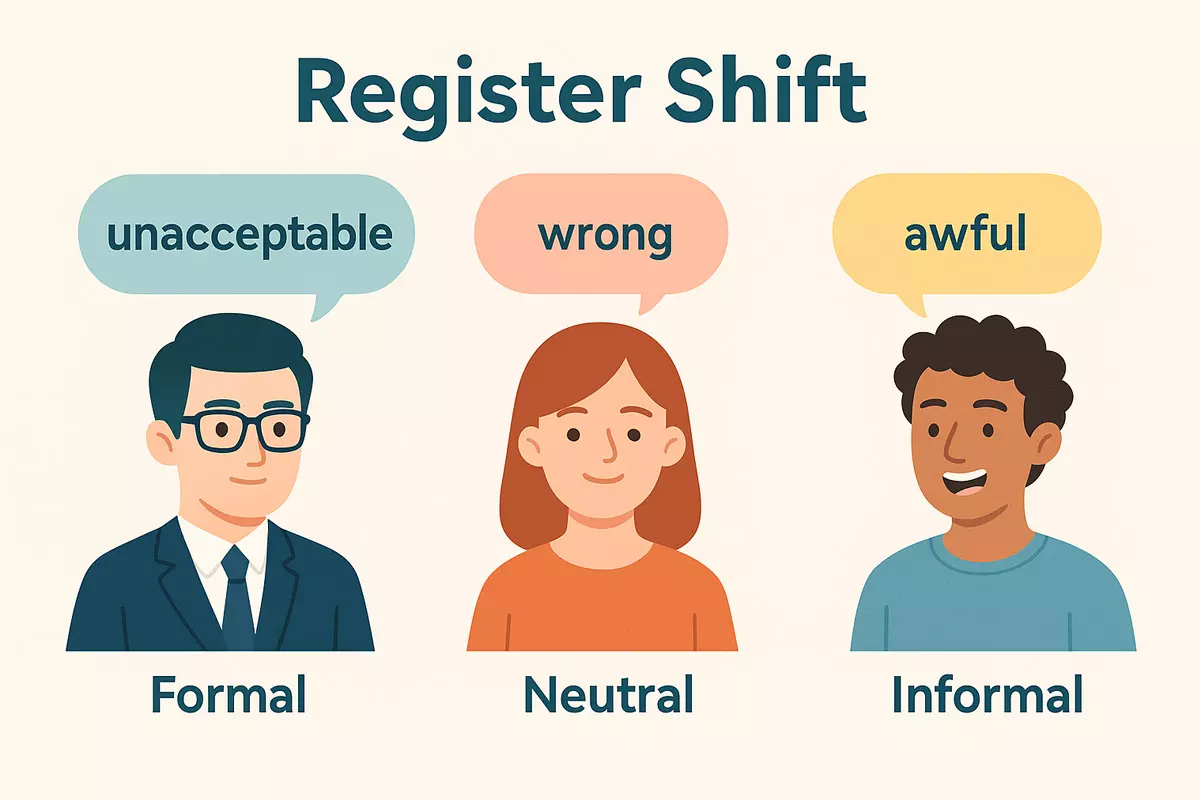 The article defines register in English, compares formal, neutral, and informal tones, explains how adjective choices change message strength, and gives guidance on choosing the right tone for academic, workplace, and casual contexts, with practice included.
Selecting the appropriate level of language is crucial, as it significantly influences how your message is perceived. By choosing adjectives that match the tone of a particular situation, you can ensure your communication is suitable for the context. This skill allows you to adapt your descriptive words to fit formal, informal, or neutral scenarios, making your message more effective and relatable. Being mindful of language choice not only helps you sound appropriate but also enhances your ability to connect with different audiences.
What Register Means in English
In linguistics, "register" refers to the level of formality or informality in language chosen for a specific context. English speakers naturally shift their word choices, grammar, and tone depending on the situation, audience, and purpose. This can range from highly formal settings (like academic writing or official speeches) to neutral, everyday interactions, and down to informal language used with friends or family.
Why Does Register Matter?
Choosing the appropriate register helps ensure that communication is clear, respectful, and effective. Using overly formal words in casual conversation can sound stiff or unnatural, while using slang in a professional setting may be perceived as disrespectful or unprofessional. Understanding how to adjust your language style is a key skill for fluent English communication.
Main Types of Register in English
- Formal: Used in academic, legal, or official contexts. Characterized by precise vocabulary, complete sentences, and often passive voice.
- Neutral: Suitable for most everyday interactions, such as talking to colleagues or acquaintances. Vocabulary is clear and standard, without slang or overly technical terms.
- Informal: Common in conversations with friends, family, or peers. Includes contractions, idioms, slang, and a relaxed tone.
Examples of Register Shifts with Adjectives
Consider how adjectives change depending on the formality of the situation. Here are some common examples:
- Formal: fortunate → Neutral: lucky → Informal: jammy
- Formal: incorrect → Neutral: wrong → Informal: off
- Formal: insufficient → Neutral: not enough → Informal: lacking
- Formal: fortunate → Neutral: lucky → Informal: jammy
- Formal: exhausted → Neutral: tired → Informal: wiped out
- Formal: incorrect → Neutral: wrong → Informal: off
- Formal: insufficient → Neutral: not enough → Informal: lacking
- Formal: pleased → Neutral: happy → Informal: chuffed
- Formal: complex → Neutral: complicated → Informal: messy
- Formal: incorrect → Neutral: wrong → Informal: off
- Formal: frequent → Neutral: often → Informal: all the time
- Formal: substantial → Neutral: large → Informal: huge
- Formal: inexpensive → Neutral: cheap → Informal: dirt cheap
- Formal: incorrect → Neutral: wrong → Informal: off
- Formal: assistive → Neutral: helpful → Informal: handy
- Formal: incorrect → Neutral: wrong → Informal: off
- Formal: insufficient → Neutral: not enough → Informal: lacking
- Formal: fortunate → Neutral: lucky → Informal: jammy
- Formal: complex → Neutral: complicated → Informal: messy
- Formal: incorrect → Neutral: wrong → Informal: off
Key Takeaways
- Register is about adapting your language to fit the situation.
- Mastering register helps you sound more natural and appropriate in different contexts.
- Pay attention to your audience and purpose when choosing adjective forms and other vocabulary.
Formal vs Neutral vs Informal Tone
Choosing the right level of formality in your adjectives can completely change the impression your writing makes. Each register—formal, neutral, and informal—serves a distinct purpose and audience. Understanding when and how to shift between these tones helps you match the style to the situation, whether it’s writing an academic essay, a business email, or chatting with friends.
What Sets the Registers Apart?
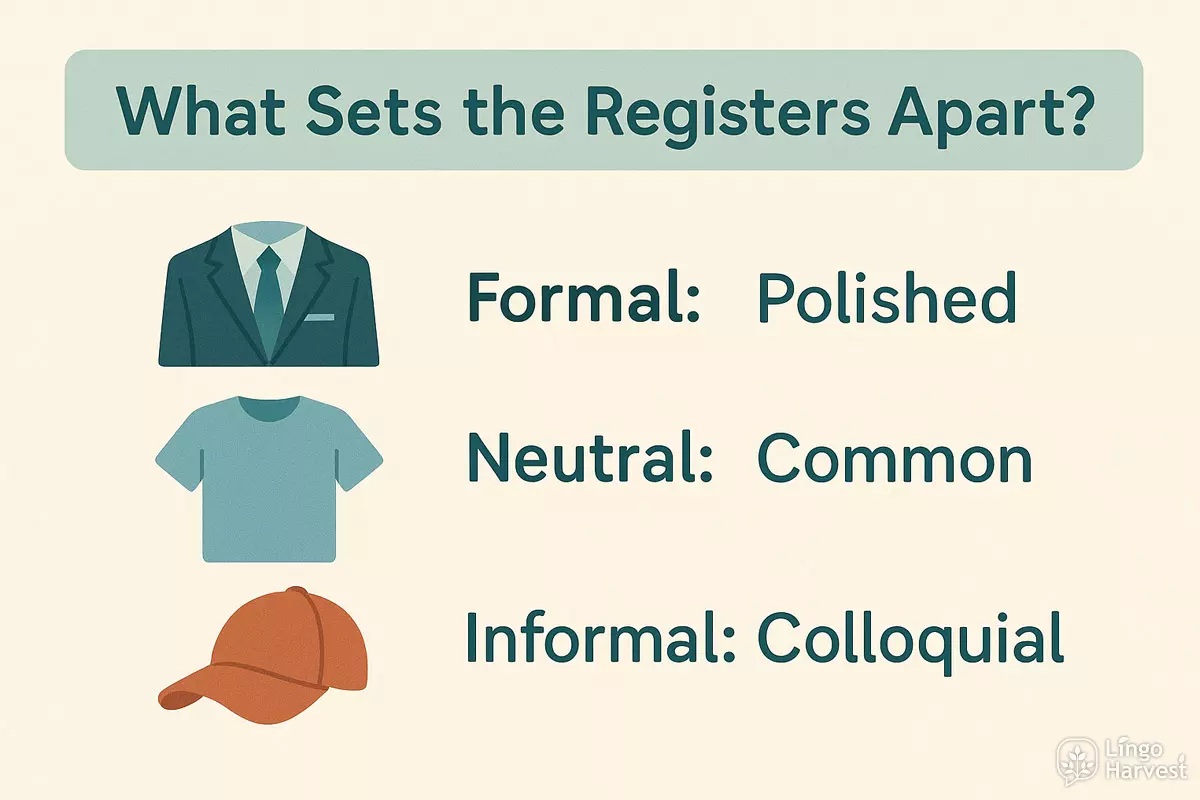
The main difference lies in word choice and the context in which certain adjectives are used. Formal adjectives often sound more sophisticated or abstract, neutral ones are suitable for most everyday uses, and informal adjectives are relaxed and conversational. Here are some key features:
- Formal: Polished, precise, sometimes Latin-based vocabulary (e.g., “insufficient” instead of “not enough”).
- Neutral: Common, straightforward, widely understood (e.g., “helpful”).
- Informal: Colloquial, sometimes slangy, typically used in speech or casual writing (e.g., “cool” for “excellent”).
Comparing Adjective Replacements
For a clearer picture, here’s a table showing how adjectives shift between registers. Notice how the meaning stays similar, but the tone changes to fit different contexts:
| Formal | Neutral | Informal | Example Context |
|---|---|---|---|
| insufficient | not enough | lacking | Project report, daily conversation, text message |
| beneficial | helpful | handy | Academic essay, workplace advice, casual chat |
| substantial | large | huge | Research paper, news article, informal story |
| insignificant | small | tiny | Scientific writing, general description, everyday talk |
| immediate | quick | instant | Business memo, instructions, online chat |
| superior | better | way better | Formal review, product comparison, conversation |
| inevitable | certain | bound to happen | Philosophical writing, report, casual exchange |
| adequate | enough | okay | Official letter, daily comment, group chat |
| complex | complicated | tricky | Technical manual, blog post, informal advice |
| frequent | often | all the time | Statistical report, diary entry, friendly chat |
| exceptional | excellent | awesome | Recommendation letter, performance review, text |
| insignificant | minor | no big deal | Formal apology, explanation, message to a friend |
| subsequent | following | next up | Report, instructions, casual directions |
| insufficient | not enough | short on | Formal letter, shopping list, chat with a friend |
| appropriate | right | cool with | Policy, decision, casual suggestion |
| significant | important | big deal | Research, conversation, group message |
| insufficient | lacking | not enough | Formal evaluation, review, chat |
| optimal | best | top-notch | Proposal, advice, casual opinion |
Tips for Choosing the Right Register
- Match your language to your audience and purpose. Use formal adjectives in professional or academic writing.
- Neutral adjectives are a safe choice for most situations, especially if you’re unsure.
- Save informal adjectives for friendly, relaxed settings or digital communication.
- When in doubt, consider the impression you want to make—formal tends to sound more serious, informal more approachable.
Understanding the nuances between registers makes your writing more precise and appropriate for any context.
Common Adjective Replacements
When adjusting your language for different levels of formality, choosing the right adjective can make a significant difference. Many everyday adjectives have more formal or informal alternatives, which can help you better match the style of your writing or speech to your audience. Below, you’ll find explanations and a structured table of typical shifts between formal, neutral, and informal adjectives.
Selecting the appropriate descriptive word often depends on context. In academic writing, for example, you might prefer precise or sophisticated terms, while casual conversation favors simpler, more direct language. Recognizing these patterns is helpful for both native speakers and learners aiming to communicate naturally in various settings.
Examples of Adjective Register Shift
| Formal | Neutral | Informal |
|---|---|---|
| insufficient | not enough | lacking |
| fortunate | lucky | jammy |
| deceased | dead | gone |
| incorrect | wrong | off |
| superior | better | top-notch |
| beneficial | helpful | handy |
| complex | complicated | tricky |
| numerous | many | loads of |
| insignificant | unimportant | no big deal |
| exhausted | tired | beat |
| inexpensive | cheap | dirt cheap |
| incorrect | wrong | off |
| substantial | large | huge |
| significant | important | big deal |
| superfluous | unnecessary | over the top |
| delighted | happy | chuffed |
| novel | new | fresh |
| insolvent | broke | skint |
| unacceptable | not okay | out of line |
| rapid | fast | quick |
Observe how certain adjectives become more relaxed or colloquial as you move from formal to informal registers. For instance, “beneficial” sounds appropriate in a business email, while “handy” fits better in casual speech. Similarly, “insolvent” is a technical term, “broke” is standard, and “skint” is distinctly informal or regional.
Tips for Choosing the Right Register
- Consider your audience: Use formal terms in professional or academic contexts, and opt for neutral or informal words with friends or in everyday conversation.
- Pay attention to tone: More sophisticated adjectives may sound out of place in relaxed settings.
- Practice by rewriting sentences: Try swapping adjectives to see how the tone shifts.
Developing an awareness of adjective register helps you communicate more effectively and appropriately in any situation.
How Register Changes Message Strength
The language register you choose—formal, neutral, or informal—directly affects the intensity and perception of your message. Selecting a more formal adjective often makes a statement sound objective, polite, or distant, while an informal choice can bring warmth, directness, or even bluntness. This variation isn’t just about etiquette; it shapes how your audience interprets your intent and the emotional weight behind your words.
Impact of Adjective Register on Tone
Adjectives play a major role in setting the tone. For instance, describing a proposal as “unacceptable” (formal) versus “not cool” (informal) changes both the perceived seriousness and the emotional charge. Formal adjectives tend to soften criticism or praise by adding a neutral or detached flavor, whereas informal ones can make feedback feel more personal, either friendly or harsh.
Comparing Register: Adjective Substitutions
Let’s look at how shifting register modifies the strength and feel of a message. The table below shows common adjectives with their formal, neutral, and informal variants, along with notes on how each version might be received.
| Formal | Neutral | Informal | Effect / Perceived Strength |
|---|---|---|---|
| insufficient | not enough | lacking | Formal is softer, less direct; informal sounds blunt |
| inappropriate | unsuitable | out of line | Formal distances speaker; informal can feel accusatory |
| beneficial | helpful | good for | Formal feels objective; informal is casual, friendly |
| ineffective | doesn’t work | useless | Formal minimizes offense; informal can be harsh |
| advantageous | useful | handy | Formal is persuasive; informal is light, relaxed |
| substantial | big | huge | Formal adds credibility; informal amplifies emotion |
| adequate | enough | okay | Formal is noncommittal; informal is vague, less forceful |
| complex | complicated | tricky | Formal is precise; informal is colloquial, less technical |
| pleased | happy | stoked | Formal is polite; informal is enthusiastic |
| displeased | unhappy | annoyed | Formal is restrained; informal is emotionally charged |
| significant | important | big deal | Formal emphasizes impact; informal highlights relevance |
| insignificant | unimportant | no big deal | Formal is clinical; informal minimizes concern |
| incorrect | wrong | off | Formal reduces blame; informal is direct |
| unacceptable | not okay | not cool | Formal is stern; informal is casual, less severe |
| remarkable | notable | awesome | Formal is understated; informal is expressive |
Choosing Register for Desired Effect
- Use formal adjectives to maintain distance, show respect, or soften criticism.
- Opt for neutral language when clarity and balance are priorities.
- Pick informal terms to connect personally, express emotion, or be direct.
Matching your register to the context helps avoid misunderstandings and ensures your message lands with the intended force and nuance.
Academic vs Workplace vs Casual Contexts
Choosing the right adjective often depends on your surroundings and the people you’re communicating with. In academic writing, precision and formality are expected, so more formal adjectives tend to dominate. Professional environments like offices or business meetings usually require a neutral tone—clear, polite, and not overly formal. In casual settings, such as chatting with friends or sending texts, informal adjectives are more natural and relatable.
How Register Influences Adjective Choice
The level of formality in language, or register, directly affects which adjectives sound appropriate. Using highly formal words with friends can seem distant or odd, while overly casual adjectives in a report may reduce credibility. The table below compares adjectives across three registers:
| Formal (Academic) | Neutral (Workplace) | Informal (Casual) |
|---|---|---|
| insufficient | not enough | too little |
| substantial | significant | big |
| beneficial | helpful | good for |
| complex | complicated | tricky |
| insignificant | minor | not a big deal |
| subsequent | following | next |
| comprehensive | thorough | all-out |
| adequate | enough | okay |
| insightful | thoughtful | smart |
| erroneous | incorrect | wrong |
Practical Tips for Adjective Register Shifts
- Audience awareness: Consider who will read or hear your words. Adjust the formality accordingly.
- Purpose matters: Reports, proposals, and academic essays require more formal choices; emails or chats at work can be more relaxed.
- Consistency: Avoid mixing registers in a single text unless you have a clear reason.
- Listen and learn: Notice how others in each environment use language, and adapt your style to fit in.
Register shift isn’t just about avoiding slang in an essay or skipping academic words with friends. It’s about making your message clear, credible, and relatable for your context—whether you’re writing an analysis, sending a memo, or catching up with someone over coffee.
Avoiding Tone Mismatches
Selecting adjectives that match the level of formality in your writing is essential for clear communication. Using words that are too formal in casual contexts (or vice versa) can make your message sound awkward or even insincere. Recognizing when to switch register—between formal, neutral, and informal choices—helps maintain the right relationship with your audience.
Recognizing Register Differences
The same meaning can be expressed in several ways, each with a different degree of formality. For instance, “insufficient” (formal), “not enough” (neutral), and “lacking” (informal/neutral) all convey similar ideas but suit different contexts. Paying attention to audience, purpose, and medium will help you select the most appropriate term.
Common Adjective Replacements by Register
Below is a list of adjectives often replaced depending on the level of formality. Swapping these terms can help you avoid sounding out of place:
- Assist (formal) → Help (neutral) → Lend a hand (informal)
- Numerous (formal) → Many (neutral) → Loads of (informal)
- Insufficient (formal) → Not enough (neutral) → Too little (informal)
- Subsequent (formal) → Next (neutral) → Coming up (informal)
- Obtainable (formal) → Available (neutral) → Up for grabs (informal)
- Commence (formal) → Start (neutral) → Kick off (informal)
- Terminate (formal) → End (neutral) → Wrap up (informal)
- Beneficial (formal) → Helpful (neutral) → Handy (informal)
- Utilize (formal) → Use (neutral) → Make use of (informal)
- Prior (formal) → Earlier (neutral) → Before (informal)
- Reside (formal) → Live (neutral) → Crash (informal)
- Require (formal) → Need (neutral) → Gotta have (informal)
- Sufficient (formal) → Enough (neutral) → Plenty (informal)
- Unable (formal) → Can’t (neutral) → Not able to (informal)
- Demonstrate (formal) → Show (neutral) → Let you see (informal)
- Purchase (formal) → Buy (neutral) → Pick up (informal)
- Facilitate (formal) → Make easier (neutral) → Smooth the way (informal)
- Commendable (formal) → Praiseworthy (neutral) → Worth a shout-out (informal)
- Conclude (formal) → Finish (neutral) → Wrap up (informal)
Spotting and Fixing Register Shift
A sudden switch in adjective formality can confuse readers. For example, using “commence” in an otherwise casual message (“Let’s commence our pizza party”) feels out of place. Instead, align your adjectives with the overall tone: “Let’s start our pizza party.”
Quick Reference Table: Formal, Neutral, and Informal Adjective Choices
| Formal | Neutral | Informal |
|---|---|---|
| Insufficient | Not enough | Too little |
| Numerous | Many | Loads of |
| Terminate | End | Wrap up |
| Beneficial | Helpful | Handy |
| Prior | Earlier | Before |
| Require | Need | Gotta have |
| Commendable | Praiseworthy | Worth a shout-out |
| Utilize | Use | Make use of |
Tips for Consistent Tone
- Review your sentences for overly formal or casual words that don’t match the context.
- Read your text aloud to notice awkward shifts in style.
- Consider your reader’s expectations and adjust your vocabulary accordingly.
- When in doubt, choose neutral adjectives—they fit most situations.
By consciously selecting the right register for your adjectives, you make your writing sound natural and appropriate for any occasion.
Practice: Replace Adjectives to Adjust Register
Adjusting the register of your language often means swapping one adjective for another that better suits the context—formal writing, professional communication, or casual conversation. Practice recognizing and replacing adjectives to fit the desired tone. Below you'll find exercises and reference lists to help you master this skill.
Common Adjective Replacements by Register
- Formal: utilize, substantial, insufficient, immediate, necessary, effective, significant, advantageous, satisfactory, appropriate
- Neutral: use, large, not enough, quick, needed, good, important, helpful, acceptable, suitable
- Informal: use, big, short, fast, need, great, big deal, handy, okay, right
Exercise: Adjust the Register
For each sentence below, change the adjective(s) to fit the specified register (formal, neutral, or informal).
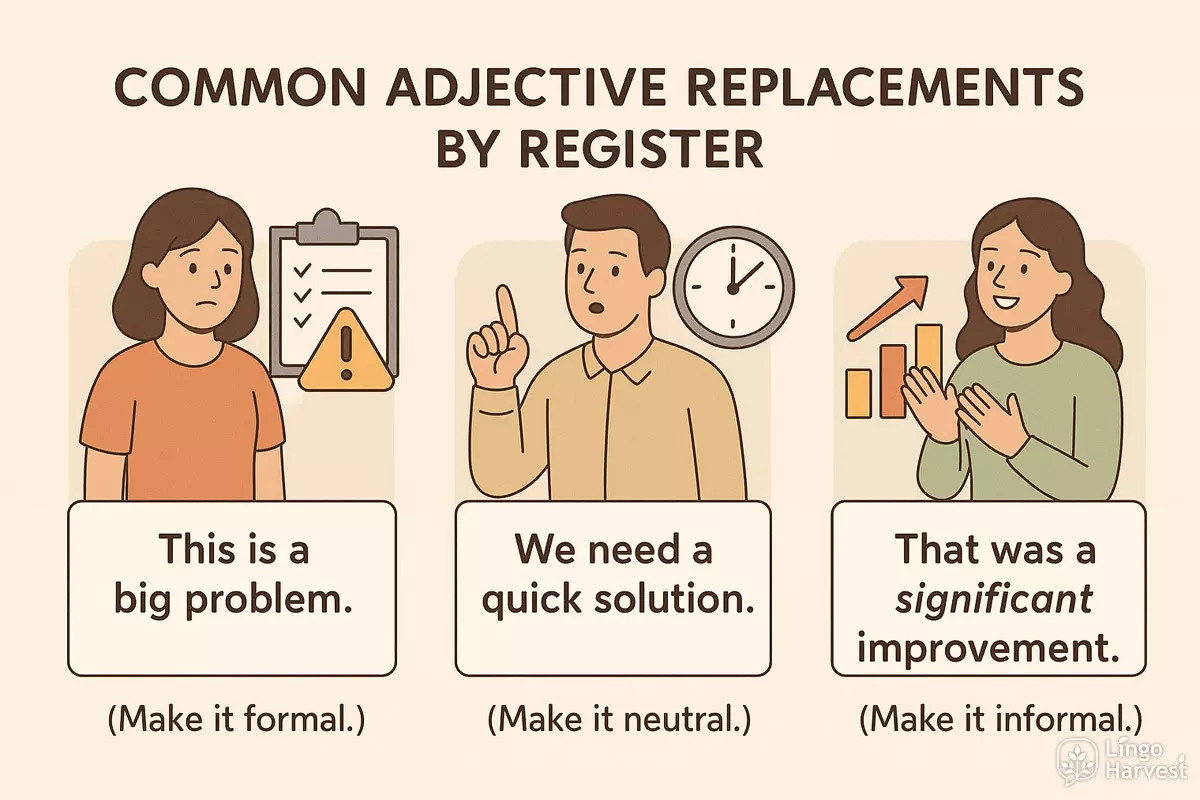
- This is a big problem. (Make it formal.)
- We need a quick solution. (Make it neutral.)
- That was a significant improvement. (Make it informal.)
- Her work is insufficient. (Make it neutral.)
- He has a substantial advantage. (Make it informal.)
Show answers
- This is a substantial problem.
- We need a fast solution.
- That was a big improvement.
- Her work is not enough.
- He has a big advantage.
Reference Table: Formal, Neutral, and Informal Adjective Equivalents
| Formal | Neutral | Informal |
|---|---|---|
| substantial | large | big |
| insufficient | not enough | short |
| immediate | quick | fast |
| necessary | needed | need |
| appropriate | suitable | right |
| advantageous | helpful | handy |
| satisfactory | acceptable | okay |
| effective | good | great |
| significant | important | big deal |
| utilize | use | use |
Self-Check: Spot the Register
Identify whether the adjective in each sentence is formal, neutral, or informal.
- This is an appropriate response.
- That’s a big mistake.
- We need a good plan.
- He made a significant contribution.
Show answers
- Formal
- Informal
- Neutral
- Formal