Questions in Formal and Informal English Compared

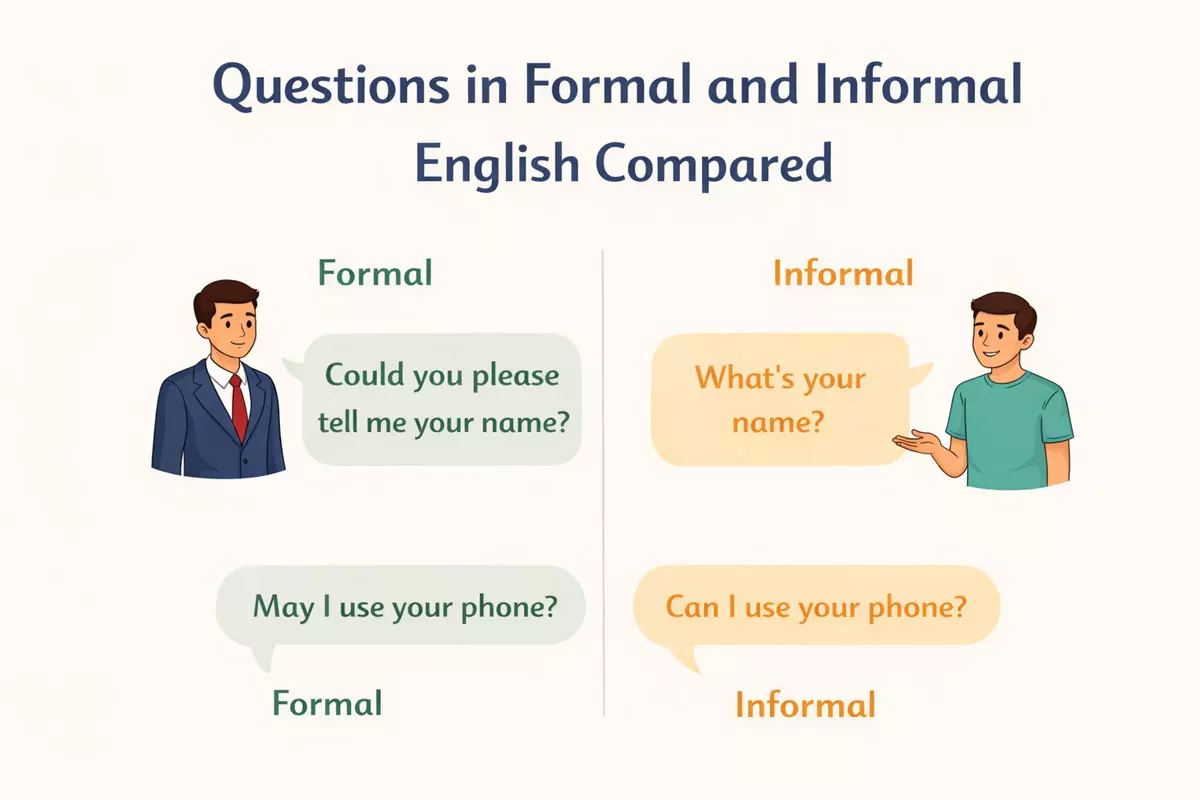 The article compares formal and informal English questions, focusing on word order, auxiliaries, and modals. It also covers politeness techniques, common style errors, and offers practice exercises for both spoken and written questions.
The way we ask questions changes depending on whether we're speaking with friends or addressing someone like a teacher. In casual conversations, questions tend to be informal, relaxed, and sometimes even incomplete, as the context and shared understanding fill in the gaps. In more formal or structured settings, however, questions are usually more carefully phrased, polite, and complete to show respect and ensure clarity. Examining these differences highlights how language adapts to suit various social situations.
Formal and Informal English Overview
Understanding the differences between formal and informal English is essential for effective communication in a variety of settings. Formal English is typically used in academic, professional, or official contexts, while informal English is more common in everyday conversation, texts, and friendly emails. The two styles differ in vocabulary, grammar, tone, and even the types of questions people ask.
Key Features of Formal English
- Uses complete sentences and avoids contractions (e.g., "cannot" instead of "can't").
- Employs more complex sentence structures and precise vocabulary.
- Maintains a respectful, neutral, or impersonal tone.
- Often avoids slang, idioms, and phrasal verbs.
- Frequently uses indirect questions and polite forms (e.g., "Could you tell me...?").
Characteristics of Informal English
- Commonly includes contractions, idiomatic expressions, and colloquialisms.
- Relies on simple sentence structures and everyday vocabulary.
- Tone is casual, friendly, and sometimes emotional.
- Direct questions are more frequent (e.g., "What’s up?").
- Grammar rules are often relaxed, especially in speech.
Common Situations for Each Register
- Formal: Business emails, academic essays, presentations, job applications, official reports.
- Informal: Messages to friends, casual conversations, social media comments, personal letters.
Typical Question Forms Compared
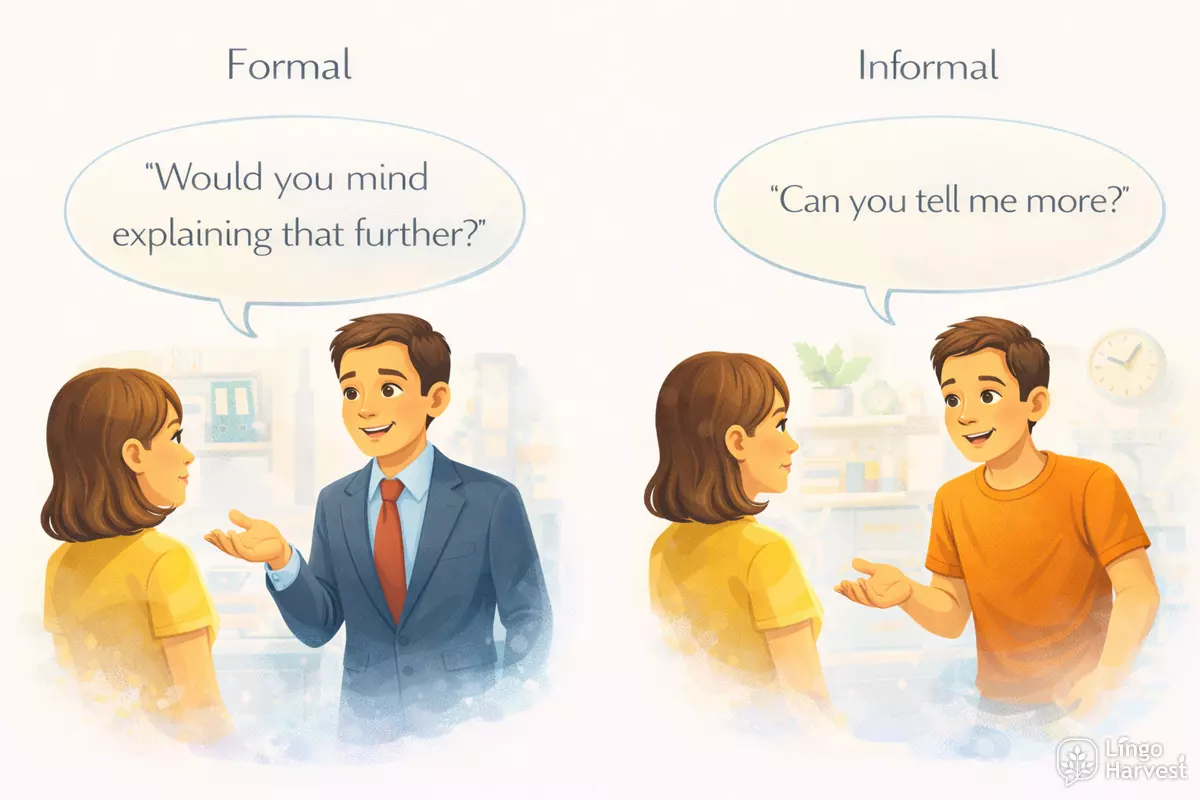
| Formal English | Informal English |
|---|---|
| Would you mind explaining that further? | Can you tell me more? |
| Could you please clarify your point? | What do you mean? |
| I was wondering if you could assist me. | Can you help me? |
| Might I ask how this works? | How does this work? |
| May I inquire about the schedule? | What’s the schedule? |
| Would it be possible to reschedule? | Can we change the time? |
| Is it acceptable if I join later? | Is it okay if I come late? |
| To whom should I address this issue? | Who do I talk to about this? |
| May I request further information? | Can you give me more info? |
| Would you be able to provide an update? | Any news? |
Choosing the right level of formality can help avoid misunderstandings and ensure your questions are appropriate for the context. While both forms serve their purposes, adjusting your language according to your audience is a key skill for clear and respectful interaction.
Word Order Differences in Questions
How we arrange words in questions often shifts depending on the level of formality. In more formal English, question structure typically follows strict grammatical guidelines, while casual speech may allow flexibility, omissions, or even unconventional ordering. Understanding these differences helps speakers choose the right tone for their audience, whether in a business meeting or chatting with friends.
Typical Patterns in Formal and Informal Questions
Formal questions usually follow standard subject-auxiliary inversion, especially in writing or professional settings. Informal questions, on the other hand, often relax the rules, especially in spoken English. Let’s look at key contrasts:
| Formal Question | Informal Question |
|---|---|
| Where are you going? | Where you going? |
| Have you finished the report? | You finished the report? |
| To whom did you speak? | Who’d you talk to? |
| May I ask a question? | Can I ask something? |
| Is that acceptable to you? | That okay with you? |
| What are you doing? | What you doing? |
| Do you have any suggestions? | Got any ideas? |
| Would you like some coffee? | Want some coffee? |
| Could you explain this? | Can you explain this? |
| Are you available tomorrow? | You free tomorrow? |
Common Features in Informal Questions
- Omission of auxiliary verbs: “You coming?” instead of “Are you coming?”
- Dropped subjects, especially with “got”: “Got time?”
- Use of contractions or reduced forms: “D’you know?”
- Ending with prepositions: “Who are you with?”
- Tag questions for emphasis: “You’re coming, right?”
- Rising intonation to indicate a question, even with statement word order
Formality and Clarity
In formal English, clarity and precision are prioritized, so full question forms are expected. In contrast, informal English often values speed and ease, leading to shortcuts in word order. However, overusing informal patterns in the wrong context can sound unprofessional or even confusing.
Choosing between formal and informal question forms depends on the situation, your relationship with the listener, and the need for clarity versus casualness. Being aware of these structural differences helps speakers navigate both everyday conversations and more official exchanges with confidence.
Use of Auxiliaries and Modals
When forming questions in English, helping verbs and modal verbs play a crucial role. In both formal and informal contexts, their choice and placement can signal the speaker’s intent, degree of politeness, and level of certainty. However, the way these verbs are used often differs between formal and casual conversation.
Auxiliary Verbs in Questions
Auxiliary verbs like do, does, did, have, is, are, and was help to form questions by inverting with the subject. In formal language, inversion is almost always observed. For instance, “Have you completed the report?” is more common in professional settings, while “You finished the report?” may be heard in informal speech, where the auxiliary is often dropped.
- Do/Does/Did: “Do you agree?” vs. “You agree?”
- Is/Are/Was/Were: “Is he coming?” vs. “He’s coming?”
- Have/Has: “Have you seen this?” vs. “You seen this?”
Modal Verbs and Politeness
Modal verbs such as can, could, may, might, will, would, and should are often used to indicate politeness, possibility, or necessity. In formal English, modals like could and would are preferred for requests and offers, while can and will are more common in everyday exchanges.
| Modal/Auxiliary | Formal Example | Informal Example |
|---|---|---|
| Can | Can you provide the details? | Can you send it? |
| Could | Could you clarify your point? | Could you help me out? |
| Will | Will you attend the meeting? | Will you come? |
| Would | Would you mind explaining? | Would you grab that? |
| May | May I ask a question? | May I use your phone? |
| Might | Might I suggest an alternative? | Might you help me later? |
| Should | Should we proceed now? | Should I call you? |
| Do/Does | Does this solution work? | Does it fit? |
| Are/Is | Are you available tomorrow? | Are you free? |
| Have/Has | Have you finished the task? | Have you eaten? |
Summary of Patterns
- Formal English often uses full modal forms (“Could you…?”, “Would you mind…?”) for politeness.
- Informal questions may omit auxiliaries (“You coming?”) or use contractions (“You’ve seen this?”).
- Modal verbs can soften requests and suggestions, especially in professional or academic communication.
- Negative questions in formal settings usually use full forms (“Have you not finished?”), while informal ones prefer contractions (“Haven’t you finished?”).
Understanding how helping verbs and modals function in different registers makes it easier to adapt your questions to the appropriate context, ensuring clarity and the right level of politeness.
Politeness and Softening Techniques
In English, how we ask questions changes depending on context and the relationship between speakers. Formal settings, such as workplaces or when speaking to strangers, usually require more indirect and softened questions. Informal conversations with friends or family often allow for directness, but speakers may still use gentle language to remain considerate.
Common Ways to Soften Questions
Adding certain words or phrases can make questions sound less abrupt and more tactful. These “softeners” help avoid sounding demanding or rude, especially in professional or unfamiliar environments.
- Using modal verbs: Could you…?, Would you mind…?, Might I…?
- Adding introductory phrases: I was wondering if…, Do you think you could…?
- Using indirect questions: Can you tell me where…?, Would it be possible to…?
- Including “please”: Could you please send me the file?
- Apologizing or acknowledging inconvenience: Sorry to bother you, but…, If it’s not too much trouble…
- Softening adverbs: just, possibly, perhaps
- Tag questions: You’re coming, aren’t you?
- Downtoners: a bit, a little
- Suggesting rather than asking directly: Maybe you could…?, Perhaps you’d like to…?
- Offering options: Would you prefer to… or…?
- Expressing gratitude in advance: Thank you for your help.
- Impersonal structures: It would be appreciated if…
- Hedging: I’m not sure, but…, I was just thinking…
Differences in Formal and Informal Contexts
How these strategies are used varies by situation. In a formal context, speakers almost always opt for indirect forms, while in casual conversation, directness is often acceptable among friends. Still, softeners may be used to maintain friendliness or avoid sounding bossy.
| Formal Question | Informal Question |
|---|---|
| Could you please clarify this point? | What do you mean? |
| I was wondering if you might have a moment to talk. | Got a sec? |
| Would it be possible to reschedule our meeting? | Can we move the meeting? |
| If it’s not too much trouble, could you send me the file? | Can you send me the file? |
| Do you happen to know where the nearest bank is? | Where’s the bank? |
| Would you mind closing the window? | Close the window? |
Why Use Softening Strategies?
Choosing gentler questioning forms helps build rapport and shows respect. It reduces the risk of offending someone or coming across as demanding. In multicultural or international settings, these strategies are especially important, as expectations for politeness may differ. Overall, adapting your questions to match the context and your relationship with the listener is a key part of effective, considerate communication.
Questions in Everyday Conversation
In informal spoken English, people usually ask questions in a much more relaxed and direct way than in formal contexts. Everyday exchanges often feature shorter sentences, contractions, and even incomplete structures. The focus is on quick understanding and natural flow, rather than strict grammar or politeness formulas.
Common Ways People Ask Questions Casually
Native speakers often simplify or shorten their questions, especially when talking to friends, family, or colleagues. These patterns reflect comfort and familiarity, allowing for efficient communication. Here are some typical ways questions appear in casual speech:
- Dropping auxiliary verbs: "You coming?" instead of "Are you coming?"
- Using question tags: "It's raining, isn't it?"
- Starting with "So": "So, what happened?"
- Adding "right?" or "okay?" at the end: "We're meeting at 8, right?"
- Beginning with "Hey" or "Listen": "Hey, you got a minute?"
- Contracting words: "What's up?" instead of "What is up?"
- Using just a single word: "Coffee?" (meaning "Do you want coffee?")
- Omitting the subject: "Need help?"
- Using rising intonation for statements: "You finished already?"
- Repeating a key word: "Dinner? Dinner sounds good?"
- Using "Wanna" or "Gonna": "Wanna go out?"
- Starting with "Did you": "Did you see that?"
- Using "How about": "How about pizza tonight?"
- Beginning with "Can you": "Can you grab that for me?"
- Using "Why don't we": "Why don't we call her?"
- Mixing statements and questions: "You like it, yeah?"
- Short follow-ups: "Where to?"
- Elliptical forms: "Anything else?"
- Using "Got": "Got a pen?"
- Starting with "What about": "What about tomorrow?"
Comparing Informal and Formal Question Patterns

To highlight the main differences, here’s a comparison between typical informal and formal questions on the same topics. Notice how word order, vocabulary, and tone shift between the two styles:
| Informal Example | Formal Example |
|---|---|
| You coming? | Are you coming? |
| Wanna join us? | Would you like to join us? |
| Got a minute? | Do you have a moment? |
| What's up? | How are you? |
| How about pizza? | Would you care for some pizza? |
| Can you help? | Could you assist me, please? |
| Everything okay? | Is everything all right? |
| Where to? | Where would you like to go? |
Key Features of Casual Questioning
Informal questions are marked by directness and often rely on shared context. Speakers use tone, body language, and implied meaning to make themselves understood. The grammar is more flexible, and mistakes are easily forgiven in daily speech. This makes casual questioning feel faster and more personal, though it may not always be appropriate in professional or unfamiliar settings.
Questions in Emails and Writing
When composing questions for professional correspondence or casual written exchanges, it’s important to adjust tone, structure, and formality to suit the context. Written questions in English—especially in emails—often differ from those used in speech, with unique conventions for both formal and informal scenarios. Understanding these differences helps ensure your message is clear and appropriate for your audience.
Common Features of Written Questions
Written queries are usually more carefully constructed than spoken ones. In formal emails, writers often use indirect language, polite expressions, and full sentences. Informal writing, such as messages between friends, tends to be more direct and may use contractions or omit auxiliary verbs.
- Politeness markers (“Could you…?”, “Would you mind…?”)
- Indirect questions (“I was wondering if…”, “May I ask…?”)
- Direct questions (“What time is the meeting?”)
- Use of modal verbs to soften requests (“Could”, “Would”, “Might”)
- Abbreviations and contractions in casual writing (“Can u send…?”, “What’s up?”)
- Omission of subject or auxiliary in notes (“Need help?”)
- Question tags for confirmation (“You’ll join us, won’t you?”)
- Reduced formality in openings (“Hey, do you know…?”)
- Explicit requests for information (“Please let me know if…”)
- Polite closing statements (“I look forward to your reply.”)
Comparing Formal and Informal Written Questions
The table below illustrates how the same intent is expressed differently depending on the level of formality. Notice the choice of vocabulary, sentence structure, and degree of politeness.
| Formal Written Question | Informal Written Question |
|---|---|
| Could you please provide the latest report? | Can you send me the report? |
| I was wondering if you might be available for a meeting next week. | Are you free for a meeting next week? |
| Would you mind confirming your attendance at your earliest convenience? | Let me know if you can make it! |
| May I ask whether the deadline has changed? | Has the deadline changed? |
| Please let me know if you require any further information. | Need more info? |
Tips for Writing Effective Questions
- Match your level of formality to the relationship and context.
- Use polite phrases for requests in business or academic emails.
- Be concise, but don’t sacrifice clarity for brevity.
- In formal writing, avoid slang and excessive abbreviations.
- For informal exchanges, keep language natural and friendly.
- Consider cultural expectations—some cultures value extra politeness.
Choosing the right question style in writing not only improves communication but also shows respect for your reader. Whether you’re seeking information, making a request, or clarifying details, adapting your approach to fit the situation is a key skill in effective written English.
Typical Style Mistakes
When learners switch between formal and informal English, certain patterns of error are especially common. These often relate to tone, word choice, and sentence structure. Even advanced speakers may accidentally use language that feels out of place in a given setting, especially when forming questions. Understanding these pitfalls can help you communicate more appropriately in both casual and professional contexts.
Confusing Formality Levels
One of the most frequent issues is mixing formal and informal question forms. For example, using contractions or slang in a business email, or adopting overly stiff language in a text message to a friend, can result in misunderstandings or awkwardness. It's important to match the style of your question to the situation and audience.
- Using "Can you..." instead of "Could you please..." in official requests
- Including "wanna" or "gonna" in academic writing
- Starting questions with "Hey" or "Yo" in professional settings
- Overusing indirect question forms in everyday conversation ("I was wondering if you could...")
- Using formal question tags ("is it not?") in casual chat
- Employing informal short forms ("What's up?") in interviews
- Skipping polite phrases ("Would you mind...?") when speaking to superiors
- Adding excessive politeness in friendly exchanges ("Might I trouble you to...?")
- Forgetting to invert subject and verb in formal questions ("You can help me?")
- Ending questions with unnecessary prepositions in formal writing ("Whom did you speak to?")
Common Question Structure Slip-Ups
Beyond vocabulary, the way questions are constructed can also signal the wrong register. Directness, word order, and auxiliary use are key areas to watch.
| Informal Question | More Formal Alternative |
|---|---|
| Where's the bathroom? | Could you tell me where the restroom is? |
| Got any plans tonight? | Do you have any plans for this evening? |
| Can I borrow your pen? | May I borrow your pen, please? |
| What do you want? | How may I help you? |
| Why'd you do that? | May I ask why you did that? |
Summary: Avoiding Missteps
To prevent these style errors, always consider your relationship to your listener or reader, the context, and how your question might be received. Adjusting your language appropriately not only avoids awkwardness but also shows respect and awareness of social conventions.
Practice Exercises and Self-Check
Looking to test your understanding of how question forms differ in formal and informal English? Use the activities below to reinforce key concepts and spot the differences in real-world examples. These tasks are crafted to help you notice patterns and build confidence in choosing the right style for any situation.
Recognizing Formal vs. Informal Questions
Read each question below. Decide if it is more typical of formal or informal usage.
- Could you please let me know your availability?
- What time are you free?
- Would you mind sending me the report?
- Can you send me the report?
- Might I ask who is calling?
- Who’s this?
- Would you be available for a brief meeting tomorrow?
- Got time to talk?
- Could you clarify your request?
- What do you mean?
Show answers
- Formal
- Informal
- Formal
- Informal
- Formal
- Informal
- Formal
- Informal
- Formal
- Informal
Transforming Questions: Practice
Rewrite each question in the opposite register (formal to informal or vice versa).
- May I request some assistance with this task?
- What’s up?
- Would you happen to know the time?
- Did you get my email?
- Could you please provide further details?
- Can you help me out?
- I would appreciate it if you could respond promptly.
- Are you coming?
- Might I inquire about the status of my application?
- Did you see this?
Show answers
- Can you help me with this?
- Hello, how are you?
- Do you know what time it is?
- Could you please confirm receipt of my email?
- Can you give me more details?
- Would you be able to assist me?
- Please reply as soon as possible.
- Would you be joining us?
- Can you tell me what’s happening with my application?
- Have you seen this?
Common Formal and Informal Question Patterns
Below is a comparison of typical question forms used in both styles. Note the differences in word choice and structure:
| Formal Pattern | Informal Pattern |
|---|---|
| Would you mind if I…? | Is it okay if I…? |
| Could you please…? | Can you…? |
| Might I ask…? | Can I ask…? |
| May I inquire…? | Can I know…? |
| Would it be possible to…? | Can I…? |
| To whom should I address…? | Who should I talk to…? |
Self-Check: Spot the Mistake
Some of the sentences below use an inappropriate register for the situation. Identify which ones do not match the likely context (e.g., too formal for a text to a friend, or too casual in a business email).
- Hey, would you be so kind as to provide the figures by Monday?
- Can you send that over?
- Could you please clarify this point for me?
- Yo, might I inquire about your availability?
- Would you be available to discuss this matter at your convenience?
- Got a minute?
- I would appreciate it if you could review the attached document.
- Can you take a look at this?
- Dear Sir or Madam, may I ask for your assistance?
- Hey dude, would you mind forwarding the invoice?
Show answers
- Too formal for a casual message
- Appropriate for informal
- Appropriate for formal
- Too formal for the informal opener
- Appropriate for formal
- Appropriate for informal
- Appropriate for formal
- Appropriate for informal
- Appropriate for formal
- Too informal for a polite request
Useful Phrases for Both Styles
Expand your repertoire by reviewing these question starters. Try forming your own questions with them:
- Do you happen to know…?
- Could you tell me…?
- Can you…?
- Would it be possible to…?
- Is it okay if…?
- Would you mind…?
- May I…?
- What’s up?
- Who’s this?
- To whom should I direct my question?
- Can I ask…?
- Would you be able to…?
By regularly practicing with these examples and patterns, you’ll become more comfortable in selecting the appropriate register for any context, whether at work or with friends.