Pronouns in Formal vs Informal English

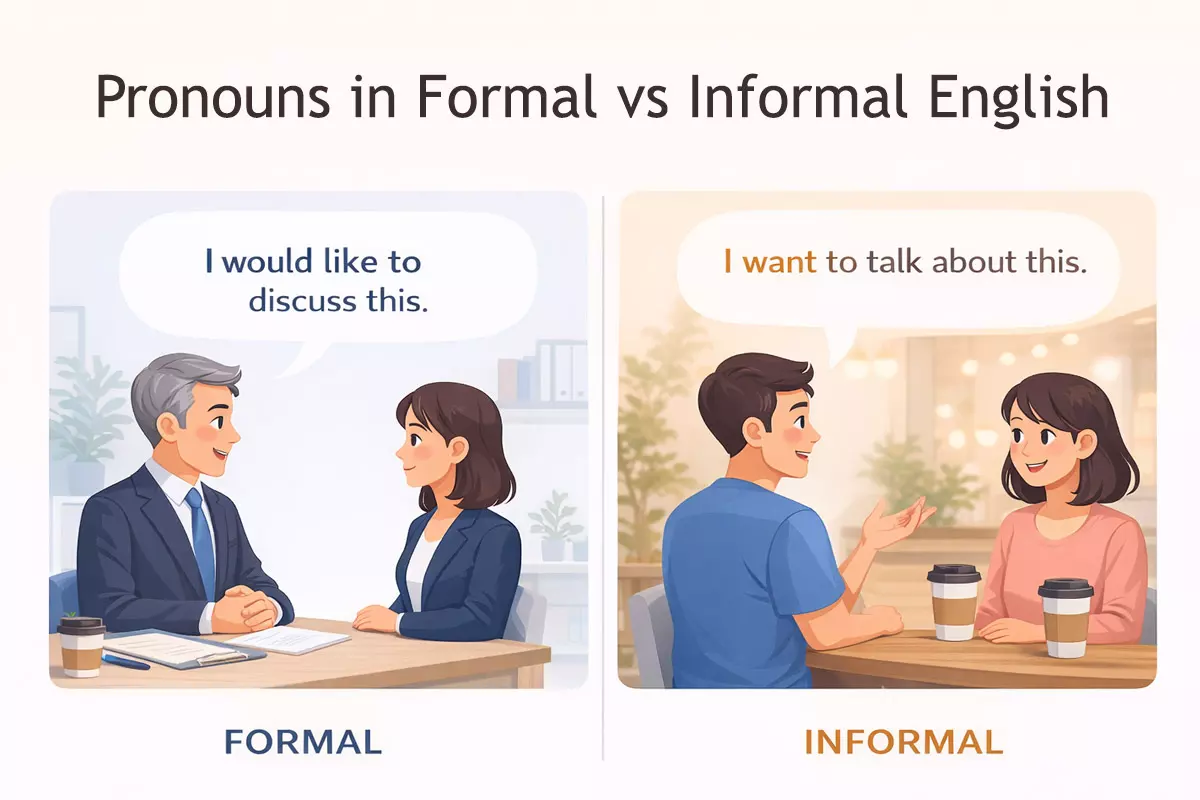 The article explains how pronoun use changes with formality, including contractions in speech, pronoun choices in emails and essays, first-person pronouns in formal contexts, avoiding overpersonal tones, register-mismatch mistakes, and sentence rewriting practice.
- What makes pronoun use formal or informal
- Contractions and pronouns in spoken English
- Pronoun choice in emails, messages, and essays
- First-person pronouns in formal contexts
- Avoiding overpersonal tone in formal writing
- Pronouns in casual conversation
- Common register-mismatch mistakes
- Practice: rewrite sentences for different registers
Selecting appropriate ways to refer to people in various contexts can be challenging, particularly as the level of formality shifts. Knowing how to use personal references correctly is essential for clear and effective communication, whether you are in casual conversations or professional environments. By being mindful of the context and the relationship between speakers, you can ensure your language is respectful and suitable, which helps build better connections and avoids misunderstandings.
What makes pronoun use formal or informal
The tone of communication, audience, and context all shape how pronouns are used in English. Formal language often follows traditional grammar rules more strictly and avoids contractions, while informal language tends to be more relaxed and personal. Whether you're writing an academic essay or texting a friend, the choice of pronouns can signal respect, familiarity, or even distance.
Key factors influencing pronoun formality
- Audience: Addressing a professor, employer, or official typically calls for more formal pronoun choices. With friends or peers, informal forms are common.
- Context: Business emails, academic writing, and public speaking require careful, standard usage. Everyday conversation or social media posts allow for more relaxed pronouns and contractions.
- Relationship: Formal pronouns convey distance or respect; informal ones show closeness or equality.
- Register: The overall level of formality in the situation affects pronoun selection. Official documents use "one" or passive constructions, while casual chat uses "you" or even "we."
Common formal vs. informal pronoun patterns
Some pronoun choices instantly set a formal or informal tone. For example, using "one" instead of "you" is much more formal, and avoiding contractions (like "it is" instead of "it's") is a hallmark of formal English. On the other hand, dropping pronouns ("Got it!") or using slang pronouns ("ya," "y'all") marks informality.

| Formal Usage | Informal Usage |
|---|---|
| One should submit one's application on time. | You should send your application in on time. |
| It is important that he or she arrives early. | They should get here early. |
| Does one have any questions? | Do you have any questions? |
| He or she must consider his or her options. | They need to think about their options. |
| It is requested that you refrain from using phones. | Please don’t use your phone. |
Typical differences and examples
- Using "one" as a generic pronoun (formal) vs. "you" (informal)
- Avoiding contractions in formal contexts ("he is," not "he’s")
- Choosing singular "he or she" (formal) vs. singular "they" (informal or inclusive)
- Omitting pronouns in casual speech ("Coming?")
- Regional or group-specific pronouns in informal speech ("y’all," "ya")
- Passive constructions in formal writing ("It is believed that...")
- Direct address in informal speech ("Hey, you!")
- Reflexive forms: "oneself" (formal) vs. "yourself" (informal)
- Use of "we" for inclusivity or to soften commands (often informal)
- Switching between "I" (personal) and impersonal forms ("the undersigned" in legal/formal contexts)
In summary, the pronouns you choose reflect not just grammar but also social dynamics, expectations, and relationships. Recognizing these patterns helps tailor your language for any situation, from boardrooms to group chats.
Contractions and pronouns in spoken English
Everyday conversation in English often sounds quite different from what you might see in formal writing. One of the main reasons is the frequent use of contractions and the tendency to shorten or even drop pronouns. This makes speech more fluid and natural, but it can also introduce ambiguity or informality that would be avoided in formal contexts.
How contractions shape spoken language
Contractions combine pronouns with auxiliary verbs or the word "not," resulting in forms like "I'm," "you're," or "isn't." These are nearly universal in spoken English, especially during casual interactions. Using full forms ("I am," "you are," "is not") can sound overly formal or stiff in conversation.
- I'm (I am) → I’m ready.
- You're (You are) → You’re right.
- He's / She's / It's (He is / She is / It is) → He’s busy today.
- We're (We are) → We’re on our way.
- They're (They are) → They’re already here.
- I've (I have) → I’ve finished my work.
- You've (You have) → You’ve seen this before.
- He'd / She'd (He had / He would, She had / She would) → He’d call you if he had time.
- Isn't (Is not) → It isn’t far.
- Don't (Do not) → Don’t worry.
- Can't (Cannot) → I can’t remember.
- Won't (Will not) → She won’t agree.
- Didn't (Did not) → They didn’t reply.
- Shouldn't (Should not) → You shouldn’t do that.
- Wouldn't (Would not) → He wouldn’t say that.
- They'll (They will) → They’ll be here soon.
- We'll (We will) → We’ll help you.
- It'll (It will) → It’ll take ten minutes.
- There's (There is / There has) → There’s a problem.
- Who's (Who is / Who has) → Who’s calling?
Pronoun reduction and omission
In informal speech, especially in rapid conversation, speakers sometimes reduce or even omit pronouns. For example, "Got any plans?" instead of "Have you got any plans?" or "Told you so" instead of "I told you so." This streamlining speeds up communication but can be confusing for learners or in unfamiliar contexts.
Comparison: Formal vs. informal patterns
| Formal Style | Informal/Spoken Style |
|---|---|
| I am not sure. | I'm not sure. |
| They have not arrived. | They haven't arrived. |
| She will not come. | She won't come. |
| Are you ready? | You ready? |
| He is going to help us. | He's gonna help us. |
| It is not important. | It's not important. |
| We have finished. | We've finished. |
| Who is coming? | Who's coming? |
Key points to remember
- Contractions are a hallmark of casual, spoken English.
- Dropping pronouns or auxiliary verbs is common in quick or familiar exchanges.
- Using full forms and explicit pronouns signals formality or emphasis.
- Non-native speakers may need extra practice to understand reduced forms in fast speech.
Being aware of these differences helps you choose the right level of formality for the situation and understand native speakers more easily.
Pronoun choice in emails, messages, and essays
Choosing the right pronouns depends on both the context and the level of formality. In digital communication like emails and messages, the tone can shift from highly formal to very casual, which directly influences whether you use "I," "we," "you," or more distant expressions like "one" or passive structures. Similarly, academic essays often require a more objective voice, which can affect which pronouns are appropriate.
Emails: Adjusting for Formality
Emails cover a wide spectrum of formality. For professional correspondence, writers often avoid "I" unless necessary, opting for "we" to represent a group or company. However, in informal exchanges with colleagues or friends, "I" and "you" are common and help create a personal connection.
- "I am writing to request..." (formal, direct)
- "We would like to inform you..." (formal, collective)
- "Let me know what you think!" (informal, personal)
- "Can you send me the file?" (neutral, conversational)
Messages: Conversational Pronouns
Instant messages and texts tend to be informal, so first- and second-person pronouns ("I," "me," "you," "we") dominate. Abbreviations and contractions are also common. Rarely do these messages use "one" or impersonal structures, except for humor or emphasis.
- "Did you see the update?"
- "I'm running late, sorry!"
- "We should meet after work."
- "Can I call you later?"
- "They said it’s ready."
Essays: Academic and Objective Language
In essays, especially academic writing, pronoun usage is more restricted. Many instructors recommend minimizing "I" to keep the tone objective, often preferring passive constructions or third-person forms. However, some disciplines now accept "I" or "we" for clarity. The use of "one" can sound overly formal or outdated, but remains acceptable in specific contexts.
| Context | Common Pronoun Choices | Example Sentences |
|---|---|---|
| Formal Email | we, you, I (sparingly) | "We appreciate your feedback." "I look forward to your reply." |
| Casual Message | I, you, we, they | "I’ll be there soon." "Did you finish it?" |
| Academic Essay | it, one, passive voice, we (in sciences) | "One can conclude that..."; "It is believed that..."; "We observed an increase in..." |
| Personal Essay | I, we, you (sometimes) | "I discovered a new perspective." "We all experience change." |
Quick Tips for Effective Pronoun Use
- Match your pronouns to the relationship and context—use formal options for unfamiliar or professional contacts.
- In essays, consider your instructor’s or publication’s guidelines on first-person usage.
- For group emails, "we" can sound more inclusive and collaborative.
- In messages, clarity and friendliness usually matter more than strict formality.
- Default to third-person or passive forms in academic writing if objectivity is required.
Being mindful of pronoun selection helps your communication sound appropriate, whether you’re writing to a professor, a friend, or a colleague.
First-person pronouns in formal contexts
In formal English, choices around self-reference can shape the tone and perceived professionalism of your language. Instead of casual "I" or "we" statements, academic, business, and official settings often call for more reserved or indirect phrasing. Using first-person pronouns appropriately can help maintain the right level of formality, clarity, and objectivity.
Common practices for self-reference
Writers and speakers often adapt their use of first-person pronouns depending on the audience and context. In formal documents, you may notice the following approaches:
- Replacing "I" with passive constructions (e.g., "The results were analyzed" instead of "I analyzed the results").
- Using "we" when representing a group or organization, even for a single author, to create a sense of collective responsibility.
- Employing phrases like "the author" or "this study" in academic writing to avoid direct self-reference.
- Choosing impersonal structures to shift focus away from the individual (e.g., "It is recommended that...").
- Reserving "I" for personal statements or reflections, where subjectivity is expected or required.
Examples of first-person pronoun usage in formal texts
Below are some ways first-person pronouns and alternatives appear in more formal writing and speech. The list covers a range of contexts, from academic to business communication:
- "We propose a new method for analysis."
- "This report examines the findings in detail."
- "It was observed that..."
- "The author suggests an alternative explanation."
- "Our team conducted the survey."
- "Recommendations are provided in the following section."
- "I would like to thank the committee for their support." (used in acknowledgments)
- "The study found significant differences."
- "We recommend further research in this area."
- "It is concluded that..."
- "This paper reviews recent developments."
- "I acknowledge the limitations of this approach." (when appropriate to express personal responsibility)
- "Our analysis indicates..."
- "The following discussion addresses..."
Comparison of pronoun choices in formal vs informal contexts
| Informal Expression | More Formal Alternative |
|---|---|
| I looked at the data. | The data were analyzed. |
| We think this is a good idea. | It is considered a viable option. |
| I'm going to explain the results. | This section explains the results. |
| We did the survey. | The survey was conducted. |
| I want to thank everyone. | Acknowledgments are extended to all contributors. |
Adapting your language to suit the formality of a situation signals both respect and awareness of conventions. While first-person pronouns are not forbidden in formal English, their use is often carefully considered and, at times, strategically limited to promote a more objective or collective voice.
Avoiding overpersonal tone in formal writing
Clarity and professionalism are central to effective formal writing. One way to maintain this is by limiting the use of personal pronouns such as "I," "we," "my," or "our." Excessive reference to oneself or the reader can make academic, business, or official documents feel subjective or informal. Instead, writers often choose constructions that emphasize the subject matter rather than personal involvement.
Common Strategies to Maintain Formality
- Passive voice: Using passive constructions (e.g., "The results were analyzed") instead of active ones ("We analyzed the results") shifts focus away from the writer.
- Impersonal structures: Expressions like "It is evident that..." or "This report examines..." help maintain objectivity.
- Nominalization: Turning verbs into nouns (e.g., "an evaluation was conducted") can reduce personal tone.
- Third-person references: Referring to groups, organizations, or concepts rather than individuals (e.g., "The committee decided" instead of "We decided").
Examples: Personal vs. Impersonal Language
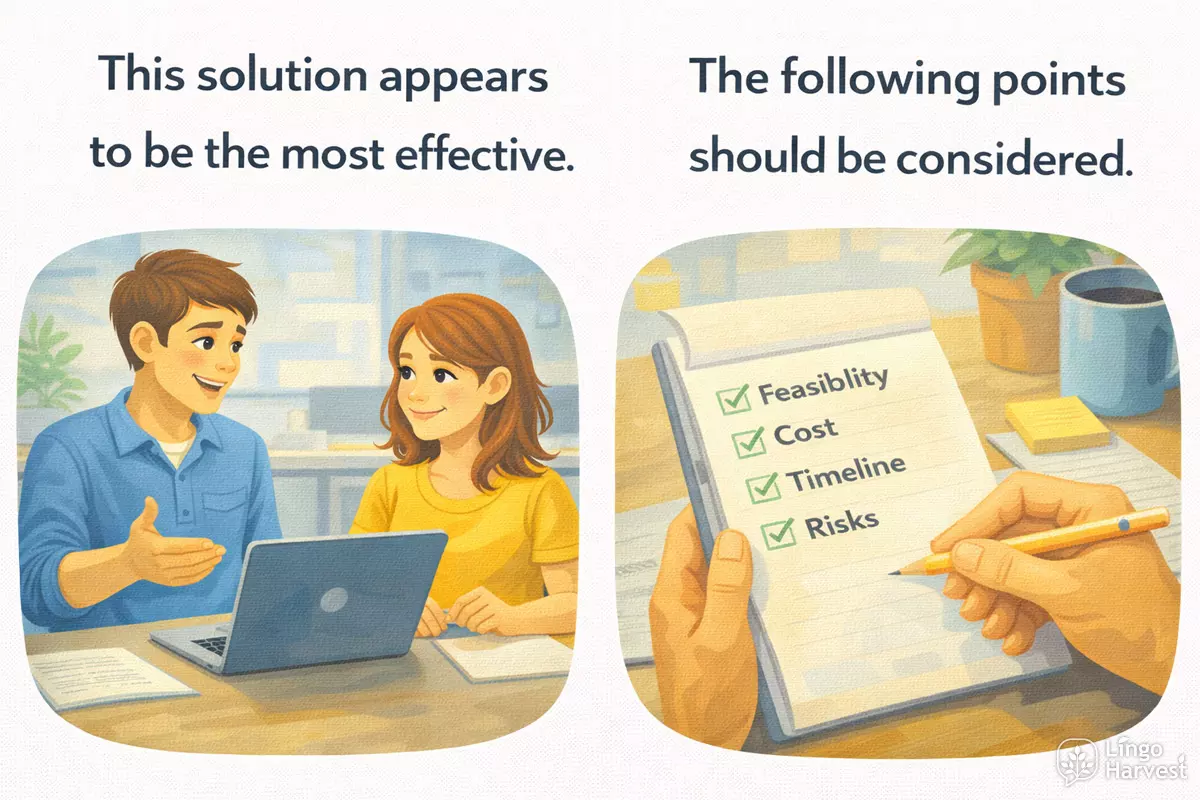
| Personal/Overly Direct | Impersonal/Formal |
|---|---|
| I believe this solution works best. | This solution appears to be the most effective. |
| We can see several issues in the data. | Several issues are evident in the data. |
| My research shows that... | The research indicates that... |
| You should consider the following points. | The following points should be considered. |
| Our team found that... | The analysis revealed that... |
| I will discuss the implications. | The implications will be discussed. |
| We recommend... | It is recommended that... |
| You need to complete this section. | This section must be completed. |
| In my opinion, the results are clear. | The results are clear. |
| Let’s review the findings. | The findings will be reviewed. |
When Is It Acceptable to Use Personal Pronouns?
In some formal contexts, such as reflective writing or personal statements, limited use of "I" or "we" is appropriate and even expected. However, for most academic, technical, or business documents, minimizing direct reference to the writer or reader keeps the tone professional and objective.
- Reserve "I" and "we" for sections where personal input is required.
- Favor third-person or passive constructions for analysis and reporting.
- Avoid addressing the reader directly with "you" unless giving instructions or guidelines.
By choosing less personal phrasing, you help ensure your formal writing is clear, objective, and authoritative.
Pronouns in casual conversation
Everyday speech in English often relaxes the rules around pronouns, favoring simplicity and ease over strict grammar. In informal settings, speakers tend to use shorter forms, drop unnecessary words, and sometimes bend the rules of agreement or reference for the sake of natural flow. This section looks at the most frequent ways people adapt pronouns when talking with friends, family, or colleagues in relaxed situations.
Common informal pronoun choices
- Dropping subject pronouns: Especially in casual chats, speakers might skip the subject if the meaning is clear: “Going out?” instead of “Are you going out?”
- Using 'they' for singular: Instead of “he or she,” many people default to “they” when the gender is unknown: “If someone calls, tell them I’ll call back.”
- Shortened forms: “I’m,” “you’re,” “she’ll,” and “they’ve” are far more common than their full forms.
- Object pronouns at sentence start: “Me and Sam are going,” instead of the formal “Sam and I are going.”
- Double subjects: “Me, I think it’s fine.”
- Overusing 'you': Used generically to mean “anyone”: “You never know what’ll happen.”
- Informal possessives: “My friend’s coming over” instead of “My friend is coming over.”
- Omitting relative pronouns: “That’s the movie I told you about,” instead of “That’s the movie that I told you about.”
- Using 'who' for objects: “The book who’s cover is red” (though technically incorrect, it appears in speech).
- Generic ‘it’: “It’s raining,” even when “it” doesn’t refer to anything specific.
- Redundant pronouns: “My brother, he’s coming too.”
- Slang and regional forms: “Y’all,” “ya,” or “youse” for plural “you.”
Casual vs. formal: Pronoun usage overview
| Formal Example | Casual Equivalent |
|---|---|
| Are you coming with us? | Coming with us? |
| He or she will call you back. | They’ll call you back. |
| My friends and I are ready. | Me and my friends are ready. |
| If anyone needs help, he or she can ask. | If anyone needs help, they can ask. |
| Who is at the door? | Who’s at the door? |
| That is the person whom I met. | That’s the person I met. |
Regional and group variations
Different English-speaking regions and social groups have their own unique pronoun habits. For instance, in the southern United States, “y’all” is widely used for addressing a group, while in some parts of Ireland and Australia, “youse” or “yous” may serve the same purpose. These forms are rarely seen in formal writing but are common in spoken English communities.
Understanding these informal pronoun patterns can help you sound more natural when chatting in English, and also makes it easier to follow native speakers in relaxed settings. While these usages are not always considered correct in formal writing, they are a vital part of everyday communication.
Common register-mismatch mistakes
Switching between formal and informal English pronouns can easily lead to awkward or confusing sentences. Many speakers and writers mix up the appropriate level of formality, especially when moving between personal communication and professional or academic contexts. The following points highlight frequent ways this happens, along with some quick tips to avoid these pitfalls.
Using Informal Pronouns in Formal Contexts
In formal writing, such as business emails, academic essays, or official documents, using overly casual pronouns can undermine your credibility. Here are some examples of informal pronouns or phrases that often slip into formal settings:
- Using "you guys" instead of "you" or "everyone"
- Writing "we" when referring to the writer and reader in academic papers (instead of passive voice or "one")
- Employing "they" as a vague reference when specificity is required
- Using "me" or "myself" in formal subject positions ("Me and John will...")
- Starting sentences with "So" or "Well" followed by a pronoun ("So you see...")
Overly Formal Pronouns in Casual Settings
On the flip side, overly stiff language can sound unnatural in friendly conversations or informal writing. People sometimes default to formal pronouns or phrasing out of habit, even in texts or chats. Common missteps include:
- Using "one" as a generic subject ("One should always...") in everyday speech
- Referring to yourself as "the author" or "the undersigned" in personal messages
- Employing "whom" in spoken English where "who" is expected
- Using "he or she" repeatedly where "they" would be more natural and inclusive
- Addressing friends as "Sir" or "Madam" jokingly but confusingly
Comparing Pronoun Choices by Register
To help clarify which pronouns fit each context, here's a quick comparison of common formal and informal options:
| Informal Usage | Formal Alternative |
|---|---|
| you guys | you / everyone |
| we (for generalizations) | one / passive voice |
| me and John | John and I |
| they (vague reference) | specific noun (e.g., "the committee") |
| who | whom (in object position) |
| he/she (repeated) | they (as a singular, gender-neutral pronoun) |
Other Common Pitfalls
- Switching between "you" and "one" in the same paragraph, leading to inconsistency
- Using contractions ("you're," "they're") in formal writing
- Addressing unknown recipients with "Hey" instead of "Dear" or "To whom it may concern"
- Mixing first person ("I") and impersonal forms ("the writer") within the same piece
- Overusing passive voice to avoid "I" in contexts where first person is acceptable
Being mindful of how you use pronouns in different settings helps your writing and speech sound more natural and appropriate. When in doubt, consider your audience and the purpose of your message before choosing between formal and informal forms.
Practice: rewrite sentences for different registers
Understanding how pronouns shift between formal and informal English can be tricky, but practicing with real examples helps. The following activities guide you through recognizing and rewriting sentences to suit different levels of formality. This will help you become more comfortable choosing the right pronouns and structures for various situations.
Task 1: Identify and Rewrite
Read each sentence, then rewrite it to match the opposite register (formal to informal or vice versa). Focus on changing pronouns, contractions, and tone where appropriate.
- You are required to submit your assignment by Monday.
- Can you give me a hand with this?
- We regret to inform you that your application was unsuccessful.
- Hey, did you get my text?
- It is requested that all participants bring their identification cards.
- I can't make it to the meeting. Sorry!
- Should you have any questions, please contact us.
- Let me know if you need anything else.
- Your cooperation is appreciated.
- Thanks for helping me out!
Show answers
- Can you get your assignment in by Monday?
- Assistance would be appreciated.
- Sorry, you didn’t get the job.
- Did you receive my message?
- Please bring your ID cards.
- I regret that I will be unable to attend the meeting. Apologies.
- If you have any questions, let us know.
- Please inform me if further assistance is required.
- We appreciate your cooperation.
- I appreciate your assistance.
Common Pronoun Shifts: Formal vs Informal Examples
Below is a comparison of how pronouns and sentence structure change depending on the register. Notice the use of full forms, indirectness, and collective nouns in more formal English.
| Informal English | Formal English |
|---|---|
| Can you send me the info? | Could you please provide the information? |
| We’ll get back to you soon. | We will respond to you shortly. |
| Let’s meet up later. | Let us arrange a meeting at a later time. |
| Did you see my email? | Have you received my email? |
| I need your help. | Your assistance is required. |
| Can you tell me? | Could you inform me? |
| I can’t make it. | I regret that I am unable to attend. |
| Let me know what you think. | Please inform me of your opinion. |
| Thanks for your time! | Thank you for your time. |
| Sorry, I missed your call. | I apologize for missing your call. |
Quick Tips for Adjusting Register
- Use full forms (e.g., “cannot” instead of “can’t”) in formal writing.
- Replace “you” with passive forms or collective nouns for greater formality.
- Soften requests and statements with modal verbs like “could,” “would,” or “may.”
- In informal contexts, contractions and direct address (“you,” “I,” “we”) are common.
- Formal English avoids slang and uses more precise vocabulary.
Practice Rewrite Challenge
Try rewriting these sentences to fit a more formal or informal context as needed. Focus on pronoun use and overall tone.
- Hey! I’ll get back to you soon.
- We kindly request your presence at the meeting.
- Let me know if you want to join us.
- Your response at your earliest convenience would be appreciated.
- Did you finish the report?
- Could you send me the details when you have a moment?
- Thanks — I really appreciate your help.
- I’m sorry for the delay in getting back to you.
- Can we reschedule for tomorrow?
- Please confirm that you received the email.
Show answers
- We will respond to you shortly.
- Please attend the meeting.
- Please inform me if you would like to participate.
- Please reply when you can.
- Have you completed the report?
- Please send me the details when you can.
- Thank you for your assistance.
- I apologize for the delayed response.
- Would it be possible to reschedule for tomorrow?
- Please confirm receipt of the email.