Intensifying Collocations (strong tea, heavy rain, deep sleep)

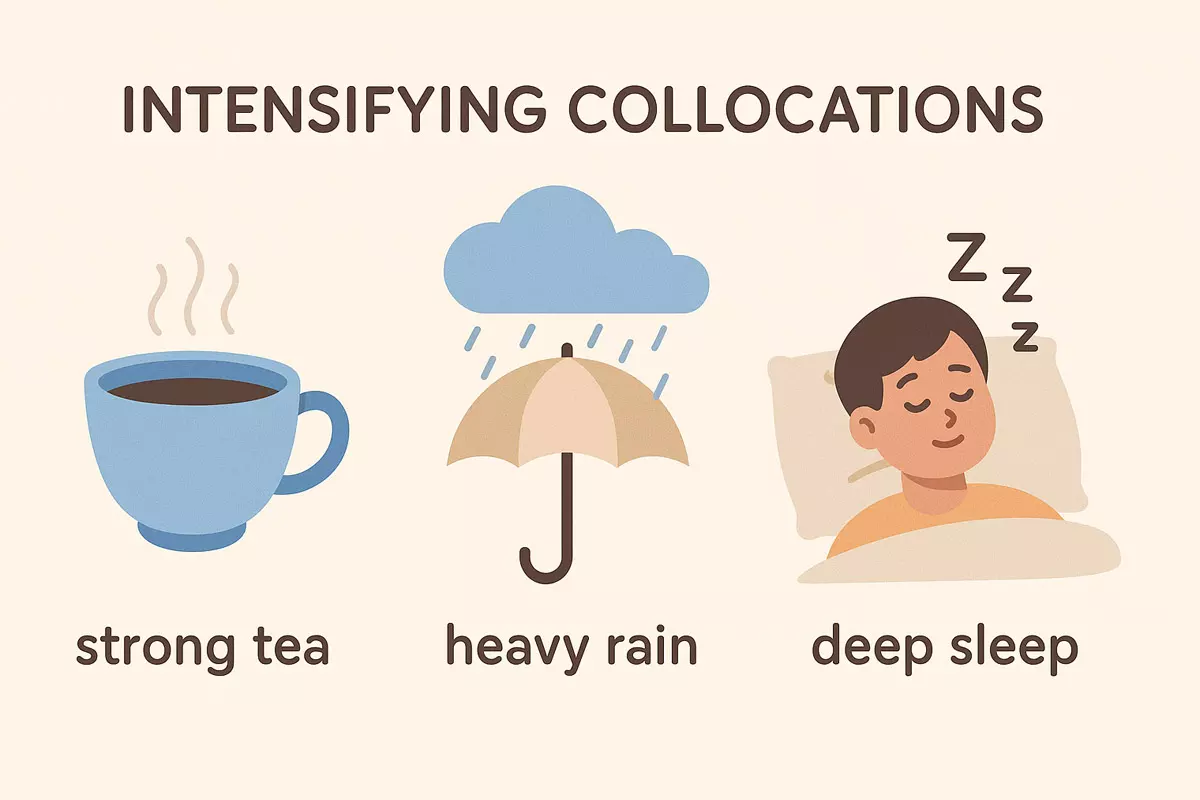 The article defines intensifying collocations, shows which English words commonly intensify others, and explains why these pairings occur. It also covers collocations with strong, heavy, and deep, gives examples, points out typical mistakes, and offers practice.
Have you ever wondered why we say strong tea but never powerful tea, or describe an intense downpour as heavy rain rather than strong rain? These natural word pairings, known as collocations, simply sound right to native speakers, even though there may not be a strict grammatical rule behind them. Mastering collocations can significantly improve your English fluency and help your speech and writing sound more authentic and natural, making communication smoother and more effective in everyday situations.
What Intensifying Collocations Are
Intensifying collocations are word combinations where an adjective or adverb strengthens the meaning of a noun or another adjective. Instead of using generic intensifiers like "very" or "really," English often prefers specific pairings that sound natural to native speakers. For example, you might hear "strong tea" rather than "powerful tea," or "heavy rain" instead of "big rain." These expressions are not always logical or directly translatable into other languages, making them a key part of mastering fluent, authentic English.
How Intensifying Collocations Work
These set phrases combine an intensifier (like "strong," "heavy," or "deep") with a noun or adjective, and the result is a more vivid, precise meaning. The choice of intensifier is not random; certain words just "fit" together, while others would sound odd or incorrect. For instance, "deep sleep" is natural, but "strong sleep" is not. Memorizing these typical combinations helps learners sound more native-like and avoid common mistakes.
Common Examples of Intensifying Collocations
- strong tea
- heavy rain
- deep sleep
- high fever
- utter chaos
- blatant lie
- sheer luck
- intense heat
- bitter disappointment
- serious injury
- pitch dark
- fast asleep
- great success
- strong smell
- deep regret
- heavy traffic
- utter silence
- total disaster
- deep concern
- strong influence
Patterns and Usage Tips
Learning which words naturally go together is essential for sounding fluent. Many intensifiers are only used with particular nouns or adjectives. For example, "heavy" often describes rain, traffic, or snow, but not tea or sleep. Similarly, "strong" is usual for flavors and smells, while "deep" relates to emotions or states.
| Intensifier | Typical Nouns/Adjectives |
|---|---|
| strong | tea, smell, influence, wind |
| heavy | rain, traffic, snow, smoker |
| deep | sleep, regret, concern, voice |
| utter | silence, chaos, disaster, confusion |
| blatant | lie, disregard, violation, racism |
Using intensifying collocations correctly adds color and precision to your English. Instead of relying on basic intensifiers, try incorporating these more natural pairings into your speech and writing for a more native-like style.
Common Intensifiers in English
In English, intensifiers are words that make adjectives or adverbs stronger, helping speakers express emphasis or exaggeration. These modifiers are often used in everyday conversation to convey emotion or clarify the degree of something. For instance, saying “very tired” instead of just “tired” adds a layer of meaning. Intensifiers frequently appear in collocations, where certain adjectives or nouns naturally pair with specific words for emphasis.
Frequently Used Intensifiers
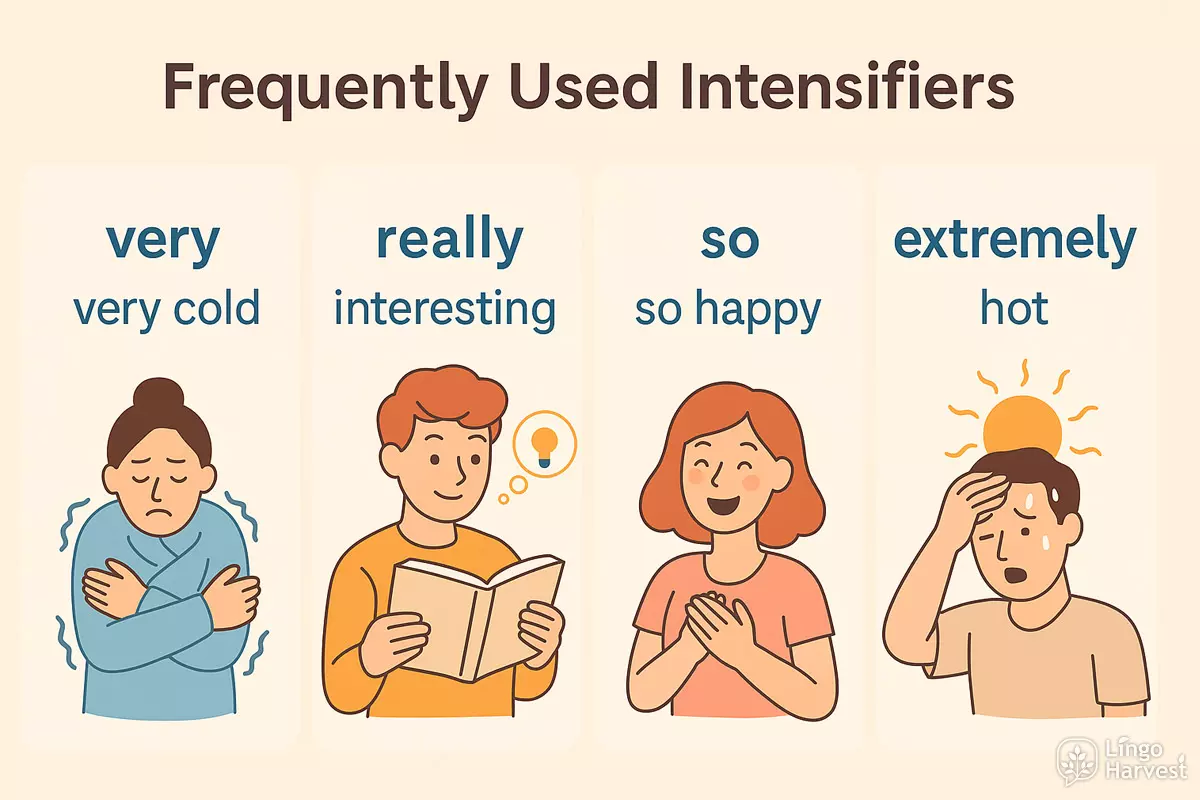
- Very – very cold, very difficult
- Really – really interesting, really big
- So – so happy, so late
- Extremely – extremely hot, extremely important
- Totally – totally wrong, totally silent
- Absolutely – absolutely sure, absolutely delicious
- Completely – completely different, completely empty
- Deeply – deeply concerned, deeply asleep
- Highly – highly recommended, highly unlikely
- Strongly – strongly believe, strongly oppose
- Perfectly – perfectly clear, perfectly normal
- Utterly – utterly exhausted, utterly ridiculous
- Bitterly – bitterly disappointed, bitterly cold
- Seriously – seriously ill, seriously damaged
- Pretty – pretty good, pretty hard
- Fairly – fairly easy, fairly close
- Too – too late, too expensive
- Rather – rather unusual, rather difficult
- Terribly – terribly sorry, terribly bored
- Awfully – awfully nice, awfully quiet
How Intensifiers Work with Collocations
Some intensifiers only fit naturally with particular adjectives or nouns. For example, “strong tea” and “heavy rain” sound natural, while “heavy tea” or “strong rain” do not. This is due to established collocational patterns, which learners need to become familiar with to sound more fluent.
| Intensifier | Typical Collocations |
|---|---|
| Absolutely | absolutely certain, absolutely impossible, absolutely amazing |
| Deeply | deeply concerned, deeply moved, deeply regret |
| Highly | highly unlikely, highly recommended, highly skilled |
| Bitterly | bitterly disappointed, bitterly opposed, bitterly cold |
| Utterly | utterly exhausted, utterly useless, utterly devastated |
Choosing the right word for emphasis depends on the context and the collocation. For example, “deeply asleep” is standard, but “deeply hungry” is not. Familiarity with these patterns helps learners avoid awkward combinations and sound more natural.
Why Some Words Pair Naturally
Certain word combinations just “sound right” to native speakers because of established usage, cultural patterns, and the way English organizes meaning. These natural pairings, called collocations, develop over time as people repeatedly use specific adjectives or intensifiers with particular nouns. For example, we say strong tea and heavy rain—not powerful tea or big rain. This instinctive choice is based on what’s most commonly heard and understood, not strict grammar rules.
How English Collocations Emerge
Usage frequency plays a big role: when a phrase is used by enough people for a long time, it becomes standard. Cultural habits and metaphorical thinking also shape which adjectives “fit” with certain nouns. For example, deep sleep uses the metaphor of depth to describe intensity. These patterns may not always make literal sense, but they feel natural because of collective experience.
Common Patterns of Intensifying Collocations
Many intensifying collocations use adjectives that express degree, size, or strength. Here are some widespread examples where only one pairing sounds correct to most native speakers:
- strong tea
- heavy rain
- deep sleep
- fast car
- high hopes
- hard work
- loud noise
- thick fog
- fierce competition
- intense heat
- severe pain
- utter silence
- sheer luck
- blinding light
- roaring success
- strong smell
- deep voice
- heavy traffic
- total disaster
- crushing defeat
Why Some Pairings Feel Wrong
When a non-standard combination is used, it can sound awkward or confusing. For instance, powerful tea or strong rain are rarely heard, even though the meaning is clear. This is because collocations are learned through exposure, not logic. Native speakers develop an ear for which words naturally go together.
Comparing Acceptable and Unusual Pairings
| Natural Pairing ✅ | Unusual/Incorrect Pairing ❌ |
|---|---|
| strong tea | powerful tea |
| heavy rain | thick rain |
| deep sleep | strong sleep |
| fast car | quick car |
| loud noise | big noise |
Collocations with Strong, Heavy, Deep
The words “strong,” “heavy,” and “deep” often combine with certain nouns to intensify their meaning in English. These combinations, known as intensifying collocations, are not always logical if translated word-for-word into other languages. Instead, English speakers tend to use specific pairings that sound natural and convey precise meanings. Let’s look at how each of these adjectives functions and some of the most common and useful combinations.
Common Pairings with “Strong”
“Strong” is frequently used to emphasize the power or intensity of something, especially regarding flavors, opinions, or emotions. For example, “strong tea” means tea with a robust flavor, not tea that is physically strong. Here are some widely used collocations:
- strong tea
- strong coffee
- strong opinion
- strong argument
- strong smell
- strong feelings
- strong influence
- strong possibility
- strong leadership
- strong wind
Typical Uses of “Heavy”
The adjective “heavy” often relates to weight, but in collocations, it usually intensifies the sense of something being substantial, overwhelming, or severe. Here are some examples:
- heavy rain
- heavy traffic
- heavy snow
- heavy smoker
- heavy workload
- heavy sleeper
- heavy losses
- heavy heart
- heavy industry
- heavy breathing
“Deep” in Intensifying Collocations
“Deep” is used to express something profound, thorough, or intense, often with abstract nouns. For instance, “deep sleep” means sleep that is very restful and undisturbed. Some common combinations include:
- deep sleep
- deep breath
- deep voice
- deep water
- deep thought
- deep concern
- deep understanding
- deep trouble
- deep feelings
- deep respect
Comparing Usage Patterns
To clarify how these adjectives pair with nouns, here’s a structured overview:
| Adjective | Example Collocations |
|---|---|
| strong | strong tea, strong argument, strong influence, strong wind, strong opinion |
| heavy | heavy rain, heavy traffic, heavy smoker, heavy workload, heavy losses |
| deep | deep sleep, deep breath, deep concern, deep water, deep understanding |
Understanding these typical combinations will help you sound more natural and precise in English. Instead of saying “strong rain” (which is incorrect), opt for “heavy rain.” Similarly, don’t say “heavy sleep”—use “deep sleep” to express a restful night. Mastering these patterns is key ✅ to idiomatic English.
Typical Everyday Examples
When it comes to describing daily experiences, English uses specific word pairs that sound natural together for extra emphasis. These combinations, called intensifying collocations, help speakers express degree or strength in a way that native speakers instantly recognize as correct. Instead of using generic intensifiers like "very" or "really," these collocations create vivid, idiomatic language.
Common Intensifying Collocations in Daily Life
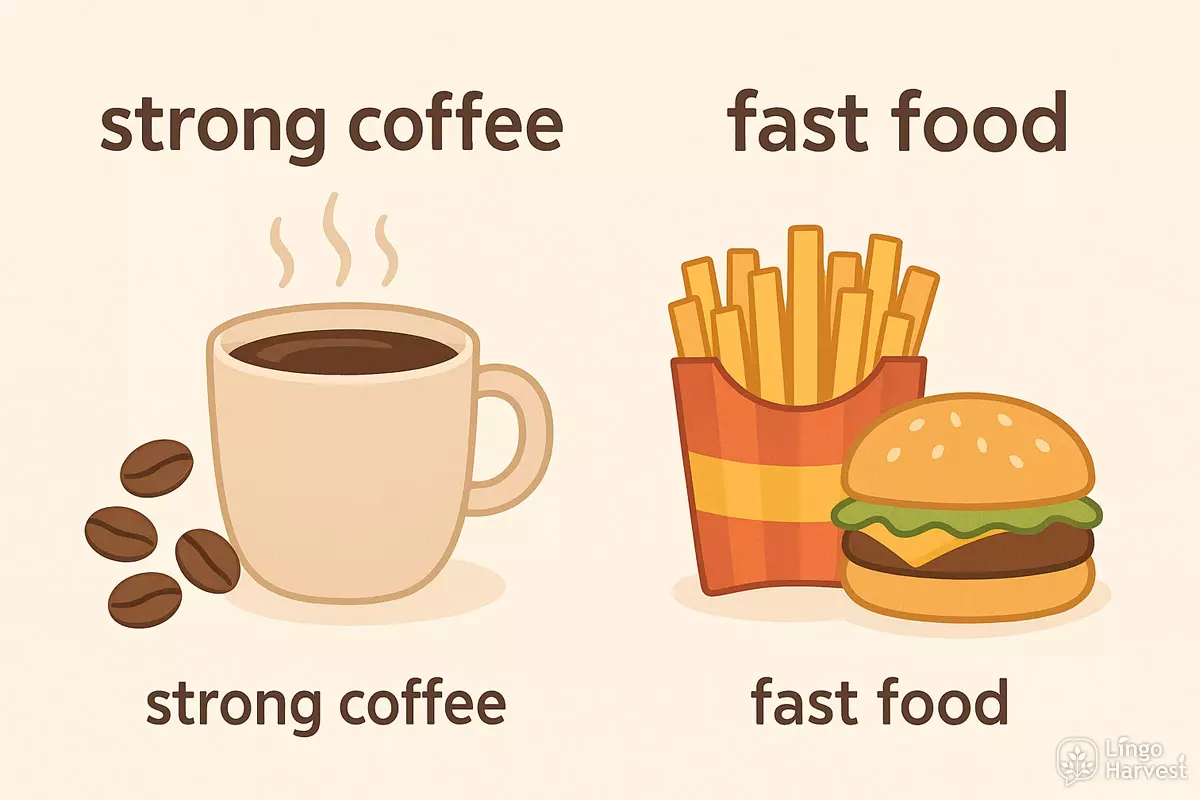
You’ll often hear these pairings in conversations about the weather, food, emotions, and routine activities. Here are some frequent examples:
- Strong coffee – for a drink with a lot of flavor or caffeine
- Heavy rain – when it’s raining intensely
- Deep sleep – a state of being fully asleep, not easily woken
- Bitter disappointment – feeling very let down
- Fast food – food prepared and served quickly
- High hopes – expecting good results
- Blazing row – a very heated argument
- Wide awake – completely alert
- Utter chaos – total disorder
- Dead silence – complete quietness
- Strong accent – a noticeable way of pronouncing words
- Heavy traffic – a lot of vehicles on the road
- Deep breath – inhaling fully
- Strong smell – a very noticeable scent
- Great success – an outstanding achievement
- Heavy smoker – someone who smokes a lot
- Roaring fire – a fire burning strongly
- Deep voice – a low-pitched voice
How Intensifying Collocations Differ from Simple Adjectives
These expressions are not always interchangeable with other adjectives or adverbs. For example, saying "strong rain" or "heavy tea" would sound odd to native speakers, even though the literal meaning is clear. Choosing the right pair helps your English sound more fluent and natural.
| Collocation | What It Means |
|---|---|
| Heavy rain | Very intense rainfall |
| Strong tea | Tea brewed to be rich and potent |
| Deep sleep | Sleep that is undisturbed and restful |
| Dead silence | Complete absence of sound |
| Bitter disappointment | Feeling extremely let down |
| Heavy traffic | Many vehicles causing congestion |
| Strong accent | Pronunciation that is easily noticeable |
| Roaring fire | A fire burning with intensity |
Why Native Speakers Prefer These Phrases
Using these fixed combinations is a mark of natural English. They add color and precision to descriptions, and help avoid awkward or unnatural phrasing. Mastering them is a useful step toward sounding more fluent and confident in conversation.
Common Mistakes with Intensifiers
Learners of English often trip up when using words like "strong," "heavy," or "deep" before nouns, especially in fixed word combinations. These intensifying collocations don’t always follow logic or direct translation from other languages, which leads to frequent mix-ups.
Confusing Intensifiers: Typical Errors
People sometimes use an intensifier that doesn’t naturally fit the noun, resulting in odd or incorrect phrases. For example, saying "heavy tea" or "strong rain" may seem reasonable, but native speakers don’t use these combinations.
- Using strong with "rain" instead of "heavy" (heavy rain ✅, strong rain ❌)
- Saying deep coffee instead of "strong coffee"
- Writing heavy sleep rather than "deep sleep"
- Choosing "strong smell" when "strong odor" or "strong perfume" might be more precise
- Using "deep pain" instead of "severe pain"
- Saying "heavy noise" instead of "loud noise"
- Mixing up "deep voice" and "strong voice"
- Using "strong snow" when "heavy snow" is correct
- Saying "deep rain" instead of "heavy rain"
- Using "strong wind" correctly, but confusing it with "heavy wind" (which is incorrect)
- Trying "deep tea" instead of "strong tea"
- Confusing "strong sun" with "bright sun"
- Saying "heavy perfume" instead of "strong perfume"
- Using "deep storm" instead of "severe storm"
- Using "heavy sleep" instead of "deep sleep"
- Saying "loud rain" instead of "heavy rain"
- Trying "strong sleep" instead of "deep sleep"
- Using "strong weather" instead of "severe weather"
Why These Collocations Matter
Choosing the wrong intensifier doesn’t just sound unnatural; it can also cause confusion. Native speakers expect certain word pairs, so using the right intensifier helps your English sound fluent and idiomatic.
Comparison of Correct and Incorrect Collocations
| Incorrect Combination | Correct Collocation |
|---|---|
| strong rain | heavy rain |
| deep tea | strong tea |
| heavy sleep | deep sleep |
| heavy snow | heavy snow |
| strong wind | strong wind |
| loud rain | heavy rain |
| strong weather | severe weather |
| deep pain | severe pain |
Tips to Avoid These Errors
Stick to the established word pairings you hear and read from native sources. Memorize common collocations as fixed expressions, not just by their individual words. If you’re unsure, check reliable dictionaries or listen to how native speakers use these combinations in context. Over time, this approach will help you sound more natural and avoid awkward mistakes.
Practice: Complete Collocations Correctly
Understanding which adjectives naturally combine with particular nouns is essential for sounding fluent. In this section, you’ll find focused exercises to help you master intensifying collocations—those pairs like “strong tea” or “heavy rain” that native speakers use instinctively. Read the tasks carefully and try to select the most natural-sounding combinations.
Fill in the Blanks
Choose the best adjective to complete each collocation. Think about which words usually go together in English.
- ______ rain kept us indoors all day.
- After a ______ sleep, I felt refreshed.
- He made a cup of ______ coffee to wake up.
- We had a ______ argument about politics.
- She gave a ______ sigh of relief.
- The city was hit by a ______ storm last night.
- I need a ______ shower after that workout.
- He told a ______ lie to avoid trouble.
- They had a ______ influence on her decision.
- It was a ______ disappointment when the event was canceled.
Show answers
- Heavy rain
- Deep sleep
- Strong coffee
- Heated argument
- Deep sigh
- Severe storm
- Hot shower
- Blatant lie
- Strong influence
- Bitter disappointment
Choose the Correct Collocation
Pick the most natural-sounding phrase. Only one option is correct in each case.
- Which is correct?
a) Strong tea
b) Heavy tea - a) Heavy traffic
b) Strong traffic - a) Strong rain
b) Heavy rain - a) Deep sleep
b) Heavy sleep - a) Strong perfume
b) Heavy perfume
Show answers
- a) Strong tea
- a) Heavy traffic
- b) Heavy rain
- a) Deep sleep
- a) Strong perfume
Common Intensifying Collocations
Here’s a quick reference list of frequent adjective-noun pairs used for emphasis. Review these to reinforce your understanding:
- Strong tea
- Heavy rain
- Deep sleep
- Bitter disappointment
- Severe pain
- Blatant lie
- Hot debate
- Heated argument
- Strong influence
- Heavy smoker
- Deep breath
- Strong evidence
- Heavy burden
- Hot topic
- Strong feeling
- Deep understanding
- Severe weather
- Heavy workload
Practicing these combinations will help you sound more natural in both writing and conversation. Try to notice them in context and use them in your own sentences for better retention.