Verb + That-Clause Structures in Modern English

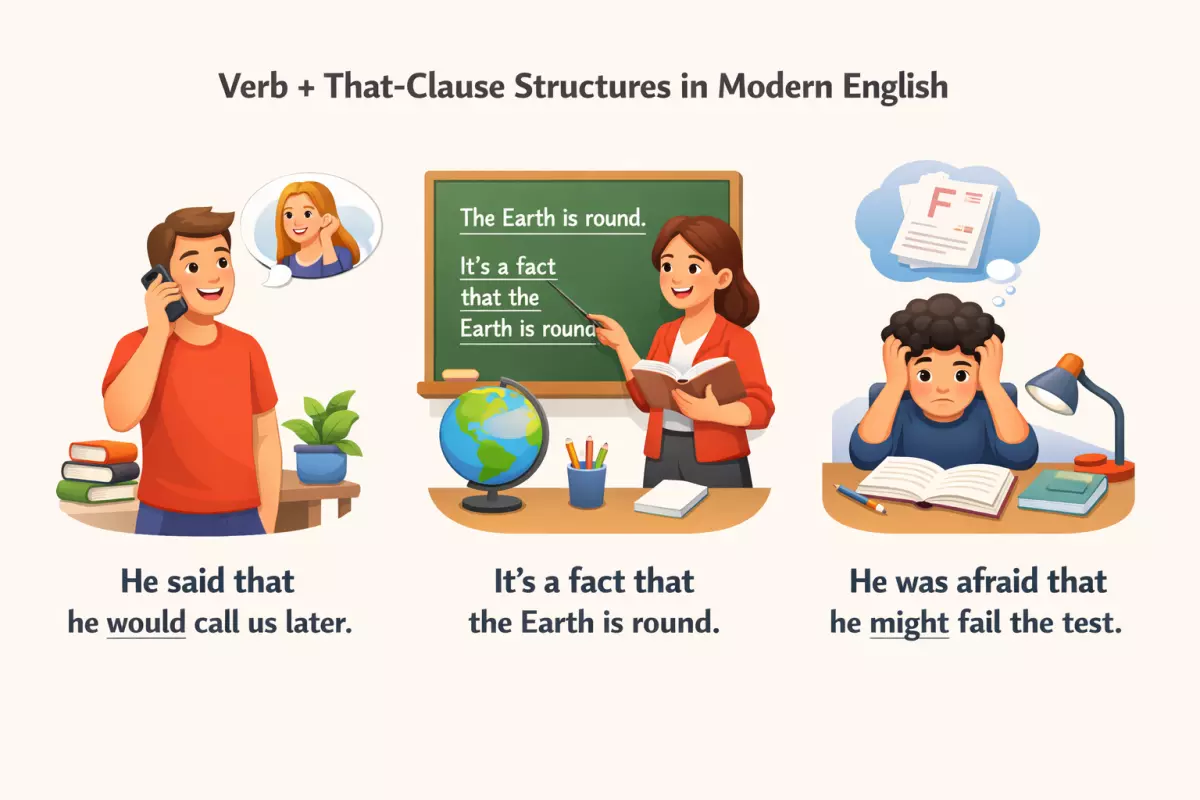 Covers what that-clauses are, common verbs that take them, and when that is optional or required. Explains word order and tense choices with reporting and mental verbs, contrasts formal vs informal use, flags typical learner errors, and ends with homework practice tasks.
In everyday English, we often use verbs followed by a full statement with that to express what we think, know, or report. You hear it at work, in the news, and in messages: I believe that, she said that, we noticed that. This article explains how to make these patterns sound natural, when that can be left out, and how to avoid common learner mistakes.
What that-clauses are
A that-clause is a dependent clause that functions like a noun phrase: it can act as the subject, object, or complement of a larger clause. It typically contains its own subject and a finite verb, and it is often introduced by that, especially after reporting, thinking, or feeling verbs.
In verb + that-clause structures, the main verb frames the information in the following clause as a statement, belief, report, discovery, or judgment. The clause answers questions like “What did they say/think/realize?” or “What does this show?”
Core form and meaning
- Basic pattern: Verb + (that) + subject + verb: “She said (that) the train was late.”
- Finite verb inside the clause: “I believe (that) he knows the answer.”
- Proposition content: the clause expresses a complete idea that can be true/false, likely/unlikely, surprising/expected.
- Not a relative clause: “I know that he left” (content) vs. “the book that he bought” (relative).
Where they appear in sentences
- Object after a verb: “They confirmed (that) the meeting is canceled.”
- Subject position (more formal): “That she refused surprised everyone.”
- Extraposed subject with it (very common): “It surprised everyone that she refused.”
- Complement after adjectives/nouns (related pattern): “I’m glad (that) you came.” / “The fact that you came helped.”
Using “that” vs. leaving it out
- ✅ Optional in many object positions: “I think (that) it’s fine.”
- ✅ Often kept for clarity when the clause is long: “She explained that, after several delays, the shipment would arrive on Friday.”
- ✅ Often kept to avoid misreading after verbs followed by another phrase: “He admitted that to the committee he had lied.”
- ❌ Not usually omitted when the clause is the subject at the start: “That she refused surprised everyone” (dropping that here is uncommon).
Common verb meanings that introduce a that-clause
- Reporting: say, report, announce, claim, admit, confess, deny, promise, agree
- Thinking and believing: think, believe, suppose, assume, expect, doubt, suspect, imagine
- Knowing and discovering: know, learn, realize, find (out), discover, notice, remember, forget
- Showing and proving: show, prove, demonstrate, indicate, suggest, reveal, confirm
Grammar notes learners often need
- Tense is chosen for meaning, not for the word “that”: “She said that she is ready” (still true now) vs. “She said that she was ready” (past viewpoint).
- Negation can belong to the main verb or the embedded clause: “I don’t think (that) he’s coming” often means “I think he isn’t coming.”
- Pronouns and time words may shift in reported contexts: “He said that he would come tomorrow” (from the speaker’s viewpoint at the time of reporting).
- Complementizer vs. demonstrative: “I know that you’re right” (connector) vs. “I know that” (demonstrative pronoun meaning “that thing/idea”).
Common verbs followed by that-clauses
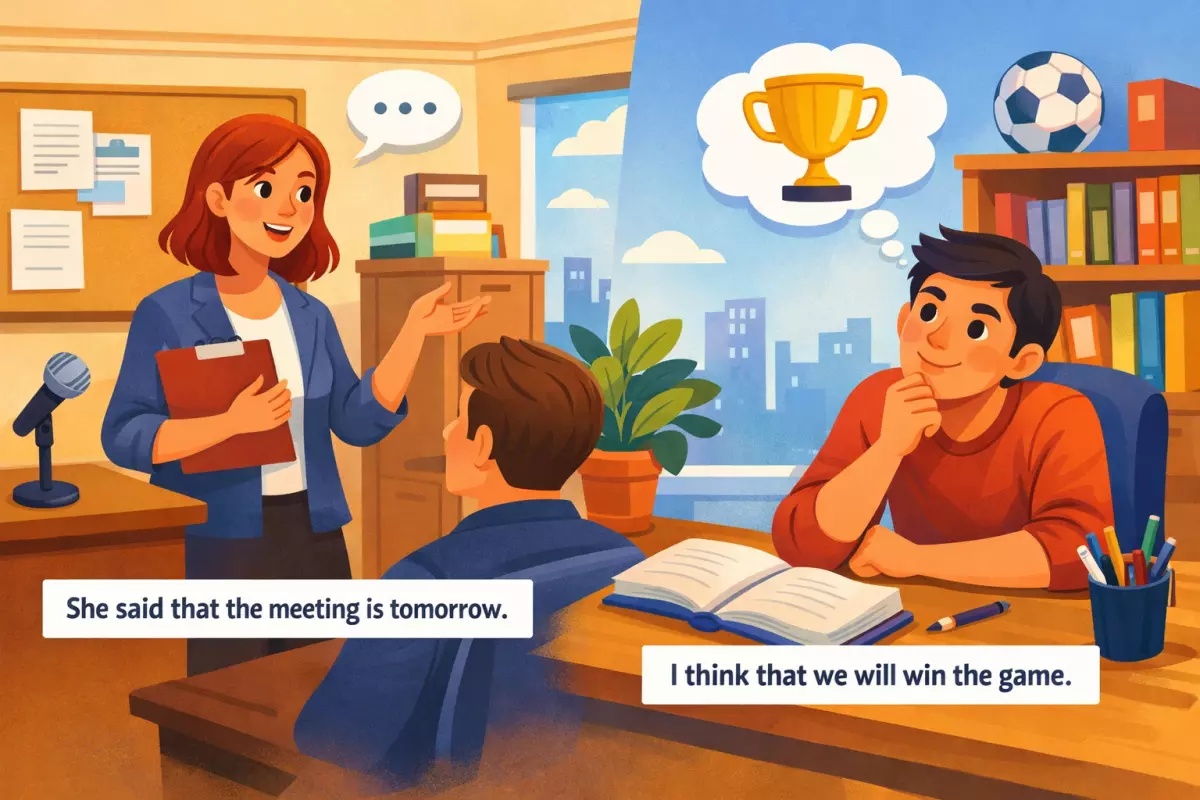
Many reporting, thinking, and feeling verbs can introduce a subordinate clause with that (often optional in informal writing). These verbs typically take the pattern verb + (that) + subject + verb, especially when the speaker is presenting information, an opinion, or a reaction.
Frequent verb groups and typical meanings
- Reporting and saying (introducing information): say, state, report, announce, mention, add, admit, confess, claim, argue.
- Thinking and believing (opinions or assumptions): think, believe, suppose, assume, expect, guess, imagine, suspect, predict, hope.
- Knowing and discovering (facts and findings): know, learn, discover, find, realize, notice, confirm, prove, reveal, show.
- Feelings and reactions (emotional response to information): regret, fear, worry, be glad, be pleased, be surprised, be disappointed, be relieved.
- Requests and demands (more formal; often with mandative meaning): insist, demand, request, recommend, suggest, propose, ask (in formal contexts).
Core patterns to teach and notice
- Basic structure: They said (that) the meeting was cancelled.
- That is often omitted after very common verbs, especially in speech: ✅ I think you’re right. → also possible: I think that you’re right.
- That is more likely to appear when the clause is long, when the verb is less frequent, or when clarity matters: The report confirmed that several systems had failed during the test.
- Pronoun + verb combinations commonly take zero that: She said she’d call., We hope it works.
- Negative meaning in the main clause can shift where negation appears (especially with think/believe): ✅ I don’t think (that) it’s ready. (more natural than) ❌ I think (that) it isn’t ready. in many everyday contexts.
Example sentences with high-utility verbs
- She admitted (that) she made a mistake.
- They announced that the train line would reopen on Monday.
- He argued that the policy was unfair.
- We assume (that) the data is accurate.
- I believe (that) this approach will help.
- The study claimed that the results were significant.
- She confirmed that the payment had been received.
- He discovered that the file was corrupted.
- I expect (that) we’ll finish by noon.
- They found that the door was unlocked.
- We hope (that) everyone can attend.
- I learned that the course starts next week.
- She noticed that the lights were still on.
- The manager reported that sales had increased.
- He suspected (that) something was wrong.
- They suggested that we (should) leave early.
Notes on “suggest/insist/demand” + that-clause
- Mandative pattern (common in American English, formal in British English): They insisted that he be present.
- Should + base verb (especially common in British English): They insisted that he should be present.
- Indicative forms occur when the speaker describes a fact rather than a demand: She insisted that she was right. (assertion, not a requirement)
Optional vs required that
In verb + that-clause patterns, the conjunction that is sometimes removable with little change in meaning, and sometimes strongly preferred (or effectively necessary) for clarity. The choice depends on the verb, the sentence structure, and how easy it is for the reader to recognize where the reported clause begins.
When that is commonly optional
In many everyday reporting and thinking structures, omitting that is natural, especially in informal writing and speech. The clause still reads smoothly because the verb clearly signals that a statement or thought follows.
- say: “She said (that) she was leaving early.”
- think: “I think (that) this is the best option.”
- believe: “They believe (that) the plan will work.”
- hope: “We hope (that) you can come.”
- guess: “I guess (that) he forgot.”
- hear: “I heard (that) the meeting was canceled.”
- know: “I know (that) you’re busy.”
- notice: “She noticed (that) the door was open.”
- feel (opinion): “I feel (that) we should wait.”
- assume: “They assumed (that) we had agreed.”
- suppose: “I suppose (that) it’s possible.”
- promise: “He promised (that) he would call.”
- agree: “We agreed (that) the deadline was unrealistic.”
- decide: “She decided (that) she needed a break.”
When that is recommended for clarity
Even with verbs where omission is allowed, writers often keep that when the sentence is long, when extra material sits between the verb and the clause, or when the next words could be misread as the verb’s direct object. Including that helps the reader parse the structure quickly.
- After an intervening phrase: “She said, after a long pause, that she disagreed.”
- With multiple clauses: “He said that the report was finished and that the files were uploaded.”
- When a noun follows the verb (possible garden-path): “I heard that Mark was promoted.” (clearer than “I heard Mark was promoted” in some contexts)
- When the clause begins with a pronoun and rhythm may feel abrupt: “She admitted that it was her mistake.”
- In formal or careful writing: keeping that can reduce ambiguity in complex sentences.
When that is effectively required
Some environments make omission sound ungrammatical or create confusion. This is especially common when the that-clause is separated from its verb, when a complementizer is needed to signal the start of the clause, or when the structure competes with another possible parse.
- After certain adjectives/nouns with extraposition: “It’s essential that everyone arrive on time.” ❌ “It’s essential everyone arrive on time.” (possible in some varieties, but often avoided in general standards)
- With “so/such … that” result clauses: “She was so tired that she fell asleep.” ❌ “She was so tired she fell asleep.” (sometimes heard, but that is the standard marker)
- When the clause is fronted (rare, but clearer with a marker): “That he resigned surprised everyone.”
- When omission causes a misleading object reading: “She convinced him that the offer was real.” (without that, the boundary can be harder to see)
- When a parenthetical interrupts the verb–clause link: “I believe, despite the rumors, that she acted responsibly.”
Practical editing rule
- If the sentence is short and the verb clearly introduces a statement, omitting that is usually fine.
- If anything interrupts the verb + clause connection (extra phrases, coordination, long subjects), keep that to prevent misreading.
- If the construction is a fixed pattern (for example, “so … that”), treat that as the normal required marker.
Word order and tense choice
In verb + that-clause structures, English is fairly strict about where the clause sits in the sentence, but flexible about how the verb inside the clause reflects time, certainty, and reported speech. The most common pattern is a reporting or stance verb followed directly by that + finite clause, with tense choices guided by meaning rather than by a single mechanical rule.
Typical placement of the that-clause
- Default order: Subject + verb + (optional object) + that-clause.
Example: She said that the meeting was cancelled. - Object before the clause: Some verbs take an object plus a clause.
Example: They told us that the train was late. - Adverbs usually stay outside the clause: Place stance adverbs after the reporting verb, not inside the embedded clause unless they belong there.
Example: He firmly believes that it will work. - Heavy clause at the end: If the that-clause is long, keep it last and avoid interrupting it with extra material.
Example: She admitted that, after months of delays and redesigns, the plan needed a reset. - Fronting is possible but marked: A that-clause can be moved to the front for emphasis, but it sounds more formal and is less common in everyday writing.
Example: That the results were misread, the report suggests. - Avoid “that” stranded after long insertions: Don’t separate the verb and the clause with too much material.
✅ She argued that the policy was unclear.
❌ She argued, after a long discussion with the committee, that the policy was unclear. (better to move the insertion)
Tense inside the that-clause: meaning-driven choices
- Present reporting + present clause for current, generally true, or still-relevant content.
Example: Experts agree that sleep affects memory. - Present reporting + past clause to refer to a completed past event.
Example: She remembers that the door was locked. - Past reporting + past clause is common in reported speech when the original was present.
Example: He said that he needed help. - Past reporting + present clause when the embedded information is still true now (no backshift needed).
Example: She said that the Earth orbits the Sun. - Past reporting + present perfect to keep a link to the present from a past report.
Example: They announced that they have reached an agreement. - Past reporting + past perfect to show the embedded event happened earlier than the reporting moment.
Example: He admitted that he had made a mistake. - Future meaning is expressed with will, be going to, or present forms depending on certainty and schedule.
Examples: She thinks that it will rain. / They confirmed that the flight leaves at 6. - Modal verbs often stay the same under reporting because they already encode time/attitude.
Example: He said that we must leave early. (context decides whether must is obligation now or then)
Backshift patterns (when speakers “move” tense back)
- Backshift is typical after a past reporting verb when the speaker is simply relaying what was said/thought at that time.
Example: She thought that the shop was open. - No backshift is common when the content is still valid, habitual, or a general fact.
Example: He explained that water boils at 100°C. - Time words can force clarity: If the clause has now, today, this week, etc., choose tense that matches the intended timeline.
Example: She said that she is busy today. (still true today) - Reported future often shifts: will commonly becomes would after past reporting, especially in narratives.
Example: They promised that they would call. - Past perfect for “earlier past” is especially helpful when two past times might be confused.
Example: She said that she had finished before the deadline.
Common ordering and tense pitfalls (with fixes)
- Using a question word order inside a that-clause (keep statement order).
✅ He asked if I was ready. / He said that I was ready.
❌ He said that was I ready. - Mixing timelines without a cue (add a time marker or adjust tense).
✅ She said that she is working there now.
✅ She said that she was working there then. - Forgetting the “earlier-than-past” form when the sequence matters.
✅ He realized that he had left his keys at home. - Letting long inserts split verb and clause (move the insert to the end or rewrite).
✅ She claimed that the figures were accurate, despite the audit. - Over-backshifting facts (use present for stable truths).
✅ The teacher said that the test counts for 40%.
Reporting and mental verbs
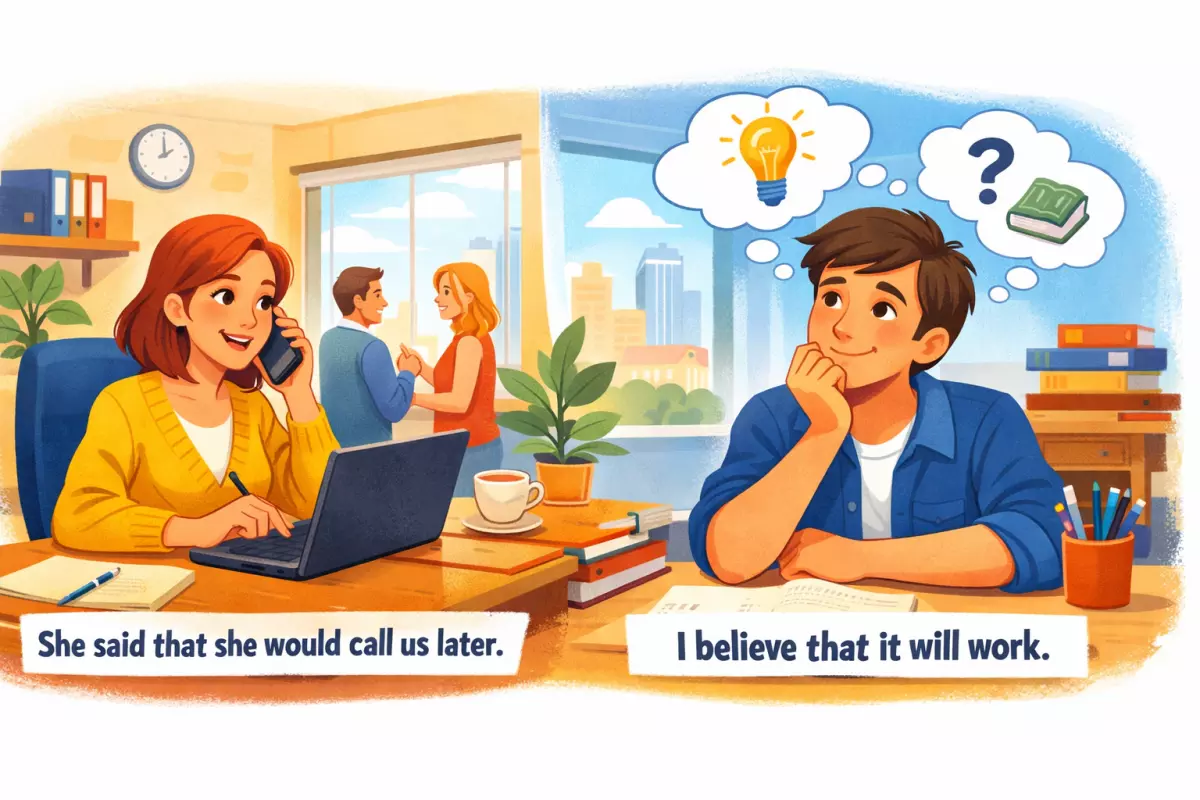
Many verbs that describe communication, beliefs, and internal thought naturally take a that-clause as their complement. The pattern is especially common when the speaker wants to present information as a statement (often with some degree of distance, certainty, or evaluation) rather than as a direct quote or a physical action.
Core patterns
The most frequent structure is Verb + (optional object) + that-clause. The conjunction that is often optional in informal style, but it is more likely to be kept when the clause is long, when there could be ambiguity, or in more formal writing.
- Verb + that-clause:
✅ She said (that) the train was late. - Verb + object + that-clause (common with “tell” and similar verbs):
✅ He told me (that) he couldn’t come. - Verb + that-clause with a preparatory subject it (more formal, often evaluative):
✅ She argued that it was necessary to act quickly. - Reporting verb + that-clause to summarise speech/thought (not quoting):
✅ They announced that the museum would reopen in May.
Common verb groups that take that-clauses
Different verb types tend to signal different meanings: reporting what was said, presenting evidence, expressing belief, or describing a mental conclusion. The that-clause usually contains the “content” of the message or thought.
- Speech/reporting: say (that), tell + object (that), report (that), announce (that), mention (that), admit (that), confess (that), reply (that), explain (that), promise (that).
- Belief/opinion: think (that), believe (that), feel (that), assume (that), suppose (that), expect (that), suspect (that), doubt (that), hope (that), fear (that).
- Evidence/argument: claim (that), argue (that), insist (that), maintain (that), demonstrate (that), show (that), prove (that), suggest (that), indicate (that).
- Discovery/realisation: realise (that), discover (that), find (that), notice (that), learn (that), remember (that), forget (that), decide (that).
When “that” is omitted (and when it is safer to keep it)
Omitting that is very common after frequent verbs like think, say, and know. Keeping it can make the sentence easier to process, especially when extra material comes between the verb and the clause.
- ✅ I think you’re right. (informal, “that” omitted)
- ✅ I think that you’re right. (slightly more deliberate or formal)
- ✅ She said that, after reviewing the figures again, the plan would change. (keeping “that” helps readability)
- ✅ He told us that the meeting, which had been postponed twice, would finally happen. (long insertions favour “that”)
Tense choices and backshifting in reported content
With past reporting verbs, the tense in the that-clause often “backshifts” to show reported time perspective. However, backshifting is not required when the information is still true, general, or presented as current.
- ✅ She said that she was tired. (backshift: “am” → “was”)
- ✅ He explained that the office opened at nine. (habitual time in the past context)
- ✅ The guide said that water boils at 100°C. (no backshift for general truth)
- ✅ They announced that the bridge will reopen next week. (future kept if it is still future from now)
Frequent learner issues
That-clauses are straightforward once the verb pattern is chosen, but a few verbs have strict complements or require an object. Paying attention to the verb’s “slot” helps avoid common errors.
- “Tell” needs an object:
✅ She told me that she was leaving.
❌ She told that she was leaving. - Don’t mix a that-clause with an infinitive pattern unless the verb allows both with different meanings:
✅ He promised that he would call.
✅ He promised to call. - “Say” vs. “tell”:
✅ She said that it was late.
✅ She told us that it was late. - “Suggest” is not “suggest me”:
✅ She suggested that we leave early.
❌ She suggested me that we leave early.
Formal vs informal usage
Register strongly affects how verb + that-clause patterns are chosen and how much is left explicit. In careful writing, the that-clause often stays fully expressed, subjects are clear, and reporting verbs are slightly more formal. In casual speech, speakers frequently omit that, prefer shorter reporting verbs, and use stance markers that sound natural in conversation.
Common tendencies in more formal contexts
- Keep the complementizer: “The report concludes that the results are reliable.”
- Use precise reporting verbs: assert, maintain, contend, demonstrate, indicate, suggest, establish, confirm.
- Prefer impersonal or institutional subjects: “The committee agreed that the policy should change.”
- Use hedging and evidential framing: “The data suggest that…”; “It appears that…”; “There is evidence that…”
- Maintain clear clause boundaries: “We recommend that the applicant be notified.”
- Allow longer that-clauses: “The court held that the contract was invalid because…”
- Use “that” to prevent misreading: “She said that the manager resigned yesterday” (clearer than “She said the manager resigned yesterday” in dense prose).
- Use extraposition for weight: “It is clear that further testing is needed.”
- More frequent passive/reporting frames: “It is reported that…”; “It is assumed that…”
Common tendencies in more informal contexts
- Omit “that” after many verbs: “I think you’re right.” / “She said she’d call.”
- Favor high-frequency verbs: think, guess, feel, hope, know, hear, say.
- Use stance phrases with a that-clause: “I’m pretty sure (that) it’s fine.”; “I bet (that) they forgot.”
- Use contractions and shorter complements: “I swear (that) I didn’t do it.”
- Fronted discourse markers: “Honestly, I think (that) we should leave.”
- More ellipsis with shared context: “They said (that) it’s cancelled.” (details assumed from the situation)
- Preference for direct personal subjects: “I reckon (that) it’ll rain.”
When “that” becomes more likely regardless of register
- After longer subjects or interruptions: “The manager, after reviewing the figures, said that we should wait.”
- When two that-clauses are coordinated: “She said that she was tired and that she wanted to go home.”
- After verbs that sound abrupt without it in careful prose: “He insisted that the door be locked.”
- To avoid a temporary ambiguity: ✅ “I heard that Maria left early.” ❌ “I heard Maria left early” (can momentarily sound like “I heard Maria”)
- When the complement is heavy or technical: “The study shows that exposure at low doses produces measurable effects over time.”
Editing guidance: choosing a register-appropriate pattern
- For academic or legal writing: keep that more often, choose specific reporting verbs, and avoid stacking too many “I think” frames.
- For emails and everyday narration: allow that-omission after common verbs, but keep that when the sentence is long or could be misread.
- For mixed audiences: prefer clarity over strict formality; add that when it helps the reader track the clause boundary.
- For emphasis: “I do think that we should reconsider” sounds more deliberate than “I think we should reconsider.”
Typical learner errors
Problems with verb + that-clause patterns usually come from mixing structures (that-clause vs. infinitive vs. gerund), dropping or adding words that change meaning, or applying rules from another language. The points below focus on what goes wrong and what to use instead.
1) Using the wrong complement type after the verb
- ❌ He suggested that to go → ✅ He suggested that we go / He suggested going (two different, correct patterns).
- ❌ She insisted to leave → ✅ She insisted that we leave / She insisted on leaving.
- ❌ I recommended him that he applies → ✅ I recommended that he apply / I recommended that he should apply.
- ❌ They explained me that… → ✅ They explained that… / They explained it to me (object placement changes).
- ❌ He demanded me that I… → ✅ He demanded that I… / He demanded of me that I… (more formal).
2) Choosing the wrong tense in reported statements
- ❌ She said that she is tired (when reporting a past statement) → ✅ She said that she was tired (backshift is common).
- ❌ He told me that he will call (past reporting verb) → ✅ He told me that he would call.
- ❌ They claimed that they are working there in 2020 → ✅ They claimed that they were working there in 2020.
- Overusing backshift can also be an error: ❌ She said that water was boiling at 100°C → ✅ She said that water boils at 100°C (general truths often stay present).
3) Misforming the mandative subjunctive and related patterns
- ❌ The doctor recommended that he takes a rest → ✅ …that he take a rest (mandative base form, especially in AmE) / …that he should take a rest (common alternative).
- ❌ They demanded that she to resign → ✅ They demanded that she resign / …that she should resign.
- ❌ It is essential that he is here on time (intended as a requirement) → ✅ It is essential that he be here on time / …that he should be here on time.
- Confusing requirement vs. fact: It is strange that he is late (a comment on reality) is different from It is essential that he be on time (a demand).
4) Omitting or overusing “that” in places where it affects clarity
- Dropping the complementizer can create “garden-path” confusion: ❌ She said John left yesterday (momentarily reads like “said John”) → ✅ She said that John left yesterday.
- In longer sentences, leaving it out often makes reading harder: ✅ We believe that the plan, despite the risks, will work.
- Adding “that” after a preposition is a common mistake: ❌ Because that it rained… → ✅ Because it rained… / Because of the rain….
5) Confusing “say/tell/ask” and object requirements
- ❌ He told that he was busy → ✅ He said that he was busy / He told me that he was busy (tell typically needs an object).
- ❌ She said me that… → ✅ She told me that… / She said that….
- ❌ I asked that he comes early → ✅ I asked him to come early / I asked that he come early (more formal; not interchangeable in tone).
6) Double complementizers and other clause-joining errors
- ❌ He said that because he was tired that he left → ✅ He said that he left because he was tired.
- ❌ I think that if we leave now that we’ll be on time → ✅ I think that if we leave now, we’ll be on time (avoid repeating “that” before the main clause).
- ❌ She explained that how it works → ✅ She explained how it works (use a wh-clause, not “that + wh-”).
7) Negation placement and meaning shifts
- Misplacing not can change the meaning: ❌ I think that he doesn’t come (sounds unnatural) → ✅ I don’t think that he’s coming (common “neg-raising” pattern).
- ❌ She said that she didn’t never see it → ✅ She said that she never saw it (avoid double negatives in standard usage).
8) Punctuation and run-on sentences with that-clauses
- Comma splices are frequent when the clause is long: ❌ He admitted that he was wrong, he apologized → ✅ He admitted that he was wrong, and he apologized / …wrong. He apologized.
- When inserting extra information inside the clause, learners often lose the main structure; keep the core frame visible: verb + that + subject + verb.
Homework: that-clause practice tasks
Use these exercises to build control over verb + that-clause patterns: when that is required, when it is optional, how tense and meaning interact, and how to avoid common errors (especially word order and missing subjects).
1) Choose the best completion
- I insist ___ everyone ___ on time. (A) that / arrives (B) that / arrive (C) Ø / arrives
- She suggested ___ we ___ the meeting. (A) that / postpone (B) that / postponed (C) Ø / postpones
- They admitted ___ they ___ the email. (A) that / didn’t receive (B) that / don’t receive (C) Ø / not received
- He promised ___ he ___ me today. (A) that / calls (B) that / would call (C) Ø / call
- I regret ___ I ___ so harshly. (A) that / spoke (B) that / speak (C) Ø / speaking
- We recommend ___ the client ___ a lawyer. (A) that / consult (B) that / consults (C) Ø / consulted
- She denied ___ she ___ the file. (A) that / deleted (B) that / deletes (C) Ø / deleting
- The report shows ___ sales ___ this quarter. (A) that / rose (B) that / rise (C) Ø / rising
- I fear ___ something ___ wrong. (A) that / has gone (B) that / goes (C) Ø / go
- He insisted ___ he ___ nothing about it. (A) that / knew (B) that / know (C) Ø / knows
Show answers
- (B) that / arrive
- (A) that / postpone
- (A) that / didn’t receive
- (B) that / would call
- (A) that / spoke
- (A) that / consult
- (A) that / deleted
- (A) that / rose
- (A) that / has gone
- (A) that / knew
2) Fix the error (rewrite each sentence)
- ❌ She suggested me to take a taxi.
- ❌ I insisted that he arrives early.
- ❌ They demanded that the manager to apologize.
- ❌ He admitted that was his mistake.
- ❌ We recommended that she consults a doctor.
- ❌ I propose that we will start at nine.
- ❌ She promised me that call later.
- ❌ The teacher explained me that the test was postponed.
- ❌ He denied that he has taken the money yesterday.
- ❌ I requested that you to send the documents today.
Show answers
- ✅ She suggested that I take a taxi. / She suggested taking a taxi.
- ✅ I insisted that he arrive early.
- ✅ They demanded that the manager apologize.
- ✅ He admitted that it was his mistake. / He admitted it was his mistake.
- ✅ We recommended that she consult a doctor.
- ✅ I propose that we start at nine.
- ✅ She promised me that she would call later. / She promised that she would call later.
- ✅ The teacher explained that the test was postponed. / The teacher explained the postponement to me.
- ✅ He denied that he took the money yesterday. / He denied taking the money yesterday.
- ✅ I requested that you send the documents today.
3) Combine the ideas using a verb + that-clause
Rewrite each pair as one sentence. Keep the meaning the same. Add that if it helps clarity.
- (think) I’m right. I’m not completely sure.
- (promise) She will not share the password. She said it clearly.
- (admit) They were wrong. They said so publicly.
- (insist) We start now. He won’t accept delays.
- (suggest) We meet on Friday. It was her idea.
- (warn) The road is icy. The police told drivers.
- (agree) The plan is realistic. Everyone accepted it.
- (regret) I said that. I wish I hadn’t.
- (confirm) The booking is valid. The hotel emailed us.
- (fear) The results will be late. I’m worried.
- (recommend) You see a specialist. The doctor advised it.
- (claim) He saw the accident. He says he did.
Show answers
- I think (that) I’m right, but I’m not completely sure.
- She promised (that) she would not share the password.
- They admitted (that) they were wrong.
- He insisted that we start now.
- She suggested (that) we meet on Friday.
- The police warned drivers that the road was icy.
- Everyone agreed (that) the plan was realistic.
- I regret (that) I said that.
- The hotel confirmed (that) the booking was valid.
- I fear (that) the results will be late.
- The doctor recommended that you see a specialist.
- He claimed (that) he saw the accident.
4) Pattern focus: mandative subjunctive vs. should
For verbs like insist, demand, recommend, suggest, request, propose, practice two common options:
- Mandative subjunctive: “They recommended that he leave early.”
- Should + base verb: “They recommended that he should leave early.”
- Rewrite using the mandative subjunctive: “The policy requires that every visitor should sign in.”
- Rewrite using should: “I suggest that we meet earlier.”
- Rewrite using the mandative subjunctive: “She requested that he should email the receipt.”
- Rewrite using should: “They demanded that the company pay compensation.”
- Rewrite using either form (two answers): “We propose that the team work in pairs.”
Show answers
- The policy requires that every visitor sign in.
- I suggest that we should meet earlier.
- She requested that he email the receipt.
- They demanded that the company should pay compensation.
- We propose that the team work in pairs. / We propose that the team should work in pairs.
5) Optional vs. helpful “that”
Decide whether you would keep that for clarity. Rewrite each sentence twice: once with that, once without it. If dropping it sounds confusing, keep it.
- I realized that when the call ended the line was still open.
- She said that after the interview she felt relieved.
- We noticed that what he promised was impossible.
- He believes that in many cases the cheaper option is better.
- I heard that because the server crashed the data was lost.
- They confirmed that if the payment arrives today the order will ship.
Show answers
- I realized that when the call ended, the line was still open. / I realized when the call ended, the line was still open.
- She said that after the interview, she felt relieved. / She said after the interview, she felt relieved.
- We noticed that what he promised was impossible. / We noticed what he promised was impossible.
- He believes that in many cases the cheaper option is better. / He believes in many cases the cheaper option is better.
- I heard that because the server crashed, the data was lost. / I heard because the server crashed, the data was lost.
- They confirmed that if the payment arrives today, the order will ship. / They confirmed if the payment arrives today, the order will ship.