Reporting Verbs and Their Common Sentence Patterns

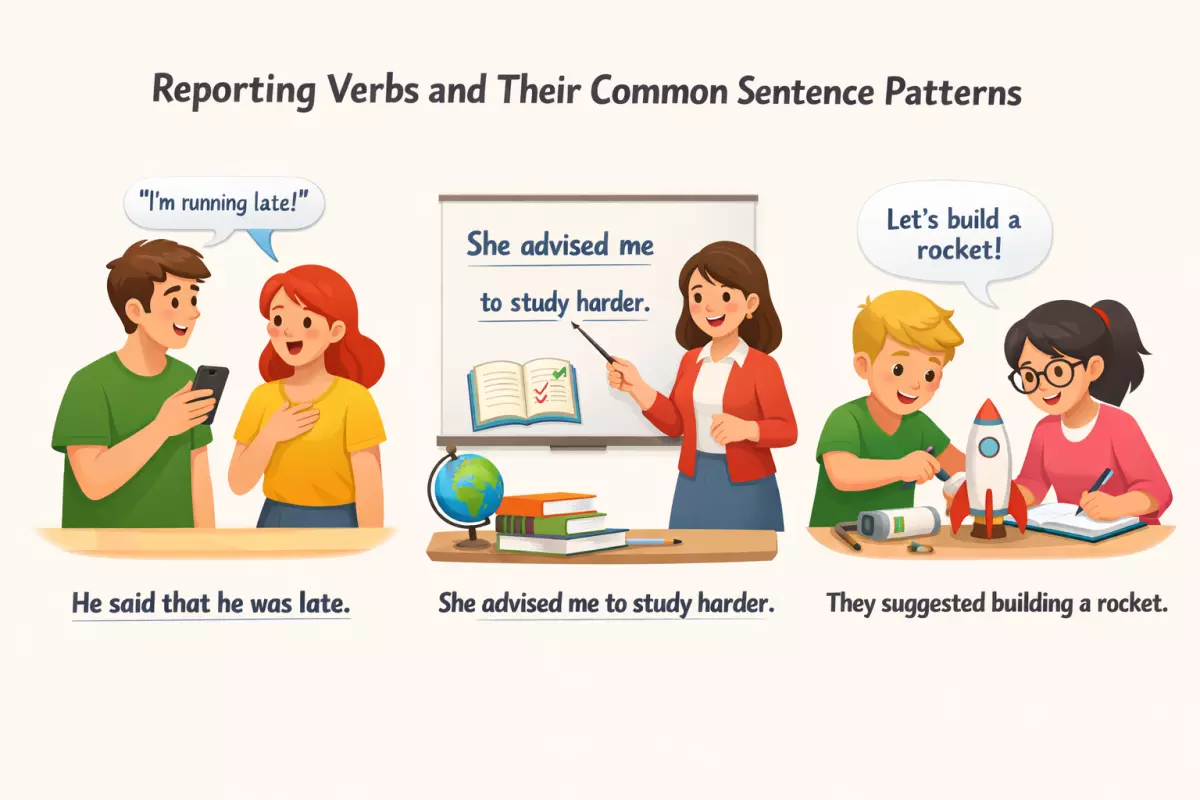 This article explains what reporting verbs express, then covers say, tell, ask and their basic patterns. You’ll learn how reporting verbs work with objects, clauses, infinitives and gerunds, plus formal vs informal choices, common learner mistakes, and homework practice tasks.
In everyday English, reporting verbs often follow predictable sentence patterns, and spotting them can make your speech and writing sound more natural. Rather than guessing whether to use that, an infinitive, or a question form, learn what usually comes after verbs like say, tell, ask, and explain. With a few practical examples, you can choose the right structure confidently in real conversations.
What reporting verbs express
These verbs do more than show that someone spoke or wrote; they also signal the speaker’s purpose, attitude, and relationship to the information. Choosing the right one helps readers understand whether the message is a fact, a belief, a request, a criticism, or a promise, and it often determines which sentence pattern follows (for example, a that-clause, an infinitive, or an -ing form).
- Stating information as fact (neutral reporting): say, state, report, announce, mention. These commonly take a that-clause or a noun phrase: “She stated (that) the files were missing.”
- Giving extra detail or clarification: add, explain, clarify, specify, point out, elaborate. Often followed by a that-clause, a wh-clause, or a prepositional phrase: “He explained why the deadline changed.”
- Showing uncertainty or probability: suggest, imply, indicate, suspect, predict, estimate. These typically introduce an interpretation rather than a confirmed fact: “They suggested (that) a mistake had been made.”
- Expressing belief or opinion: think, believe, argue, claim, maintain, contend. Many take a that-clause; some sound stronger (claim/maintain) and can imply disagreement from others.
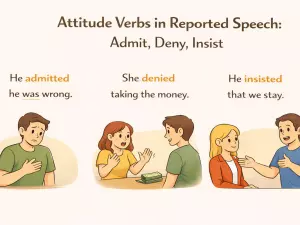
- Agreeing or disagreeing: agree, concede, admit, deny, dispute, object. Pattern choices vary: “She admitted (that) she was wrong.” / “He denied stealing the data.” (often + -ing or a noun phrase).
- Correcting or contradicting: correct, contradict, refute, counter. These often appear with a noun phrase or a that-clause and are common in academic or formal writing: “The study refuted the claim that the drug was safe.”
- Asking for information: ask, inquire, question, wonder. These frequently use wh-clauses or if/whether: “She asked whether the meeting was confirmed.”
- Requesting, instructing, or directing (trying to make someone do something): ask, request, tell, order, instruct, advise, urge, encourage, warn. Many of these prefer an object + infinitive pattern: “They urged him to apply.”
- Recommending a course of action (often softer than commands): recommend, suggest, propose, advise. Watch the pattern: “They recommended that we leave early” (or “recommended leaving early”); ❌ “recommended us to leave” is usually not natural.
- Making promises and commitments: promise, swear, pledge, guarantee, undertake. Common patterns include infinitives and that-clauses: “He promised to call.” / “They guaranteed that refunds would be issued.”
- Offering help or services: offer, volunteer. Typically followed by an infinitive: “She offered to drive.”
- Threatening or warning about consequences: threaten, warn, caution. These often take an infinitive or a that-clause; warnings also commonly use about/against: “They warned him not to respond.” / “She cautioned against sharing passwords.”
- Apologising and expressing regret: apologise, regret, confess. Patterns include -ing, a noun phrase, or a that-clause: “He apologised for being late.” / “She confessed (that) she had lied.”
- Accusing and blaming: accuse, blame, criticise. These often use a noun phrase + of/-ing: “They accused him of cheating.”
- Praising and approving: praise, commend, congratulate, approve. Common patterns include a noun phrase and prepositions: “She congratulated him on passing.”
- Complaining and protesting: complain, protest, object. These often use about + noun/-ing or a that-clause: “Residents complained about the noise.” / “He protested that the decision was unfair.”
- Emphasising or highlighting: stress, emphasise, underline, note. These are frequent in formal writing and usually introduce a that-clause: “The report stressed that safety checks were essential.”
Why meaning affects sentence pattern
Meaning and grammar are linked. Verbs that report information and beliefs often lead into a clause (commonly with that), because the focus is the content of the message. Verbs that report attempts to influence behaviour (requests, advice, orders, promises, offers) often prefer an infinitive, because the focus is an action to be done. When a verb commonly takes more than one pattern, the choice can slightly change emphasis: a that-clause can sound more formal or explicit, while an -ing form can sound more general or summarising.
Say, tell, ask and basic patterns

These three reporting verbs cover a lot of everyday indirect speech, but they do not behave the same way in sentence structure. The main differences are whether you need an object (who receives the message) and what kind of clause can follow (statement, question, request).
Core grammar differences
- say focuses on the words spoken; it usually does not take a direct object for the listener.
- tell requires a listener or target (an object) in most common uses.
- ask is used for questions and requests; it commonly takes an object and then either a question form or an infinitive.
Common patterns with examples
- say + (that) clause: She said (that) she was tired.
- say + to + person + (that) clause: She said to me (that) she was tired.
- say + something (noun phrase): He said a few words about the plan.
- say + quote: He said, “I’ll call you later.”
- tell + person + (that) clause: He told me (that) he would call later.
- tell + person + noun phrase: Please tell your sister the news.
- tell + person + to-infinitive (instructions/orders): They told us to wait outside.
- tell + person + wh-clause (information): Can you tell me where the station is?
- ask + person + wh-clause (questions): I asked her what time it started.
- ask + person + if/whether clause (yes/no questions): He asked me if I was ready.
- ask + person + to-infinitive (requests): She asked him to help with the boxes.
- ask + for + noun phrase (requesting a thing): I asked for a receipt.
- ask + about + noun phrase (topic): They asked about the schedule.
- ask + noun phrase (a question): She asked a difficult question.
Frequent errors and quick fixes
- ❌ He said me the truth. → ✅ He told me the truth. (Use tell with a person as object.)
- ❌ She told that she was late. → ✅ She said (that) she was late. / ✅ She told me (that) she was late. (With tell, add the listener.)
- ❌ He asked me do it. → ✅ He asked me to do it. (Use to + infinitive.)
- ❌ She said to clean the room. → ✅ She told me to clean the room. (Instructions typically use tell + object + to-infinitive.)
- ❌ I asked him that he was coming. → ✅ I asked him if/whether he was coming. (Yes/no questions use if/whether.)
Choosing the right verb in reporting
- Use say when the listener is not important or is added with to: She said (to us) that the meeting was cancelled.
- Use tell when you name the listener directly: She told us that the meeting was cancelled.
- Use ask for reported questions and polite requests: She asked us whether we could stay later; She asked us to stay later.
Reporting verbs with objects
Many reporting structures place a noun or pronoun between the verb and the rest of the message. This object often identifies the listener or the person affected (me, her, the team), and it changes which complement patterns are possible (for example, an infinitive clause vs. a that-clause).
Common sentence patterns
- V + object + that-clause:
✅ She told me that the meeting was cancelled. - V + object + to-infinitive:
✅ They advised us to leave early. - V + object + not to-infinitive:
✅ He warned her not to touch the wire. - V + object + about + noun/gerund:
✅ She reminded him about the deadline. - V + object + of + noun:
✅ They informed customers of the change in policy. - V + object + (that) + clause with should (more formal):
✅ The guide recommended us that we should book ahead. (Also common: “recommended that we (should) book ahead” without an object.) - V + object + wh-clause:
✅ She showed me how to reset the router. - V + object + preposition + wh-clause:
✅ He explained to us why the figures changed.
Verb choices and what they usually take
- tell: typically needs an object before a that-clause.
✅ She told me that she was tired. ❌ She told that she was tired. - inform: common with object + that-clause or object + of + noun.
✅ They informed staff that the office would close.
✅ They informed staff of the closure. - advise: often object + to-infinitive for practical guidance.
✅ I advised him to wait. - persuade: strongly favors object + to-infinitive (successful influence).
✅ She persuaded them to try again. - encourage: object + to-infinitive (supportive influence).
✅ The coach encouraged her to keep going. - warn: object + to-infinitive or object + against + noun/gerund.
✅ He warned me not to drive in the storm.
✅ He warned me against driving in the storm. - remind: commonly object + to-infinitive or object + about/of.
✅ Remind me to call her.
✅ Remind me about the call. - promise: can take an object, but the meaning shifts to “promise someone.”
✅ He promised me that he would help.
✅ He promised me to help. (Less common, but possible.) - assure: often object + that-clause (to make someone feel certain).
✅ She assured us that everything was under control. - convince: object + that-clause or object + to-infinitive.
✅ They convinced her that it was safe.
✅ They convinced her to go. - accuse: uses object + of + noun/gerund.
✅ He accused her of lying. - blame: uses object + for + noun/gerund.
✅ They blamed him for losing the keys. - thank: uses object + for + noun/gerund.
✅ She thanked him for helping. - congratulate: uses object + on + noun/gerund.
✅ We congratulated them on winning. - apologize: typically needs to + person (not a direct object) plus for.
✅ He apologized to her for being late. ❌ He apologized her for being late. - explain: usually takes to + person, not a direct object.
✅ She explained the problem to me. ❌ She explained me the problem.
Meaning differences: object vs. no object
- advise:
✅ They advised me to leave. (direct guidance to a person)
✅ They advised leaving early. (general recommendation) - promise:
✅ He promised me that he would call. (commitment made to someone)
✅ He promised that he would call. (commitment stated, listener not specified) - warn:
✅ She warned us not to enter. (the listener is clear)
✅ She warned that the road was closed. (more like an announcement)
When choosing a pattern, decide first whether the listener needs to be named. If it does, place the object right after the reporting verb (or use a prepositional phrase like “to me” with verbs such as “explain” and “apologize”), then match the verb to its typical complement (that-clause, to-infinitive, or preposition + noun/gerund).
Reporting verbs with clauses
Many reporting verbs are followed by a whole clause that contains its own subject and verb. The most common options are that-clauses, wh-clauses, and if/whether-clauses. Choice depends on what kind of information is being reported: a statement, a question, or an uncertainty.
1) That-clauses (statements and opinions)
Use a that-clause to report what someone says, thinks, believes, or promises. That is often optional in informal writing, but it is clearer to keep it after longer subjects or when the sentence could be misread.
- say + (that) + clause: She said (that) the meeting was cancelled.
- tell + object + (that) + clause: He told me (that) he would be late.
- explain + (that) + clause: The guide explained (that) the museum closes at six.
- admit + (that) + clause: They admitted (that) they made a mistake.
- deny + (that) + clause: She denied (that) she knew about the plan.
- promise + (that) + clause: I promised (that) I would call.
- agree + (that) + clause: We agreed (that) the deadline was unrealistic.
- claim + (that) + clause: He claimed (that) the file was missing.
- confirm + (that) + clause: The email confirmed (that) your order was shipped.
- suggest + (that) + clause: She suggested (that) we start earlier.
- insist + (that) + clause: He insisted (that) he had paid already.
- announce + (that) + clause: The company announced (that) it would expand.
- warn + object + (that) + clause: They warned us (that) the road was icy.
- assure + object + (that) + clause: She assured him (that) everything was ready.
2) Wh-clauses (reported questions and information)
Use a wh-clause after verbs like ask, explain, and describe when the reported content begins with who/what/where/when/why/how. In reported questions, use statement word order (no auxiliary inversion).
- ask + wh-clause: He asked where the station was. ✅ / He asked where was the station. ❌
- explain + wh-clause: Could you explain how this works?
- describe + wh-clause: She described what happened after the lights went out.
- remember + wh-clause: I can’t remember where I put my keys.
- discover + wh-clause: They discovered why the system kept crashing.
- show + object + wh-clause: He showed me how to reset the router.
- tell + object + wh-clause: Please tell us when the results will be ready.
- find out + wh-clause: We found out who sent the anonymous message.
3) If/whether-clauses (yes/no questions and uncertainty)
Use if or whether to report yes/no questions or express uncertainty. Whether is more formal and is preferred when you present alternatives (whether A or B) or when the clause is the subject.
- ask + if/whether + clause: She asked if/whether I had finished.
- wonder + if/whether + clause: I wonder if/whether they are coming.
- check + if/whether + clause: Please check if the door is locked.
- find out + if/whether + clause: We need to find out whether the tickets are refundable.
- know + if/whether + clause (often negative): I don’t know if he received the message.
- decide + whether + to-infinitive (common alternative): She couldn’t decide whether to stay or leave.
4) Tense and pronoun changes inside the clause
When the reporting verb is in the past, the verb in the following clause often shifts back (present → past, will → would). This is common but not automatic; keep the original tense when the information is still true or is a general fact.
- Backshift typical: “I am tired.” → He said (that) he was tired.
- Backshift typical: “We will help.” → They promised (that) they would help.
- No backshift (still true): She said (that) water boils at 100°C.
- Pronoun/time changes: “I’ll see you tomorrow.” → He said (that) he would see me the next day.
5) Common pitfalls to avoid
- Don’t use question word order in reported questions: He asked what I wanted. ✅ (not: what did I want ❌)
- Remember objects with certain verbs: tell + object + clause (He told me that…) ✅ (not: He told that… ❌)
- Avoid double “that” clutter: She said that she thought the plan would work. (One that is usually enough.)
- Choose if vs. whether appropriately: Use whether for alternatives: They asked whether we wanted tea or coffee.
Reporting verbs with infinitives and gerunds
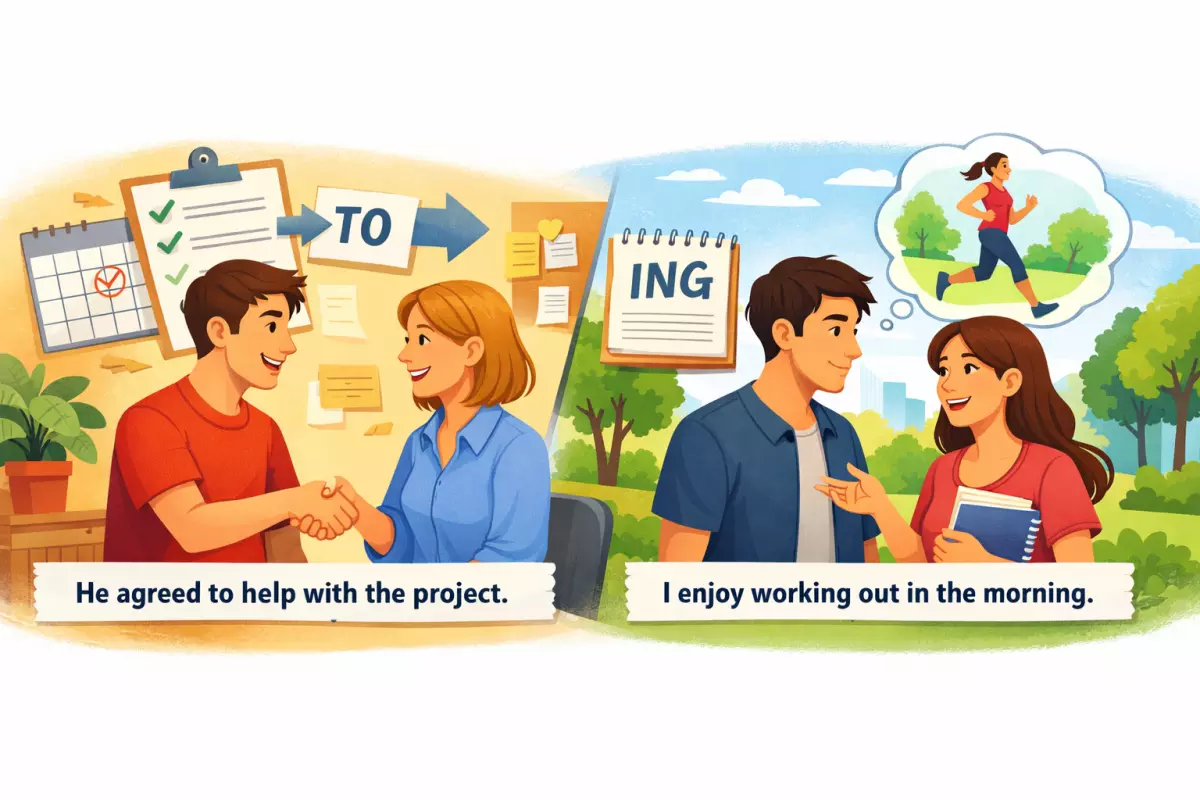
Many reporting verbs control the form that follows them. Some are typically followed by an infinitive (to + base verb), some by a gerund (-ing), and a smaller group can take either form with little or no change in meaning. Learning these patterns helps you avoid errors like using an -ing form after a verb that needs to, or using an infinitive where an -ing form is required.
Common patterns and examples
- Verb + to-infinitive (often used for intentions, promises, refusals, and requests):
- agree to: “She agreed to meet the editor after the interview.”
- promise to: “He promised to send the report by Friday.”
- refuse to: “They refused to comment on the allegation.”
- offer to: “I offered to explain the results in person.”
- decide to: “We decided to postpone the announcement.”
- plan to: “The spokesperson plans to address the issue tomorrow.”
- claim to: “She claimed to have seen the document.”
- pretend to: “He pretended to understand the instructions.”
- threaten to: “They threatened to resign if the policy changed.”
- ask/tell someone to: “The manager told staff to remain calm.”
- invite someone to: “They invited reporters to attend the briefing.”
- encourage someone to: “The coach encouraged the team to keep trying.”
- advise someone to: “The doctor advised her to rest for a week.”
- remind someone to: “Please remind him to attach the file.”
- Verb + gerund (-ing) (often used for admissions, denials, and reactions to actions):
- admit: “He admitted taking the money.”
- deny: “She denied leaking the information.”
- confess to: “They confessed to breaking the rules.”
- suggest: “The witness suggested calling the police.”
- mention: “He mentioned seeing her earlier.”
- recommend: “Experts recommend checking the figures again.”
- propose: “They proposed delaying the vote.”
- report: “Several outlets reported hearing explosions.”
- regret: “I regret saying that in the meeting.”
- apologize for: “She apologized for arriving late.”
- insist on: “He insisted on speaking to the director.”
- object to: “Residents objected to building a new road.”
- Verb + to-infinitive or gerund (meaning may stay similar or change depending on the verb):
- begin / start: “She started to explain” / “She started explaining.” (usually similar meaning)
- continue: “He continued to argue” / “He continued arguing.” (usually similar meaning)
- prefer: “I prefer to wait” / “I prefer waiting.” (often similar; context decides)
- like / love / hate: “I hate to interrupt” / “I hate interrupting.” (often similar; infinitive can sound more immediate or polite)
- remember: “Remember to lock the door.” (do it later) vs ✅ “I remember locking the door.” (memory of a past action)
- forget: “He forgot to mention it.” (didn’t do it) vs ✅ “He’ll never forget meeting her.” (memory of an event)
- regret: “We regret to inform you...” (formal announcement) vs ✅ “I regret saying that.” (feeling sorry about a past action)
- stop: “She stopped to answer the phone.” (stopped in order to do something) vs ✅ “She stopped answering the phone.” (ended the activity)
- try: “Try to finish today.” (make an effort) vs ✅ “Try restarting the device.” (experiment with a possible solution)
Quick accuracy checks
- After promise/refuse/agree/offer, use to + verb: ✅ “He refused to answer.” ❌ “He refused answering.”
- After admit/deny/suggest/recommend, use -ing: ✅ “She denied taking it.” ❌ “She denied to take it.”
- With ask/tell/advise/remind, include the object before the infinitive: ✅ “They advised him to wait.” ❌ “They advised to wait.”
- For verbs that allow both forms, check meaning (especially remember/forget/stop/try/regret) before choosing the structure.
Formal vs informal reporting verbs
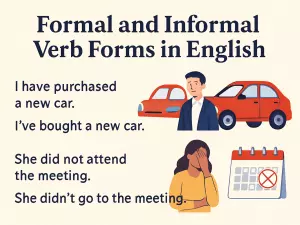
Register affects which reporting verb sounds natural, which sentence pattern it tends to take, and how much distance or certainty the speaker signals. In academic, legal, and workplace writing, verbs often sound more neutral and structured, and they frequently pair with noun clauses (that-clauses), passive voice, and cautious phrasing. In everyday conversation, choices are shorter, more direct, and more likely to appear with simple quotes or reduced that-clauses.
| More formal (common patterns) | More informal (common patterns) |
|---|---|
| state + (that) clause: “The report stated (that) sales fell.” | say + (that) clause / quote: “She said (that) she’s busy.” |
| claim + (that) clause: “The company claimed (that) it complied.” | tell + object + (that) clause: “He told me (that) it’s fine.” |
| argue + (that) clause: “Researchers argue (that) the effect is small.” | ask + object + to-infinitive: “She asked me to wait.” |
| maintain + (that) clause: “They maintained (that) the policy works.” | go + quote/that-clause: “He goes, ‘No way.’” / “He goes (that) he can’t.” |
| assert + (that) clause: “The witness asserted (that) he saw it.” | be like + quote: “I was like, ‘Really?’” |
| confirm + (that) clause: “HR confirmed (that) the meeting is Monday.” | promise + to-infinitive: “He promised to call.” |
| deny + noun / -ing / (that) clause: “She denied the allegation.” / “denied taking it.” | admit + -ing / (that) clause: “She admitted forgetting.” |
| acknowledge + noun / (that) clause: “They acknowledged the risk.” | complain + (that) clause: “He complained (that) it’s too loud.” |
Pattern differences that often come with register
- That-clauses are common in formal writing: “The committee concluded (that) the proposal was incomplete.” In speech, that is often dropped: “They concluded it was incomplete.”
- Passive reporting is more typical in formal contexts: “It was reported that…” / “It is alleged that…” This creates distance and avoids naming a source.
- More formal verbs often pair with cautious framing: “suggest,” “indicate,” “appear,” “seem” + (that) clause to avoid overclaiming.
- Informal choices favor directness: “say,” “tell,” “ask,” “go,” “be like” often introduce short content clauses or direct quotes.
- Object patterns show up more in conversation: “tell/ask + someone + (that/to…)” because everyday speech frequently includes the listener explicitly.
Usage notes to avoid register mismatches
- ✅ “The spokesperson stated that the figures were accurate.” → suitable for reports and announcements.
❌ “The spokesperson was like, ‘The figures are accurate.’” → too casual for most formal writing. - ✅ “The paper argues that the method reduces bias.” → typical academic phrasing.
❌ “The paper says the method reduces bias.” → not wrong, but can sound less precise in academic style. - ✅ “They confirmed that the payment was received.” → official tone.
❌ “They told that the payment was received.” → incorrect pattern (needs an object: “told me/us”). - ✅ “She denied taking the files.” → common formal pattern with -ing.
❌ “She denied to take the files.” → unnatural for most varieties of English. - ✅ “He promised to email the details.” → neutral; works in both speech and writing.
✅ “He assured us that he would email the details.” → more formal and more emphatic.
Common learner mistakes
Reporting verbs often go wrong when the verb’s sentence pattern is mixed up (that-clause vs. infinitive vs. -ing), or when learners choose the wrong structure for the meaning (for example, confusing “advise” with “suggest”). The points below focus on frequent pattern errors and how to fix them.
-
Using an infinitive after verbs that need a that-clause
❌ “He said to leave early.” → ✅ “He said (that) we should leave early.”
Remember: say, claim, admit, deny, agree, promise typically take a that-clause (often with “(that)”).
-
Using a that-clause after verbs that prefer an infinitive
❌ “She offered that she would help.” → ✅ “She offered to help.”
Common infinitive patterns: offer to, refuse to, agree to, promise to, decide to.
-
Confusing verb + object + infinitive with verb + infinitive
❌ “They persuaded to stay.” → ✅ “They persuaded him to stay.”
Many verbs require an object before the infinitive: persuade, encourage, invite, warn, remind, tell, advise.
-
Adding an object after verbs that don’t take one in this meaning
❌ “He suggested me to take a taxi.” → ✅ “He suggested taking a taxi.” / “He suggested that I take a taxi.”
Suggest and recommend usually do not take “suggest/recommend + person + to…”. Use -ing or a that-clause instead.
-
Mixing up “advise” and “suggest” patterns
❌ “She advised that I to rest.” → ✅ “She advised me to rest.” / “She advised that I (should) rest.”
Advise can be “advise + object + to-infinitive” or “advise + that-clause”. Suggest is typically “suggest + -ing” or “suggest + that-clause”.
-
Wrong preposition after “accuse” and “blame”
❌ “They accused him for cheating.” → ✅ “They accused him of cheating.”
❌ “She blamed him of the mistake.” → ✅ “She blamed him for the mistake.”
-
Wrong preposition after “apologise” and “complain”
❌ “He apologised me.” → ✅ “He apologised to me.”
❌ “They complained me about the noise.” → ✅ “They complained to me about the noise.”
-
Forgetting the “to” in “explain” and using the wrong object pattern
❌ “She explained me the problem.” → ✅ “She explained the problem to me.”
Explain normally takes “explain + thing + to + person”, not “explain + person + thing”.
-
Using “tell” without an object
❌ “He told that he was tired.” → ✅ “He told me that he was tired.”
Tell usually needs a listener: “tell + person + (that) …”. If there is no listener, use say: “He said (that) …”.
-
Using “say” with an indirect object
❌ “She said me that she was late.” → ✅ “She told me that she was late.” / “She said to me that she was late.”
Pattern reminder: say → “say (that) …” or “say to + person …”; tell → “tell + person …”.
-
Choosing -ing when the verb needs a to-infinitive (and vice versa)
❌ “He refused paying.” → ✅ “He refused to pay.”
❌ “She admitted to steal the money.” → ✅ “She admitted stealing the money.”
Typical -ing after reporting verbs: admit, deny, regret (when reporting), suggest (often).
-
Overusing “that” or removing it where clarity suffers
Omitting “that” is often fine, but long clauses can become confusing without it.
✅ Clear: “She claimed that the manager who interviewed her had promised a raise.”
-
Mixing direct and reported forms in the same sentence
❌ “He said that ‘I am busy’.” → ✅ “He said, ‘I’m busy.’” or “He said that he was busy.”
Keep either direct speech (with quotation marks) or reported speech (with tense/pronoun changes), not both together.
-
Using reporting verbs that don’t match the intended meaning
Some verbs sound similar but signal different intentions:
❌ “He promised me to help” when it’s only advice. → ✅ “He offered to help” (voluntary) / “He advised me to…” (guidance).
-
Incorrect passive patterns with reporting verbs
❌ “He is said that he is rich.” → ✅ “He is said to be rich.” / “It is said that he is rich.”
Two common passive frames: “It is said that…” and “He is said to…”. Don’t combine them.
Homework: reporting verb practice tasks
Focus on choosing the right reporting verb and matching it to a correct sentence pattern (that-clause, to-infinitive, -ing form, object + to-infinitive, and preposition patterns). Keep verb tense and pronoun changes consistent when you rewrite direct speech into reported structures.
Task 1: Choose the correct pattern
Rewrite each sentence using the reporting verb in brackets. Use the most natural pattern.
- “I didn’t take your laptop.” (deny)
- “Let’s meet after class.” (suggest)
- “You should see a dentist.” (advise)
- “I’m sorry I’m late.” (apologize)
- “Please don’t tell anyone.” (beg)
- “I will call you tonight.” (promise)
- “Yes, I broke the vase.” (admit)
- “Can you open the window?” (ask)
- “You must wear a helmet.” (insist)
- “I didn’t mean to offend you.” (claim)
Show answers
- He denied taking my laptop / denied that he had taken my laptop.
- She suggested meeting after class.
- He advised me to see a dentist.
- She apologized for being late.
- He begged me not to tell anyone.
- She promised to call me tonight.
- He admitted breaking the vase / admitted that he had broken the vase.
- She asked me to open the window.
- He insisted that I wear a helmet / insisted on wearing a helmet (context-dependent).
- She claimed that she hadn’t meant to offend me.
Task 2: Fix the pattern errors
Each item contains a common mistake with reporting verbs. Rewrite each sentence so the pattern is correct.
- He suggested to go by train.
- She explained me that the office was closed.
- They accused him to cheat.
- I warned him not touching the wires.
- She insisted me to pay.
- He admitted to break the rules.
- We agreed going earlier.
- She refused that she would help.
- He reminded me to not forget my ID.
- They complained us about the noise.
Show answers
- He suggested going by train.
- She explained that the office was closed / She explained it to me.
- They accused him of cheating.
- I warned him not to touch the wires.
- She insisted that I pay / She insisted on paying (meaning changes).
- He admitted breaking the rules / He admitted to breaking the rules.
- We agreed to go earlier.
- She refused to help.
- He reminded me not to forget my ID.
- They complained to us about the noise / They complained about the noise.
Task 3: Match verbs to patterns (production)
Write one original sentence for each reporting verb using the required pattern. Aim for natural context and correct complements.
- admit + -ing / that-clause
- advise + object + to-infinitive
- agree + to-infinitive
- apologize + for + -ing
- blame + object + for + noun/-ing
- complain + (to + person) + about + noun/-ing
- deny + -ing / that-clause
- encourage + object + to-infinitive
- insist + that-clause / on + -ing
- invite + object + to-infinitive
- promise + to-infinitive
- recommend + -ing / that + subject + base verb
- refuse + to-infinitive
- remind + object + to-infinitive
- suggest + -ing / that-clause
- warn + object + (not) to-infinitive
Task 4: Report a short dialogue (mixed patterns)
Convert the dialogue into reported speech. Use a variety of reporting verbs and patterns (at least six different verbs). Keep meaning accurate.
- A: “I can’t come tomorrow.” B: “Why not?” A: “I have to work late.”
- B: “You should tell your manager earlier.”
- A: “Okay, I’ll send a message tonight.”
- B: “Don’t forget to mention the deadline.”
- A: “I won’t. And please don’t tell anyone yet.”
Show answers
- A said that she couldn’t come the next day and explained that she had to work late.
- B asked why she couldn’t come and advised her to tell her manager earlier.
- A agreed and promised to send a message that night.
- B reminded her to mention the deadline and warned her not to forget it.
- A promised that she wouldn’t and begged B not to tell anyone yet.
Task 5: Self-check list (before submitting)
- Check whether the verb takes a that-clause (say, admit, claim, insist) or a non-finite form (promise to, suggest -ing, avoid -ing).
- Confirm whether an object is required (advise someone to, remind someone to, warn someone not to).
- Use the correct preposition (apologize for, accuse of, complain about, insist on).
- Keep time references consistent (today → that day; tomorrow → the next day) when reporting.
- When two patterns are possible, choose the one that best matches meaning (insist that vs. insist on; recommend -ing vs. recommend that).