Avoiding Overuse of Get, Do, Make, and Have

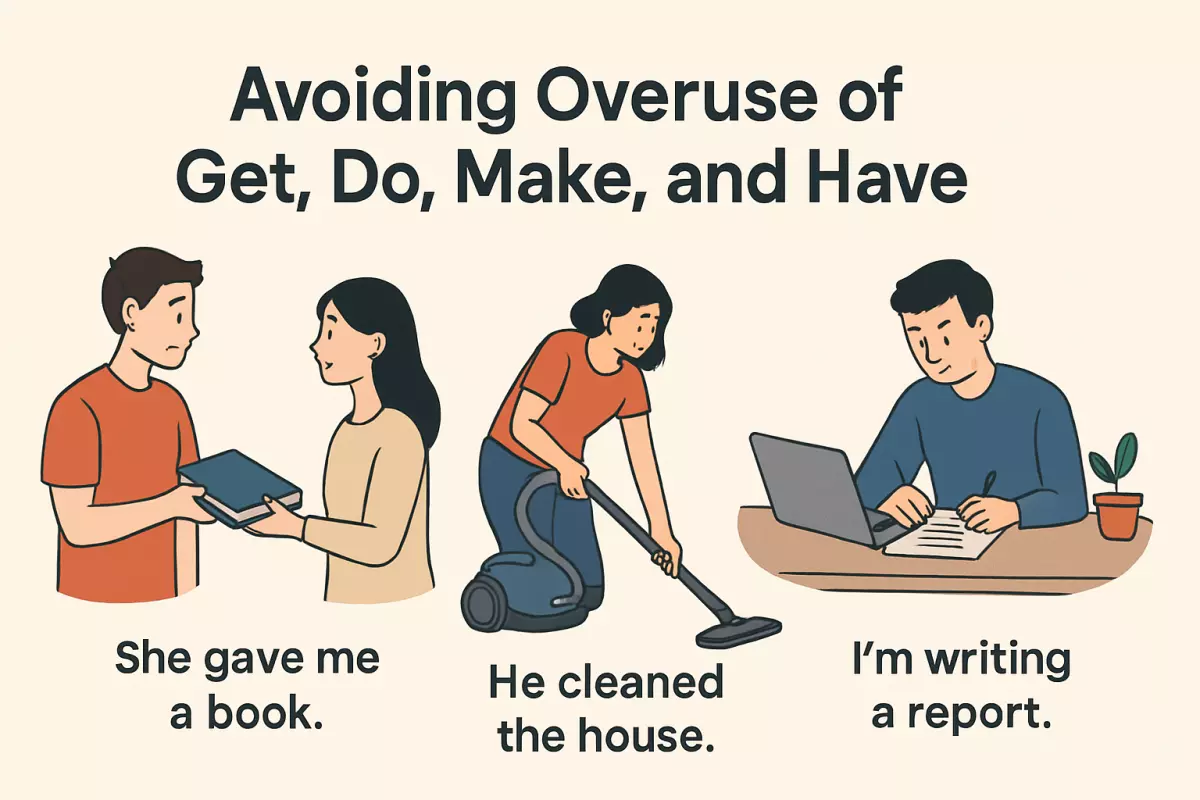 The article explains why get, do, make, and have are overused and how to replace them with more precise verbs, including formal and informal options. It also covers stronger-verb style tips, common learner habits and fixes, and choosing verbs for clarity.
Overusing common verbs like get, do, make, and have can make your English sound flat or imprecise. This guide shows easy replacements and practical context clues so you can choose stronger verbs, express meaning more clearly, and sound more natural in both speaking and writing. You will also see quick examples that help you pick the right verb for the situation without memorizing long lists.
Why these verbs are overused
These four verbs act like “all-purpose” tools in English. They fit into many sentence frames, combine easily with nouns, and stay grammatical even when the meaning is vague. That convenience makes them a default choice in drafting, especially when the writer hasn’t decided on a more specific action yet.
1) They work in many common sentence patterns
Get, do, make, and have appear in high-frequency structures that are easy to reuse:
- Verb + object: “do the work,” “make a plan,” “have a meeting,” “get a result.”
- Verb + adjective (especially with get): “get ready,” “get worse,” “get busy.”
- Verb + to-infinitive (common with get): “get to know,” “get to see,” “get to use.”
- Have + noun as a light-verb alternative to a single verb: “have a look,” “have a try.”
- Make + noun to express creation or change: “make a decision,” “make progress.”
- Do + noun for tasks and activities: “do research,” “do repairs,” “do business.”
2) They function as “light verbs” that carry little meaning by themselves
In many phrases, the noun holds most of the meaning, while the verb mainly supplies grammar (tense, aspect, agreement). This encourages repetition because the same verb can pair with dozens of nouns.
- make + decision/choice/attempt/offer/promise/claim
- do + homework/laundry/research/analysis/inspection/maintenance
- have + meeting/conversation/discussion/argument/problem/idea
- get + chance/opportunity/answer/response/approval/permission
3) They help writers stay noncommittal when details are unclear
General verbs let a sentence “work” before the writer has pinned down the exact action. This is common in early drafts, summaries, and emails where speed matters more than precision.
- “We did some work on it” (unclear: revised, tested, debugged, redesigned?).
- “She made changes” (unclear: edited, updated, refactored, corrected?).
- “They had issues” (unclear: encountered errors, disagreed, lacked resources?).
- “I got feedback” (unclear: received comments, collected survey results, heard complaints?).
4) They are reinforced by fixed expressions and everyday collocations
Many set phrases sound natural with these verbs, so writers reach for them automatically. Once a collocation is learned as a chunk, it tends to be reused even when a sharper verb would fit better.
- get started; get back; get in touch; get involved; get the hang of it
- do your best; do the right thing; do damage; do your part; do without
- make sure; make sense; make room; make a point; make time
- have a seat; have fun; have a word; have a go; have second thoughts
5) They support causative and passive-like meanings with minimal grammar
These verbs can express “cause” or “arrange” without naming the agent or the method, which is useful but often leads to bland phrasing.
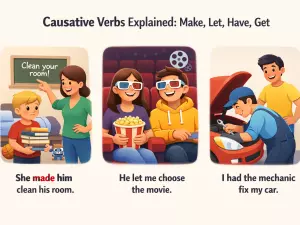
- get + object + past participle: “get it fixed,” “get the report finished,” “get the door replaced.”
- have + object + past participle: “have it repaired,” “have the files backed up,” “have the contract reviewed.”
- make + object + base verb/adjective: “make them wait,” “make it clear,” “make the system stable.”
6) They are “safe” choices for learners and for formal neutrality
Because these verbs are widely understood and rarely sound wrong, they become default options in academic and workplace writing. The trade-off is that repeated reliance can flatten tone and hide the real action.
- They avoid choosing between close verbs (e.g., “obtain” vs. “receive” vs. “secure”).
- They reduce the risk of mis-collocation (a common concern for non-native writers).
- They keep sentences grammatically simple, especially under time pressure.
Replacing get with more precise verbs
“Get” is flexible, but it often hides the real action: receiving, becoming, arriving, understanding, or persuading. Choosing a more specific verb makes the sentence clearer and usually more formal, especially in academic and professional writing. A useful habit is to ask what “get” means in context, then pick a verb that names that meaning directly.
Common meanings of “get” and stronger verb choices
- Receive: “I got your email.” → “I received your email.”
- Obtain (by effort): “She got a visa.” → “She obtained a visa.”
- Buy: “I’ll get some bread.” → “I’ll buy some bread.”
- Fetch/collect: “Can you get my coat?” → “Can you fetch/pick up my coat?”
- Bring: “Get the documents to my office.” → “Bring the documents to my office.”
- Arrive: “We got home late.” → “We arrived home late.”
- Reach (a place/level): “The train gets to Oxford at noon.” → “The train reaches Oxford at noon.”
- Become (change of state): “It’s getting cold.” → “It’s becoming cold.”
- Grow (gradual change): “He’s getting better at chess.” → “He’s improving at chess.”
- Recover (health): “She got well quickly.” → “She recovered quickly.”
- Catch/contract (illness): “I got the flu.” → “I caught the flu.”
- Understand: “I don’t get it.” → “I don’t understand it.”
- Hear/learn (information): “I got the news yesterday.” → “I heard/learned the news yesterday.”
- Persuade/convince: “We got them to agree.” → “We persuaded/convinced them to agree.”
- Contact/reach (a person): “I couldn’t get him.” → “I couldn’t reach him.”
- Bring about (a result): “That will get better results.” → “That will produce/yield better results.”
- Earn (money/points): “She got a bonus.” → “She earned a bonus.”
- Score/achieve (a result): “He got 90%.” → “He scored 90%.”
- Cause (annoy/affect): “That noise gets me.” → “That noise annoys me.”
Useful patterns to rewrite
- get + adjective (state change): replace with become, grow, or a specific verb.
- ✅ “They got angry.” → “They became angry.” / “They lost their temper.”
- ✅ “The situation got worse.” → “The situation deteriorated.”
- get + to + place (movement/arrival): replace with arrive, reach, or return.
- ✅ “When did you get to the office?” → “When did you arrive at the office?”
- ✅ “We got back at six.” → “We returned at six.”
- get + object (obtain/receive): replace with receive, obtain, purchase, collect, depending on how it happens.
- ✅ “Did you get my message?” → “Did you receive my message?”
- ✅ “He got a refund.” → “He received a refund.”
- get + person + to + verb (influence): replace with persuade, convince, encourage, prompt.
- ✅ “She got him to apologize.” → “She persuaded him to apologize.”
- ✅ “The report got them to act.” → “The report prompted them to act.”
When “get” is part of a fixed phrase (for example, “get rid of,” “get along,” “get away”), replacing it may sound unnatural. In those cases, focus on clarity elsewhere: tighten the sentence, choose precise nouns, or add a specific verb nearby to carry the main meaning.
Alternatives to do and make
When do and make start carrying too much meaning, switch to a verb that names the action more precisely. This improves clarity and often makes the sentence sound more natural, especially in formal or technical writing.
Replace do with action-specific verbs
- do research → conduct research / carry out research
- do an experiment → run an experiment / perform an experiment
- do an analysis → analyze / conduct an analysis
- do a test → test / administer a test
- do a survey → survey / carry out a survey
- do a check → check / verify / inspect
- do a review → review / evaluate / assess
- do a calculation → calculate / compute
- do an audit → audit / carry out an audit
- do maintenance → maintain / service
- do repairs → repair / fix / restore
- do the dishes → wash the dishes
- do laundry → wash clothes / do the laundry (common fixed phrase)
- do your homework → complete your homework / finish your assignment
- do a presentation → give a presentation / deliver a talk
- do a job/task → complete a task / handle a task / carry out a task
- do a meeting ❌ → hold a meeting / have a meeting / meet
Pattern tip: conduct/carry out/perform often fits with nouns for formal activities (research, investigation, procedure). For everyday actions, a direct verb is usually best (check, wash, fix, call, email).
Replace make with verbs that show creation, change, or decision
- make a decision → decide / reach a decision
- make a plan → plan / draw up a plan
- make a suggestion → suggest / propose
- make a complaint → complain / file a complaint
- make a request → request / submit a request
- make an appointment → book an appointment / schedule an appointment
- make a reservation → reserve / book
- make a call → call / phone
- make a payment → pay / make a payment (common in formal contexts)
- make an offer → offer / submit an offer
- make progress → progress / advance
- make changes → change / revise / modify
- make improvements → improve / upgrade
- make a mistake → err / miscalculate / make a mistake (very common)
- make sure → ensure / confirm / check
- make someone do something → require / force / compel / persuade (meaning changes by verb)
Pattern tip: use create/produce/generate for outputs (reports, results, electricity), cause/lead to/result in for effects, and reach/achieve/attain for goals and outcomes.
Keep common fixed expressions, but avoid vague “catch-all” uses
- ✅ do your best, do business, do your hair (set phrases that sound natural)
- ✅ make friends, make money, make sense (idiomatic combinations)
- ❌ make a discussion → have a discussion / discuss
- ❌ do a decision → make a decision / decide
Formal and informal replacements for have
When have starts to do too many jobs in a paragraph, switch to a verb that names the relationship more precisely: possession, experience, obligation, or arrangement. The best alternative depends on what have means in your sentence and how formal the context is.
Choose a replacement based on meaning
- Possession (owning something): use own, possess, hold, keep.
- ✅ We own three apartments. → (instead of: We have three apartments.)
- ✅ The museum holds a large collection of maps.
- ✅ She kept a spare key in her bag.
- Relationships and features (something includes/contains): use include, contain, feature, offer, provide.
- ✅ The plan includes two revisions.
- ✅ The room features floor-to-ceiling windows.
- ✅ The package provides technical support.
- Experiences and events (have a meeting/a call/a chat): use meet, speak, talk, discuss, consult, confer.
- ✅ Let’s meet tomorrow at 10. (instead of: have a meeting)
- ✅ I’ll speak with the client this afternoon. (instead of: have a call)
- ✅ We should discuss the timeline.
- Eating and drinking (have lunch/coffee): use eat, drink, grab (informal), share.
- ✅ We ate lunch at noon.
- ✅ Do you want to grab coffee? (casual)
- ✅ They shared a quick meal after the event.
- Illness and symptoms (have a cold/headache): use have is common, but alternatives can be clearer: catch, develop, suffer from, experience.
- ✅ She caught a cold on the trip.
- ✅ He developed a fever overnight.
- ✅ She suffers from migraines. (more formal/clinical)
- Obligation (have to): use must (strong), need to (neutral), be required to (formal), be expected to (policy/norm).
- ✅ You need to submit the form by Friday.
- ✅ Staff are required to wear badges.
- ✅ Applicants must provide proof of identity.
- Plans and arrangements (have an appointment): use schedule, book, arrange, set up (informal), confirm.
- ✅ I booked an appointment for Tuesday.
- ✅ We scheduled a follow-up session.
- ✅ Can you confirm the appointment time?
- Opinions and ideas (have an idea/concern): use think, believe, suggest, propose, raise, express.
- ✅ I suggest we start with the risks.
- ✅ She raised a concern about costs.
- ✅ He expressed reservations about the timeline.
- Opportunities and access (have the chance/access): use can, be able to, gain, obtain, secure.
- ✅ You can view the report in the dashboard.
- ✅ We gained access to the archive.
- ✅ She secured permission to publish the data.
- Responsibility (have responsibility for): use manage, oversee, handle, be responsible for (explicit), lead.
- ✅ He oversees vendor relationships.
- ✅ She handles customer complaints.
- ✅ They lead the implementation.
Quick register guide (casual to formal)
- Informal: grab (coffee), set up (a meeting), hang out (time together), get together (a meetup).
- Neutral: meet, talk, need to, schedule, include, provide.
- More formal: possess, obtain, be required to, consult, confer, express, oversee.
As a final check, replace have with a candidate verb and see whether the sentence becomes more specific without changing the meaning. If the new verb adds an unintended nuance (for example, possess sounding too legal, or must sounding too strict), choose a closer match such as own, need to, or be expected to.
Improving style with stronger verbs
Clearer writing often comes from replacing vague, all-purpose verbs with specific actions. When get, do, make, or have carry most of the meaning, sentences can sound flat or imprecise. A stronger verb usually names the action directly, reduces extra words, and makes the subject’s role clearer.
Common upgrade patterns
- Swap “get + adjective” for a precise change verb: get better → improve, recover, stabilize.
- Replace “get + noun” with an action verb: get permission → obtain, secure, receive.
- Turn “do + noun” into one verb: do research → research; do an analysis → analyze.
- Replace “make + noun” with a creation/decision verb: make a choice → choose, decide.
- Replace “have + noun” with an experience/possession/requirement verb: have a need → need; have access → access.
- Use a verb that shows agency: We had a discussion → We discussed (or debated, reviewed, depending on tone).
- Prefer concrete process verbs in instructions: do the form → complete, fill out, submit.
- Choose reporting verbs for communication: make a statement → state, announce, clarify.
Practical replacements you can reuse
- ❌ get ready → ✅ prepare
- ❌ get worse → ✅ deteriorate, worsen
- ❌ get the message → ✅ receive, understand
- ❌ get help → ✅ seek help, request assistance
- ❌ get results → ✅ achieve results, deliver results
- ❌ do a presentation → ✅ present
- ❌ do a review → ✅ review, evaluate, assess
- ❌ do a test → ✅ test, run a test
- ❌ do damage → ✅ damage, harm
- ❌ make changes → ✅ revise, adjust, modify
- ❌ make progress → ✅ advance, improve
- ❌ make a plan → ✅ plan, outline, draft
- ❌ make a request → ✅ request, ask
- ❌ have a look → ✅ look, examine, review
- ❌ have a problem → ✅ face a problem, encounter an issue
- ❌ have an impact → ✅ affect, influence
- ❌ have a meeting → ✅ meet, confer
- ❌ have a conversation → ✅ talk, discuss, negotiate
How to choose the right stronger verb
- Name the real action: If the phrase hides the verb, convert the noun to a verb (make a decision → decide).
- Match the level of formality: get often becomes receive in formal writing, but pick up may fit casual instructions.
- Keep the original meaning: have to expresses obligation; alternatives like must or need to can be stronger, but they may change tone.
- Prefer verbs that reduce extra words: If the rewrite removes filler without adding complexity, it usually reads better.
- Use specificity to avoid ambiguity: make can mean create, cause, force, or earn; choose the verb that signals which one you mean.
Common learner habits and fixes
Learners often rely on a few high-frequency verbs as “all-purpose” choices. The result is usually vague meaning, unnatural collocations, and missed chances to show the real action. The fixes below focus on noticing patterns (what nouns typically go with which verbs) and choosing a more specific verb when the context demands it.
- Habit: Using get for every change.
❌ I got angry. → ✅ I became angry. / ✅ I lost my temper.
❌ She got better. → ✅ She recovered. / ✅ She improved.
Fix: Separate “change of state” (become, turn, grow) from “recovery/repair” (recover, heal, improve) and “acquisition” (obtain, receive, buy). - Habit: Using get when the meaning is “receive.”
❌ I got an email from HR. → ✅ I received an email from HR.
❌ He got a refund. → ✅ He received a refund. / ✅ He was refunded.
Fix: Use receive for formal contexts, pick up for collecting something, and passive forms when the agent is unimportant. - Habit: Using get instead of “arrive.”
❌ We got to the airport at 6. → ✅ We arrived at the airport at 6.
Fix: Keep get to for casual speech, but prefer arrive in writing, schedules, reports, and announcements. - Habit: Using do with nouns that usually take make.
❌ do a decision → ✅ make a decision
❌ do a plan → ✅ make a plan
Fix: Use make for “creating/producing” results (a plan, a choice, a promise) and do for “performing” tasks (homework, research, work). - Habit: Using make when the meaning is “force.”
❌ They made me to sign it. → ✅ They made me sign it.
❌ The rule made us to pay. → ✅ The rule required us to pay.
Fix: Remember the pattern make + object + base verb (no to). If it’s obligation from rules, use require, oblige, or mandate. - Habit: Overusing have for actions.
❌ I had a shower. → ✅ I took a shower.
❌ We had a walk. → ✅ We went for a walk.
Fix: Learn common “light verb” pairings: take a shower, go for a walk, take a break, give a presentation. - Habit: Using have when you mean “experience” or “suffer.”
❌ I had a problem with my back. → ✅ I had back pain. / ✅ I suffered from back pain.
❌ She had a difficult time. → ✅ She struggled.
Fix: Switch to verbs that show the type of experience: struggle, cope, suffer, face, encounter. - Habit: Writing with “verb + thing” instead of a precise verb.
❌ do the meeting → ✅ hold the meeting / ✅ run the meeting
❌ make an exam → ✅ take an exam (student) / ✅ write an exam (teacher, create)
Fix: Ask: “Am I creating it, participating in it, or managing it?” Then choose create, take, conduct, administer, chair, etc. - Habit: Translating collocations directly from your first language.
❌ make sports → ✅ play sports / ✅ do sport (BrE, general) / ✅ work out
❌ do a photo → ✅ take a photo
Fix: Memorize collocations as chunks (verb + noun) rather than translating word-by-word. - Habit: Using a light verb where English prefers a strong verb in formal writing.
❌ We did an analysis. → ✅ We analyzed the data.
❌ The team made improvements. → ✅ The team improved the process.
Fix: In reports and essays, turn noun phrases into verbs: conduct an investigation → investigate; make a recommendation → recommend. - Habit: Mixing up “do” vs. “make” with common nouns.
Fix: Learn a high-value set of pairings and treat them as fixed:- ✅ make a decision, make a mistake, make progress, make an effort
- ✅ do homework, do research, do business, do the dishes
- ✅ make a promise, make an appointment, make a complaint, make an offer
- ✅ do exercise, do a job, do a test (often BrE), do your best
- Habit: Using have for possession when “there is/are” is clearer.
❌ The city has many parks in the center. → ✅ There are many parks in the city center.
Fix: Use there is/are to describe existence and location; keep have for ownership, features, or relationships. - Habit: Using get in passive-like meanings without clarity.
❌ The file got deleted. → ✅ The file was deleted. / ✅ Someone deleted the file.
Fix: Choose be + past participle for neutral passive, or name the agent if responsibility matters.
Quick replacement bank (learn as chunks)
- get → become, receive, obtain, fetch, pick up, arrive, reach, understand, manage
- do → perform, carry out, conduct, handle, complete, fix, solve, run, manage
- make → create, produce, cause, generate, build, draft, prepare, deliver (a speech), reach (an agreement)
- have → possess, experience, suffer, hold (a meeting), take (a break/shower), host
Choosing verbs for clarity
Replace vague “helper” verbs by naming the action and, when useful, the result. This makes sentences easier to scan because the verb carries the meaning instead of leaning on a generic word plus a noun.
Pick a verb that matches the action
- Movement or transfer: use send, deliver, bring, carry, forward, ship instead of “get” or “have.”
- Creation or production: use build, draft, compose, design, generate, produce instead of “make.”
- Decision or choice: use decide, choose, approve, reject, authorize instead of “make” or “do.”
- Communication: use ask, request, explain, clarify, notify, confirm instead of “do” or “have.”
- Change or improvement: use improve, increase, reduce, adjust, update, refine instead of “make” plus an abstract noun.
- Investigation: use analyze, review, examine, evaluate, audit instead of “do” plus “analysis/review.”
- Completion: use finish, complete, resolve, close, finalize instead of “get it done.”
- Acquisition: use obtain, receive, collect, retrieve, purchase instead of “get.”
- Experience or state: use become, feel, remain, appear instead of “get” (for states and changes).
- Responsibility or control: use manage, oversee, handle, coordinate, lead instead of “do” or “have” (for duties).
Swap “verb + noun” with a single strong verb
| Less clear | Clearer verb choice |
|---|---|
| ❌ do an analysis of the data | ✅ analyze the data |
| ❌ make a decision | ✅ decide |
| ❌ make an improvement to the process | ✅ improve the process |
| ❌ have a discussion about pricing | ✅ discuss pricing |
| ❌ get approval from legal | ✅ obtain legal approval / secure legal sign-off |
| ❌ do a review of the draft | ✅ review the draft |
| ❌ make a recommendation | ✅ recommend |
| ❌ have a look at the report | ✅ examine the report / review the report |
Use patterns that keep meaning upfront
- Prefer verbs that name the outcome: “reduce costs” (not “make costs lower”), “resolve the issue” (not “get it fixed”).
- Choose the right level of formality: “get” → “receive” (neutral), “obtain” (more formal), “retrieve” (specific).
- Match the verb to the subject: people decide, request, approve; systems generate, detect, calculate; documents state, outline, specify.
- Keep collocations natural: “conduct an interview” is standard, but “interview the candidate” is often shorter and clearer.
- Avoid hiding actions in nouns: “perform an evaluation” → “evaluate,” “provide assistance” → “assist.”
- Be specific about responsibility: “handle customer complaints” is clearer than “do customer complaints.”
Homework: verb replacement practice tasks
Replace vague verbs with more specific choices that match the meaning and grammar of the sentence. Focus on common patterns such as collocations (natural word partners), verb + noun combinations, and fixed phrases in work, study, and daily-life contexts.
Task 1: Rewrite by replacing the weak verb
Rewrite each sentence using a more precise verb instead of get, do, make, or have. Keep the meaning as close as possible.
- I got an email from HR this morning.
- She got a cold after the trip.
- We got permission to leave early.
- He got angry when he saw the bill.
- They got the idea from a podcast.
- Please do a quick check of the figures.
- He did a complaint about the service.
- We did research on customer needs.
- She made a suggestion during the meeting.
- I made a mistake in the final paragraph.
- They made an announcement at noon.
- Can you have a look at this draft?
- We had a discussion about deadlines.
- He had an argument with his neighbor.
- I had a shower and left.
Show answers
- I received an email from HR this morning.
- She caught a cold after the trip.
- We obtained permission to leave early.
- He became angry when he saw the bill.
- They picked up the idea from a podcast.
- Please check the figures quickly.
- He filed a complaint about the service.
- We conducted research on customer needs.
- She proposed a suggestion during the meeting.
- I made an error in the final paragraph.
- They announced it at noon.
- Can you review this draft?
- We discussed deadlines.
- He argued with his neighbor.
- I took a shower and left.
Task 2: Choose the best replacement (context matters)
For each item, replace the underlined verb with the best option. Aim for a natural collocation, not just a synonym.
- We made a plan for the next quarter. (Options: drafted / built / cooked)
- She did a presentation to the team. (Options: delivered / made / performed)
- I got the train at 7:10. (Options: caught / seized / received)
- They had a meeting at 3 p.m. (Options: held / owned / kept)
- He made progress after two weeks. (Options: did / made / created)
- We got a reply from the supplier. (Options: received / achieved / earned)
- She did a decision without asking anyone. (Options: made / took / did)
- Can you have a chat with him? (Options: take / have / hold)
- They got ready for the interview. (Options: prepared / produced / practiced)
- I had a break after lunch. (Options: took / did / made)
Show answers
- We drafted a plan for the next quarter.
- She delivered a presentation to the team.
- I caught the train at 7:10.
- They held a meeting at 3 p.m.
- He made progress after two weeks.
- We received a reply from the supplier.
- She made a decision without asking anyone.
- Can you have a chat with him?
- They prepared for the interview.
- I took a break after lunch.
Task 3: Pattern practice (verb + noun upgrades)
Rewrite each prompt as a full sentence by choosing a strong verb that typically goes with the noun. Use the tense that fits the time phrase.
- (yesterday) complaint → __________________________
- (every Monday) progress report → __________________________
- (right now) a quick check → __________________________
- (last week) an appointment → __________________________
- (tomorrow) a decision → __________________________
- (this morning) a request → __________________________
- (at 5 p.m.) an announcement → __________________________
- (recently) research → __________________________
- (after the call) a summary → __________________________
- (before lunch) a revision → __________________________
- (during the meeting) a suggestion → __________________________
- (at the end) an apology → __________________________
Show answers
- Yesterday, I filed a complaint.
- Every Monday, we submit a progress report.
- Right now, I am checking the numbers.
- Last week, I scheduled an appointment.
- Tomorrow, we will make a decision.
- This morning, she made a request.
- At 5 p.m., they will make an announcement.
- Recently, the team has conducted research.
- After the call, I wrote a summary.
- Before lunch, I revised the document.
- During the meeting, he made a suggestion.
- At the end, she offered an apology.
Task 4: Edit a short paragraph for stronger verbs
Improve the paragraph by replacing repeated uses of get, do, make, and have. Keep the meaning, but make the verbs more exact.
Yesterday we had a meeting about the new policy. I made a few notes and did a quick check of the numbers. Later, we got feedback from two managers and made a decision to change the timeline. I got a message from the client, then had a short chat with the team and made an update to the document.
Show answers
Yesterday we held a meeting about the new policy. I took a few notes and checked the numbers. Later, we received feedback from two managers and decided to change the timeline. I received a message from the client, then spoke briefly with the team and updated the document.