Semi-Modals Explained: Be Able To, Used To, Supposed To

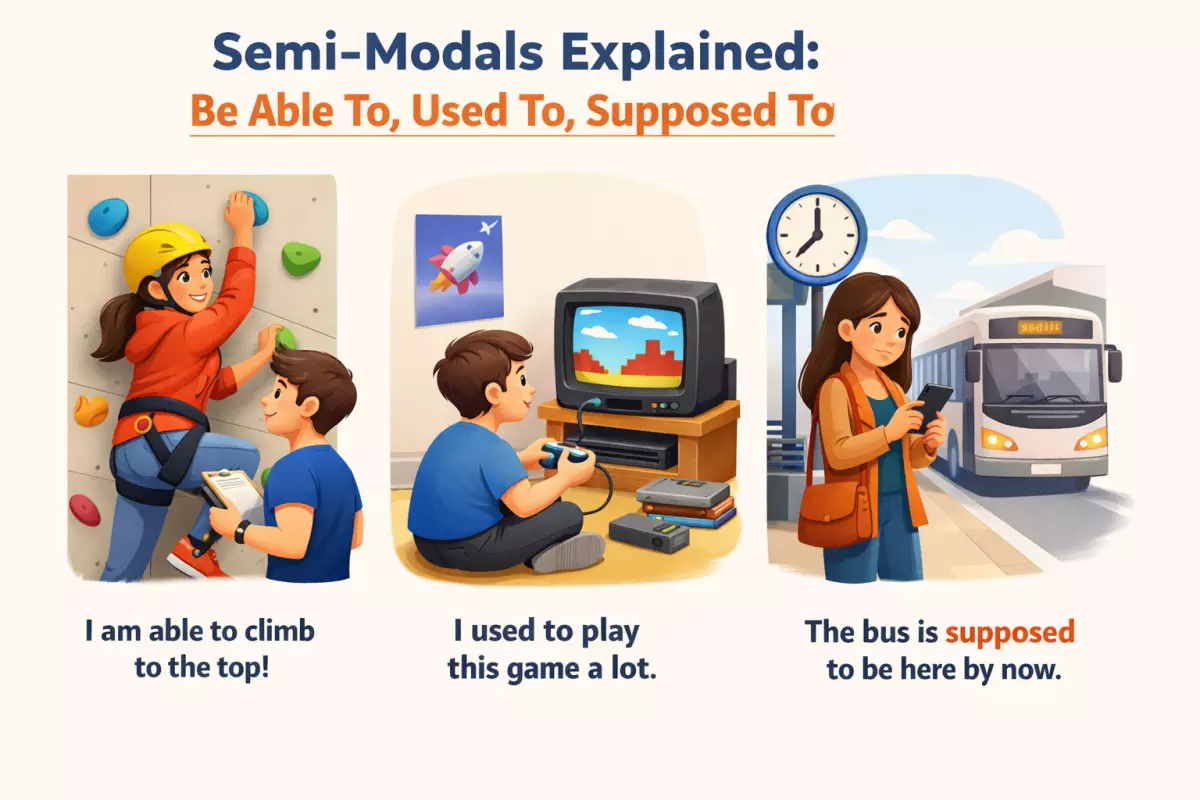 This article explains what semi-modals are in English, then shows how be able to expresses ability, used to describes past habits and states, and supposed to covers obligation and expectation. It also reviews tense forms, negatives, questions, common confusion, and homework practice tasks.
Some English helpers look like modal verbs but work more like fixed phrases, such as be able to, used to, and supposed to. You hear them all the time in daily conversation to talk about ability and possibility, past routines, and expectations or obligations. This guide focuses on how they are used in real situations, helping you pick the right form without getting stuck on grammar rules.
What semi-modals are in English
Semi-modals are multi-word verb expressions that behave a bit like modal verbs (can, must, should) because they add meanings such as ability, obligation, expectation, or habit. Unlike “true” modals, they often change form for tense or person, and they may use to, an infinitive, or a participle.
Key features to notice
- They come in phrases (not single words): be able to, have to, be supposed to, used to.
- They can inflect: am/is/are able to, was/were able to, has/have/had to. (True modals don’t: not “cans” or “musted”.)
- They often require “to” + base verb: be able to go, be supposed to call, have to leave.
- Negatives and questions use normal auxiliary patterns (often with do or be): Do you have to…?, Are you supposed to…?, I didn’t use to….
- Meaning is modal-like: they express possibility/ability, necessity, advice, expectation, permission, or past habits.
Common semi-modal patterns (with usage notes)
- be able to + base verb (ability; often used when tense/aspect matters): “She was able to finish on time.”
- have to + base verb (external necessity/requirement): “I have to work late.”
- have got to + base verb (informal, strong necessity): “We’ve got to go.”
- be supposed to + base verb (expectation, rule, plan): “You’re supposed to sign here.”
- be allowed to + base verb (permission): “Are we allowed to park here?”
- be going to + base verb (future plan/prediction from evidence): “It’s going to rain.”
- be about to + base verb (immediate future): “The meeting is about to start.”
- be likely to + base verb (probability): “Prices are likely to rise.”
- be meant to + base verb (intended purpose/expectation): “This button is meant to open the door.”
- be due to + base verb (scheduled expectation): “The train is due to arrive at 6.”
- used to + base verb (past habit/state, not present): “I used to live downtown.”
- need to + base verb (necessity; main verb, but modal-like meaning): “You need to back up your files.”
- ought to + base verb (advice/expectation; often grouped with semi-modals): “You ought to apologize.”
- be able/allowed/supposed/likely + to-infinitive (a productive pattern): “He’s unlikely to agree.”
Form reminders that prevent common errors
- After “to,” use the base verb: ✅ “She is able to drive.” ❌ “able to drives.”
- Questions depend on the first auxiliary: “Are you supposed to…?” / “Do you have to…?”
- “Used to” is past-focused: it contrasts with the present (“I used to run every day, but I don’t now.”).
- Many semi-modals allow tense changes → “have to” becomes “had to”; “be supposed to” becomes “was/were supposed to”.
Be able to for ability

Use be able to to talk about someone’s capability in a specific situation, especially when you want to highlight success, difficulty, or a change in what was possible. It often works like can, but it is more flexible across tenses and is common when you describe what happened in one particular case.
Core pattern
- Form: be (am/is/are/was/were/been/being) + able to + base verb
- Meaning: having the skill, opportunity, or conditions needed to do something
- Typical focus: real-world possibility (not just permission), often with an implied “because of the circumstances”
Why speakers choose it instead of can
- Past single events: it clearly marks a successful result in one situation (often with “managed to”).
- Perfect forms: it fits naturally with have/has been able to to describe ability up to now.
- Infinitives and -ing forms: it can follow other verbs (want to, hope to, need to) and appear as a gerund (being able to).
- More formal or careful tone: it can sound more precise than can in writing.
Common tense and clause patterns (with examples)
- Present: I am able to work remotely most days.
- Present negative: She isn’t able to join the call today.
- Past (general): When I lived there, I was able to walk to work.
- Past (single success): We were able to get the last two tickets.
- Future: You’ll be able to see the results tomorrow.
- Present perfect: He has been able to save more money this year.
- Past perfect: They had been able to finish before the deadline.
- Modal + be able to: We might be able to reschedule.
- Infinitive after another verb: I need to be able to concentrate.
- -ing form: Being able to explain it clearly is important.
- Question: Were you able to contact support?
- Wh-clause: I wasn’t able to remember where I parked.
Past ability: “could” vs “was/were able to”
- General past ability (skill over time): “I could swim when I was six.” (a general skill)
- One specific situation (successful outcome): ✅ “I was able to swim back to shore.” → suggests you managed it in that moment
- Avoid using could for a single success when you mean the result: ❌ “I could swim back to shore (so I did).” (often unclear; may sound like only potential)
- Negative is different: “I couldn’t” and “I wasn’t able to” are both common for failure in a specific case.
Useful example set (short, realistic contexts)
- After resetting the router, we were able to connect again.
- I haven’t been able to sleep well lately.
- Will you be able to pick me up at six?
- She wasn’t able to answer because the microphone wasn’t working.
- Once the rain stopped, they were able to continue the match.
- We might be able to deliver it earlier than planned.
- He’s never been able to understand that accent.
- Were you able to back up the files before the update?
- They won’t be able to approve it without ID.
- Being able to say “no” politely is a useful skill.
- I’d like to be able to run 5K without stopping.
- She was finally able to speak to the manager.
Used to for past habits and states
Used to describes things that were true in the past but are not true now. It commonly refers to repeated actions (old routines) and long-term situations (past states). The meaning usually includes a contrast with the present, even if you do not say the contrast directly.
Core meaning and when to choose it
- Past habit: a repeated action in earlier life. Example: “I used to walk to school.”
- Past state: a situation that lasted for a period of time. Example: “She used to live near the station.”
- Implied change: it suggests “but not anymore.” Example: “They used to be close (but they aren’t now).”
- Not for one-time events: avoid it for a single completed action. ❌ “I used to buy a coffee yesterday.”
- Often with time references: “when I was a kid,” “in high school,” “back then,” “before we moved.”
Form and patterns
- Affirmative: subject + used to + base verb: “We used to play outside.”
- Negative (common): subject + didn’t use to + base verb: “He didn’t use to like tea.”
- Negative (less common): subject + used not to + base verb: “He used not to like tea.”
- Questions: Did + subject + use to + base verb? “Did you use to live here?”
- Short answers: “Yes, I did.” / “No, I didn’t.” (not “Yes, I used to.”)
- Pronunciation note: in speech, “used to” often sounds like “yoosta,” but spelling stays the same.
Common mistakes to avoid
- ✅ “Did you use to work nights?” → ❌ “Did you used to work nights?”
- ✅ “She didn’t use to eat spicy food.” → ❌ “She didn’t used to eat spicy food.”
- ✅ “I used to be shy.” (state) → avoid replacing it with a simple past if you want the “not now” contrast.
- ✅ “I lived in Osaka for two years.” (neutral past fact) → “I used to live in Osaka.” (highlights that you don’t now)
Example sentences (habits and states)
- My brother used to collect stamps.
- I used to take the bus every morning.
- We used to eat dinner at 6 p.m.
- She used to call her grandparents every Sunday.
- They used to go camping every summer.
- He used to play the piano after school.
- I used to drink soda all the time, but now I don’t.
- This street used to be much quieter.
- Our office used to be on the third floor.
- There used to be a bookstore here.
- She used to have long hair.
- He didn’t use to wear glasses.
- Did you use to live in this neighborhood?
- What games did you use to play as a kid?
- I used not to understand this topic, but it’s clearer now.
Quick contrast with similar past forms
- Simple past reports past facts or completed actions: “I worked there in 2020.” (no contrast required)
- Used to highlights change from past to present: “I used to work there.” (implies you don’t now)
- Would can describe repeated past actions, but not states: “We would visit every winter.” (but not “I would be shy”)
Supposed to for obligation and expectation
Supposed to is used to talk about what is expected, required, or arranged by rules, plans, or other people. It often implies “this is the correct thing” or “this is what was planned,” and it can also suggest that reality may not match the expectation.
Core pattern and meaning
- Form: be + supposed to + base verb (infinitive without to after it). Example: “You are supposed to wear a helmet.”
- Meaning: obligation/expectation from outside (rules, instructions, schedules, social norms), not personal desire.
- Common context: reminders, complaints, instructions, and explaining what the rule or plan is.
Affirmative, negative, and questions
- Affirmative: “I’m supposed to submit the form today.”
- Negative: “You aren’t supposed to park here.” (not allowed / against the rules)
- Question: “Are we supposed to bring ID?” (asking about the rule/expectation)
- Wh- question: “What am I supposed to do next?” (asking for the expected action)
- Short answers: “Yes, you are.” / “No, you aren’t.”
Time reference: present, past, and future
- Present expectations: “Employees are supposed to clock in by 9.”
- Past expectation not met: “You were supposed to call me.” (often implies you didn’t)
- Planned future: “The package is supposed to arrive tomorrow.” (a schedule/plan, not a promise)
- Past plan that didn’t happen: “We were supposed to meet, but the train was canceled.”
Typical uses (with varied examples)
- Rules and prohibition: “Visitors aren’t supposed to enter this area.”
- Work duties: “I’m supposed to update the spreadsheet every Friday.”
- School instructions: “You’re supposed to cite your sources.”
- Social expectations: “You’re supposed to say thank you.”
- Advice with a “rule” feel: “You’re supposed to rest after the procedure.”
- Schedules and arrangements: “The meeting is supposed to start at 2.”
- Product/design purpose: “This button is supposed to reset the device.”
- Complaints: “This app is supposed to be free, but it keeps charging me.”
- Clarifying responsibilities: “Who’s supposed to pick up the keys?”
- Uncertainty about the rule: “Am I supposed to sign here or on the last page?”
- Expectation vs. reality: “It’s supposed to be quiet here, but it’s always noisy.”
- Polite correction: “I think you’re supposed to use the other entrance.”
Common patterns and useful variations
- “supposed to” + place/time: “You’re supposed to be here at 8.”
- “supposed to be” + adjective: “The report is supposed to be confidential.”
- “supposed to be” + noun: “This is supposed to be a vegetarian dish.”
- “supposed to” for reported information: “He’s supposed to be very experienced.” (what people say; not fully confirmed)
- Softening with hedges: “We’re supposed to finish today, but it depends on the data.”
Frequent learner mistakes to avoid
- ✅ “You are supposed to turn off your phone.” → ❌ “You supposed to turn off your phone.” (missing be)
- ✅ “She is supposed to go now.” → ❌ “She is supposed to to go now.” (double to)
- ✅ “They weren’t supposed to leave early.” → ❌ “They didn’t supposed to leave early.” (wrong auxiliary)
- ✅ “Are we supposed to pay now?” → ❌ “Do we supposed to pay now?” (use be for questions)
Forms in different tenses
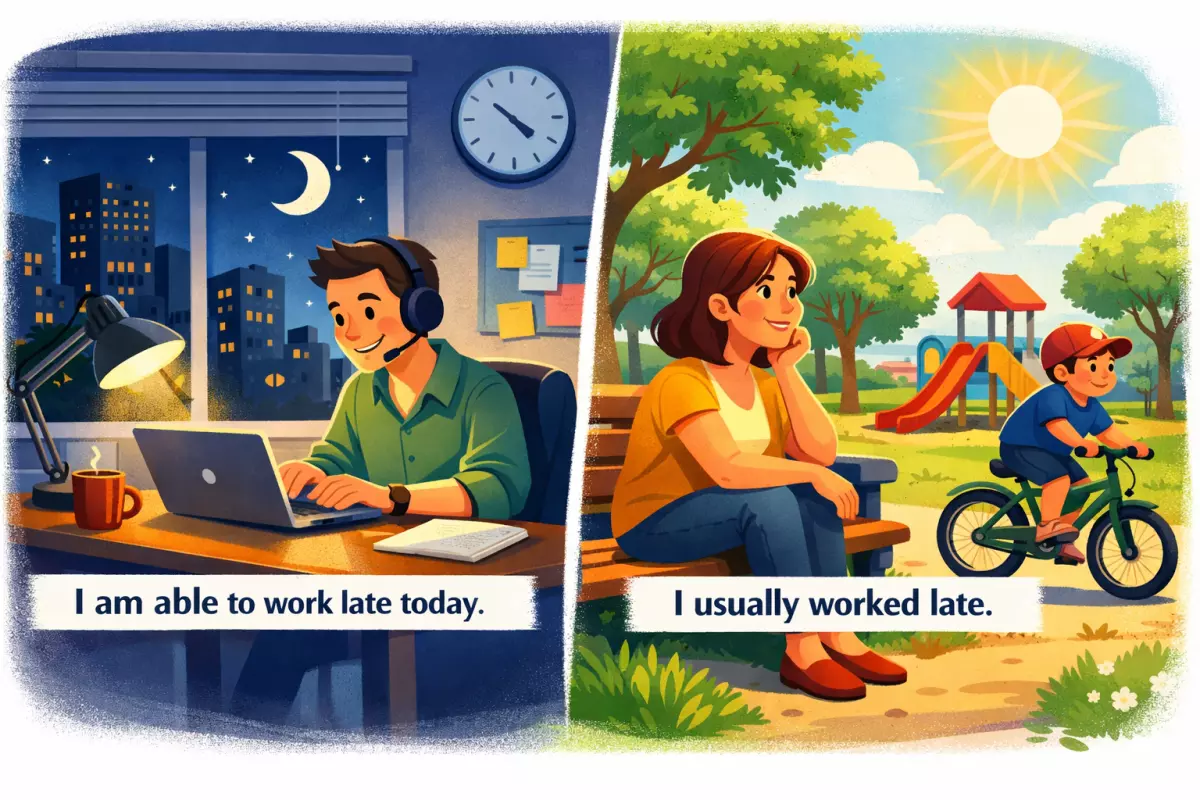
These semi-modals behave more like fixed phrases than true modal verbs, so tense and time are usually shown by changing be, using do support, or switching to a close synonym (often could or was/were). The patterns below show what is natural in modern English, plus common alternatives when a direct tense form is awkward.
| Time / grammar | Be able to | Used to | Supposed to |
|---|---|---|---|
| Present (general ability / expectation) | I am able to work late today. | ❌ I use to work late. → I usually work late. | I am supposed to call my manager. |
| Past (completed time) | I was able to fix it yesterday. | I used to live near here. | I was supposed to call, but I forgot. |
| Future (plans / predictions) | I will be able to drive next month. | (Not used for future.) | I am supposed to meet them tomorrow. |
| Present perfect (up to now) | I have been able to focus lately. | (Not used in perfect.) | I have been supposed to send it for weeks. |
| Past perfect (earlier past) | I had been able to save some money. | (Not used in perfect.) | I had been supposed to leave earlier. |
| Questions | Are you able to join us? | Did you use to swim here? | Are we supposed to bring ID? |
| Negatives | I’m not able to log in. | I didn’t use to like coffee. | You’re not supposed to park here. |
| With modals (can/might/should, etc.) | I might be able to help. | (Avoid: no modal + used to.) | You should be supposed to… (rare/awkward; usually rephrase) |
Key usage notes and common patterns
Use these rules to choose the most natural tense form.
- Be able to changes like the verb be: am/is/are, was/were, will be, have been, had been.
- For a single successful action in the past, was/were able to often fits better than could: ✅ I was able to get a ticket. (one success) vs. I could get tickets. (general ability).
- In negatives, both are common: ✅ I wasn’t able to reach you. / ✅ I couldn’t reach you.
- Used to is essentially a past-habit form; it does not take present, future, or perfect forms.
- For questions and negatives with used to, modern standard English prefers did support: ✅ Did you use to…? / I didn’t use to…
- In informal writing you may see used to kept in questions/negatives (e.g., “Used you to…?”), but it is much less common and can look nonstandard.
- Supposed to shows time by changing be (am/is/are/was/were) and can also appear in perfect forms: have been / had been supposed to.
- To talk about an expectation in the future, English usually uses present forms with future time words: ✅ I’m supposed to start next week.
- To report a missed obligation, past forms are typical: ✅ I was supposed to email you, but I didn’t.
- Avoid stacking another modal directly on top of supposed to unless you rephrase: instead of “should be supposed to,” prefer ✅ should / supposed to / expected to (choose one).
- With be able to, adding another modal is normal and useful for uncertainty: ✅ We may be able to finish today.
- With used to, if you need present meaning, switch to usually, tend to, or the simple present: ✅ I usually take the train.
- With supposed to, the negative often signals prohibition or a rule: ✅ You’re not supposed to take photos.
- For reported speech, keep the time reference clear: ✅ He said he was supposed to call. / ✅ He said he had been supposed to call earlier.
Negatives and questions
These semi-modal expressions form negatives and questions in a few different ways. The main choice is whether you use do/does/did support (common with used to and be able to) or whether you invert the verb be (common with supposed to and sometimes be able to).
Be able to: negatives and questions
- Negative (present/future): be + not + able to + base verb
Example: She isn’t able to join us tonight. - Question (present/future): be + subject + able to + base verb?
Example: Are you able to finish by Friday? - Negative (past): was/were + not + able to
Example: They weren’t able to get tickets. - Question (past): was/were + subject + able to?
Example: Was he able to reach you? - With other auxiliaries/modals: keep the auxiliary and negate/invert it, not “able”
✅ I won’t be able to come. / Will you be able to come?
✅ She hasn’t been able to sleep. / Has she been able to sleep? - Common learner issue: don’t add do when be is the main verb
❌ Do you able to drive? → ✅ Are you able to drive?
Used to: negatives and questions
- Standard negative (past habit/state): didn’t use to + base verb
Example: I didn’t use to like coffee. - Standard question: Did + subject + use to + base verb?
Example: Did you use to live here? - Short answers: use did/didn’t, not “used to”
Example: Yes, I did. / No, I didn’t. - Spelling note: in negatives and questions, prefer use to (not used to) because did already marks the past
✅ Did you use to play tennis?
✅ She didn’t use to eat fish. - Less common but seen: usedn’t to exists in some varieties, but it’s rare and can sound old-fashioned; didn’t use to is safer in modern English.
- Common learner issue: don’t use do/does for present time meaning
❌ Do you use to work here? (wrong time) → ✅ Did you use to work here?
Supposed to: negatives and questions
- Negative (obligation/expectation): be + not + supposed to + base verb
Example: You aren’t supposed to park here. - Question: be + subject + supposed to + base verb?
Example: Are we supposed to bring ID? - Past forms: was/were (not) supposed to
Example: He wasn’t supposed to tell anyone. - Future meaning: still uses present forms of be when the schedule/rule is future
Example: We are supposed to meet tomorrow at 10. - Common learner issue: don’t add do when be is present
❌ Do we supposed to sign? → ✅ Are we supposed to sign?
Quick pattern checklist
- If the structure contains be as the main verb (be able to, be supposed to), make negatives with not after be and make questions by inverting be.
- If the structure is used to (past only), make negatives and questions with didn’t / Did…? and use use to after did.
- When another auxiliary is present (will, have, might), negate or invert that auxiliary: won’t be able to, hasn’t been able to, might not be supposed to.
Common learner confusion
These semi-modal patterns look simple, but learners often mix up their grammar rules, meanings, and time references. The key is to notice (1) whether the phrase behaves like a modal (no “to” after it, no -s), (2) whether it needs an auxiliary for questions/negatives, and (3) whether the meaning is ability, habit/past state, or expectation/obligation.
-
Mixing up “be able to” with “can” (and choosing the wrong one)
Be able to is often used when you need a specific tense or form that can doesn’t handle well.
- Future: ✅ I’ll be able to call you later. (more natural than “I’ll can…”) ❌
- Perfect: ✅ I’ve been able to sleep better lately. (not “I’ve could…”) ❌
- Infinitive after another verb: ✅ I want to be able to drive. (not “to can drive”) ❌
- Past ability: general ability often uses could (I could swim when I was six), but a single successful event often prefers was/were able to (I was able to fix it yesterday).
-
Forgetting that “be able to” changes with the subject and tense
This phrase contains the verb be, so it must agree and conjugate like any other form of “be.”
- ✅ She is able to join. → ❌ She are able to join.
- ✅ They were able to finish. → ❌ They was able to finish.
- ✅ He has been able to work. → ❌ He has be able to work.
-
Making questions and negatives incorrectly with “be able to”
Because it includes “be,” you usually form questions/negatives by moving or negating be (not by adding “do” unless there is no “be” present).
- ✅ Are you able to come? → ❌ Do you able to come?
- ✅ I am not able to log in. → ❌ I don’t able to log in.
- ✅ Will you be able to help? (modal “will” + base “be”)
- ✅ Have you been able to reach her? (auxiliary “have” + past participle “been”)
-
Confusing “used to” (past habit/state) with “be used to” (familiar/accustomed)
Used to + base verb talks about past routines or past situations that are no longer true. Be used to + noun/gerund means “accustomed to” (often present, but can be past/future too).
- ✅ I used to live downtown. (past situation, not true now)
- ✅ I am used to the noise. (I’m accustomed now)
- ✅ She is used to working nights. (gerund after “to”)
- ❌ She used to working nights. (wrong structure for past habit)
- ❌ I am used to live downtown. (wrong: after “be used to,” use noun/gerund)
-
Using the wrong verb form after “used to”
After used to (past habit), use the base verb, not -ing and not a past form.
- ✅ We used to go there every summer. → ❌ We used to went there.
- ✅ He used to play tennis. → ❌ He used to playing tennis.
- ✅ There used to be a café here. (common fixed pattern)
-
Spelling and pronunciation issues: “used to” vs “use to”
In affirmative statements, it’s normally written used to. In negatives and questions, many learners meet use to because “did” already carries the past tense.
- ✅ I used to take the bus.
- ✅ Did you use to take the bus?
- ✅ I didn’t use to like coffee.
- Note: You may also see “didn’t used to” in informal writing, but “didn’t use to” is the safer standard form.
-
Misreading “supposed to” as only “planned to”
Be supposed to often expresses expectation, rule, or what others think is correct—not just a personal plan.
- Expectation: ✅ The train is supposed to arrive at 6. (scheduled/expected)
- Obligation/rule: ✅ You’re supposed to wear a badge. (required)
- Reported belief: ✅ He’s supposed to be very good. (people say so)
- Plan (possible, but context-dependent): ✅ I’m supposed to meet her at 3. (arranged, expected)
-
Forming “supposed to” incorrectly (missing “be” or adding the wrong verb form)
This structure needs a form of be + supposed + to + base verb.
- ✅ I am supposed to call you. → ❌ I supposed to call you.
- ✅ She was supposed to arrive early. (past expectation)
- ✅ They are supposed to be here soon. (base verb after “to”)
- ❌ They are supposed to are here soon. (don’t conjugate after “to”)
-
Negatives and questions with “supposed to”
Use the auxiliary “be” for word order and negation.
- ✅ Are we supposed to sign in?
- ✅ You aren’t supposed to park here.
- ✅ Was he supposed to email you?
- ✅ I wasn’t supposed to tell anyone. (often implies “but I did”)
-
Confusing “should” with “supposed to”
Should is advice/opinion. Be supposed to points to an external expectation (rules, instructions, schedule, other people’s assumptions). They can overlap, but the source of pressure is different.
- ✅ You should see a doctor. (recommendation)
- ✅ You’re supposed to show ID. (rule/procedure)
- ✅ The package should arrive tomorrow. (speaker’s prediction)
- ✅ The package is supposed to arrive tomorrow. (expected/scheduled)
-
Time reference problems: past vs present expectation
Changing the tense of “be” changes the time of the expectation or obligation.
- Present: ✅ I am supposed to be in class now. (current expectation)
- Past: ✅ I was supposed to be in class yesterday. (past expectation; often not met)
- Future: ✅ I will be supposed to submit it next week. (less common, but possible when rules start later)
- With perfect meaning: ✅ He was supposed to have finished by noon. (expected completion before a past time)
-
Overusing semi-modals where a simpler verb works
These expressions are useful, but sometimes a straightforward verb is clearer, especially in short statements.
- ✅ I can help. (simple ability now) vs. I am able to help. (more formal/heavier)
- ✅ We have to leave. vs. We are supposed to leave. (different meaning: necessity vs expectation)
- ✅ I often went there as a child. vs. I used to go there. (both fine; choose based on style and emphasis)
Homework: semi-modal practice tasks
Use these exercises to build accuracy with common semi-modal patterns (form, tense, and meaning). Focus on the structure after each expression: be able to + base verb, used to + base verb, and be supposed to + base verb. Pay attention to negatives and questions, because the auxiliary changes depending on the tense.
1) Choose the best option (form + meaning)
- When I was a child, I ______ play outside until dark. (past habit)
- Sorry I’m late. I ______ find parking anywhere. (past ability in one situation)
- You ______ submit the form by Friday. (rule/expectation)
- She ______ work nights, but now she has a day job. (past routine, now different)
- I’m not ______ log in right now; the site is down. (present ability)
- ______ we ______ bring our passports to the hotel? (requirement)
- He ______ be shy, but he’s more confident these days. (past state)
- They weren’t ______ finish the project on time. (past ability)
- What time ______ the meeting ______ start? (schedule/expectation)
- I didn’t ______ like coffee, but I do now. (past preference)
- After a few lessons, you’ll ______ drive on the highway. (future ability)
- You ______ tell anyone; it’s confidential. (obligation)
Show answers
- used to
- couldn’t / wasn’t able to (both possible; “wasn’t able to” emphasizes the specific situation)
- are supposed to
- used to
- able to
- Are / supposed to
- used to
- able to
- is / supposed to
- used to
- be able to
- are supposed to
2) Rewrite the sentence (keep the meaning)
- In the past, I lived near the sea. (rewrite with used to)
- It’s expected that you reply within 24 hours. (rewrite with be supposed to)
- She couldn’t open the jar. (rewrite with be able to)
- Did you have the habit of taking the bus to work? (rewrite with used to)
- We will have the ability to meet you next week. (rewrite with be able to)
- It wasn’t expected that he would call. (rewrite with be supposed to)
- I no longer eat meat. (rewrite with used to + contrast)
- Are we required to wear helmets? (rewrite with be supposed to)
Show answers
- I used to live near the sea.
- You are supposed to reply within 24 hours.
- She wasn’t able to open the jar.
- Did you use to take the bus to work?
- We will be able to meet you next week.
- He wasn’t supposed to call.
- I used to eat meat, but I don’t anymore.
- Are we supposed to wear helmets?
3) Fix the mistake (one error per sentence)
- ❌ I am used to speak French at school.
- ❌ She supposed to finish by noon.
- ❌ Did you used to live here?
- ❌ We weren’t able finish the test.
- ❌ He is suppose to be here already.
- ❌ I use to hate mushrooms.
- ❌ Are you able to can come tomorrow?
- ❌ They didn’t used to eat breakfast.
- ❌ I’m supposed study tonight.
- ❌ She used to can swim very fast.
Show answers
- ✅ I used to speak French at school.
- ✅ She is supposed to finish by noon.
- ✅ Did you use to live here?
- ✅ We weren’t able to finish the test.
- ✅ He is supposed to be here already.
- ✅ I used to hate mushrooms.
- ✅ Are you able to come tomorrow?
- ✅ They didn’t use to eat breakfast.
- ✅ I’m supposed to study tonight.
- ✅ She used to swim very fast.
4) Production practice (write your own)
Write complete sentences. Keep the verb after the expression in the base form (without -ing and without to unless the pattern requires it).
- Write 3 sentences about past habits you don’t have now (use used to).
- Write 3 sentences about rules or expectations in your school/work/home (use be supposed to).
- Write 3 sentences about abilities: one present, one past (a specific situation), and one future (use be able to).
- Write 2 questions: one with Did you use to…? and one with Are/Is … supposed to…?
- Write 2 negative sentences: one with didn’t use to and one with not supposed to.
Quick pattern checklist (before you submit)
- Used to for past habits/states: “I used to live…”, negative “didn’t use to…”, question “Did you use to…?”
- Be able to for ability (all tenses): “am/was/will be able to + verb”; avoid double modals (❌ “able to can”).
- Be supposed to for expectation/obligation: “am/is/are supposed to + verb”; negative “not supposed to”.
- After all three, the main verb is the base form: “to go,” “to finish,” “to reply.”