Adverbial Fronting for Emphasis (C1 structure)

 Here we how fronting adverbials shifts emphasis and focus in sentences, which types of adverbials can be fronted, and the impact on tone in both formal and literary English. It also covers naturalness and provides practice for emphasis.
Shifting adverbs to the beginning of a sentence is a powerful technique that can make your writing stand out and convey strong emphasis, particularly at advanced levels of English. By placing adverbs at the start, you draw the reader's attention and add variety to sentence structure, which can help transform ordinary statements into more engaging and memorable expressions. This approach not only highlights important information but also demonstrates a sophisticated command of language, making your writing more dynamic and effective overall.
What fronting achieves in discourse
Adverbial fronting plays a distinct role in shaping the flow and meaning of spoken and written English, especially at advanced proficiency levels. Moving an adverbial to the beginning of a sentence draws the listener’s or reader’s attention to that element, establishing it as the focal point. This structural choice can guide interpretation, highlight contrasts, or set a specific emotional tone.
Managing information flow
By placing an adverbial at the front, speakers can control which details are foregrounded. This is particularly useful for:
- Signaling a shift in topic or perspective
- Emphasizing time, place, or manner
- Clarifying context before introducing new information
- Contrasting ideas or events
- Building suspense or expectation
Creating emphasis and nuance
Fronting isn’t just about moving words; it’s about meaning. For example, compare:
- Suddenly, the lights went out. → The lights went out suddenly.
- In the distance, a storm was forming. → A storm was forming in the distance.
- Only then did he understand the message. → He understood the message only then.
- Quietly, she closed the door. → She closed the door quietly.
- On the table lay a pile of documents. → A pile of documents lay on the table.
- Never have I seen such chaos. → I have never seen such chaos.
- With great effort, they lifted the box. → They lifted the box with great effort.
- Out of nowhere, the dog appeared. → The dog appeared out of nowhere.
- Only later did we discover the truth. → We discovered the truth only later.
- In the morning, the news spread quickly. → The news spread quickly in the morning.
Such rearrangement brings subtle shifts in focus, making communication more expressive. It can add drama, underline surprise, or clarify cause and effect.
Common functions of adverbial fronting
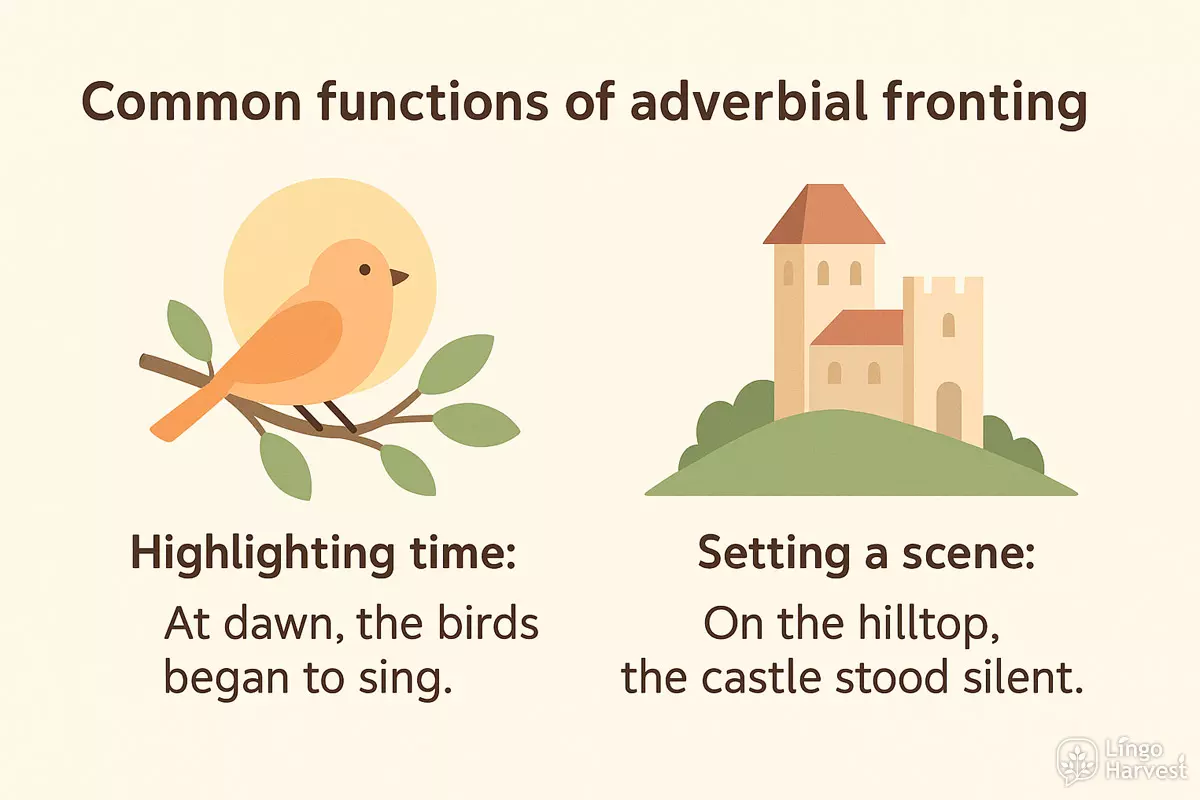
- Highlighting time: At dawn, the birds began to sing.
- Setting a scene: On the hilltop, the castle stood silent.
- Drawing contrasts: By contrast, her brother was always punctual.
- Showing result: As a result, the meeting was postponed.
- Expressing condition: If necessary, we can reschedule.
- Emphasizing manner: With great care, she finished the painting.
- Marking frequency: Once in a while, he visits his hometown.
- Indicating cause: Because of the storm, the flight was delayed.
- Focusing attention: To my surprise, nobody objected.
- Signaling concession: Despite the rain, the event continued.
- Introducing reason: For this reason, we declined the offer.
- Establishing place: In the corner, a cat was sleeping.
- Presenting sequence: First of all, let’s review the agenda.
- Emphasizing exception: With one exception, everyone agreed.
- Stressing immediacy: Right away, he called the ambulance.
- Indicating purpose: To improve efficiency, new software was installed.
- Summarizing: In short, the plan failed.
- Contrasting expectation: Unexpectedly, the results were positive.
Comparison: Neutral vs. fronted adverbials
| Standard Order | Fronted Adverbial |
|---|---|
| He left the party without saying goodbye. | Without saying goodbye, he left the party. |
| The children played in the garden all afternoon. | In the garden, the children played all afternoon. |
| She announced the results with great excitement. | With great excitement, she announced the results. |
| The train arrived after midnight. | After midnight, the train arrived. |
| We decided to cancel because of the weather. | Because of the weather, we decided to cancel. |
In summary, adverbial fronting is a powerful tool for structuring discourse, managing emphasis, and making communication more dynamic and engaging. When used thoughtfully, it can signal importance, clarify relationships between ideas, and help the audience follow the speaker’s or writer’s intentions more easily.
Which adverbials can be fronted
Many types of adverbials can appear at the beginning of a sentence for emphasis, contrast, or style. This fronting is especially common in formal, literary, or academic writing at advanced levels. Placing an adverbial at the start of a sentence highlights that information and can alter the rhythm and focus of your message.
Types of adverbials suitable for fronting
Time, place, manner, and degree adverbials are all candidates for fronting. Some function words and phrases are particularly natural when moved to the front, while others sound awkward or are rarely used this way.
- Time: Yesterday, In the morning, After the meeting, Suddenly
- Place: At the top of the hill, In the garden, Nowhere, Here
- Manner: With great care, In silence, Quickly, Reluctantly
- Degree: To a large extent, Only then, Hardly ever, So much
- Negative and restrictive expressions: Never, Rarely, Seldom, Not once, Under no circumstances
- Conditional adverbials: If necessary, Should you need help, Were it required
- Result or consequence: As a result, Consequently, Therefore
- Contrast or concession: Although tired, Despite the rain, Even so
- Frequency: Occasionally, Every now and then, From time to time
- Reason or cause: Because of this, For that reason, Owing to the delay
- Attitude or viewpoint: To be honest, Frankly, Personally
- Sequence or transition: Firstly, Next, Finally
Restrictions and naturalness
Not all adverbials are equally natural at the front. Short, common time and place adverbials, as well as negative expressions (for inversion), are frequently fronted. More complex or less common adverbials might sound forced in initial position.
| Adverbial Type | Fronted Example |
|---|---|
| Time | Last night, we heard a strange noise. |
| Place | On the desk lay a single red rose. |
| Negative (for inversion) | Never have I seen such chaos. |
| Manner | With a sigh, she closed the book. |
| Conditional | Should you need assistance, let me know. |
| Result | Consequently, the meeting was postponed. |
| Contrast | Despite the warnings, he persisted. |
| Frequency | From time to time, mistakes are inevitable. |
Summary
Fronting is most effective with time, place, manner, negative, and conditional adverbials, especially when clarity or emphasis is the goal. The choice depends on tone and context; overuse can sound unnatural, but well-chosen fronted adverbials add variety and sophistication to C1-level writing.
Impact on tone and focus
Adverbial fronting, especially at the C1 proficiency level, can dramatically shift which elements of a sentence stand out to the reader or listener. By moving an adverbial phrase to the beginning, writers and speakers signal that what follows is particularly significant or deserves special attention. This stylistic choice isn’t just a matter of grammar—it’s a powerful way to shape how information is received.
How adverbial fronting changes emphasis
Placing adverbials at the start of a sentence often brings a sense of drama or formality, and can subtly manipulate the listener’s expectations. Instead of the subject, the fronted element becomes the “frame” for the message, guiding interpretation and emotional response.
- Rarely have I seen such dedication in a team.
- In no way should these results be ignored.
- Only after hours of debate did they reach consensus.
- Under no circumstances will we accept defeat.
- Hardly had she spoken when the room fell silent.
- On no account must this door be left unlocked.
- Little did they know what awaited them.
- Not until midnight did the storm subside.
- Never before had the city experienced such a festival.
- Only by working together can we solve this problem.
- Nowhere else will you find such hospitality.
- So quickly did they finish the project that everyone was amazed.
- At no time did he express regret.
- Barely had they arrived when the announcement was made.
- Not only did she win the prize, but she also set a record.
Effects on register and clarity
Using this advanced word order can make statements sound more formal or literary, and is often used for rhetorical impact in speeches, articles, or persuasive writing. However, overuse can lead to stiffness or distract from the main message, so it’s most effective when used sparingly and purposefully.
Comparison: Standard vs. fronted adverbial
| Standard Word Order | Fronted Adverbial |
|---|---|
| I had never seen such chaos before. | Never before had I seen such chaos. |
| She realized the truth only after the meeting. | Only after the meeting did she realize the truth. |
| We will accept defeat under no circumstances. | Under no circumstances will we accept defeat. |
| They had hardly finished eating when the phone rang. | Hardly had they finished eating when the phone rang. |
| You will find such views nowhere else. | Nowhere else will you find such views. |
When to use this structure
Fronting in formal vs literary English
Fronting—placing adverbials or other elements at the beginning of a sentence—serves distinct purposes in different styles of English. In academic or business writing, this structure often signals emphasis, contrast, or a logical sequence. In contrast, creative and narrative texts use it for rhythm, suspense, or to highlight mood and scene setting.
Usage in formal English
Writers in formal contexts use fronted adverbials to clarify relationships between ideas or to foreground important information. Typical examples include linking phrases and time markers. This style avoids excessive dramatization and focuses on clarity.
- For this reason, the committee rejected the proposal.
- In recent years, technology has advanced rapidly.
- Under no circumstances should these rules be ignored.
- Only after careful consideration did they approve the plan.
- With regard to your question, further research is required.
- On the other hand, some experts disagree.
- By no means is this solution perfect.
- To summarize, the results support our hypothesis.
- Rarely have we seen such dedication.
- In conclusion, the evidence is compelling.
Fronting in literary and creative writing
Literary English embraces a wider range of fronted elements, often for stylistic or dramatic effect. Authors use this structure to create atmosphere, shift the reader’s focus, or mirror spoken rhythms. The effect can be poetic, suspenseful, or intimate.
- Out of the mist crept the silent figure.
- Never before had she felt such joy.
- Down the lane ran the startled fox.
- Beyond the hills lay the unknown.
- Suddenly, the lights went out.
- Into the darkness he vanished.
- Not a word did she utter.
- Quietly he closed the door.
- Through the window streamed the morning sun.
- Never again would he return.
- On the horizon appeared a tiny sail.
- With trembling hands she opened the letter.
Comparing patterns and intent
While both formal and literary fronting add emphasis, their typical uses and effects differ. The table below outlines some key distinctions:
| Style | Typical Fronted Elements | Purpose | Example |
|---|---|---|---|
| Formal/Academic | Adverbials of time, contrast, cause | Clarity, logical flow, emphasis | Only then did the results emerge. |
| Literary/Creative | Place, manner, suspenseful cues | Atmosphere, rhythm, dramatic effect | Into the woods vanished the child. |
| Formal/Official | Restrictions, conditions | Formality, precision | Under no circumstances will we yield. |
| Literary/Poetic | Imagery, inversion | Stylistic color, tone | Upon the silent lake floated the moon. |
Summary
Writers choose fronting strategies according to their goals and audience. In formal English, it signals structure and logic. In literary texts, it becomes a tool for vivid storytelling and emotional nuance. Mastering both styles allows for more expressive and effective communication at advanced proficiency levels.
Restrictions and naturalness
When using adverbial fronting for emphasis (C1 structure), not every adverb or sentence is suitable for this construction. Advanced learners need to be aware of both grammatical limitations and how such fronting affects the tone and flow of speech or writing.
Common limitations
Some adverbials simply do not front naturally, especially those that are tightly connected to the verb or are not typically used for contrast or emphasis. For example, frequency adverbs like "often" or "sometimes" rarely appear at the beginning for emphasis unless in literary or rhetorical contexts. Similarly, adverbials that are too short or lack semantic weight may sound forced at the start of a sentence.
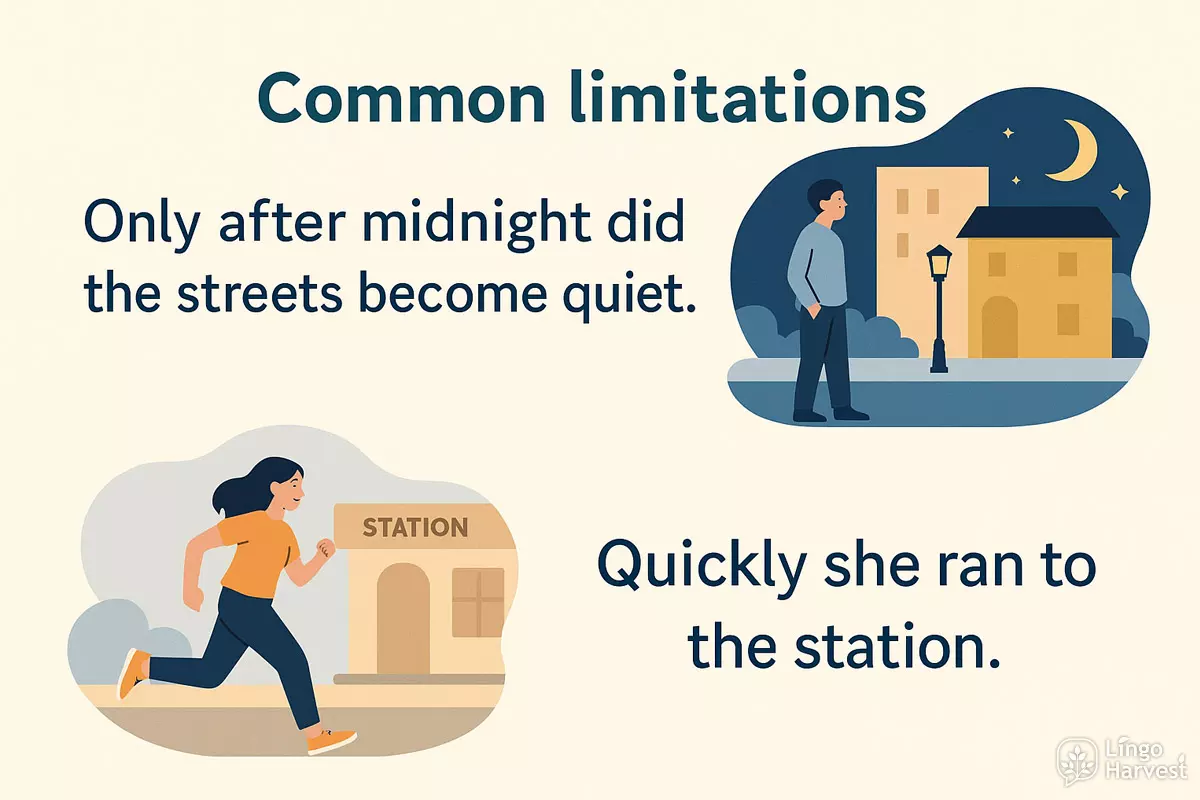
- Only after midnight did the streets become quiet. ✅
- Quickly she ran to the station. ✅ (formal/literary)
- Often I visit my grandmother. ❌ (sounds unnatural; better: I often visit...)
- Outside the house stood a cat. ✅
- Never have I seen such chaos. ✅
- Yesterday I finished the report. ❌ (normal order preferred)
- On no account should you touch that switch. ✅
- Hardly had he left when it started to rain. ✅
- Very quickly we left. ❌ (normal order preferred)
- With great care did she answer. ✅ (formal/literary)
Naturalness and register
Adverbial fronting tends to sound formal, literary, or emphatic. In everyday conversation, it can seem unnatural or overly dramatic. Writers and speakers should consider the context: a news report, speech, or narrative may benefit from this device, while casual dialogue usually does not.
Summary of suitable and unsuitable adverbials
| Adverbial Type | Fronting for Emphasis? |
|---|---|
| Negative adverbials ("Never", "Rarely", "Seldom") | Very natural and common ✅ |
| Time adverbs ("Yesterday", "Today") | Usually not for emphasis ❌ |
| Prepositional phrases ("In no way", "On no account") | Suitable, often formal ✅ |
| Frequency adverbs ("Often", "Sometimes") | Rarely fronted, sounds odd ❌ |
| Result adverbials ("Only then", "Only after") | Effective for emphasis ✅ |
| Manner adverbs ("Quickly", "Carefully") | Possible, but can sound literary → |
Key points for advanced usage
- Reserve adverbial fronting for contexts where emphasis or dramatic effect is desired.
- Check if inversion is required after fronting; many cases trigger subject-auxiliary inversion.
- Be cautious with spoken English—overuse can make speech seem unnatural.
- In formal writing or storytelling, this structure can create suspense or highlight contrast.
- Practice with authentic examples to refine intuition for when this structure fits naturally.
Practice: front adverbials for emphasis
Understanding how to place adverbials at the beginning of a sentence can dramatically change the focus and impact of your statements. This structure is especially useful in formal writing or when you want to draw attention to a particular aspect of your message. Below, you'll find targeted exercises to help you master this advanced C1-level technique.
Task 1: Rewrite for Emphasis
Rewrite each sentence by moving the adverbial to the front for stronger emphasis.
- I found the keys in the garden this morning.
- We will finish the project only after the meeting.
- She rarely visits us on weekends.
- They announced the results with great excitement yesterday.
- He noticed the error only at the last moment.
- They completed the task with surprising ease.
- We discovered the problem during the final test.
- She realized the truth only after talking to him.
- The team arrived at the venue early in the morning.
- He explained the issue with remarkable clarity.
Show answers
- This morning, I found the keys in the garden.
- Only after the meeting will we finish the project.
- Rarely does she visit us on weekends.
- With great excitement, they announced the results yesterday.
- Only at the last moment did he notice the error.
- With surprising ease, they completed the task.
- During the final test, we discovered the problem.
- Only after talking to him did she realize the truth.
- Early in the morning, the team arrived at the venue.
- With remarkable clarity, he explained the issue.
Common Fronted Adverbials for Emphasis
- Never
- Only then
- Seldom
- Hardly ever
- In no circumstances
- Under no condition
- At no time
- On no account
- Not until...
- Little did I know
- Nowhere
- Rarely
- Not only ... but also
- No sooner ... than
- So + adjective ... that
- Such + noun ... that
- Only by
- Scarcely
Task 2: Identify the Emphasis
Read the sentences below. For each, underline the fronted adverbial and explain what is being emphasized.
- Never have I seen such determination.
- Only by working together can we succeed.
- At no time did he admit his mistake.
- So quickly did she finish the work that everyone was surprised.
- Rarely do we encounter such dedication.
- Hardly had the meeting started when the power went out.
- Seldom does he make such an effort.
- Only after reviewing the data did they understand the issue.
- Little did she know what would happen next.
- Never again will I trust that source.
Show answers
- Never – Emphasizes that the speaker has not seen such determination before.
- Only by working together – Highlights collaboration as essential for success.
- At no time – Stresses that he never admitted his mistake.
- So quickly – Highlights the exceptional speed of her work.
- Rarely – Emphasizes how uncommon such dedication is.
- Hardly – Shows the action happened almost immediately after another.
- Seldom – Underscores how infrequently he makes such an effort.
- Only after reviewing the data – Indicates the moment understanding became possible.
- Little – Emphasizes her lack of awareness about what would happen.
- Never again – Strongly stresses refusal to repeat the experience.
Comparison: Standard vs. Fronted Adverbial Structures
| Standard Order | Fronted Adverbial (Emphatic) |
|---|---|
| I had never heard such a story before. | Never had I heard such a story before. |
| We can solve the problem only by discussing it. | Only by discussing it can we solve the problem. |
| He rarely goes out on weekdays. | Rarely does he go out on weekdays. |
| She understood the solution so well that she explained it to everyone. | So well did she understand the solution that she explained it to everyone. |
Quick Practice: Create Your Own
Try forming sentences using these fronted adverbials for emphasis:
- Not until
- Under no circumstances
- No sooner ... than
- Little did I know
- On no account
Make sure to invert the subject and auxiliary verb after the fronted adverbial.
Show answers
- Not until the sun set did we leave the beach.
- Under no circumstances should you share your password.
- No sooner had I sat down than the phone rang.
- Little did I know what was about to happen.
- On no account must this door be left unlocked.