Emphatic Adverbs: absolutely, definitely, completely (advanced list)

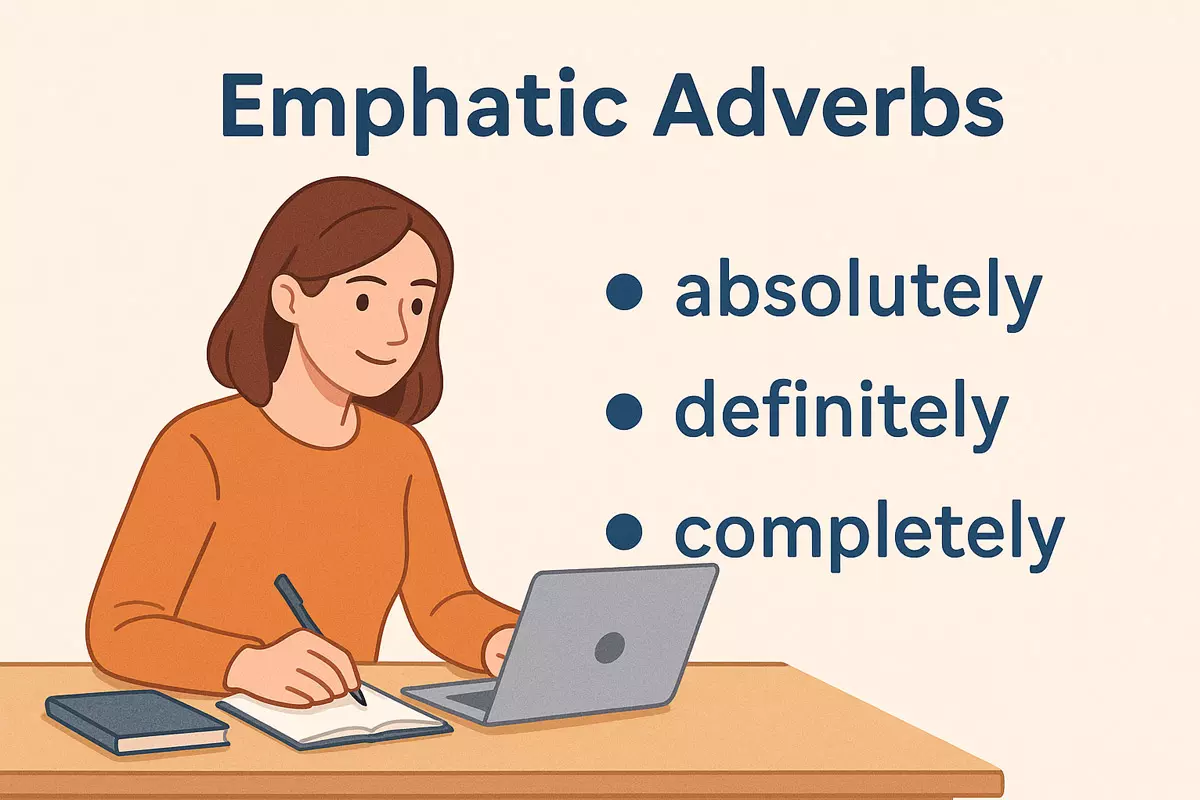 Here we how emphatic adverbs show intensity and certainty, describes their main categories, and gives examples of common collocations. It also explains how they change tone, advises on avoiding overuse, and includes practice choosing suitable adverbs.
Using powerful intensifiers in your statements can make your English sound more persuasive and expressive, helping you convey certainty, enthusiasm, or completeness. Mastering advanced adverbs such as absolutely, completely, or utterly strengthens your ability to communicate fluently and precisely. By carefully choosing the right intensifiers, you can add emphasis to your ideas and ensure your message resonates more strongly with your audience, whether in conversation, writing, or presentations.
What emphatic adverbs express
Emphatic adverbs like absolutely, definitely, and completely serve to intensify the meaning of the words they modify. These adverbs communicate a high degree of certainty, totality, or emphasis, making statements stronger and more convincing. Rather than simply describing an action or quality, they reinforce just how true, complete, or extreme something is.
Functions and Nuances
These intensifiers perform several functions in English sentences:
- Show total agreement or disagreement (absolutely correct, definitely not)
- Express full completion or extent (completely finished, utterly destroyed)
- Add certainty or resolve (certainly true, undoubtedly the case)
- Convey strong emotional reaction (positively thrilled, thoroughly disappointed)
- Highlight uniqueness or exception (solely responsible, purely accidental)
Common Emphatic Adverbs and Their Effects
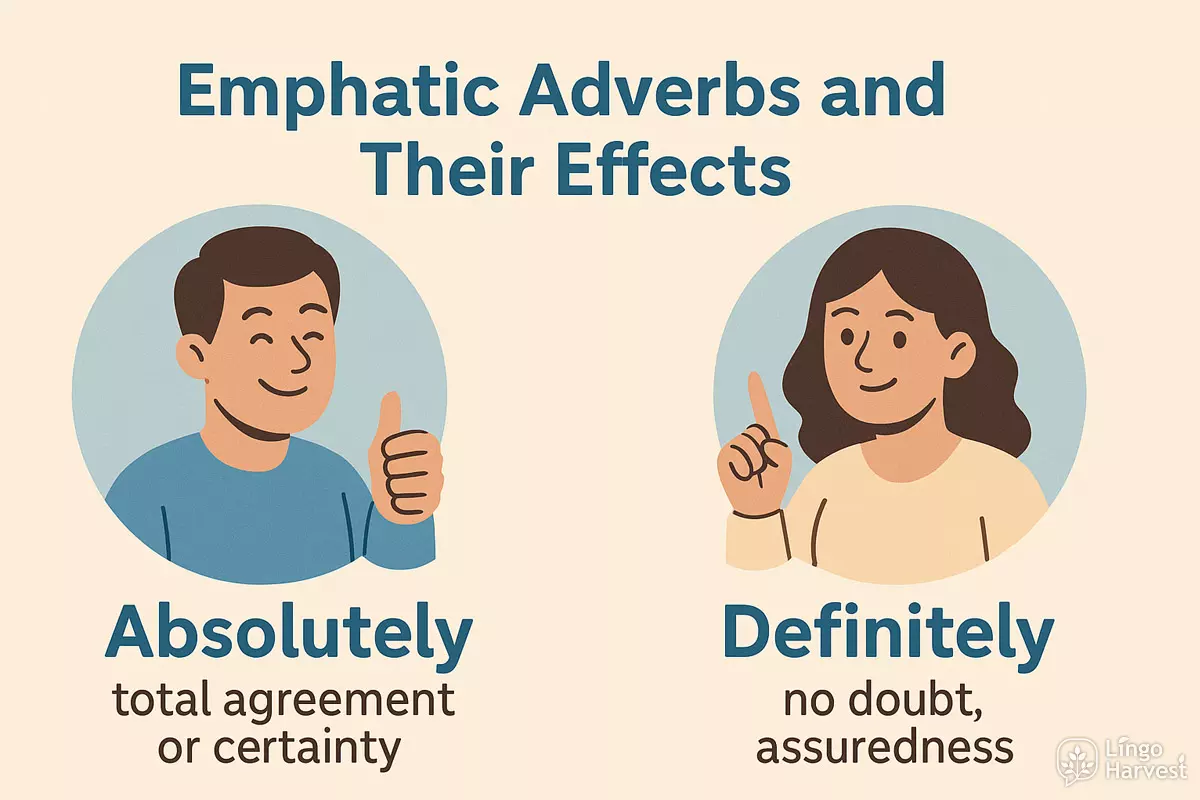
Some adverbs are more commonly used for emphasis, and each brings its own nuance. Here’s a list of advanced examples, showing how they can change the tone or strength of a statement:
- Absolutely – total agreement or certainty
- Definitely – no doubt, assuredness
- Completely – total extent, nothing lacking
- Utterly – extreme, often negative
- Thoroughly – in every way, exhaustively
- Totally – entire, without exception
- Entirely – whole, without reservation
- Unquestionably – beyond doubt
- Undoubtedly – almost certain, little room for doubt
- Positively – very certain, often with enthusiasm
- Purely – only, exclusively
- Solely – alone, with no others involved
- Fully – to the maximum extent
- Clearly – without confusion, obviously
- Decidedly – with determination
- Precisely – exactly, with accuracy
- Surely – with confidence
- Frankly – honestly, without hiding anything
- Seriously – with gravity or sincerity
- Literally – in a strict sense, not figurative
How Emphatic Adverbs Affect Sentence Meaning
Using these adverbs can transform a neutral sentence into one that is more forceful or emotionally charged. For example:
- “She finished the project.” → “She completely finished the project.”
- “I agree.” → “I absolutely agree.”
- “He’s right.” → “He’s definitely right.”
These additions clarify the speaker’s stance and leave less room for ambiguity.
Comparison of Emphatic Adverbs
| Adverb | Typical Use/Meaning |
|---|---|
| Absolutely | Expresses total certainty or agreement (e.g., “absolutely sure”) |
| Definitely | Indicates no doubt or hesitation (e.g., “definitely possible”) |
| Completely | Describes something done in full or without anything missing (e.g., “completely forgotten”) |
| Utterly | Used for strong, often negative emphasis (e.g., “utterly destroyed”) |
| Totally | Similar to “completely,” but often with informal tone (e.g., “totally agree”) |
| Thoroughly | Implies careful or exhaustive action (e.g., “thoroughly enjoyed”) |
In summary, these adverbs are key tools for adding force, clarity, or emotion to your communication. By choosing the right one, you can precisely convey how strongly you feel or how fully something is true.
Categories of intensity and certainty
When using adverbs like absolutely, definitely, and completely, it helps to recognize how these words express different levels of force or assurance. Some adverbs intensify meaning, while others underline confidence or sureness in a statement. Understanding how these categories work can make your English sound more precise and expressive.
Adverbs of Intensity
Intensifying adverbs strengthen the meaning of verbs, adjectives, or other adverbs. They are used to add force or to show the highest or lowest degree. Here are some examples:
- Absolutely — shows the highest level of intensity (e.g., "She is absolutely right.") ✅
- Completely — means 'totally' or 'fully' (e.g., "I completely forgot about the meeting.")
- Utterly — used for emphasis, especially with negative adjectives (e.g., "The plan was utterly hopeless.")
- Totally — very similar to 'completely' (e.g., "That’s totally unacceptable.")
- Perfectly — means 'in every way' (e.g., "This is perfectly normal.")
- Entirely — means 'wholly' (e.g., "He is entirely responsible.")
- Extremely — adds strong emphasis (e.g., "The task was extremely difficult.")
- Highly — often used with positive adjectives (e.g., "She is highly qualified.")
- Deeply — often paired with feelings (e.g., "I am deeply grateful.")
- Strongly — used to express opinions or feelings (e.g., "I strongly disagree.")
Adverbs of Certainty
Certainty adverbs communicate how sure you are about what you’re saying. They range from complete confidence to moderate probability. Here are some frequently used ones:
- Definitely — shows absolute certainty (e.g., "She will definitely attend.") ✅
- Certainly — means you are sure (e.g., "I will certainly help you.")
- Undoubtedly — no doubt at all (e.g., "He is undoubtedly the best candidate.")
- Clearly — shows obviousness (e.g., "You are clearly upset.")
- Obviously — means 'it is clear' (e.g., "She is obviously talented.")
- Presumably — suggests a high level of probability (e.g., "Presumably, they have left already.")
- Apparently — based on what you have heard or read (e.g., "Apparently, it’s going to rain.")
- Probably — more likely than not (e.g., "They will probably arrive soon.")
- Possibly — indicates some uncertainty (e.g., "He could possibly be late.")
- Likely — shows something is expected (e.g., "It is likely to snow tonight.")
Comparing Intensity and Certainty Adverbs
To see how these words differ in their function, here’s a comparison:
| Adverb | Type & Example |
|---|---|
| Absolutely | Intensity – "She is absolutely certain." |
| Definitely | Certainty – "He will definitely call." |
| Completely | Intensity – "I completely agree." |
| Probably | Certainty (lower) – "They will probably join us." |
| Utterly | Intensity – "That’s utterly ridiculous." |
| Certainly | Certainty – "You can certainly trust her." |
Choosing the right adverb depends on whether you want to show strength of feeling or level of confidence. Using them accurately will help your language sound more advanced and nuanced.
Collocations with emphatic adverbs
Understanding how to combine emphatic adverbs like absolutely, definitely, and completely with verbs, adjectives, and participles can make your speech or writing sound much more natural and expressive. These adverbs usually intensify the meaning of the word they modify, but they are not used with just any word; they tend to form strong, common pairings in English.
Typical pairings with "absolutely"
- absolutely certain ✅
- absolutely essential
- absolutely impossible
- absolutely furious
- absolutely clear
- absolutely silent
- absolutely sure
- absolutely necessary
- absolutely right/wrong
Common combinations for "definitely"
- definitely agree
- definitely recommend
- definitely worth
- definitely not (negation/contradiction)
- definitely possible
- definitely true
- definitely going to (future intention)
Frequent collocations with "completely"
- completely different
- completely forgotten
- completely destroyed
- completely unnecessary
- completely lost
- completely wrong
- completely finished
- completely alone
- completely satisfied
Patterns and restrictions
Some emphatic adverbs are only used with particular adjectives or verbs. For example, absolutely is rarely used before gradable adjectives (e.g., "absolutely good" ❌), but it's natural with non-gradable ones ("absolutely perfect" ✅). Completely often appears with participles or adjectives expressing a total state, while definitely is commonly used to confirm or assure.
| Emphatic Adverb | Typical Collocations |
|---|---|
| Absolutely | certain, essential, silent, furious, necessary, clear |
| Definitely | agree, recommend, worth, possible, true, not |
| Completely | different, destroyed, forgotten, finished, wrong, satisfied |
By noticing these set phrases, you can avoid unnatural combinations and sound more like a native speaker. Practice using emphatic adverbs with these frequent partners for more fluent and convincing communication.
How emphasis changes tone
Using emphatic adverbs like absolutely, definitely, and completely can dramatically shift the feeling or strength of a statement. These words don’t just add information—they often reveal the speaker’s attitude, certainty, or even emotional intensity. By selecting a particular adverb, you can make your language sound more persuasive, committed, or even confrontational, depending on the context.
Soft vs. strong statements
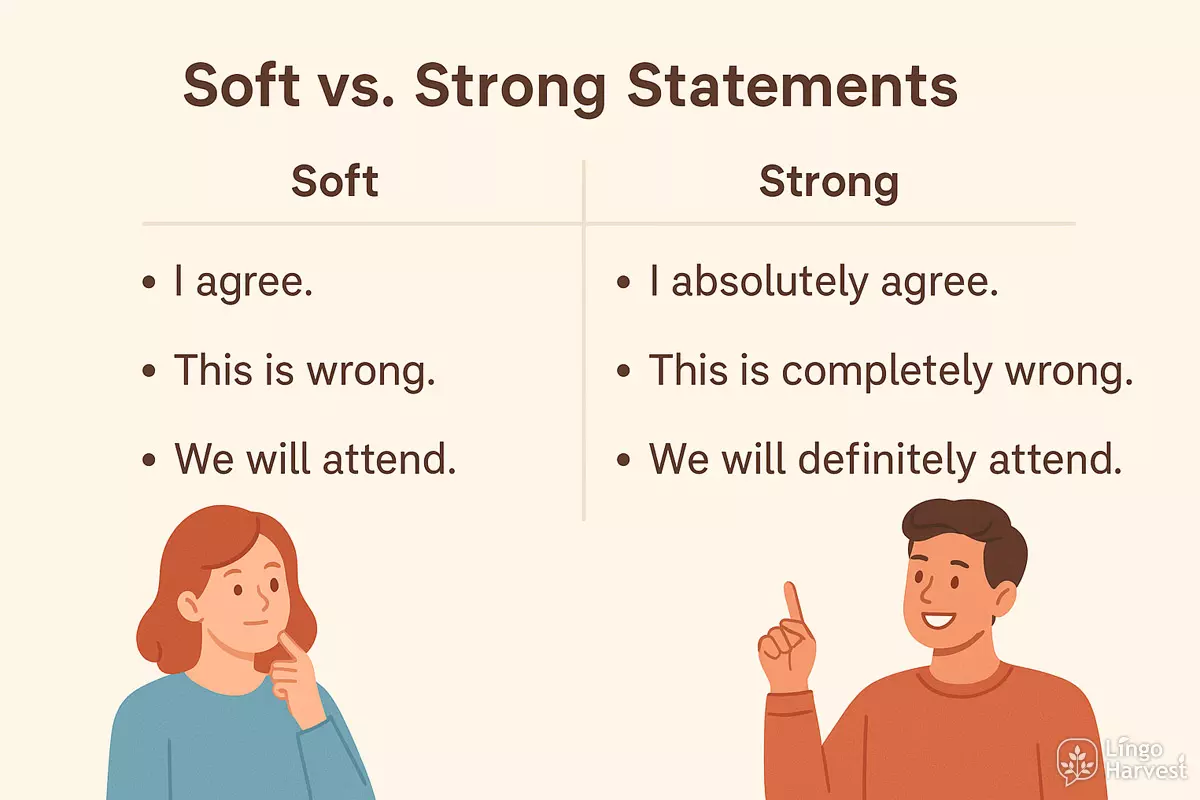
Without emphatic adverbs, statements may sound neutral or tentative. Adding them, however, can increase the speaker’s confidence or urgency. For example, compare the following:
- I agree. → I absolutely agree.
- This is wrong. → This is completely wrong.
- We will attend. → We will definitely attend.
Notice how the second version in each pair feels stronger and more committed. This is especially important in persuasive writing or when you want to reassure, insist, or express strong emotions.
Nuances and tone shifts
The level of emphasis can suggest different nuances. For instance, absolutely implies no doubt whatsoever, while definitely signals a high level of certainty but may leave room for exceptions. Completely highlights totality or thoroughness, often used to reinforce negatives or positives.
| Statement | Tone with Emphatic Adverb |
|---|---|
| I understand. | “I completely understand.” Adds empathy and assurance. |
| This is false. | “This is absolutely false.” Conveys strong rejection. |
| She is right. | “She is definitely right.” Shows confidence in her correctness. |
| It’s necessary. | “It’s absolutely necessary.” Indicates non-negotiable need. |
| You’re mistaken. | “You’re completely mistaken.” Intensifies the criticism. |
Common emphatic adverbs and their effects
Here are some advanced adverbs and the typical tones or effects they produce in sentences:
- Absolutely – total certainty, no doubt
- Definitely – strong confirmation, confidence
- Completely – totality, thoroughness
- Utterly – extreme, often negative
- Entirely – wholeness, without exception
- Totally – informal, full degree
- Perfectly – flawless, ideal
- Thoroughly – in-depth, exhaustive
- Unquestionably – no room for doubt
- Positively – confident, sometimes reassuring
- Decidedly – firmly, resolutely
- Undoubtedly – strong belief, little uncertainty
- Wholly – completely, fully
- Clearly – obviousness, transparency
- Seriously – earnestness, gravity
- Remarkably – impressive, notable
- Highly – strong recommendation or degree
- Fully – completeness, no parts missing
- Literally – actually, not figuratively (sometimes for emphasis)
- Profoundly – deep, significant impact
In conversation or writing, these adverbs help you control how assertive, polite, emotional, or formal your message sounds. Choosing the right level of emphasis ensures your meaning and intention are clear to your audience.
Avoiding overuse in writing
Writers often rely on emphatic adverbs like absolutely, definitely, or completely to reinforce their points. However, when these intensifiers appear too frequently, sentences can lose subtlety and start to sound exaggerated or insincere. Careful usage ensures your message remains powerful and natural.
Recognizing excessive emphasis
Overusing intensifiers not only weakens their effect but can also make your style repetitive. Instead of making your writing more persuasive, repeated adverbs may distract or even annoy readers. Consider whether the strength of your statement comes from the adverb, or if the verb or context already carries enough weight.
- “She was absolutely exhausted after work.” (might be strong enough without “absolutely”)
- “The room was completely silent.” (does “silent” already express the idea?)
- “He definitely disagreed with the proposal.” (is “disagreed” already strong?)
- “The results were really shocking.” (does “shocking” need “really”?)
- “She was extremely happy with the outcome.” (would “thrilled” be clearer?)
- “The task was absolutely impossible.” (is “impossible” strong enough?)
- “They were totally surprised by the news.” (could “surprised” work alone?)
- “He spoke very clearly during the presentation.” (is “clearly” precise enough?)
- “The meeting was completely unnecessary.” (does “unnecessary” already convey the meaning?)
- “Her reaction was really strange.” (is “strange” already expressive?)
Strategies for controlling intensifier use
To maintain clear, impactful prose, try these approaches:
- Replace emphatic adverbs with stronger verbs or adjectives (exhausted instead of very tired).
- Use adverbs sparingly—reserve them for moments that truly require extra force.
- Vary sentence structure to avoid repetitive patterns.
- Edit drafts to remove unnecessary intensifiers; read your writing aloud to catch awkward repetition.
Alternatives to emphatic adverbs
Sometimes, a direct expression or a more vivid word works better than an intensifier. Consider these substitutions:
- absolutely certain → convinced
- completely destroyed → ruined
- definitely wrong → mistaken
- absolutely necessary → essential
- completely sure → confident
- definitely possible → feasible
- absolutely silent → hushed
- completely full → packed
- definitely finished → completed
- absolutely unique → one-of-a-kind
Summary: achieving balance
Emphatic adverbs are most effective when used thoughtfully. Rely on them to highlight truly exceptional cases, not as routine fillers. By varying your language and focusing on precision, your writing will remain engaging and credible.
Practice: choose suitable emphatic adverbs
Applying advanced intensifiers like absolutely, definitely, and completely can add nuance and force to your statements. Below you’ll find exercises and examples to help you master these emphatic adverbs in context.
Choose the best emphatic adverb
For each sentence, select the most appropriate adverb from the advanced list: absolutely, definitely, completely, utterly, totally, thoroughly, perfectly, entirely, unquestionably, positively, distinctly, categorically, undeniably, unconditionally, exceptionally, remarkably, seriously, profoundly, deeply, fiercely.
- That statement is _____ false; there’s no truth in it at all.
- She was _____ exhausted after the marathon.
- I can _____ assure you that your package will arrive tomorrow.
- This solution is _____ effective for complex problems.
- He was _____ convinced he was right, despite the evidence.
- The room was _____ silent after the announcement.
- They are _____ certain they saw her at the event.
- The project failed _____ due to lack of planning.
- Her performance was _____ outstanding.
- He is _____ committed to improving his skills.
Show answers
- utterly
- completely
- definitely
- exceptionally
- absolutely
- perfectly
- positively
- entirely
- remarkably
- deeply
Contextual Usage: Emphatic Adverbs in Sentences
Notice how each adverb intensifies the meaning. Try to match the adverb to the context, considering both collocation and degree of emphasis. Here’s a table with common pairings:
| Adverb | Typical Collocations / Example Phrases |
|---|---|
| absolutely | absolutely certain, absolutely essential, absolutely impossible |
| completely | completely agree, completely silent, completely destroyed |
| definitely | definitely true, definitely going, definitely not |
| totally | totally unacceptable, totally different, totally convinced |
| entirely | entirely responsible, entirely new, entirely separate |
| perfectly | perfectly clear, perfectly normal, perfectly safe |
| utterly | utterly ridiculous, utterly hopeless, utterly alone |
| thoroughly | thoroughly enjoy, thoroughly cleaned, thoroughly convinced |
| profoundly | profoundly grateful, profoundly affected, profoundly different |
| categorically | categorically deny, categorically refuse |
Task: Rewrite with Emphatic Adverbs
Upgrade each sentence using a suitable intensifier from the advanced list:
- I agree. → I _____ agree.
- He is wrong. → He is _____ wrong.
- The results are clear. → The results are _____ clear.
- I support you. → I _____ support you.
- She succeeded. → She _____ succeeded.
- They failed. → They _____ failed.
- The plan works. → The plan _____ works.
- He refused. → He _____ refused.
- The idea is wrong. → The idea is _____ wrong.
- I trust him. → I _____ trust him.
Show answers
- I completely agree.
- He is absolutely wrong.
- The results are perfectly clear.
- I unconditionally support you.
- She fully succeeded.
- They completely failed.
- The plan definitely works.
- He firmly refused.
- The idea is completely wrong.
- I completely trust him.
Practicing with a range of intensifiers not only makes your English more expressive but also helps convey the exact strength of your opinions or descriptions. Experiment with these adverbs to see which best fits different situations.