What Are Adjectives? Complete Beginner Guide

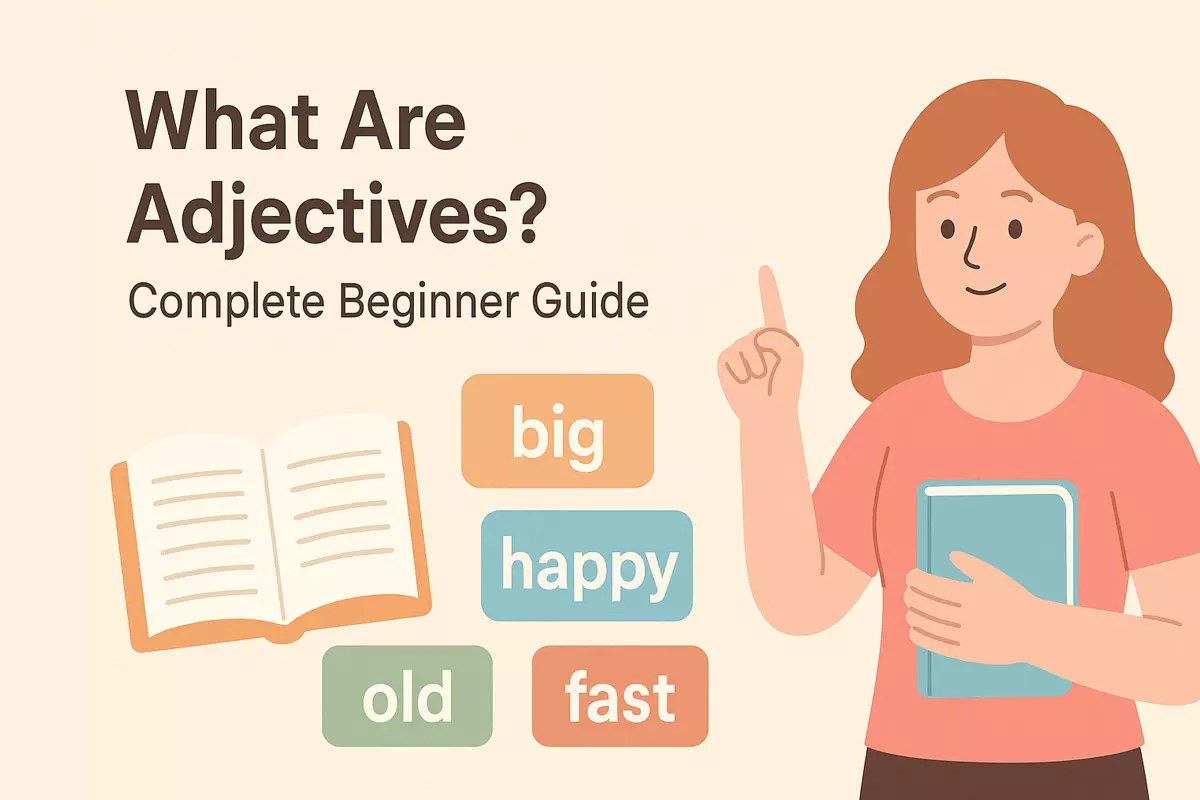 This article explains what adjectives are in English, what they describe, and where they appear in sentences. It includes clear examples with people, places, and things, highlights common mistakes, and offers a brief practice exercise.
Descriptive words help us paint a clearer picture of the world by adding details and color to our language. By using terms that modify nouns and pronouns, we can make our writing more engaging and precise, helping readers visualize scenes and understand meaning more deeply. Learning how to use these descriptive tools effectively allows us to transform plain sentences into lively narratives, making our communication more interesting and memorable. Developing this skill is essential for anyone looking to improve their writing and storytelling abilities.
Definition of adjectives in English
An adjective is a word that describes or modifies a noun or pronoun, giving more information about its qualities, quantity, or state. In everyday English, these words help us paint a clearer picture by answering questions like "What kind?", "How many?", or "Which one?". For example, in the phrase a red apple, the word red tells us more about the apple.
What Do Adjectives Do?
Adjectives add detail and specificity. They can describe color, size, shape, age, origin, material, or other characteristics. This makes sentences more vivid and precise. Consider how different these two sentences feel:
- The cat slept.
- The fluffy, white cat slept peacefully.
The second example uses adjectives to create a much clearer image.
Common Types of Adjectives
- Descriptive adjectives: Describe qualities (e.g., happy, blue, tall).
- Quantitative adjectives: Indicate amount or number (e.g., many, few, several).
- Demonstrative adjectives: Point out specific things (e.g., this, those).
- Possessive adjectives: Show ownership (e.g., my, their).
- Interrogative adjectives: Used in questions (e.g., which, what).
- Distributive adjectives: Refer to individual items in a group (e.g., each, every).
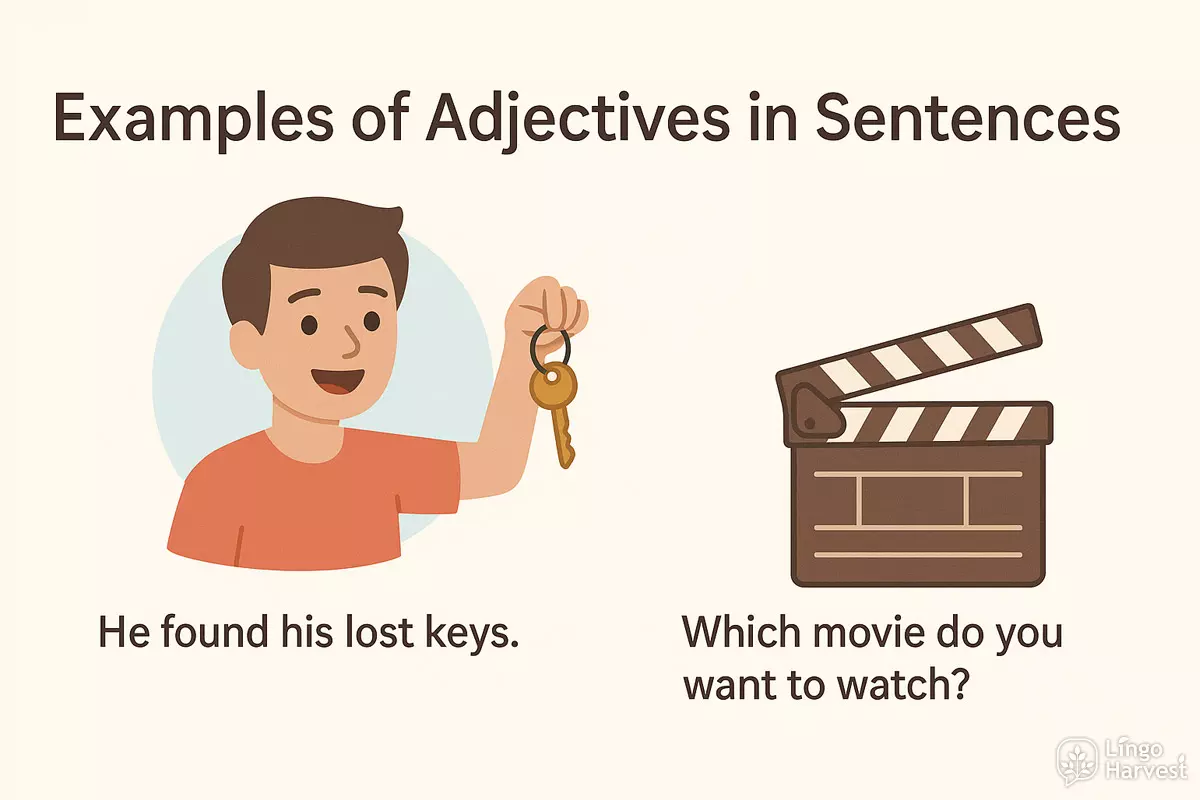
Examples of Adjectives in Sentences
- A small puppy barked loudly.
- She wore a beautiful dress.
- There are twelve cookies on the plate.
- Those books are interesting.
- He found his lost keys.
- Which movie do you want to watch?
- Each student received a prize.
- The old car broke down.
- They visited a famous museum.
- She has a red umbrella.
Position of Adjectives in English
Most often, adjectives come before the noun they describe: a cold drink. Sometimes, adjectives follow a linking verb: The soup is hot. This placement depends on the sentence structure and the adjective’s function.
Quick Comparison: Adjectives vs. Other Modifiers
| Type | What it modifies |
|---|---|
| Adjective | Nouns or pronouns (a busy street, she is happy) |
| Adverb | Verbs, adjectives, or other adverbs (runs quickly, very tall) |
| Determiner | Nouns, specifying which or how many (this book, three chairs) |
| Pronoun | Replaces a noun (he, they) |
Understanding how adjectives work is essential for building clear and engaging sentences in English. These descriptive words help you communicate details and make your language more expressive.
What adjectives describe in a sentence
Adjectives are words that modify nouns or pronouns, providing more information about their qualities, quantities, or characteristics. Instead of just naming something, adjectives help paint a clearer picture by telling us what kind, how many, or which one. For example, in the sentence “She wore a beautiful dress,” the word “beautiful” gives us an idea about the dress’s appearance.
Types of information adjectives express
Adjectives can describe many different aspects of a noun. Some of the most common types of information include:
- Appearance: tall, short, colorful, shiny
- Size: large, tiny, massive, small
- Shape: round, square, flat, oval
- Color: red, blue, green, golden
- Quantity: many, few, several, numerous
- Age: old, young, ancient, new
- Emotion: happy, anxious, excited, calm
- Origin: Italian, American, ancient, modern
- Material: wooden, plastic, metallic, cotton
- Condition: broken, clean, dirty, perfect
Placement of adjectives in sentences
Adjectives usually appear before the noun they describe (attributive position):
- “A blue car”
- “Three happy children”
They can also come after a verb (predicative position), often following “be,” “seem,” or “become”:
- “The sky is clear.”
- “Those apples look fresh.”
Examples of adjectives describing nouns
Here are more examples showing what kind of details adjectives can add:
- A noisy classroom
- An interesting book
- The old bridge
- Five golden coins
- A dangerous road
- Some delicious cookies
- The empty street
- A quick answer
- The friendly dog
- Several broken chairs
- The cold weather
- A famous actor
Adjectives enrich sentences by giving readers and listeners a clearer, more specific understanding of the people, places, and things being discussed. They answer questions like “What kind?”, “How many?”, and “Which one?”, making language more vivid and precise.
Where adjectives usually go in a sentence
Adjectives typically appear right before the noun they describe. This is called the "attributive" position. For example, in the phrase "a red apple," the word "red" is an adjective that comes before "apple." Putting the descriptive word directly in front of the noun is the most common pattern in English. Sometimes, adjectives can also follow a linking verb such as "be," "seem," or "become." In these cases, the adjective is in the "predicative" position. For example: "The apple is red." Here, "red" comes after the verb "is" and still describes the noun "apple." Both positions are common, but which one you use depends on the sentence structure.
Typical adjective placements
- Before a noun (attributive): a tall building
- After a linking verb (predicative): The building is tall
- After certain pronouns: something interesting, nothing new
- After "as," "so," "too," "enough": so cold, big enough
- With verbs like "make," "find," "consider": make it easy, find her helpful
- In comparative or superlative forms: the biggest city, smaller car
- In adjective phrases: full of hope, afraid of dogs
- After "something," "anyone," etc.: anything possible, someone special
- In set expressions: heir apparent, attorney general
- After nouns in certain cases (mostly in poetry or older English): the stars bright
Examples of adjective order with multiple adjectives
When you use more than one adjective before a noun, there’s a standard order:
| Adjective Type | Example |
|---|---|
| Opinion | beautiful, boring |
| Size | big, tiny |
| Age | old, modern |
| Shape | round, square |
| Color | red, green |
| Origin | French, American |
| Material | wooden, plastic |
| Purpose | sleeping (as in "sleeping bag"), gardening |
The usual sequence is: opinion ➔ size ➔ age ➔ shape ➔ color ➔ origin ➔ material ➔ purpose ➔ noun. For example, "a lovely small old round red French wooden jewelry box." Most sentences use only two or three adjectives, but this order helps them sound natural. Understanding where descriptive words fit in a sentence makes your English clearer and more natural. If you remember the basic patterns and common exceptions, you’ll use adjectives much more confidently.
Basic examples with people, places, and things
Adjectives are used to describe or give more information about nouns, such as people, locations, and objects. They help make sentences clearer and more vivid by adding details about qualities like color, size, shape, or mood. Let’s look at how descriptive words work in everyday situations.
Describing People
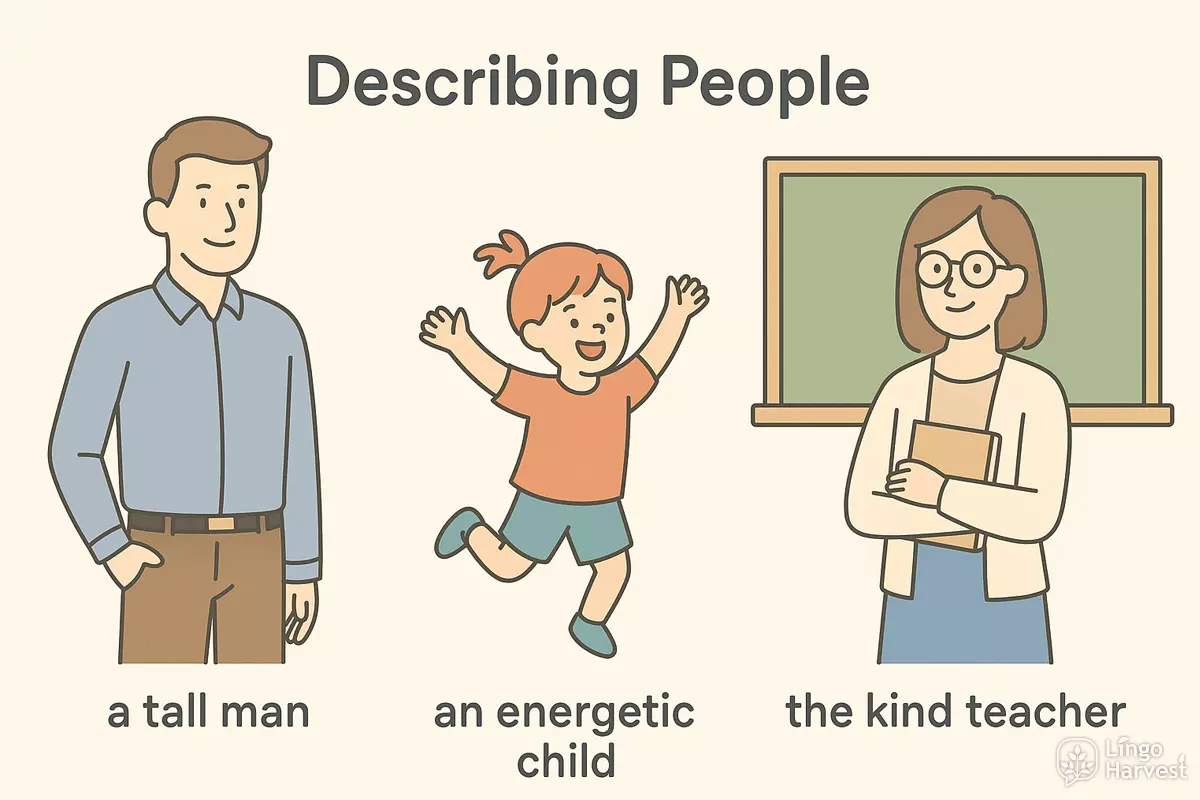
When talking about individuals, adjectives can highlight appearance, personality, or feelings. Here are a few ways to describe someone:
- a tall man
- an energetic child
- the kind teacher
- her curly hair
- a thoughtful friend
- the friendly neighbor
- his blue eyes
- a brave firefighter
- the shy student
- an optimistic coach
Talking About Places
Adjectives help us paint a picture of locations, whether they’re cities, rooms, or landscapes. Notice how these words set the scene:
- a crowded market
- the quiet library
- an ancient castle
- a peaceful park
- the busy street
- a modern building
- the sunny beach
- a remote village
- the dark alley
- a colorful garden
Describing Things
Objects can be described by their shape, material, or other qualities. This helps listeners or readers understand exactly what is meant:
- a round table
- the broken clock
- an old book
- a soft pillow
- the shiny car
- an expensive watch
- a heavy box
- the cold drink
- a wooden chair
- the fresh bread
Comparing Examples
To see how adjectives work with different nouns, here’s a comparison of how a single descriptive word can be used with a person, a place, and a thing:
| Adjective | Person Example | Place/Thing Example |
|---|---|---|
| cold | a cold doctor (unfriendly) | a cold room / a cold drink |
| bright | a bright student (intelligent) | a bright classroom / bright lights |
| old | an old neighbor | an old city / old shoes |
| quiet | a quiet child | a quiet village / quiet street |
| happy | a happy teacher | a happy place / happy memory |
By using adjectives, your sentences become more specific and interesting, helping others understand exactly what you mean, whether you’re talking about someone you know, a memorable location, or an everyday object.
Common mistakes beginners make with adjectives
Learning to use describing words correctly can be tricky at first. Many learners stumble over similar challenges, especially if their native language handles these words differently. Below, you'll find some of the most frequent errors and tips on how to avoid them.
Placing adjectives in the wrong position
One of the first hurdles is word order. In English, adjectives almost always come before the noun they describe (a red apple), not after (apple red ❌). Some languages do the opposite, so it's easy to mix up.
Using too many adjectives at once
Stacking several adjectives together can make sentences confusing. There is a natural order for multiple adjectives, but beginners often ignore it. Here's a handy guide:
| Order | Type | Example |
|---|---|---|
| 1 | Opinion | beautiful, ugly, delicious |
| 2 | Size | big, tiny, huge |
| 3 | Age | old, new, young |
| 4 | Shape | round, square, flat |
| 5 | Color | red, blue, green |
| 6 | Origin | French, American, ancient |
| 7 | Material | wooden, plastic, cotton |
| 8 | Purpose | sleeping (as in sleeping bag) |
For example: "a beautiful big old round red French wooden sleeping chair". While you rarely need so many, the order helps sentences sound natural.
Confusing adjectives and adverbs
Mixing up adjectives (which describe nouns) and adverbs (which describe verbs, adjectives, or other adverbs) is a classic pitfall. For example:
- He ran quickly (adverb, correct), not quick (adjective, incorrect here).
- She is a good singer (adjective, correct), not well singer (adverb, incorrect here).
Forgetting comparative and superlative forms
When comparing things, it's important to use the right forms:
- big → bigger → biggest
- happy → happier → happiest
- expensive → more expensive → most expensive
Beginners sometimes use "more" or "most" with short adjectives (e.g., more big ❌) or add "-er/-est" to long words (e.g., beautifuller ❌).
Using adjectives as nouns
Some learners try to use adjectives alone as nouns. In English, you need a noun for most situations: say "a red car" instead of just "a red".
Overusing "very" and similar intensifiers
Words like "very", "really", and "so" can make speech less precise. Try more descriptive adjectives instead of always saying "very big" or "very nice".
Common examples of mistakes:
- She has hairs long. ❌ → She has long hair. ✅
- It is a blue beautiful car. ❌ → It is a beautiful blue car. ✅
- This soup is deliciously. ❌ → This soup is delicious. ✅
- He is more tall than me. ❌ → He is taller than me. ✅
- I have a green small bag. ❌ → I have a small green bag. ✅
- She is a well teacher. ❌ → She is a good teacher. ✅
- He is the most fastest runner. ❌ → He is the fastest runner. ✅
- The dress red is pretty. ❌ → The red dress is pretty. ✅
- She is more happier now. ❌ → She is happier now. ✅
- This is the beautifullest place. ❌ → This is the most beautiful place. ✅
Paying attention to these patterns will help you avoid many of the early mistakes and use descriptive words more naturally in your sentences.
Short practice: choose the adjective for each noun
Understanding how adjectives work is easiest when you match them directly to nouns. Below you’ll find a variety of exercises to help you pick the correct describing word for different objects, people, and places. This activity is designed to reinforce your grasp of how adjectives modify nouns in English.
Look at each noun below and select the most suitable adjective from the options provided. Try to think about what makes sense or sounds natural in English.
Practice: Match the adjective to the noun
- Car: (old, green, delicious)
- Dog: (furry, tall, spicy)
- Weather: (rainy, salty, wooden)
- Pizza: (cheesy, noisy, narrow)
- Book: (interesting, bitter, silver)
- River: (wide, sweet, fluffy)
- Chair: (comfortable, thirsty, round)
- Music: (loud, heavy, sour)
- House: (big, spicy, polite)
- Flower: (beautiful, bright, dry)
Some adjectives fit naturally, while others sound odd. This helps you notice which adjectives are commonly used with certain nouns.
More adjective-noun combinations
- Mountain: (high, salty, polite)
- Tea: (hot, green, furry)
- Road: (long, loud, sweet)
- Child: (happy, wooden, wide)
- Cat: (playful, delicious, narrow)
Try making your own adjective-noun pairs, or switch adjectives to create funny or strange images. This can help you remember which words go well together.
Show answers
- Car: old, green
- Dog: furry, tall
- Weather: rainy
- Pizza: cheesy
- Book: interesting
- River: wide
- Chair: comfortable, round
- Music: loud, heavy
- House: big
- Flower: beautiful, bright, dry
- Mountain: high
- Tea: hot, green
- Road: long
- Child: happy
- Cat: playful, narrow