More vs Most: Comparative and Superlative Quantifiers Explained

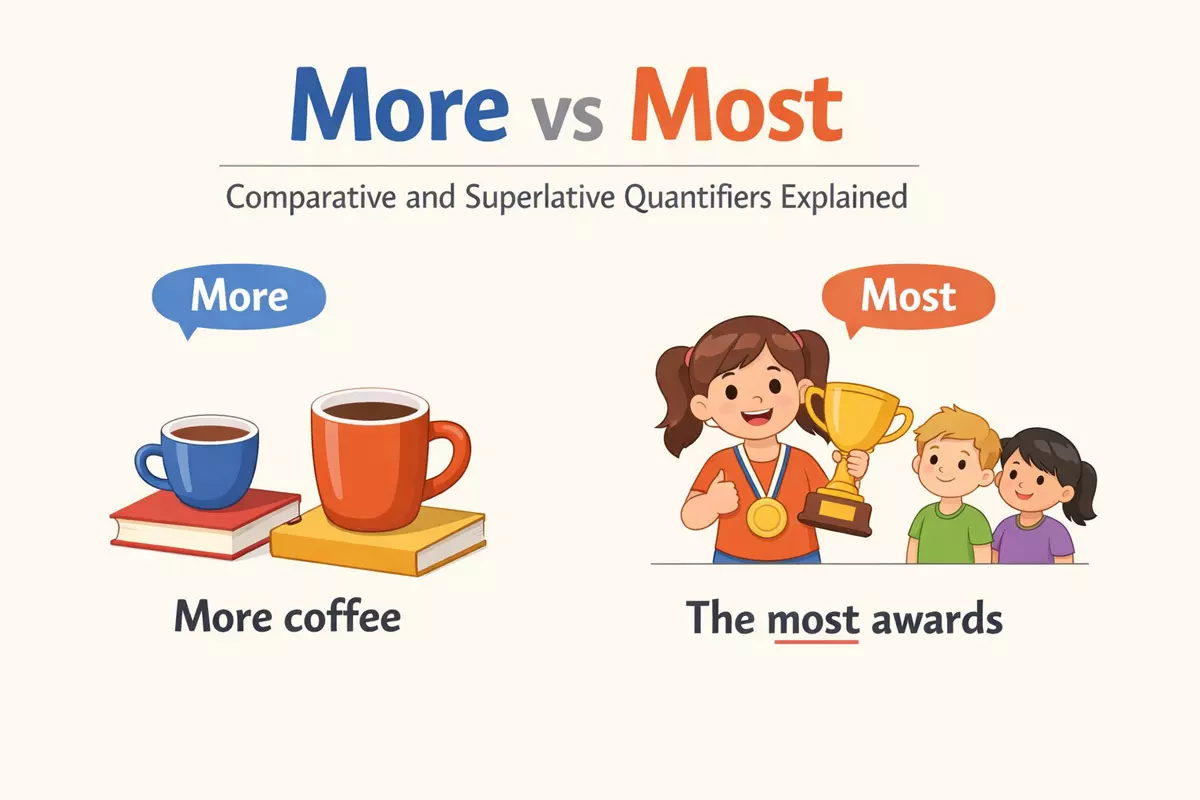 Here we how to use 'more' and 'most' for comparisons and superlatives, including their use with countable and uncountable nouns, sentence patterns, meaning shifts, and common mistakes. It also provides examples and practice for accurate usage.
- Comparative vs superlative meaning in quantity
- Use with countable and uncountable nouns
- More and most in comparisons and groups
- Sentence structure and common patterns
- Meaning changes depending on context
- Frequent learner mistakes
- Examples in spoken and written English
- Practice: selecting more or most accurately
Comparing quantities and expressing the highest degree are essential skills for clear communication, especially when you want to highlight differences or identify the top choice among several options. To compare two things, you can use comparative forms such as “bigger,” “more interesting,” or “less expensive.” When you want to show that something stands out as the best or most extreme among three or more items, you use superlative forms like “biggest,” “most interesting,” or “least expensive.” Mastering these forms will help you convey your ideas more precisely and effectively.
Comparative vs superlative meaning in quantity
When discussing amounts, English uses specific quantifiers to signal whether we’re comparing two things or highlighting the highest degree among several. The words “more” and “most” are the primary comparative and superlative forms for quantity, and each serves a distinct purpose in communication.
How comparatives express quantity
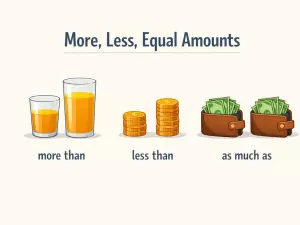
Comparatives like more indicate a greater amount relative to another thing or group. This form is used when comparing exactly two items or sets. For example, saying “She has more experience than Tom” directly compares the experience of two people. The focus is on difference, not absolute extremes.
- More water than juice
- More apples than oranges
- More students in Class A than in Class B
- More sugar in tea than in coffee
- More questions this time than last time
- More money than last year
- More books than his friend
- More time than before
- More effort than necessary
- More options than expected
Superlatives and their role in quantity
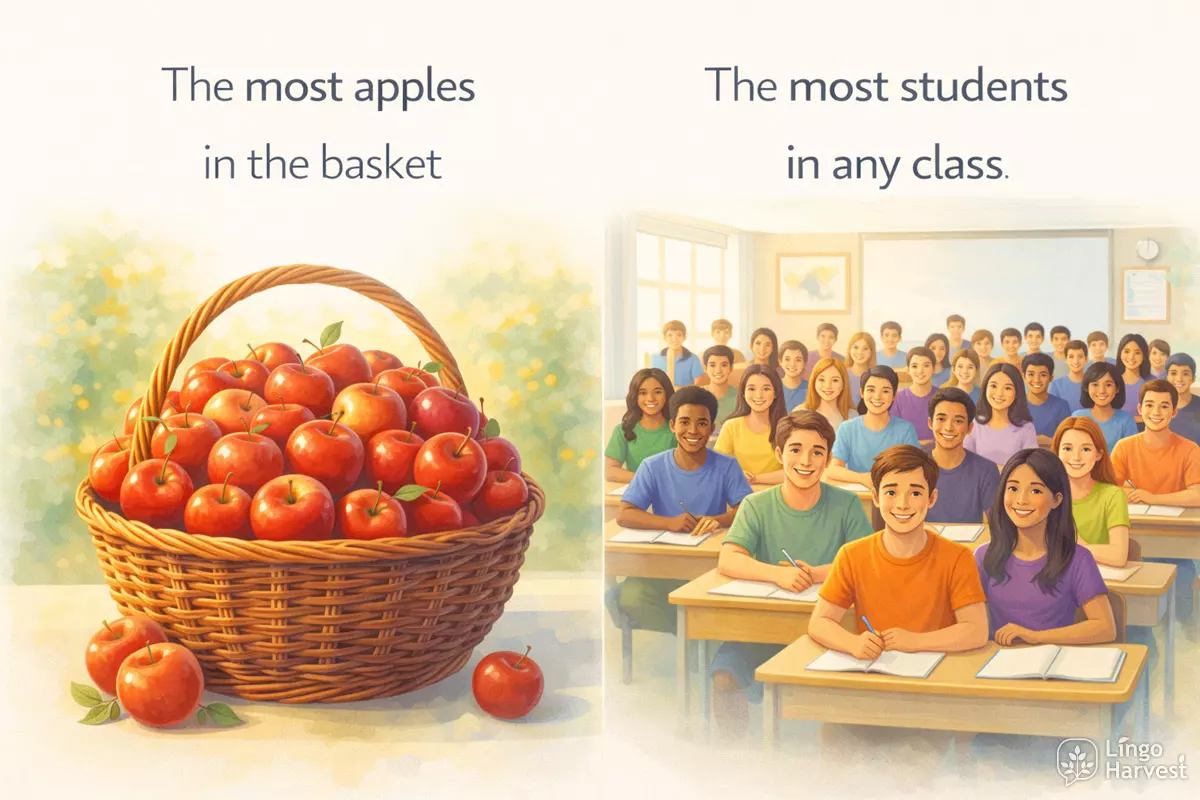
Superlatives such as most identify the highest quantity within a group of three or more. Rather than just comparing, they single out what stands above all others in terms of amount. For instance, “She has the most experience in the team” tells us no one else in the group has more. It’s about identifying the top or the extreme.
- The most water on the table
- The most apples in the basket
- The most students in any class
- The most sugar in any drink
- The most questions asked
- The most money saved
- The most books read
- The most time available
- The most effort put in
- The most options offered
Comparing forms: “more” vs “most”
The table below summarizes how comparative and superlative quantifiers function in sentences about quantity:
| Form | Function | Example |
|---|---|---|
| More | Compares two things or groups in terms of amount | “He ate more cookies than Sam.” |
| Most | Identifies what has the greatest amount in a group of three or more | “She ate the most cookies at the party.” |
Key points to remember
- Use more when comparing two entities.
- Use most when singling out the greatest quantity among three or more.
- These quantifiers can be applied to countable and uncountable nouns.
- Context determines which form is appropriate.
Understanding these distinctions helps ensure clarity when describing differences or extremes in quantity, whether in everyday conversation or academic writing.
Use with countable and uncountable nouns
When talking about quantities, whether something can be counted individually or not affects how we use “more” and “most.” Countable nouns refer to items you can count one by one, like “books,” “apples,” or “cars.” Uncountable nouns (sometimes called mass nouns) refer to substances or concepts you can’t separate into individual elements, such as “water,” “information,” or “happiness.”
Comparing quantities
The good news: both “more” and “most” work for both types of nouns. There’s no need to switch to a different word depending on whether you’re talking about countable or uncountable things. The main difference is in the noun form that follows.
- More + plural countable noun: “more apples,” “more chairs”
- More + uncountable noun: “more sugar,” “more music”
- Most + plural countable noun: “the most students,” “the most ideas”
- Most + uncountable noun: “the most patience,” “the most equipment”
Examples in context
To see the difference in practice, here are examples with both forms:
| Countable Nouns | Uncountable Nouns |
|---|---|
| She has more books than I do. | He needs more advice on the topic. |
| Who ate the most cookies? | Which recipe uses the most flour? |
| There are more cars in the parking lot today. | This glass has more water than that one. |
| She answered the most questions in class. | He showed the most interest in the project. |
Quick tips for correct usage
- If you can make a noun plural (like “dogs” or “ideas”), it’s countable.
- If the noun does not have a plural form (like “milk” or “music”), it’s uncountable.
- “More” and “most” remain unchanged—what matters is the noun that follows.
- Some nouns can be both countable and uncountable depending on context (e.g., “chicken” as an animal vs. as food).
- Always use “the” before “most” when you mean the superlative (“the most time,” “the most friends”).
Understanding when a noun is countable or uncountable helps you pair “more” and “most” with the right form, but the words themselves stay the same. Just focus on the noun: is it something you can count, or a substance/idea you measure?
More and most in comparisons and groups
When discussing quantities, frequency, or degree, English uses specific words to show differences between two items or among several. "More" is typically used to compare two entities, highlighting an increase or greater amount, while "most" is reserved for singling out the highest degree within a group of three or more. Understanding how to use these quantifiers correctly can clarify your meaning and help you construct precise sentences.
Comparing Two: Using "more"
We use "more" to show that one thing has a greater amount or degree than another. This form is called the comparative. It works with adjectives, adverbs, and nouns, especially when the base word is long or irregular. Here are some examples:
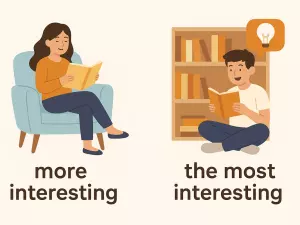
- This book is more interesting than that one.
- She runs more quickly than her brother.
- There are more apples in this basket than in the other.
- He has more patience than most people.
- Today is more humid than yesterday.
- They need more time to finish the project.
- Which city is more expensive to live in?
- We should invite more friends to the party.
- This movie is more suitable for children.
- She speaks more languages than her classmates.
Comparing Groups: Using "most"
"Most" is used to indicate the highest level of a quality or quantity within a group of three or more. This is the superlative form, which identifies one item as standing out from the rest. Here are some ways to use it:
- He is the most talented musician in the band.
- This is the most comfortable chair in the room.
- Of all the students, she answered the most questions correctly.
- This is the most exciting part of the trip.
- Who has the most experience in this field?
- It was the most difficult exam of the year.
- He made the most mistakes on the test.
- This is the most beautiful painting in the gallery.
- She is the most popular teacher at school.
- This area receives the most rainfall annually.
Comparative and Superlative Patterns
To help visualize how these forms are used, here is a table showing common patterns with "more" and "most" for different types of words:
| Base Form | Comparative ("more") | Superlative ("most") |
|---|---|---|
| careful | more careful | most careful |
| interesting | more interesting | most interesting |
| quickly | more quickly | most quickly |
| apples | more apples | most apples |
| experience | more experience | most experience |
| comfortable | more comfortable | most comfortable |
Tips for Usage
- Use more when comparing two things or people.
- Use most when referring to the greatest quantity or degree in a group of three or more.
- With short adjectives (one syllable), use "-er" and "-est" forms instead (e.g., "taller," "tallest").
- With longer adjectives (two syllables or more), use "more" and "most" (e.g., "more careful," "most careful").
- For uncountable nouns, "more" and "most" still apply (e.g., "more water," "most information").
Choosing between these quantifiers depends on the number of items being compared and the type of word involved. Accurate usage helps your English sound natural and precise.
Sentence structure and common patterns
Understanding how to use "more" and "most" correctly in sentences is essential for expressing comparisons and superlative ideas. Both words function as quantifiers, but they appear in different grammatical environments and follow distinct patterns.
Typical sentence patterns with "more"
"More" is used for comparative statements, often comparing two entities or groups. It commonly appears before adjectives, adverbs, or nouns, depending on what is being compared. Here are some frequent structures:
- More + adjective/adverb + than: She is more experienced than her colleague.
- More + noun + than: The library has more books than the bookstore.
- More of + noun: I would like more of that cake.
- Verb + more: Please eat more.
- More + uncountable noun: We need more information.
"More" can also be used with plural countable nouns and uncountable nouns, making it highly flexible in comparative contexts.
Typical sentence patterns with "most"
"Most" is used for superlative statements, highlighting something as the highest degree within a group or category. Common structures include:
- The most + adjective: She is the most talented artist in the class.
- Most + noun: Most children like ice cream.
- The most + adverb: He runs the most quickly of all the competitors.
- Most of + noun/pronoun: Most of them agreed with the decision.
- Verb + the most: He studies the most.
"Most" can act as a determiner or as a superlative adverb/adjective, depending on its position.
Comparing "more" and "most" in context
The choice between "more" and "most" depends on whether you are comparing two things or identifying the highest degree among three or more. Here’s a summary of how these quantifiers are typically structured:
| Pattern | Example Sentence |
|---|---|
| More + adjective/adverb + than | This movie is more exciting than the last one. |
| Most + adjective (with "the") | He is the most intelligent student in the group. |
| More + noun + than | She has more friends than her brother. |
| Most + noun | Most people enjoy holidays. |
| Verb + more | Try to read more every day. |
| Verb + the most | Out of everyone, she smiles the most. |
Common mistakes to watch for
Learners often confuse when to use each quantifier. For example, using "most" when only comparing two items is incorrect (❌ "She is the most tall of the two" should be "She is taller of the two" or "She is more tall of the two" if the adjective requires it). Remember:
- Use "more" for comparisons between two.
- Use "most" for the highest degree among three or more.
- Do not use "the" before "most" when it means "the majority of" (e.g., "Most cats are independent").
Recognizing these patterns helps make your comparative and superlative statements clear and grammatically correct.
Meaning changes depending on context
How we use "more" and "most" often depends on the situation, what’s being compared, and whether we’re dealing with countable or uncountable quantities. While both terms serve as quantifiers, their interpretation can shift based on the words they modify and the context in which they appear.
Countable vs. Uncountable Nouns
"More" and "most" behave differently with countable and uncountable nouns. For example, "more apples" refers to a greater number of individual apples, while "more water" means a larger quantity of water. The distinction is subtle but important for clarity.
- Countable: more books, most students
- Uncountable: more information, most sugar
Comparing Two vs. Many

When comparing just two items, "more" is appropriate. For three or more, "most" is usually the right choice. However, conversational nuance may lead to exceptions, especially in informal speech or writing.
| Situation | Correct Usage |
|---|---|
| Comparing two people | She is more talented than her brother. |
| Comparing a group | She is the most talented in her class. |
| Describing quantity (uncountable) | He has more patience than most. |
| Superlative among many | This is the most important rule. |
Shifting Focus: Quality, Quantity, and Preference
Sometimes, "more" and "most" focus on different aspects, such as quality, quantity, or preference. The intended meaning can change subtly:
- Quality: "This solution is more effective."
- Quantity: "There are more options available."
- Preference: "I like this one the most."
- Frequency: "She visits more often than he does."
- Degree: "This is the most challenging task."
- Emphasis: "What matters most is honesty."
- Comparison: "He eats more than I do."
- Superiority: "She is the most respected leader."
- Proportion: "More than half agreed."
- Majority: "Most people enjoyed the event."
Interpretation in Real-World Contexts
The same phrase can mean different things depending on context. For instance, "more important" could refer to urgency in one scenario and to personal value in another. The surrounding words and the listener’s expectations help determine the precise meaning.
Ultimately, understanding how these quantifiers operate within specific contexts helps avoid ambiguity and ensures your meaning is clear, whether you’re comparing objects, people, or ideas.
Frequent learner mistakes
When discussing comparative and superlative quantifiers like "more" and "most," it's common to see errors caused by confusion over usage rules, word forms, or sentence structure. These mistakes can make sentences sound unnatural or even change their meaning entirely.
Common misuse in comparisons and superlatives
Many English learners mistakenly use "more" when "most" is needed and vice versa. Others combine these words with regular comparative or superlative forms, resulting in ungrammatical phrases. Here are some typical issues:
- Using "more" with adjectives that already have the "-er" ending (e.g., more taller instead of taller)
- Using "most" with adjectives that take the "-est" form (e.g., most fastest instead of fastest)
- Applying "more" or "most" to non-gradable adjectives (e.g., more perfect, most unique)
- Choosing "most" in comparisons between two items, where "more" is correct
- Forgetting to use "the" before "most" in superlative noun phrases (e.g., most interesting book vs the most interesting book)
- Using "more" or "most" before nouns without "of" or an article when required (e.g., more students vs the more of students)
- Mixing up countable and uncountable nouns with "more" and "most" (e.g., more informations instead of more information)
- Adding unnecessary words: the more better, the most best
- Using "most" as an intensifier instead of a superlative (e.g., She is most happy instead of She is very happy)
- Confusing "most" (superlative) with "almost" (adverb meaning "nearly")
Side-by-side comparison errors
Learners often get confused by when to use "more" or "most" based on the number of items being compared. The table below shows some typical mistakes and their corrected forms:
| Incorrect | Correct |
|---|---|
| This solution is more easiest. | This solution is the easiest. |
| She is the most tallest in the class. | She is the tallest in the class. |
| Between these two, John is the most intelligent. | Between these two, John is more intelligent. |
| He gave me more better advice. | He gave me better advice. |
| This is the most unique design. | This is a unique design. |
| She is the more hardworking student. | She is the most hardworking student. |
Mixing forms with irregular adjectives
Irregular adjectives like "good," "bad," or "far" have unique comparative and superlative forms. Learners sometimes mistakenly use "more" or "most" with these:
- more better ❌ → better ✅
- most worst ❌ → worst ✅
- more farther ❌ → farther ✅
Summary tips
To avoid these pitfalls, remember:
- Use "more" for comparisons between two items or groups
- Use "most" when singling out one item as having the highest degree
- Don't combine "more/most" with "-er/-est" or irregular forms
- Check if the adjective is gradable before using comparative or superlative forms
A careful review of these patterns can help make your English sound more natural and precise.
Examples in spoken and written English
Understanding how to use "more" and "most" naturally is easiest when you see them in context. These words help us compare quantities, qualities, or degrees, both in everyday speech and formal writing. Below, you'll find a range of sample sentences and typical phrases that show how these quantifiers appear in real communication.
Everyday conversational uses
- Can I have more coffee, please?
- She has more experience than anyone else on the team.
- Who has the most points so far?
- This is the most interesting book I've read all year.
- We need more chairs for the meeting.
- Which restaurant has the most reviews?
- He spends more time outside than his brother.
- What do you enjoy most about your job?
- They want more options on the menu.
- Out of all the candidates, she answered the questions most confidently.
Written English: formal and informal examples
- The study found that participants who exercised more reported better health outcomes.
- More information will be provided in the next newsletter.
- Among all the proposals, this one offers the most comprehensive solution.
- Students who read more books tend to perform better in exams.
- The most important factor is clear communication.
- This software allows you to access more features with a subscription.
- The most effective strategies were implemented first.
- More research is needed to confirm these findings.
Comparative and superlative patterns
To clarify the difference between these forms, consider the typical sentence structures below:
| Form | Example Sentence |
|---|---|
| Comparative ("more") | This project is more challenging than the last one. |
| Superlative ("most") | She is the most talented artist in the group. |
| Comparative (uncountable noun) | We need more information before making a decision. |
| Superlative (uncountable noun) | This report contains the most data. |
These examples illustrate how "more" and "most" fit into both spoken and written English, adapting to context, tone, and topic. Whether you're describing quantity, degree, or quality, choosing the right form helps make your meaning clear.
Practice: selecting more or most accurately
Understanding when to use “more” or “most” improves both clarity and precision in English. Let’s work through some practical exercises and examples to help you confidently choose the correct form in different contexts.
Quick review: when to use each form
- “More” is used for comparisons between two items, people, or groups, or when comparing an item to a group.
- “Most” is used when referring to the highest degree within a group of three or more.
- Some adjectives and adverbs use “more” and “most” instead of “-er” or “-est” endings, especially if they have two or more syllables (e.g., “more beautiful,” “most interesting”).
Common patterns with “more” and “most”
Here are typical collocations and structures you’ll see:
- more comfortable / most comfortable
- more difficult / most difficult
- more expensive / most expensive
- more reliable / most reliable
- more successful / most successful
- more convenient / most convenient
- more important / most important
- more careful / most careful
- more creative / most creative
- more dangerous / most dangerous
- more recent / most recent
- more unusual / most unusual
- more helpful / most helpful
- more patient / most patient
- more efficient / most efficient
- more thoughtful / most thoughtful
- more talented / most talented
- more flexible / most flexible
- more generous / most generous
- more powerful / most powerful
Choosing the right form: practice quiz
Try these sentences. Decide if “more” or “most” fits best in each blank.
- This is the ________ challenging puzzle I’ve ever tried.
- Of the two options, which is ________ affordable?
- She is the ________ experienced member of the team.
- Is this book ________ interesting than the last one?
- He is ________ patient than his brother, but not the ________ patient in the class.
- This route is ________ direct than the one we used yesterday.
- That was the ________ exciting moment of the entire trip.
- Her explanation was ________ clear than the teacher’s.
- This is the ________ useful feature in the new update.
- Of all the students, Mark is the ________ confident speaker.
Show answers
- most
- more
- most
- more
- more; most
- more
- most
- more
- most
- most
Comparison table: “more” vs “most” in context
| Example with “more” | Example with “most” |
|---|---|
| This task is more complicated than the last one. | This is the most complicated task on the list. |
| She is more creative than her colleague. | She is the most creative designer in the company. |
| Is this route more direct than the other? | This is the most direct route available. |
| English is more widely spoken than French here. | English is the most widely spoken language here. |
Spot the error
Identify if the use of “more” or “most” is incorrect in these sentences. If yes, correct it.
- This is more delicious cake I have eaten.
- He is the more responsible student in the class.
- The mountain is more tall than the hill.
- She is the most talented musician in the orchestra.
- This solution is the more effective one we discussed.
- Today is more hot than yesterday.
- That was the most easiest exam of the semester.
- This explanation is more clear than the previous one.
- She is the more confident speaker in the group.
- This is the most interesting book I’ve read this year.
Show answers
- ❌ Incorrect. Should be: This is the most delicious cake I have eaten.
- ❌ Incorrect. Should be: He is the most responsible student in the class.
- ❌ Incorrect. Should be: The mountain is taller than the hill.
- ✅ Correct.
- ❌ Incorrect. Should be: This solution is the most effective one we discussed.
- ❌ Incorrect. Should be: Today is hotter than yesterday.
- ❌ Incorrect. Should be: That was the easiest exam of the semester.
- ❌ Incorrect. Should be: This explanation is clearer than the previous one.
- ❌ Incorrect. Should be: She is the most confident speaker in the group.
- ✅ Correct.
With regular practice and attention to context, choosing between “more” and “most” will soon become second nature. Use these examples as a guide when you encounter similar sentences in your own writing or speaking.