Adjectives Ending in -ed vs -ing: Meaning Differences

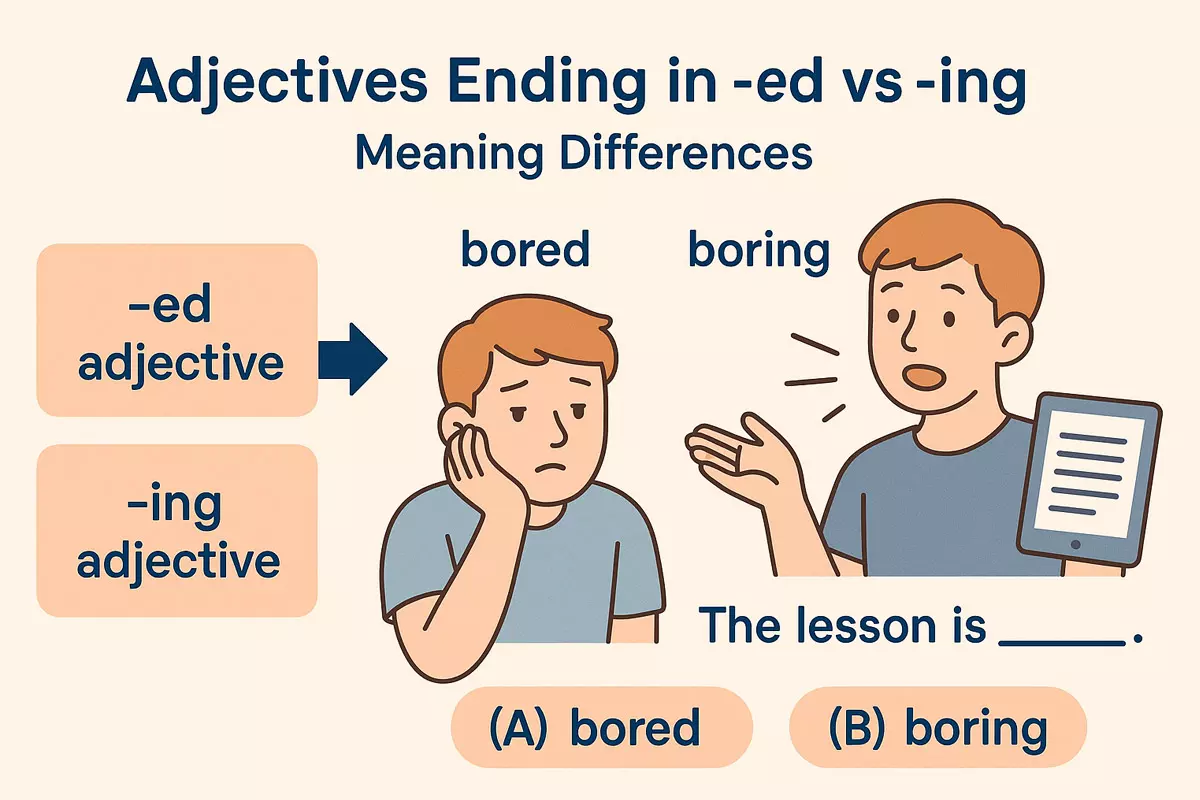 Here we the rule for using -ed and -ing adjective endings, common adjective pairs like bored/boring, how wrong endings change meaning, frequent beginner mistakes, and provides short practice sentences to choose the correct form.
Choosing between words like bored and boring can be tricky, but understanding the difference is essential for clear English communication. The word bored describes how someone feels, as in "I am bored," while boring describes something that causes that feeling, as in "This movie is boring." Paying attention to these endings helps you express your thoughts more accurately and avoids confusion in conversation. With practice, using the correct form will become second nature and make your English sound more natural.
Basic rule: -ed for feelings, -ing for things
When choosing between adjectives that end in -ed or -ing, the difference usually depends on whether you're describing a person's emotion or the thing that causes it. Adjectives ending with -ed typically describe how someone feels, while those ending in -ing refer to the characteristic of a situation, thing, or person that produces that emotion. For example, if a movie makes you feel a certain way, you are "bored" but the movie itself is "boring." This pattern helps speakers clarify who or what is experiencing the feeling and what is causing it.
Common -ed Adjectives (for feelings)
- annoyed → She felt annoyed by the constant noise.
- confused → I was confused by the instructions.
- excited → The kids were excited about the trip.
- interested → He is interested in learning Spanish.
- surprised → We were surprised by the results.
- tired → She looked tired after work.
- worried → They were worried about the exam.
- amused → He was amused by the joke.
- frightened → The child felt frightened during the storm.
- embarrassed → She was embarrassed when she tripped.
- disappointed → He felt disappointed with the outcome.
- irritated → She was irritated by the long wait.
- relaxed → I felt relaxed after the massage.
- stressed → She seemed stressed before the deadline.
- bored → They were bored during the lecture.
- shocked → We were shocked by the news.
- frustrated → He became frustrated with the slow progress.
- thrilled → She was thrilled with her promotion.
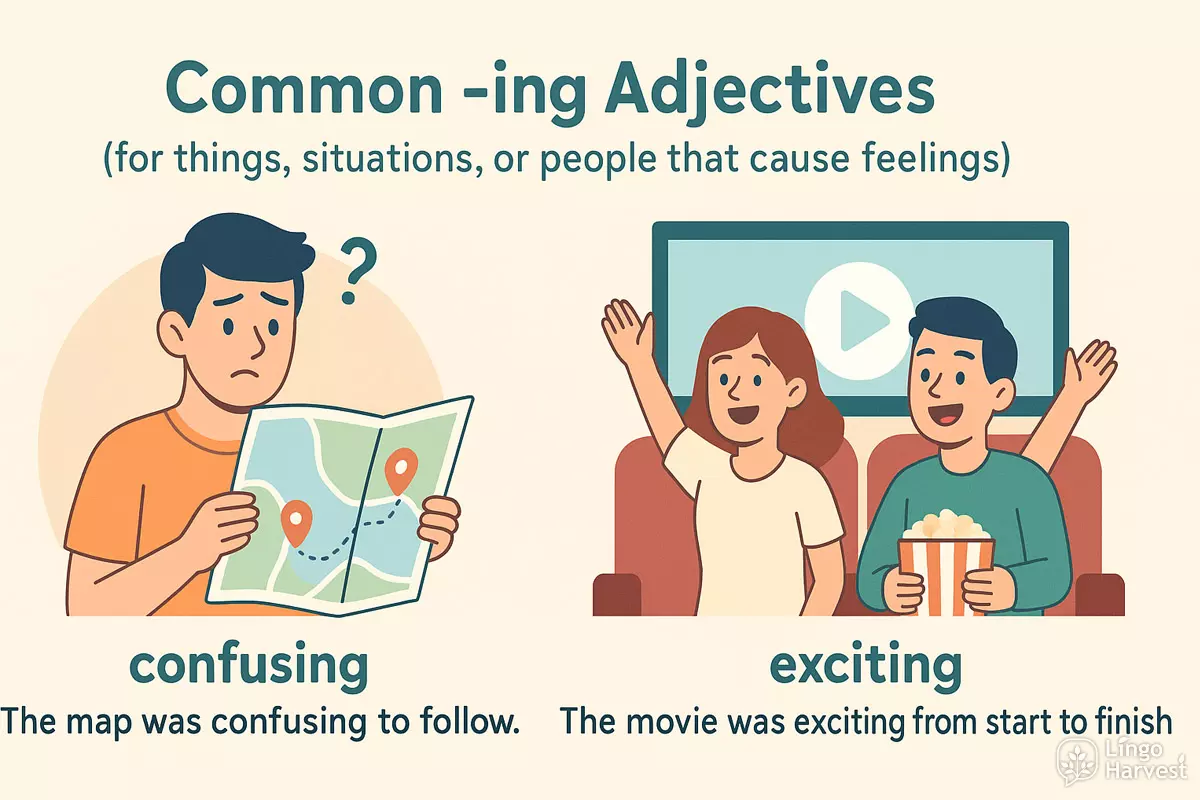
Common -ing Adjectives (for things, situations, or people that cause feelings)
- annoying → The buzzing sound was very annoying.
- confusing → The map was confusing to follow.
- exciting → The movie was exciting from start to finish.
- interesting → The book is interesting so far.
- surprising → The ending was surprising.
- tiring → Running long distances is tiring.
- worrying → The news was worrying for everyone.
- amusing → His stories were amusing.
- frightening → The loud thunder was frightening.
- embarrassing → Forgetting her lines was embarrassing.
- disappointing → The test results were disappointing.
- irritating → The repeated beeping was irritating.
- relaxing → The music was relaxing.
- stressful → Moving to a new city can be stressful.
- boring → The documentary was boring.
- shocking → The plot twist was shocking.
- frustrating → The slow internet connection is frustrating.
- thrilling → The roller coaster ride was thrilling.
Comparing -ed and -ing in Context
This distinction becomes clear when you compare similar sentences. Notice how the meaning changes depending on which form you use:
| Sentence with -ed | Sentence with -ing |
|---|---|
| I am tired. | This job is tiring. |
| She was amused by the joke. | The joke was amusing. |
| We felt confused by the instructions. | The instructions were confusing. |
| He is frightened by spiders. | Spiders are frightening. |
| They were excited about the trip. | The trip was exciting. |
Using -ed forms expresses a personal response or reaction, while -ing forms describe the thing or event that prompts that reaction. This pattern is a helpful shortcut for choosing the correct adjective form in most everyday situations.
Common adjective pairs: bored/boring, tired/tiring
Understanding the difference between adjectives ending in -ed and -ing is essential for clear communication. These pairs often cause confusion because their forms look similar, but their meanings are quite distinct. To illustrate, let’s focus on two of the most frequent pairs: bored vs. boring and tired vs. tiring.
How -ed and -ing adjectives differ
Adjectives ending in -ed describe how a person feels. In contrast, those ending in -ing describe the thing or situation that causes the feeling. For example, if a lecture is uninteresting, you might say, “The lecture was boring,” and as a result, “I was bored.”
- Bored: describes someone’s emotional state (e.g., I am bored.)
- Boring: describes something that produces boredom (e.g., The movie was boring.)
- Tired: describes someone who lacks energy (e.g., She felt tired after work.)
- Tiring: describes something that makes you tired (e.g., The journey was tiring.)
More examples of -ed/-ing adjective pairs
To build confidence with these adjective forms, it helps to see more common pairs in real-life contexts:
- amused / amusing
- confused / confusing
- excited / exciting
- embarrassed / embarrassing
- frustrated / frustrating
- annoyed / annoying
- interested / interesting
- shocked / shocking
- surprised / surprising
- disappointed / disappointing
- relaxed / relaxing
- worried / worrying
- exhausted / exhausting
- scared / scary
- challenged / challenging
Quick guide: usage patterns
When deciding which adjective to use, ask yourself: Are you describing a person’s reaction or the thing that causes it? Here’s a simple guide:
- Use -ed for people’s feelings: “He is bored.”
- Use -ing for the source: “This book is boring.”
Mixing these up can lead to misunderstandings, so it’s helpful to practice with different verbs and contexts. Remember, the -ed form is about how someone feels, while the -ing form is about what makes them feel that way.
How wrong endings change the meaning
Choosing between -ed and -ing on adjectives isn’t just a grammar detail—it can completely flip the intended meaning. These endings signal whether something causes a feeling or experiences it. If you mix them up, you might accidentally describe an object as having emotions or say a person is causing a feeling instead of feeling it.
Common mistakes and their effects
It’s easy to confuse these endings, but the consequences can be awkward, funny, or even misleading. For instance, calling a person “boring” instead of “bored” suggests they make others feel uninterested, not that they feel uninterested themselves.
- Interested (having curiosity) vs. Interesting (causing curiosity)
- Excited (feeling happy anticipation) vs. Exciting (causing excitement)
- Confused (not understanding) vs. Confusing (hard to understand)
- Tired (needing rest) vs. Tiring (causing fatigue)
- Annoyed (feeling irritation) vs. Annoying (causing irritation)
- Amused (finding something funny) vs. Amusing (causing laughter)
- Frightened (feeling fear) vs. Frightening (causing fear)
- Depressed (feeling very sad) vs. Depressing (causing sadness)
- Relaxed (feeling calm) vs. Relaxing (causing calm)
- Embarrassed (feeling awkward) vs. Embarrassing (causing awkwardness)
- Disappointed (feeling let down) vs. Disappointing (causing disappointment)
- Shocked (feeling surprise) vs. Shocking (causing surprise)
- Surprised (feeling surprise) vs. Surprising (causing surprise)
- Inspired (feeling motivated) vs. Inspiring (causing motivation)
Why the distinction matters
Mixing up these endings can affect how others understand your message. For example, “I am boring” means you make others uninterested, while “I am bored” means you feel uninterested. This distinction is crucial in both spoken and written English, especially in professional or academic settings.
Quick overview: -ed vs -ing adjectives
| Ending | Who/What does it describe? |
|---|---|
| -ed | Describes how someone feels (the receiver of the emotion) |
| -ing | Describes something or someone that causes the emotion or feeling |
Understanding and using the correct adjective ending not only avoids confusion but also helps you sound more natural and accurate in English.
Using these adjectives about people and situations
When choosing between adjectives ending in -ed and -ing, consider whether you’re describing a person’s feelings or the thing/situation causing those feelings. Adjectives with -ed typically describe how someone feels, while those with -ing describe the characteristic of something or someone that produces that feeling.
Describing emotions and causes
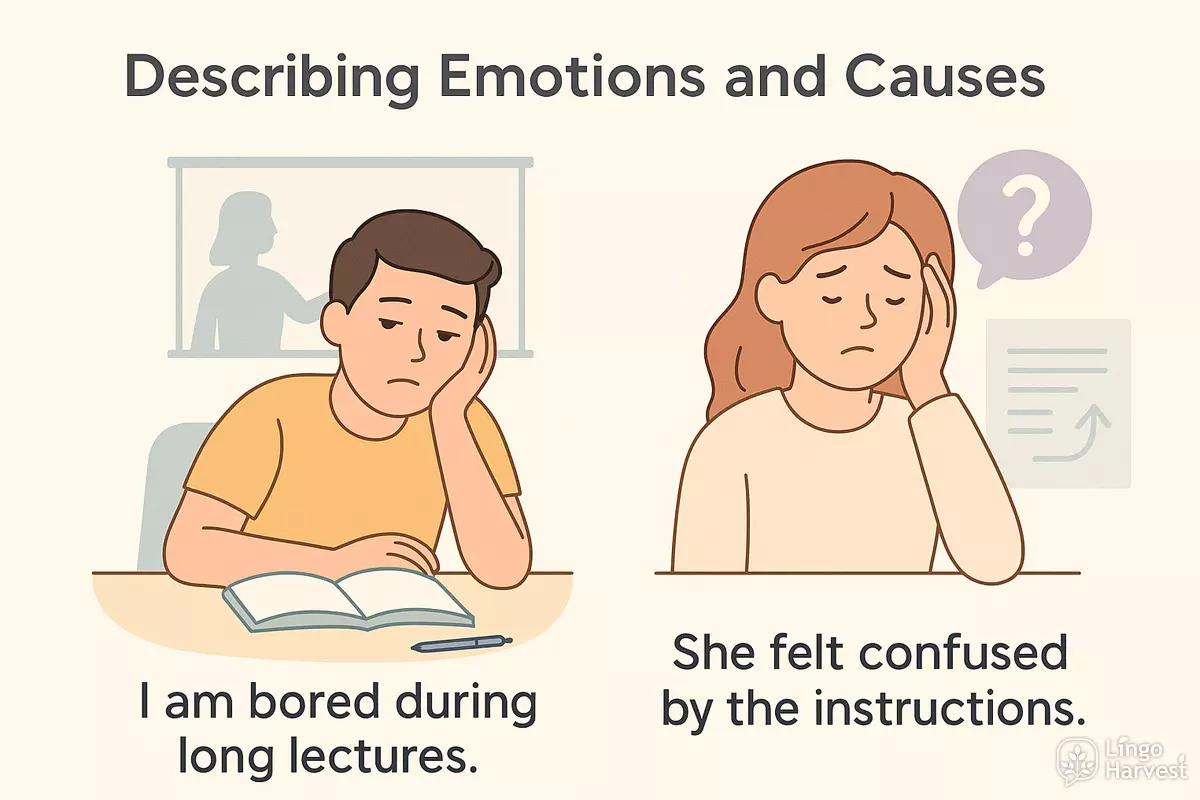
If you want to talk about your reaction or internal state, opt for the -ed form:
- I am bored during long lectures.
- She felt confused by the instructions.
- He looked surprised when he heard the news.
- They were tired after the hike.
- We felt worried about the results.
- She seemed excited about the trip.
- He was annoyed by the loud noise.
- I felt embarrassed when I forgot his name.
When you want to refer to what makes people feel a certain way, use the -ing form:
- The movie was boring.
- That explanation was confusing.
- The announcement was surprising.
- The journey was tiring.
- The book was interesting.
- The noise outside was annoying.
- The speech was inspiring.
- The situation was worrying.
Common -ed/-ing adjective pairs
It’s helpful to know some frequently used pairs. Here are examples showing their typical use in context:
- amazed / amazing — I was amazed by the amazing view.
- annoyed / annoying — He is annoyed by the annoying noise.
- frightened / frightening — She felt frightened after the frightening experience.
- excited / exciting — The class is excited about the exciting project.
- tired / tiring — I am tired after the tiring workout.
- interested / interesting — They are interested in the interesting topic.
- disappointed / disappointing — We were disappointed by the disappointing results.
- shocked / shocking — Everyone was shocked by the shocking event.
- embarrassed / embarrassing — He felt embarrassed during the embarrassing moment.
- relaxed / relaxing — She is relaxed after the relaxing holiday.
- interested / interesting — Are you interested in this interesting book?
- worried / worrying — I’m worried about the worrying news.
Quick comparison: feelings vs. causes
Below is a comparison of how these forms work in sentences:
| Adjective (-ed) | Adjective (-ing) |
|---|---|
| I’m confused by the instructions. | The instructions are confusing. |
| She was amused by the joke. | The joke was amusing. |
| They felt frustrated after waiting. | The delay was frustrating. |
| He is interested in science. | The lesson is interesting. |
| We’re tired after the trip. | The trip was tiring. |
Tips for choosing the right form
- Use -ed for people’s reactions or emotions.
- Use -ing for things or situations that cause those emotions.
- Ask yourself: “Who or what is being described?” If it’s a person’s feeling, choose -ed. If it’s a thing or event, choose -ing.
- Watch out for exceptions and context-specific meanings.
Practicing with real sentences helps you get comfortable with choosing the correct adjective form for both people and situations.
Frequent mistakes at beginner level
Many English learners find it tricky to decide when to use adjectives ending in -ed or -ing. This confusion often leads to sentences that sound unnatural or even change the intended meaning. The core issue is that -ed adjectives typically describe how someone feels, while -ing adjectives describe the cause of that feeling.
Common mix-ups with -ed and -ing adjectives
- Saying "I am boring" when you mean "I am bored" ❌ (It sounds like you think you are not interesting!)
- Using "He is interesting" when you want to say "He is interested" ❌ (Describing his feeling vs. his character)
- Mixing up "The news was shocked" instead of "The news was shocking"
- Writing "She felt embarrassing" instead of "She felt embarrassed"
- Confusing "The movie was bored" with "The movie was boring"
- Saying "I am confusing" instead of "I am confused"
- Using "The lesson was interested" rather than "The lesson was interesting"
- Mixing up "I am exciting" with "I am excited"
- Saying "The story was tired" instead of "The story was tiring"
- Using "He looked frightening" when you mean "He looked frightened"
Why do these mistakes happen?
Learners often translate directly from their native language, where the distinction may not exist. Others simply memorize adjectives without noticing the pattern: -ed forms relate to a person’s reaction or emotion, while -ing forms describe the thing or situation causing that emotion.
Quick comparison of -ed vs -ing adjectives
| Adjective (-ed) | Adjective (-ing) | Correct Example Sentence | Common Mistake |
|---|---|---|---|
| interested | interesting | I am interested in science. | I am interesting in science. |
| bored | boring | The class was boring. | The class was bored. |
| confused | confusing | This question is confusing. | This question is confused. |
| excited | exciting | We are excited about the trip. | We are exciting about the trip. |
| embarrassed | embarrassing | She felt embarrassed. | She felt embarrassing. |
| frightened | frightening | The noise was frightening. | The noise was frightened. |
| tired | tiring | The journey was tiring. | The journey was tired. |
| amused | amusing | He was amused by the joke. | He was amusing by the joke. |
Tips to avoid confusion
- Ask yourself: Does this describe a feeling (use -ed) or a thing/situation (use -ing)?
- Remember: People usually feel -ed; things are -ing.
- Practice with pairs: excited/exciting, bored/boring, confused/confusing, etc.
- Read example sentences and notice the pattern.
- Don’t rely on direct translation from your first language.
By understanding these patterns and practicing with real examples, you can avoid the most frequent slip-ups and sound more natural when describing feelings and situations.
Practice: choose -ed or -ing in short sentences
Understanding when to use adjectives ending in -ed or -ing can be tricky. The best way to master this is through targeted exercises. Here, you'll find a variety of short sentences. For each, decide which form fits best: the past participle (-ed) or the present participle (-ing).
Remember: adjectives ending in -ed usually describe feelings or reactions (bored, excited), while those ending in -ing describe the thing that causes those feelings (boring, exciting).
Quick Fill-in-the-Blank Quiz
- This movie is really _______ (bored/boring).
- She felt _______ after the long meeting. (tired/tiring)
- That joke was quite _______. (amused/amusing)
- We are _______ by the news. (shocked/shocking)
- His explanation was _______. (confused/confusing)
- I get _______ when people talk loudly. (annoyed/annoying)
- The students looked _______ during the lecture. (interested/interesting)
- This puzzle is very _______! (challenged/challenging)
- She gave me a _______ smile. (pleased/pleasing)
- It was a _______ experience. (frightened/frightening)
Show answers
- boring
- tired
- amusing
- shocked
- confusing
- annoyed
- interested
- challenging
- pleased
- frightening
Common -ed and -ing Adjective Pairs
Here is a list of adjective pairs that often cause confusion. Review them and try to use each in your own sentence to reinforce the difference.
- amazed / amazing
- surprised / surprising
- disappointed / disappointing
- embarrassed / embarrassing
- interested / interesting
- excited / exciting
- tired / tiring
- confused / confusing
- frightened / frightening
- relaxed / relaxing
- annoyed / annoying
- bored / boring
- satisfied / satisfying
- shocked / shocking
- pleased / pleasing
- worried / worrying
Spot the Error
Read each sentence and decide if the adjective is correct. If not, which form should it be?
- The match was very excited.
- I am boring in math class.
- That news is really shocking.
- He felt relaxing after the holidays.
- The trip was very tired.
- She felt very interesting in the topic.
- The results were very disappointing.
- I was really depressing after the news.
- The game was very bored.
- They were so exciting before the concert.
Show answers
- Incorrect: "excited" → "exciting"
- Incorrect: "boring" → "bored"
- Correct
- Incorrect: "relaxing" → "relaxed"
- Incorrect: "tired" → "tiring"
- Incorrect: "interesting" → "interested"
- Correct
- Incorrect: "depressing" → "depressed"
- Incorrect: "bored" → "boring"
- Incorrect: "exciting" → "excited"
Summary Table: -ed vs -ing Adjectives
| Feeling (-ed) | Cause (-ing) |
|---|---|
| amused | amusing |
| confused | confusing |
| excited | exciting |
| annoyed | annoying |
| tired | tiring |
| frightened | frightening |
| pleased | pleasing |
| satisfied | satisfying |
Practice with these examples to build confidence in choosing the right adjective form in everyday English.