Modal Verbs Explained: Meaning, Form, and Main Functions

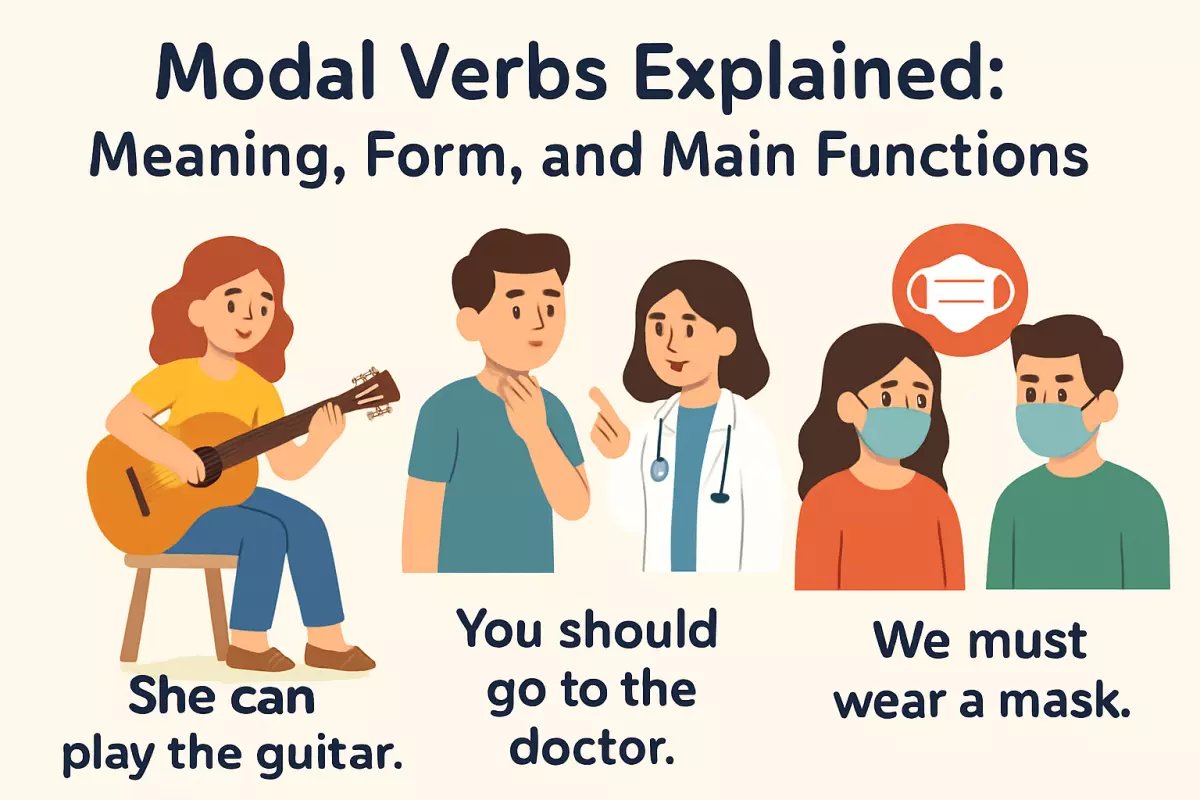 This article explains what modal verbs are, the core modals and their meanings, and the form rules: no -s, infinitive, or -ing. It shows how to make questions and negatives, express ability, permission, and obligation, and use modals in polite requests and offers.
In English, a lot of meaning is carried by small words that come before the main verb. These words help speakers show how sure they are, whether something is required, optional, polite, or simply possible. Understanding how these helpers work makes everyday English clearer and more natural, especially in conversations about rules, advice, plans, and expectations.
What modal verbs are
Modal verbs are a limited group of auxiliary (helping) verbs that modify the meaning of another verb. Instead of describing an action themselves, they express the speaker’s view of that action — for example, whether it is necessary, allowed, recommended, likely, or uncertain.
Modals are followed by a bare infinitive, which means the base form of the verb without to: can work, should wait, might arrive. Together, the modal and the main verb function as a single unit that communicates both the action and the attitude toward it.
Because modal verbs shape meaning rather than tense, they are especially important in spoken English, where tone, context, and intention matter as much as grammar.
Core members of the modal set
Modern English relies on a small, well-defined set of core modal verbs. Each of them covers a range of related meanings rather than just one fixed idea.
- can / could — ability, possibility, informal permission
- may / might — possibility, uncertainty, formal permission
- must — obligation, necessity, strong logical conclusion
- shall / should — suggestion, advice, expectation, mild obligation
- will / would — future reference, willingness, habits, polite requests
Some modals, such as shall and may, appear more often in formal or written English, while others, like can and will, dominate everyday speech.
How modals behave in a sentence
Modal verbs follow a few distinctive grammatical rules that separate them from regular verbs. Recognizing these patterns helps avoid common learner errors.
- No third-person -s: the verb form stays the same for all subjects (❌ He cans drive → ✅ He can drive).
- No “to” before the main verb: modals connect directly to the base form (❌ She must to leave → ✅ She must leave).
- Questions form by inversion: the modal moves before the subject, without do (✅ Can you help?).
- Negatives add not directly: cannot, shouldn’t, might not.
- Only one modal per verb phrase: combinations like ❌ will can are not possible; alternative structures are used instead.
These rules make modal constructions relatively compact and efficient, which is why they are so common in spoken interaction.
Meaning comes from context, not just the verb
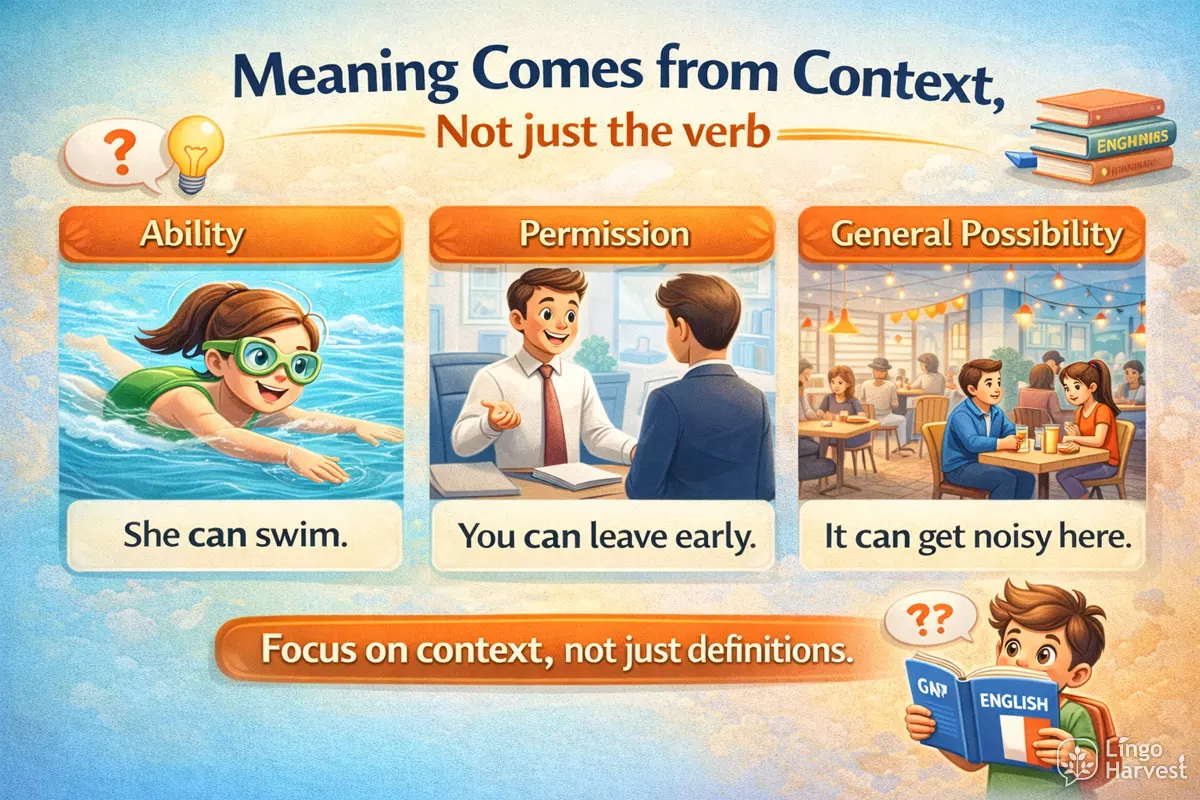
Modal verbs are flexible, and their exact meaning often depends on context rather than the word alone. The same modal can signal different ideas depending on the situation, the subject, and surrounding language.
For example, can may indicate:
- Ability: She can swim.
- Permission: You can leave early.
- General possibility: It can get noisy here.
Because of this flexibility, learners should focus less on memorizing one-to-one definitions and more on understanding how modals function in real communicative situations.
Modal verbs vs. “semi-modals”
Alongside true modal verbs, English uses several expressions that carry similar meanings but behave differently in grammar. These are often called semi-modals or modal-like constructions.
Unlike core modals, these expressions:
- can change tense normally,
- use to before the main verb,
- form questions and negatives with do.
Common examples include:
- have to — external obligation (I have to work late.)
- be able to — ability across tenses (She was able to finish.)
- be allowed to — permission by rules or authority (Are we allowed to enter?)
- need to — necessity (You need to be careful.)
- ought to — moral duty or advice (You ought to apologize.)
- be going to — planned or expected future (They are going to travel.)
These forms often appear where true modals are limited or unavailable, making them an essential part of natural English usage.
Core modal verbs and their meanings
English modal verbs are used to express ideas like ability, permission, obligation, advice, possibility, and prediction. They are followed by a base verb form (the infinitive without to) and they do not take -s in the third person singular.
| Modal verb | Main meanings | Common patterns | Example |
|---|---|---|---|
| can | ability; permission; general possibility | can + base verb; can’t + base verb | I can swim. You can leave early. |
| could | past ability; polite requests; weaker possibility | could + base verb; could you + base verb? | She could read at four. Could you help me? |
| may | permission (formal); possibility | may + base verb; may not + base verb | You may begin. It may rain later. |
| might | less certain possibility; tentative suggestions | might + base verb | We might be late. You might try restarting it. |
| must | strong obligation; logical conclusion (certainty) | must + base verb; mustn’t + base verb | You must wear a seatbelt. He must be tired. |
| shall | offers/suggestions (BrE); formal future reference | shall + base verb; shall we + base verb? | Shall we start? I shall contact you tomorrow. |
| should | advice; expectation; mild obligation | should + base verb; shouldn’t + base verb | You should rest. The train should arrive soon. |
| will | future; willingness; promises; predictions | will + base verb; won’t + base verb | I will call tonight. It will be fine. |
| would | polite requests; hypothetical results; past habits (context) | would + base verb; would you + base verb? | Would you open the window? I would go if I could. |
How to choose between similar modals
Several modals overlap in meaning, so the best choice depends on strength, formality, and how certain you want to sound. These contrasts are especially common in everyday usage:
- Can vs may for permission: can is common and informal; may is more formal or rule-based (✅ May I speak to the manager?).
- Could vs can for requests: could is usually more polite or tentative (Could you send it today?).
- May vs might for possibility: both express uncertainty, but might often sounds less certain (It might take longer than expected).
- Must vs should: must signals strong obligation or firm conclusion; should signals advice or expectation (You must submit it today → You should submit it soon).
- Will vs shall: will is the default for future and predictions; shall is common in set phrases like Shall we…? and in formal writing.
- Would vs will: would softens requests and is used for hypothetical situations (I will help → I would help if I had time).
Meaning depends on context
Many modal verbs carry more than one function, so context decides the interpretation. Compare how the same form changes meaning:
- must for obligation: You must finish the report today.
- must for deduction: The lights are off, so they must be asleep.
- can for ability: He can run fast.
- can for possibility: Prices can change without notice.
- would for politeness: Would you mind waiting a moment?
- would for hypothetical result: That would solve the problem.
Form: no -s, no infinitive, no -ing
Modal verbs stand out in English because their form is unusually stable. Unlike most verbs, they do not change with the subject, they are not followed by to, and they do not appear in -ing forms. This simplicity is one reason modals are so common in everyday speech: once you learn the pattern, it works the same way every time.
No third-person -s
In the present tense, regular verbs add -s with he, she, or it. Modal verbs never do this. The form of the modal remains identical for all subjects.
- I can swim.
- She can swim. (not cans)
- They must leave now.
- He should call you.
- It might rain later.
This fixed form helps learners spot modal verbs quickly, especially in longer sentences.
No to after a modal
Modal verbs are always followed by the base form of another verb. There is no to between the modal and the main verb. This rule is consistent and has no common exceptions.
- You must wear a seatbelt.
- We should leave early.
- They may arrive late.
Forms like must to wear or should to leave sound unnatural because the modal already performs the grammatical role that to would normally signal.
No -ing or infinitive forms of the modal itself
Modal verbs do not behave like full verbs. They do not have infinitive forms (to can), -ing forms (canning), or regular past participles. When English needs those forms, it switches to a related structure.
- Incorrect: I want to can drive.
- Correct: I want to be able to drive.
- Incorrect: She is musting work late.
- Correct: She has to work late.
- Incorrect: They enjoy canning speak English.
- Correct: They enjoy being able to speak English.
These alternative expressions carry the same meaning as the modal but allow English to form tenses, infinitives, or gerunds.
Common substitute structures
| Modal Meaning | Modal Form | Alternative Structure |
|---|---|---|
| Ability | can | be able to |
| Obligation | must | have to |
| Permission | may | be allowed to |
| Advice | should | be supposed to |
Core structure to remember
Most modal sentences follow one of these basic patterns:
- Subject + modal + base verb → She might join us.
- Subject + modal + not + base verb → You should not touch that.
- Modal + subject + base verb → Can you help me?
Because the modal itself never changes, the main focus should always be on choosing the correct verb form that follows it. Once this structure becomes familiar, modal verbs become one of the most reliable and flexible tools in English grammar.
Questions and negatives with modals
To form questions and negatives with modal verbs, use the modal as the “helper” (auxiliary). That means you usually do not add do/does/did, and you usually do not add -s, -ed, or -ing to the modal itself.
Core word order patterns
- Yes/No question: Modal + subject + base verb → Can you drive?
- Wh-question: Wh-word + modal + subject + base verb → Where should we meet?
- Negative statement: Subject + modal + not + base verb → She cannot attend.
- Negative question: Modal + subject + not + base verb → Can’t you stay?
- Short answers: Yes/No + subject + modal → Yes, I can. / No, they won’t.
- No “do” support: ❌ Do you can swim? → ✅ Can you swim?
- Base verb after the modal: ❌ He can goes. → ✅ He can go.
Negatives: “not” and common contractions
- Not placement: Put not directly after the modal: You should not worry.
- Contractions are common in speech: can’t, won’t, shouldn’t, mustn’t, couldn’t, mightn’t (some are less common in American English).
- “Cannot” vs “can not”: cannot is the standard spelling for inability/permission: I cannot hear you. Use can not mainly when emphasizing a choice: You can not go, or you can stay.
- Meaning changes with negatives: must (strong obligation) vs mustn’t (prohibition): You must wear a helmet. / You mustn’t touch that.
Question types and typical uses
- Ability: Can you lift this? / I can’t lift it.
- Permission (informal): Can I leave early? / You can’t leave yet.
- Permission (more formal): May I come in? / You may not use your phone.
- Requests: Could you open the window? / Couldn’t you help for a minute?
- Advice: Should we call them? / You shouldn’t wait too long.
- Obligation: Must I sign here? / You must not forget your ID.
- Possibility: Could it be a mistake? / It might not be true.
- Prediction: Will it rain? / It won’t take long.
- Offers: Shall I carry that? / I shan’t be long. (more common in British English)
- Polite suggestions: Shall we start? / Shouldn’t we check the time?
Common learner issues to avoid
- Don’t add “to” after a modal: ❌ She can to swim. → ✅ She can swim.
- Don’t double-modals: ❌ He might can come. → ✅ He might be able to come.
- Don’t use “do” with a modal: ❌ Did you should call? → ✅ Should you call?
- Watch negative meaning: You don’t have to (no obligation) is different from You mustn’t (forbidden).
- Keep the base verb in past-looking questions: Could you help? is polite; it does not necessarily mean past time.
Expressing ability, permission, obligation
Modal verbs are a practical way to talk about what someone is capable of doing, what is allowed, and what is required. The key is choosing the right modal for the meaning (skill vs. permission vs. duty) and using the standard pattern: modal + base verb (no to, no -s).
Ability: can, could, be able to
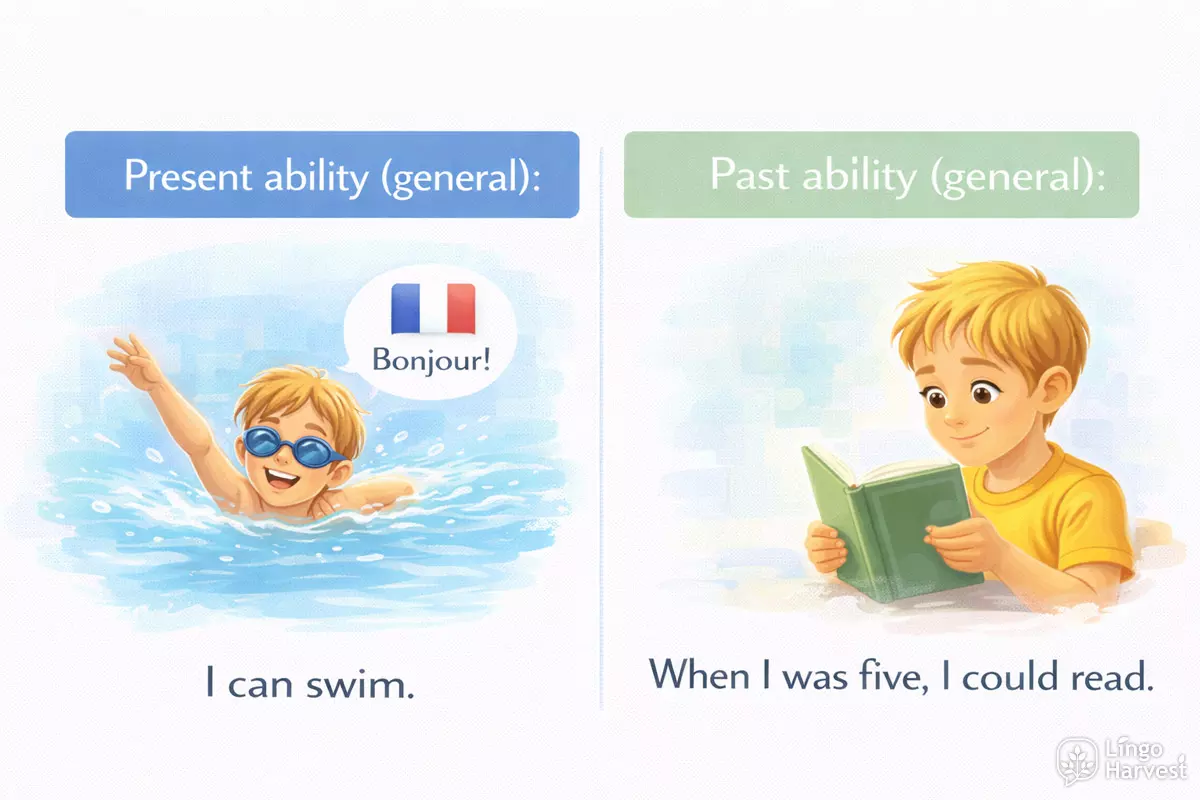
Use can for present ability and general skills. Use could for past general ability, and be able to when you need a form that modals don’t have (infinitive, -ing form, certain tenses) or when you want to highlight success in a specific situation.
- Present ability (general): I can swim. / She can speak French.
- Past ability (general): When I was five, I could read.
- Specific past achievement: We were able to fix it in time. (often preferred over could for one successful event)
- Negative ability: I can’t hear you. / He couldn’t open the jar.
- Ability in other forms: I’d like to be able to drive. / Being able to concentrate is important.
- Future capability: I’ll be able to meet you tomorrow. (more natural than will can, which is not possible)
Permission: can, could, may, might
For asking and giving permission, can is common and neutral. Could is more polite or tentative. May is more formal, and might can sound very cautious or indirect. In replies, match the level of formality and be clear about whether you are granting, refusing, or setting conditions.
- Asking (neutral): Can I sit here?
- Asking (polite): Could I leave a bit early?
- Asking (formal): May I ask a question?
- Giving permission: You can use my phone. / You may begin.
- Refusing permission: You can’t park here. / You may not enter.
- Conditional permission: You can go out if you finish your work.
- Past permission: We were allowed to take photos. (common alternative because modals have limited past forms)
- Polite “soft no”: You can’t, I’m afraid. / I’m sorry, you may not.
Obligation and necessity: must, have to, should, ought to
Use must for strong obligation, rules, or the speaker’s insistence. Use have to for external requirements and for most past/future forms. Use should and ought to for advice and weaker obligation. For lack of necessity, prefer don’t have to (not required) rather than mustn’t (prohibited).
- Strong obligation (speaker emphasis): You must wear a seatbelt.
- External requirement: I have to submit the form today.
- Past requirement: We had to leave early.
- Future requirement: You’ll have to show ID.
- Advice / expectation: You should see a doctor. / You ought to apologize.
- Negative obligation (prohibition): You mustn’t touch that. ❌ (not allowed)
- No necessity: You don’t have to come tomorrow. ✅ (optional)
- Logical necessity in context: I have to be there by nine. (practical requirement)
Common form patterns and typical errors
Keep the structure simple: modal + base verb. Use have to and be allowed to when you need tense changes or non-finite forms.
- ✅ She can drive. → ❌ She can drives.
- ✅ You must leave now. → ❌ You must to leave now.
- ✅ I had to work late. → ❌ I musted work late.
- ✅ We’re allowed to bring guests. → ❌ We can to bring guests.
- ✅ Do I have to pay today? (common question form)
- ✅ Must I pay today? (more formal; less common in conversation)
Modals in polite requests and offers
Politeness in English often depends on how directly you ask. Modal verbs help you soften the request, show respect, and give the other person room to say no. In general, more indirect forms sound more formal, while direct forms sound more casual or can feel demanding in some contexts.
Choosing the right modal: how polite does it sound?
| Modal / pattern | Typical use and level of politeness | Example |
|---|---|---|
| can + base verb | Neutral, everyday requests; common with friends and colleagues | Can you send me the file? |
| could + base verb | More polite/softer than can; good for most professional situations | Could you send me the file? |
| will + base verb | Direct request; often fine when the relationship is close or the task is routine | Will you call me when you arrive? |
| would + base verb | Polite and less direct than will; common in customer service and emails | Would you call me when you arrive? |
| may + base verb | Formal permission requests; can sound distant in casual speech | May I come in? |
| might + base verb | Very tentative; used when you want to be especially careful or non-pushy | Might I ask a quick question? |
| Would you mind + -ing | Polite, indirect; useful when the request could inconvenience someone | Would you mind waiting a moment? |
| Could you possibly + base verb | Extra-softened request; often used when asking for a favor | Could you possibly cover my shift? |
| Would you like + to-infinitive | Standard way to make an offer or invitation; polite and neutral | Would you like to sit down? |
| Shall I / Shall we + base verb | Offers and suggestions (more common in British English); cooperative tone | Shall I open the window? |
Key patterns to copy in real situations
Requests usually follow a small set of reliable structures. The verb after the modal is the base form (send, help, check), not to send or sends. For extra politeness, add softeners such as please, just, or a short reason.
- Can/Could you + base verb: Can you help me with this? / Could you help me with this?
- Will/Would you + base verb: Will you hold the door? / Would you hold the door?
- Would you mind + -ing: Would you mind speaking a bit more slowly?
- Could you possibly + base verb: Could you possibly check the number again?
- May I + base verb (permission): May I leave a little early today?
- Could I + base verb (polite permission): Could I use your phone for a second?
- Would it be possible to + base verb: Would it be possible to reschedule the meeting?
- I was wondering if you could + base verb: I was wondering if you could review my draft.
- Would you be able to + base verb: Would you be able to send it by noon?
- If you could + base verb (soft directive): If you could sign here, please.
- Do you think you could + base verb: Do you think you could give me a hand?
- Could you + base verb + when you have a moment: Could you call me when you have a moment?
Offers and invitations with modals
Offers focus on what the speaker can do for the listener. Invitations focus on what the listener might want to do. Forms with would often sound warmer and less forceful than forms with will.
- Shall I + base verb? → Shall I carry that for you?
- Can I + base verb? → Can I help you with your bags?
- Would you like + to-infinitive? → Would you like to join us for lunch?
- Would you like me to + base verb? → Would you like me to email you the details?
- Should I + base verb? (checking preference) → Should I book a table?
- We could + base verb (suggestion) → We could meet a bit earlier.
- Would you like + noun? → Would you like some water?
- Could I offer you + noun? → Could I offer you a seat?
Common pitfalls and quick fixes
- ❌ Could you to send it? → ✅ Could you send it? (base verb after the modal)
- ❌ Would you mind to wait? → ✅ Would you mind waiting? (-ing form after would you mind)
- ❌ May you help me? → ✅ Could you help me? (use may mainly for asking permission: May I…?)
- ❌ Can you please to… → ✅ Can you please… (no to after a modal)
- ❌ Would you like that you… → ✅ Would you like to…? (standard invitation pattern)
Common learner mistakes with modals
Problems with modal verbs usually appear when learners combine modal grammar with patterns from regular verbs, or when they choose a modal whose meaning is too strong, too weak, or simply wrong for the situation. The good news is that most of these mistakes fall into a small number of repeatable patterns.
1) Adding to after a modal
Modal verbs are followed directly by the base form of the verb. Adding to is a very common learner habit, especially for speakers of languages where infinitives are required.
- ❌ She can to finish this today. → ✅ She can finish this today.
- ❌ You might to miss the last train. → ✅ You might miss the last train.
- ❌ We must to reconsider the plan. → ✅ We must reconsider the plan.
2) Changing the verb form after a modal
The verb that follows a modal never takes -s, -ed, or -ing. All tense and agreement information comes from the modal itself.
- ❌ He may needs more time. → ✅ He may need more time.
- ❌ They could finished earlier. → ✅ They could finish earlier.
- ❌ You should working on this now. → ✅ You should work on this now.
3) Using do / does / did with modal questions or negatives
Most modals form questions and negatives on their own. Adding do creates a structure that does not exist in standard English.
- ❌ Do we should submit this today? → ✅ Should we submit this today?
- ❌ He doesn’t might understand the rule. → ✅ He might not understand the rule.
- ❌ Did they must sign the form? → ✅ Must they sign the form?
4) Confusing prohibition with lack of necessity
Some modal meanings look similar on the surface but are very different in practice. Mixing them up can cause serious misunderstandings.
- mustn’t = forbidden → “You mustn’t access this file.”
- don’t have to = optional → “You don’t have to attend the meeting.”
- ❌ You mustn’t reply immediately. (sounds like replying is not allowed)
- ✅ You don’t have to reply immediately. (no obligation)
5) Using a modal where English requires a different structure
Because modals have limited tense forms, English often switches to expressions like have to or be able to when talking about time, sequence, or completion.
- ❌ I will can access the system tomorrow. → ✅ I will be able to access the system tomorrow.
- ❌ She musted explain the delay. → ✅ She had to explain the delay.
- ❌ We will may receive feedback soon. → ✅ We may receive feedback soon. / We might receive feedback soon.
6) Past ability: could vs. was / were able to
Could usually describes general ability in the past, while was / were able to often highlights success in a specific situation.
- General ability: ✅ During college, she could read academic texts easily.
- Single achievement: ✅ She was able to secure funding last year.
- ❌ She could secure funding last year. (may sound unclear or incomplete)
7) Using must when should is more natural
Must expresses strong obligation or rules. For recommendations, opinions, or friendly advice, should is usually the better choice.
- ✅ You should back up your files regularly.
- ✅ Employees must wear ID badges at all times.
- ❌ You must read this article. → ✅ You should read this article.
8) Using may to describe skill or competence
May is not used to talk about ability. It signals permission or possibility, especially in more formal contexts.
- ❌ He may code in Python fluently. → ✅ He can code in Python fluently.
- ✅ The results may change after review.
- ✅ May I ask a question?
9) Missing the perfect form for past judgment or speculation
When talking about the past from a present viewpoint, English often requires modal + have + past participle.
- ❌ She must forget the deadline. → ✅ She must have forgotten the deadline.
- ❌ They might leave early. (about yesterday) → ✅ They might have left early.
- ❌ You should finish the report sooner. → ✅ You should have finished the report sooner.
10) Stacking multiple modals in one verb phrase
Standard English normally allows only one modal at a time. When more meaning is needed, it is expressed through adverbs or alternative structures.
- ❌ I might can resolve this today. → ✅ I might be able to resolve this today.
- ❌ We will must update the policy. → ✅ We will have to update the policy.
- ❌ She should may reconsider. → ✅ She should probably reconsider.
Homework: modal verb practice exercises
These tasks help you build accuracy with modal verbs by focusing on three things: (1) choosing the right meaning (ability, advice, obligation, permission, probability), (2) using the correct form (bare infinitive, negative, question), and (3) matching time (present, past, future, and “past speculation”). Work slowly and check patterns, not just individual words.
1) Choose the best modal (meaning first)
Complete each sentence with one modal verb (or modal phrase) that fits the meaning. Use: can, could, may, might, must, should, have to, don’t have to, mustn’t, needn’t, ought to.
- You _____ wear a seatbelt in this car. It’s the law.
- You _____ park here. It’s a no-parking zone.
- I’m not sure, but she _____ be in the meeting already.
- He _____ speak three languages when he was a child.
- We _____ leave now if we want to catch the last train.
- “_____ I borrow your charger?” “Yes, of course.”
- You _____ apologize. It would help.
- You _____ bring any food; we’ve already ordered dinner.
- She _____ be at home; I just saw her downtown.
- They _____ finish today, but it depends on the client.
- Students _____ submit the form by Friday (school rule).
- He _____ be very tired after the flight (reasonable guess).
Show answers
- have to
- mustn’t
- might
- could
- must
- May
- should
- don’t have to / needn’t
- can’t
- may / might / could
- have to / must
- must
2) Fix the form (pattern practice)
Each sentence has a common modal-verb mistake. Rewrite it correctly.
- She can to drive.
- You must to finish this today.
- Do you can help me?
- He doesn’t can swim.
- We shouldn’t to be late.
- May you to send me the file?
- I don’t have to to work tomorrow.
- He might goes later.
- You mustn’t to touch that switch.
- Could you to open the window?
Show answers
- She can drive.
- You must finish this today.
- Can you help me?
- He can’t swim.
- We shouldn’t be late.
- May you send me the file?
- I don’t have to work tomorrow.
- He might go later.
- You mustn’t touch that switch.
- Could you open the window?
3) Match the time (present vs past vs “past speculation”)
Rewrite each sentence using the cue in brackets. Keep the meaning as close as possible.
- I’m sure she is at work. (use must)
- It’s possible they are lost. (use might)
- I’m sure he wasn’t at home yesterday. (use can’t + past)
- It was possible she missed the bus. (use might + past)
- You were required to show ID at the entrance. (use have to in the past)
- It was a good idea for you to call earlier. (use should + past)
- I’m sure they finished already. (use must + past)
- It wasn’t necessary for me to pay. (use didn’t have to)
Show answers
- She must be at work.
- They might be lost.
- He can’t have been at home yesterday.
- She might have missed the bus.
- You had to show ID at the entrance.
- You should have called earlier.
- They must have finished already.
- I didn’t have to pay.
4) Mini-dialogues (politeness and intent)
Choose one option (A or B) that sounds more natural for the situation.
- Asking a stranger for help politely:
A) Can you tell me where the station is?
B) Must you tell me where the station is? - Giving strong advice to a friend who feels sick:
A) You should see a doctor.
B) You may see a doctor. - Stating a rule in a museum:
A) Visitors mustn’t touch the paintings.
B) Visitors mightn’t touch the paintings. - Expressing a reasonable conclusion:
A) She must be busy; she hasn’t replied all day.
B) She should be busy; she hasn’t replied all day. - Saying something is not required:
A) You don’t have to print it.
B) You mustn’t print it. - Making a cautious guess:
A) It might rain later.
B) It must rain later. - Offering permission formally:
A) You may begin now.
B) You should begin now. - Talking about general ability:
A) I can’t play the piano.
B) I mustn’t play the piano.
Show answers
- A
- A
- A
- A
- A
- A
- A
- A
5) Production task (write your own sentences)
Write one original sentence for each prompt. Aim for correct form and a clear meaning.
- Give advice using should.
- Express prohibition using mustn’t.
- Ask permission using may or could.
- Express strong certainty using must.
- Express possibility using might.
- Express lack of necessity using don’t have to or needn’t.
- Talk about past obligation using had to.
- Make a past deduction using must have.
- Make a past negative deduction using can’t have.
- Express past regret/criticism using should have.