Adjectives of Opinion and Fact: Simple Guide

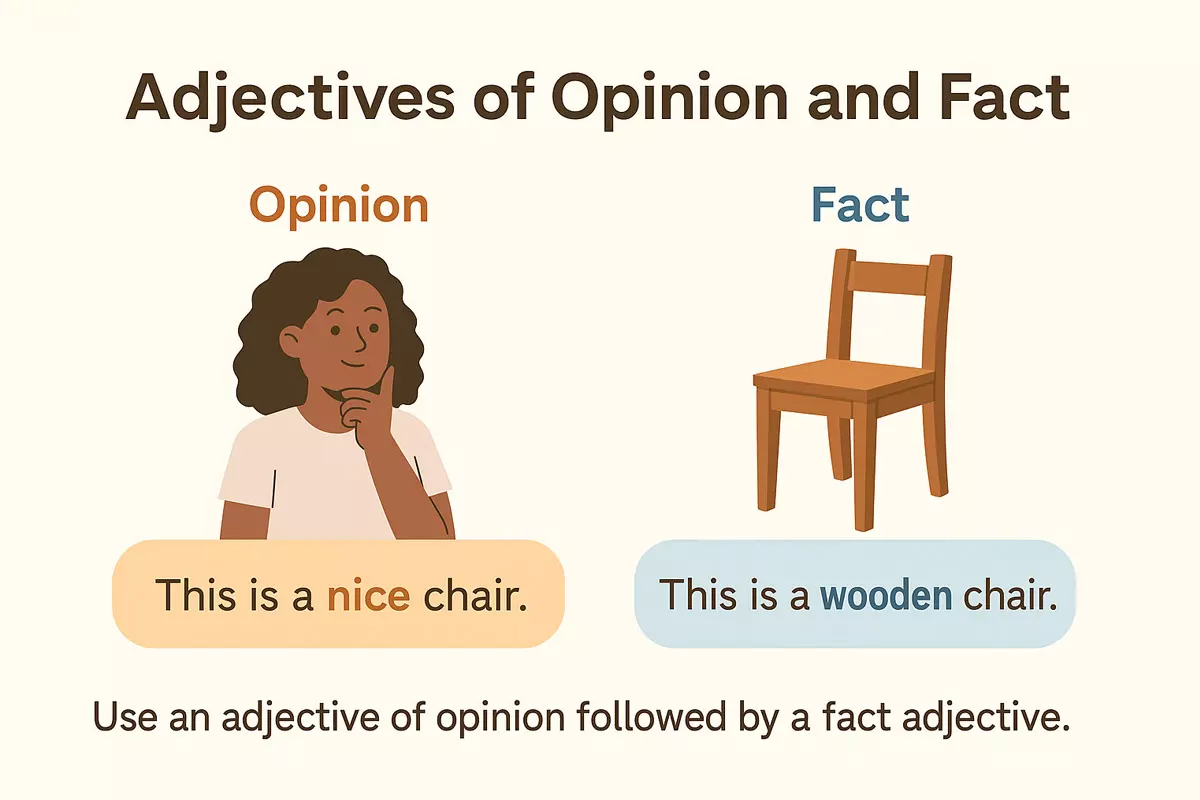 Learn the difference between opinion adjectives like nice and boring and fact adjectives like wooden or Italian. The article explains their typical order, how to use both together naturally, and offers practice with adjective order.
Selecting appropriate descriptive words enhances clarity and engagement in your sentences, but distinguishing between personal impressions and objective details is essential. Personal impressions reflect your own feelings or subjective views, while objective details are based on observable facts that others can verify. By learning to balance both types in your writing, you can create vivid, trustworthy descriptions that appeal to readers and make your work more effective overall.
What opinion adjectives are (nice, boring, beautiful)
Opinion adjectives express a speaker’s feelings, thoughts, or judgments about something. These words tell us what someone thinks about a person, place, thing, or idea, rather than describing an objective fact. For example, calling a movie “boring” says how you feel about it, not a measurable detail everyone would agree on. Words like “nice,” “beautiful,” and “delicious” also fit this category—they reflect subjective impressions.
How opinion adjectives work
You’ll often find these descriptive words before the noun they qualify. They help add a personal touch to your sentences and show your attitude. Unlike factual adjectives (such as “red,” “wooden,” or “large”), these do not rely on universally accepted criteria. Instead, they can change from person to person.
- amazing → The view from the mountain was absolutely amazing.
- awful → The weather was awful all weekend.
- brilliant → She had a brilliant idea during the meeting.
- charming → The little village looked charming in the morning light.
- confusing → The instructions were confusing and unclear.
- delightful → We had a delightful evening at the café.
- dull → The lecture was so dull that many students fell asleep.
- exciting → The race was exciting from start to finish.
- fantastic → The concert was fantastic—everyone enjoyed it.
- funny → The movie was funny and made us laugh out loud.
- horrible → The food tasted horrible, so we sent it back.
- interesting → His presentation was interesting and full of examples.
- lovely → She wore a lovely dress to the party.
- mean → His comment was mean and unnecessary.
- pleasant → We had a pleasant walk by the river.
- remarkable → Her progress in English is quite remarkable.
- terrible → The service at the restaurant was terrible.
- ugly → The building looks ugly after years without repair.
- wonderful → We had a wonderful time on vacation.
- weird → The story was weird but entertaining.
Examples in context
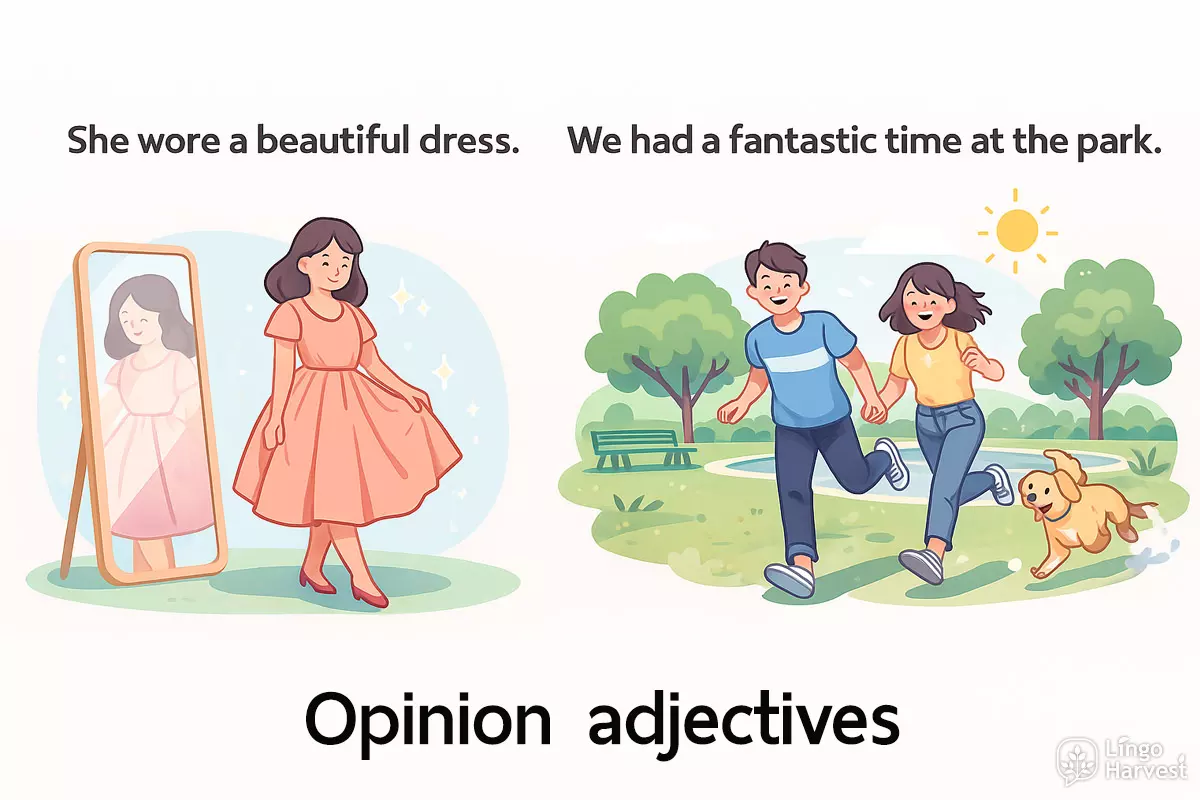
Notice how these adjectives reveal individual perspectives in sentences:
- She wore a beautiful dress.
- This is a boring book.
- We had a fantastic time at the park.
- He’s a nice neighbor.
- The weather today is awful.
Opinion adjectives can be positive, negative, or neutral, depending on what the speaker wants to communicate. They are useful for sharing tastes or preferences and often appear in reviews, conversations, and stories. Unlike fact adjectives, these words cannot be measured or proved; they simply show how someone feels.
What fact adjectives are (wooden, red, Italian)
Fact adjectives describe qualities that are generally objective, observable, or measurable. These words provide clear, factual information about something, such as its material, color, shape, size, age, or origin. For example, when you say “a wooden table,” you are specifying the material. If you say “an Italian car,” you’re indicating where the car comes from. These descriptors do not express opinions or feelings; instead, they state something most people would agree on.
Common types of fact adjectives
Fact adjectives usually answer questions like “What is it made of?”, “What color is it?”, “Where is it from?”, or “How big is it?”. Here are some typical categories:
- Material: wooden, metal, plastic, glass, stone, cotton, leather
- Color: red, blue, green, yellow, black, white, pink, silver
- Origin/Nationality: Italian, French, American, Chinese, Indian, Russian
- Shape: round, square, rectangular, oval, triangular
- Size: big, small, tiny, huge, tall, short
- Age: old, young, ancient, modern, new
- Purpose: sleeping (as in “sleeping bag”), running (as in “running shoes”)
How fact adjectives differ from opinion adjectives
While factual adjectives give concrete details, opinion adjectives express a personal judgment or feeling (like “beautiful” or “boring”). For example, “a red shirt” is a straightforward fact, but “a stylish shirt” is an opinion.
| Fact Adjective | What It Describes |
|---|---|
| wooden | Material (made of wood) |
| red | Color |
| Italian | Origin/Nationality |
| round | Shape |
| small | Size |
| old | Age |
| cotton | Material (made of cotton) |
| French | Origin/Nationality |
| blue | Color |
| rectangular | Shape |
You can combine several fact adjectives in one phrase, usually following a set order: opinion + size + age + shape + color + origin + material + purpose + noun. For instance: “a beautiful small old round red Italian wooden table.” This structure helps keep descriptions clear and logical.
Typical order of opinion and fact adjectives
When describing nouns with multiple adjectives, English usually follows a certain sequence. Adjectives expressing personal feelings or judgments—often called "opinion" adjectives—tend to come before those describing objective details, known as "fact" adjectives. This order helps sentences sound natural and prevents confusion.
Understanding the two types
Opinion adjectives reflect subjective thoughts or attitudes, such as "beautiful," "boring," or "delicious." Fact adjectives, on the other hand, provide factual details about things like size, age, shape, color, origin, or material. For example:
- Opinion: lovely, awful, interesting, ugly, nice, terrible
- Fact: large, old, round, blue, French, wooden
General pattern in English
A common structure places the opinion adjective first, followed by the factual one:
- a beautiful (opinion) old (fact) painting
- an interesting (opinion) modern (fact) building
- a delicious (opinion) chocolate (fact) cake
When more than two adjectives are used, the order generally follows: opinion, size, age, shape, color, origin, material, purpose.
| Adjective Type | Example in a Phrase |
|---|---|
| Opinion + Fact | an amazing Italian car |
| Opinion + Size + Fact | a wonderful big wooden table |
| Opinion + Age + Fact | a boring old science book |
| Opinion + Color + Fact | a lovely red silk dress |
| Opinion + Origin + Fact | a strange French movie |
Common mistakes and tips
Placing a descriptive adjective before an opinion one can sound odd to native speakers. For example, "a wooden beautiful chair" ❌ is incorrect, while "a beautiful wooden chair" ✅ sounds natural. Remember that native usage almost always puts the subjective view first.
Expanded examples for practice
- a fantastic small apartment
- an awful cold morning
- a wonderful old friend
- a boring long meeting
- an elegant black dress
- a tasty Italian pizza
- an exciting new job
- a horrible rainy day
- a friendly young teacher
- a comfortable leather sofa
- a charming French village
- a noisy crowded street
Mastering the sequence of subjective and factual adjectives makes your English clearer and more idiomatic. Practice by combining your own opinions and facts about different objects, and soon this order will come naturally.
Using both types together naturally
Combining adjectives of opinion and fact in your sentences helps you sound fluent and expressive. In English, it's common to place the opinion adjective first, followed by the factual one. This ordering feels natural to native speakers and makes your description clear and engaging.
Typical order in descriptive phrases
When you want to give both your impression and some concrete detail, start with what you think or feel, then add the factual adjective. For example: "a beautiful old house" or "an interesting French film." This pattern applies to many situations and is a useful guideline for building longer descriptions.
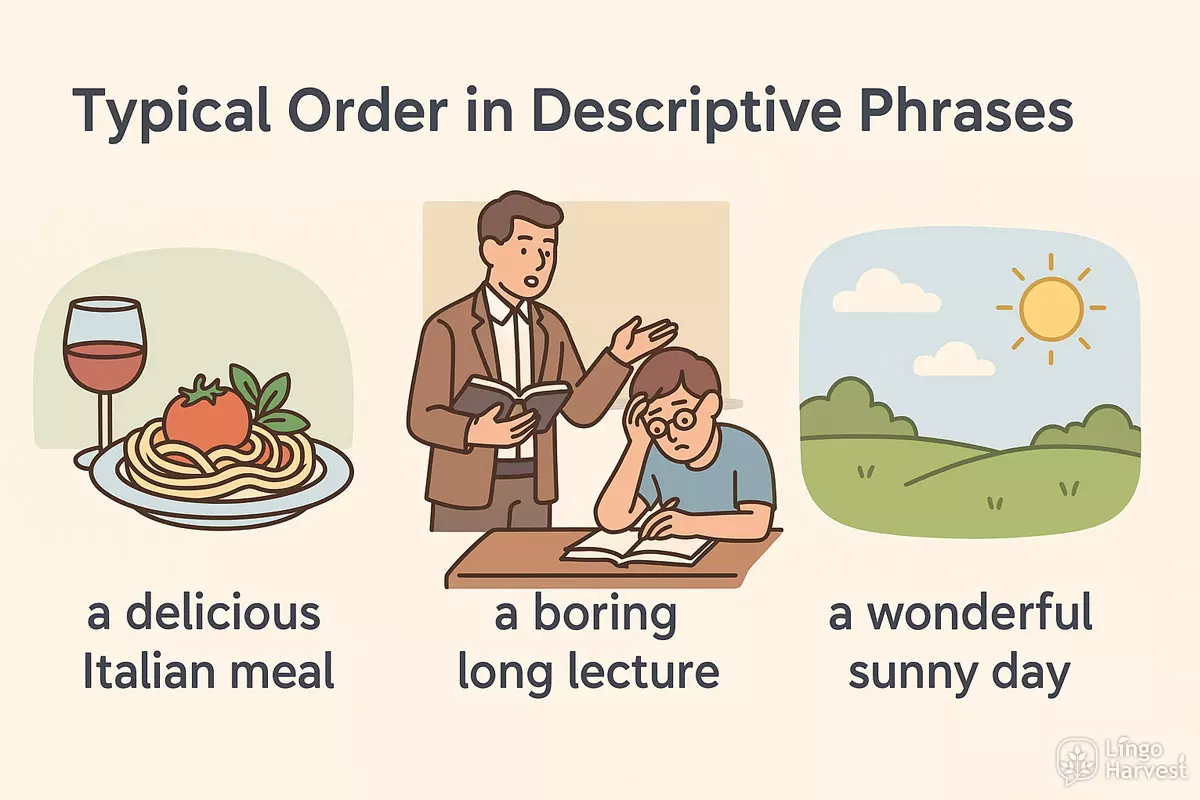
- a delicious Italian meal
- a boring long lecture
- a wonderful sunny day
- a terrible cold morning
- an amazing historical site
- a funny little dog
- a strange new idea
- a charming wooden bridge
- a lovely red dress
- an exciting basketball match
- a dreadful rainy weekend
- a pleasant quiet evening
- a silly old joke
- a brilliant young scientist
- an awful noisy street
- a fascinating ancient city
Why the order matters
Putting the opinion adjective first signals to your listener what you feel, then supports it with factual information. Reversing this order can sound awkward or unnatural. For instance, "an old beautiful house" is less idiomatic than "a beautiful old house."
Common patterns in everyday English
Here are some more real-life combinations that follow this natural structure:
- a lovely quiet park
- a horrible traffic accident
- an impressive modern building
- a cute little kitten
- a delicious spicy soup
- a friendly local guide
- a boring science textbook
- a wonderful winter holiday
Practicing these combinations will help your English sound smooth and authentic. Try mixing different opinion and fact adjectives to describe things around you for extra practice.
Avoiding confusing or strange combinations
When using adjectives of opinion and fact together, it's important to create combinations that sound natural and make sense to native speakers. Mixing these types incorrectly can lead to awkward or unclear descriptions. The most common issue is placing adjectives in the wrong order or choosing words that don't logically fit together.
Common pitfalls to watch for
- Placing opinion adjectives after factual ones (e.g., wooden ugly chair instead of ugly wooden chair).
- Combining adjectives that contradict each other (e.g., delicious disgusting soup).
- Using too many adjectives, which can confuse the reader and weaken your description.
- Pairing adjectives that don’t match the noun’s qualities (e.g., happy metal table).
- Using subjective adjectives with technical or scientific nouns, leading to unclear meaning.
Examples of awkward vs. natural combinations
To help clarify, here is a list of adjective-noun pairings that often sound strange, alongside improved alternatives:
- ❌ cold friendly teacher → ✔️ friendly cold teacher (Better: friendly strict teacher / strict but friendly teacher)
- ❌ boring blue cake → ✔️ blue boring cake (Better: boring-looking blue cake / plain blue cake)
- ❌ beautiful plastic flower → ✔️ beautiful artificial flower
- ❌ tasty wooden spoon → ✔️ wooden kitchen spoon
- ❌ old delicious bread → ✔️ delicious old bread (Better: fresh delicious bread)
- ❌ huge intelligent idea → ✔️ huge brilliant idea / brilliant huge idea
- ❌ red clever student → ✔️ clever student in red / clever red-haired student
- ❌ strange metal music → ✔️ strange-sounding metal music / unusual metal music
- ❌ funny glass window → ✔️ unusual glass window / peculiar glass window
- ❌ interesting green apple → ✔️ interesting-looking green apple / unusual green apple
Tips for clear and effective combinations
- Start with opinion adjectives, then add factual ones: beautiful old house, not old beautiful house.
- Limit the number of adjectives to two or three, unless you want a dramatic effect.
- Think about whether the adjectives logically fit the noun and each other.
- Read your sentence aloud to check for awkwardness or ambiguity.
Getting the balance right between subjective and objective descriptions makes your writing clearer and more engaging. If you’re unsure about a combination, try simplifying the description or asking whether a native speaker would use it that way.
Practice: reorder adjectives in simple sentences
Understanding how to arrange adjectives in English is essential for clear and natural-sounding sentences. When multiple adjectives describe a noun, their order is not random. Opinion adjectives (how you feel about something) typically come before fact-based adjectives (such as size, age, shape, or color). Practicing this order helps you build more accurate and fluent sentences.
Task: Put the adjectives in the correct order
Below are sentences with adjectives in a mixed or incorrect order. Rewrite each sentence so the adjectives appear in the most natural English sequence. Remember, opinions come first, followed by facts (size, age, shape, color, origin, material, purpose).
- A wooden old lovely table
- A French little delicious cake
- An interesting blue big book
- An ugly metal heavy statue
- A silk beautiful red scarf
- A scary long black movie
- A modern white small apartment
- An antique round golden mirror
- A boring green thick notebook
- A comfortable leather brown chair
- A plastic cheap tiny toy
- An exciting new American series
Show answers
- A lovely old wooden table
- A delicious little French cake
- An interesting big blue book
- An ugly heavy metal statue
- A beautiful red silk scarf
- A scary long black movie
- A modern small white apartment
- An antique round golden mirror
- A boring thick green notebook
- A comfortable brown leather chair
- A cheap tiny plastic toy
- An exciting new American series
Tips for Remembering Adjective Order
- Opinion (beautiful, delicious, ugly)
- Size (big, small, tiny)
- Age (old, new, antique, modern)
- Shape (round, long, thick)
- Color (red, blue, green, black, golden, white, brown)
- Origin (French, American)
- Material (wooden, metal, silk, leather, plastic)
- Purpose (series, toy, scarf, chair, cake)
Try practicing with your own examples. Mix and match adjectives, then check if the order feels natural and follows the opinion-to-fact pattern.