Limiting Adjectives: Definition and Usage

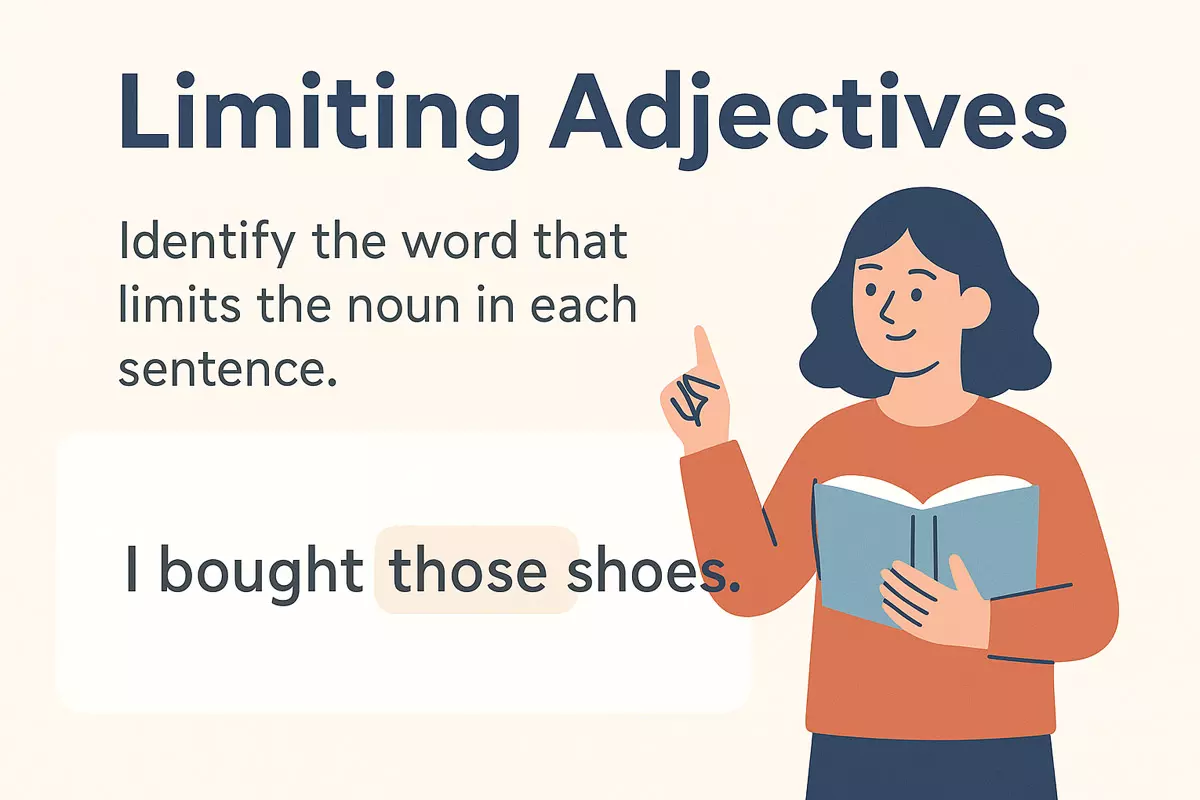 Here we how limiting adjectives such as main, only, first, and last define nouns and differ from descriptive adjectives. It explains where they are placed in noun phrases, how they change meaning, and provides practice using them in short descriptions.
Certain words, known as specifying modifiers, help clarify which particular nouns we are referring to in a sentence, making our communication more precise. By narrowing down the focus, these modifiers ensure that listeners or readers understand exactly who or what is being discussed. Using them correctly helps avoid confusion and provides clear, detailed information, which is essential for effective and accurate expression in both spoken and written language.
What limiting adjectives do in a noun phrase
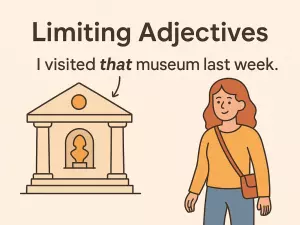
Limiting adjectives help to narrow down or specify exactly which person, place, or thing is being talked about in a sentence. Rather than describing qualities or characteristics, these words tell us which one, how many, whose, or which amount is intended. Their main function is to restrict or define the reference of the noun that follows, making the meaning more precise.
How limiting adjectives shape meaning
By placing a limiting adjective before a noun, you make it clear whether you mean all, some, or a specific one. This can change the entire meaning of a sentence. For example, “every student” is not the same as “this student” or “no student.” These modifiers help the listener or reader focus on the intended subset or individual among possible choices.
- Articles: a, an, the
- Demonstratives: this, that, these, those
- Possessives: my, your, his, her, its, our, their
- Quantifiers: some, any, each, every, no, several, many, few
- Numbers: one, two, three, etc.
- Distributives: either, neither, both
- Indefinites: another, other, much, most
- Interrogatives: which, what, whose
- Negative words: no, neither
- Ordinals: first, second, last, next
Placement and effect
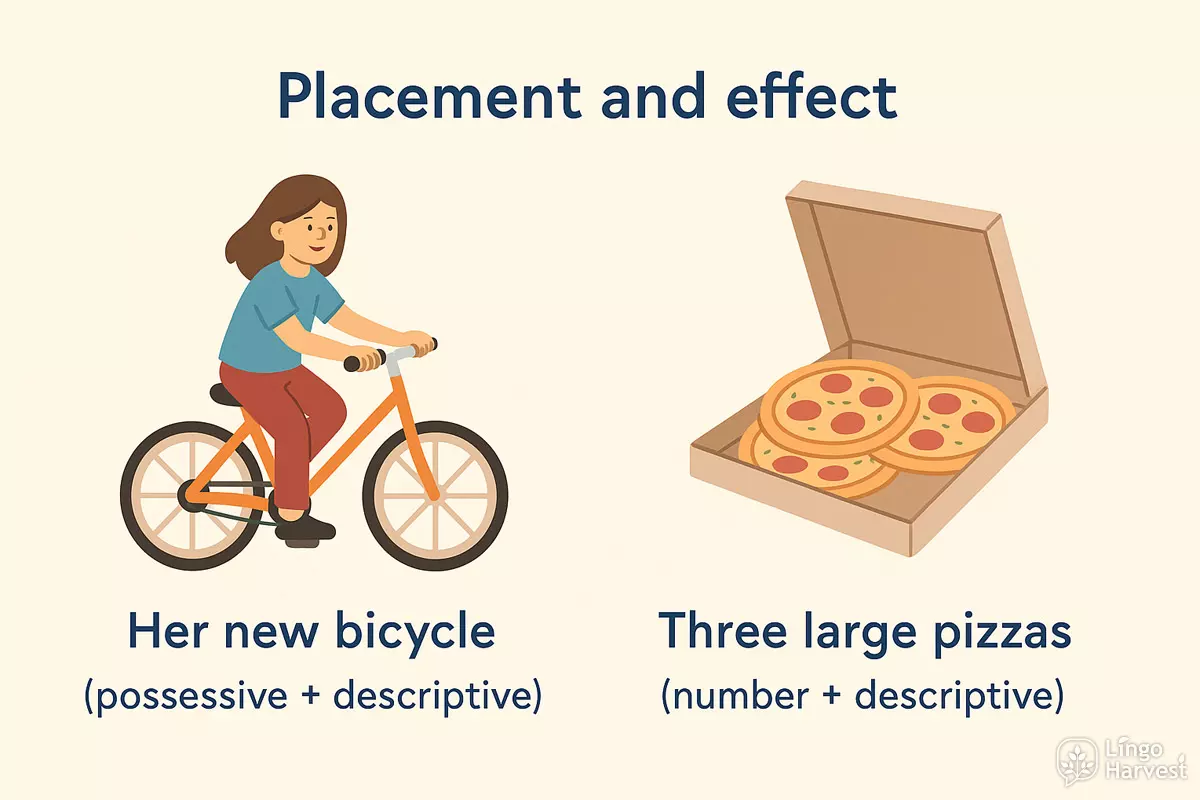
These modifiers always appear before the noun or noun phrase they limit. Their position is fixed, and they usually come before any descriptive adjectives. For instance:
- Her new bicycle (possessive + descriptive)
- Three large pizzas (number + descriptive)
- Every important detail (quantifier + descriptive)
Limiting vs. descriptive adjectives
Limiting adjectives are often contrasted with descriptive adjectives, which add qualities rather than restrictions. Here’s a comparison of how they function in a phrase:
| Type | Example & Function |
|---|---|
| Limiting adjective | Those books (specifies which books) |
| Descriptive adjective | Interesting books (describes what kind of books) |
| Both together | Those interesting books (specifies and describes) |
| Limiting + different noun | My car (shows possession, not quality) |
Summary
In short, limiting adjectives play a crucial role in clarifying exactly which noun is meant in a given context. They add precision, help avoid ambiguity, and ensure that communication is clear and specific.
Common limiting adjectives: main, only, first, last
Some adjectives have a special role in English: they restrict or specify the noun in a way that makes it clear which one is meant. Words like main, only, first, and last fall into this category. These modifiers don’t just describe; they set boundaries and help the listener or reader understand exactly which person, thing, or idea you’re discussing.
How these adjectives function
Limiting adjectives such as main, only, first, and last usually appear before the noun they modify. Their presence signals exclusivity, order, or importance. For example, “the only option,” “the main reason,” “the first step,” or “the last page” each narrow down the possible meanings of the noun.
Usage examples
- Main: She explained the main idea behind the project.
- Only: He was the only child in his family.
- First: The first chapter introduces the main characters.
- Last: Please read the last paragraph carefully.
- Main: The main entrance is closed after 8 p.m.
- Only: She’s the only person who knows the answer.
- First: I caught the first train this morning.
- Last: This is your last chance to apply.
- Main: The main point is still unclear.
- Only: That’s the only reason I came.
- First: She finished in first place.
- Last: He arrived at the last minute.
Quick comparison
To see how these limiting adjectives differ in meaning and usage, here’s a side-by-side overview:
| Adjective | Typical Meaning/Function |
|---|---|
| Main | Highlights the most important or central aspect |
| Only | Indicates uniqueness or exclusivity |
| First | Marks the beginning or initial element in a sequence |
| Last | Signals the final item or end point |
Understanding how to use these modifiers helps make communication more specific and clear. Whether you’re introducing a sequence, emphasizing importance, or pointing out something unique, limiting adjectives guide your audience directly to your intended meaning.
Difference between limiting and descriptive adjectives
Limiting and descriptive adjectives both modify nouns, but they serve very different roles in sentences. While one type adds specific details about which noun is meant, the other brings color and information about qualities or characteristics.
What are limiting adjectives?
These adjectives narrow down or restrict the meaning of a noun. They tell us exactly which one, how many, or whose. Limiting adjectives do not describe qualities; instead, they clarify identity or quantity. Common types include demonstratives (this, those), possessives (my, their), articles (a, an, the), numbers (five, second), and distributives (each, every).
What are descriptive adjectives?
Descriptive adjectives, on the other hand, answer questions like "what kind?" or "what is it like?" They provide more information about a noun’s size, shape, color, or other attributes. Examples include words like blue, tall, friendly, ancient, noisy, and delicious.
| Limiting Adjectives | Descriptive Adjectives |
|---|---|
| Point out, specify, or limit (e.g., these, my, first, every) |
Describe qualities or characteristics (e.g., red, tall, happy, large) |
| Answer "which one?" or "how many?" | Answer "what kind?" or "what is it like?" |
| Cannot be graded or compared | Often have comparative/superlative forms (smaller, happiest) |
| Usually come before descriptive adjectives (e.g., my old shoes not old my shoes) |
Follow limiting adjectives in a phrase |
Examples in sentences
- Limiting: Those apples are sour. (points out which apples)
- Descriptive: The green apples are sour. (describes the apples’ color)
- Limiting + Descriptive: My new coat is warm. (possessive + quality)
- She read every interesting article. (distributive + descriptive)
- He owns three old cars. (number + description)
- Give me that heavy box. (demonstrative + descriptive)
- We saw some wild animals. (indefinite + descriptive)
- The first red balloon popped. (ordinal + descriptive)
- Her favorite book is missing. (possessive + descriptive)
- They found several rare coins. (indefinite + descriptive)
In summary, limiting adjectives help identify or specify nouns, while descriptive adjectives enrich the sentence with details about what the noun is like. Both are essential for clear and vivid communication, but they play distinctly different roles in language.
Usual position of limiting adjectives
When it comes to sentence structure, limiting adjectives almost always appear directly before the noun or noun phrase they modify. This placement helps clarify which specific person, place, thing, or amount is being referenced. In English, these modifiers—like articles, demonstratives, possessives, and quantifiers—are not scattered throughout the sentence. Instead, they tightly “hug” the noun, ensuring the intended meaning is clear right from the start.
Immediate pre-noun placement
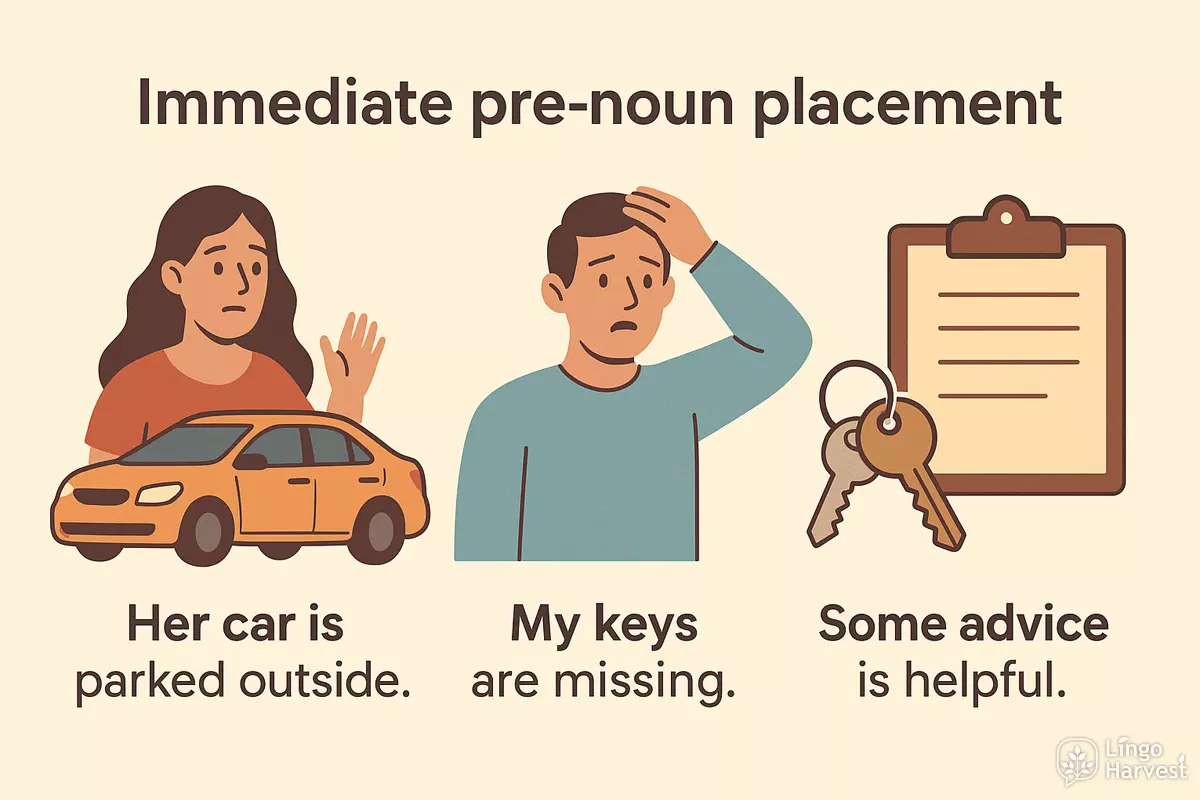
Most limiting adjectives are found immediately before the noun. This keeps the information about quantity, ownership, or specificity close to the word it affects. Here are some common examples:
- This book is new.
- Her car is parked outside.
- Every student submitted the assignment.
- My keys are missing.
- Some advice is helpful.
- All children love stories.
- That idea is promising.
- Each answer was considered.
- Our team won.
- Any solution will do.
- No dogs allowed.
- Those cookies are fresh.
Order with other adjectives
When other descriptive adjectives are present, limiting adjectives nearly always come first. This rule helps keep the sentence organized and prevents confusion. For example, you would say, “My big red ball” rather than “Big my red ball.”
| Word Order | Example |
|---|---|
| Limiting adjective + descriptive adjective + noun | Her old bicycle |
| Limiting adjective + number + noun | Those three cats |
| Limiting adjective + adjective + noun | My favorite book |
| Limiting adjective + noun | Each question |
Exceptions and special cases
There are rare instances where limiting adjectives follow the noun, such as in poetic language (“the city eternal”) or certain set phrases (“time immemorial”). However, in everyday English, these are exceptions. The default position remains: right before the noun. In summary, knowing where to place these modifiers makes English sentences clearer and more natural. Keeping them next to the noun ensures your meaning is precise and easy to understand.
How limiting adjectives affect meaning
Limiting adjectives set boundaries on the nouns they describe, making sentences more specific and often changing which particular thing, person, or amount is referenced. Instead of giving extra details about qualities, these words focus on narrowing down exactly what or how many are meant. For example, in “this book” versus “that book,” the limiting adjective tells you which book is being discussed.
Clarifying exactly which one
Words like “each,” “every,” “some,” or “my” help listeners and readers know precisely which item or group is involved. Without these, a sentence could be too vague. Here are some common ways these modifiers create clarity:
- Articles: a, an, the (e.g., “The cat is sleeping.”)
- Demonstratives: this, that, these, those (e.g., “Those apples are ripe.”)
- Possessives: my, your, his, her, its, our, their (e.g., “Her jacket is blue.”)
- Quantifiers: some, any, several, many, few (e.g., “Few people attended.”)
- Numbers: one, two, three, etc. (e.g., “Three dogs barked.”)
- Distributives: each, every, either, neither (e.g., “Each student received a book.”)
- Interrogatives: which, what, whose (e.g., “Whose keys are these?”)
- Indefinites: another, other (e.g., “Another chance will come.”)
- Negative words: no, neither (e.g., “No solution was found.”)
- Ordinal numbers: first, second, last (e.g., “First prize goes to Anna.”)
Changing the message with a single word
A small shift in a limiting adjective can completely alter a sentence’s meaning. For instance, compare the difference between “some answers are correct” and “all answers are correct.” The choice of word restricts or broadens what is being referenced.
| Sentence | Effect of Limiting Adjective |
|---|---|
| This car is fast. | Points to one specific car out of many. |
| Every student must sign in. | Refers to all students, no exceptions. |
| Some cookies are missing. | Indicates an unspecified number, not all. |
| My idea was chosen. | Shows ownership and specifies whose idea. |
| First runner finished. | Identifies the order, not just anyone. |
Why precision matters
Using the right limiting adjective avoids confusion and ensures the listener or reader knows exactly what’s meant. It’s the difference between talking about “books” in general and “these books” on the table. Such words help control the scope of a statement, making your communication clearer and more effective.
Practice: add limiting adjectives to short descriptions
Applying limiting adjectives is a useful way to specify or narrow down the meaning of nouns in everyday sentences. These modifiers help us clarify quantity, possession, or identity with just a word or two. In this practice section, you’ll find short descriptions that could be made clearer or more precise by adding the right limiting adjective.
Task: Insert an Appropriate Limiting Adjective
Read each description. Add a suitable limiting adjective (such as some, each, my, that, no, every, this, any, his, several, all, their, the, many, few, etc.) to make it more specific.
- _____ student finished the assignment on time.
- _____ cookies are left in the jar.
- _____ dog barked loudly at the mail carrier.
- She found _____ mistake in the report.
- _____ friends came to the party.
- He forgot _____ umbrella at home.
- _____ apples on the table are fresh.
- _____ book belongs to Sarah.
- We didn't see _____ birds in the park today.
- _____ teacher explained the lesson clearly.
- _____ of the answers were correct.
- _____ house is painted blue.
- _____ people know about the event.
- _____ shoes are these?
- _____ cat likes to sleep on the windowsill.
Show answers
- Every student finished the assignment on time.
- No cookies are left in the jar.
- That dog barked loudly at the mail carrier.
- Some mistake in the report.
- Several friends came to the party.
- His umbrella at home.
- The apples on the table are fresh.
- This book belongs to Sarah.
- Any birds in the park today.
- The teacher explained the lesson clearly.
- All of the answers were correct.
- Their house is painted blue.
- Few people know about the event.
- Whose shoes are these?
- My cat likes to sleep on the windowsill.
Limiting Adjectives in Context
To reinforce your understanding, here are examples of how limiting adjectives can change the meaning of a sentence by specifying quantity, ownership, or identity:
- All students must attend the meeting.
- Each book was carefully wrapped.
- My keys are missing.
- These shoes are too small.
- Some people prefer tea over coffee.
- No tickets remain for the concert.
- His phone is new.
- Every morning, she goes jogging.
- That answer is incorrect.
- Few options are available.
- Several students volunteered.
- Their car is parked outside.
As you practice, notice how these modifiers help make statements more exact and less ambiguous, providing readers or listeners with clear information about what or whom you mean.