Prepositions in Relative Clauses and Question Structures Guide

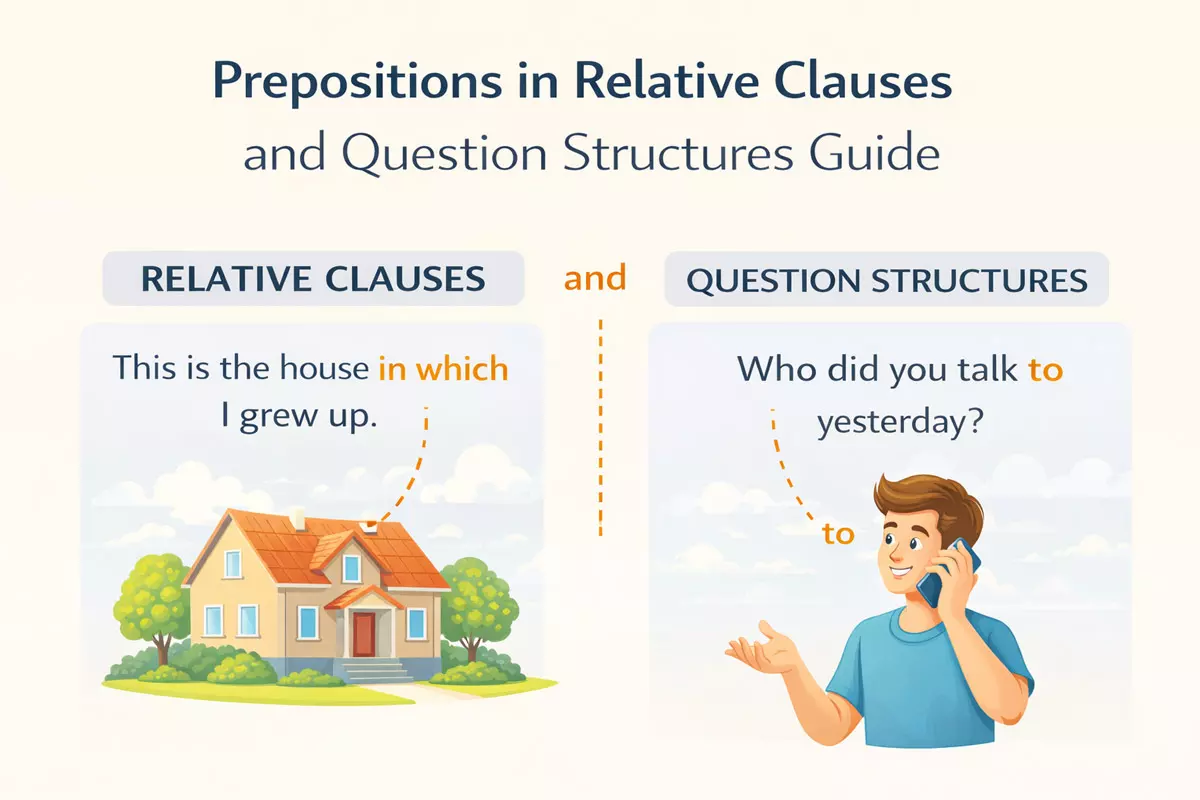 Here we rules for preposition placement in English, including stranding versus fronting, academic use with whom or which, and recognizing structures where fronting is impossible. It also addresses punctuation, register, pitfalls, and rewriting practice.
- Placement Mechanics: Preposition stranding vs. Fronting (Pied-piping) rules
- Formal Precision: Mastering 'Preposition + Whom/Which' in academic writing
- Incompatible Structures: Recognizing when fronting is grammatically impossible
- Punctuation in Relative Clauses: Comma placement with prepositional 'Wh-phrases'
- Question Logic: Strategy for ending informal questions with stranded prepositions
- Register and Flow: How fronting shifts the focus and increases professional tone
- Common Pitfalls: Correcting 'double prepositions' in complex relative clauses
- Practice: Stylistic rewriting—balancing natural speech with formal written requirements
Understanding where to place prepositions in various English sentences can be challenging, particularly when working with clauses that provide additional information or when structuring questions. This guide explains the key rules and common patterns, making it easier for you to use prepositions correctly and confidently across different contexts. With clear examples and straightforward tips, you'll be able to navigate the complexities of preposition placement and improve both your written and spoken English.
Placement Mechanics: Preposition stranding vs. Fronting (Pied-piping) rules
Understanding where to put prepositions in relative clauses and question structures is key to forming natural and correct sentences. In English, prepositions can either remain with their object at the end of the clause (known as "stranding") or move to the front together with the relative or interrogative word (called "fronting" or "pied-piping"). Each option has its own usage patterns, levels of formality, and acceptability depending on context.
Preposition Stranding
Leaving the preposition at the end is common in everyday English, especially in speech and informal writing. This approach feels more relaxed and conversational. For example:
- That's the book she was talking about.
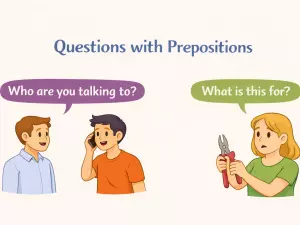
- Who are you going with?
- This is the place we stayed at.
- What did you put it in?
Stranding is typical after pronouns and in most modern relative or interrogative clauses.
Pied-piping (Fronting)

Moving the preposition in front of the relative or wh-word is usually seen as more formal or literary. This construction is common in academic writing and formal speech. Examples include:
- This is the book about which she was talking.
- With whom are you going?
- The house in which we stayed was beautiful.
- To whom did you send the letter?
Pied-piping is generally preferred with whom/which rather than who/that, and is rare in everyday conversation.
Comparing Stranding and Pied-piping
The choice between these two options affects tone and style. Below is a comparison to illustrate when and how each is used:
| Construction | Example | Typical Use | Formality |
|---|---|---|---|
| Preposition stranding | That’s the person I spoke to. | Everyday speech, informal writing | Informal |
| Pied-piping (fronting) | The person to whom I spoke | Academic, formal contexts | Formal |
| Stranding in questions | Who are you waiting for? | Spoken English, emails | Informal |
| Pied-piping in questions | For whom are you waiting? | Written exams, official documents | Formal |
Patterns and Usage Tips
Choosing between these forms depends on register, audience, and sometimes the relative pronoun used. Here are some guidelines:
- Use stranding for a conversational, natural tone.
- Reserve pied-piping for formal writing or when clarity is crucial.
- Pied-piping often follows "which" and "whom," but is awkward with "who" or "that."
- Avoid preposition stranding in very formal or academic contexts if possible.
- Some prepositions (like "of" or "about") can sound awkward when stranded; consider fronting in these cases.
Expanded Example List
Here’s a range of examples showing both options in context:
- The friend whom I spoke with (stranding)
- The friend with whom I spoke (pied-piping)
- This is the chair you sat on
- This is the chair on which you sat
- The topic we are interested in
- The topic in which we are interested
- The person she was talking about
- The person about whom she was talking
- Who did you go with?
- With whom did you go?
- The company he works for
- The company for which he works
- The room they stayed in
- The room in which they stayed
- What are you looking for?
- For what are you looking?
Understanding these placement options helps you adjust your English for different situations, making your sentences both accurate and appropriate for your audience.
Formal Precision: Mastering 'Preposition + Whom/Which' in academic writing
Academic writing often demands clarity and exactness, especially in the structure of relative clauses. Using a preposition before "whom" or "which" is a hallmark of formal style, distinguishing scholarly texts from everyday conversation. This construction not only refines your prose but also clarifies the relationships between ideas.
Understanding the Structure
The "Preposition + whom/which" pattern places the preposition directly before the relative pronoun. This is common with formal prepositions such as "to," "for," "by," "with," "about," "from," "on," and "in." For example:
- The theory to which she referred is widely accepted.
- The committee by which the decision was made met last week.
- The sources from which data were collected are listed below.
Why Position Matters
Placing the preposition before "whom" or "which" signals a higher level of formality. In less formal contexts, prepositions often appear at the end ("the person whom I spoke to"), but in academic contexts, fronting the preposition is preferred.
Common Preposition + Whom/Which Patterns
Writers often use the following combinations in scholarly texts:
- to whom → She is the colleague to whom I spoke yesterday.
- for whom → He is the client for whom the report was prepared.
- about whom → She is the author about whom everyone is talking.
- from whom → He is the mentor from whom I learned the most.
- with whom → She is the partner with whom he started the company.
- by whom → This is the artist by whom the painting was created.
- to which → This is the project to which she was assigned.
- in which → That is the city in which they met.
- on which → This is the day on which the decision was made.
- for which → That is the reason for which he apologized.
- about which → This is the topic about which we disagreed.
- by which → That is the method by which the results were measured.
- at which → This is the point at which the process stops.
- with which → That is the tool with which the task was completed.
- from which → This is the source from which the data was taken.
- under which → These are the conditions under which the contract applies.
- through which → This is the channel through which the message was sent.
Comparison: Formal vs. Informal Usage
| Formal (Preposition before pronoun) | Informal (Preposition at end) |
|---|---|
| The author to whom the letter was addressed... | The author whom the letter was addressed to... |
| The method by which the results were obtained... | The method which the results were obtained by... |
| The issue about which we are concerned... | The issue which we are concerned about... |
| The institution in which the study was conducted... | The institution which the study was conducted in... |
| The principle on which this theory rests... | The principle which this theory rests on... |
Practical Tips for Academic Precision
- Always use "whom" for people, "which" for things or concepts.
- Front the preposition in formal writing, especially in published papers and theses.
- If the clause is non-defining (extra information), use a comma before the relative pronoun.
- Avoid using "that" after prepositions; it is not standard (e.g., "the book to that..." ❌).
- Review your sentences for clarity; sometimes, rephrasing avoids awkward constructions.
Mastering the "preposition + whom/which" structure elevates your academic writing and demonstrates attention to detail, a valued trait in scholarly communication.
Incompatible Structures: Recognizing when fronting is grammatically impossible
Some English sentences simply do not allow preposition fronting, no matter how formal or informal the context. Recognizing these patterns can prevent unnatural or incorrect phrasing, especially in relative clauses and question structures. The following points highlight common cases where preposition fronting is not permitted.
Key Contexts Where Preposition Fronting Fails
Certain grammatical structures inherently block the movement of a preposition to the front of a clause. The reasons may be tied to the type of relative pronoun, the absence of an explicit object, or the informal register of the sentence. Here are some of the main scenarios:
- Relative clauses with "that": Preposition fronting is not possible with "that" as a relative pronoun (e.g., The chair that I sat on ✅, On that I sat ❌).
- Omitted relative pronoun: When the relative pronoun is dropped, fronting is impossible (The topic I spoke about ✅, About I spoke ❌).
- Informal spoken English: Conversation favors stranded prepositions, making fronting sound unnatural or overly formal.
- Questions with "who/what": When "who" or "what" is the object of a preposition, fronting is rare and often incorrect (Who did you speak to? ✅, To whom did you speak? is formal but correct, To who did you speak? ❌).
- Phrasal verbs: The preposition (particle) can't be separated and fronted (The book I looked up ✅, Up which I looked the book ❌).
- Idiomatic expressions: Many idioms require the preposition to remain after the verb (The solution we came up with ✅, With which we came up the solution ❌).
- Non-interrogative "where/when/why": These adverbial relatives do not allow preposition fronting (The year when I was born ✅, In which year I was born is possible but less natural than the year when).
- Non-standard dialects: Some dialects never use preposition fronting, regardless of context.
- Double prepositions: Sentences with more than one preposition typically do not allow both to be fronted.
- Relative clauses modifying entire clauses: Fronting is rarely grammatical in this case.
Comparison: Acceptable vs. Unacceptable Structures
| Natural / Standard | Wrong or Not Recommended (and why) |
|---|---|
| This is the person who I spoke with. | This is the person with who I spoke. ❌ (Use whom after a preposition: with whom.) |
| This is the person with whom I spoke. (formal) | This is the person with that I spoke. ❌ (That cannot follow a preposition.) |
| The problem (that) we talked about. | The problem about that we talked. ❌ (That cannot follow a preposition; use about which in formal style.) |
| The problem about which we talked. (formal) | The problem about which we talked about. ❌ (Do not repeat the preposition.) |
| The project (which) I worked on. | The project on which I worked on. ❌ (Redundant preposition.) |
| The project on which I worked. (formal) | The project on that I worked. ❌ (That cannot follow a preposition.) |
| Who did you go with? | With who did you go? ⚠️ (Common in speech, but not recommended in careful writing; formal: With whom did you go?) |
| The book (that) I looked up. | Up which I looked the book. ❌ (Wrong word order; phrasal verbs like look up don’t front naturally.) |
| The idea (that) we came up with. | With which we came up the idea. ❌ (Wrong word order; keep came up with together in natural use.) |
| The year when I was born. | The year in which I was born. ⚠️ (Grammatically correct but more formal; when is usually more natural.) |
| This is the person I spoke to. | This is the person to who I spoke. ❌ (Use whom after a preposition: to whom.) |
| This is the person to whom I spoke. (formal) | To whom I spoke. ⚠️ (Incomplete on its own; add a main clause: This is the person...) |
Quick Reference: When to Avoid Preposition Fronting
- Never front with "that" as the relative pronoun.
- Do not front when the relative pronoun is omitted.
- Fronting is generally avoided in informal speech.
- Most phrasal verbs and idioms do not allow preposition movement.
Understanding these restrictions will help you construct natural, accurate sentences and avoid common pitfalls when working with prepositions in complex clauses.
Punctuation in Relative Clauses: Comma placement with prepositional 'Wh-phrases'
Understanding how to punctuate relative clauses—especially those containing prepositional 'Wh-phrases' like “to whom” or “with which”—is essential for clear and correct writing. The use of commas depends largely on whether the clause is restrictive (essential) or non-restrictive (non-essential). Recognizing the difference helps you decide when and where commas are necessary.
Restrictive vs. Non-Restrictive Clauses
Restrictive clauses (also called defining clauses) provide essential information about the noun they modify. These clauses do not require commas. In contrast, non-restrictive clauses add extra, non-essential details and are set off with commas. The placement of a preposition with a 'Wh-phrase' does not change this rule, but the structure can sometimes make punctuation choices less obvious.
- Restrictive: The professor to whom I spoke explained the concept. (No commas; the clause is essential.)
- Non-restrictive: My advisor, to whom I sent the email, replied promptly. (Commas set off the additional information.)
Prepositional 'Wh-phrases' in Relative Clauses
When a prepositional phrase introduces the 'Wh-word' (e.g., “in which,” “about whom”), the same punctuation principles apply. The preposition can appear before the 'Wh-word' (formal) or at the end (informal), but comma usage is determined by the type of clause, not the preposition’s position.
| Clause Type | Comma Usage Example | Explanation |
|---|---|---|
| Restrictive | The book in which she wrote her notes is missing. | No commas; 'in which she wrote her notes' is essential. |
| Non-restrictive | The meeting, during which we discussed budgets, was productive. | Commas enclose 'during which we discussed budgets'—extra info. |
| Restrictive (preposition at end) | The person I was talking to is my neighbor. | No commas; 'I was talking to' restricts the noun. |
| Non-restrictive (preposition at end) | My colleague, whom I traveled with, moved abroad. | Commas used; the clause is not essential to the main noun. |
Common Prepositional 'Wh-phrases' in Context
Writers often encounter a variety of prepositional 'Wh-phrases' in relative clauses. Here are some commonly used combinations, shown in both restrictive and non-restrictive settings:
- against whom → He is the opponent against whom the lawsuit was filed.
- among whom → She was one of the experts among whom the decision was discussed.
- during which → It was a phase during which the company expanded rapidly.
- after which → He signed the contract, after which the project began.
- before which → The system runs a check, before which all files are locked.
- over which → This is the territory over which the empire once ruled.
- into which → This is the folder into which all backups are saved.
- within which → It is a structure within which teams can operate freely.
- upon which → This is the assumption upon which the theory depends.
- around which → That is the issue around which the debate developed.
- beyond which → This is the limit beyond which access is restricted.
- beneath which → The cave lay beneath which an underground river flowed.
- alongside which → A new system was introduced, alongside which training was provided.
- across which → This is the bridge across which the supplies were transported.
- between which → These are the two options between which users must choose.
- towards which → That is the goal towards which all efforts are directed.
- out of which → This is the material out of which the device is made.
- in favour of which → This is the proposal in favour of which the committee voted.
- by means of which → That is the method by means of which the data was collected.
Pay attention to whether your clause is essential. If it is non-essential, insert commas around the clause—even when the preposition precedes the 'Wh-word.' If the clause is necessary for meaning, omit the commas. This practice ensures your sentences are both grammatically correct and easy to read.
Question Logic: Strategy for ending informal questions with stranded prepositions
In spoken English, ending questions with prepositions—leaving them "stranded"—often feels natural and conversational. This is especially true when forming questions from relative clauses or when the preposition is closely linked to the verb. For example, "Who are you talking to?" sounds friendlier than the more formal "To whom are you talking?" Choosing whether to strand a preposition depends on the tone, audience, and level of formality required.
When is it acceptable to strand prepositions?
Stranding is generally accepted in:
- Everyday conversations
- Informal writing (emails, texts, messages)
- Questions with short or common verbs
- Situations where moving the preposition to the front sounds awkward or overly formal
In contrast, academic or highly formal contexts may favor placing the preposition before the relative pronoun or question word.
Forming questions with stranded prepositions
The process often involves:
- Identifying the verb-preposition pairing (e.g., "look at," "talk to," "listen to")
- Moving the question word (who, what, which, etc.) to the front
- Leaving the preposition at the end of the question
This structure keeps the sentence natural and easy to understand.
Common patterns and examples

Here are typical question types that end with prepositions. Notice how natural they sound in everyday speech:
- Who are you waiting for?
- What are you looking at?
- Which team are you cheering for?
- Where did you come from?
- What are you interested in?
- Who are you talking about?
- Who did you go with?
- What are you thinking about?
- What did you step on?
- Who are you laughing at?
- What did you sign up for?
- Who did you borrow it from?
- Who do you agree with?
- What did you pay for?
- Which class are you enrolled in?
- Who can you rely on?
- What are you afraid of?
- Who are you sitting with?
- What did you run into?
- Who did you hear it from?
Comparing formal vs. informal question forms
For a clearer understanding, see how standard spoken questions differ from their formal counterparts:
| Informal (Stranded Preposition) | Formal (Preposition Fronted) |
|---|---|
| Who are you talking to? | To whom are you talking? |
| What are you interested in? | In what are you interested? |
| Who did you go with? | With whom did you go? |
| Which class are you enrolled in? | In which class are you enrolled? |
| Who did you borrow it from? | From whom did you borrow it? |
Tips for using stranded prepositions
- Use the stranded form for natural, friendly interactions.
- Switch to the fronted preposition form for formal writing or when clarity is needed in complex sentences.
- Avoid overcorrecting; “to whom” can sound stilted in casual conversation.
- Pay attention to regional and register differences — American and British English both accept stranded prepositions in speech.
In summary, ending questions with prepositions is a practical strategy for informal English. Understanding when and how to use this structure helps you sound fluent and approachable in everyday interactions.
Register and Flow: How fronting shifts the focus and increases professional tone
Fronting prepositions in relative clauses and questions is more than a grammatical curiosity—it’s a way to direct attention and create a polished, formal impression in both writing and speech. Instead of letting prepositions trail at the end of sentences, moving them to the front signals control, clarity, and a higher linguistic register. This technique is especially valued in academic, legal, or professional contexts, where precision and tone matter.
What is Preposition Fronting?
Preposition fronting means placing the preposition before the relative pronoun or question word, rather than leaving it stranded at the end. For example:
- Standard: That’s the report which I was talking about.
- Fronted: That’s the report about which I was talking.
This subtle change shifts the focus, highlighting the relationship between the elements, and avoids ending sentences with prepositions—a feature associated with casual or informal English.
Effects on Professional Tone
Using preposition fronting can immediately elevate the tone of your sentences. It signals careful construction and respect for formal conventions, which is often expected in business communications, academic writing, and official correspondence. Additionally, this structure can clarify complex relationships within sentences, aiding reader comprehension.
Comparing Preposition Placement
Below is a comparison of typical and fronted structures in both relative clauses and question forms, showing how focus and formality are affected:
| Standard Structure | Fronted Preposition |
|---|---|
| The person who I spoke to | The person to whom I spoke |
| The topic that she is interested in | The topic in which she is interested |
| Who are you going with? | With whom are you going? |
| This is the project we worked on | This is the project on which we worked |
When to Use Fronting for Better Flow
Preposition fronting is most effective:
- In formal reports or proposals
- During presentations or speeches
- When clarity and precision are priorities
- To avoid ambiguity in complex sentences
- In academic writing and research papers
However, overuse in everyday conversation or simple writing can sound stilted. Reserve this technique for moments when style and professionalism are essential.
Summary
Shifting prepositions to the front in relative clauses and questions not only changes the focus but also elevates the professionalism of your language. This approach is an effective tool for anyone looking to improve the tone and clarity of their formal English.
Common Pitfalls: Correcting 'double prepositions' in complex relative clauses
Misplacing or duplicating prepositions is a frequent stumbling block in advanced English sentences, especially when using relative clauses. This often happens when both the main clause and the relative clause contain a preposition, leading to awkward or incorrect constructions. Understanding how to avoid these errors will make your writing and speaking clearer and more natural.
What Are 'Double Prepositions'?
A 'double preposition' error occurs when a preposition is unnecessarily repeated—once before the relative pronoun (like "which," "whom," or "that") and again at the end or within the clause. This is most common in sentences that contain complex or embedded relative clauses, especially in formal or academic writing.
Typical Problem Patterns
- Preposition at both ends: "The topic about which we talked about."
- Mixing formal and informal placement: "The person to whom I spoke to."
- Omitting necessary prepositions or adding extra ones: "The house in which I lived in."
How to Spot and Fix the Issue
Look for sentences where a preposition appears both before and after the relative pronoun. If you find one, remove the redundant preposition. Only one is needed, and its position depends on the formality of the sentence and the chosen relative pronoun.
| Incorrect Example | Corrected Version |
|---|---|
| The book about which we talked about | The book about which we talked |
| The person to whom I spoke to | The person to whom I spoke |
| The place in which we stayed in | The place in which we stayed |
| The reason for which she left for | The reason for which she left |
Quick Reference: Common Prepositions in Relative Clauses
When forming complex sentences, keep these patterns in mind to avoid duplication:
- in which → This is the environment in which the experiment was conducted.
- on which → That is the date on which the contract expires.
- to whom → She is the manager to whom all requests must be sent.
- with whom → He is the colleague with whom I collaborate most often.
- about which → This is the issue about which the committee is divided.
- for which → That is the purpose for which the funds were allocated.
- at which → This is the point at which the process becomes unstable.
- by which → That is the deadline by which all tasks must be completed.
- from which → This is the source from which the information was obtained.
- through which → This is the channel through which the data is transmitted.
- under which → These are the conditions under which access is granted.
- over which → That is the area over which the authority has control.
- after which → She submitted the form, after which she received confirmation.
- before which → The system performs a backup, before which all users are logged out.
- into which → This is the folder into which the files are automatically saved.
- upon which → This is the principle upon which the decision was based.
- within which → It is a framework within which teams can operate independently.
- between which → These are the two paths between which users must choose.
Tips for Avoiding Redundancy
- Always check if the preposition is already included with the relative pronoun.
- Decide whether to use the preposition at the start (formal) or at the end (informal), but never both.
- Read the sentence aloud to spot awkwardness caused by repetition.
- Be especially cautious with "whom" and "which," as these often attract double prepositions.
By being attentive to the structure of relative clauses, you can sidestep these frequent errors and produce more polished, professional English.
Practice: Stylistic rewriting—balancing natural speech with formal written requirements
Adapting sentences with relative clauses and question structures often means striking a balance between how we naturally speak and what is expected in formal writing. Spoken English tends to use more casual forms, sometimes omitting prepositions or reordering sentences for ease. In contrast, written English—especially in academic or professional contexts—often requires more precise and explicit structures. Let’s explore how to revise sentences for clarity and appropriateness, considering both natural flow and formal conventions.
Common Transformations: From Speech to Formal Writing
- Moving prepositions from the end to before the relative pronoun in formal writing
- Choosing between “who,” “whom,” “which,” and “that” appropriately
- Rewriting indirect questions for clarity
- Eliminating informal contractions or filler words
- Ensuring subject-verb agreement in complex clauses
- Clarifying ambiguous references
- Maintaining parallel structure in lists and questions
- Replacing phrasal verbs with single-word equivalents (when suitable)
- Reducing wordiness for concise expression
- Using passive or active voice as context demands
Exercise: Rewriting Sentences
Rewrite these sentences to make them suitable for formal written English. Pay attention to preposition placement, pronoun choice, and sentence structure.
- This is the book I was talking about.
- Who did you give the report to?
- The person who you spoke with is my colleague.
- Where did you get that idea from?
- That’s the project which I am responsible for.
- Can you tell me where the meeting is at?
- The company that she works for is expanding.
- Is this the address you sent the letter to?
- The reason why he left is not clear.
- What are you interested in?
Show answers
- This is the book about which I was speaking.
- To whom did you give the report?
- The person with whom you spoke is my colleague.
- From where did you get that idea?
- That is the project for which I am responsible.
- Can you tell me where the meeting is?
- The company for which she works is expanding.
- Is this the address to which you sent the letter?
- The reason for which he left is not clear.
- In what are you interested?
Quick Reference: Informal vs. Formal Structures
| Spoken/Informal | Formal/Written |
|---|---|
| This is the person I talked to. | This is the person to whom I spoke. |
| Where’s the document from? | From where is the document? |
| Who are you working with? | With whom are you working? |
| The team that I am part of… | The team of which I am a part… |
| The issue we talked about… | The issue about which we spoke… |
| What’s this about? | About what is this? |
| Who did you send it to? | To whom did you send it? |
| The person you met with… | The person with whom you met… |
| The office she works in… | The office in which she works… |
| The reason he left… | The reason for which he left… |
Tips for Effective Stylistic Rewriting
- In formal contexts, avoid ending clauses with prepositions when possible.
- Use “whom” after prepositions in relative and interrogative clauses.
- Prefer explicit references to avoid ambiguity.
- Read sentences aloud to check for clarity and natural flow.
- Consider your audience: academic writing usually favors more formal structures.