Limiting Adjectives: Definition and Use

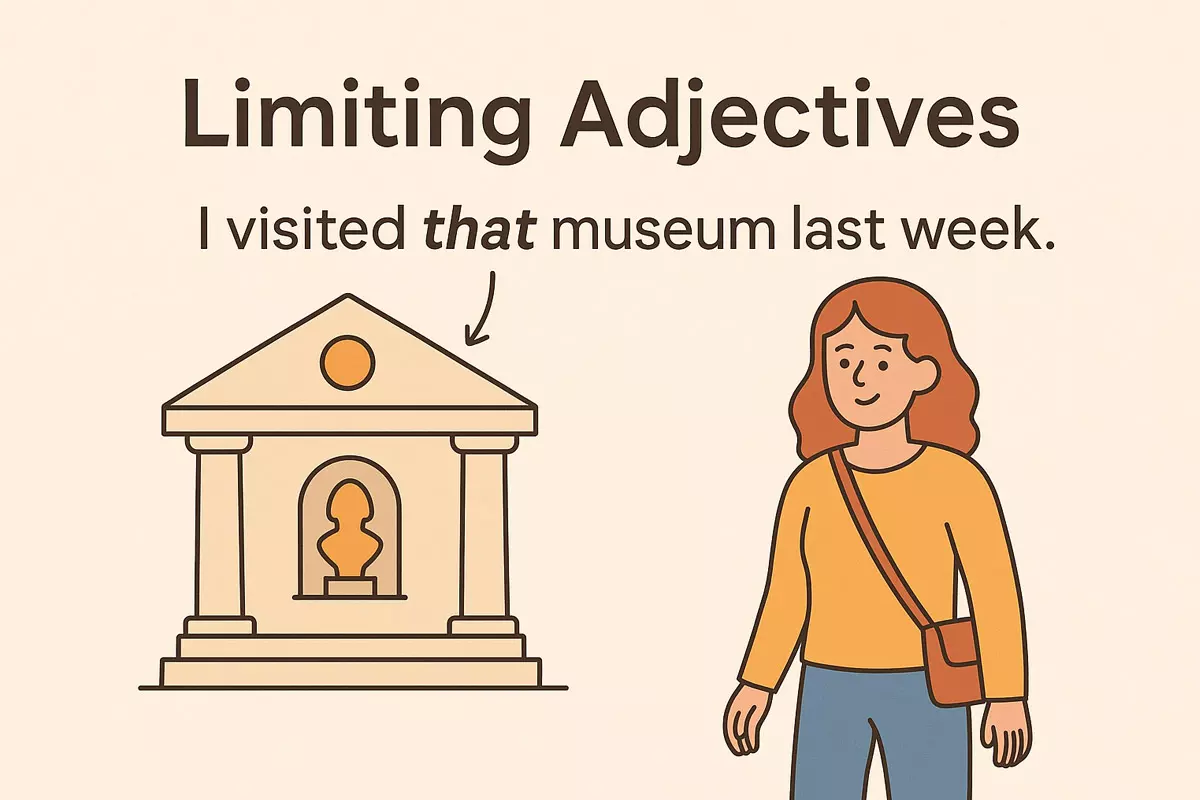 Here we how limiting adjectives specify nouns, details their main categories and typical sentence positions, and explains how they change meaning. It also provides examples, points out beginner mistakes, and offers practice items.
Have you ever noticed how certain words in English help us specify exactly which person, place, or thing we mean? These important words, known as determiners, play a vital role in making our communication clearer and more precise. By using determiners like the, a, this, that, my, or some, we can narrow down what we are referring to in conversation or writing. Without them, our sentences could easily become confusing or ambiguous, leaving listeners or readers unsure of our intended meaning. Determiners help us share information more effectively in everyday language.
What Limiting Adjectives Do
Limiting adjectives set boundaries on the nouns they describe. Instead of adding qualities or characteristics, these words point out which specific thing, how many, or whose item is in focus. They help clarify, specify, or restrict the reference of a noun in a sentence, making communication more precise.
How They Function in Sentences
These adjectives answer questions like "Which one?", "How many?", or "Whose?" For example:
- Which one? – This book is interesting.
- How many? – Several students attended the meeting.
- Whose? – My car is parked outside.
By doing so, they narrow down the meaning of the noun, guiding the reader or listener to the intended reference.
Common Types with Examples
Limiting adjectives come in several forms. Here are some of the most frequent types:
- Articles: a, an, the
- Demonstratives: this, that, these, those
- Possessives: my, your, his, her, its, our, their
- Quantifiers: some, many, few, several, all, both, each, every
- Numbers: one, two, three, etc.
- Distributives: each, every, either, neither
- Interrogatives: which, what, whose (when used before a noun)
Comparison: Limiting vs. Descriptive Adjectives
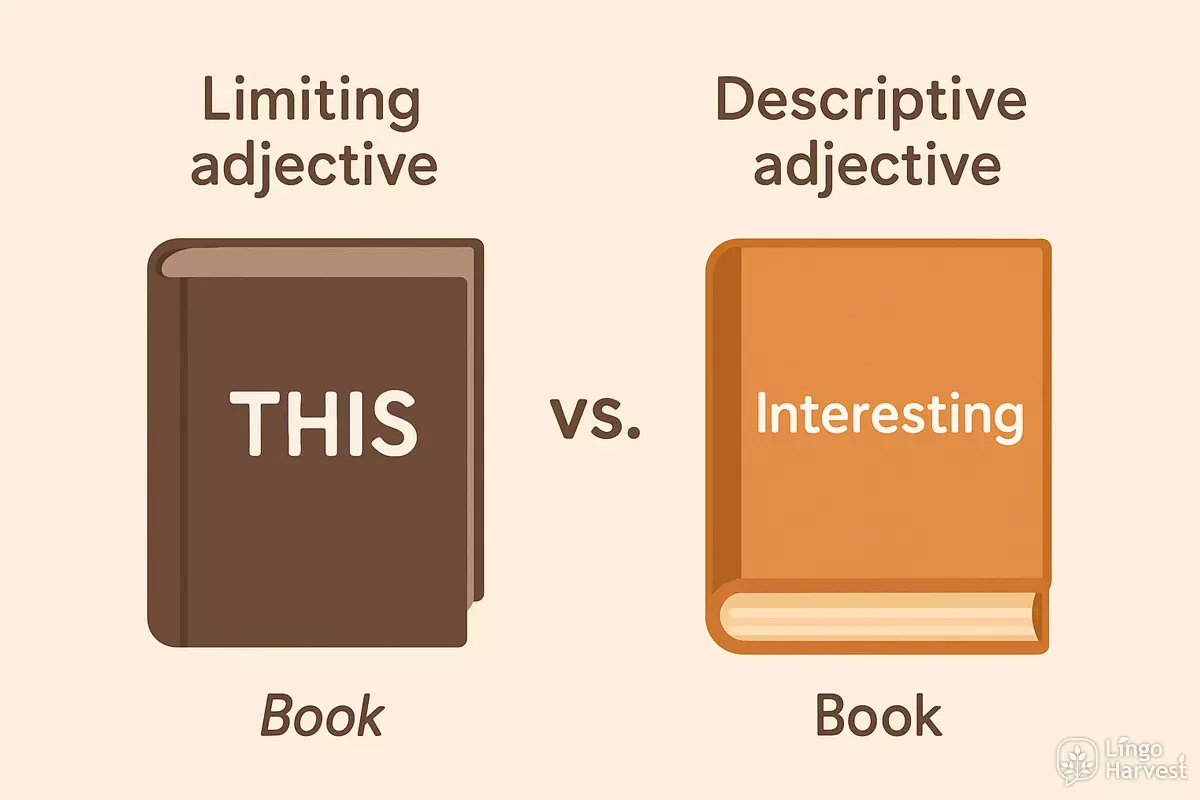
To highlight their unique function, here’s a side-by-side look at how limiting adjectives differ from descriptive ones:
| Limiting Adjective | Descriptive Adjective |
|---|---|
| This book (specifies which book) | Interesting book (tells what kind of book) |
| Five apples (shows how many apples) | Red apples (describes the apples’ color) |
| Her bag (indicates whose bag) | Large bag (describes bag’s size) |
| Every student (includes all students) | Talented student (describes the student’s ability) |
Why They Matter
Using limiting adjectives ensures that your meaning is clear and unambiguous. They help avoid confusion by pinpointing exactly what or whom you’re referring to. Whether you’re indicating ownership, number, or a particular item out of a group, these words play a crucial role in effective communication.
Main Categories
When discussing limiting adjectives, it's helpful to group them by their specific roles and the kinds of information they provide. These words or phrases help to narrow down or define the nouns they modify, making communication more precise.
Types of Limiting Adjectives
Limiting adjectives come in several distinct types, each serving a unique function in a sentence. Here are the most common categories:
- Articles (definite and indefinite): the, a, an
- Demonstratives: this, that, these, those
- Possessives: my, your, his, her, its, our, their
- Quantifiers: some, any, few, several, many, each, every
- Numbers (cardinals and ordinals): one, two, three, first, second, third
- Distributives: either, neither, each, every
- Interrogative adjectives: which, what, whose
- Indefinites: another, other, certain, various
Examples of Limiting Adjectives in Context
To see how these function, consider the following sentences:
- That book is interesting. ✅
- My friends are coming over.
- She has two cats.
- Each student received a prize.
- Which movie do you want to watch?
Comparison of Limiting Adjective Types
| Type | Examples | Function |
|---|---|---|
| Articles | the, a, an | Specify definiteness or indefiniteness |
| Demonstratives | this, that, these, those | Point out specific items |
| Possessives | my, your, his, her, its, our, their | Show ownership or relation |
| Quantifiers | some, any, few, several, many | Indicate quantity or amount |
| Numbers | one, two, three, first, second | Express exact number or order |
| Distributives | each, every, either, neither | Refer to individuals within a group |
| Interrogatives | which, what, whose | Ask questions about nouns |
| Indefinites | another, other, certain, various | Refer to non-specific items |
Key Takeaways
Limiting adjectives are essential for clarifying which noun you’re talking about, how many you mean, or whose it is. Understanding the different types helps you use them precisely, making your writing and speech clearer and more effective.
Position in Sentence
When you’re working with limiting adjectives, their placement matters for clarity and meaning. Typically, these adjectives appear directly before the noun they modify, acting as a boundary or specifying which noun is meant. Unlike descriptive adjectives, which may sometimes be separated from the noun or used predicatively, limiting adjectives nearly always come right before the noun or noun phrase.
Common Patterns for Placement
There’s a straightforward rule: limiting adjectives do not stand alone and are rarely separated from the noun. Here’s how they are usually arranged:
- Directly before the noun: that book, every student, my keys
- Before other adjectives if both are present: my old jacket, each tall building
- In a sequence, limiting adjectives come first: his three favorite songs (possessive + numeral + descriptive)
Examples of Correct and Incorrect Placement
Paying attention to where you place these specifying words can help avoid confusion. Here are several examples showing the right and wrong way to position them:
- ✅ Correct: Some people enjoy classical music.
- ❌ Incorrect: People some enjoy classical music.
- ✅ Correct: Each child received a gift.
- ❌ Incorrect: Child each received a gift.
- ✅ Correct: His new car is red.
- ❌ Incorrect: New his car is red.
Types of Limiting Adjectives and Their Typical Placement
Limiting adjectives come in several categories, each with its own typical spot in a sentence. Here’s how they’re commonly positioned:
- Articles: a, an, the — always first before any other adjective (the big dog)
- Demonstratives: this, that, these, those — directly before the noun (these apples)
- Possessives: my, your, his, her, its, our, their — precede any other adjective (my favorite mug)
- Quantifiers: some, many, few, all, several — before the noun, sometimes followed by another adjective (many happy children)
- Numbers: one, two, ten, etc. — typically come right before the noun (three cats)
- Distributives: each, every, either, neither — directly before the noun (each person)
- Interrogatives: which, what, whose — at the start of a question before the noun (which color?)
- Indefinites: another, other, any, some — before the noun (another chance)
Order When Multiple Adjectives Are Present
If you use several adjectives together, there’s a preferred sequence. Limiting adjectives come before descriptive ones. Here’s a handy comparison:
| Adjective Order | Example |
|---|---|
| Possessive + Descriptive + Noun | her old bicycle |
| Article + Descriptive + Noun | the blue house |
| Demonstrative + Descriptive + Noun | those interesting books |
| Quantifier + Descriptive + Noun | several large boxes |
| Number + Descriptive + Noun | two tall trees |
Summary
To keep your meaning clear, always place limiting adjectives as close as possible to the noun they modify. When combining with other adjectives, remember that these limiting forms take priority in order. This approach avoids ambiguity and helps your writing sound natural and precise.
How They Change Meaning
Limiting adjectives play a crucial role in shaping the information a noun conveys. By specifying which one, how many, or whose item we’re talking about, these words narrow the focus, making sentences clearer and more precise. For example, compare “students” with “these students”—the limiting adjective “these” instantly tells us which group is meant.
Specificity and Precision
Using such modifiers, speakers and writers can control the scope of their statements. “Some books” is different from “all books,” and “my idea” is not the same as “an idea.” The choice of a limiting word can completely alter what the listener or reader understands.
- Each dog (every single one, considered individually)
- That house (a particular house, not any house)
- Few options (not many options, almost none)
- Several reasons (more than a couple, but not all)
- No time (zero time available)
- Another chance (one more, not the same as before)
- Whose bag (asks about ownership)
- My friend (belonging to the speaker)
- Every answer (all, without exception)
- Which color (asks to choose from a set)
- Some advice (an unspecified amount, not all)
- Those shoes (specific shoes, likely not nearby)
- Neither option (not one or the other)
- Both tickets (the two tickets together)
- First impression (the earliest one)
- Many people (a large, non-specific number)
- Her idea (possessed by her)
- Our team (belonging to us)
Comparing Sentences: The Impact of Limiting Adjectives
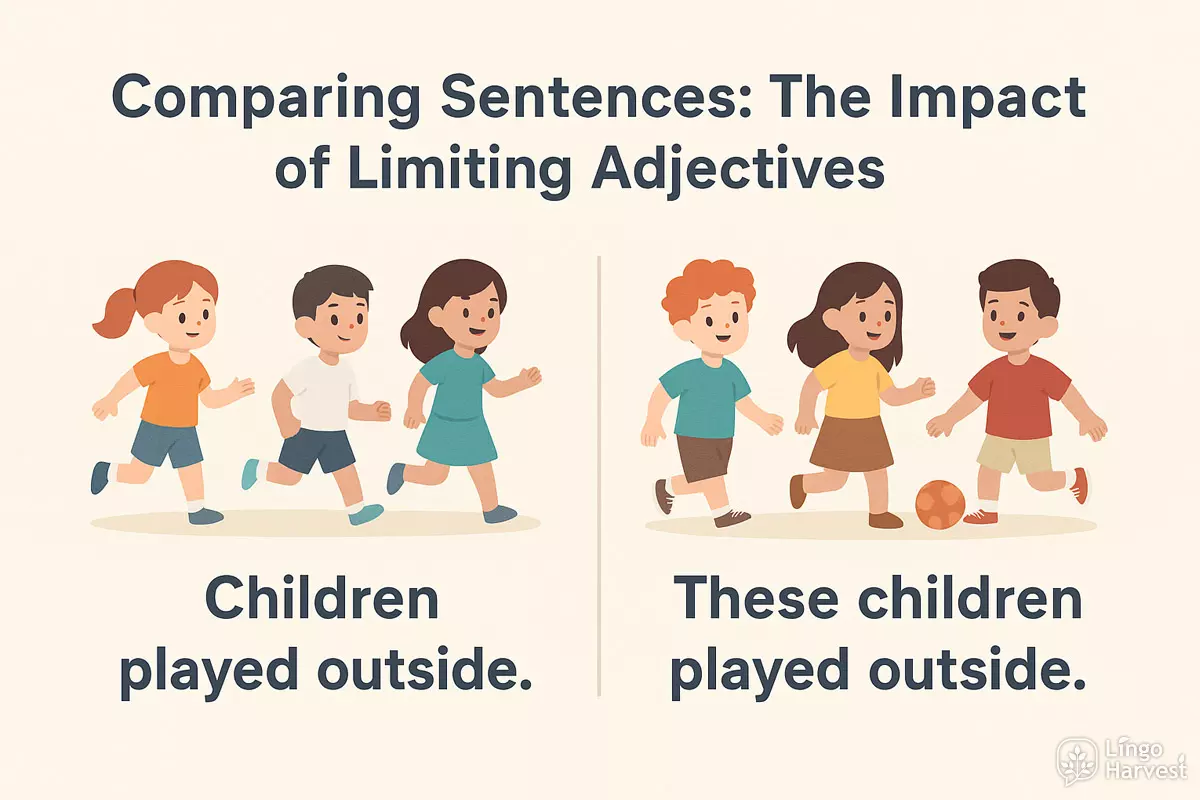
The presence—or absence—of such modifiers can dramatically shift meaning. Consider the following comparisons:
| Without Limiting Adjective | With Limiting Adjective |
|---|---|
| Children played outside. | These children played outside. |
| She found letters. | She found my letters. |
| Cats are sleeping. | Both cats are sleeping. |
| We have milk. | We have no milk. |
| He saw apples. | He saw several apples. |
Common Types and Their Effects
Limiting adjectives include demonstratives (this, that), possessives (my, their), quantifiers (some, every, few), interrogatives (which, whose), and numbers (one, two, first). Each brings its own nuance:
- Demonstratives point to specific things: that car vs. cars.
- Possessives show ownership: her book vs. book.
- Quantifiers indicate amount or number: few problems vs. problems.
- Interrogatives ask for clarification: which path vs. path.
- Numbers and order words specify exact quantity or sequence: three dogs, second chance.
By carefully choosing or omitting these adjectives, speakers can include or exclude, generalize or specify, and clarify or obscure meaning—making them essential for effective communication.
Examples
Understanding how limiting adjectives function is much easier when you see them in action. These modifiers help specify exactly which person or thing is meant, narrowing the meaning of the noun. While many words can serve this purpose, some of the most common are articles, demonstratives, possessives, quantifiers, and numbers.
Common Types in Sentences
You’ll encounter limiting adjectives in everyday speech and writing. Here are a variety of ways they are used to clarify or restrict the nouns they modify:
- This book is mine. (demonstrative)
- Can you hand me that pen? (demonstrative)
- My shoes are under the table. (possessive)
- Her advice was helpful. (possessive)
- Some students are absent today. (quantifier)
- Every ticket has a number. (quantifier)
- Each child received a gift. (quantifier)
- Ten apples were on the table. (number)
- Few people know the answer. (quantifier)
- The cat is sleeping. (definite article)
- A car is parked outside. (indefinite article)
- Those cookies look delicious. (demonstrative)
- Our team won the match. (possessive)
- Which dress do you prefer? (interrogative)
- Any solution will do. (quantifier)
- No mistakes were found. (quantifier/negative)
- Another chance is possible. (distributive)
- First prize goes to Sam. (ordinal number)
Limiting vs. Descriptive Adjectives
To clarify the difference between limiting and descriptive adjectives, consider the following:
| Limiting Adjective | Descriptive Adjective |
|---|---|
| This car | Red car |
| Five dogs | Playful dogs |
| Her idea | Brilliant idea |
| Each student | Talented student |
As shown above, limiting modifiers answer questions like “which one?” or “how many?”, while descriptive ones tell us about qualities or characteristics.
Patterns and Placement
Limiting adjectives almost always come before the noun and any descriptive adjectives. For instance:
- Those three large boxes (order: limiting, number, descriptive, noun)
- My old friend (order: limiting, descriptive, noun)
- That blue shirt (order: limiting, descriptive, noun)
This placement helps ensure the noun is clearly identified before any extra information is added.
Beginner Errors
New learners frequently mix up limiting and descriptive adjectives, leading to awkward or unclear sentences. These issues usually stem from misunderstanding which words actually restrict or specify a noun, as opposed to describing its qualities. Paying attention to word placement and meaning can help avoid confusion and clarify communication.
Common Missteps with Limiting Modifiers
- Using too many limiters together, making the noun phrase clumsy (e.g., "my each every book").
- Placing the restricting adjective after the noun instead of before it ("students all" instead of "all students").
- Confusing limiting adjectives with pronouns ("these" vs. "those ones").
- Omitting the limiter and unintentionally generalizing ("cat" instead of "this cat").
- Repeating the same limiter for emphasis, which is incorrect ("the both boys").
- Using descriptive words in place of limiters ("blue dog" when intending to specify "that dog").
- Mistaking quantity words for limiters when they do not actually restrict ("many books" does not limit, but "some books" does).
- Forgetting to match the limiting adjective to the noun's number ("these book" instead of "these books").
- Using possessives redundantly ("my her pencil").
- Applying limiters to uncountable nouns incorrectly ("some sand" is correct, but "these sand" is not).
Spotting the Difference: Limiting vs. Descriptive
It’s easy to mistake descriptive modifiers for those that restrict. The table below highlights typical errors and correct forms to clarify this distinction:
| Incorrect Usage | Corrected Form & Reason |
|---|---|
| Each my friend is here. | Each of my friends is here. Use "each" with "of" when paired with possessives. |
| This both dogs barked. | Both dogs barked. Use one limiter; "both" already specifies. |
| That books are new. | Those books are new. Match the limiter to plural nouns. |
| I saw some that cats. | I saw some cats. Don’t combine multiple limiters unnecessarily. |
| She likes any apple. | She likes any apples. "Any" is usually for plurals or uncountables in this context. |
| Blue this car is fast. | This blue car is fast. Place the limiting adjective before the descriptive one. |
| All of the my pencils are missing. | All my pencils are missing. Don’t double up on possessive and "of the." |
| Some water bottles is empty. | Some water bottles are empty. Ensure subject-verb agreement with limiters. |
| Much apples are sweet. | Many apples are sweet. Use "many" for countable nouns, "much" for uncountable. |
| Every students passed. | Every student passed. "Every" is singular; use with singular nouns. |
Understanding how to choose and position limiting adjectives helps learners avoid these typical missteps and create more precise, natural sentences. Practice and careful review of sentence structure can greatly improve accuracy.
Practice Items
Test your understanding of limiting adjectives with these exercises. You'll find identification tasks, fill-in-the-blank sentences, and opportunities to distinguish limiting modifiers from descriptive ones. Try to complete each activity before checking the answers.
Identify the Limiting Adjective
In the following sentences, pick out the word that restricts or specifies the noun. Write it down or say it aloud for each:
- That book is on the table.
- She wants some water.
- Many students passed the exam.
- I have three cats.
- Each child received a gift.
Show answers
- That
- Some
- Many
- Three
- Each
Fill in the Blanks
Choose an appropriate limiting adjective (such as this, every, few, no, several) to complete each sentence:
- ________ student should bring their own notebook.
- ________ of these apples are ripe.
- I have ________ money left in my wallet.
- ________ dog in the park was barking loudly.
- ________ person knows the answer.
Show answers
- Every
- Several
- No
- Each
- No
Distinguishing Limiting and Descriptive Modifiers
Decide if the highlighted adjective in each phrase is limiting (L) or descriptive (D):
- Ten books (____)
- Red car (____)
- That house (____)
- Old friend (____)
- Some advice (____)
- Beautiful garden (____)
Show answers
- Ten books (L)
- Red car (D)
- That house (L)
- Old friend (D)
- Some advice (L)
- Beautiful garden (D)
Common Types: Chart of Limiting Adjectives
Explore a selection of limiting adjectives grouped by type. This overview helps you recognize patterns and categories at a glance.
| Type | Examples |
|---|---|
| Demonstrative | this, that, these, those |
| Quantitative | some, few, many, several, all, no, any |
| Distributive | each, every, either, neither |
| Numeral | one, two, ten, first, second, third |
| Possessive | my, your, his, her, its, our, their |
| Interrogative | which, what, whose |
Practicing with a range of limiting adjectives in context can improve your ability to spot and use them effectively in writing and speech.