Predicate Adjectives After Linking Verbs

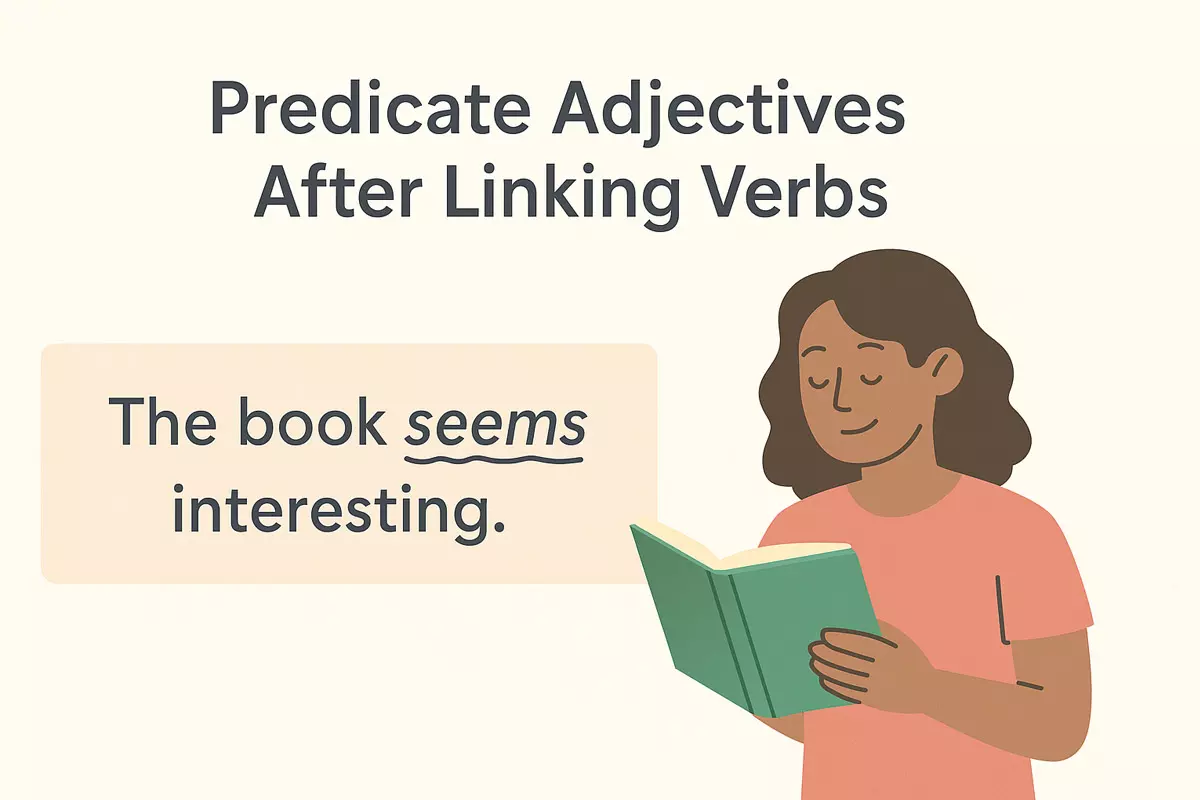 The article defines predicate adjectives, introduces common linking verbs such as be, seem, feel, look, and sound, explains the subject-verb-adjective pattern, highlights errors with good versus well, and provides practice using predicate adjectives in sentences.
Have you ever noticed how certain words in a sentence can describe the subject even when they are not placed directly next to it? This happens when we use linking verbs such as "is," "seems," or "becomes," which connect the subject to an adjective or phrase that gives us more information. These adjectives, known as predicate adjectives, follow the linking verb and help paint a clearer picture of the subject, making our sentences more expressive and accurate without needing the adjective to be immediately beside the noun.
What predicate adjectives are
Predicate adjectives describe or modify the subject of a sentence, but they appear after a linking verb instead of directly before the noun. They don’t stand alone; their purpose is to give more information about the subject by following verbs like “be,” “seem,” “become,” and others that serve as links rather than actions. A predicate adjective is not found next to the noun it describes. Instead, it comes after the verb and completes the meaning of the subject. For example, in the sentence “The sky is blue,” “blue” is the adjective that tells us something about “the sky,” and it follows the linking verb “is.”
How predicate adjectives work in sentences
Linking verbs act as bridges between the subject and the word that describes it. Predicate adjectives are that describing word. They answer questions like “What is the subject like?” or “How does the subject feel?” Here are some common linking verbs used with these adjectives:
- am, is, are, was, were → She is happy with the results.
- seem → He seems unsure about the plan.
- become → The sky became dark quickly.
- appear → She appears calm before the test.
- feel → I feel tired after work.
- look → He looks confident today.
- sound → That idea sounds interesting.
- remain → They remain hopeful despite the news.
- grow → The room grew quiet suddenly.
- stay → Please stay calm during the procedure.
- taste → The cookies taste fresh.
- smell → This perfume smells wonderful.
- prove → His theory proved correct.
- turn → The sky turned orange at sunset.
- get → She got angry after the argument.
Examples of predicate adjectives in context
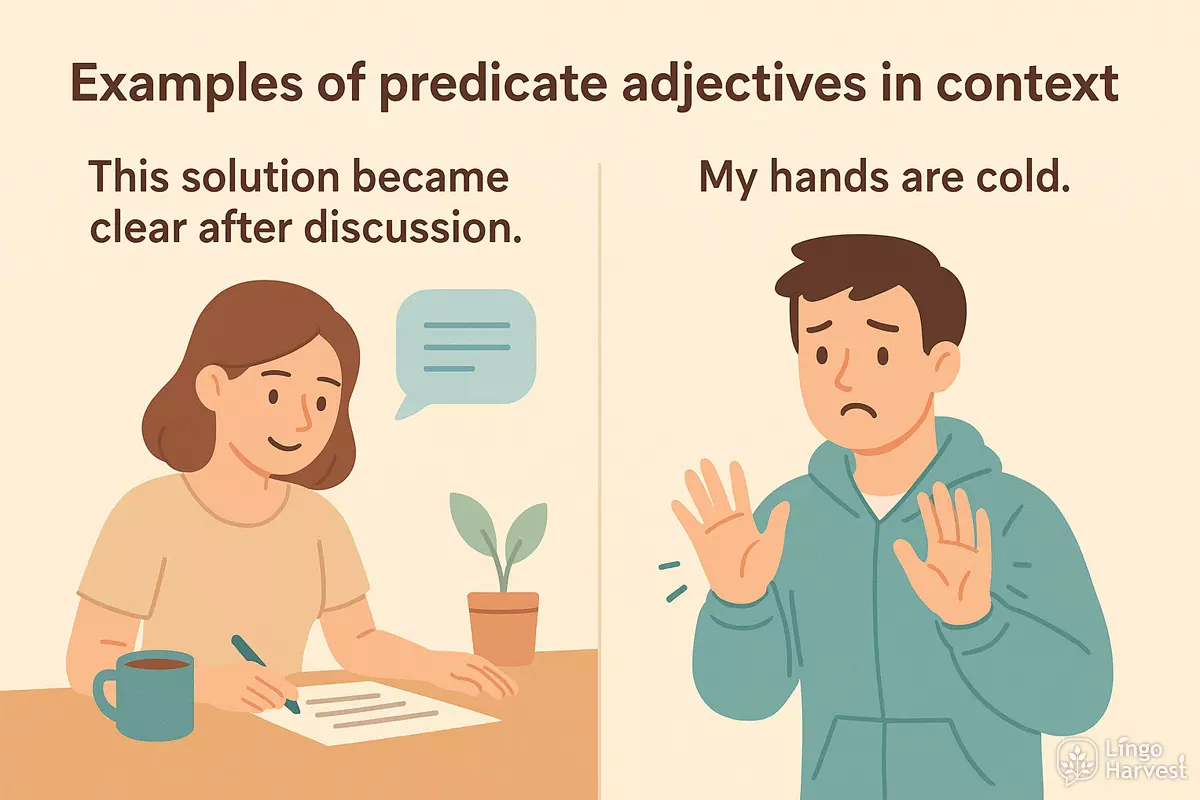
To see how these adjectives function, consider the following sentences:
- The soup tastes delicious.
- She looks tired today.
- The dog seemed happy.
- This solution became clear after discussion.
- My hands are cold.
- The movie was boring.
- His explanation sounded conviving.
- The leaves turned yellow in autumn.
- They remain optimistic about the future.
- The cake smells amazing.
- The water felt freezing in the morning.
- Her voice sounded gentle.
- The decision proved wise.
- The children grew excited as the show began.
- The room stayed quiet during the exam.
Predicate adjectives vs. attributive adjectives
It’s useful to compare these adjectives with attributive adjectives, which come before nouns. See the difference in this structured overview:
| Predicate Adjective | Attributive Adjective |
|---|---|
| The dog is playful. | The playful dog runs fast. |
| The answer seems correct. | The correct answer is obvious. |
| The weather became stormy. | The stormy weather worried us. |
| The food tastes spicy. | The spicy food is my favorite. |
| The plan was simple. | A simple plan works best. |
Key points to remember
- These adjectives always follow a linking verb, not an action verb.
- They describe or qualify the subject, not a direct object.
- Not every adjective can be used in both attributive and predicate positions; some are limited to one function.
- Recognizing the linking verb is crucial for identifying predicate adjectives in a sentence.
Common linking verbs: be, seem, feel, look, sound
Linking verbs serve to connect the subject of a sentence with information about it, often in the form of an adjective. These verbs don’t show action, but instead link the subject to a state or condition. Some of the most frequently used verbs in this category include "be," "seem," "feel," "look," and "sound." They play a crucial role in sentences where predicate adjectives describe or identify the subject.
How Linking Verbs Work
When you use a linking verb, the word that follows—often an adjective—tells us more about the subject’s qualities, state, or appearance. For example, in “The soup tastes delicious,” "tastes" connects "soup" to the descriptive adjective "delicious." This structure helps convey feelings, perceptions, or characteristics without expressing an action.
Examples of Linking Verbs in Sentences
- She is happy.
- He seems tired today.
- The blanket feels soft.
- You look confident.
- This music sounds peaceful.
- The answer was correct.
- My coffee smells amazing.
- They became friends quickly.
- The sky turns gray before rain.
- The story remained interesting throughout.
- Her explanation appears logical.
- This plan proves effective.
Comparing Linking Verbs: Forms and Functions
| Verb | Primary Use | Example Sentence |
|---|---|---|
| be | Describes existence, state, or identity | The cake is delicious. |
| seem | Expresses appearance or impression | He seems upset. |
| feel | Relates to touch or emotion | The pillow feels soft. |
| look | Refers to visual appearance | You look ready. |
| sound | Describes auditory impression | This idea sounds interesting. |
Additional Tips for Recognizing Linking Verbs
Many verbs can act as linking verbs in some contexts but not in others. If you can replace the verb with a form of "be" and the sentence still makes sense, you likely have a linking verb. Remember, linking verbs are followed by adjectives, not adverbs (e.g., "She feels bad," not "feels badly"). Understanding these connectors will help you describe people, objects, and situations more precisely, making your sentences clearer and more expressive.
Patterns: subject + verb + adjective
When a linking verb connects a subject to an adjective, the adjective describes the subject’s state or quality. In grammar, these adjectives are called predicate adjectives, and they always follow a linking verb rather than directly modifying the noun in front of them. This structure is common in English and helps us describe how someone or something is, seems, feels, or becomes.
Understanding the Structure
The typical setup involves three parts:
- Subject – the person, place, thing, or idea being described
- Linking verb – verbs like be, seem, become, feel, appear, look, sound, smell, taste, remain, or stay
- Adjective – the word that tells us more about the subject
The adjective in this pattern does not describe the verb or the action, but rather, it refers back to the subject itself.
Common Linking Verbs and Examples
Here are some example sentences using this structure:
- The soup tastes delicious.
- She seems happy.
- His explanation sounded confusing.
- The sky is blue.
- They became tired after the hike.
- The flowers smell wonderful.
- The teacher appeared calm.
- The baby looks sleepy.
- He remained silent.
- The milk turned sour.
- Our plan proved successful.
- The results are disappointing.
- The water feels cold.
- Her idea was brilliant.
- The city stays busy at night.
- The answer became obvious.
- The child grew restless.
- The movie looks interesting.
Predicate Adjectives vs. Attributive Adjectives
To clarify how predicate adjectives differ from attributive adjectives (those that come before nouns), consider this comparison:
| Predicate Adjective (after linking verb) | Attributive Adjective (before noun) |
|---|---|
| The cat is sleepy. | The sleepy cat is on the couch. |
| The weather became cold. | The cold weather surprised us. |
| The story sounds interesting. | An interesting story was told. |
| His answer was correct. | The correct answer is marked. |
Tips for Using Predicate Adjectives
- Remember that only linking verbs can be used in this pattern; action verbs do not connect the subject to an adjective.
- Not all adjectives work as predicate adjectives; some naturally fit before nouns.
- If you remove the linking verb, the sentence usually becomes ungrammatical or changes meaning entirely.
This structure is essential for describing qualities, states, and conditions in English in a clear and natural way.
Avoiding adverb forms after linking verbs
Choosing the correct word after a linking verb is crucial for clear, grammatical sentences. Linking verbs, such as be, seem, become, feel, and appear, connect the subject to an adjective that describes it, not to an adverb. Using an adverb after these verbs is a common mistake, but it can make your writing sound awkward or even change the meaning.
Common Errors to Watch Out For
Writers sometimes use adverbs instead of adjectives after linking verbs because many adverbs end in -ly, and it’s easy to assume they sound more “correct” or formal. However, adverbs describe actions (verbs), not states or qualities (nouns/pronouns after linking verbs). For example, saying “She feels badly” is incorrect if you mean she is sad; the proper form is “She feels bad.”
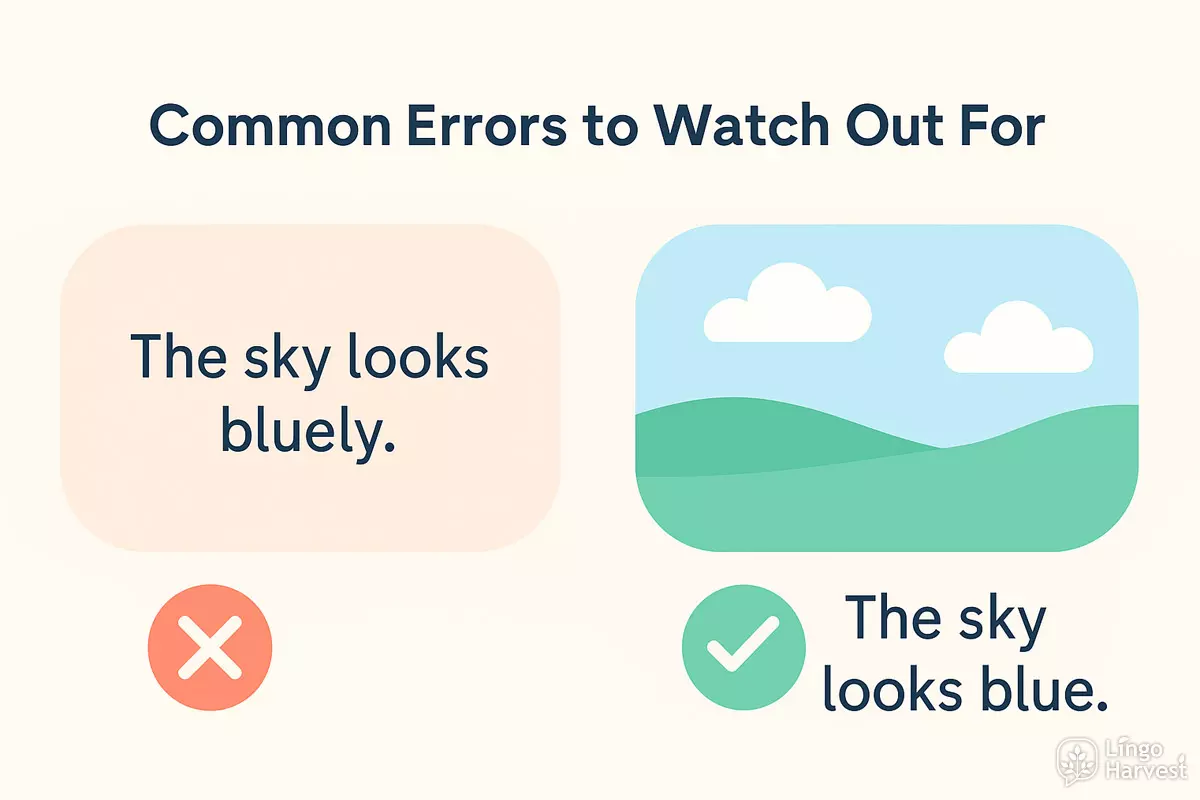
- He seems happily ❌ → He seems happy ✅
- The soup tastes deliciously ❌ → The soup tastes delicious ✅
- I feel badly ❌ → I feel bad ✅
- The sky looks bluely ❌ → The sky looks blue ✅
- This shirt became wetly ❌ → This shirt became wet ✅
- She appeared calmly ❌ → She appeared calm ✅
- My coffee got coldly ❌ → My coffee got cold ✅
- The plan sounds reasonably ❌ → The plan sounds reasonable ✅
- They grew tiredly ❌ → They grew tired ✅
- He looked angrily ❌ → He looked angry ✅
- The flowers smelled sweetly ❌ → The flowers smelled sweet ✅
- She feels nervously ❌ → She feels nervous ✅
When Adverbs Are Actually Appropriate
There are cases where an adverb is needed—mainly when you are describing how the action of the verb is performed, not the state of the subject. For instance, in “She spoke softly,” the adverb modifies the action spoke. But with linking verbs, you’re describing the subject itself, so an adjective is required.
Quick Reference: Adjectives vs. Adverbs After Linking Verbs
The following table contrasts correct and incorrect forms to help you recognize proper usage:
| Predicate Adjective Context | Correct Form |
|---|---|
| Describing general state or quality (after linking verb) |
good She feels good. |
| Describing health (after linking verb) |
well He is well. |
| Describing how something is done (action verb) |
well She sings well. |
| Describing appearance, taste, smell, sound (after linking verb) |
good The food smells good. |
| Describing mood or emotions (after linking verb) |
good I feel good about this decision. |
| Talking about feeling healthy again (after linking verb) |
well I feel well again. |
| Describing ability or skill (after linking verb + preposition) |
good He is good at maths. |
| Describing result or outcome (after linking verb) |
good The result was good. |
Quick tips to avoid errors
- Use "good" for qualities or feelings after linking verbs.
- Use "well" after linking verbs only when talking about health.
- Use "well" as an adverb to modify action verbs.
- Remember: "I feel good" (emotion), "I feel well" (health).
Understanding these distinctions will help you avoid the most frequent slips with these two words in predicate positions.
Practice: complete sentences with predicate adjectives
Understanding how to use predicate adjectives after linking verbs helps your writing sound natural and descriptive. In this section, you'll find exercises and explanations to reinforce the concept. Predicate adjectives come after linking verbs (like be, seem, become, feel) and describe the subject of the sentence.
Choose the correct predicate adjective
Read each sentence and select the adjective that best completes the meaning. Focus on how each adjective describes the subject, following the linking verb.
- The soup smells _____. (delicious / loudly)
- After the long run, they felt _____. (tired / quickly)
- The sky is _____ tonight. (clear / clearly)
- Her answers seem _____. (confused / confusingly)
- My little brother became _____ after the movie. (scared / scarily)
- The plan sounds _____. (reasonable / reasonably)
- The flowers smell _____. (sweet / sweetly)
- The teacher looked _____ during the test. (angry / angrily)
- The room stayed _____ all afternoon. (quiet / quietly)
- The story grew _____ near the end. (exciting / excitingly)
Show answers
- delicious
- tired
- clear
- confused
- scared
- reasonable
- sweet
- angry
- quiet
- exciting
Complete the sentences with your own predicate adjectives
Write an adjective that makes sense after the linking verb in each sentence below. Think about how the adjective describes the subject.
- The garden looks __________ in spring.
- My parents are __________ today.
- The cake tasted __________.
- His explanation was __________.
- The students became __________ when the teacher arrived.
- The sky grew __________ before the storm.
- The soup smells __________ right now.
- The children stayed __________ during the movie.
- The room felt __________ after the heater was turned on.
- The new design seems __________ to everyone.
Show answers
- beautiful, colorful, fresh, bright, etc.
- happy, relaxed, busy, tired, etc.
- sweet, delicious, rich, creamy, etc.
- clear, confusing, helpful, detailed, etc.
- quiet, excited, nervous, focused, etc.
- dark, cloudy, threatening, grey, etc.
- good, tasty, spicy, strong, etc.
- quiet, calm, focused, still, etc.
- warm, cozy, comfortable, inviting, etc.
- reasonable, strange, interesting, simple, etc.
Common predicate adjectives: Vocabulary bank
Here are some adjectives commonly used after linking verbs. Use them to expand your practice sentences:
- happy → She felt happy after hearing the good news.
- sad → He looked sad when the movie ended.
- angry → She became angry after the argument.
- nervous → He feels nervous before exams.
- excited → The children grew excited as the show began.
- hungry → I am hungry after the long walk.
- thirsty → They were thirsty after playing football.
- clean → The kitchen looks clean today.
- dirty → Your shoes are dirty from the rain.
- ready → She is ready for the presentation.
- late → He was late to the meeting again.
- early → We arrived early to get good seats.
- bored → The students looked bored during the lecture.
- interested → She seems interested in science.
- curious → The baby looked curious about the new toy.
- cold → My hands are cold in winter.
- hot → The soup is hot, so be careful.
- tall → The new student is very tall.
- short → He is short compared to his classmates.
- calm → She stayed calm during the emergency.
Linking verbs and predicate adjective patterns
The following table shows examples of different linking verbs paired with predicate adjectives, so you can see the pattern in context.
| Linking Verb | Example with Predicate Adjective |
|---|---|
| be (am/is/are/was/were) | The children are happy. |
| seem | The answer seems correct. |
| become | The room became quiet. |
| feel | She feels tired after work. |
| look | The sky looks blue. |
| sound | Your idea sounds interesting. |