Linking Verbs: Be, Seem, Become and Other Copular Verbs

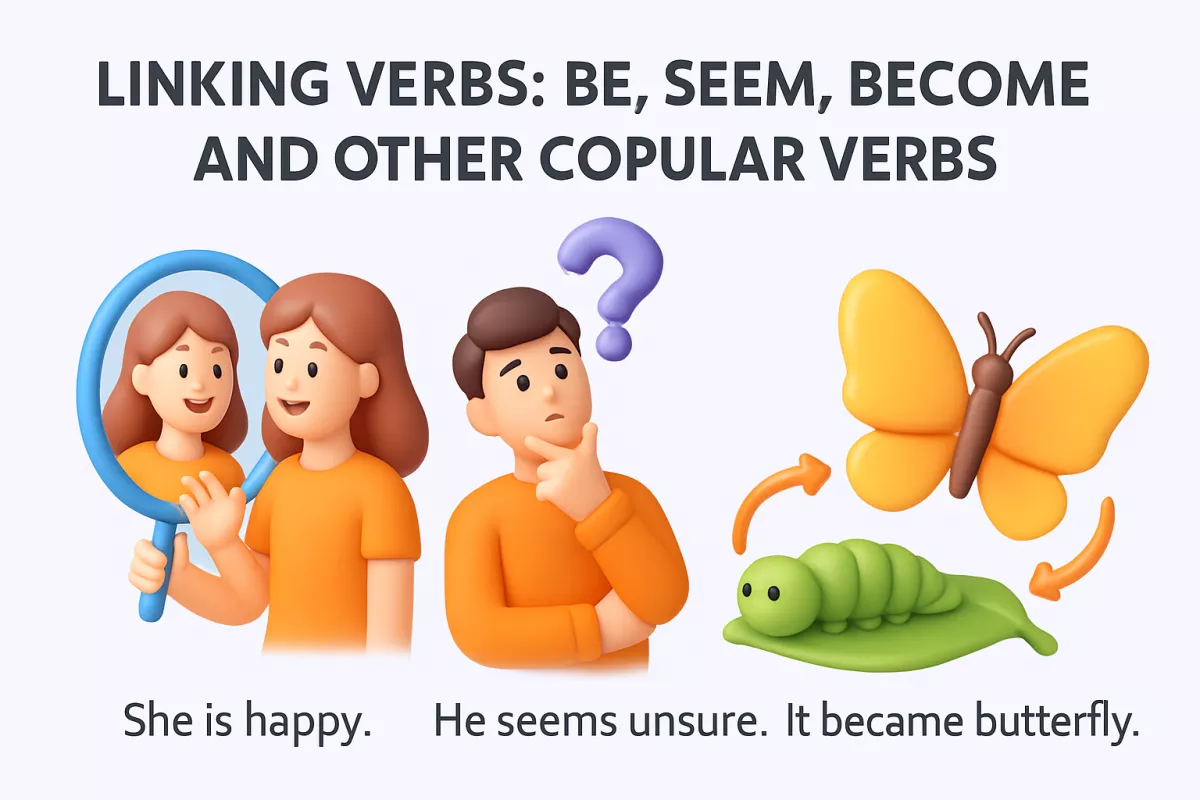 The article explains how linking verbs connect subjects to descriptions or identities, compares them with action verbs, lists common examples, discusses subject complements and sense verbs, highlights common mistakes, gives style advice, and includes practice exercises.
- What linking verbs do in a sentence
- Linking verbs vs action verbs
- Common linking verbs and typical meanings
- Subject complements: nouns vs adjectives
- Linking verbs with sense verbs: look, feel, sound
- Common mistakes: adverbs after linking verbs
- Style tips: clearer sentences with linking verbs
- Homework: linking verb sentence practice
Some English verbs do not describe an action at all. Instead, they connect the subject of a sentence to information that describes or identifies it. These verbs are called linking verbs. Common examples include be, seem, and become. Their role is to help us talk about states, qualities, identities, and changes, rather than about actions. Without linking verbs, it would be difficult to clearly express how someone feels, what something is like, or how a situation changes over time.
What linking verbs do in a sentence
In a sentence, a linking verb works like a connector. It links the subject to additional information that explains or defines it. This information comes after the verb and is called a subject complement. The complement does not receive an action; instead, it describes the subject or tells us what the subject is. Very often, this complement is an adjective or a noun, but it can also be a longer phrase.
How linking verbs function
Linking verbs focus on states and conditions rather than activities. They answer questions such as: What is the subject like? or What has the subject become? For example, in the sentence “She is a doctor,” the verb “is” does not describe anything she is doing. It simply connects the subject “she” to the noun “doctor,” which identifies her role. In the same way, sentences like “He seems tired” or “The sky became dark” use linking verbs to describe appearance and change, not action.
- Be: “The sky is blue.”
- Seem: “He seems tired.”
- Become: “It became cold.”
- Appear: “She appears happy.”
- Feel: “This feels soft.”
- Grow: “He grew anxious.”
- Remain: “They remained silent.”
- Look: “The soup looks delicious.”
- Sound: “That sounds strange.”
- Stay: “The room stayed quiet.”
- Turn: “The leaves turned yellow.”
- Prove: “The plan proved successful.”
Types of subject complements
The word or phrase after a linking verb completes the idea. This element typically falls into one of two categories:
- Predicate nouns: rename or identify the subject (“My friend is a teacher.”)
- Predicate adjectives: describe the subject (“The cake tastes sweet.”)
Some less common linking verbs may also connect the subject to a phrase or clause that gives additional details.
Comparison: Linking vs. Action Verbs
| Linking Verb Example | Action Verb Example | How to Tell the Difference |
|---|---|---|
| The soup smells delicious. | She smells the flowers. | Linking: verb + adjective (describes the subject). Action: verb + object (what is smelled?). |
| She looks tired. | She looks at the screen. | Linking: looks = “seems” + adjective. Action: looks = “directs eyes” + at + noun. |
| This music sounds relaxing. | He sounds the alarm. | Linking: adjective describes the subject. Action: object receives the action (rare but possible). |
| The cake tastes sweet. | He tastes the sauce. | Linking: verb + adjective. Action: verb + object (what is tasted?). |
| The room feels warm. | He felt the fabric. | Linking: describes the subject. Action: direct object answers “what?”. |
| He grew tired. | The plant grew quickly. | Linking: change of state (tired = new condition). Action: physical growth or increase. |
| The sky turned red. | She turned the key. | Linking: “became” + color/adjective. Action: object is physically turned. |
| He became nervous. | They became friends at school. | Linking: adjective describes the subject. Action-like meaning: “formed a relationship” (no adjective complement). |
| The meeting remained calm. | The workers remained in the building. | Linking: adjective describes a state. Action-like: “stayed” + place phrase. |
| Her idea proved useful. | They proved the point with data. | Linking: adjective complement after the verb. Action: object follows the verb (what did they prove?). |
Notice that some verbs, like “smell” or “grow,” can be either linking or action verbs, depending on how they are used. The key is whether they connect the subject to more information, or if they show what the subject is doing.
Summary
In short, copular verbs help describe or identify the subject, rather than showing an action. Recognizing these verbs and how they connect ideas will make your sentences clearer and more precise.
Linking verbs vs action verbs
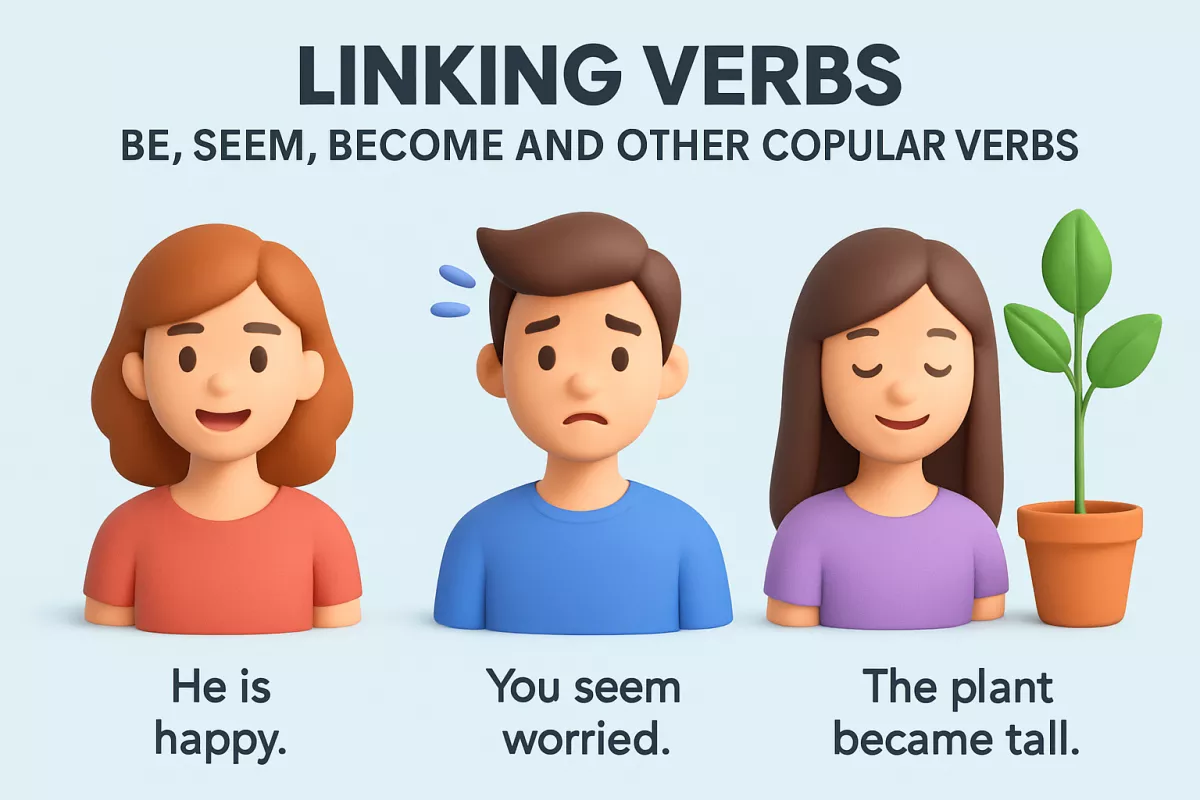
Understanding the difference between verbs that connect a subject to more information and those that show an action is essential for clear communication. Linking verbs, sometimes called copular verbs, do not express any physical or mental activity. Instead, they serve as connectors, joining the subject with a subject complement—usually an adjective or noun that describes or identifies the subject. On the other hand, action verbs show what the subject is doing, whether it's a visible movement or a mental process.
How linking verbs work
Words like be, seem, and become are classic linking verbs. They tell us about the state or condition of the subject, rather than what it is doing. For example, in the sentence "She is tired," the verb is connects the subject "she" to the adjective "tired." No action occurs; instead, the verb links the subject to a state of being.
How action verbs work
Action verbs, in contrast, are all about doing. They describe activities, movements, or processes. For instance, in "She runs every morning," the verb runs indicates a physical activity performed by the subject. These verbs can be either transitive (requiring an object) or intransitive (not requiring an object).
| Linking Verbs | Action Verbs |
|---|---|
| do not show action | show what the subject does |
| connect subject to a state or quality | describe activities, processes, or movements |
| common examples: am, is, are, was, were, seem, become, appear, feel, look, remain, stay, sound, taste, turn | common examples: run, jump, think, write, eat, sing, read, build, play, swim, drive, dance, paint, learn, teach |
| cannot take a direct object | can take a direct object (if transitive) |
Identifying each type in a sentence
- Linking verb: The soup smells delicious. (No action; "smells" describes the soup's quality.)
- Action verb: He smells the soup. (Action; "smells" describes what he does.)
- Linking verb: The sky became dark.
- Action verb: She runs a marathon every year.
Notice that some verbs, such as look or feel, can serve as both linking and action verbs depending on the context. The key is to check whether the verb connects the subject to more information about its state (linking) or shows something the subject does (action).
Common linking verbs and typical meanings
Linking verbs, often called copular verbs, serve an important function in English: they connect the subject of a sentence to information about that subject, typically an adjective or noun phrase. Unlike action verbs, these verbs do not express actions but rather states, conditions, or identities. Some are used to describe changes or perceptions, while others relate to existence or status.
Main types of linking verbs
The most familiar linking verb is be (am, is, are, was, were, etc.), but there are several others that frequently appear in both spoken and written English. Here are some of the most common ones:
- be (am, is, are, was, were, been, being)
- seem
- become
- appear
- feel
- look
- sound
- smell
- taste
- remain
- stay
- get
- grow
- turn
- prove
Typical meanings and uses
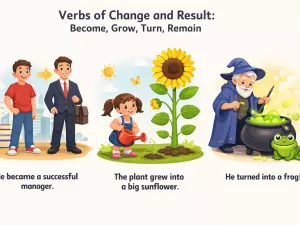
Each copular verb carries its own nuance. Some describe a state or condition, while others indicate a change or transformation. The verb be is used for identity, classification, or description: "She is a teacher." Verbs like seem and appear suggest perception or impression: "He seems tired." Others, such as become, get, grow, and turn, usually refer to a process of change: "The sky became dark," or "He got angry."
A smaller group—look, feel, sound, taste, and smell—connect the subject to sensory experiences or subjective assessments: "This soup tastes delicious," "The room looks clean," "She feels happy."
Comparison of linking verbs and their typical meanings
| Verb | Typical Meaning/Use |
|---|---|
| be | State of being, identity, classification |
| seem | Impression, appearance (not fact) |
| become | Change of state or condition |
| appear | Similar to "seem," suggesting an impression |
| look | Visual impression or appearance |
| feel | Emotional or physical state, or subjective impression |
| sound | Auditory impression |
| smell | Olfactory impression |
| taste | Gustatory impression |
| remain | Continuing in a particular state |
| stay | Maintaining a state or condition |
| get | Becoming, entering a new state (informal) |
| grow | Gradual change, often emotional or physical |
| turn | Sudden change of state (often color or mood) |
| prove | Be revealed as, turn out to be |
Understanding these verbs and their typical uses helps clarify sentence meaning and improves both writing and speaking. While some can also act as action verbs in different contexts (for example, "smell" in "I smell the flowers"), when used as copulas, they link the subject to further information about its condition, identity, or state.
Subject complements: nouns vs adjectives
When linking verbs appear in a sentence, they connect the subject to a word or phrase that completes its meaning. This "completer" is called the subject complement, and it can be either a noun (or noun phrase) or an adjective (or adjective phrase). Understanding the difference between these two types is crucial for clear and accurate sentences.
Noun complements: renaming the subject
A noun or noun phrase following a linking verb usually renames or identifies the subject. This type of subject complement is sometimes called a predicate nominative. It answers the question "Who or what is the subject?" Here are some common examples:
- My brother is a doctor.
- That building became a museum.
- The winner was Sarah.
- This seems the best solution.
- Her dream became reality.
- Their goal remains a mystery.
In each case, the noun after the linking verb tells us exactly who or what the subject is.
Adjective complements: describing the subject
An adjective or adjective phrase after a linking verb gives more information about the subject by describing its quality, state, or condition. This is also called a predicate adjective. Consider these examples:
- The soup smells delicious.
- She is excited.
- The sky became dark.
- His explanation seems clear.
- My hands feel cold.
- The answer remains uncertain.
Here, the adjective after the linking verb describes a characteristic or condition of the subject.
Quick comparison: nouns vs adjectives as subject complements
| Type | Example Sentence | Function |
|---|---|---|
| Noun/Noun phrase | Mary is a teacher. | Renames the subject |
| Adjective/Adjective phrase | Mary is happy. | Describes the subject |
| Noun/Noun phrase | The result was an accident. | Identifies the subject |
| Adjective/Adjective phrase | The result was unexpected. | Describes the subject's state |
Common linking verbs used with complements
- be (am, is, are, was, were)
- become
- seem
- appear
- feel
- look
- sound
- stay
- remain
- grow
Pay attention to which complement is appropriate for the verb and the intended meaning. For example, "He became angry" (adjective) describes a state, while "He became a leader" (noun) identifies a role.
In summary, subject complements following linking verbs either rename the subject with a noun or describe it with an adjective. Recognizing this distinction helps you write sentences that are both precise and easy to understand.
Linking verbs with sense verbs: look, feel, sound
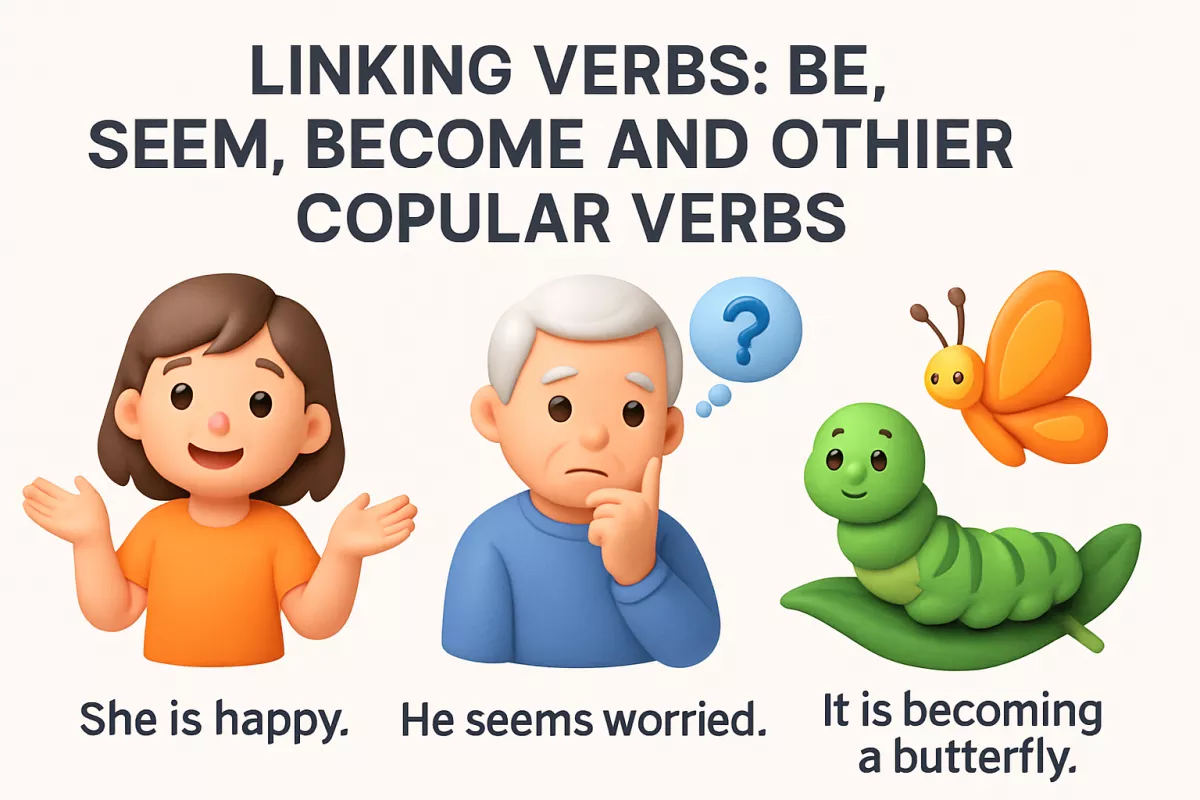
Some verbs related to our senses—such as look, feel, and sound—often serve as linking verbs. When used this way, they connect the subject to a description or state rather than describing an action. For example, in “The soup smells delicious,” the verb “smells” links “soup” to the adjective “delicious,” showing a quality rather than an activity.
How sense verbs function as linkers
Sense verbs act as connectors when they are followed by adjectives, not adverbs. The adjective describes the subject, not the verb. Compare “The cake tastes sweet” (describing the cake) with “She tasted the cake carefully” (describing how she tasted).
- The sky looks grey.
- This pillow feels soft.
- The music sounds amazing.
- He looks tired after work.
- The blanket feels warm.
- That answer sounds correct.
- The soup smells good.
- This cheese tastes strange.
- Her voice sounds familiar.
- The room looks clean.
- The chair feels uncomfortable.
- The explanation sounds logical.
Comparing sense verbs as linkers vs. action verbs
Some sense verbs can be both linking and action verbs, depending on the context. The difference is whether the verb is followed by an adjective (linking use) or an adverb/object (action use).
| Linking Verb Use | Action Verb Use |
|---|---|
| The bread smells fresh. | He smelled the flowers. |
| She looks happy. | She looked at the clock. |
| The surface feels rough. | He felt the fabric. |
| The song sounds cheerful. | She sounded the alarm. |
Common adjectives after sense verbs
When sense verbs such as look, feel, sound, smell, and taste act as linking verbs, they are followed by adjectives, not adverbs. These adjectives describe the subject’s condition, appearance, or quality rather than an action.
- happy → She looks happy today.
- sad → He seemed sad after the news.
- tired → You sound tired.
- delicious → The soup smells delicious.
- terrible → The idea sounds terrible.
- wonderful → The plan sounds wonderful.
- awful → The weather feels awful.
- new → Her jacket looks new.
- soft → The fabric feels soft.
- calm → She seems calm now.
- dangerous → The road looks dangerous.
- familiar → This place feels familiar.
- fresh → The bread smells fresh.
- cold → The water feels cold.
In summary, sense verbs like look, feel, and sound frequently serve to link subjects with descriptive adjectives, providing information about states or qualities rather than actions. Recognizing this use helps make sentences clearer and more precise.
Common mistakes: adverbs after linking verbs
Many learners accidentally use adverbs where adjectives are needed after linking verbs. This happens because adverbs often describe verbs in English, but linking verbs (like “be,” “seem,” and “become”) don’t show action—they connect the subject to a description. In these cases, the word after the linking verb should describe the subject (using an adjective), not the verb (with an adverb).
Why adjectives, not adverbs?
Linking verbs function to “link” the subject to more information about itself. For example, in “She looks tired,” the word “tired” describes “she.” If you said “She looks tiredly,” it would mean she is looking at something in a tired way, which is not the intended meaning.
Frequent errors and how to fix them
Learners sometimes place adverbs after linking verbs by mistake. Here are some common incorrect patterns and their correct forms:
- Incorrect: He is happily.
- Correct: He is happy.
- Incorrect: The soup tastes deliciously.
- Correct: The soup tastes delicious.
- Incorrect: You seem angrily.
- Correct: You seem angry.
- Incorrect: This became quickly a problem.
- Correct: This became quick a problem.
- Incorrect: The plan appears smoothly.
- Correct: The plan appears smooth.
Table: Adjective vs. Adverb after Linking Verbs
| Incorrect (with Adverb) | Correct (with Adjective) |
|---|---|
| She is beautifully. | She is beautiful. |
| The weather became coldly. | The weather became cold. |
| It sounds strangely. | It sounds strange. |
| They look happily. | They look happy. |
| The food smells wonderfully. | The food smells wonderful. |
| He seems calmly. | He seems calm. |
Quick tips to avoid this mistake
- If the verb is “be,” “seem,” “become,” “look,” “feel,” “taste,” “smell,” “sound,” or “appear,” use an adjective to describe the subject.
- Ask yourself: Does the word after the verb describe the subject? If yes, choose an adjective.
- Remember: Adverbs describe actions; adjectives describe people or things.
Understanding this distinction will help you make your sentences clearer and avoid confusion. When in doubt, check if the word after a linking verb is truly describing the subject—if so, reach for an adjective, not an adverb.
Style tips: clearer sentences with linking verbs
Writing with linking verbs can make your sentences smoother and more direct. These verbs—like "be," "seem," and "become"—connect the subject to information about its state or identity. By using them thoughtfully, you can avoid awkward phrasing and clarify your meaning.
Choose precise complements
The word or phrase that follows a linking verb (the subject complement) shapes the whole sentence. Pick complements that are specific and relevant. For example, instead of "She is nice," you might say "She is generous," which paints a clearer picture.
- He became an engineer.
- The soup tastes delicious.
- They are ready.
- The night grew cold.
- Her explanation sounded convincing.
- The answer seemed obvious.
- My idea was unique.
- The project remains unfinished.
- His attitude turned hostile.
- The news appears false.
Use linking verbs to avoid repetition
When you want to describe someone or something without repeating the subject, linking verbs help you restructure sentences for variety and clarity.
- Instead of: "Her voice is soft. Her voice is pleasant."
Try: "Her voice is soft and pleasant." - Instead of: "The plan is simple. The plan is effective."
Try: "The plan is simple yet effective."
Comparing linking verbs and action verbs
Sometimes, writers confuse linking verbs with action verbs. Linking verbs do not show action but rather connect the subject to more information about it. Here's a quick comparison:
| Linking Verb Example | Action Verb Example | How to Tell |
|---|---|---|
| The sky is blue. | The sky changed color. | Linking: verb connects the subject to a description (blue). Action: verb shows something happening (changed). |
| She became tired. | She ran quickly. | Linking: shows a change of state (tired). Action: shows an activity (ran). |
| This cake tastes sweet. | This cake contains sugar. | Linking: adjective describes the cake (sweet). Action: verb gives factual information (contains). |
| He seems upset. | He shouts loudly. | Linking: appearance/state (upset). Action: behavior/activity (shouts). |
| They are students. | They study every evening. | Linking: identifies the subject (students). Action: describes what they do (study). |
| The room feels cold. | She felt the wall. | Linking: describes the room (cold). Action: physical action with an object (the wall). |
| The soup smells delicious. | He smelled the milk. | Linking: description of the soup (delicious). Action: a person performs the action (smelled). |
| Her idea sounds reasonable. | The bell sounded at noon. | Linking: “sounds” = seems + adjective (reasonable). Action: “sounded” describes an event (rang). |
| He looks exhausted. | He looked out the window. | Linking: appearance/state (exhausted). Action: directed attention (looked out). |
| The leaves turned yellow. | She turned the page. | Linking: change of color/state (yellow). Action: physical movement with an object (the page). |
| He remained calm. | He remained in the room. | Linking: adjective describes the subject (calm). Action-like: “remained” = stayed + place phrase. |
| The result proved useful. | They proved the theory. | Linking: adjective complement (useful). Action: direct object answers “what?” (the theory). |
Avoid unnecessary linking verbs
Sometimes sentences are clearer without a linking verb, especially when you can use a strong action verb instead. Compare:
- Wordy: "The reason is because he forgot."
- Better: "He forgot."
Streamlining sentences in this way makes your writing more direct and engaging.
Quick checklist for clearer sentences
- Pick descriptive complements to add detail.
- Combine related ideas using one linking verb where possible.
- Distinguish between linking and action verbs for accurate meaning.
- Eliminate unnecessary words by substituting strong verbs when appropriate.
- Read your sentence aloud to check for clarity and flow.
By focusing on these strategies, you can make your sentences with linking verbs more effective and reader-friendly.
Homework: linking verb sentence practice
Understanding copular verbs like "be," "seem," and "become" is essential for expressing states and changes in English. Practice helps reinforce how these verbs connect the subject to additional information, such as adjectives or nouns that describe or identify it. Below, you'll find a variety of tasks to sharpen your skills using linking verbs in different sentence structures.
Task 1: Identify the linking verb
Read each sentence and underline the linking verb:
- The soup tastes delicious.
- He became a doctor last year.
- The sky is blue.
- It seems impossible.
- My parents are proud.
- This solution appears simple.
- The child grew tired.
- You look happy today.
- The milk smells sour.
- Everything remains quiet.
Show answers
- tastes
- became
- is
- seems
- are
- appears
- grew
- look
- smells
- remains
Task 2: Complete the sentences
Choose the correct linking verb for each blank. Use each verb only once: be, seem, become, feel, appear, look, smell, taste, remain, grow
- The baby ______ sleepy after lunch.
- This cheese ______ strange.
- She ______ excited about her new job.
- The night ______ darker as the storm approached.
- He ______ happy with his results.
- The answer ______ obvious.
- The flowers ______ fresh.
- It ______ cold this morning.
- The soup ______ salty.
- The rules ______ unchanged for years.
Show answers
- feels
- smells
- is
- grew
- looks
- seems
- appear
- is
- tastes
- remain
Task 3: Copular verb patterns
Review the table below for common patterns with linking verbs and their complements. Pay attention to how the subject, verb, and complement work together.
| Subject | Linking Verb | Complement |
|---|---|---|
| The cake | is | delicious |
| He | became | a teacher |
| The idea | seems | interesting |
| They | remained | calm |
| The room | smells | fresh |
| My brother | looks | tired |
Task 4: Make your own sentences
Write five original sentences using different linking verbs from the list: be, seem, become, feel, appear, look, smell, taste, remain, grow. Make sure each sentence connects the subject to a complement (adjective or noun).
Show answers
Example sentences:
- The flowers smell wonderful.
- She became a famous artist.
- It seems difficult at first.
- My hands feel cold.
- The city remains busy at night.
Regular practice with these verbs will help you recognize and use them correctly in your writing and speech. Try to notice them in books, conversations, and media as well.