Comparative and Superlative Adjectives: Full Theory

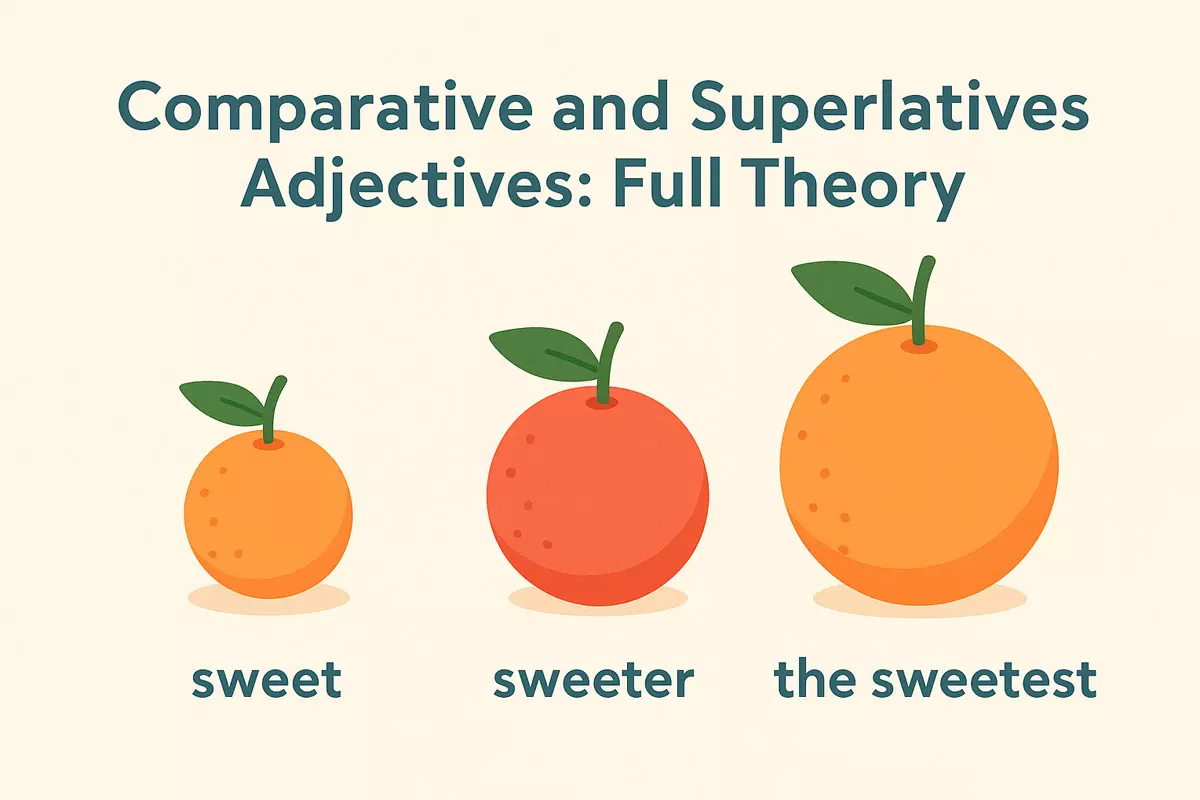 The article defines comparatives and superlatives, explains how to form them with -er, -est, more, and most, details spelling changes for short adjectives, shows how to use than and the, and gives practice rewriting sentences.
Have you ever wondered why we say something is bigger or the most exciting? Being able to compare qualities allows us to describe the world more precisely and vividly. Here we the various ways we express differences and extremes in English, from using comparative and superlative forms to employing phrases that highlight contrasts. By understanding these methods, you can make your descriptions clearer and more engaging, whether you are speaking or writing.
What comparatives and superlatives mean
Comparatives and superlatives are ways to describe differences between things, people, or ideas. They help us express whether something has a greater or lesser degree of a quality compared to another, or stands out as the most or least within a group. These forms are central to making comparisons in English, and understanding them makes your descriptions much more precise.
Comparative adjectives
Comparative adjectives are used when you want to compare two things. The form often involves adding -er to the end of short adjectives, or using more before longer adjectives. The goal is to show that one thing has more or less of a quality than another.
- smaller → This room is smaller than the one upstairs.
- taller → She is taller than her brother.
- more beautiful → That garden is more beautiful in spring.
- less expensive → This option is less expensive than the others.
- happier → He seems happier now that he changed jobs.
- colder → Today is colder than yesterday.
- more difficult → The second question was more difficult than the first.
- brighter → The kitchen is brighter after the renovation.
- quieter → This neighborhood is quieter at night.
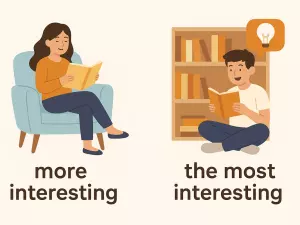
- more interesting → The documentary was more interesting than I expected.
Superlative adjectives
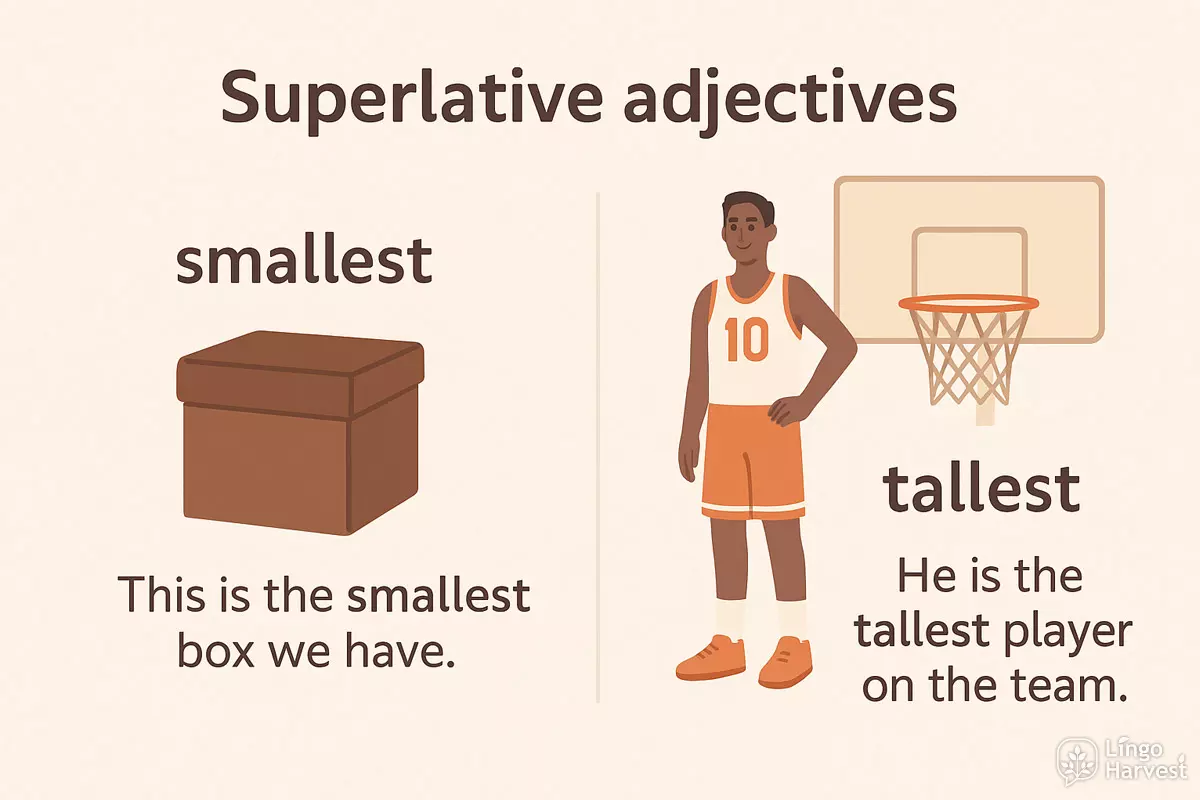
- smallest → This is the smallest box we have.
- tallest → He is the tallest player on the team.
- most beautiful → It’s the most beautiful view I’ve ever seen.
- least expensive → This is the least expensive item on the menu.
- happiest → She is the happiest person I know.
- coldest → January is usually the coldest month.
- most difficult → This is the most difficult task of all.
- brightest → She is the brightest student in the class.
- quietest → This is the quietest place in the house.
- most interesting → That was the most interesting lecture today.
For example: “She is the oldest student in the class.”
Comparative vs. superlative: key differences
| Type | Function & Example |
|---|---|
| Comparative | Compares two things. Example: “This lesson is easier than the last one.” |
| Superlative | Shows the extreme (most/least) among three or more. Example: “He is the fastest runner here.” |
It’s important to use these forms correctly to avoid confusion. Not all adjectives follow the same pattern—some are irregular (like good, better, best). By mastering comparatives and superlatives, you’ll make your speech and writing clearer and more expressive.
Forming comparatives: -er and more
English adjectives typically express comparison through two main strategies: adding the suffix -er or placing more before the adjective. The choice depends on adjective length, spelling, and pronunciation patterns. Understanding which form to use is essential for clear, correct comparisons.
Comparatives with -er
Most short adjectives—generally those with one syllable, and some with two syllables ending in -y—form the comparative by adding -er. Spelling changes may occur:
- If the adjective ends in a single vowel + single consonant, double the consonant: big → bigger
- If the adjective ends in -y, change y to i: happy → happier
- For most others, simply add -er: cold → colder
Comparatives with more
Longer adjectives (usually those with two or more syllables, except for some ending in -y) form the comparative by using more before the adjective. This method is also used for adjectives that do not change form easily.
- beautiful → more beautiful
- interesting → more interesting
- comfortable → more comfortable
- expensive → more expensive
- useful → more useful
- dangerous → more dangerous
- convenient → more convenient
- exciting → more exciting
- delicious → more delicious
- important → more important
Summary of comparative adjective patterns
| Adjective | Comparative Form | Pattern |
|---|---|---|
| small | smaller | Add -er (one syllable) |
| fast | faster | Add -er (one syllable) |
| big | bigger | Double consonant + -er |
| happy | happier | Change y to i + -er |
| simple | simpler | Add -er (some two-syllable, esp. -le) |
| modern | more modern | Use more (two syllables) |
| expensive | more expensive | Use more (three syllables or more) |
| careful | more careful | Use more (two syllables, not ending in -y, -le, -ow) |
| narrow | narrower | Add -er (exceptions: some -ow words) |
| useful | more useful | Use more (compound adjectives) |
Irregular forms and exceptions
Some adjectives do not follow the -er or more rules and have unique comparative forms, such as good → better and bad → worse. These should be memorized separately.
Choosing the correct comparative form helps avoid confusion and supports natural, fluent English. When in doubt, check a dictionary or reliable grammar resource.
Forming superlatives: -est and most
Superlative adjectives express the highest or lowest degree of a quality among three or more items. In English, these forms are typically created in two main ways: by adding -est to the adjective, or by placing most before the adjective. The choice depends on the length and structure of the adjective.
Using -est with short adjectives
For most adjectives with one syllable, and some with two syllables ending in -y, the superlative is formed by attaching -est to the end. Spelling changes may occur, such as doubling the final consonant or changing y to i.
- dark → darkest → This is the darkest room in the house.
- light → lightest → She chose the lightest suitcase for travel.
- high → highest → This tower is the highest in the city.
- low → lowest → Today had the lowest temperature of the week.
- strong → strongest → He is the strongest player on the team.
- weak → weakest → That was their weakest performance.
- wide → widest → This is the widest street downtown.
- narrow → narrowest → The narrowest alley leads to the garden.
- clean → cleanest → This café has the cleanest tables.
- slow → slowest → He drives the slowest of all my friends.
- quick → quickest → She gave the quickest answer in class.
- dry → driest → The driest month here is February.
Using most with longer adjectives
Adjectives with three or more syllables, and many two-syllable adjectives (except those ending in -y), form the superlative with most before the adjective. This method does not require any spelling changes to the adjective itself.
- creative → most creative → She is the most creative designer on the team.
- comfortable → most comfortable → This is the most comfortable chair I’ve ever sat on.
- efficient → most efficient → He found the most efficient solution.
- powerful → most powerful → This is the most powerful laptop available.
- persuasive → most persuasive → That was the most persuasive argument.
- attractive → most attractive → This is the most attractive offer so far.
- polite → most polite → She is the most polite student.
- accurate → most accurate → This model gives the most accurate results.
- practical → most practical → It’s the most practical option.
- flexible → most flexible → This schedule is the most flexible.
- convenient → most convenient → This route is the most convenient.
- valuable → most valuable → That was the most valuable lesson.
Irregular superlative forms
Some common adjectives have unique superlative forms that do not follow the standard patterns:
- near → nearest / next → Our house is the nearest to the school.
- in → innermost / inmost → She shared her innermost thoughts.
- out → outermost → The outermost planets are hard to see.
- up → uppermost → Safety is the uppermost priority.
- down → nethermost → They explored the nethermost caves.
- hind → hindmost → He stood at the hindmost part of the line.
- north → northernmost → The northernmost region is very cold.
- south → southernmost → This is the southernmost point of the island.
- east → easternmost → The easternmost village wakes up first.
- west → westernmost → The westernmost town has beautiful sunsets.
Summary table: Regular and Irregular Superlative Forms
| Base Adjective | Superlative Form |
|---|---|
| bright | brightest |
| friendly | friendliest |
| strong | strongest |
| busy | busiest |
| complex | most complex |
| useful | most useful |
| polite | most polite |
| accurate | most accurate |
| rare | rarest |
| deep | deepest |
Superlatives are often preceded by the (e.g., the tallest, the most interesting) when identifying a specific item in a group. Mastering these patterns helps you describe extremes and make your descriptions much clearer.
Spelling changes with short adjectives
When forming comparatives and superlatives, short adjectives in English often have unique spelling adjustments. These changes help maintain correct pronunciation and follow English spelling conventions. Understanding these patterns ensures your comparative and superlative forms are both natural and accurate.
Doubling the final consonant
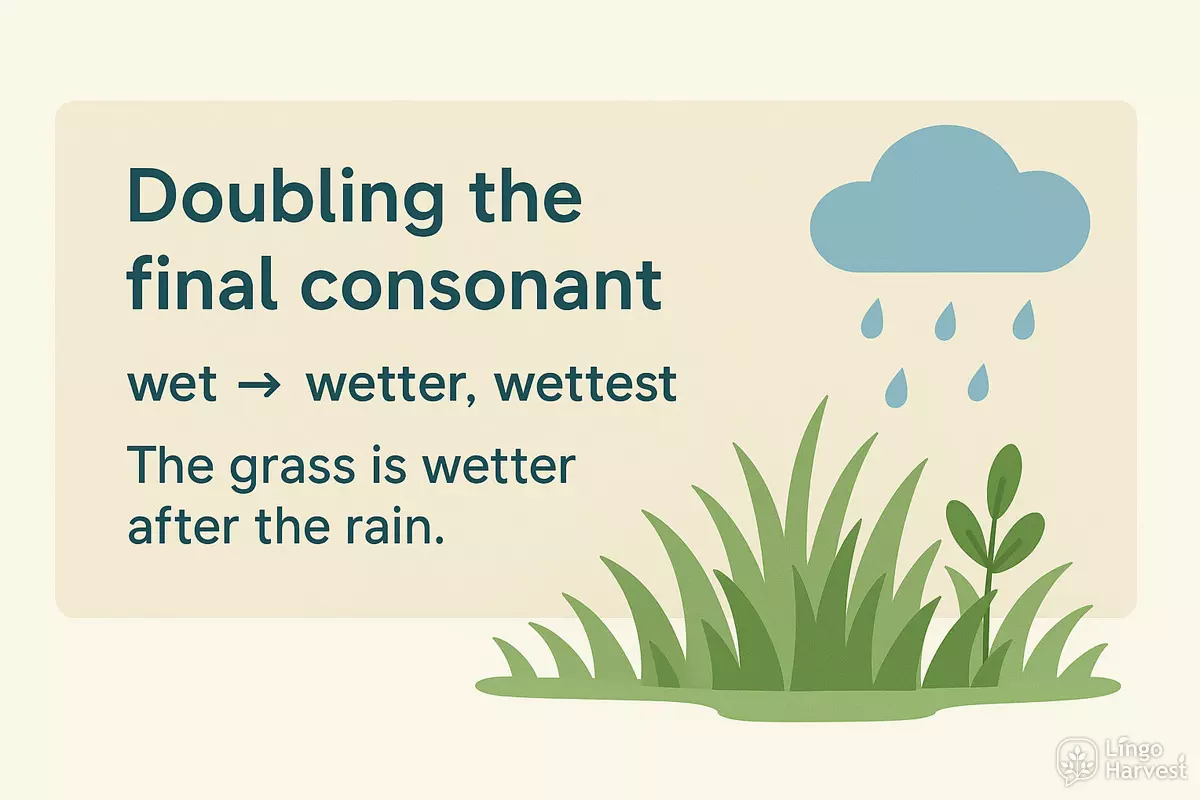
For adjectives with one syllable that end in a single vowel followed by a single consonant, double the final consonant before adding -er or -est:
- big → bigger, biggest → This bag is bigger than mine.
- hot → hotter, hottest → Today is hotter than yesterday.
- sad → sadder, saddest → He felt sadder after the bad news.
- thin → thinner, thinnest → This book is thinner than that one.
- fat → fatter, fattest → The second cat is fatter than the first.
- wet → wetter, wettest → The grass is wetter after the rain.
- dim → dimmer, dimmest → The light became dimmer in the evening.
- red → redder, reddest → Her face grew redder with embarrassment.
- flat → flatter, flattest → This road is flatter than the last one.
- slim → slimmer, slimmest → She looks slimmer than before.
Dropping the final -e
If the adjective ends in a silent -e, remove the -e before adding -er or -est:
- large → larger, largest → Their house is larger than ours.
- nice → nicer, nicest → This café is nicer than the other one.
- late → later, latest → He arrived later than everyone else.
- safe → safer, safest → This route is safer at night.
- wise → wiser, wisest → She is wiser than her classmates.
- close → closer, closest → The station is closer than you think.
- wide → wider, widest → The river is wider in this part.
- brave → braver, bravest → She is braver than she looks.
Changing -y to -i
Adjectives ending in a consonant plus -y change the -y to -i before adding the comparative or superlative ending:
- happy → happier, happiest → She is happier in her new job.
- busy → busier, busiest → This week is busier than last week.
- easy → easier, easiest → This exercise is easier than the first one.
- funny → funnier, funniest → The second joke was funnier.
- dry → drier, driest → The air is drier in winter.
- angry → angrier, angriest → He was angrier than before.
- lucky → luckier, luckiest → She is luckier than she thinks.
- noisy → noisier, noisiest → This street is noisier at night.
- tiny → tinier, tiniest → This is the tiniest bird I’ve seen.
- cloudy → cloudier, cloudiest → Today is cloudier than yesterday.
Summary of typical spelling patterns
| Pattern | Example Transformation |
|---|---|
| Double final consonant | big → bigger / biggest |
| Drop silent -e | large → larger / largest |
| -y to -i | happy → happier / happiest |
These spelling shifts are standard for most one-syllable and some two-syllable adjectives. However, always check exceptions and irregular forms, as English sometimes breaks its own rules.
Using than and the with comparisons
Comparative and superlative adjectives often rely on specific words to express relationships between things. Two of the most important words in these constructions are “than” and “the.” Each serves a distinct function in helping us compare qualities, people, or objects.
How “than” works with comparatives
The word “than” is used to highlight differences between two entities. It always follows a comparative adjective. This pattern allows us to specify what is being compared and the direction of the comparison.
- She is taller than her brother.
- This exam was easier than the last one.
- My car is faster than yours.
- He is more patient than I expected.
- This book is less interesting than I hoped.
- Our house is bigger than theirs.
- The new phone is lighter than the old one.
- He speaks more fluently than before.
- Winter nights are longer than summer ones.
- My coffee is hotter than yours.
Using “the” with superlatives
When describing the highest or lowest degree of a quality among three or more items, “the” is placed before the superlative adjective. This signals that the subject stands out in some way within a group.
- She is the smartest student in the class.
- This is the oldest building in town.
- He ran the fastest in the race.
- That was the most exciting film I’ve seen.
- This is the least expensive option.
- We chose the biggest pumpkin.
- She gave the best answer.
- This is the worst day for a picnic.
- He has the brightest smile.
- That was the most difficult question.
Summary of patterns
| Pattern | Example |
|---|---|
| Comparative + than + noun/pronoun | “smaller than a mouse” |
| More/less + adjective + than + noun/pronoun | “more careful than before” |
| The + superlative adjective + (group) | “the tallest in the group” |
| The most/least + adjective + (group) | “the most popular choice” |
In summary, “than” is essential for making direct comparisons, while “the” is required when identifying something as having the highest or lowest degree of a quality. Remembering these structures helps ensure clarity and precision in your comparative and superlative sentences.
Practice: rewrite sentences using comparative and superlative forms
Understanding how to transform sentences by using comparative and superlative adjectives is essential for clear and accurate English. The exercises below will help you practice changing basic statements into ones that compare two or more things. Remember: comparatives often use “-er” or “more,” while superlatives use “-est” or “most.”
Rewrite the sentences
Change each sentence so it compares two or more items. Use the correct comparative or superlative form of the adjective given in parentheses.
- John is (tall) than Mike.
- This puzzle is (easy) than the last one.
- Today is (cold) day of the year.
- My cat is (lazy) than my dog.
- Mount Everest is (high) mountain in the world.
- My house is (far) from school than yours.
- She is (intelligent) student in our class.
- This book is (interesting) than that one.
- Sarah runs (fast) than Tom.
- This painting is (beautiful) in the gallery.
Show answers
- John is taller than Mike.
- This puzzle is easier than the last one.
- Today is the coldest day of the year.
- My cat is lazier than my dog.
- Mount Everest is the highest mountain in the world.
- My house is farther from school than yours.
- She is the most intelligent student in our class.
- This book is more interesting than that one.
- Sarah runs faster than Tom.
- This painting is the most beautiful in the gallery.
Comparative and Superlative Adjective Patterns
Below is a reference table showing common adjectives with their comparative and superlative forms:
| Adjective | Comparative | Superlative |
|---|---|---|
| small | smaller | smallest |
| happy | happier | happiest |
| good | better | best |
| bad | worse | worst |
| expensive | more expensive | most expensive |
| fast | faster | fastest |
| beautiful | more beautiful | most beautiful |
| old | older | oldest |
Quick Practice: Identify the Error
Decide if the following sentences use the correct form of the adjective. If not, rewrite them correctly.
- This is the more difficult exam of all.
- My brother is more taller than me.
- She is the smartest student in the group.
- Today is colder than yesterday.
Show answers
- This is the most difficult exam of all.
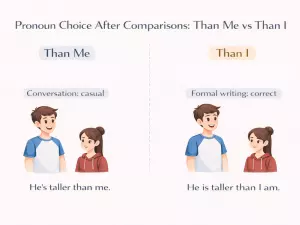
- My brother is taller than me.
- ✅ (Correct as written)
- ✅ (Correct as written)
Practicing these transformations will help you use comparatives and superlatives accurately in both writing and conversation.