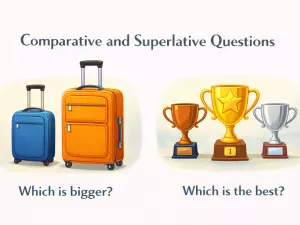
Comparative and Superlative Basics: -er, -est, More, Most

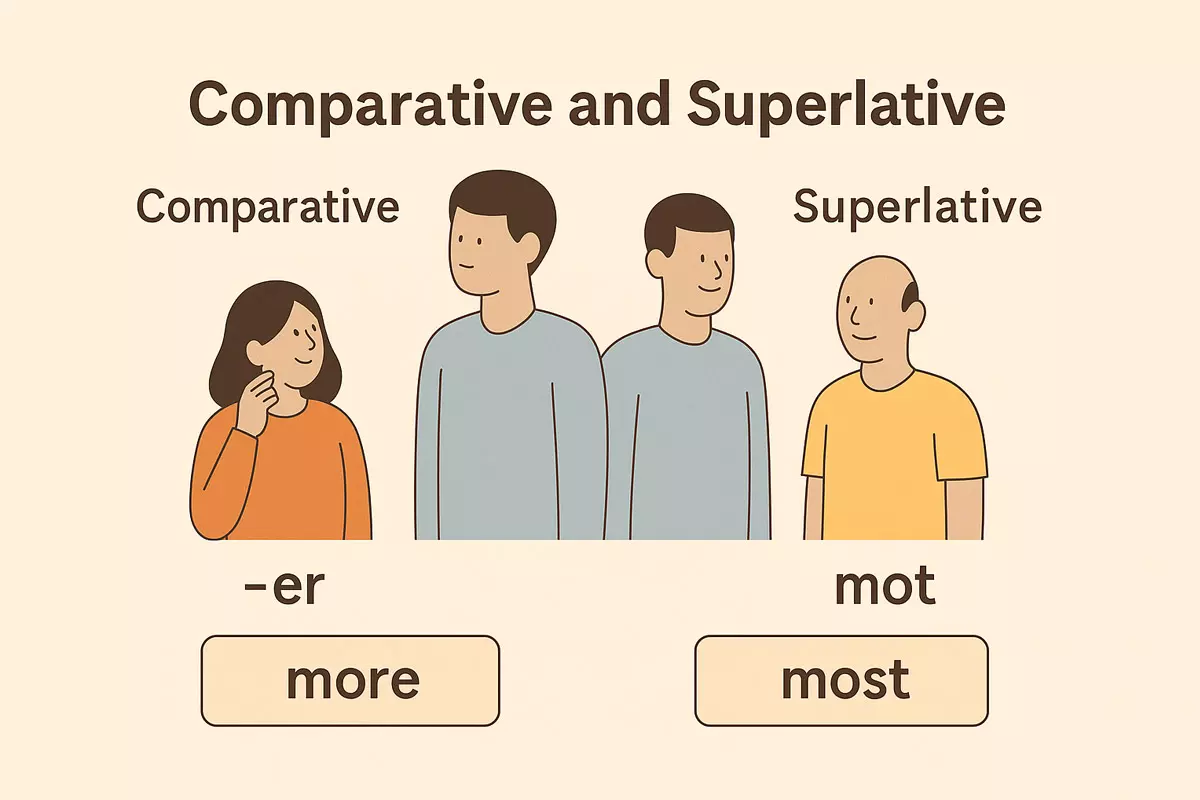 Here we how to compare things in English, including spelling rules for -er and -est, using more or most with longer adjectives, irregular forms, how to use than, avoiding double comparatives, and provides practice comparing people and objects.
In English, we use comparative and superlative forms of adjectives and adverbs to express differences and extremes between people, places, or things. For example, when comparing two items, we often add "-er" or use "more" before the adjective, as in "smarter" or "more interesting." To highlight the highest degree among three or more, we use "-est" or "most," such as "fastest" or "most beautiful." Learning how to use these forms correctly helps you communicate your ideas more clearly and accurately, making your speech and writing both precise and engaging.
When We Compare Things
Comparing two or more people, objects, or ideas is a common part of everyday language. English provides specific forms to show these differences, helping us express which item stands out, or how two things relate. These forms are called comparatives and superlatives, and they change depending on the word’s length and structure.
Comparative Forms: Finding Differences
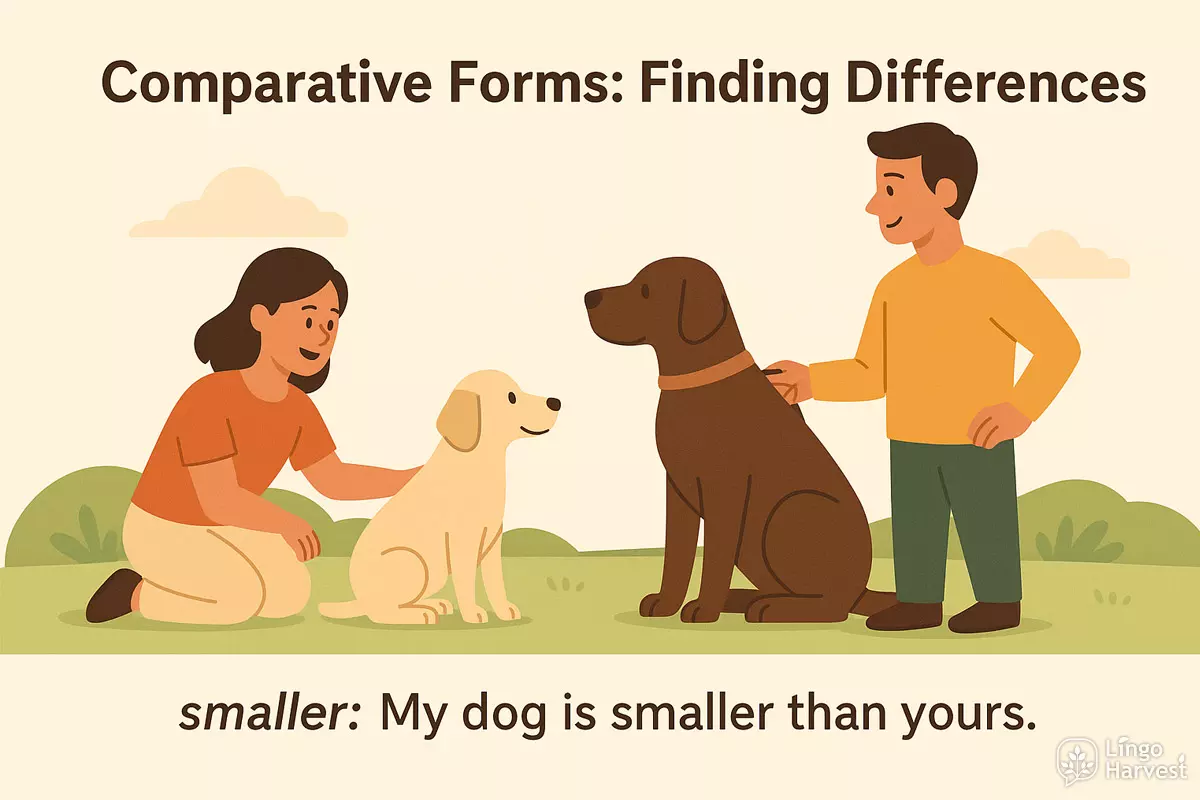
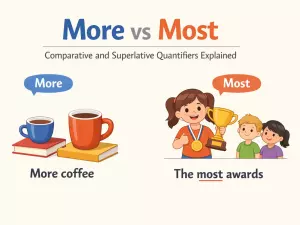
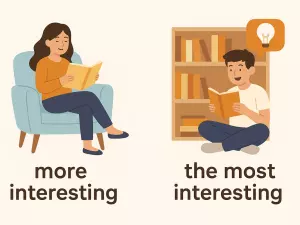
To highlight how two things are different, English uses "comparative" forms. Most short adjectives add -er (like "taller"), while longer adjectives use more before the word (such as "more interesting"). This is useful when you want to say one thing has more of a quality than another.
- smaller: My dog is smaller than yours.
- happier: She looks happier today.
- more careful: Please be more careful with the glass.
- hotter: July is hotter than May.
- more expensive: This phone is more expensive than that one.
- colder: The water is colder in the morning.
- quieter: Libraries are quieter than cafes.
- more useful: This tool is more useful for repairs.
- older: My brother is older than me.
- more creative: Her solution was more creative.
Superlative Forms: Showing Extremes
Superlatives are used when comparing more than two items to show which one is the most or least in a group. For short adjectives, add -est ("fastest"), and for longer ones, use most ("most delicious").
- biggest: That’s the biggest apple in the basket.
- most beautiful: She is the most beautiful person I know.
- fastest: Usain Bolt is the fastest runner.
- most comfortable: This chair is the most comfortable here.
- oldest: He’s the oldest student in the class.
- most interesting: That was the most interesting book I’ve read.
- smallest: This is the smallest room in the house.
- most talented: She’s the most talented musician in the band.
- coldest: January is usually the coldest month.
- most difficult: That was the most difficult question on the test.
Comparative and Superlative Patterns
Adjective length usually determines which form to use. Here’s a quick overview:
| Adjective | Comparative | Superlative |
|---|---|---|
| short | shorter | shortest |
| happy | happier | happiest |
| expensive | more expensive | most expensive |
| interesting | more interesting | most interesting |
| old | older | oldest |
| quiet | quieter | quietest |
| useful | more useful | most useful |
| strong | stronger | strongest |
| comfortable | more comfortable | most comfortable |
| creative | more creative | most creative |
By using these patterns, you can clearly express how things relate in terms of quality, size, speed, or other features. This makes your descriptions and comparisons much more precise and natural in conversation or writing.
Spelling Rules for -er/-est
Understanding how to correctly add -er and -est to adjectives is essential for forming the comparative and superlative forms of many English words. These endings are mostly used with short adjectives, but spelling can change depending on the structure of the word. Let’s break down the main points you’ll need to keep in mind.
Basic Patterns for Adding -er and -est
For most one-syllable adjectives, simply add -er or -est:
- tall → taller, tallest
- quick → quicker, quickest
- bright → brighter, brightest
If the adjective ends in -e, just add -r or -st:
- large → larger, largest
- late → later, latest
Doubling the Final Consonant
When an adjective ends with a single vowel followed by a single consonant, double the consonant before adding the ending:
- big → bigger, biggest
- hot → hotter, hottest
- sad → sadder, saddest
- thin → thinner, thinnest
Changing -y to -i
If the word ends in -y with a consonant before it, change the -y to -i before adding the ending:
- happy → happier, happiest
- funny → funnier, funniest
- busy → busier, busiest
- dry → drier, driest
Summary Table of Spelling Changes
| Adjective | Comparative / Superlative |
|---|---|
| fast | faster / fastest |
| nice | nicer / nicest |
| big | bigger / biggest |
| sad | sadder / saddest |
| happy | happier / happiest |
| dry | drier / driest |
| busy | busier / busiest |
| hot | hotter / hottest |
| late | later / latest |
| quiet | quieter / quietest |
When Not to Use -er/-est
Not every adjective can take these endings. For most adjectives with two or more syllables (except some ending in -y), use more and most instead, as in more beautiful or most careful. Stick with -er/-est for short, simple adjectives and follow the above spelling tips for accuracy.
More/Most with Longer Adjectives
When describing differences using adjectives with two or more syllables, English typically avoids the -er and -est endings. Instead, it uses “more” for comparisons and “most” for superlative forms. This pattern helps keep sentences smooth and avoids awkward or unclear words.
When Do We Use "More" and "Most"?
Longer adjectives—especially those ending in -ful, -ous, -ing, -ed, -ive, and -al—almost always take "more" and "most" for their comparative and superlative forms. For example, instead of saying "beautifuller," we say "more beautiful." The same goes for "most beautiful" instead of "beautifulest."
- more interesting / most interesting
- more comfortable / most comfortable
- more important / most important
- more expensive / most expensive
- more dangerous / most dangerous
- more successful / most successful
- more delicious / most delicious
- more creative / most creative
- more traditional / most traditional
- more convenient / most convenient
- more exciting / most exciting
- more flexible / most flexible
- more reliable / most reliable
- more comfortable / most comfortable
- more unusual / most unusual
- more powerful / most powerful
- more attractive / most attractive
- more responsible / most responsible
Quick Reference Table
Below is a reference showing how some common longer adjectives form their comparative and superlative:
| Adjective | Comparative | Superlative |
|---|---|---|
| beautiful | more beautiful | most beautiful |
| expensive | more expensive | most expensive |
| comfortable | more comfortable | most comfortable |
| interesting | more interesting | most interesting |
| important | more important | most important |
| delicious | more delicious | most delicious |
Common Mistakes to Avoid
- ❌ "beautifuller" → ✅ "more beautiful"
- ❌ "importanter" → ✅ "more important"
- ❌ "comfortablest" → ✅ "most comfortable"
Using “more” and “most” with multi-syllable adjectives helps your English sound natural. When in doubt, try saying both forms—if the -er or -est version sounds strange, “more” or “most” is probably the way to go.
Irregular Forms (good, bad, far)
Some adjectives in English don’t follow the usual “-er” and “-est” endings or the “more/most” patterns. Instead, their comparative and superlative forms are completely different words. This is especially true for common adjectives like “good,” “bad,” and “far.” These special cases are important because they are frequently used—and memorizing them helps you sound more natural and fluent.
Unique Comparative and Superlative Forms
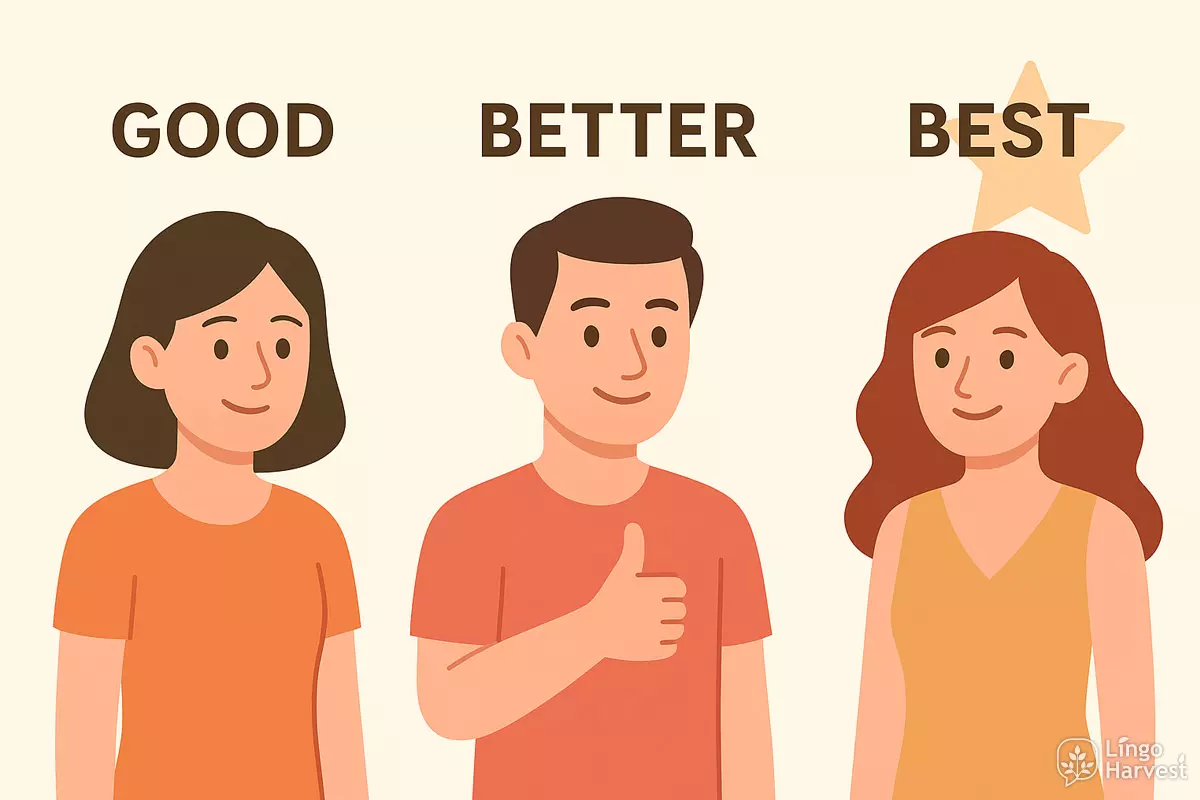
Unlike regular adjectives (like “tall/taller/tallest”), these words change form entirely. For example, “good” doesn’t become “gooder” or “goodest.” Instead, it uses “better” and “best.” The same is true for “bad” and “far.”
| Base Form | Comparative | Superlative |
|---|---|---|
| good | better | best |
| bad | worse | worst |
| far | farther / further | farthest / furthest |
Usage Notes and Examples
- Good: “She is a better singer than her brother.” / “He is the best in the class.”
- Bad: “This movie is worse than the last one.” / “That was the worst meal I’ve ever had.”
- Far:
- “farther” and “farthest” are usually for physical distance: “New York is farther from London than Paris is.”
- “further” and “furthest” can refer to both distance and degree: “Let’s discuss this further.”
Other Common Irregulars (for Reference)
While “good,” “bad,” and “far” are some of the most well-known, English has a few other adjectives and adverbs with irregular patterns. Here are some additional examples:
- little → less → least
- many / much → more → most
- old → older/elder → oldest/eldest (elder/eldest are often used for people in families)
Memorizing these forms is essential since regular rules do not apply. English speakers use these words every day, so becoming familiar with their patterns will help you both understand and communicate more clearly.
Than, Of the Two, In the Group
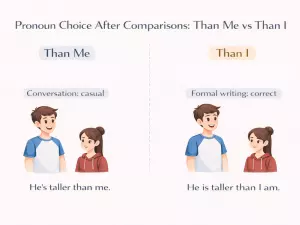
Comparative and superlative forms often appear in sentences where choices or groups are being discussed. When comparing just two items, we typically use the comparative form (ending in -er or using more) and connect them with the word than. For example: “This book is longer than that one.” The word than signals a direct comparison between two things. When you want to show something is the most or least within a set of three or more, the superlative form (with -est or most) comes into play. You’ll often see phrases like “in the group” or “of all,” which indicate the subject is being compared to more than one other thing. For example: “She is the fastest in the group.”
Comparing Two: Using “Than” and “Of the Two”
When only two items are compared, English often uses structures like:
- He is taller than his brother.
- This exam is easier than the last one.
- Of the two cars, the red one is newer.
- Which is more expensive: tea or coffee?
- My house is smaller than yours.
- Of the two options, this is better.
- This song is catchier than that one.
- Of the two, this solution is simpler.
- The blue pen writes smoother than the black pen.
- Of the two dresses, the green is prettier.
Notice how “of the two” is often used to introduce the comparison, especially when the context needs to be clear.
Superlatives: “In the Group” and “Of All”
Superlative forms identify something as the extreme within a group. Common expressions include “in the group,” “of all,” or “among.” Here are some patterns:
- She is the smartest in the class.
- This is the most interesting book of all.
- He is the youngest in the family.
- That was the fastest time in the race.
- This is the least expensive option in the menu.
- Of all the students, he is the most diligent.
- Among the three, this is the brightest color.
- It’s the coldest day in the week.
- This is the most comfortable chair in the office.
- She is the friendliest of the group.
- Of all the answers, yours is the best.
- He is the tallest among his friends.
Quick Reference: Comparative vs. Superlative in Context
| Context | Example |
|---|---|
| Comparing two (using "than") | This road is longer than that one. |
| Comparing two (using "of the two") | Of the two shirts, the blue is nicer. |
| Superlative in a group ("in the group") | He is the fastest in the group. |
| Superlative of all | This is the most delicious cake of all. |
| Superlative among options | Among the options, this is the cheapest. |
Understanding when to use these forms helps your comparisons stay clear and natural. Use “than” or “of the two” for pairs, and “in the group,” “of all,” or “among” for larger sets. This distinction keeps your English precise and fluent.
Avoiding Double Comparatives
It’s important to use only one comparative form at a time when comparing things in English. Native speakers sometimes make the mistake of doubling up by using both “-er” and “more” together, but this is never correct. Each adjective has its own way of forming the comparative, and mixing methods leads to grammatical errors.
What Are Double Comparatives?
A double comparative happens when you try to make an adjective comparative twice, often by combining “-er” with “more.” For example, saying “more faster” or “more happier” is incorrect. You only need one comparative marker: either the “-er” ending for shorter adjectives, or “more” for longer ones.
Common Incorrect Patterns
Watch out for these mistakes in everyday speech and writing:
- more taller
- more bigger
- more smaller
- more easier
- more louder
- more earlier
- more colder
- more newer
- more quicker
- more longer
- more richer
- more shorter
- more brighter
- more slower
- more friendlier
- more simpler
- more weaker
- more harder
- more sharper
- more cleverer
How to Use Comparatives Correctly
Adjectives of one syllable (like “fast,” “tall,” “small”) usually take “-er.” For longer adjectives, use “more.” Never combine both forms. Here’s a quick guide:
| Incorrect Form | Correct Form |
|---|---|
| more faster | faster |
| more happier | happier |
| more beautifuler | more beautiful |
| more easier | easier |
| more expensiveer | more expensive |
| more friendlier | friendlier / more friendly |
| more cleverer | cleverer / more clever |
| more colder | colder |
Tips for Clear Comparisons
- Use “-er” for most one-syllable adjectives: smaller, taller, quicker.
- Use “more” for most adjectives with two or more syllables: more careful, more interesting.
- Never say both together: choose one form only.
- Some two-syllable adjectives can use either: friendlier/more friendly.
Making accurate comparisons helps your English sound natural and clear. Stick to one comparative form per adjective to avoid confusion and mistakes.
Practice: Compare People and Objects
Understanding how to compare two or more people or things is a key part of mastering comparative and superlative forms in English. When you compare, you usually focus on qualities like size, age, speed, or other characteristics. Let’s look at some practical ways to apply these forms to real-life situations with both people and objects.
Common Patterns for Comparisons
You can compare people and things using adjectives with -er/-est endings (for short adjectives), or with more/most (for longer adjectives). Here are some examples of how you might use these patterns in sentences:
- My brother is taller than me.
- This exam is easier than the last one.
- She is more intelligent than her classmates.
- Tom is the oldest student in the class.
- This phone is more expensive than my laptop.
- That was the most interesting book I’ve ever read.
- Mount Everest is the highest mountain in the world.
- My house is bigger than yours.
- Winter is the coldest season.
- Her bag is heavier than mine.
- He is the youngest player on the team.
- This is the most comfortable chair here.
Comparing People and Objects: Structured Examples
When you want to see how different forms look side by side, a table can help. Here are some adjectives and their comparative and superlative forms, along with example comparisons:
| Adjective | Comparative | Superlative | Example Sentence |
|---|---|---|---|
| fast | faster | fastest | My bike is faster than yours. |
| heavy | heavier | heaviest | This suitcase is the heaviest. |
| beautiful | more beautiful | most beautiful | That painting is more beautiful than the others. |
| good | better | best | She is the best student in the group. |
| old | older | oldest | My grandfather is older than my grandmother. |
| expensive | more expensive | most expensive | This car is the most expensive in the showroom. |
| young | younger | youngest | Lisa is younger than her brother. |
| small | smaller | smallest | This dog is smaller than that one. |
Try It Yourself: Make Comparisons
Use the correct comparative or superlative form to complete each sentence. Choose from the adjectives in parentheses.
- My bag is __________ (heavy) than your bag.
- This is the __________ (nice) park in the city.
- Ben is __________ (tall) than his sister.
- That movie was __________ (interesting) than the last one.
- She is the __________ (young) in her family.
- This computer is __________ (expensive) than my old one.
- Today is the __________ (hot) day of the week.
- Which is __________ (good), tea or coffee?
Show answers
- heavier
- nicest
- taller
- more interesting
- youngest
- more expensive
- hottest
- better
Tips for Comparing People and Things
- Use -er and -est for one-syllable adjectives (e.g., taller, tallest).
- Use more and most for longer adjectives (e.g., more beautiful, most beautiful).
- Irregular adjectives (good, bad, far, etc.) have unique forms (better/best, worse/worst, farther/farthest).
- Always use "than" with comparatives; use "the" before superlatives.
Practicing these patterns will help you confidently compare both people and objects in English conversations and writing.