Pronoun Choice After Comparisons: Than Me vs Than I

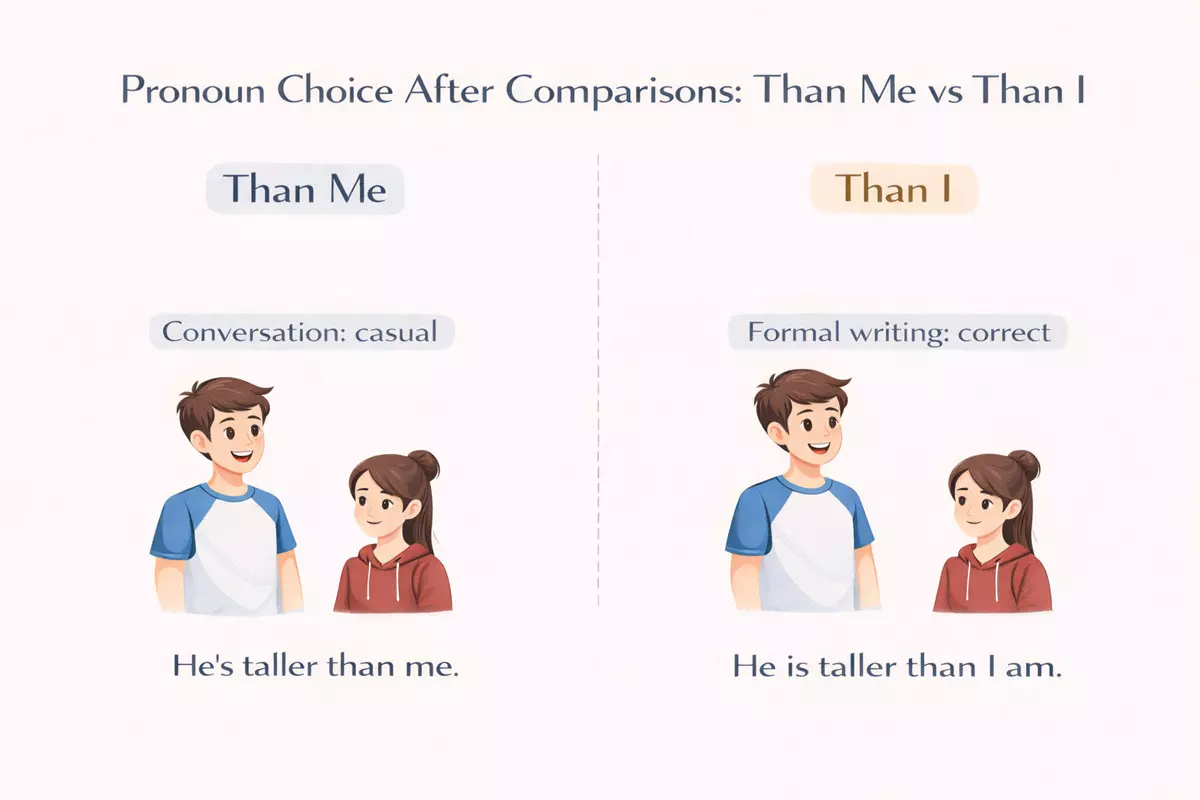 This article explains why comparisons confuse pronouns, how than functions as a conjunction or preposition, and differences between formal and informal patterns.
- Why comparisons cause pronoun confusion
- Than as a conjunction vs preposition
- Formal vs informal comparison patterns
- Meaning differences in ambiguous comparisons
- Common learner errors after than and as
- Spoken English preferences
- Editing strategies to test correctness
- Practice: choose the correct pronoun in comparisons
Choosing the correct pronoun after making a comparison, such as deciding between than me and than I, can be challenging. The choice depends on the sentence structure and the intended meaning. If the comparison is followed by a verb, as in she is taller than I am, use the subject pronoun. If the verb is omitted and only the pronoun remains, as in she is taller than me, the object pronoun is generally accepted in informal speech. Understanding these subtle differences will help you use pronouns correctly in comparisons.
Why comparisons cause pronoun confusion
When we compare two things using words like "than" or "as," choosing the right pronoun suddenly feels tricky. The confusion comes from English grammar's flexibility: sometimes we drop words that are "understood," and sometimes rules from formal writing clash with how people actually speak. This mix of grammar, style, and habit makes it easy to second-guess ourselves in sentences like "She is taller than me" versus "She is taller than I."
Ellipsis and Implied Words
A big reason for uncertainty is ellipsis, where words are left out because they’re assumed. In comparisons, we often skip repeating verbs or subjects. For example, "He plays better than I" is short for "He plays better than I do." If we use "me" instead, it could mean something subtly different: "He plays better than (he plays) me." The omitted words change the meaning—and the correct pronoun.
Subject vs. Object Pronouns
Another issue is knowing whether to use the subject form ("I," "she," "he") or the object form ("me," "her," "him"). In everyday speech, object pronouns often sound more natural, but formal grammar sometimes demands the subject form. This inconsistency leads to common mix-ups.
Examples of Comparison Sentences
Here are some sentences where pronoun choice after "than" or "as" can be confusing:
- She is smarter than I / me.
- No one runs faster than he / him.
- You worked harder than I / me.
- This matters more to her than I / me.
- They have more experience than we / us.
- He likes cats more than I / me.
- My team performed better than theirs / them.
- She's as tall as I / me.
- He sings better than she / her.
- Our dog obeys commands faster than theirs / them.
- She trusts you more than I / me.
- They invited Sam as well as I / me.
- He can cook better than I / me.
- You know the answer better than she / her.
- This rule applies to you more than I / me.
Formal vs. Informal Usage

In formal English, subject pronouns are preferred when the verb is implied ("He is taller than I [am]"). But in casual conversation, most people use object pronouns ("He is taller than me"), which can sound more natural.
| Formal (Subject Pronoun) | Informal (Object Pronoun) |
|---|---|
| She is older than I. | She is older than me. |
| No one works harder than he. | No one works harder than him. |
| They are as prepared as we. | They are as prepared as us. |
| He plays chess better than she. | He plays chess better than her. |
Ambiguity in Meaning
Sometimes, switching pronouns actually changes what the sentence means. For example, "He likes her more than me" could mean either "He likes her more than he likes me" or "He likes her more than I like her." The right pronoun depends on what you're trying to say.
- He likes her more than me → He prefers her over me.
- He likes her more than I → He likes her more than I do.
These subtle differences explain why choosing between "than me" and "than I" is often confusing—even for native speakers.
Than as a conjunction vs preposition
Understanding how "than" functions in a sentence is key to choosing the correct pronoun after a comparison. Traditionally, "than" is considered a conjunction, but in modern usage, it sometimes acts like a preposition. This difference directly affects whether you should use subject pronouns (like "I") or object pronouns (like "me") after "than."
When "than" is a conjunction
As a conjunction, "than" links two clauses and usually implies omitted words. In formal or traditional grammar, the pronoun following "than" is part of a full clause, so it should be in the subject form. Here are some examples:
- She is taller than I (am).
- They work harder than we (do).
- No one knows more than he (does).
- You have more experience than I (have).
- She can run faster than he (can).
- Alex is older than I (am).
- We finished sooner than they (did).
- This costs less than it (used to).
- He eats more than she (does).
- Lucy sings better than I (do).
When "than" is a preposition
In everyday conversation, "than" is often treated as a preposition, directly followed by an object pronoun. This usage is common and widely accepted in informal English. Here, the pronoun takes the object form:
- She is taller than me.
- They work harder than us.
- No one knows more than him.
- You have more experience than me.
- She can run faster than him.
- Alex is older than me.
- We finished sooner than them.
- This costs less than her.
- He eats more than her.
- Lucy sings better than me.
| Function of "than" | Correct Pronoun Form | Example |
|---|---|---|
| Conjunction (linking clauses) | Subject pronoun | He is smarter than I (am). |
| Preposition (directly before noun/pronoun) | Object pronoun | He is smarter than me. |
| Conjunction (formal/written) | Subject pronoun | She likes music more than I (do). |
| Preposition (informal/spoken) | Object pronoun | She likes music more than me. |
Summary: Choosing the right pronoun after "than"
In formal writing, using the subject form after "than" is preferred when a verb is implied. In casual conversation, the object form is common and generally accepted. The context—spoken or written, formal or informal—should guide your choice. Both forms are grammatically justifiable, but clarity and tone matter most.
Formal vs informal comparison patterns
Choosing between “than me” and “than I” often depends on the level of formality in your sentence. In casual conversation, people typically opt for shorter, less formal structures, while in academic or formal writing, more complete grammatical forms are expected. Understanding when to use each option helps you sound both natural and correct in a variety of settings.
How spoken and written English differ
In informal speech, it’s common to drop parts of the sentence that are understood from context. For example, “She’s taller than me” is widely accepted in conversation because the full verb (“am”) is implied. In contrast, formal writing prefers the complete structure: “She’s taller than I am.” This distinction can affect your choice of pronoun after “than.”
Common comparison patterns
Here are some typical ways comparisons are made, with both relaxed and more structured versions:
- He runs faster than me. → He runs faster than I do.
- They know more than us. → They know more than we know.
- You arrived earlier than her. → You arrived earlier than she did.
- He likes coffee more than me. → He likes coffee more than I do.
- She’s older than him. → She’s older than he is.
- My brother is stronger than me. → My brother is stronger than I am.
- She has more experience than us. → She has more experience than we have.
- He finished quicker than her. → He finished quicker than she did.
- They’re better at chess than me. → They’re better at chess than I am.
- We ate more cake than them. → We ate more cake than they did.
Table: Pronoun choice in comparisons
| Informal Pattern | More Formal Equivalent |
|---|---|
| than me | than I am |
| than him | than he is |
| than her | than she is |
| than us | than we are |
| than them | than they are |
Quick tips for choosing the right form
- In everyday conversation, using “than me” or “than him” is acceptable and natural.
- For formal writing or exams, use the subject pronoun plus the implied verb: “than I am,” “than he is,” etc.
- When in doubt, expand the comparison to include the full verb to check if the pronoun sounds correct.
Being aware of context and audience will help you select the most appropriate comparison structure, making your language both clear and suitable for the situation.
Meaning differences in ambiguous comparisons
Ambiguous comparisons with pronouns like "than me" and "than I" often lead to subtle shifts in meaning, depending on which grammatical structure is assumed. When speakers say sentences such as "She likes him more than me," the interpretation may hinge on whether "than me" is taken as the object of liking or as a comparison of liking between two people. The choice between "than me" and "than I" is not just about grammar—it can signal different relationships or actions.
How ambiguity arises
English allows for both elliptical and full forms after "than." Ellipsis can result in more than one possible reading, especially when pronouns are involved. For example, "He is taller than her" could mean either "He is taller than she is" or "He is taller than he is tall." Context usually clarifies, but written sentences without context can remain unclear.
Common ambiguous patterns
Below is a list of typical ambiguous constructions that illustrate how different pronoun choices and sentence structures can lead to multiple valid interpretations:
- She likes him more than me.
- She likes him more than I.
- They invited you more than her.
- He trusts you more than I.
- He trusts you more than me.
- John knows Mary better than me.
- John knows Mary better than I.
- My brother runs faster than her.
- My brother runs faster than she.
- You called them earlier than us.
- You called them earlier than we.
- Lisa helps Tom more than me.
- Lisa helps Tom more than I.
- He thanked Anna more than me.
- He thanked Anna more than I.
Interpretation depends on structure
The ambiguity often results from whether the comparison is between two objects or two subjects. For instance, "She likes him more than me" could mean:
- She likes him more than she likes me. (object comparison)
- I like him less than she does. (subject comparison)
Choosing "than I" typically signals the subject interpretation, especially in formal registers, while "than me" is common in speech and may favor the object reading.
Summary of possible readings
| Example | Possible Interpretations |
|---|---|
| She likes him more than me. |
|
| He trusts you more than I. |
|
| My brother runs faster than her. |
|
| Lisa helps Tom more than me. |
|
Choosing clarity
When the meaning matters, rephrasing or using the full form ("than I do," "than she does") can remove confusion. In informal speech, context usually resolves the ambiguity, but in writing or formal contexts, precise pronoun use and expanded forms are preferred for clarity.
Common learner errors after than and as
Many English learners stumble when choosing the right pronoun after comparison words like than and as. The confusion often arises because spoken English and formal written English don’t always match, and some forms that feel “natural” in conversation may be considered incorrect in academic or professional contexts. Let’s look at the most frequent mistakes and how to avoid them.
Mixing up subject and object pronouns
A typical issue is using an object pronoun (like me, him, her) where a subject pronoun (like I, he, she) is needed, or vice versa. This often happens because the comparison is actually a shortened clause, even though the second verb is usually omitted in casual speech.
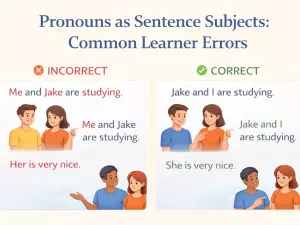
- Incorrect: She is taller than me. ❌
- Correct: She is taller than I (am). ✅
- Incorrect: He runs faster than her. ❌
- Correct: He runs faster than she (does). ✅
Ambiguous meaning with omitted verbs
Leaving out the verb after than or as can cause confusion, especially when both subject and object pronouns seem possible. Sometimes, the pronoun choice changes the meaning:
| Sentence | Meaning |
|---|---|
| She likes him more than me. | She likes him more than she likes me. |
| She likes him more than I. | I like him less than she does. |
| He works as hard as me. | He works as hard as I work (informal but common). |
| He works as hard as I. | He works as hard as I do (formal/correct). |
Overusing object pronouns in casual speech
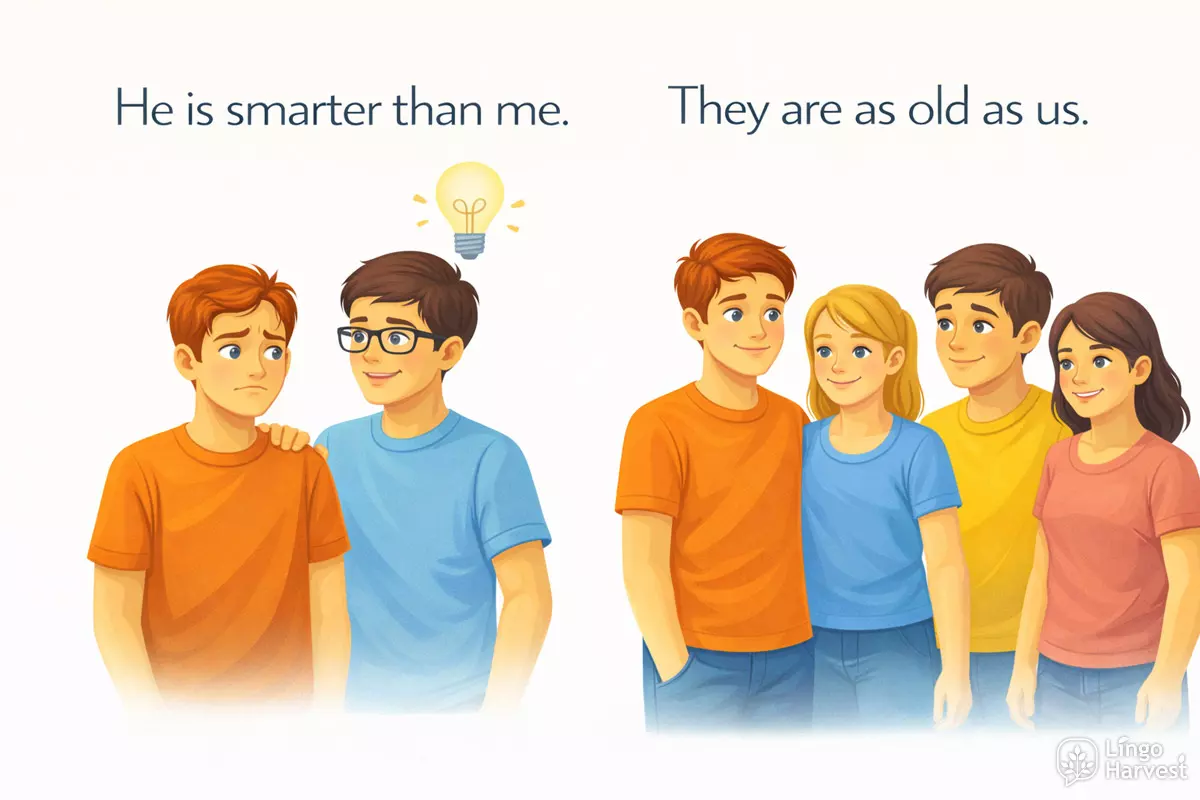
In everyday conversation, people often use object pronouns after than and as because it sounds more natural. However, in exams or formal writing, subject pronouns are usually expected when the comparison is with a subject. Some common informal patterns include:
- He is smarter than me.
- They are as old as us.
- She’s better at it than him.
While these are widely used in conversation, remember to use subject pronouns (I, we, he, she, they) in formal contexts when the comparison refers to the subject of the sentence.
Forgetting to complete the comparison clause
Another pitfall is omitting the implied verb entirely, which can make the sentence unclear. For clarity, especially in writing, it’s helpful to complete the comparison:
- He is taller than I am.
- She sings as beautifully as they do.
- We finished faster than they did.
Summary of errors to watch for
- Using object pronouns where subject pronouns are correct (and vice versa).
- Creating ambiguity by omitting the verb after than or as.
- Relying on informal patterns in formal writing or exams.
- Failing to match the pronoun to the implied verb in the comparison.
- Not completing the comparison, leading to unclear meaning.
Understanding these common pitfalls can help you make more precise and confident choices after comparison words.
Spoken English preferences
In everyday conversation, most people naturally gravitate toward the simpler “than me” construction rather than “than I.” This preference is especially strong in informal speech, where ease and familiarity usually outweigh strict adherence to traditional grammar rules. For many speakers, using “than I” can sound overly formal or even awkward, unless it’s followed by the verb “am” (as in, “She is taller than I am”). As a result, “than me” is far more common in spoken exchanges, even among those who know the prescriptive rule.
Common usage patterns
When comparing two people, these are the forms you’ll hear most often in conversation:
- He’s faster than me.
- She likes pizza more than me.
- They’re older than us.
- You’re smarter than him.
- My brother is stronger than her.
- We finished earlier than them.
- This job pays better than mine.
- Her cat is lazier than ours.
- They got more votes than we did.
- He can swim further than I can.
- Sarah is a better cook than me.
- He spends more time on homework than her.
- I have less patience than him.
- We arrived later than they did.
- The movie was more exciting for you than me.
Why “than me” is so common
People often choose “me” (or “him,” “her,” “us,” “them”) after “than” because it fits the natural rhythm of speech. Many don’t consciously analyze the underlying grammar, especially when the verb is omitted (“than me” instead of “than I am”). In most dialects and regions, this usage is not only accepted but expected in casual settings.
Perceptions and corrections
Although some speakers might correct themselves to “than I” in formal situations, most will default to “than me” without hesitation. Teachers or editors may point out the traditional rule, but in conversation, “than me” rarely draws attention or criticism.
Informal vs. formal comparison
To illustrate the difference in register, here’s a comparison of typical spoken and more formal or written forms:
| Conversational Example | Formal/Written Example |
|---|---|
| He’s taller than me. | He’s taller than I am. |
| She runs faster than him. | She runs faster than he does. |
| You got a better score than us. | You got a better score than we did. |
| They work harder than her. | They work harder than she does. |
In summary, while grammar guides may recommend “than I,” most English speakers use “than me” in speech, and this choice is widely accepted in informal contexts.
Editing strategies to test correctness
When reviewing sentences involving comparisons like "than me" or "than I," it's important to verify both grammar and clarity. Editors can apply a few targeted methods to check which pronoun form fits best after "than." Below are some practical approaches for ensuring correctness in your writing.
Substitute the implied verb
One of the quickest ways to test pronoun choice is to mentally insert the implied verb after the comparison. This helps reveal whether a subject or object pronoun is needed. For example, in "She is taller than I (am)," the verb "am" is implied, so the subject pronoun "I" is correct. In "She likes him more than me," no verb follows, so the object pronoun "me" is appropriate.
- He knows more than I (do).
- She called you more than me.
- They arrived earlier than we (did).
- She is stronger than him.
- I spend more time with her than (with) him.
- They finished sooner than us.
- He is better at chess than I (am).
- She trusts him more than me.
- He cares about them more than us.
- She can run faster than I (can).
Compare sentence structure
Analyzing the sentence structure helps determine if the pronoun serves as a subject or object. If the comparison is between two subjects performing an action, use the subject form ("I," "he," "she," "we," "they"). If it compares objects receiving an action, use the object form ("me," "him," "her," "us," "them").
Test with other pronouns
Sometimes, substituting a different pronoun clarifies the correct form. For example, if "She is taller than me" sounds questionable, try "She is taller than he." If the result seems awkward, the sentence may need the subject form.
Common patterns and corrections
Editors often encounter recurring patterns in comparative sentences. The table below summarizes common scenarios and their preferred pronoun choices.
| Example | Correct Pronoun Form |
|---|---|
| She is taller than I (am). | Subject ("I") |
| She likes him more than me. | Object ("me") |
| He works harder than we (do). | Subject ("we") |
| They invited her instead of us. | Object ("us") |
| He is smarter than she (is). | Subject ("she") |
| He helped them more than her. | Object ("her") |
Quick editing checklist
- Insert the implied verb after the comparison—does the pronoun still fit?
- Check if the pronoun acts as subject or object in the clause.
- Try rephrasing the sentence for clarity.
- Test with parallel sentences using other pronouns.
- Consult a style guide for formal writing, as conversational English sometimes allows for object pronouns ("than me") where traditional grammar prefers subject forms ("than I").
Practice: Identify the correct form
- She can sing better than (I/me).
- He trusts you more than (her/she).
- They arrived later than (us/we).
- He is taller than (her/she).
- I spend more time with them than (him/he).
- Maria works harder than (I/me).
- This task matters more to you than (we/us).
- She speaks more confidently than (him/he).
- They respect her more than (I/me).
- He talks to you more than (she/her).
Show answers
- I
- her
- we
- she
- him
- I
- we
- he
- I
- she
By systematically applying these techniques, editors and writers can confidently determine which pronoun is appropriate after "than" in comparative constructions.
Practice: choose the correct pronoun in comparisons
Comparisons often cause confusion when choosing between subject and object pronouns, especially after words like "than" or "as." The right choice depends on whether the pronoun is the subject or object of an implied verb. Let’s work through some exercises to reinforce the rules.
Choose the correct pronoun
Read each sentence and select the most appropriate pronoun to complete it. Think about whether the full meaning would include a verb (“than I am,” “than me”) or not.
- She is taller than me / I.
- No one can run faster than he / him.
- They know more about history than us / we.
- My brother is older than me / I.
- Julia likes chocolate more than me / I.
- He plays chess better than her / she.
- You have more books than them / they.
- Linda is smarter than us / we.
- He can dance better than I / me.
- The dog likes you more than her / she.
Show answers
- me
- he
- we
- I
- me
- she
- they
- we
- I
- her
Common patterns in comparative pronoun choice
To help you visualize some typical sentence structures and the correct pronoun form, see the table below:
| Comparison Phrase | Correct Pronoun Form |
|---|---|
| She is taller than I (am). | Subject pronoun (I) |
| He likes her more than me. | Object pronoun (me) |
| They are better singers than we (are). | Subject pronoun (we) |
| She called you more than him. | Object pronoun (him) |
| He is stronger than she (is). | Subject pronoun (she) |
Reflection: When do you use "than me" or "than I"?
- Use the subject pronoun (I, he, we, she, they) when the comparison implies a verb: “He is taller than I (am).”
- Use the object pronoun (me, him, us, her, them) when the pronoun is the object of the comparison: “She likes pizza more than me.”
- Always check if an implied verb fits after the pronoun; if so, use the subject form.
Show answers
Use "than I" when you can expand the sentence with a verb after the pronoun. Use "than me" when the pronoun is the object of the comparison.
Practicing these examples will help you avoid common mistakes and make your comparisons clearer and more grammatically precise.