Irregular Adjectives in Comparison: Good, Better, Best

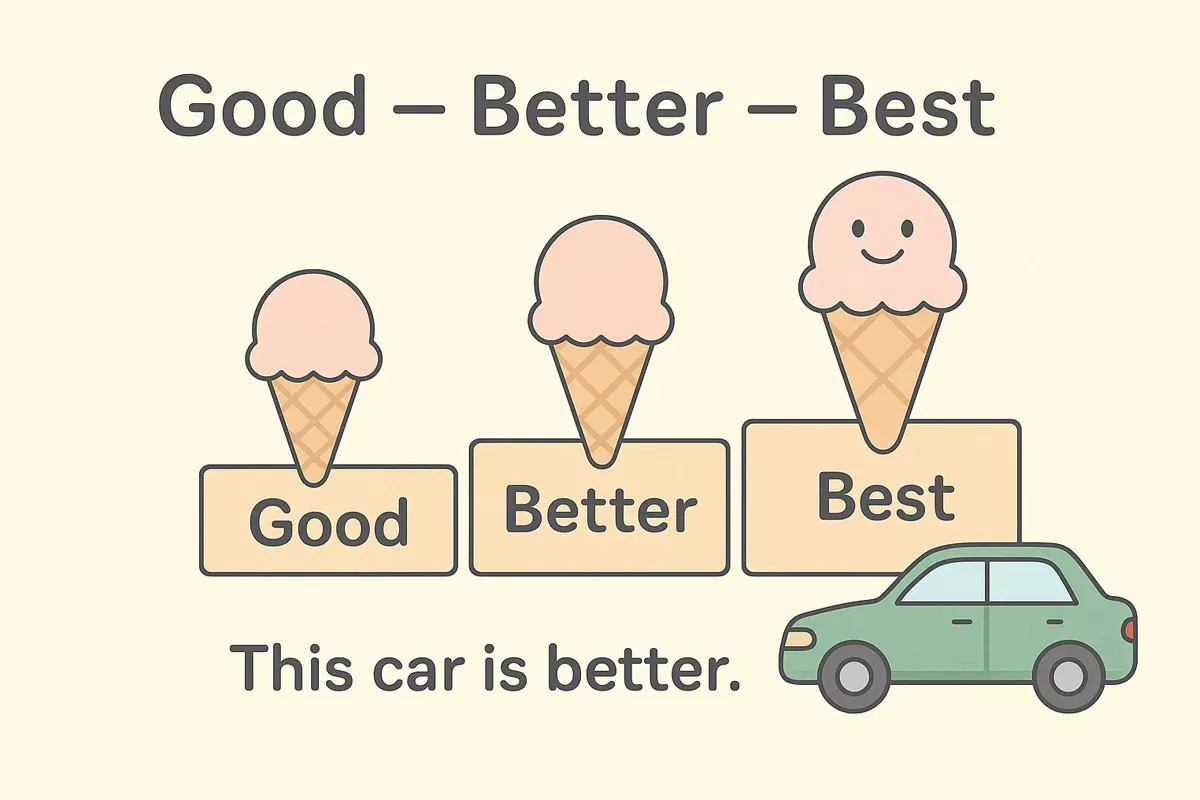 Here we what irregular comparison means, lists key irregular forms such as good/better/best and bad/worse/worst, explains the difference between farther and further, discusses common mistakes, and provides practice choosing correct forms.
Mastering the quirks of English can be tricky, especially when it comes to adjectives that do not follow the usual patterns for forming comparisons. Irregular adjectives like "good," "better," and "best" have unique forms that do not simply add "-er" or "-est" as regular adjectives do. This can make it challenging for learners to remember and use them correctly in both spoken and written English. Understanding these exceptions is important for achieving fluency and avoiding common mistakes, so regular practice and exposure to authentic language can help reinforce the correct usage of irregular adjectives.
What irregular comparison means
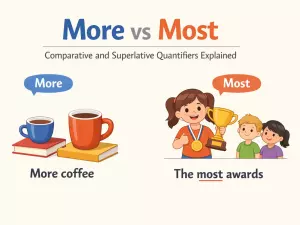
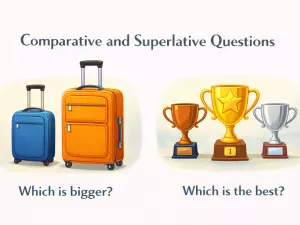
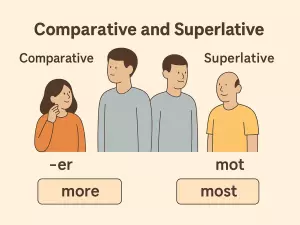
In English, most adjectives form their comparative and superlative forms in a predictable way—usually by adding -er and -est (like tall, taller, tallest), or by using more and most (as in beautiful, more beautiful, most beautiful). However, some adjectives do not follow these standard patterns. These are called irregular adjectives in comparison.
Irregular comparisons occur when an adjective changes form completely instead of taking the usual endings or modifiers. This means you can’t simply attach -er or -est, or add more or most; the word itself often transforms. These exceptions are important to recognize because they are common in everyday English and are essential for accurate communication.
How irregular adjectives behave
Unlike regular adjectives, irregular ones may have unique forms for their comparative and superlative degrees. For instance, the word good doesn’t become gooder or goodest; it switches to better and best. Learning these forms is crucial, since using the regular rules would result in incorrect and unnatural-sounding English.
Common examples of irregular adjective comparison
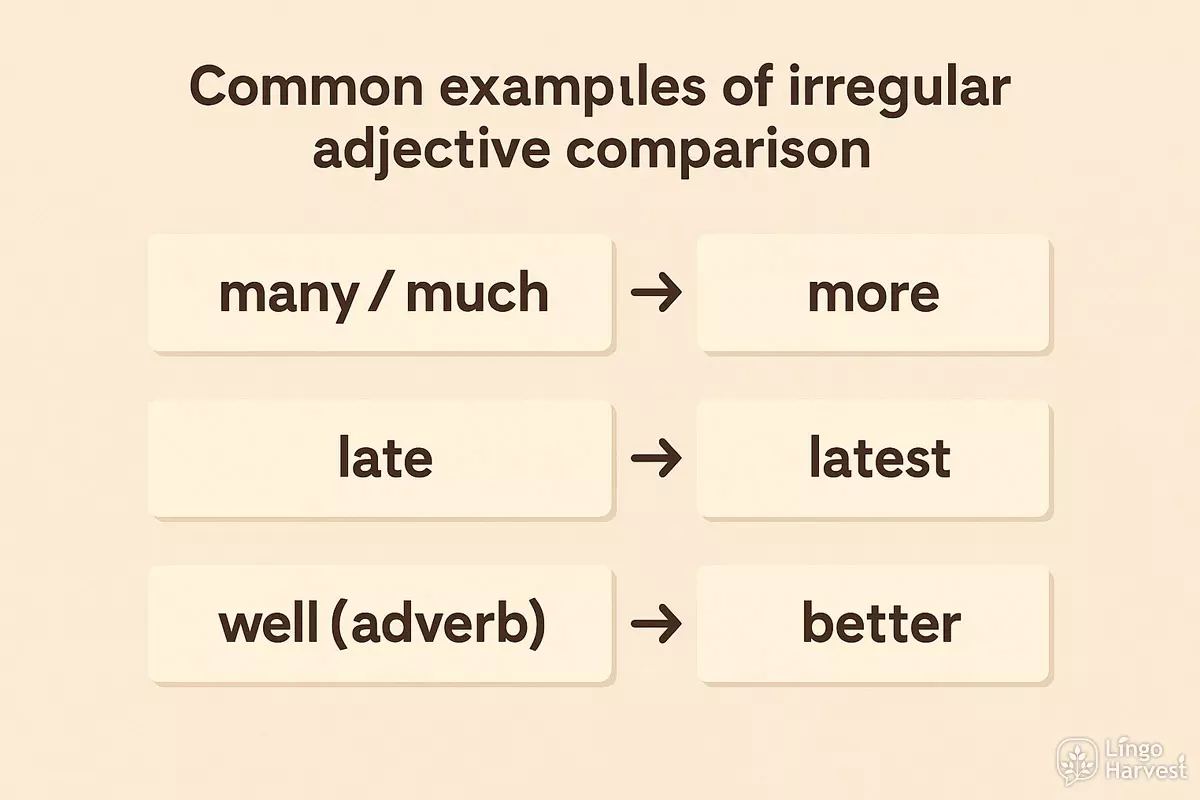
- good → better → best
- bad → worse → worst
- far → farther / further → farthest / furthest
- little (amount) → less → least
- many / much → more → most
- old → older / elder → oldest / eldest
- late → later → latest
- well (adverb) → better → best
- badly (adverb) → worse → worst
- much (amount) → more → most
- far (distance in time/order) → further → furthest
- little (size) → smaller → smallest
- many (countable) → more → most
- some → more → most
- few → fewer → fewest
- several → more → most
- good (morally) → better → best
- well (health) → better → best
- bad (morally) → worse → worst
- ill → worse → worst
Why does English have irregular forms?
Irregular comparison forms mostly come from historical changes in the language. Over centuries, frequently used words tend to keep older, non-standard forms. That’s why highly common adjectives like good and bad have unique comparative and superlative versions.
Mastering these exceptions is necessary for fluent, natural English. Since there are not many truly irregular adjectives, memorizing them is manageable. When unsure, check if the adjective is on the list of irregular forms or follow the regular pattern.
Key irregular forms: good/better/best, bad/worse/worst
Irregular adjectives stand out because they do not follow the typical “-er” and “-est” endings seen in regular comparatives and superlatives. Instead, their forms change entirely, making them essential to remember for accurate English usage. Two of the most important examples are the words for describing quality: “good” and “bad.” These transform in a way that is unique and must be memorized, not deduced from a rule.
Comparing "good" and "bad": Forms and usage
When comparing qualities, “good” becomes “better” in the comparative and “best” in the superlative. Likewise, “bad” shifts to “worse” and “worst.” These shifts are not just spelling changes—they are completely different words. For example, you would say, “This solution is better than the last,” not “gooder.”
- good → better → best
- bad → worse → worst
These forms are used in both spoken and written English, and are common in everyday comparisons. The same pattern applies whether you’re talking about food, performance, health, or behavior.
More examples in context
Here are some sample sentences to illustrate these irregular adjective forms:
- This pizza tastes better than the one we had last week.
- She is the best player on the team.
- His grades are worse this semester.
- That was the worst storm of the year.
Quick reference: Irregular adjective patterns
Unlike regular adjectives, these do not follow a predictable pattern. Here’s a practical list for quick reference:
- near → nearer → nearest / next
- in → inner → innermost / inmost
- out → outer → outermost / utmost
- up → upper → uppermost
- down → nether → nethermost
- hind → hinder → hindmost
- under → lower → lowermost
- over → upper → uppermost
- north → more northern → northernmost
- south → more southern → southernmost
- east → more eastern → easternmost
- west → more western → westernmost
Memorizing these exceptions is crucial, as using the wrong comparative or superlative form can easily lead to confusion or misunderstandings. When in doubt, consult a reliable list or practice with examples to reinforce these irregular patterns.
Farther vs further: basic difference
When comparing "farther" and "further," the main distinction lies in their usage and meaning, though both serve as comparative forms of "far." Traditionally, "farther" is used to refer specifically to physical distance, while "further" is more flexible, covering both physical distance and abstract, figurative extensions such as time, degree, or depth in discussion.
Physical vs. Figurative Use
"Farther" is generally reserved for measurable, literal distances. For example, if you’re talking about miles, kilometers, or any physical space, "farther" is the preferred term. On the other hand, "further" is used for anything non-physical or metaphorical, like discussing ideas or steps in a process.
- She ran farther than anyone else in the race. ✅
- Let’s discuss this further in our next meeting. ✅
- How much farther is the next gas station? → distance
- Can you explain your reasoning further? → explanation
Common Usage Patterns
Here are typical scenarios where each word appears naturally:
- The mountain peak is farther than it looks.
- Do you want to go farther down the road?
- We need to look further into this issue.
- Nothing could be further from the truth.
- He moved farther away from the city.
- She needs to research further before deciding.
- They traveled farther north than last year.
- Let’s not discuss this any further.
- The store is farther than the library.
- He offered no further explanation.
Summary Table: Key Differences
| Word | Typical Contexts |
|---|---|
| Farther | Physical distance only (e.g., miles, locations, measurable space) |
| Further | Figurative or abstract extension (e.g., discussion, time, degree) Can also be used for physical distance, especially in modern English |
Despite these guidelines, many native speakers now use "further" for both senses, especially in informal contexts. However, in formal or academic writing, sticking to the traditional distinction can help avoid ambiguity.
Common errors with more better and more worse
When learning English, many students mistakenly use “more better” or “more worse” to intensify comparisons. However, these forms are incorrect because “better” and “worse” are already comparative adjectives. Adding “more” creates redundancy, turning the phrase ungrammatical.
Why “more better” and “more worse” are incorrect
“Better” is the comparative form of “good,” and “worse” is the comparative form of “bad.” Since “better” already means “more good,” adding “more” repeats the comparison. The same logic applies to “worse” (which already means “more bad”).
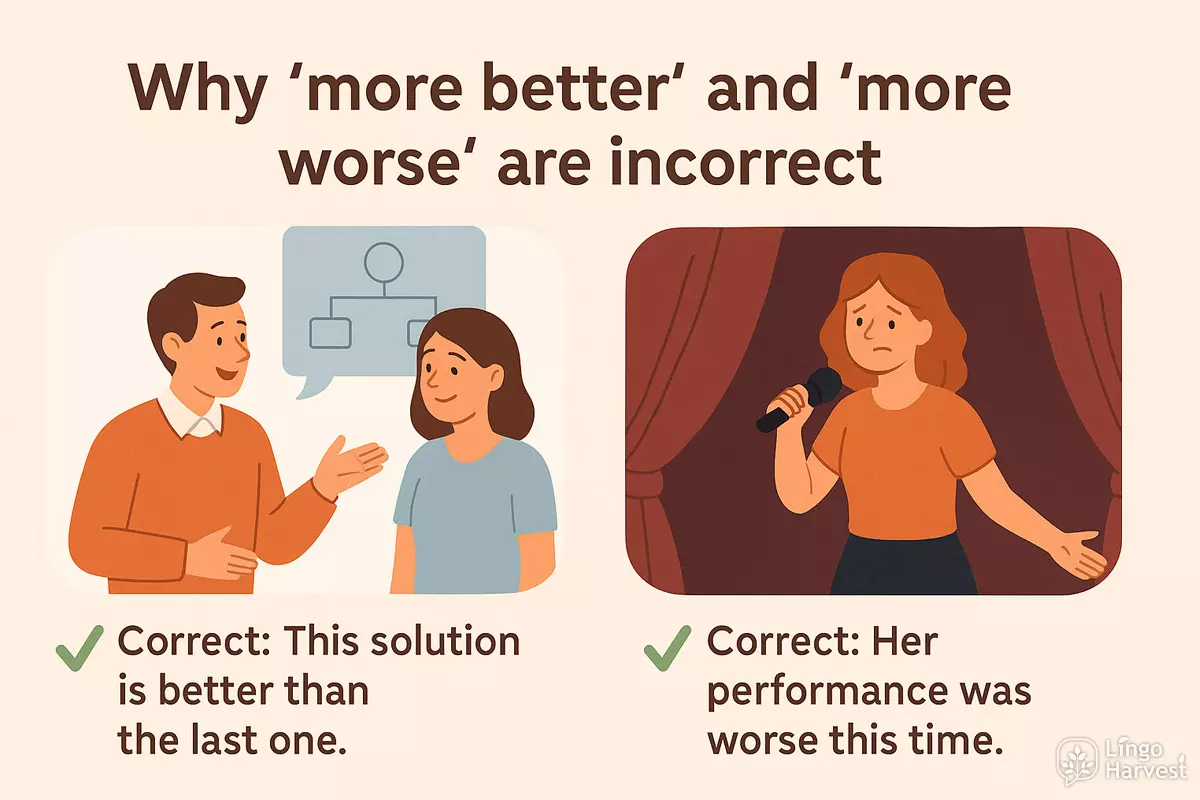
- ❌ Incorrect: This solution is more better than the last one.
- ✅ Correct: This solution is better than the last one.
- ❌ Incorrect: Her performance was more worse this time.
- ✅ Correct: Her performance was worse this time.
Common incorrect forms to avoid
Learners often try to intensify “better” or “worse,” but only one comparative marker should be used. Here are some frequent mistakes:
- more better → This sentence is wrong; you should say “better,” not “more better.”
- more worse → This is incorrect; the correct form is simply “worse.”
- much more better → This is wrong; you can say “much better,” but not “much more better.”
- much more worse → Incorrect; use “much worse” instead.
- more best → This is wrong; “best” is already the superlative.
- more worst → Incorrect; “worst” cannot take “more.”
- most better → Wrong; you should use “best,” not “most better.”
- most worse → Incorrect; you should use “worst.”
- most best → This is wrong; “best” cannot be intensified with “most.”
- most worst → Incorrect; the correct form is simply “worst.”
- very better → Wrong; say “much better,” not “very better.”
- very worse → Incorrect; say “much worse,” not “very worse.”
- less better → This is incorrect; use “not as good” instead.
- less worse → Not correct; use “not as bad” instead.
- so better → Wrong; use “so much better” or just “much better.”
- so worse → Incorrect; say “much worse” or “so much worse.”
- quite better → Incorrect in most contexts; say “much better.”
- quite worse → Wrong; use “much worse” instead.
- even more better → Incorrect; the correct form is “even better.”
- even more worse → Wrong; say “even worse,” not “even more worse.”
Correct alternatives for emphasis
If you want to intensify “better” or “worse,” use words like “much,” “far,” or “a lot” before the comparative—not “more.” For example:
- much better
- far better
- a lot better
- much worse
- far worse
- a lot worse
Summary of correct and incorrect forms
| Incorrect Form | Correct Form |
|---|---|
| more better | better |
| more worse | worse |
| much more better | much better |
| most best | best |
| most worst | worst |
| even more better | even better |
| even more worse | even worse |
Understanding these patterns ensures more natural and accurate comparisons. Always remember: use only one comparative or superlative marker per adjective.
When to use more/most instead of -er/-est
Some adjectives don’t follow the simple -er or -est pattern for their comparative and superlative forms. The choice between “more/most” and “-er/-est” depends on the length, structure, and sometimes the origin of the adjective.
Adjectives with Two or More Syllables
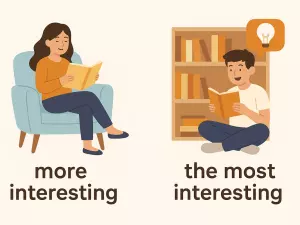
Longer adjectives, especially those with two or more syllables (except some ending in -y), typically use “more” for the comparative and “most” for the superlative. For example, we say “more beautiful” rather than “beautifuller.”
- comfortable → more comfortable → most comfortable
- interesting → more interesting → most interesting
- expensive → more expensive → most expensive
- difficult → more difficult → most difficult
- modern → more modern → most modern
- generous → more generous → most generous
- important → more important → most important
- famous → more famous → most famous
- colorful → more colorful → most colorful
- dangerous → more dangerous → most dangerous
- effective → more effective → most effective
- reliable → more reliable → most reliable
Adjectives Ending in -y
Adjectives ending in -y (like “happy”) often change to -ier/-iest: “happier,” “happiest.” However, if the adjective is longer and just happens to end in -y, “more/most” is still preferred (“more slippery,” “most slippery”).
Exceptions and Special Cases
There are some adjectives that don’t fit the usual patterns due to irregular forms (like “good, better, best”), but for regular adjectives, these guidelines help you decide. Some two-syllable adjectives can use either form in casual speech (like “cleverer/more clever”), but “more/most” is always correct and often preferred for clarity.
Quick Reference: When to Use Each Form
| Adjective Type | Comparative & Superlative Pattern |
|---|---|
| One-syllable (short) | Usually add -er/-est (e.g., small, smaller, smallest) |
| Two-syllable ending in -y | Change to -ier/-iest (e.g., happy, happier, happiest) |
| Two or more syllables (not -y) | Use more/most (e.g., careful, more careful, most careful) |
| Irregular adjectives | Unique forms (e.g., good, better, best) |
Summary
In short, if an adjective is long or doesn’t sound natural with -er/-est, opt for “more” and “most.” This approach ensures your comparisons are both correct and clear.
Practice: choose the correct irregular form in context
Understanding how to use irregular adjectives like "good," "better," and "best" is essential for clear, natural English. The following exercises will help you practice selecting the right form based on context. Pay attention to the sentence meaning and the comparison being made.
Fill in the blank
Choose the most suitable form of the adjective ("good," "better," or "best") for each sentence below.
- This pizza is ______ than the one we had last week.
- Of all the players, Maria is the ______ at serving.
- I think my old phone was ______ than this new one.
- She always tries to do her ______ in every exam.
- John is a ______ friend than Tom because he listens more.
- Which movie do you think is the ______?
- My handwriting is getting ______ every day.
- That was the ______ meal I've eaten all year!
- Could you recommend a ______ way to solve this problem?
- He’s not the ______ singer, but he works hard.
Show answers
- better
- best
- better
- best
- better
- best
- better
- best
- better
- best
Recognizing the correct form in sentences
Below are several sentences. Decide if the irregular adjective form is correct (✅) or incorrect (❌). If it’s incorrect, think about what it should be.
- She is the better student in the class.
- This is the best cake I have ever tasted.
- He is more good at maths than his brother.
- They had a gooder idea for the project.
- Who is the best player on your team?
- I feel better today than yesterday.
- This is the most good solution we have.
- Which one is better: tea or coffee?
Show answers
- Incorrect (should be "the best student")
- Correct
- Incorrect (should be "better at maths")
- Incorrect (should be "a better idea")
- Correct
- Correct
- Incorrect (should be "the best solution")
- Correct
Summary Table: Forms of “Good” in Comparison
| Form | Usage | Example |
|---|---|---|
| good | Positive (no comparison) | This is a good book. |
| better | Comparative (between two) | This book is better than that one. |
| best | Superlative (of all) | This is the best book I’ve read. |
Remember, irregular adjectives do not follow the usual "-er" and "-est" endings. Practice helps make the correct forms automatic in speech and writing.