Order of Adjectives in English: Complete Explanation

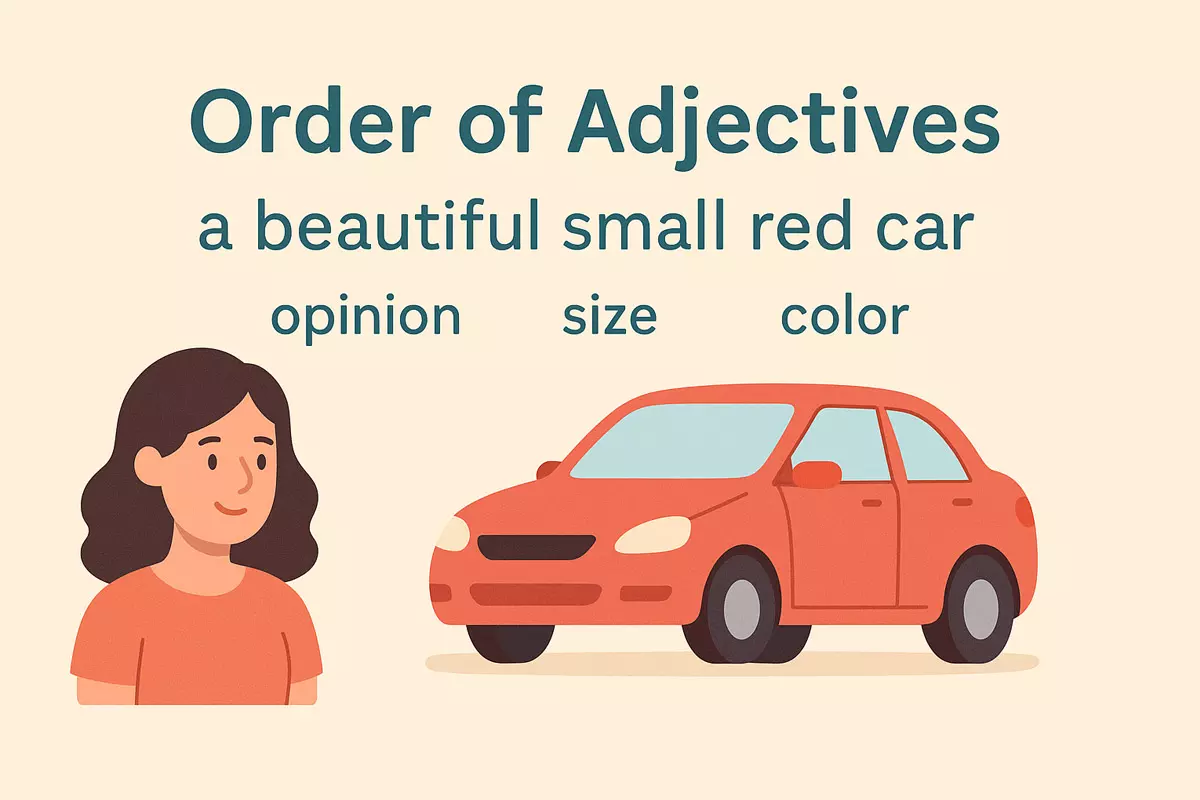 Here we why adjective order is important in English, explains the usual sequence (opinion, size, age, color, material), gives examples, discusses exceptions, and includes a practice activity to help beginners use adjectives naturally.
Have you ever noticed that we naturally say big red balloon rather than red big balloon? The order in which we place descriptive words before nouns is not random; it follows a pattern that makes English sound more fluent and natural. Learning this sequence, often called the order of adjectives, can help you construct sentences that feel right to native speakers. By understanding and practicing this structure, you can make your English smoother and communicate your ideas more clearly in both writing and conversation.
Why adjective order matters
Getting the sequence of adjectives right is essential for clear and natural communication in English. Native speakers instinctively follow a specific pattern when listing multiple descriptive words before a noun. If this order is mixed up, the phrase can sound awkward or even confusing, making it harder for listeners or readers to understand what is meant. For learners, using the standard arrangement helps speech and writing feel more fluent and professional.
Clarity and naturalness
When adjectives are in the expected order, the meaning comes across smoothly and efficiently. For example, “a big red wooden box” is easy to process, while “a wooden red big box” feels jumbled and may cause hesitation or misunderstanding. Listeners expect qualities to appear in a certain sequence, and deviations can distract from the message.
Common mistakes when order is incorrect
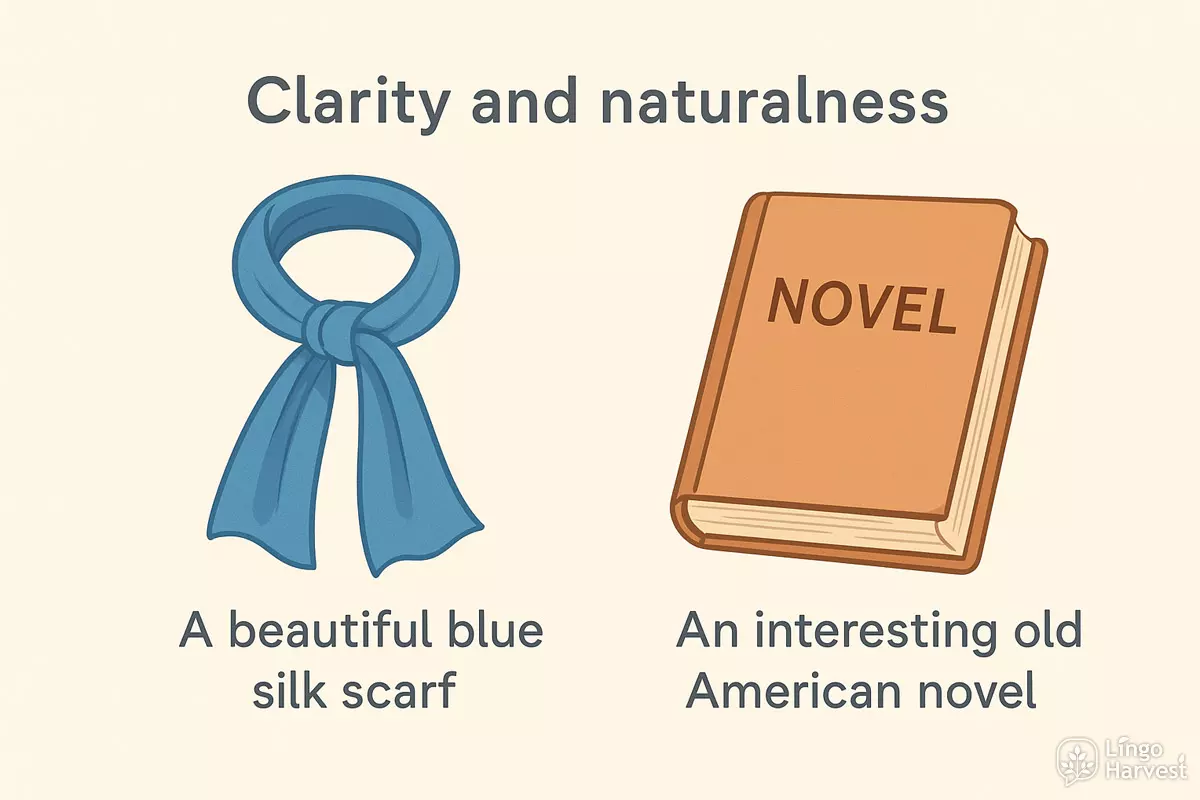
- “A silk beautiful blue scarf” ❌ (confusing)
- “A beautiful blue silk scarf” ✅ (correct and natural)
- “An American old interesting novel” ❌
- “An interesting old American novel” ✅
- “A round small table” ❌
- “A small round table” ✅
How order affects meaning
Sometimes, switching the sequence of adjectives can subtly change the focus or even the meaning of the phrase. Consider these two:
- “A fake leather Italian bag” (an Italian bag made of fake leather)
- “An Italian fake leather bag” (a fake leather bag that is Italian)
Placing the descriptive words in the wrong order can unintentionally shift what you are emphasizing or describing.
Adjective order patterns
English organizes multiple adjectives according to a typical hierarchy. Here’s a helpful summary:
- Quantity or number (e.g., two, several)
- Opinion or quality (e.g., lovely, boring)
- Size (e.g., small, huge)
- Age (e.g., old, modern)
- Shape (e.g., round, flat)
- Color (e.g., red, pale)
- Origin (e.g., French, ancient)
- Material (e.g., wooden, silk)
- Purpose or type (e.g., sleeping [as in “sleeping bag”])
Following this order makes your English sound polished and easy to follow.
Basic order pattern (opinion, size, age, color, material)
When you use several adjectives before a noun in English, there’s a preferred sequence that keeps your sentence sounding natural. This sequence is not random; native speakers follow a specific convention for clarity and flow. The typical order is: opinion, size, age, color, material, and finally the noun itself.
Understanding Each Category
- Opinion: Words that express what someone thinks or feels about something (e.g., beautiful, ugly, delicious, boring).
- Size: Describes how big or small something is (e.g., large, tiny, tall, short).
- Age: Tells how old something or someone is (e.g., new, ancient, young, modern).
- Color: Describes the color (e.g., red, blue, green, golden).
- Material: What something is made of (e.g., wooden, plastic, silk, cotton).
Example Combinations
Putting these elements together, you get phrases like “a lovely small old green wooden box” or “an ugly big new red metal car.” Notice that even with several adjectives, the order helps keep the phrase easy to understand.
| Adjective Type | Example (in order before noun) |
|---|---|
| Opinion | a beautiful painting |
| Opinion + Size | a lovely small puppy |
| Size + Age + Color | a big old brown sofa |
| Opinion + Size + Age + Color + Material | a charming little vintage blue silk dress |
| All categories + Noun | an interesting large ancient red wooden door |
Common Adjectives by Category
- Opinion: nice, horrible, tasty, boring, pretty, awful, useful
- Size: huge, tiny, small, enormous, short, tall, slim, thick
- Age: young, old, modern, ancient, new, antique, recent
- Color: blue, red, green, yellow, black, pink, golden, silver
- Material: plastic, metal, glass, wool, leather, paper, stone
Arranging adjectives in this standard sequence is important for natural-sounding English. While native speakers rarely think about the rule, using the wrong order can make your sentences sound odd or confusing. With practice, this pattern becomes automatic and helps your descriptions flow smoothly.
Examples with two or three adjectives
When using multiple adjectives before a noun, it’s important to place them in the correct order. English speakers naturally follow a typical sequence: quantity, opinion, size, age, shape, color, origin, material, and purpose. Placing adjectives out of this sequence can sound awkward or confusing. Let’s look at how this works in practice.
Two-Adjective Combinations
Pairing two describing words is very common. Here are some sample phrases that show how to combine different types of adjectives:
- a beautiful old house
- three large dogs
- a small round table
- an elegant French restaurant
- a delicious Italian meal
- two young energetic children
- a long wooden bench
- a famous American actor
- an expensive leather bag
- a soft blue blanket
Notice how the adjectives are ordered by type—opinion before age, size before color, etc.
Three-Adjective Combinations
Using three adjectives is less common in everyday speech but still useful, especially for detailed descriptions. See how the order is maintained:
- an old red wooden chair
- a small black Spanish car
- an interesting new Italian movie
- a big heavy metal door
- a beautiful long silk scarf
- two friendly young British teachers
- a tiny round glass bottle
- an ancient Chinese bronze bell
- a delicious hot chicken soup
- an elegant tall blonde woman
Correct vs. Incorrect Order
To highlight how order affects clarity, here are some comparisons:
| Correct Order ✅ | Incorrect Order ❌ |
|---|---|
| a beautiful old house | an old beautiful house |
| three large black dogs | three black large dogs |
| a small round table | a round small table |
| an interesting new Italian movie | an Italian new interesting movie |
| a big heavy metal door | a metal heavy big door |
By following the traditional adjective order, your descriptions will sound natural and clear to native speakers. Practicing these combinations helps build confidence and fluency in everyday English.
When native speakers break the pattern
Even with clear guidelines for adjective order, everyday English speakers sometimes use a different sequence. This isn’t always a mistake—there are natural reasons for these exceptions. Context, rhythm, emphasis, and personal style all influence how people actually organize adjectives in real conversations and writing.
Why do speakers switch the order?
- Emphasis: Placing a certain adjective last or first can make it stand out (e.g., “a blue beautiful dress” to highlight beauty more than color).
- Fixed expressions: Some phrases are set by tradition, like “big bad wolf” or “old black magic.”
- Sound and rhythm: Sometimes, a different order just “sounds better” or flows more naturally.
- Poetic or creative effect: Writers and speakers might play with adjective order for style, humor, or impact.
- Regional or dialectal variation: Different varieties of English may have their own preferences.
Examples of unconventional adjective order
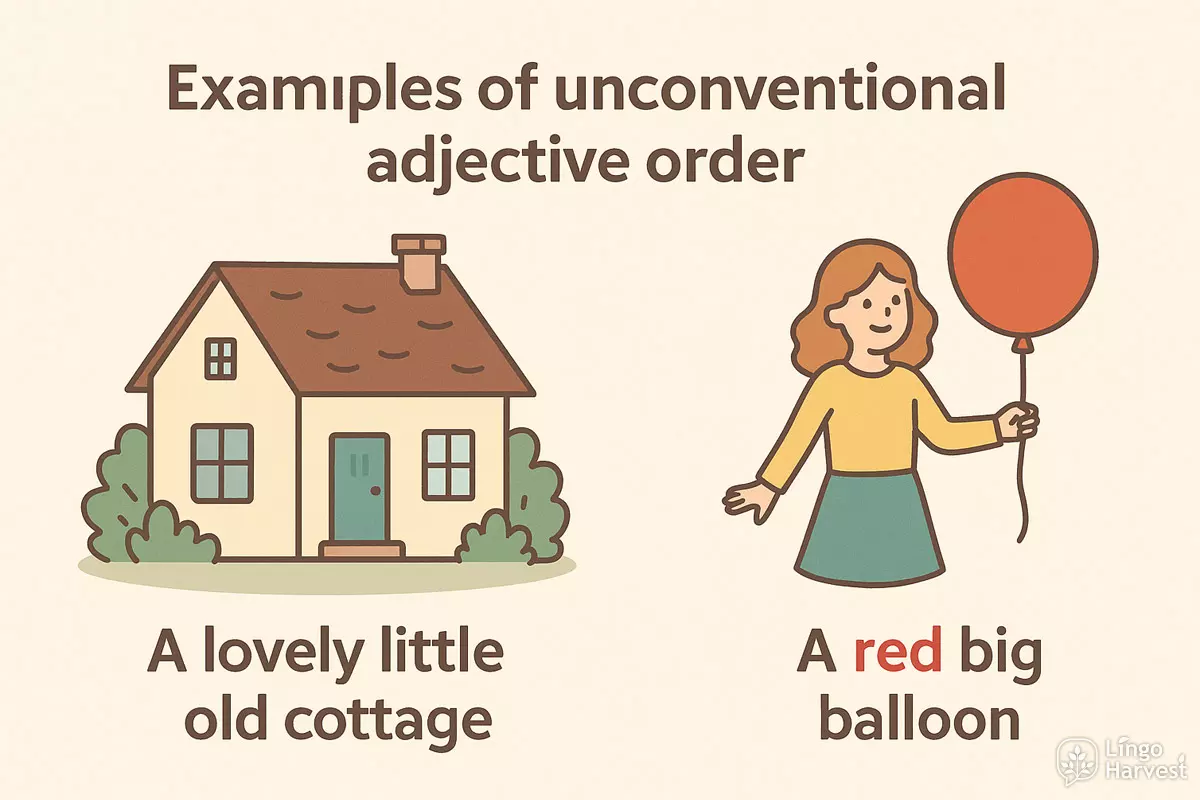
- “A lovely little old cottage” (standard order)
- “A little old lovely cottage” (unusual, but possible for emphasis)
- “A big red balloon” (standard)
- “A red big balloon” (rare, but sometimes used in poetry or songs)
- “A famous French old painting” (to highlight ‘old’ rather than ‘French’)
- “A tricky small problem” (instead of ‘small tricky problem’)
- “A plastic broken toy” (to stress that the toy is broken, not just plastic)
- “That amazing new Italian restaurant” (typical)
- “That new amazing Italian restaurant” (if ‘amazing’ is the speaker’s main point)
- “A black shiny car” (instead of ‘shiny black car’)
- “A delicious homemade chocolate cake” (standard)
- “A homemade delicious chocolate cake” (unusual, but possible for emphasis)
- “A huge round old table” (standard)
- “A round huge old table” (possible in creative writing)
- “A beautiful young woman” (standard)
- “A young beautiful woman” (sometimes used for rhythm or focus)
- “A lovely little old dog” (standard)
- “A little lovely old dog” (to highlight ‘lovely’)
Fixed expressions that ignore the usual order
- Big bad wolf
- Old black magic
- Good old days
- Great big mess
- Sweet little lies
- Fine young cannibals
- Pretty little thing
- Big fat lie
- Lovely little lamb
- Dirty old town
When breaking the pattern is acceptable
Altering the traditional order is most common in creative writing, conversational speech, and idiomatic expressions. In formal writing or academic contexts, following the standard sequence is usually preferred. However, understanding these variations helps learners sound natural and recognize when and why native speakers might bend the rules.
Keeping order simple at beginner level
For learners just starting out, focusing on the most common adjective patterns is usually enough. English sentences rarely require long strings of describing words, so most daily communication uses only one or two adjectives before a noun. Rather than memorizing the full official order, beginners can use a few practical guidelines to sound natural and avoid confusion.
Basic Rule: Opinion Before Fact
When you use two adjectives, put your personal opinion or feeling first, and the more factual or physical description second. This simple rule covers most everyday cases:
- a beautiful (opinion) old (fact) house
- a delicious (opinion) Italian (fact) meal
- a funny (opinion) little (fact) dog
Most Common Adjective Types
At the beginner stage, it helps to recognize and practice with a few key types of adjectives that often appear together:
- Opinion: nice, boring, lovely, terrible, interesting
- Size: big, small, tiny, huge, tall
- Age: old, young, new, ancient
- Color: red, green, blue, black, white
- Origin: French, Chinese, American, Italian
- Material: wooden, plastic, metal, silk, cotton
Simple Patterns to Practice
Here are some useful adjective + noun combinations that show the most frequent word order learners need:
- big brown dog → A big brown dog ran across the yard.
- old wooden chair → She sat on an old wooden chair by the window.
- beautiful red flower → He picked a beautiful red flower from the garden.
- delicious Chinese food → We ordered some delicious Chinese food for dinner.
- small green apple → She ate a small green apple as a snack.
- funny little cat → Their funny little cat loves to chase shadows.
- new French book → I bought a new French book yesterday.
- tall American man → A tall American man greeted us at the entrance.
- tiny white bird → A tiny white bird landed on the fence.
- ancient stone bridge → We walked across an ancient stone bridge.
- lovely silk dress → She wore a lovely silk dress to the party.
- boring long movie → We watched a boring long movie last night.
- huge metal door → He pushed open a huge metal door with effort.
- interesting black car → An interesting black car parked outside our house.
- old plastic toy → He found an old plastic toy in the attic.
- nice blue shirt → He put on a nice blue shirt for the meeting.
Quick Reference: Two-Adjective Order
| Adjective 1 (Opinion/Feeling) |
Adjective 2 (Fact/Description) |
Noun | Example |
|---|---|---|---|
| nice | old | house | nice old house |
| delicious | Italian | pizza | delicious Italian pizza |
| funny | little | cat | funny little cat |
| interesting | new | film | interesting new film |
With practice, these simple structures become automatic. As your confidence grows, you can start adding more adjectives and learning the full sequence, but for now, using one or two in the right order is enough for clear, natural English.
Practice: put adjectives in natural order
Arranging multiple adjectives before a noun in English can be tricky. The natural order usually follows this pattern: opinion, size, age, shape, color, origin, material, purpose + noun. Let's practice by reordering groups of adjectives so they sound natural to native speakers.
Exercise 1: Rearranging Adjectives
Place the adjectives before the noun in the correct order:
- Spanish / old / interesting / paintings
- round / small / wooden / table
- leather / stylish / black / bag
- kitchen / large / modern / white / appliances
- plastic / blue / new / bottle
- glass / beautiful / French / vase
- sleeping / little / brown / dog
- fancy / red / silk / scarf
- metal / heavy / antique / lamp
- delicious / round / Italian / cheese / pizza
Show answers
- interesting old Spanish paintings
- small round wooden table
- stylish black leather bag
- large modern white kitchen appliances
- new blue plastic bottle
- beautiful French glass vase
- little brown sleeping dog
- fancy red silk scarf
- heavy antique metal lamp
- delicious round Italian cheese pizza
Exercise 2: Identify the Incorrect Order
Read each phrase and decide if the adjective order is natural. If not, fix it:
- an old big house
- a blue lovely dress
- a wooden small box
- a beautiful red Italian car
- a cotton new white shirt
- a leather old brown bag
- a plastic small red toy
- a German fast new car
- a round big wooden table
- a sleeping comfortable blue bag
Show answers
- big old house (should be: "a big old house")
- lovely blue dress (should be: "a lovely blue dress")
- small wooden box (should be: "a small wooden box")
- beautiful red Italian car (correct)
- new white cotton shirt (should be: "a new white cotton shirt")
- old brown leather bag (should be: "an old brown leather bag")
- small red plastic toy (should be: "a small red plastic toy")
- fast new German car (should be: "a fast new German car")
- big round wooden table (should be: "a big round wooden table")
- comfortable blue sleeping bag (should be: "a comfortable blue sleeping bag")
Common Patterns Table
Review these typical adjective combinations and their correct order:
| Adjective Phrase | Order Explained |
|---|---|
| beautiful large green garden | opinion, size, color |
| old round stone tower | age, shape, material |
| expensive Italian leather shoes | opinion, origin, material |
| tiny ancient bronze coin | size, age, material |
| amazing small blue glass beads | opinion, size, color, material |
Tips for Remembering Adjective Order
- Start with your opinions or general impressions.
- Add size, age, or shape next if relevant.
- Colors and origins usually come before material.
- Material adjectives are close to the noun.
- Practice with real objects around you for natural use.