Describing Personality with Adjectives

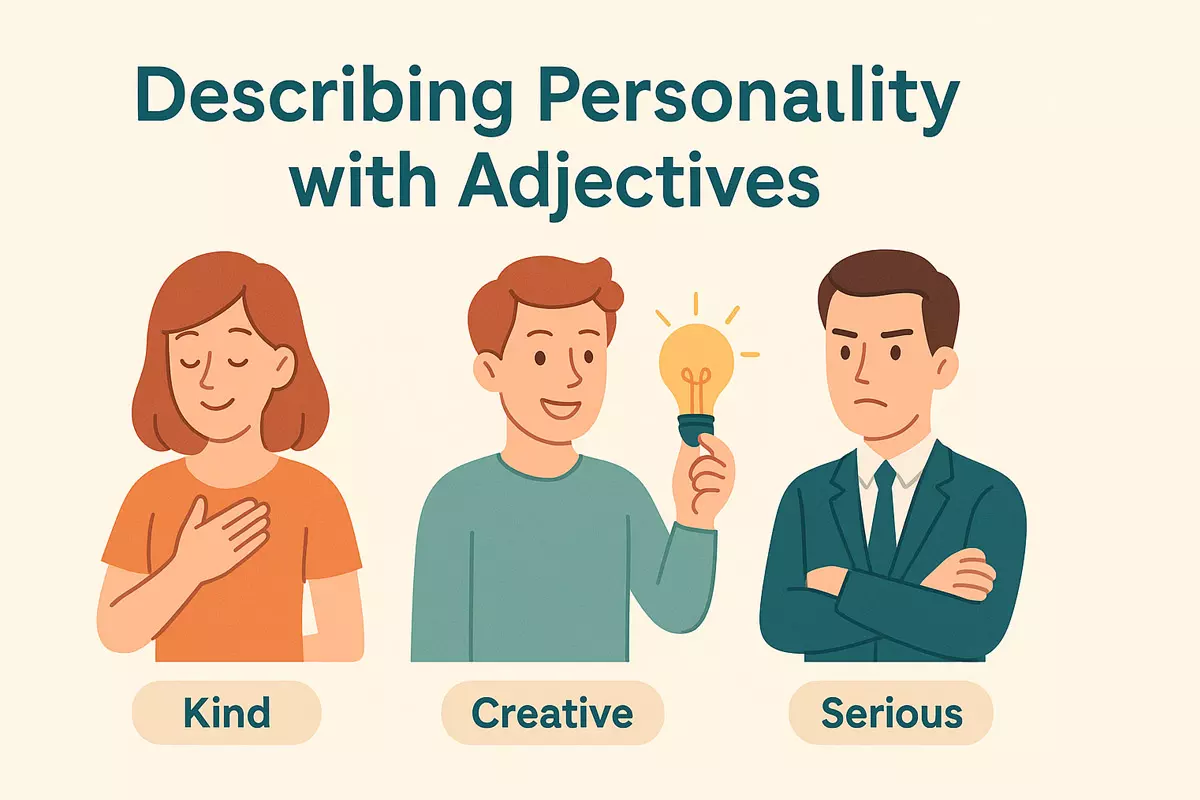 This article explains how to describe personalities using adjectives like kind, honest, lazy, or quiet. It covers words for friends and family, avoiding stereotypes, and includes a practice activity matching traits to character descriptions.
- Positive personality adjectives: kind, friendly, honest
- Negative personality adjectives: lazy, rude, selfish
- Neutral personality adjectives: quiet, serious, shy
- Adjectives to talk about friends and family
- Avoiding stereotypes and rude labels
- Practice: match adjectives to short character descriptions
Discussing character traits with vivid and accurate language helps us gain deeper insights into ourselves and those around us. By choosing specific and expressive words to describe personalities, we create a more engaging and nuanced understanding of human behavior. This thoughtful approach not only enriches our conversations but also fosters empathy and stronger connections with others. Ultimately, being mindful of how we talk about character traits encourages self-reflection and improves the quality of our interactions, making communication more rewarding for everyone involved.
Positive personality adjectives: kind, friendly, honest
Describing someone’s character often means choosing words that highlight their best qualities. Adjectives like kind, friendly, and honest are frequently used to express positive traits in English. These words help paint a picture of someone who is caring, approachable, and trustworthy.
What Do These Words Mean?
- Kind: Shows compassion and willingness to help others without expecting anything in return.
- Friendly: Approachable, easy to talk to, and makes others feel comfortable.
- Honest: Tells the truth, is sincere, and does not deceive others.
To expand your vocabulary, consider these additional adjectives for describing positive qualities:
- Generous → She is generous and always shares what she has.
- Helpful → He’s very helpful and loves assisting others.
- Patient → The teacher is patient with every student.
- Reliable → She is reliable and never breaks her promises.
- Cheerful → He stays cheerful even on difficult days.
- Thoughtful → Her thoughtful messages always make me smile.
- Respectful → He is respectful toward everyone he meets.
- Optimistic → She remains optimistic about the future.
- Hardworking → He’s hardworking and always gives his best.
- Loyal → A loyal friend will stand by you no matter what.
- Supportive → She is supportive and encourages others.
- Polite → He is always polite when speaking to people.
- Understanding → She is understanding and listens carefully.
- Tolerant → He is tolerant of different opinions.
- Fair → She tries to be fair when making decisions.
- Considerate → He is considerate and thinks about others’ feelings.
- Trustworthy → She is trustworthy—you can tell her anything.
- Sincere → His sincere apology made everyone forgive him.
Using Positive Adjectives in Sentences
Here are some simple ways to use these words when talking about someone’s personality:
- She is always kind to her classmates.
- People enjoy his company because he is so friendly.
- Everyone trusts him because he is honest.
- Our neighbor is very helpful and always offers a hand.
- He remains optimistic even in tough situations.
Quick Comparison of Positive Adjectives
| Adjective | Typical Behaviors |
|---|---|
| Kind | Helps others, shows empathy, offers support |
| Friendly | Greets people warmly, initiates conversations, makes others feel welcome |
| Honest | Tells the truth, admits mistakes, keeps promises |
| Patient | Waits calmly, does not get annoyed easily, listens to others |
| Generous | Shares resources, gives time or gifts, thinks of others’ needs |
| Reliable | Fulfills commitments, arrives on time, can be counted on |
Using a variety of positive adjectives enriches your descriptions and helps you express exactly what makes someone admirable. Practice incorporating these words into your everyday English to sound more natural and precise.
Negative personality adjectives: lazy, rude, selfish
When describing character, some adjectives focus on traits that are generally seen as undesirable. Words like "lazy," "rude," and "selfish" help us talk about behaviors that often cause problems in relationships or social settings. Understanding these adjectives can make your descriptions more precise and honest, especially when discussing challenges in working with or getting along with others.
Common negative adjectives for personality
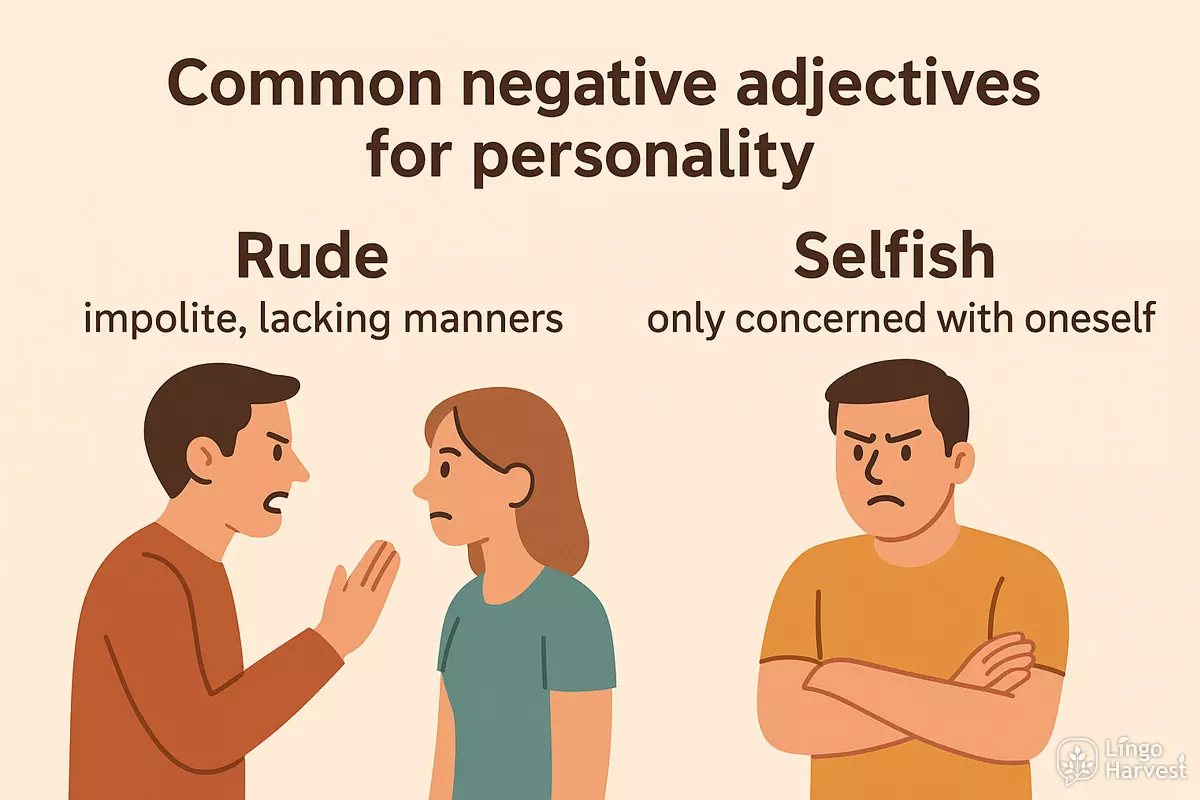
Here are some commonly used words to describe someone in a negative light. These terms can describe work habits, social interactions, or attitudes toward others:
- Lazy – avoids work or effort
- Rude – impolite, lacking manners
- Selfish – only concerned with oneself
- Arrogant – thinks they are better than others
- Stubborn – refuses to change their mind
- Moody – changes emotions quickly, unpredictable
- Greedy – wants more than they need, especially with money or food
- Jealous – resents others’ success or happiness
- Bossy – likes to tell others what to do
- Impulsive – acts without thinking
- Dishonest – does not tell the truth
- Insensitive – does not care about others’ feelings
- Inconsiderate – thoughtless about the needs of others
- Petty – focuses on unimportant things
- Pessimistic – always expects the worst
- Unreliable – cannot be depended on
- Manipulative – tries to control others for their own benefit
- Hostile – unfriendly or aggressive
- Envious – wants what others have
- Vain – too focused on appearance or achievements
Describing negative traits in context
When using these adjectives, context is important. For example, saying someone is "lazy" in a work setting means they avoid their responsibilities, while calling someone "rude" often refers to their behavior in conversation or public places.
Tips for using negative adjectives appropriately
- Be specific: Instead of just saying "He is selfish," explain what behavior shows this trait.
- Consider tone: These words can be strong, so use them carefully to avoid sounding too harsh.
- Balance with positive traits if possible, to give a fair description.
Negative personality adjectives are useful for honest communication, but they should be chosen thoughtfully to avoid misunderstandings or offense.
Neutral personality adjectives: quiet, serious, shy
When describing someone’s character, not every word conveys a positive or negative judgment. Some adjectives simply state facts about how a person tends to behave, without suggesting approval or criticism. Words like “quiet,” “serious,” and “shy” fall into this category—they give information about someone’s demeanor or social style, but don’t imply whether it is good or bad. These terms are useful when you want to be objective or avoid making assumptions.
What makes an adjective “neutral”?
Neutral adjectives do not carry strong emotional connotations. They describe traits without suggesting advantage or disadvantage. For example, calling someone “quiet” just means they don’t talk much; it does not mean they are unfriendly or lacking confidence.
- Quiet – someone who speaks little or prefers calm environments
- Serious – a person who is thoughtful, not playful or joking often
- Shy – someone who feels uncomfortable or reserved in social situations
- Reserved – keeps their feelings or thoughts private
- Calm – not easily excited or upset
- Stoic – does not show emotions easily
- Neutral – does not show strong feelings one way or the other
- Introverted – prefers being alone or with a small group
- Moderate – avoids extremes in behavior
- Practical – focuses on facts and realistic outcomes
- Steady – consistent and reliable, not dramatic
- Unassuming – does not draw attention to oneself
- Thoughtful – considers things carefully, not impulsive
- Methodical – works in an orderly, systematic way
- Balanced – shows emotional stability
- Reflective – spends time thinking deeply
- Cautious – avoids risks, careful in actions
- Measured – responds in a controlled, deliberate way
Using neutral adjectives in context
When you want to describe a person without making judgments, these adjectives are especially useful. For example, in a workplace, saying someone is “serious and methodical” can simply mean they focus on tasks, not that they lack a sense of humor. Similarly, describing a classmate as “quiet and reserved” might just indicate their preference for listening over speaking.
Comparing neutral traits
It’s helpful to distinguish between similar neutral adjectives. Here’s a quick comparison of a few common ones:
| Adjective | Description |
|---|---|
| Quiet | Speaks infrequently, prefers silence or calm environments |
| Serious | Tends to be thoughtful, not often joking or playful |
| Shy | Feels nervous or uncomfortable in social situations |
| Reserved | Keeps feelings and opinions to oneself, not openly expressive |
Neutral descriptive words help you communicate clearly and respectfully about others. They are especially helpful in formal or unfamiliar situations, where being objective is important.
Adjectives to talk about friends and family
When describing the people closest to us, we often reach for words that capture their character, habits, and how they make us feel. Whether discussing your best friend, a sibling, or a parent, the right adjectives help paint a clear picture of their personality.
Positive adjectives for loved ones
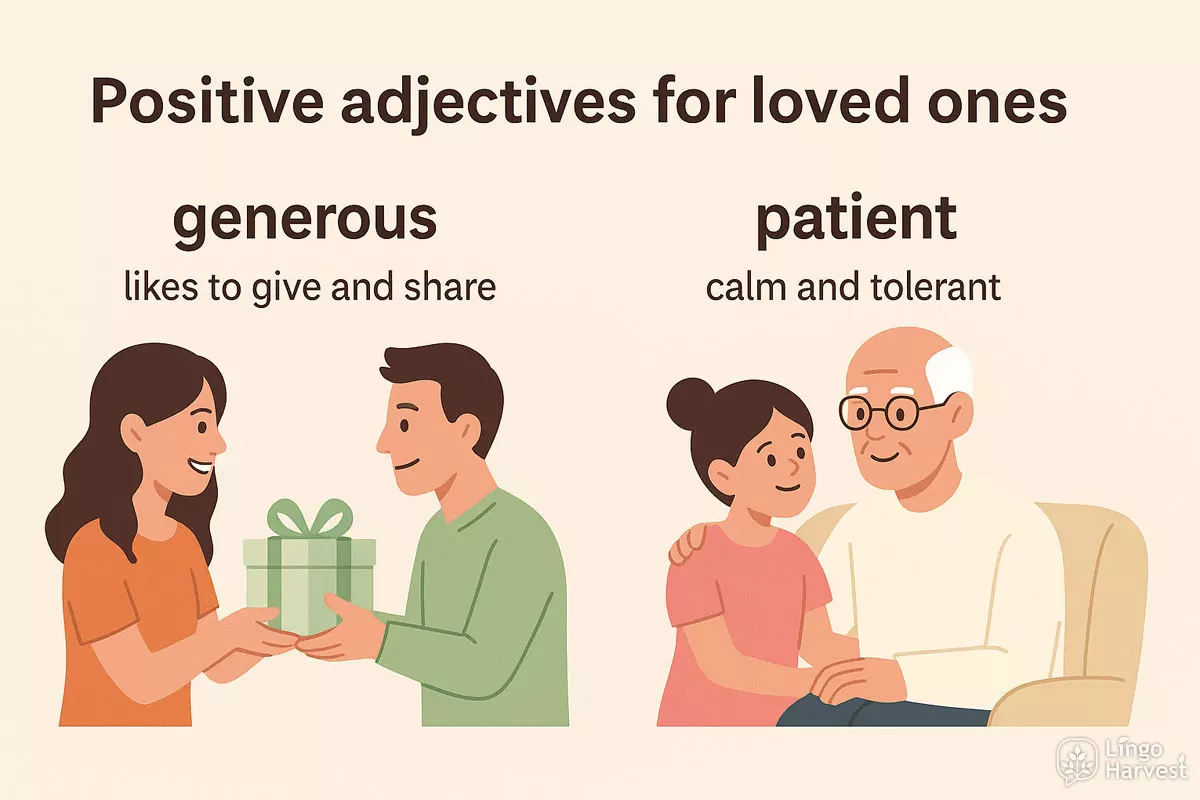
Many people use kind, supportive words to highlight the strengths of friends and relatives. Here are some common options:
- Loyal – always there for you, trustworthy
- Generous – likes to give and share
- Patient – calm and tolerant, doesn’t get angry easily
- Understanding – listens and empathizes
- Cheerful – often happy and positive
- Reliable – you can depend on them
- Supportive – encourages and helps others
- Funny – makes people laugh
- Affectionate – shows love and care
- Honest – tells the truth and is sincere
- Sensible – makes good decisions
- Hardworking – puts effort into tasks
- Easygoing – relaxed and not easily upset
- Creative – full of new ideas
- Thoughtful – considers others’ feelings
Describing challenging traits
Not all relationships are easy, and sometimes it’s necessary to mention less positive qualities. Here are some adjectives for those situations:
- Stubborn – refuses to change their mind
- Moody – emotions change quickly
- Overprotective – worries too much about others
- Bossy – likes to give orders
- Impatient – can’t wait or gets annoyed quickly
- Critical – often finds faults
- Noisy – talks loudly or too much
- Selfish – thinks mostly about themselves
- Forgetful – often doesn’t remember things
Comparing family and friends
Sometimes, it helps to compare how we might use these descriptors. Here’s a table with example sentences to illustrate the use of various adjectives for different people:
| Adjective | Example Sentence |
|---|---|
| Reliable | My brother is very reliable; I can always count on him. |
| Funny | My best friend is funny and always makes me laugh. |
| Stubborn | My grandmother is stubborn and rarely changes her mind. |
| Supportive | My parents are supportive of my decisions. |
| Bossy | Sometimes my older sister can be a bit bossy. |
| Generous | My uncle is generous and always brings gifts. |
| Moody | My cousin is moody and his mood changes quickly. |
Using these words with care allows you to express both the strengths and quirks of those closest to you. With a wide range of adjectives, you can describe relationships more vividly and accurately, whether you’re writing, speaking, or just reflecting on the important people in your life.
Avoiding stereotypes and rude labels
When describing personality with adjectives, it’s important to choose words that are respectful and accurate, rather than relying on assumptions or negative labels. Using thoughtful language helps create a more inclusive and understanding environment, whether you’re talking about yourself, friends, or people in general.
Why careful word choice matters
Jumping to conclusions about someone’s character based on limited information can reinforce harmful clichés. For example, describing someone as “bossy” instead of “confident” or “assertive” can carry an unfair, negative undertone. Language shapes how we see others and ourselves, so mindful adjective selection avoids reinforcing outdated or prejudiced ideas.
Common pitfalls to watch out for
- Using adjectives tied to gender, age, or culture (e.g., “emotional” for women, “grumpy” for older people)
- Employing labels that suggest inferiority or lack of value (e.g., “lazy,” “crazy”)
- Reducing someone to a single trait (e.g., “shy” as the only description)
- Choosing adjectives that generalize or exaggerate (e.g., “always negative,” “never reliable”)
Alternative adjectives that show respect
Selecting positive or neutral descriptors can better reflect a person’s individuality. Consider these alternatives to commonly misused or insensitive adjectives:
- Instead of “bossy” → “decisive,” “confident,” “direct”
- Instead of “weird” → “unique,” “original,” “creative”
- Instead of “lazy” → “relaxed,” “laid-back,” “easygoing”
- Instead of “crazy” → “adventurous,” “unconventional,” “spontaneous”
- Instead of “stubborn” → “determined,” “persistent,” “resolute”
- Instead of “timid” → “thoughtful,” “reserved,” “cautious”
- Instead of “clingy” → “loyal,” “supportive,” “affectionate”
- Instead of “cold” → “calm,” “reserved,” “objective”
- Instead of “naive” → “optimistic,” “trusting,” “open-minded”
- Instead of “arrogant” → “self-assured,” “confident,” “independent”
- Instead of “moody” → “sensitive,” “expressive,” “intuitive”
- Instead of “pushy” → “motivated,” “enthusiastic,” “goal-oriented”
- Instead of “nerdy” → “intelligent,” “curious,” “knowledgeable”
- Instead of “childish” → “playful,” “imaginative,” “youthful”
- Instead of “antisocial” → “independent,” “introverted,” “self-reliant”
Guidelines for describing personality thoughtfully
- Focus on specific behaviors or actions rather than vague traits
- Ask the person how they prefer to be described if possible
- Consider the context and purpose of your description
- Use adjectives that highlight strengths and individuality
- Avoid overgeneralizing or making assumptions
Taking care with the adjectives you use can promote mutual respect and a more accurate understanding of each person’s character. By choosing language that is considerate and nuanced, you help break down stereotypes and create space for everyone’s true personality to shine.
Practice: match adjectives to short character descriptions
Learning to describe personality means recognizing how different adjectives fit specific people. Below, you'll find a set of brief character sketches. Your task is to choose the most suitable personality word for each one. This exercise helps you get comfortable applying vocabulary in context, rather than just memorizing lists.
Task: Choose the correct adjective
Read each description and pick the adjective that fits best from the options provided.
- Maria always helps her classmates with their homework and listens when they have problems.
- a) stubborn
- b) generous
- c) impatient
- David never gives up, even when things are very difficult.
- a) determined
- b) lazy
- c) shy
- Lucy enjoys meeting new people and loves going to parties.
- a) outgoing
- b) reserved
- c) moody
- Tom often gets angry over small things and his mood changes quickly.
- a) cheerful
- b) moody
- c) patient
- Emma always tells the truth, even when it’s difficult.
- a) honest
- b) selfish
- c) unreliable
Show answers
- b) generous
- a) determined
- a) outgoing
- b) moody
- a) honest
Expanded Personality Adjectives List
Here is a selection of adjectives commonly used to describe people’s characters. Review these before matching them to descriptions or creating your own examples:
- friendly
- optimistic
- pessimistic
- reliable
- ambitious
- creative
- sincere
- cautious
- adventurous
- generous
- stubborn
- jealous
- honest
- moody
- outgoing
- reserved
- cheerful
- determined
- lazy
- patient
This variety allows you to describe personalities in detail, whether you’re writing, speaking, or reading about people. Practice choosing the best word for each situation, and soon you’ll be able to describe anyone’s character more precisely.