Adjectives for Feelings: confused, excited, frustrated

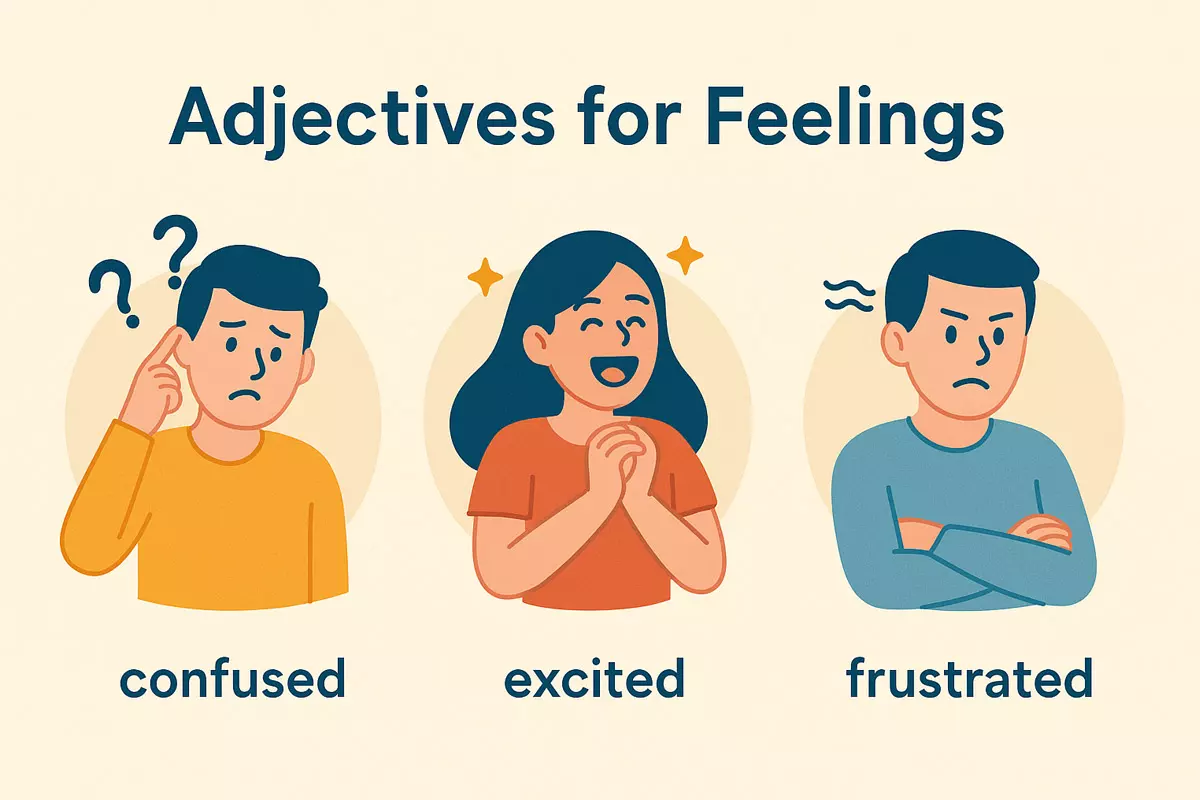 Here we adjectives for positive and negative feelings, explains how to use 'ed' adjectives for emotions, gives sentence frames like I feel or I am, and includes practice choosing the right adjective for different situations.
Our emotions can often feel tangled or overwhelming, making it challenging to express how we truly feel. Whether we are puzzled, thrilled, or irritated, finding the right words to describe our emotions can make a significant difference in how we connect with others. Exploring the language we use for our feelings not only helps us understand ourselves better but also improves our ability to communicate and build stronger relationships with those around us. By learning to articulate our emotions clearly, we foster empathy and deepen our connections.
Adjectives for positive feelings
Describing pleasant emotions accurately helps you communicate more clearly and connect with others. When you want to express happiness, satisfaction, or enthusiasm, the right descriptive word can make your meaning vivid and precise. Instead of just saying “good” or “happy,” try using more specific terms that capture the exact shade of your emotion.
Common words expressing uplifting emotions
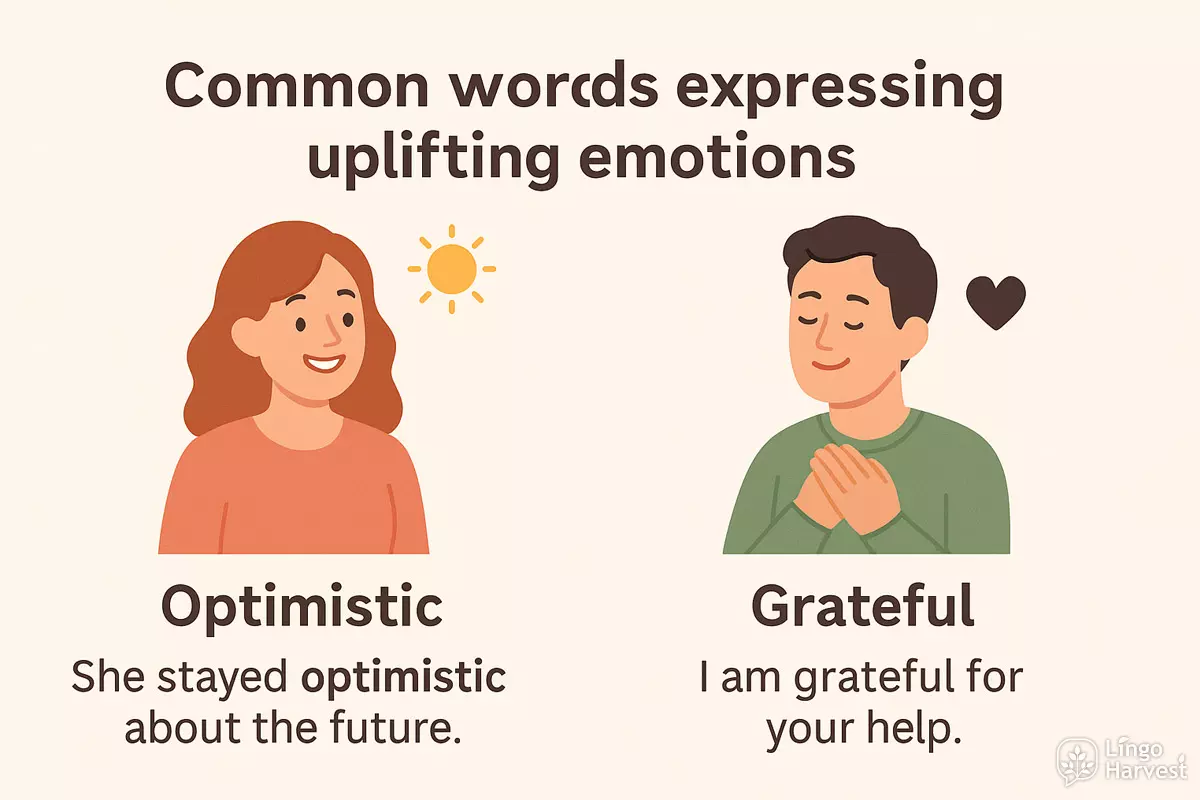
Here are some widely used adjectives that convey positive states:
- Joyful → She felt joyful after hearing the good news.
- Content → He seemed content with his simple, quiet day.
- Optimistic → She stayed optimistic about the future.
- Grateful → I am grateful for your help.
- Relaxed → He looked relaxed after the vacation.
- Proud → They were proud of their hard work.
- Cheerful → She greeted everyone with a cheerful smile.
- Hopeful → The team felt hopeful about winning.
- Energized → He woke up energized and ready to work.
- Inspired → The speech left her inspired.
- Confident → He felt confident before the interview.
- Amused → The children were amused by the joke.
- Peaceful → The lake looked peaceful at sunrise.
- Enthusiastic → She was enthusiastic about the new project.
- Delighted → They were delighted with the surprise.
- Passionate → She is passionate about teaching.
- Satisfied → He felt satisfied after finishing the task.
- Excited → The students were excited for the trip.
How to use these words in context
Choosing the best adjective depends on the situation. For example, you might say, “I feel grateful for your help,” or “She was energized after the meeting.” Each word adds nuance, letting you share not just that you feel good, but how you feel good.
Comparing positive adjectives
Some words overlap in meaning, but their intensity or focus can differ. For instance, “cheerful” suggests a light, outwardly happy mood, while “proud” refers to a feeling of accomplishment. “Inspired” might describe motivation, and “peaceful” suggests calmness. Consider the context and the intensity of your emotion when selecting the right term. Feel free to mix and match these adjectives in your conversations or writing to reflect your feelings more precisely and enrich your emotional vocabulary.
Adjectives for negative feelings
People often use specific descriptive words to express unpleasant emotions or states of mind. These terms help us communicate discomfort, disappointment, or distress more precisely in both conversation and writing. Understanding a wide range of these words can make it easier to describe how you or others are feeling, especially in challenging situations.
Common words for unpleasant emotions
Here are some frequently used adjectives to describe negative emotions:
- frustrated → She felt frustrated when the plan failed again.
- confused → He looked confused after reading the instructions.
- angry → She became angry when no one listened to her.
- upset → He was upset about the unexpected news.
- anxious → She felt anxious before the exam.
- disappointed → They were disappointed with the results.
- sad → He looked sad after the conversation.
- overwhelmed → She felt overwhelmed by too many tasks.
- jealous → He became jealous when he saw them together.
- ashamed → She felt ashamed of her mistake.
- embarrassed → He was embarrassed when everyone stared at him.
- guilty → She felt guilty for forgetting his birthday.
- worried → He seemed worried about the situation.
- lonely → She felt lonely in the big city.
- irritated → He grew irritated by the constant noise.
- hurt → She was hurt by his rude words.
- discouraged → He felt discouraged after several failures.
- hopeless → She felt hopeless about finding a solution.
- resentful → He became resentful after being ignored.
- pessimistic → She remained pessimistic about the outcome.
How to use these adjectives in sentences
These descriptive words can be used to talk about your own feelings or to describe someone else’s emotional state. For example:
- She felt disappointed after hearing the bad news.
- He seemed anxious before the exam.
- I was frustrated by the delay.
Comparing similar adjectives
Some adjectives for negative emotions are closely related but have slightly different meanings. Here’s a comparison to clarify their nuances:
| Adjective | Typical Usage / Nuance |
|---|---|
| Frustrated | Blocked from achieving a goal or result |
| Confused | Unable to understand or think clearly |
| Upset | Disturbed emotionally; generally unhappy or troubled |
| Angry | Strong feeling of displeasure or annoyance |
| Disappointed | Let down by unmet expectations |
| Anxious | Worried or uneasy about something uncertain |
Expanding your vocabulary with these adjectives allows for more accurate self-expression and a better understanding of others’ experiences.
-ed adjectives to describe how people feel
Understanding how to express personal emotions with precision in English often involves using adjectives ending in -ed. These words help describe a person’s emotional state, such as feeling confused, excited, or frustrated. Such adjectives are formed from verbs and indicate how someone is affected by something.
Common -ed adjectives for emotions
These adjectives are useful for describing your own feelings or someone else’s response to a situation. Here are some frequently used examples:
- confused → She looked confused after hearing the instructions.
- excited → He felt excited about the upcoming trip.
- frustrated → She became frustrated when the app kept crashing.
- tired → He was tired after a long day at work.
- interested → She seemed interested in the new project.
- relaxed → He felt relaxed while listening to music.
- worried → She looked worried about the results.
- annoyed → He was annoyed by the constant interruptions.
- bored → She felt bored during the long meeting.
- surprised → He was surprised to receive a gift.
- amused → She looked amused by the funny story.
- disappointed → He felt disappointed with his test score.
- embarrassed → She was embarrassed after forgetting the words.
- shocked → He looked shocked by the sudden announcement.
- pleased → She felt pleased with the positive feedback.
- scared → He was scared during the horror movie.
- thrilled → She felt thrilled about her new job offer.
- upset → He was upset after the argument.
How to use these adjectives
The -ed form is specifically for describing how a person feels, not the thing or event causing the feeling. For example:
- She felt confused by the instructions.
- I am excited about my new job.
- He gets frustrated when plans change suddenly.
If you want to talk about the source of the feeling, use the -ing form (e.g., "The instructions were confusing").
Comparing -ed and -ing adjectives
| Emotion (-ed adjective) | Cause (-ing adjective) |
|---|---|
| confused | confusing |
| excited | exciting |
| frustrated | frustrating |
| bored | boring |
| interested | interesting |
| tired | tiring |
| amused | amusing |
| surprised | surprising |
Tips for learners
To sound natural, remember: use the -ed ending when talking about people’s reactions or feelings. Reserve the -ing ending for things or situations that cause those reactions. For example, "He is bored" (his feeling) vs. "The movie is boring" (the cause). Practicing these forms will help you communicate emotions more clearly and understand others better.
Talking about emotions in everyday situations
Understanding how to describe your feelings can help you communicate more clearly with friends, colleagues, and family. Words like confused, excited, and frustrated are especially common when explaining reactions to daily events. Using the right adjectives makes it easier to express what you’re experiencing and helps others understand your perspective.
Common scenarios using "confused", "excited", and "frustrated"
People often find themselves unsure which word to use for a particular mood or reaction. Here are some everyday situations where these adjectives fit naturally:
- Confused – When you don’t understand instructions at work or school.
- Excited – Before a big trip, when you get good news, or when meeting someone special.
- Frustrated – Stuck in traffic, dealing with slow internet, or facing repeated misunderstandings.
Useful phrases for expressing feelings
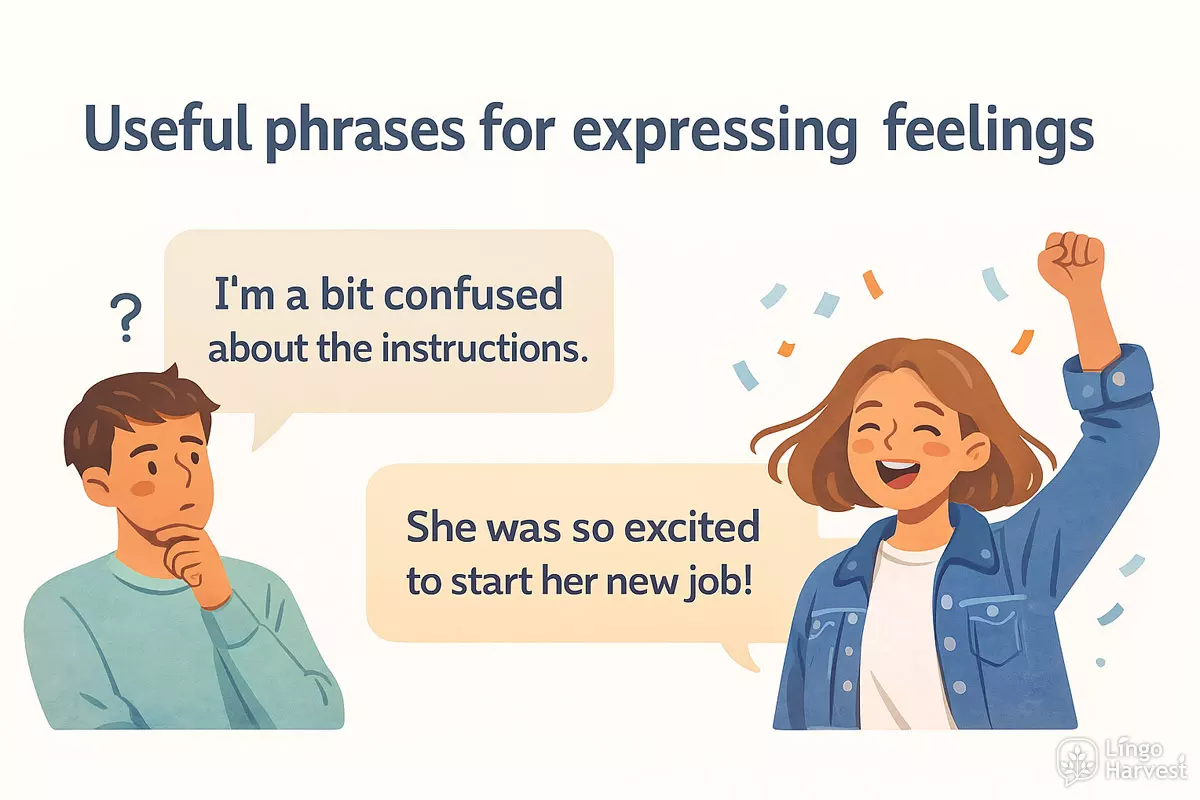
It’s helpful to have a variety of phrases ready to describe your emotions accurately. Here are some practical ways to talk about being confused, excited, or frustrated:
- “I’m a bit confused about the instructions.”
- “She was so excited to start her new job!”
- “He gets frustrated when things don’t go as planned.”
- “This math problem is confusing.”
- “I’m really excited for the weekend.”
- “I felt frustrated by the delays.”
- “It’s confusing when the rules change.”
- “The kids are excited about the party.”
- “I get frustrated with complicated forms.”
- “Can you explain that again? I’m confused.”
- “Waiting for results is exciting and nerve-wracking.”
- “She sounded frustrated on the phone.”
Comparing the usage of "confused", "excited", and "frustrated"
Sometimes, it’s helpful to see how these adjectives fit into different types of situations or sentences. The table below compares their typical usage in various contexts:
| Feeling | Typical Situations & Example Sentences |
|---|---|
| Confused |
|
| Excited |
|
| Frustrated |
|
Tips for choosing the right adjective
Pay attention to the cause of your feeling. If you don’t understand something, confused is a good choice. When you’re looking forward to something, excited fits best. Use frustrated when you’re blocked or things aren’t working as expected. Practicing these words in different situations will help you sound more natural and confident in conversations.
Useful sentence frames for feelings (I feel…, I am…)
When talking about emotions like confused, excited, or frustrated, having practical ways to express yourself can help you communicate more clearly. People often use certain patterns or starters to talk about their feelings, especially in English. Here are some common structures and examples that can help you describe your emotions accurately.
Simple sentence starters for expressing feelings
- I feel confused when I don’t understand the instructions.
- I am excited about the upcoming event.
- I feel frustrated because my computer isn’t working.
- I’m feeling confused by all the new information.
- I am really excited to see my friends.
- I get frustrated if things don’t go as planned.
- I feel a bit confused right now.
- I am not sure if I’m excited or nervous.
- I sometimes feel frustrated with difficult tasks.
- I am so excited about the results!
- I feel confused about what to do next.
- I am getting frustrated with this problem.
- I’m excited for the weekend.
- I feel frustrated when I can’t find the answer.
- I am confused by these instructions.
Expanding your emotional vocabulary
Using a variety of sentence frames helps make your communication more natural. Here are some other useful ways to share your emotional state:
- Sometimes I feel confused in new situations.
- It makes me excited to try something new.
- This situation leaves me frustrated.
- I find myself confused by technical language.
- I can be excited about small things.
- I become frustrated easily when I’m tired.
Comparing sentence frames for feelings
Below is a table comparing sentence structures for the adjectives "confused," "excited," and "frustrated." This can help you see how to form sentences with each emotion.
| Emotion | Example Sentences |
|---|---|
| Confused | I feel confused by the instructions. I am confused about the schedule. Sometimes I get confused easily. This makes me feel confused. |
| Excited | I am excited for the trip. I feel excited to start. I’m getting excited about the news. It makes me excited. |
| Frustrated | I feel frustrated with my progress. I am frustrated by delays. I get frustrated when things go wrong. This situation is frustrating. |
Mixing and matching these frames will help you describe a range of emotional experiences in everyday conversations. Try adapting them to fit your own situations for more fluent self-expression.
Practice: choose the feeling adjective for each situation
Understanding when to use words like "confused," "excited," and "frustrated" can help you describe emotions more precisely. Below you'll find real-life situations. For each, decide which adjective best fits. This will help you practice recognizing the right word for different emotional experiences.
Choose the correct adjective for each scenario
- You studied hard for a test, but the questions look completely unfamiliar when you open the exam. How do you feel?
- Your favorite band announces a surprise concert in your city. What is your reaction?
- You try to assemble new furniture, but the instructions make no sense at all. What word describes your feeling?
- After waiting for hours, your computer still won’t install the software. What emotion do you experience?
- Your best friend tells you some surprising news and you can’t wait to hear more details. How do you feel?
- Someone gives you directions in a language you barely understand. What’s your emotional state?
- You finally solve a difficult puzzle after many attempts. What did you feel before you succeeded?
- Your birthday is tomorrow and you suspect your family is planning something special. What is your feeling?
- You listen to a lecture, but the topic seems very complicated and unclear. How would you describe your mood?
- You keep trying to log in to your account, but the password never works. What word matches your emotion?
Show answers
- Confused
- Excited
- Confused
- Frustrated
- Excited
- Confused
- Frustrated
- Excited
- Confused
- Frustrated
Tips to distinguish between "confused," "excited," and "frustrated"
- Confused: use this when you don’t understand something or feel uncertain.
- Excited: choose this word for moments of strong positive anticipation or happiness.
- Frustrated: this applies when you face repeated problems or obstacles and start to feel annoyed or upset.
Practicing with real-life examples helps you build confidence in using emotional adjectives correctly. Try to create your own situations and see if you can identify the right word for each feeling.