What Are Adverbs? Simple Explanation for Beginners

 This article defines adverbs, shows how they describe verbs, adjectives, or other adverbs, and explains the question words they answer. It covers common adverbs for beginners, the difference between adjectives and adverbs, and includes practice exercises.
Have you ever noticed how words such as quickly, very, or always enrich our sentences by adding detail and nuance? These useful modifiers, known as adverbs, help us describe how actions are performed, intensify emotions, and specify the timing or frequency of events. By incorporating adverbs into our speech and writing, we make our language more precise, vivid, and expressive, allowing us to communicate our thoughts and experiences more clearly and effectively.
Simple definition of adverbs
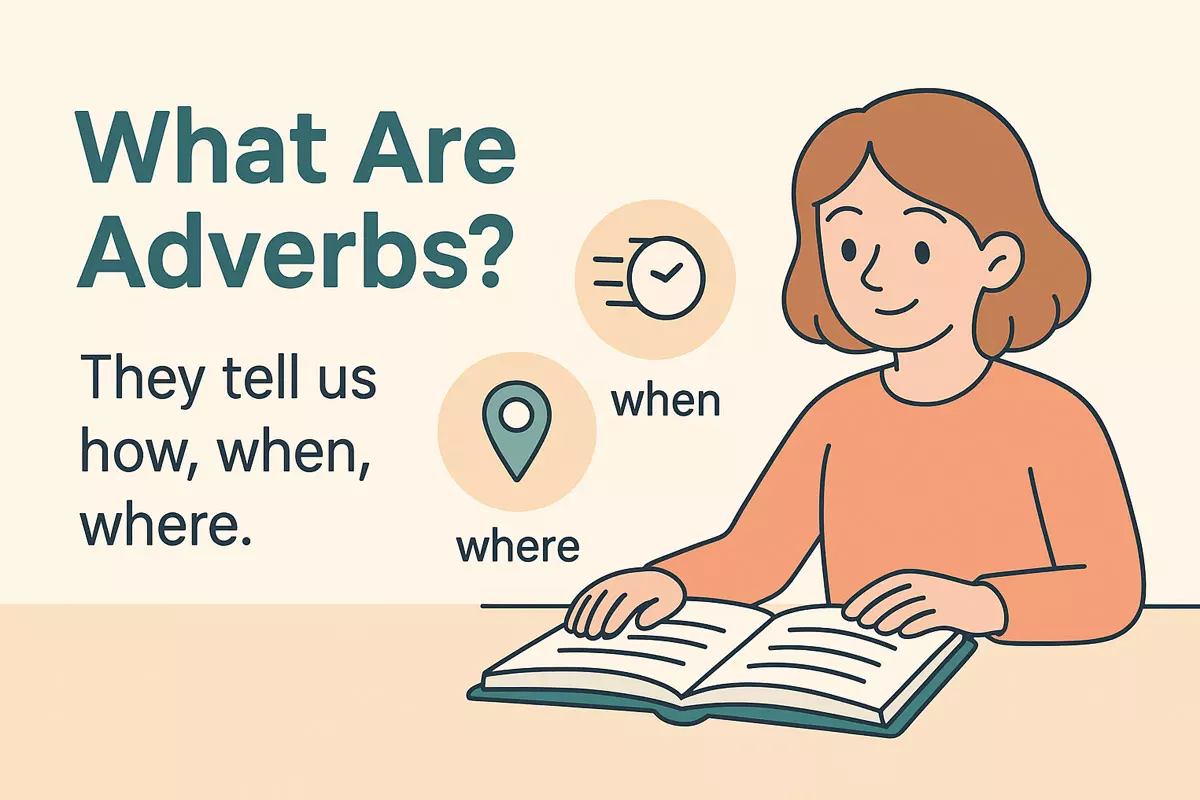
Adverbs are words that describe or modify verbs, adjectives, or other adverbs. They typically give more information about how, when, where, or to what extent something happens. For example, in the sentence “She runs quickly,” the word “quickly” tells us more about the verb “runs”—specifically, how she runs.
What do adverbs do?
Adverbs answer questions like:
- How? (slowly, happily, loudly)
- When? (yesterday, soon, always)
- Where? (here, everywhere, outside)
- To what degree? (very, almost, completely)
They often show up in different positions within a sentence, and sometimes they end in -ly, but not always.
Common adverb examples
Here are some frequently used adverbs:
- quickly → She quickly grabbed her jacket.
- very → The room is very bright.
- never → I never eat late at night.
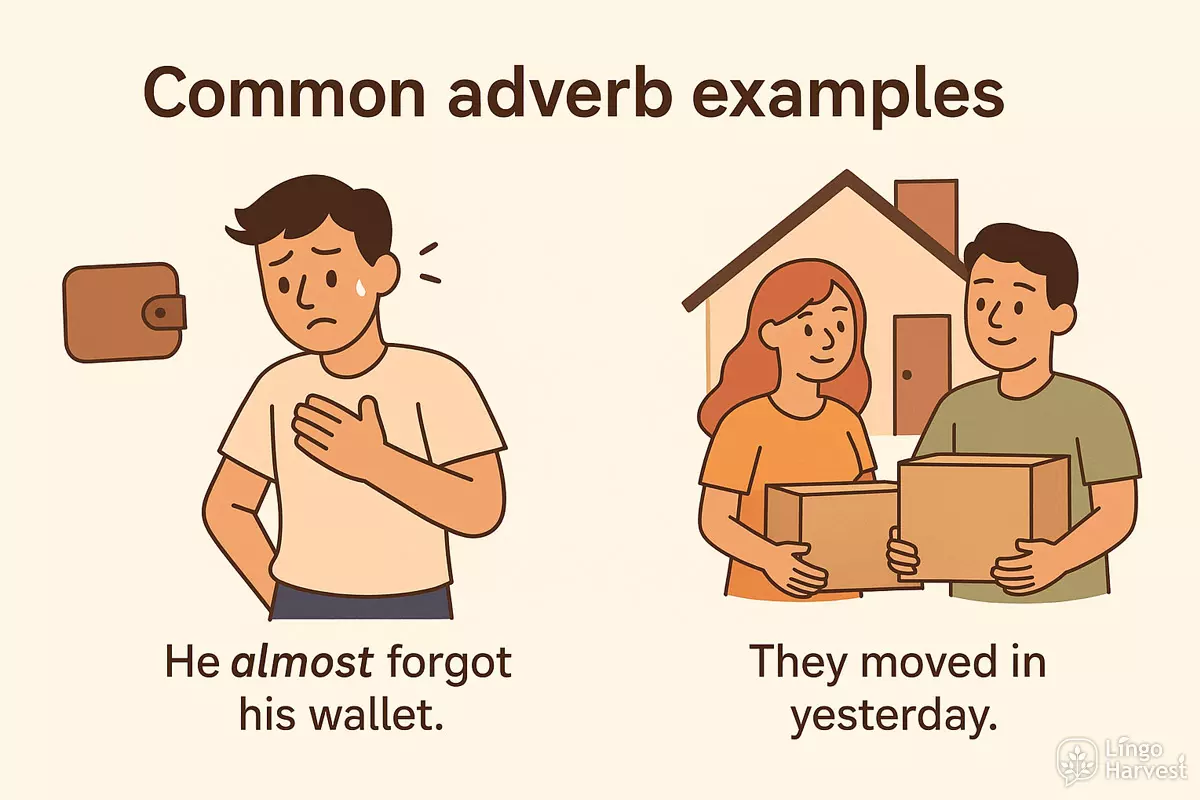
- almost → He almost forgot his wallet.
- yesterday → They moved in yesterday.
- outside → The kids are playing outside.
- carefully → She carefully opened the box.
- always → He always checks his messages in the morning.
- loudly → The teacher spoke loudly to the class.
- too → It’s too noisy here.
- soon → Our guests will arrive soon.
- really → I really like this song.
- sometimes → We sometimes walk by the river.
- well → She plays the piano well.
- everywhere → His name is known everywhere.
- now → I need your help now.
- easily → She easily passed the test.
- hard → They worked hard all week.
How adverbs are used in sentences
Adverbs can appear in various places, often before or after the verb, or at the start or end of a sentence. Their placement can change the focus or meaning slightly. For example:
- He quickly finished his homework.
- She sings beautifully.
- Sometimes, we eat out.
- I will call you soon.
- They arrived early to the meeting.
- The dog barked loudly.
- We often walk in the park.
- She answered the question correctly.
- He is never late for work.
- The kids played happily outside.
- I usually drink coffee in the morning.
- She read the instructions carefully.
Adverbs vs. adjectives
Adjectives describe nouns (people, places, things), while adverbs describe actions or qualities of actions, as well as other modifiers. Here’s a comparison:
| Adjective (modifies noun) | Adverb (modifies verb/adjective/adverb) |
|---|---|
| The quick fox | The fox ran quickly |
| A loud noise | She spoke loudly |
| A happy child | The child laughed happily |
| The hard task | He worked hard |
| A beautiful song | She sings beautifully |
| A careful driver | He drives carefully |
| A slow turtle | The turtle moved slowly |
| A polite student | She answered politely |
| A quiet room | They spoke quietly |
| A gentle breeze | The wind blew gently |
| A bad idea | He explained it badly |
| A serious problem | She listened seriously |
In summary, adverbs add detail to sentences by explaining how, when, where, or to what degree something happens. They help make your language clearer and more precise.
What adverbs can describe: verbs, adjectives, other adverbs
Adverbs are versatile words that add detail and depth to sentences by modifying different parts of speech. Their primary function is to provide more information about how, when, where, or to what extent something happens. Let’s break down the various ways adverbs enhance meaning in sentences.
Describing verbs: how actions happen
Most commonly, adverbs modify verbs, giving us insight into how an action is performed. For example, in “She ran quickly,” the adverb “quickly” tells us how she ran. This use answers questions like “how?”, “when?”, “where?”, and “to what degree?” about the verb.
- She sings beautifully. (How does she sing?)
- He arrived late. (When did he arrive?)
- They live nearby. (Where do they live?)
- She almost finished. (To what extent did she finish?)
- He rarely visits. (How often does he visit?)
- We will start soon. (When will we start?)
- He shouted loudly. (How did he shout?)
- She works efficiently. (How does she work?)
- They often travel. (How often do they travel?)
- He completely forgot. (To what extent did he forget?)
Modifying adjectives: intensifying or softening
Adverbs can also adjust the meaning of adjectives, usually to show intensity or degree. In “The movie was incredibly funny,” the adverb “incredibly” increases the strength of the adjective “funny.” This helps express how much or how little a quality is present.
- extremely cold → It was extremely cold this morning.
- quite interesting → The book was quite interesting.
- remarkably easy → The test was remarkably easy.
- very tall → He is very tall for his age.
- somewhat tired → She felt somewhat tired after work.
- almost ready → Dinner is almost ready.
- totally different → Their opinions are totally different.
- absolutely certain → I am absolutely certain about my answer.
- fairly simple → The instructions were fairly simple.
- surprisingly difficult → The puzzle was surprisingly difficult.
Describing other adverbs: adding layers
Adverbs can even modify other adverbs, giving extra nuance. For instance, “She finished the test remarkably quickly” uses “remarkably” to emphasize the adverb “quickly.” This lets us fine-tune the description of an action or quality.
- very slowly → The turtle moved very slowly.
- almost never → He almost never watches TV.
- quite easily → She solved the puzzle quite easily.
- too loudly → The children were laughing too loudly.
- rather well → She speaks French rather well.
- extremely carefully → He painted the model extremely carefully.
- just barely → I could just barely hear the music.
- nearly always → They nearly always arrive early.
- fairly quickly → The problem was fixed fairly quickly.
- so suddenly → The lights went out so suddenly.
Quick comparison of adverb use
To see how adverbs interact with verbs, adjectives, and other adverbs, here’s a simple comparison:
| Modified Word | Example with Adverb |
|---|---|
| Verb | He speaks softly. |
| Adjective | The answer is completely wrong. |
| Adverb | She moved very quickly. |
Adverbs are powerful tools for making language richer and more precise. Whether they’re describing actions, qualities, or even other adverbs, knowing how to use them helps you communicate with greater clarity and subtlety.
Basic question words they answer (how, when, where, how often)
Adverbs often provide key details about actions, helping us understand the manner, time, place, or frequency of an event. These words typically answer specific questions about verbs, adjectives, or other adverbs. Let’s look at the most common types of questions they address and what this means for understanding or constructing sentences.
How? (Manner)
Adverbs of manner describe the way something happens. They answer the question “How?”
- quickly → She ran quickly to catch the bus.
- carefully → He packed the dishes carefully.
- loudly → The baby cried loudly.
- happily → They danced happily at the party.
- slowly → The turtle moved slowly.
- easily → She solved the puzzle easily.
- badly → He played badly in the match.
- quietly → Please speak quietly.
- well → She sings well.
- sadly → He sighed sadly.
For example: She sang beautifully. (How did she sing? Beautifully.)
When? (Time)
Adverbs of time tell us when something happens. They answer “When?”
- yesterday → They arrived yesterday.
- now → I need your help now.
- soon → The results will come soon.
- already → She has already finished.
- later → I’ll call you later.
- recently → He recently moved here.
- tomorrow → We will meet tomorrow.
- tonight → They are going out tonight.
- eventually → He will understand eventually.
- immediately → Come here immediately.
For instance: I will call you tomorrow. (When will I call? Tomorrow.)
Where? (Place)
Adverbs of place describe location or direction, answering “Where?”
- here → Put your bag here.
- there → She is standing there.
- everywhere → His name is known everywhere.
- outside → The kids are playing outside.
- upstairs → Your shoes are upstairs.
- inside → Come inside, it’s cold.
- abroad → She wants to study abroad.
- nearby → There’s a café nearby.
- away → The dog ran away.
- downstairs → Breakfast is downstairs.
Example: The children are playing outside. (Where are the children playing? Outside.)
How often? (Frequency)
To talk about frequency, adverbs answer “How often?” These words help us describe the regularity of an action.
| Adverb of Frequency | Example Sentence |
|---|---|
| always | He always drinks coffee in the morning. |
| usually | They usually walk to school. |
| often | She often visits her grandmother. |
| sometimes | We sometimes eat out. |
| rarely | I rarely watch TV. |
| never | He never smokes. |
| occasionally | They occasionally travel abroad. |
| frequently | She frequently checks her email. |
Summary
By answering questions like “how,” “when,” “where,” and “how often,” adverbs add detail and clarity. Recognizing these question words helps you both identify adverbs and use them more effectively in your own writing.
Common adverbs for beginners
Learning adverbs is a great way to add more detail and clarity to your sentences in English. Adverbs are words that describe how, when, where, or to what extent something happens. For those just starting out, it helps to focus on the most frequently used adverbs, as these appear in everyday conversations and writing.
Frequently used adverbs in English
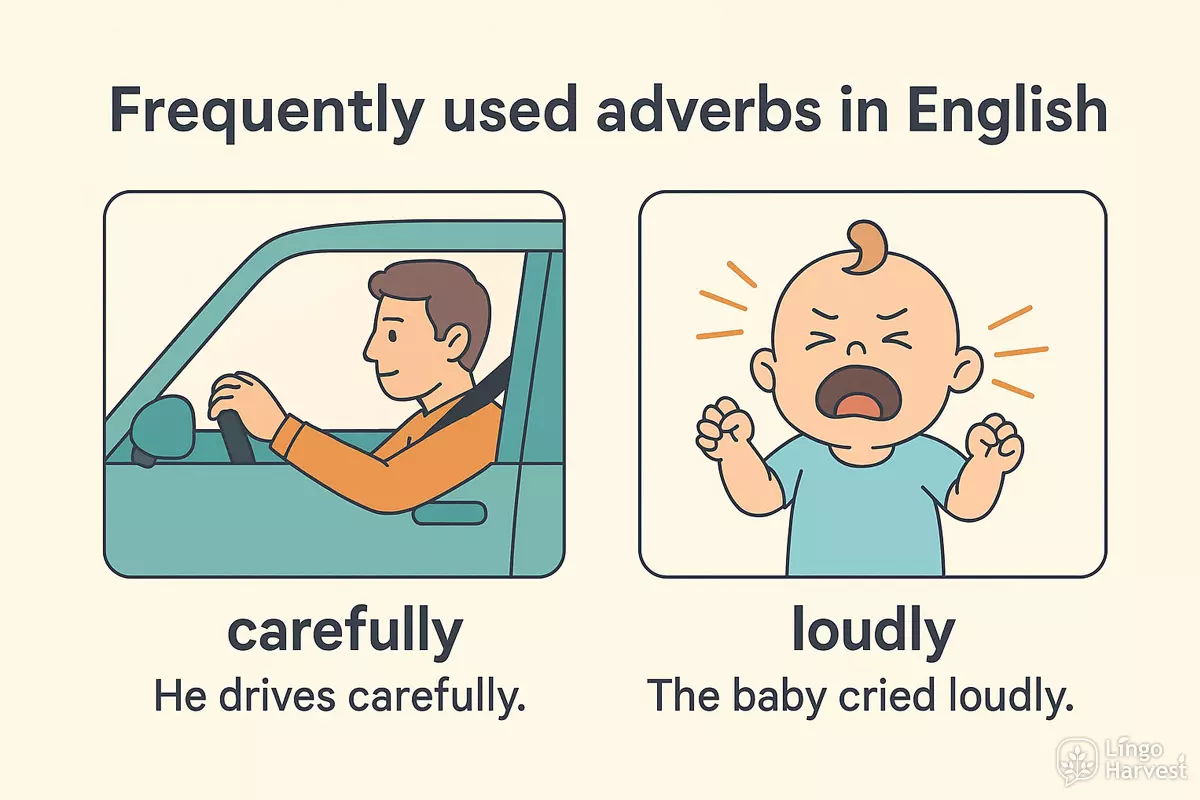
Many adverbs describe how an action is performed. These often end in -ly, but not always. Here is a helpful list of simple adverbs that are common in basic English:
- quickly – She finished her homework quickly.
- slowly – Please speak slowly.
- carefully – He drives carefully.
- loudly – The baby cried loudly.
- quietly – They entered the room quietly.
- well – She sings well.
- badly – He did badly on the test.
- often – I often read before bed.
- sometimes – We sometimes eat out.
- never – He never drinks coffee.
- always – She always arrives on time.
- usually – They usually walk to school.
- now – Start your work now.
- then – We went shopping, then had lunch.
- here – Come here, please.
- there – Your bag is there.
- very – The soup is very hot.
- too – It’s too late.
- really – I really like this song.
- almost – She almost missed the bus.
Types and placement
Adverbs can describe time (when), manner (how), place (where), and degree (how much). Understanding where to put them in a sentence is just as important as knowing their meaning. For example, adverbs of frequency like always or never often come before the main verb, while adverbs of manner, such as quickly or carefully, usually come after the verb.
| Adverb Type | Examples | Sample Sentence |
|---|---|---|
| Manner | quickly, slowly, carefully | She finished the race quickly. |
| Frequency | always, never, often | He always wakes up early. |
| Place | here, there, everywhere | Look here! |
| Time | now, then, soon | We will leave soon. |
| Degree | very, too, almost | It’s very cold today. |
By practicing these commonly used adverbs, you can start making your English sentences more precise and expressive. As you get comfortable with these basics, you’ll find it easier to understand and use more advanced adverbs in different contexts.
Difference between adjectives and adverbs
Adjectives and adverbs are both descriptive words, but they serve different purposes in a sentence. Adjectives modify nouns or pronouns, giving more information about people, places, things, or ideas. In contrast, adverbs typically describe verbs, adjectives, or even other adverbs, providing details about how, when, where, or to what extent something happens.
How adjectives work
Adjectives usually answer questions like “What kind?”, “Which one?”, or “How many?” For example:
- Blue sky
- Three cats
- Happy child
- Cold water
- Long road
- Delicious soup
- Young student
- Tall building
- Old book
- Heavy bag
They often appear right before the noun they describe or after linking verbs like “be,” “seem,” or “become” (e.g., “The soup tastes delicious.”).
How adverbs function
Adverbs add information about the action or quality described by the verb, adjective, or another adverb. They often answer “How?”, “When?”, “Where?”, or “To what degree?” Some examples:
- She ran quickly.
- They arrived early.
- He spoke very softly.
- This car is extremely fast.
- The baby slept peacefully.
- We will leave soon.
- The dog barked loudly.
- She answered politely.
- The phone rang suddenly.
- He works hard every day.
Many adverbs end in -ly, but not all (e.g., “fast,” “well,” “never”).
Common mistakes to avoid
Mistaking adjectives for adverbs (and vice versa) is a frequent error. Remember: use adjectives to describe nouns and pronouns, and adverbs to modify verbs, adjectives, or other adverbs.
| Adjective | Adverb |
|---|---|
| She is a careful driver. | She drives carefully. |
| This is a quiet room. | They spoke quietly. |
| He is a quick learner. | He learns quickly. |
| The soup smells delicious. | She cooks deliciously (rare, but possible). |
| It was a bad idea. | He behaved badly. |
| This is a fast car. | He runs fast. |
| She wore a beautiful dress. | She sang beautifully. |
| He is a hard worker. | He works hard. |
| That’s the right answer. | Did you do it right? |
| This is an easy task. | She finished easily. |
Quick tips for telling them apart
- If the word is describing a noun or pronoun, it’s usually an adjective.
- If it’s describing how, when, where, or to what extent something happens, it’s likely an adverb.
- Look for the -ly ending, but remember some adverbs (like “fast” and “hard”) don’t have it.
- Some words, like “fast,” can act as both, so check what they’re modifying.
Understanding whether a word is an adjective or an adverb helps you choose the right form and express your ideas clearly. This distinction is key to mastering sentence structure and effective communication.
Practice: decide if each word is an adjective or adverb
Understanding the difference between adjectives and adverbs is essential for clear and precise English. Below, you'll find a series of practice items to help you recognize and identify whether a given word is functioning as an adjective or an adverb in a sentence. Take your time to read each sentence and decide how the highlighted word is being used.
Identify the role: adjective or adverb?
For each sentence, decide if the highlighted word describes a noun (adjective) or modifies a verb, adjective, or another adverb (adverb).
- The quick fox jumps over the lazy dog.
- She ran quickly to catch the bus.
- This soup tastes delicious.
- He spoke loudly during the meeting.
- The blue sky was clear all day.
- She answered the question correctly.
- It was a cold morning.
- He worked hard to finish the project.
- The friendly dog greeted everyone.
- She smiled happily at her friend.
- He is a careful driver.
- The cat moved silently across the room.
- This is an important message.
- She sings beautifully.
- We had a long conversation.
- They arrived late to the party.
- He gave a helpful suggestion.
- She danced gracefully.
- It was a sunny afternoon.
- He finished the work easily.
Show answers
- 1. Adjective
- 2. Adverb
- 3. Adjective
- 4. Adverb
- 5. Adjective
- 6. Adverb
- 7. Adjective
- 8. Adverb
- 9. Adjective
- 10. Adverb
- 11. Adjective
- 12. Adverb
- 13. Adjective
- 14. Adverb
- 15. Adjective
- 16. Adverb
- 17. Adjective
- 18. Adverb
- 19. Adjective
- 20. Adverb
Common patterns: adjective vs. adverb
Some words change form to show whether they are adjectives or adverbs. Here’s a comparison of common adjective–adverb pairs for reference:
| Adjective (Describes a noun) |
Adverb (Describes a verb, adjective, or adverb) |
|---|---|
| quick | quickly |
| careful | carefully |
| happy | happily |
| loud | loudly |
| graceful | gracefully |
| beautiful | beautifully |
| silent | silently |
| easy | easily |
| late | late |
| hard | hard |
Remember: adjectives describe nouns and pronouns, while adverbs usually modify verbs, adjectives, or other adverbs. Paying attention to what the word is describing will help you choose the correct form in your writing.