Types of Adverbs: Manner, Time, Place, Degree, Frequency

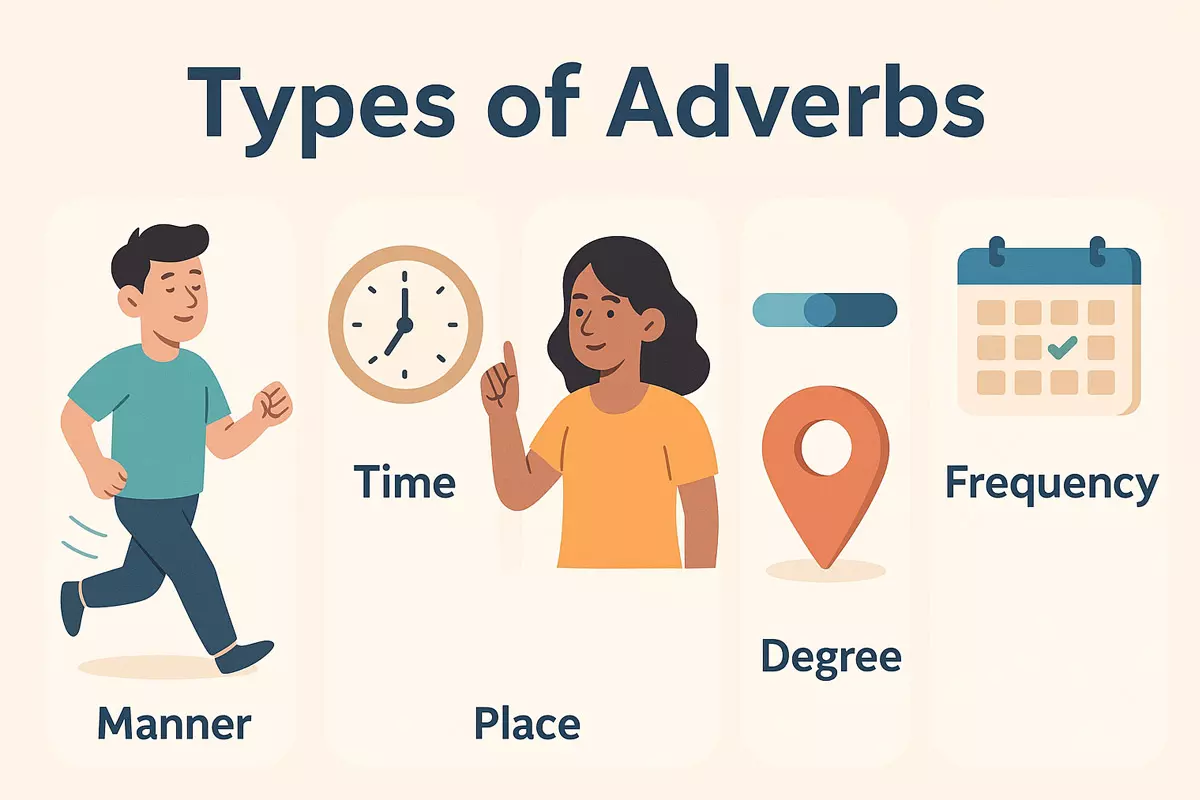 This article explains the main types of adverbs, including those of manner, time, place, frequency, and degree. It also provides practice in identifying and sorting adverbs into these categories based on their function in sentences.
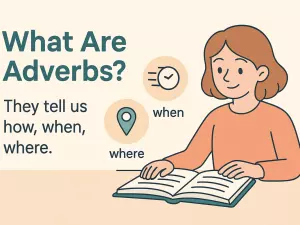
Have you ever wondered how we bring more detail and color to our sentences? Words that describe how, when, where, how much, or how often something happens are essential for clear communication. These modifiers, known as adverbs, help us express actions and ideas more precisely. For example, saying someone runs quickly or visits often gives a clearer picture than simply saying they run or visit. By using adverbs thoughtfully, we can make our language more vivid and engaging, allowing listeners or readers to understand exactly what we mean.
Overview of the main adverb types
Understanding adverbs means knowing how they function to modify verbs, adjectives, or even other adverbs. Different kinds of adverbs answer different questions, such as how, when, where, how often, or to what extent something happens. Let’s break down the key categories that help shape the meaning of sentences.
Adverbs of Manner
Adverbs of manner describe the way in which an action is performed. They often answer the question “How?” and are typically placed after the main verb or the object. Common examples include:
- quickly → She finished the task quickly.
- carefully → He checked the report carefully.
- loudly → The dog barked loudly.
- silently → She entered the room silently.
- happily → The children played happily.
- badly → He played badly in the match.
- easily → She solved the puzzle easily.
- slowly → The turtle moved slowly.
- gracefully → She danced gracefully on stage.
- neatly → He folded his clothes neatly.
- politely → She asked the question politely.
- seriously → He takes his work seriously.
- softly → She spoke softly to the baby.
- warmly → He welcomed us warmly.
These modifiers help paint a clearer picture of the action taking place.
Adverbs of Time
Time-related adverbs tell us when an action occurs. They answer questions such as “When?” or “How long?” and are often positioned at the beginning or end of a sentence. Some frequently used options are:
- yesterday → We met yesterday.
- today → I feel better today.
- soon → The bus will arrive soon.
- now → Please come here now.
- already → She has already finished.
- still → He is still waiting.
- later → I’ll call you later.
- eventually → They eventually agreed.
- recently → I saw him recently.
- immediately → She left immediately.
- tonight → We are eating out tonight.
- finally → The storm finally ended.
- soon afterward → He left soon afterward.
- beforehand → Prepare everything beforehand.
They provide essential context for the timing of events.
Adverbs of Place
These adverbs indicate the location or direction of an action, answering “Where?” They’re especially useful for clarifying movement or positioning. Examples include:
- here → Come here, please.
- there → The keys are over there.
- everywhere → We looked everywhere.
- nearby → A café is located nearby.
- away → She walked away quickly.
- inside → The kids are playing inside.
- outside → Let's wait outside.
- above → The picture hangs above.
- below → Read the notes below.
- upstairs → My room is upstairs.
- downstairs → Breakfast is served downstairs.
- indoors → We stayed indoors during the storm.
- abroad → She wants to study abroad.
- near → He stood near the window.
Their placement in a sentence can subtly shift the meaning of the statement.
Adverbs of Degree
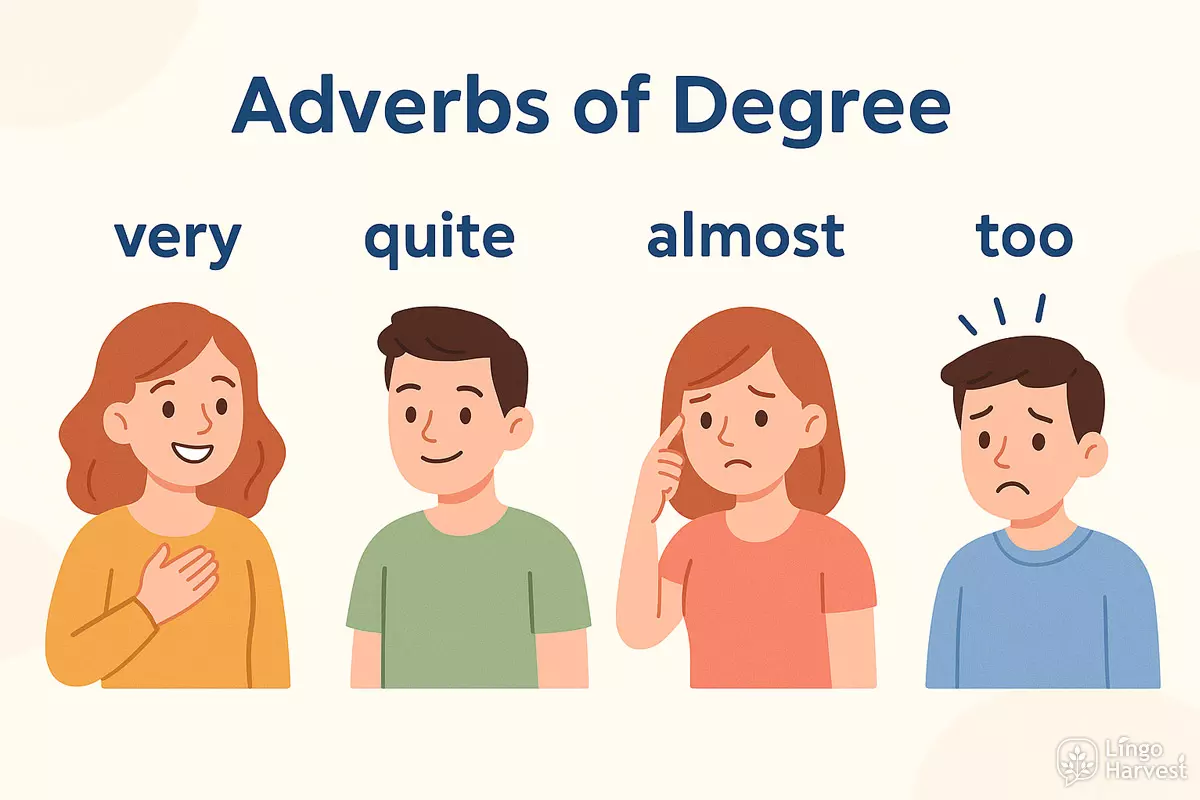
Adverbs of degree indicate the intensity or extent of an action, adjective, or another adverb. They respond to “How much?” or “To what extent?” and are often used before the word they modify. Here are some common ones:
- very → She is very tired.
- quite → The movie was quite good.
- almost → He almost missed the bus.
- too → The coffee is too hot.
- enough → She is strong enough to lift it.
- just → I just arrived.
- completely → The room is completely silent.
- absolutely → I absolutely agree.
- barely → He barely passed the test.
- nearly → We nearly finished the project.
- totally → That’s totally true.
- fully → She is fully prepared.
- deeply → He was deeply moved.
- highly → The plan is highly effective.
These adverbs help add nuance to descriptions and statements.
Adverbs of Frequency
Frequency adverbs describe how often something happens, providing clarity on repetition or regularity. They answer “How often?” and typically appear before the main verb (but after ‘to be’). Consider the following:
- always → She always wakes up early.
- usually → He usually walks to work.
- often → We often eat out on weekends.
- sometimes → She sometimes forgets her keys.
- occasionally → They occasionally travel abroad.
- rarely → He rarely watches TV.
- never → I never drink soda.
- seldom → She seldom gets angry.
- frequently → He frequently checks his email.
- constantly → The baby constantly cries at night.
- regularly → They regularly exercise at the gym.
- periodically → The system is periodically updated.
- hardly ever → We hardly ever go to the cinema.
- almost always → She is almost always on time.
These words help set expectations about habits or routines.
| Type | Function | Sample Adverbs |
|---|---|---|
| Manner | Describes how an action is performed | quickly, slowly, neatly, badly |
| Time | Indicates when or how long | now, soon, yesterday, already |
| Place | Shows location or direction | here, there, outside, nearby |
| Degree | Expresses intensity or extent | very, quite, almost, enough |
| Frequency | Tells how often something occurs | always, sometimes, rarely, never |
Each type of adverb plays a unique role in adding detail and precision to language, making communication more vivid and specific. By recognizing these distinctions, you can craft clearer and more effective sentences.
Adverbs of manner: how something happens
Adverbs that describe the way an action occurs help us understand the quality or style of the action. These words answer the question “How?” about verbs in a sentence, showing whether something is done quickly, carefully, or even badly. Most often, these modifiers are formed by adding -ly to adjectives (for example, “quick” becomes “quickly”), but there are exceptions and irregular forms.
Common examples and usage
Here are some widely used adverbs that describe manner:
- quickly → She finished the task quickly.
- slowly → The turtle moved slowly.
- carefully → He drove carefully in the rain.
- easily → She solved the puzzle easily.
- loudly → The children laughed loudly.
- quietly → He spoke quietly in the library.
- happily → They danced happily all night.
- sadly → She sighed sadly.
- badly → He played badly today.
- well → She sings well.
- politely → He asked politely for help.
- honestly → She answered honestly.
- angrily → He slammed the door angrily.
- gently → She held the baby gently.
- hard → They worked hard to finish on time.
- fast → The car drove fast.
- beautifully → She paints beautifully.
- bravely → The firefighter acted bravely.
Position in a sentence
In most cases, these adverbs are placed after the main verb or after the object if there is one. For example:
- She sang beautifully.
- They finished the project quickly.
- He answered the question honestly.
However, some short adverbs (like “well” or “hard”) may come directly after the verb: “She works hard.” Placing them elsewhere in the sentence can change the emphasis or sound unnatural.
Irregular forms and exceptions
Not every word follows the typical -ly pattern. Some, like “fast” and “hard,” remain unchanged from their adjective form. Others, such as “good,” become “well.” Here are a few examples:
- fast (not “fastly”): He runs fast.
- hard (not “hardly”): She works hard. (“Hardly” has a different meaning.)
- well (from “good”): He speaks English well.
Comparing adverbs of manner
Some adverbs that tell us about manner can be compared to show different degrees. For most, the comparative and superlative forms are made with “more/most” or by changing the ending (if possible).
| Base Form | Comparative | Superlative |
|---|---|---|
| quickly | more quickly | most quickly |
| carefully | more carefully | most carefully |
| well | better | best |
| hard | harder | hardest |
| loudly | more loudly | most loudly |
Key points to remember
- These modifiers describe the way an action is performed.
- They often end in -ly, but not always.
- Word order matters for clarity and natural-sounding English.
- Some adverbs have irregular forms for comparison.
Using these words precisely can make your descriptions clearer and more vivid, letting listeners or readers picture exactly how things happen.
Adverbs of time and place: when and where
Understanding how to describe when or where something happens is essential for clear communication. Words that give us this information are called temporal and locational adverbs. These help answer questions like "When did it happen?" or "Where did it take place?" and add valuable context to your sentences.
When? – Temporal Adverbs
Temporal adverbs specify the timing of an action or event. They can indicate a precise moment, a relative time, or a frequency. Common examples include:
- now → She is studying now.
- yesterday → We met yesterday.
- today → I feel better today.
- soon → The movie will start soon.
- later → I'll call you later.
- already → She has already finished the task.
- tomorrow → They will leave tomorrow.
- recently → He recently moved to a new city.
- still → She is still waiting for you.
- eventually → They eventually found the solution.
- immediately → He answered immediately.
- lately → I have been tired lately.
- before → I’ve heard that before.
- afterwards → We went for ice cream afterwards.
- finally → She finally solved the problem.
- tonight → We’re going out tonight.
Placement of these words is flexible, but they most often appear at the beginning or end of a sentence: "She called yesterday." or "Yesterday, she called."
Where? – Locational Adverbs
Locational adverbs describe the place where something occurs. Whether you want to mention a specific location or a more general area, these adverbs help paint a clearer picture.
- here → Come here, please.
- there → She is standing over there.
- everywhere → We looked everywhere for the keys.
- somewhere → I left my phone somewhere in the house.
- outside → The kids are playing outside.
- inside → Please wait inside.
- upstairs → He went upstairs to his room.
- downstairs → Breakfast is served downstairs.
- nearby → There is a café nearby.
- abroad → She wants to study abroad.
- away → The dog ran away.
- above → The lamp is hanging above the table.
- below → The river flows below the bridge.
- in → Come in, the door is open.
- out → Let’s go out for a walk.
- back → I will be back soon.
These words usually come after the main verb or at the end of a sentence: "He looked everywhere." or "She is outside."
Comparing Time and Place Adverbs in Use
| Adverb of Time | Adverb of Place |
|---|---|
| We will meet tomorrow. | Please wait here. |
| She left already. | The keys are upstairs. |
| I saw him recently. | They traveled abroad. |
| The show starts soon. | Come inside. |
In summary, using these adverbs effectively lets you answer both "when" and "where" questions, making your speech and writing much more precise and engaging. For learners, practicing with a variety of these words in different sentences is a helpful way to build confidence and fluency.
Adverbs of frequency: how often
Words that describe how regularly something happens help us talk about routines and habits. These modifiers answer questions like “How often do you exercise?” or “How frequently does it rain here?” They are essential for expressing schedules, tendencies, and general truths. You’ll often see them in both spoken and written English, especially when discussing daily activities or repeated actions.
Common frequency adverbs and their meanings
Some adverbs suggest something happens all the time, while others indicate rare or occasional events. Here’s a range you’ll hear frequently in English:
- Always – at all times, 100% of the time
- Usually – most of the time, about 80-90%
- Frequently – regularly, more than half the time
- Often – many times, around 60-70%
- Sometimes – occasionally, about 40-50%
- Occasionally – not regularly, less than half the time
- Seldom – rarely, almost never
- Rarely – infrequently, about 10% of the time
- Hardly ever – almost never
- Never – not at any time, 0%
Word order and usage
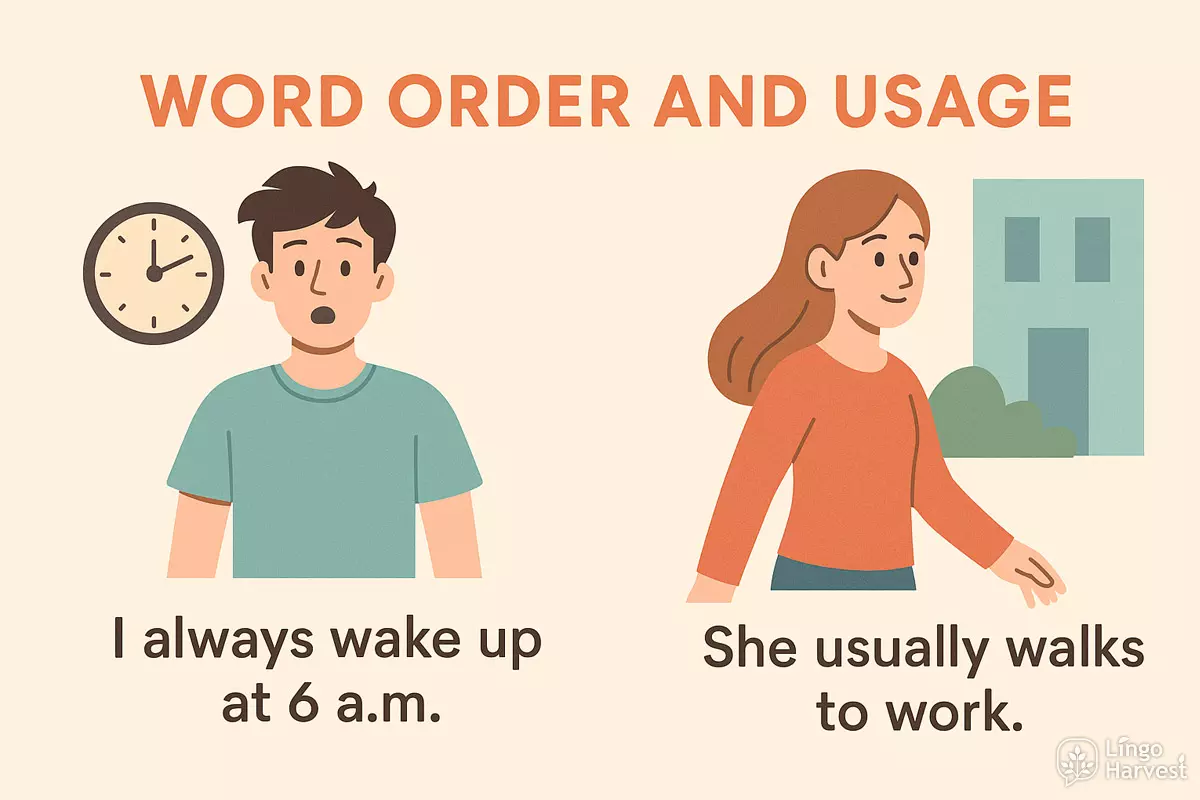
Frequency adverbs usually appear before the main verb (He always eats breakfast), but after the verb “to be” (She is often late). When using auxiliary verbs, place the adverb between the auxiliary and the main verb (They have never visited Paris).
| Adverb | Example Sentence |
|---|---|
| Always | I always wake up at 6 a.m. |
| Usually | She usually walks to work. |
| Often | We often eat out on Fridays. |
| Sometimes | They sometimes play tennis after school. |
| Rarely | He rarely drinks coffee. |
| Never | I never forget my keys. |
Tips for using adverbs of regularity
- Choose the word that best matches the real frequency.
- Don’t use double negatives: “I never don’t go” is incorrect.
- Mix up your vocabulary to sound more natural and precise.
- Some adverbs (like always or never) can add strong emphasis to your statements.
By mastering these expressions, you’ll be able to describe routines and habits clearly and naturally in English conversations and writing.
Adverbs of degree: how much or how strong
Words that tell us about the intensity or extent of an action, adjective, or another adverb are called degree adverbs. They help answer questions such as “how much?”, “to what extent?”, or “how strong?” For example, in the sentence She was extremely happy, the word extremely indicates the strength of her happiness.
Common adverbs that express degree
You’ll find these modifiers used with verbs, adjectives, and even other adverbs. Here are some of the most frequent ones:
- very → The movie was very good.
- too → It’s too cold to go outside.
- quite → The lesson was quite interesting.
- almost → She almost missed the bus.
- enough → He isn’t tall enough to reach the shelf.
- so → I’m so tired today.
- just → I just finished my homework.
- hardly → She could hardly hear him.
- nearly → We nearly won the game.
- completely → The room was completely silent.
- absolutely → She is absolutely certain about her answer.
- totally → The plan was totally unexpected.
- barely → He barely slept last night.
- entirely → The idea is entirely new to me.
- utterly → The house was utterly destroyed by the storm.
- somewhat → His explanation was somewhat confusing.
- rather → The movie was rather long.
- pretty → The solution is pretty simple.
- fairly → This exercise is fairly easy.
- slightly → She felt slightly better today.
How degree adverbs are used
These adverbs typically go before the word they modify. For example, “The soup is too hot,” or “He almost finished his homework.” However, a few, such as enough, usually follow the adjective or adverb: “She’s old enough to vote.”
Some degree adverbs can intensify both adjectives and other adverbs (“really fast,” “incredibly expensive”), while others are mainly used to modify verbs (“hardly noticed,” “almost forgot”).
Examples in context
- He is very tired after work.
- The movie was quite interesting.
- She sings rather beautifully.
- They were almost late.
- The answer is completely wrong.
- We are totally ready.
- He’s barely awake.
- The room was so clean.
- This bag is too heavy.
- She is just right for the job.
Comparing degree: strong vs. weak intensity
| Weaker degree | Stronger degree |
|---|---|
| slightly | completely |
| fairly | absolutely |
| somewhat | totally |
| a bit | utterly |
Understanding how to use these modifiers helps make your speech and writing more precise. They allow you to express subtle differences in emphasis, from “slightly annoyed” to “absolutely furious.” Mastering them will give your English more nuance and clarity.
Practice: sort adverbs into the correct type
Understanding the different categories of adverbs helps you use them accurately in sentences. Below are some practical tasks to help you distinguish between adverbs of manner, time, place, degree, and frequency. Read each adverb and decide which type it belongs to. This hands-on activity will strengthen your grasp of how these words function in context.
Task 1: Identify the type of each adverb
Below is a list of adverbs. For each one, decide whether it describes manner, time, place, degree, or frequency.
- quickly → She packed her bag quickly.
- yesterday → We met yesterday at the café.
- everywhere → His name is known everywhere.
- almost → She almost forgot her passport.
- usually → I usually wake up at 7.
- gently → He closed the door gently.
- soon → The results will be ready soon.
- nowhere → There was nowhere to sit.
- completely → The room was completely dark.
- rarely → They rarely travel abroad.
- loudly → The audience laughed loudly.
- often → She often visits her grandparents.
- here → Put your bag here.
- hardly → He hardly spoke during the meeting.
- late → She arrived late again.
- silently → He left the room silently.
- very → The water is very cold.
- upstairs → The kids are playing upstairs.
- never → I never drink coffee at night.
- tomorrow → We will discuss it tomorrow.
Show answers
- quickly – manner
- yesterday – time
- everywhere – place
- almost – degree
- usually – frequency
- gently – manner
- soon – time
- nowhere – place
- completely – degree
- rarely – frequency
- loudly – manner
- often – frequency
- here – place
- hardly – degree
- late – time
- silently – manner
- very – degree
- upstairs – place
- never – frequency
- tomorrow – time
Task 2: Match adverbs with their type
Review the following table and match each group of adverbs to its category. This will help you see patterns and similarities within each type.
| Adverb Type | Example Adverbs |
|---|---|
| Manner | quickly, gently, loudly, silently |
| Time | yesterday, soon, late, tomorrow |
| Place | everywhere, nowhere, here, upstairs |
| Degree | almost, completely, hardly, very |
| Frequency | usually, rarely, often, never |
Show answers
- Manner: quickly, gently, loudly, silently
- Time: yesterday, soon, late, tomorrow
- Place: everywhere, nowhere, here, upstairs
- Degree: almost, completely, hardly, very
- Frequency: usually, rarely, often, never
Sorting adverbs by their function helps you use them precisely in sentences. With practice, recognizing these five categories becomes automatic, making your speech and writing more natural and clear.