Flat Adverbs: Fast, Hard, Late — Meaning, Rules, and Examples

 The article defines flat adverbs, lists words that act as both adjectives and adverbs, explains differences between pairs like hard and hardly or late and lately, discusses their correct placement in sentences, points out common mistakes, and includes practice…
Certain English words serve as both adjectives and adverbs without altering their form, making them versatile in everyday language. Words such as fast, hard, and late easily fit into different contexts, functioning as adjectives when describing nouns and as adverbs when modifying verbs. This flexibility sets them apart from most adverbs, which typically end in -ly, and can sometimes cause confusion for learners of English. Understanding how these words operate helps in constructing clear and grammatically correct sentences.
What flat adverbs are
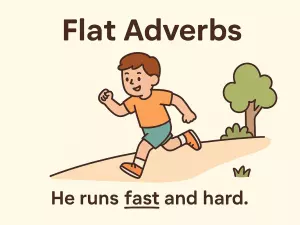
Flat adverbs are a special group of adverbs in English that share the same form as their adjective counterparts. Unlike most adverbs, which typically end in -ly (like quickly or happily), these words do not change their spelling when used to modify verbs. For example, fast works as both an adjective (a fast car) and an adverb (run fast).
These words are called “flat” because their form is uninflected—they remain “flat” and do not take the usual -ly ending. Many of these adverbs have been in use for centuries and are common in both spoken and written English. They are especially frequent in everyday, informal contexts, and some even sound more natural than their -ly versions (for example, “drive safe” is common in speech, though “drive safely” is technically more formal).
How flat adverbs work
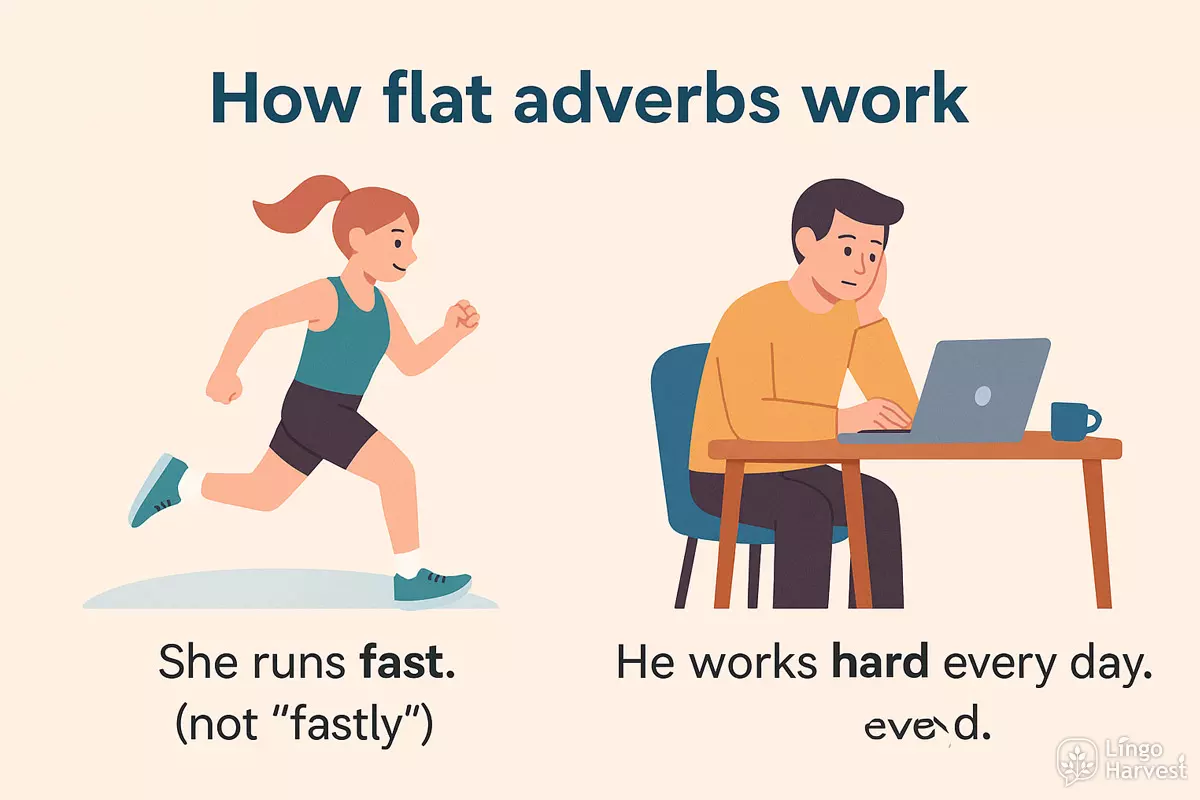
Flat adverbs typically modify verbs, adjectives, or even other adverbs, just like their -ly counterparts. The main difference lies in form, not function. Here are some common examples and how they’re used:
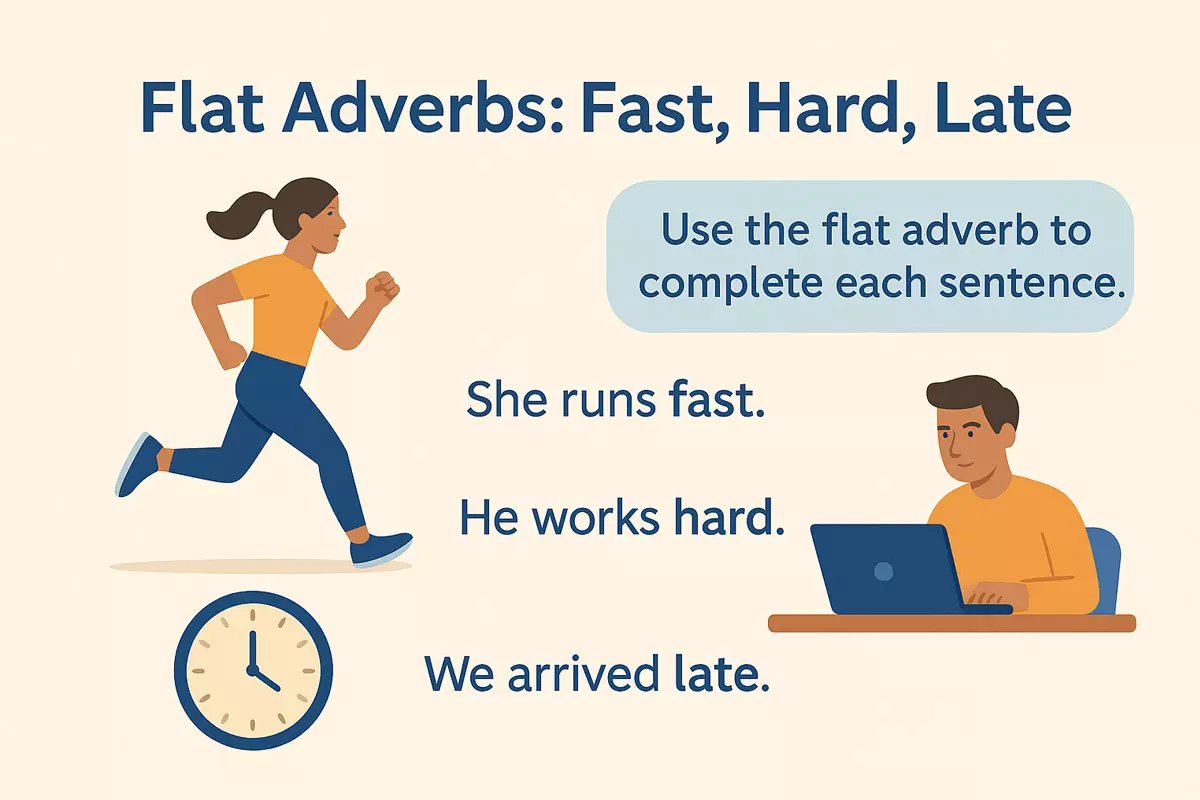
- fast – She runs fast. (not “fastly”)
- hard – He works hard every day.
- late – Don’t arrive late.
- high – The bird flew high.
- long – We waited long for the bus.
- straight – Go straight ahead.
- deep – Breathe deep.
- right – Turn right at the corner.
- wrong – You spelled it wrong.
- near – Sit near to the window.
- close – Stay close to me.
- wide – The door opened wide.
- clean – Wipe the board clean.
- quick – Think quick!
- slow – Drive slow in the rain.
- sure – Are you sure?
Flat adverbs versus -ly adverbs
Some words have both a flat form and an -ly form, but the meaning can change depending on which one is used. For example, “hard” and “hardly” mean very different things: “He works hard” (he puts in a lot of effort) versus “He hardly works” (he almost doesn’t work at all).
It’s important to know which flat adverbs are standard and which are considered informal or even incorrect in formal writing. For instance, “drive safe” is common in speech, but “drive safely” is preferred in formal contexts.
Words that can be both adjectives and adverbs
Some English words serve double duty: they function as both describing words for nouns and as modifiers for verbs, adjectives, or other adverbs. These are often called “flat adverbs,” and they don’t need the usual -ly ending to act as adverbs. This makes them especially interesting in everyday speech and writing, where their form does not change, but their grammatical role does.
Common examples of flat adverbs and adjectives
These words function both as adjectives and adverbs without changing form:
- fast → She runs fast.
- hard → He tried hard.
- late → They arrived late.
- early → We woke up early.
- high → Prices went high.
- low → The plane flew low.
- right → Turn right here.
- wrong → You heard wrong.
- straight → Go straight ahead.
- long → We waited long.
- deep → Breathe deep.
- near → Come near.
- close → Stay close.
- loud → Speak loud. (informal)
- quick → Think quick.
- sharp → Turn sharp left.
- wide → Open your eyes wide.
- clear → Speak clear.
- clean → Wipe it clean.
- fair → He played fair.
- smooth → Spread it smooth.
- tight → Hold on tight.
How they work in sentences
These words can describe a noun or modify an action, depending on placement. For example:
- fast car (adjective) → She runs fast (adverb)
- hard surface (adjective) → He works hard (adverb)
- late train (adjective) → She arrived late (adverb)
- high mountain (adjective) → The bird flew high (adverb)
- early morning (adjective) → We woke up early (adverb)
- low price (adjective) → The plane flew low (adverb)
- right answer (adjective) → Turn right at the corner (adverb)
- wrong decision (adjective) → You heard it wrong (adverb)
- long road (adjective) → We waited long for the bus (adverb)
- straight line (adjective) → Go straight ahead (adverb)
- deep hole (adjective) → Breathe deep (adverb)
- close friend (adjective) → Stay close to me (adverb)
Why does English allow this?
Historically, many adverbs in English did not require the -ly ending. Over time, some words retained this older form, especially those frequently used in spoken language. In modern usage, these flat adverbs are perfectly standard and natural.
Comparing forms and meanings
Some words have both a “flat” adverb form and an -ly version, but the meanings may differ. Here are a few examples for comparison:
| Word | Flat Adverb Example | -ly Form Example | Difference in Meaning |
|---|---|---|---|
| hard | He works hard. | He hardly works. | hard = with effort; hardly = almost not |
| late | She arrived late. | She lately arrived. | late = not on time; lately = recently |
| near | Come near. | Nearly finished. | near = close in space; nearly = almost |
| right | Turn right. | Rightly so. | right = correct direction; rightly = in a just way |
Key takeaways
Flat adverbs are an exception to the typical -ly rule, making English more flexible. Understanding which terms can play both roles helps avoid mistakes and adds variety to your writing and speech.
Difference between hard/hardly, late/lately
Understanding the contrast between "hard" and "hardly," as well as "late" and "lately," is essential for precise communication. These word pairs look similar but have quite different meanings and uses in sentences, especially when functioning as flat adverbs.
"Hard" vs "Hardly"
"Hard" typically serves as both an adjective and a flat adverb, meaning "with a lot of effort" or "intensely." In contrast, "hardly" is an adverb with a completely different meaning: it indicates something happens only barely or almost not at all.
- She works hard. → She puts in a lot of effort at work.
- He hardly works. → He does almost no work.
- Try hard if you want to succeed.
- I hardly know him. → I barely know him.
- The rain fell hard all night.
- There was hardly any rain last week.
- He hit the ball hard.
- She could hardly believe the news.
- They studied hard for the exam.
- The baby hardly cried.
- The wind blew hard across the field.
- She could hardly see in the dark.
- The team played hard until the final whistle.
"Late" vs "Lately"
"Late" can be an adjective or a flat adverb, signifying "after the expected time." "Lately," on the other hand, is an adverb that refers to "recently" or "in the recent past." These forms are not interchangeable.
- He arrived late. → He was not on time.
- She has been busy lately. → She has been busy in recent days.
- Don't stay out late.
- Have you seen him lately?
- The bus is always late.
- Lately, I've been tired.
- They left late in the evening.
- There haven't been any updates lately.
- Why are you late?
- Lately, the weather has been cold.
- He goes to bed late most nights.
- I haven't heard from her lately.
- We finished the project late, but it's done.
Practice: Choose Between Late and Lately
- She has been very tired __________.
- The train arrived __________ again this morning.
- I haven't seen my neighbor __________.
- Why did you come home so __________ last night?
- Have you heard any news __________?
- He stays up __________ to finish his work.
- The weather has been strange __________.
- They left the office quite __________ yesterday.
- I haven't been eating well __________.
- My phone has been acting weird __________.
Show answers
- lately
- late
- lately
- late
- lately
- late
- lately
- late
- lately
- lately
Quick Reference Table
| Word | Meaning & Example |
|---|---|
| hard | With effort/intensity She trains hard for competitions. |
| hardly | Barely, almost not He hardly eats breakfast. |
| late | After the expected time We arrived late to the meeting. |
| lately | Recently Lately, I've been reading more. |
Grasping these distinctions helps avoid confusion and makes your English clearer and more natural. Each pair, though similar in form, serves distinct roles in everyday communication.
Position of flat adverbs in a sentence
Flat adverbs like "fast," "hard," and "late" often appear in positions typical for adverbs of manner, usually following the main verb or the object. These adverbs do not take the -ly ending, but their placement in sentences still follows general adverb rules.
Common Placement Patterns
Flat adverbs are most frequently placed after the verb they modify. If the verb has a direct object, the adverb usually comes after the object. Here are some typical patterns:
- Verb + flat adverb: She runs fast.
- Verb + object + flat adverb: He finished the work late.
- Verb + flat adverb + prepositional phrase: They worked hard in the garden.
Examples of Flat Adverb Placement
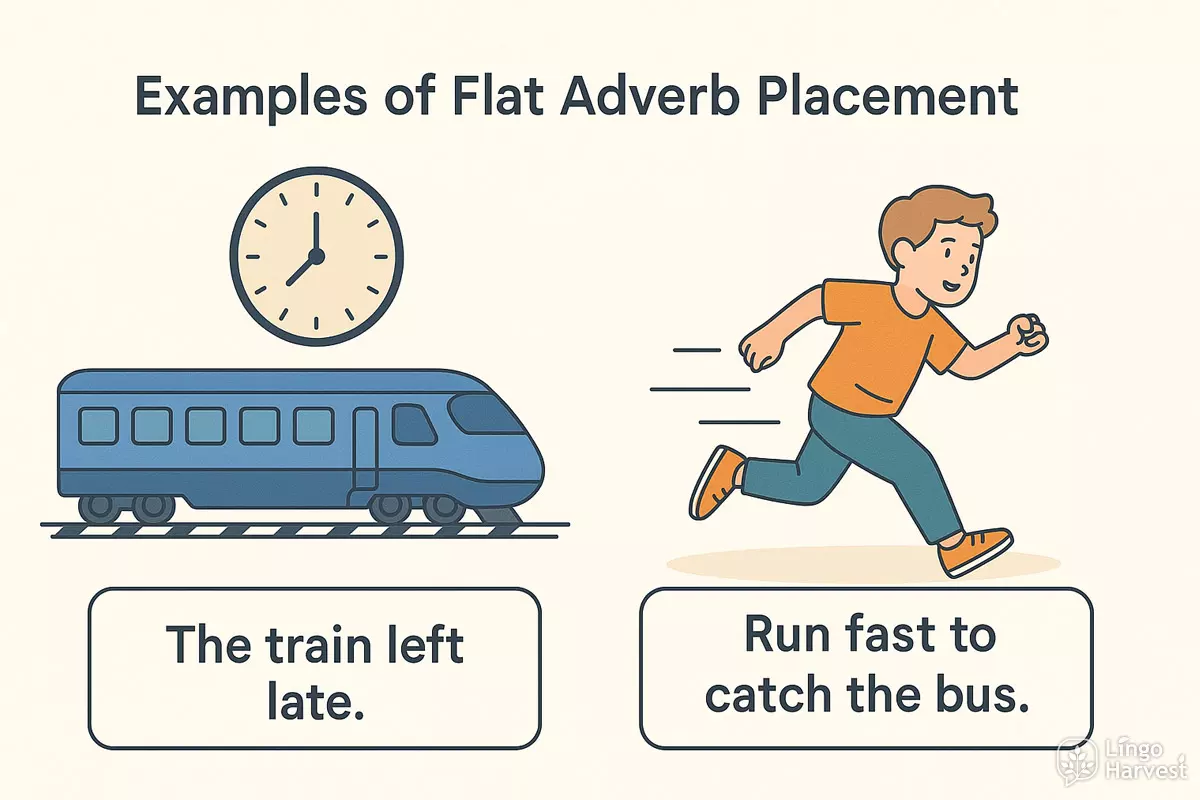
To illustrate, here are several sentences showing different positions for "fast," "hard," and "late":
- He drives fast.
- They arrived late.
- She worked hard all day.
- The train left late.
- Run fast to catch the bus.
- He hit the ball hard.
- She studies hard for exams.
- We woke up late this morning.
- The dog ran fast across the field.
- They played hard but lost the game.
- The meeting started late.
- Finish your homework fast.
- He fought hard for his rights.
- The team worked late into the night.
- Arrive late and you’ll miss the show.
Before the Verb: Rare and Marked Usage
Occasionally, flat adverbs may appear before the main verb, typically for emphasis or in poetic style, but this is much less common and can sound unnatural in everyday speech:
- Fast he ran down the track. ❌ (unusual)
- Hard she worked to succeed. ❌ (uncommon)
Placing them before the verb is generally avoided in standard usage.
Summary Table: Typical Placement Patterns
| Pattern | Example Sentence |
|---|---|
| Verb + flat adverb | He runs fast. |
| Verb + object + flat adverb | She finished the report late. |
| Verb + flat adverb + prepositional phrase | They worked hard during the summer. |
| Flat adverb before verb (rare) | Late he arrived at the party. ❌ |
In summary, while flat adverbs are flexible, they most naturally follow the verb or object. Placing them elsewhere is rare and typically only used for emphasis or stylistic effect.
Common mistakes with these forms
Learners often stumble when using flat adverbs like "fast," "hard," and "late." These words look similar to their adjective forms, and that can cause confusion about which is correct in a particular sentence. Misuse often occurs when speakers try to apply a regular "-ly" ending where it isn't needed, or when they misunderstand the difference in meaning between the adverb and adjective forms.
Confusing flat adverbs with "-ly" forms
One frequent error is adding "-ly" to words that are already correct as adverbs. For example, "fastly" and "hardly" are not suitable substitutes for "fast" and "hard" in most contexts. "Fast" and "hard" serve as both adjectives and adverbs without any changes in form, while "hardly" actually has a very different meaning ("barely" or "almost not").
- ❌ She runs fastly. → ✅ She runs fast.
- ❌ He works hardly. → ✅ He works hard.
- ❌ They arrived lately. → ✅ They arrived late.
- ❌ She spoke quiet. → ✅ She spoke quietly.
- ❌ He answered correct. → ✅ He answered correctly.
- ❌ The baby cried soft. → ✅ The baby cried softly.
- ❌ She drives careful. → ✅ She drives carefully.
- ❌ He explained it simple. → ✅ He explained it simply.
- ❌ The dog barked loud. → ✅ The dog barked loudly.
- ❌ She sings beautiful. → ✅ She sings beautifully.
- ❌ He behaved strange. → ✅ He behaved strangely.
- ❌ They left quick. → ✅ They left quickly.
Misunderstanding meaning differences
Some words, like "hard" and "hardly" or "late" and "lately," are not interchangeable. Their meanings change significantly, and using the wrong form can make a sentence confusing or even the opposite of what you intend.
| Word | Incorrect Use | Correct Use & Explanation |
|---|---|---|
| fast | She drives fastly. | She drives fast. "Fast" is both the adjective and adverb form. |
| hard | He studies hardly for exams. | He studies hard for exams. "Hardly" means "almost not," which changes the meaning. |
| late | They arrived lately. | They arrived late. "Lately" means "recently," not "after the expected time." |
| hardly | I can hard hear you. | I can hardly hear you. "Hardly" is correct for 'almost not.' "Hard" is not used here. |
| lately | I haven't seen her late. | I haven't seen her lately. "Lately" means "recently." |
Summary of typical errors
Missteps usually fall into these categories:
- Adding "-ly" to words that don’t need it (e.g., "fastly").
- Using the wrong word for the intended meaning ("hardly" instead of "hard").
- Confusing "lately" (recently) with "late" (not on time).
- Applying adjective forms when an adverb is required and vice versa.
- Overgeneralizing patterns from regular adverbs to these irregular forms.
Paying attention to these specific pitfalls will help you use flat adverbs more accurately and naturally.
Practice: complete sentences using flat adverbs correctly
Understanding how to use flat adverbs like fast, hard, and late in sentences helps your English sound natural. These adverbs are unique because they have the same form as their adjective counterparts, but they modify verbs directly. Below, you'll find practice exercises and tips to help you master these words in context.
Complete the sentences with the correct flat adverb
- She ran ________ to catch the bus.
- He works ________ every day to support his family.
- We arrived ________ and missed the beginning of the movie.
- Try not to study too ________ before bed; it can make it hard to sleep.
- The train moves ________ through the countryside.
- Sometimes you have to try ________ to achieve your goals.
- They stayed ________ at the party and helped clean up.
- Drive ________ in the rain to avoid accidents.
- She hit the ball ________ during the match.
- Don’t leave ________; you might miss an important announcement.
Show answers
- fast
- hard
- late
- hard
- fast
- hard
- late
- fast
- hard
- late
Choose the correct form: adjective or flat adverb?
Select the right word to complete each sentence. Remember, use the adverb form to modify verbs, and the adjective form to describe nouns.
- He is a ________ runner. (fast/fastly)
- She finished her homework ________. (hard/hardly)
- The train arrived ________. (late/lately)
- It’s a ________ decision to make. (hard/hardly)
- We have seen him ________ at work recently. (hard/hardly)
- I have been very busy ________. (late/lately)
- They left the office ________ yesterday. (late/lately)
- She trains ________ before a competition. (hard/hardly)
- We ________ ever go out together these days. (hard/hardly)
- He drives ________ at night to get home faster. (fast/fastly)
- She has been tired ________. (late/lately)
- The meeting started ________ because of traffic. (late/lately)
Show answers
- fast
- hard
- late
- hard
- hardly
- lately
- late
- hard
- hardly
- fast
- lately
- late
Common mistakes with flat adverbs
Learners sometimes confuse flat adverbs with their -ly versions. Here's a quick comparison to clarify the difference:
| Adjective / Flat Adverb | Incorrect Form | Example Sentence |
|---|---|---|
| fast | fastly ❌ | She runs fast, not fastly. |
| hard | hardly ❌ | He works hard (a lot), not hardly (almost not at all). |
| late | lately ❌ | They arrived late (not lately, which means ‘recently’). |
Practice with these words helps you avoid common errors and makes your sentences clearer. Try creating your own examples to reinforce the difference between adjectives and flat adverbs.