Flat Adverbs: When Adjectives Act as Adverbs

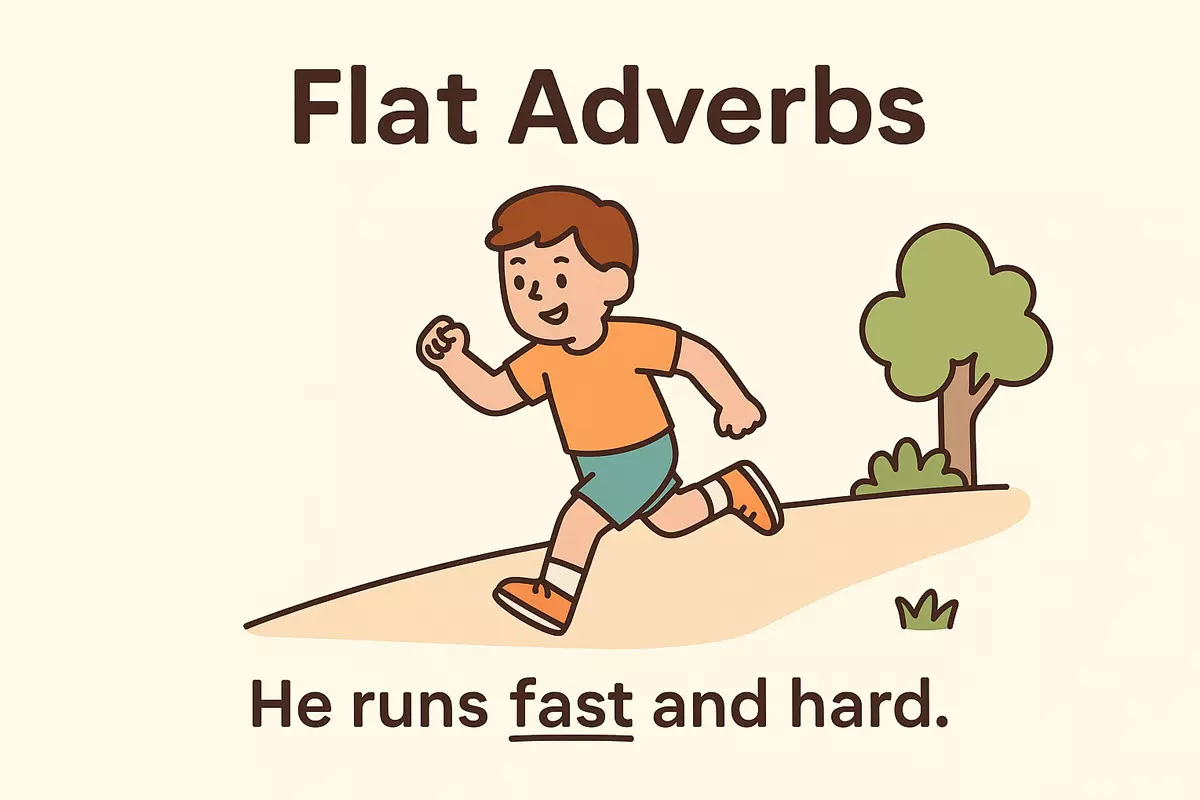 The article defines flat adverbs, compares them to adjectives, and lists common examples. It explains meaning differences, shows usage in sentences, points out typical beginner mistakes, and offers a brief practice exercise.
Have you ever noticed that words typically used to describe things, such as fast or hard, can also modify actions in English? This interesting aspect of the language, where adjectives take on the role of adverbs without changing form, highlights the remarkable flexibility and adaptability of English. It allows speakers to convey meaning in a concise way, making communication both efficient and expressive. Such shifts in word function demonstrate how English evolves to meet the needs of its users in everyday conversation.
What Flat Adverbs Are
Flat adverbs are a distinctive group of words in English that look just like adjectives, but function as adverbs in a sentence. Unlike most adverbs, which take the typical -ly ending (such as “quickly” or “happily”), these words have a “flat” or unchanged form—no added suffix. You’ll notice them in phrases like “drive slow,” “work hard,” or “turn right,” where the adverb is identical to its adjective counterpart.
The Origins and Usage
Historically, many adverbs in English didn’t have the -ly ending. Over time, the -ly form became more common, but some words retained their original “bare” structure. These are most often found in everyday speech, informal writing, and certain set expressions. While some people consider them informal, many flat adverbs are entirely standard and accepted, especially in American English.
Common Examples
You encounter these adverbs regularly, even if you haven’t noticed them before. Some well-known flat adverbs include:
- fast (as in “run fast”)
- hard (“work hard”)
- late (“arrive late”)
- early (“wake up early”)
- long (“wait long”)
- high (“jump high”)
- right (“turn right”)
- wrong (“spell wrong”)
- straight (“go straight”)
- wide (“spread wide”)
- slow (“drive slow”)
- close (“hold close”)
- deep (“dig deep”)
- fair (“play fair”)
- clear (“see clear”)
- sure (“guess sure”)
- low (“fly low”)
- loud (“talk loud”)
- quick (“move quick”)
Flat Adverbs vs. -ly Adverbs
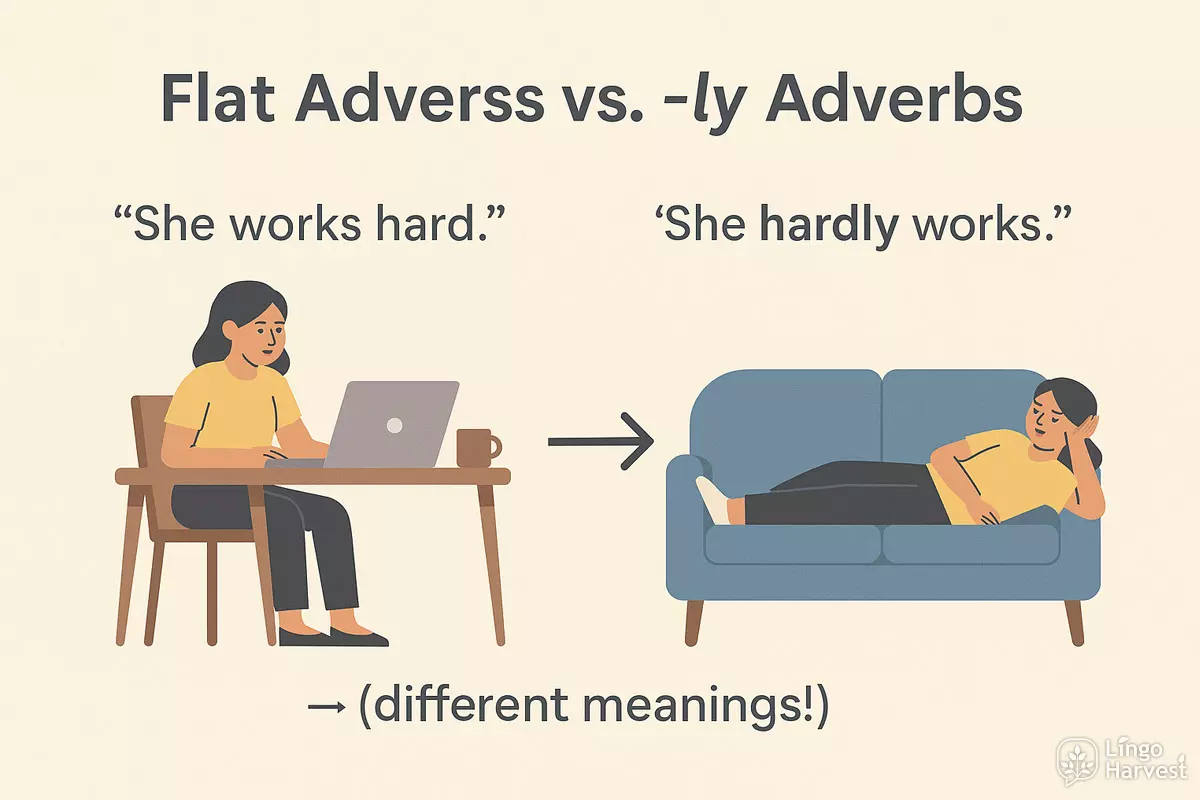
Sometimes both the flat and -ly forms exist, but they can carry different meanings or levels of formality. Here’s a comparison of some common pairs:
| Flat Adverb | -ly Adverb | Example Sentence |
|---|---|---|
| hard | hardly | “She works hard.” → “She hardly works.” (different meanings!) |
| fast | fastly | “He runs fast.” (no “fastly” in modern English) |
| late | lately | “They arrived late.” → “Lately, I’ve been tired.” (different uses) |
| right | rightly | “Turn right at the corner.” → “She was rightly angry.” |
| close | closely | “Hold me close.” → “Study the case closely.” |
| wrong | wrongly | “You spelled it wrong.” → “He was wrongly accused.” |
| fair | fairly | “Play fair.” → “It’s fairly easy.” |
Where You’ll See Flat Adverbs
These adverbs are especially common after verbs of movement or action, and in instructions or idiomatic phrases. They often sound more natural in spoken English, though many are perfectly acceptable in formal writing. Some, like “fast” and “hard,” are almost never used with -ly. In summary, flat adverbs illustrate how flexible English can be with word forms, and knowing how to spot and use them can make your language sound both more natural and concise.
Adjective vs Adverb Form
Understanding the difference between adjectives and adverbs is essential, especially when dealing with "flat adverbs"—words that look like adjectives but function as adverbs. Traditionally, adjectives describe nouns, while adverbs modify verbs, adjectives, or other adverbs. However, with flat adverbs, the same word can serve both purposes, leading to confusion and sometimes debate over what is correct or acceptable in modern usage.
How Flat Adverbs Blur the Lines
Flat adverbs are unique because they don’t end with the typical -ly suffix. Instead, they appear identical to their adjective counterparts. For example, in "run fast" and "a fast runner," "fast" functions as both an adverb and an adjective, depending on the context. This overlap can make it tricky to determine which form to use, particularly in formal writing.
Common Flat Adverbs and Their Uses
Many everyday words belong to this group. Here’s a list of frequently used flat adverbs that double as adjectives:
- fast (He runs fast. / a fast car)
- hard (Work hard. / a hard task)
- late (Arrive late. / a late train)
- high (Jump high. / a high jump)
- early (Wake up early. / an early morning)
- right (Turn right. / the right answer)
- wrong (Spell it wrong. / the wrong word)
- straight (Go straight. / a straight line)
- long (Wait long. / a long wait)
- far (Travel far. / a far country)
- wide (Spread wide. / a wide river)
- deep (Dig deep. / a deep hole)
- short (Cut it short. / a short break)
- low (Fly low. / a low ceiling)
- close (Hold close. / a close friend)
- loud (Speak loud. / a loud noise)
- clear (See clear. / a clear sky)
- slow (Drive slow. / a slow process)
Comparing Traditional and Flat Adverb Forms
Some words have both a flat adverb and an -ly adverb form, but they may carry different meanings or levels of formality. The table below highlights a few common examples:
| Adjective / Flat Adverb | -ly Adverb | Example Sentences |
|---|---|---|
| hard | hardly | He works hard. → He hardly works. (very different meanings!) |
| late | lately | She arrived late. → Have you seen her lately? |
| close | closely | Hold close. → Watch closely. |
| right | rightly | Turn right. → She was rightly upset. |
| short | shortly | Cut it short. → I’ll arrive shortly. |
Tips for Choosing the Correct Form
When unsure whether to use a flat adverb or the -ly version, consider the following:
- Check if the word is commonly accepted as a flat adverb (e.g., "run fast" is standard, but "run quick" is not).
- Be aware that some -ly forms have different meanings (e.g., "hard" vs. "hardly").
- In formal writing, -ly adverbs are often preferred unless the flat form is idiomatic.
- Listen for natural usage in speech and published writing.
Flat adverbs demonstrate how flexible and sometimes unpredictable English can be. Understanding their dual role helps you write and speak with more precision—and confidence.
Common Flat Adverbs
Flat adverbs are words that look like adjectives but serve as adverbs, typically without the -ly ending. These words often appear in everyday English, especially in informal speech and older texts. They modify verbs, adjectives, or other adverbs while retaining their adjective form. This is why you might hear phrases like "drive slow" or "work hard," where "slow" and "hard" are functioning as adverbs, not adjectives.
Frequently Used Flat Adverbs
Some adverbs without the -ly ending have become so common that many speakers use them naturally. Here are several widely used examples:
- fast
- hard
- late
- early
- high
- long
- deep
- loud
- quick
- slow
- straight
- wrong
- right
- close
- short
- clear
- fair
- cheap
Comparing Flat Adverbs and -ly Forms
Some words are accepted both as flat adverbs and in their -ly form, while others are only correct in one form or the other. The table below shows a comparison between a selection of these words and their alternative forms, noting any differences in meaning or usage.
| Flat Adverb | -ly Form | Notes on Usage |
|---|---|---|
| hard | hardly | "Hard" means with effort; "hardly" means barely. |
| late | lately | "Late" refers to time; "lately" means recently. |
| high | highly | "High" is about position; "highly" means very or extremely. |
| right | rightly | "Right" means correctly; "rightly" means justifiably. |
| fast | — | No common -ly form; "fastly" is not standard. |
| straight | straightly | "Straight" is preferred; "straightly" is rare. |
Patterns in Usage
Most flat adverbs are short, everyday words. They’re especially common after verbs of motion (like "run fast") or in commands ("sit still"). In some cases, adding -ly changes the meaning significantly, so it’s important to choose the right form for clarity. For both native speakers and learners, exposure and practice help with recognizing when these adverbial forms are appropriate.
Meaning Differences
The distinction between flat adverbs and their -ly counterparts often goes beyond form, subtly affecting the sense of a sentence. While both versions can function as modifiers, their use can signal shifts in emphasis, register, or even change the meaning altogether. Understanding these nuances helps writers and speakers choose the most precise word for their context.
Shifts in Emphasis and Tone
Flat adverbs, such as fast or hard, typically sound more direct and colloquial compared to their -ly forms (fastly is rare, hardly means something quite different). The -ly adverbs often carry a more formal or abstract tone. For example, saying "She runs fast" feels more natural in conversation, while "She runs quickly" might appear in formal writing.
Cases with Different Meanings
Some pairs consist of a flat adverb and an -ly adverb, but their meanings diverge. Choosing one over the other can entirely change what's being communicated. Consider these examples:
- Hard (with effort): "He works hard." → Hardly (barely): "He hardly works."
- Late (after the expected time): "She arrived late." → Lately (recently): "She has been arriving lately."
- Near (close by): "Come near." → Nearly (almost): "She nearly fell."
- Short (suddenly): "Stop short." → Shortly (soon): "I'll be there shortly."
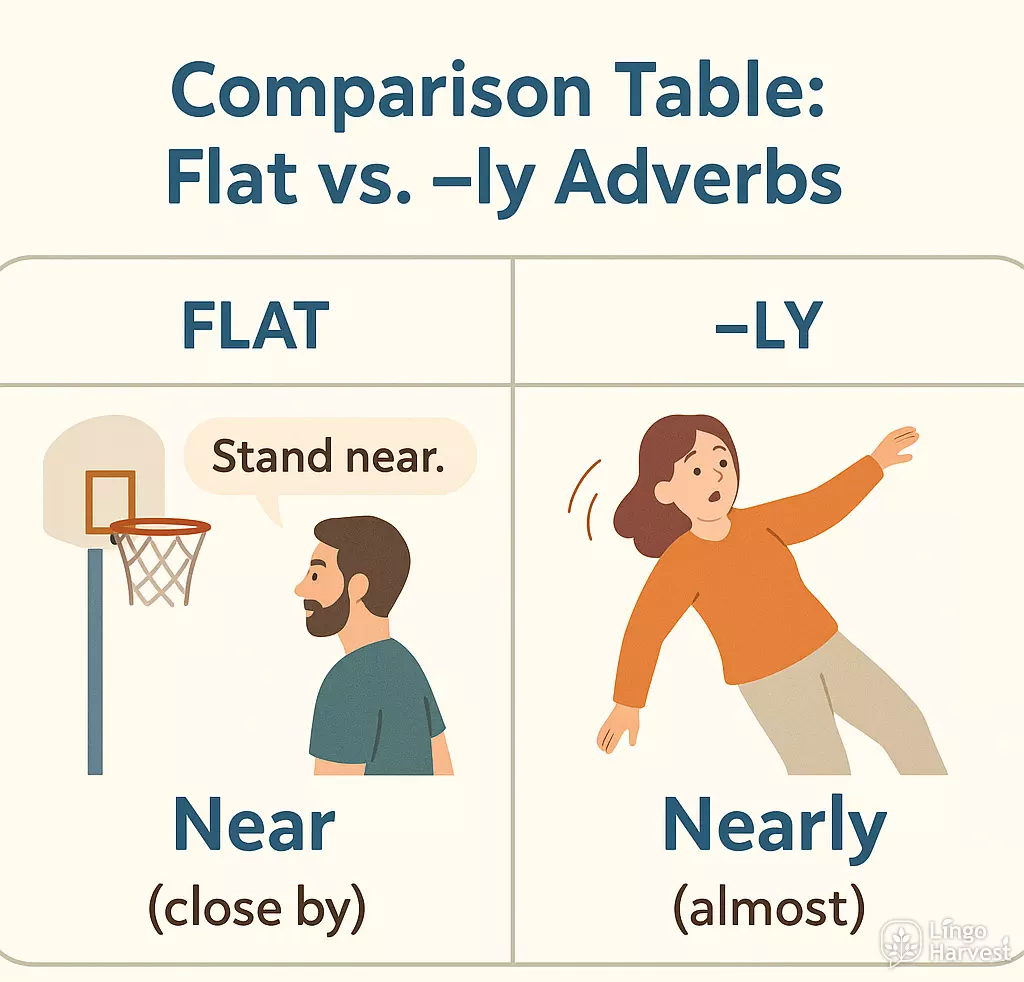
Comparison Table: Flat vs. -ly Adverbs
| Flat Adverb | -ly Adverb | Example & Meaning |
|---|---|---|
| Hard | Hardly | Hard: "She studies hard." (with effort) Hardly: "She hardly studies." (almost not at all) |
| Late | Lately | Late: "He arrived late." (not on time) Lately: "He has been arriving lately." (in recent times) |
| Near | Nearly | Near: "Stand near." (close by) Nearly: "She nearly fell." (almost) |
| Short | Shortly | Short: "Pull up short." (suddenly) Shortly: "I'll be there shortly." (soon) |
| Right | Rightly | Right: "Turn right." (direction) Rightly: "She was rightly upset." (justifiably) |
| Direct | Directly | Direct: "Go direct to the station." (without stopping) Directly: "He answered directly." (straightforwardly) |
| Clean | Cleanly | Clean: "Cut clean through." (completely) Cleanly: "He cut cleanly." (in a clean manner) |
| High | Highly | High: "Fly high." (at a great height) Highly: "Highly recommended." (very much) |
| Wide | Widely | Wide: "Open wide." (to a great extent) Widely: "Widely accepted." (by many people) |
| Cheap | Cheaply | Cheap: "Buy cheap." (at a low price, informal) Cheaply: "The product was cheaply made." (inexpensively) |
Summary Points
- Flat adverbs can sound more natural or informal in some contexts.
- -ly adverbs sometimes carry a distinct or more formal meaning.
- For certain words, the two forms are not interchangeable; meanings may differ significantly.
- Choosing the right form enhances clarity and precision in both speech and writing.
Examples in Sentences
Flat adverbs often appear in everyday speech and writing, sometimes going unnoticed because they look identical to adjectives. To better understand how these words function, let's look at a variety of usage cases. These samples show how such adverbs can modify verbs without the typical "-ly" ending, and how their meaning shifts depending on context.
Common Flat Adverbs in Context
- Drive slow when the roads are icy.
- The train arrived late last night.
- He ran fast to catch the bus.
- She turned the knob hard, but the door wouldn’t open.
- The children played quiet after dinner.
- Speak loud so everyone can hear you.
- He hit the ball straight down the field.
- They worked long into the night.
- The dog sat close to the fire.
- I like my eggs sunny side up and my coffee black.
- She stood near the window.
- He jumped high to reach the shelf.
- We arrived early for the meeting.
- The team finished strong in the final quarter.
- She always comes straight home after work.
- He answered short, not wanting to talk.
Comparing Flat Adverbs and -ly Forms
Sometimes both the flat form and the "-ly" version are accepted, but the tone or meaning may shift. Here's a comparison:
| Flat Adverb | -ly Form (if used) |
|---|---|
| Drive slow. | Drive slowly. (More formal or traditional) |
| He spoke loud. | He spoke loudly. (Preferred in writing) |
| She turned hard. | She turned hardly. (Completely different meaning: "barely") |
| He ran fast. | No "-ly" form exists; "fastly" is incorrect ❌. |
| Come quick! | Come quickly! (Both are common in speech) |
Observations on Usage
Writers and speakers sometimes choose the flat form for a more conversational or informal style. In certain cases, only the flat version is correct (for example, "run fast" ✅, but not "run fastly" ❌). In other cases, both forms are possible, and the choice can depend on context or personal preference. Seeing these words in action helps clarify how flexible English can be when adjectives take on an adverbial role. Notice how the sentence meaning remains clear, even when the adverb does not end in "-ly."
Beginner Errors
Many new writers and speakers stumble when dealing with words that can function both as adjectives and as adverbs—so-called flat adverbs. The confusion often arises because these forms break the more familiar -ly adverb pattern, making it tricky to recognize when their use is correct. Mixing up flat adverbs with adjectives or mistakenly adding -ly where it doesn’t belong are typical pitfalls.
Common Pitfalls with Flat Adverbs
- Adding an unnecessary -ly ending: saying "drive safely" instead of "drive safe" when "safe" is acceptable in casual speech.
- Assuming "wrong" and "wrongly" are always interchangeable: "You spelled it wrong" vs. "You spelled it wrongly."
- Believing "real" can never modify verbs: "He runs real fast" is standard in some dialects but often marked as nonstandard in formal writing.
- Using "quick" incorrectly: "Come quick!" (informal, but common) vs. "Come quickly!" (formally correct).
- Overcorrecting to avoid a flat adverb: changing "sit tight" to "sit tightly," which sounds awkward.
- Confusing meaning: "hard" (with effort) vs. "hardly" (barely).
- Using "sure" instead of "surely": "He sure can dance" (colloquial, not formal).
- Misplacing "slow": "Drive slow" is common, but "drive slowly" is often preferred in formal English.
- Incorrect forms with "easy": "Take it easy" (correct) vs. "Take it easily" (which changes the nuance).
- Applying rules inconsistently: sometimes using "fast" and sometimes "fastly" (which isn’t a word).
Spotting the Differences
Flat adverbs can look identical to adjectives, which leads to mix-ups. It helps to check if the word is modifying a verb (adverb role) or a noun (adjective role). For example, in "He runs fast," "fast" describes how he runs (adverb). In "He is a fast runner," "fast" describes the noun "runner" (adjective).
| Adjective | Flat Adverb | -ly Adverb | Example Sentence |
|---|---|---|---|
| hard | hard | hardly | She works hard. ✓ She hardly works. ✓ (different meaning: “almost not at all”) |
| fast | fast | — | The car goes fast. ✓ He drove fastly. ✗ incorrect (fastly is not a valid adverb) |
| late | late | lately | He arrived late. ✓ He has been late lately. ✓ (different function) |
| wrong | wrong | wrongly | You spelled it wrong. ✓ informal You judged wrongly. ✓ formal |
| easy | easy | easily | Take it easy. ✓ (idiomatic) She solved it easily. ✓ |
| slow | slow | slowly | Drive slow. ✓ informal Drive slowly. ✓ formal / standard |
| sure | sure | surely | You sure can sing. ✓ informal You surely can sing. ✓ formal |
| clear | clear | clearly | Speak clear. ✓ dialect / non-standard Speak clearly. ✓ standard |
| fair | fair | fairly | Play fair. ✓ The test was fairly hard. ✓ |
| tight | tight | tightly | Hold tight. ✓ Hold tightly. ✓ |
| near | near | nearly | Come near. ✓ We nearly won. ✓ (meaning: “almost”) |
| wide | wide | widely | Open your eyes wide. ✓ The book is widely known. ✓ (different meaning) |
| close | close | closely | Stay close. ✓ They are closely related. ✓ |
| high | high | highly | Prices are high. ✓ She is highly respected. ✓ (different meaning) |
| deep | deep | deeply | Breathe deep. ✓ informal She was deeply moved. ✓ |
| free | free | freely | Walk free. ✓ (meaning: “not imprisoned”) They spoke freely. ✓ |
| clean | clean | cleanly | Hit it clean. ✓ informal (sports) The cut was cleanly made. ✓ |
| sharp | sharp | sharply | Turn sharp. ✓ informal Prices rose sharply. ✓ |
Tips to Avoid Missteps
- Check if a word ending in -ly changes the meaning ("hard" vs. "hardly").
- Consider the context: formal writing often expects -ly forms, while speech may prefer flat adverbs.
- Remember that not every adjective has a corresponding flat adverb ("fastly" is always incorrect).
- Read your sentence aloud—if the flat form sounds awkward, try the -ly version and see if it fits better.
Grasping these tricky forms takes practice, but noticing the typical places where mistakes occur will help you write and speak with more confidence.
Mini Practice
Try your hand at recognizing and using words that function as adverbs without the typical -ly ending. These exercises will help you get comfortable with how certain adjectives double as adverbs, sometimes creating confusion.
Identify the Flat Adverb
In each sentence below, spot the word that is acting as an adverb but looks like an adjective. Write it down or just think about your answer.
- She runs fast every morning.
- Drive safe in the rain.
- The teacher spoke loud so everyone could hear.
- Please turn the music down.
- He arrived late to the meeting.
Show answers
- fast
- safe
- loud
- down
- late
Choose the Correct Form
Pick the proper word for each blank. Sometimes, both options are used in English, but one is more standard.
- He answered the question (clear / clearly).
- They arrived (late / lately) for the show.
- Please drive (slow / slowly) in the neighborhood.
- The baby slept (sound / soundly) through the night.
- She smiled (bright / brightly) at her friend.
Show answers
- clearly
- late
- slow or slowly (both possible, but "slowly" is more formal)
- soundly
- brightly
Common Flat Adverbs and Their "Ly" Counterparts
Some adverbs can appear in both forms. Familiarize yourself with pairs that are often used interchangeably or in specific contexts.
| Flat Adverb | With -ly | Example Sentence |
|---|---|---|
| fast | fastly ❌ (not used) | She ran fast. |
| hard | hardly (different meaning) | He worked hard. |
| late | lately (different meaning) | They arrived late. |
| high | highly (different meaning) | The bird flew high. |
| straight | straightly ❌ (not used) | Go straight ahead. |
| safe | safely | Drive safe. / Drive safely. |
| slow | slowly | Speak slow. / Speak slowly. |
| loud | loudly | Talk loud. / Talk loudly. |
| wrong | wrongly | You guessed wrong. / You guessed wrongly. |
| quick | quickly | Act quick. / Act quickly. |
Rewrite with Flat Adverbs
Change the sentences by replacing the -ly adverb with its flat (adjective) form, where natural. If it sounds awkward, note it.
- She spoke softly to the child.
- Please drive carefully.
- He answered quickly.
- They worked quietly in the library.
- Turn the music down quietly.
Show answers
- She spoke soft to the child. (used in some dialects/informal English)
- Please drive careful. (informal, but heard in speech)
- He answered quick. (common in speech)
- They worked quiet in the library. (rare; "quiet" as adverb is not standard)
- Turn the music down quiet. (awkward; "quietly" is preferred)
Practicing with these examples helps you recognize when adjectives step in as adverbs and where standard usage prefers one form over another. Not all adjective forms are accepted as adverbs in every context—pay attention to what sounds natural and what is considered formal or informal.