-ly vs Non-ly Adverbs: Formation Rules

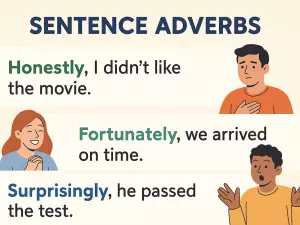
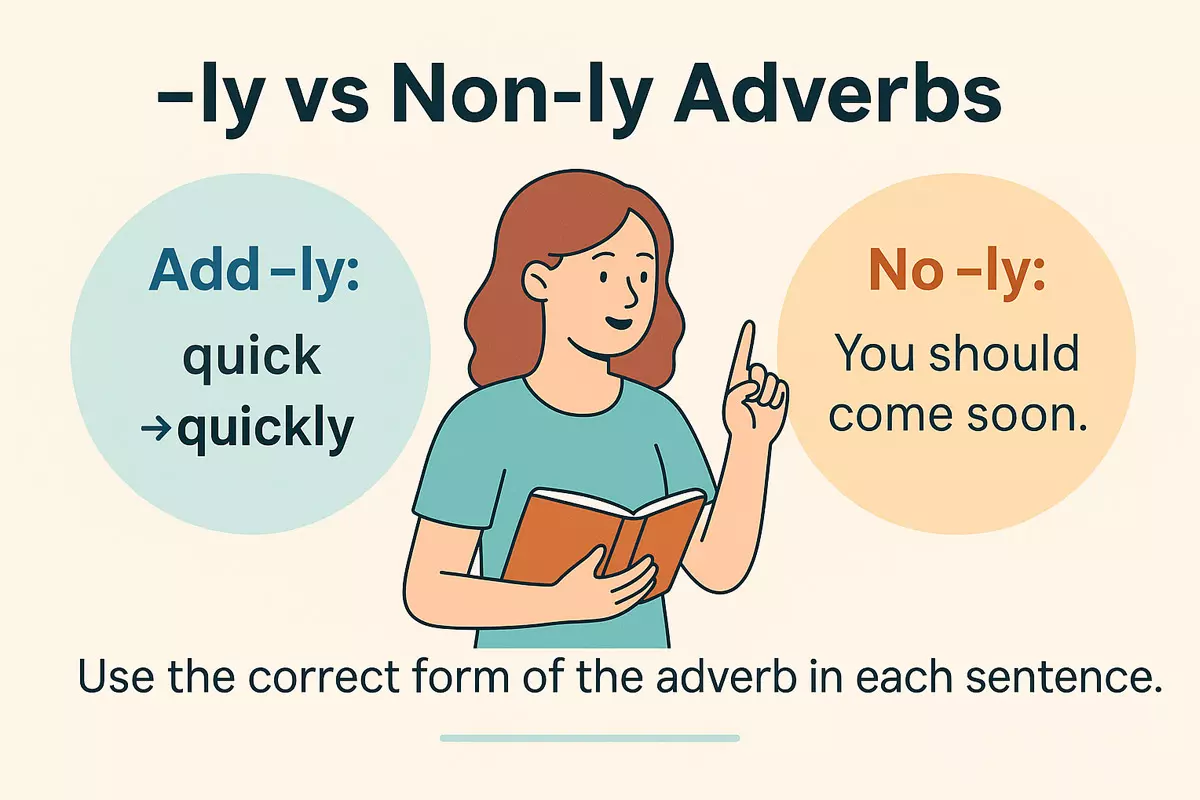 Here we how to create adverbs from adjectives with -ly, points out adjectives that do not take -ly, discusses words whose meaning changes with -ly, reviews spelling changes, highlights common mistakes, and offers practice exercises.
Have you ever noticed that some words describing actions end in -ly, while others do not? Learning how to correctly form and use these different types of adverbs can improve your writing by adding clarity and precision. Adverbs often modify verbs, adjectives, or even other adverbs, helping to convey how, when, where, or to what extent something happens. By using adverbs thoughtfully, you can make your sentences more expressive and your meaning more accurate, enhancing the overall quality of your communication.
Typical -ly adverbs from adjectives
Many adverbs in English are created by adding -ly to the base form of adjectives. This transformation is highly productive and applies to a wide range of descriptive words, making it one of the most recognizable ways to form adverbs. These forms often express manner, degree, or frequency, and are used to modify verbs, adjectives, or other adverbs in a sentence.
How the -ly ending is added
Generally, simply attach -ly to the adjective. However, there are a few spelling patterns to watch for:
- If the adjective ends in -y, change the y to i before adding -ly (happy → happily).
- Adjectives ending in -le often replace the e with y (gentle → gently).
- Some adjectives ending in -ic require -ally instead (basic → basically).
| Adjective | Adverb |
|---|---|
| quick | quickly |
| careful | carefully |
| happy | happily |
| gentle | gently |
| loud | loudly |
| slow | slowly |
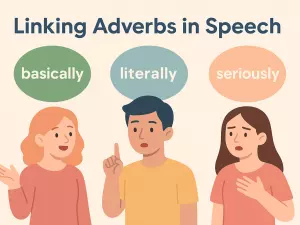
| basic | basically |
| automatic | automatically |
| real | really |
| final | finally |
| honest | honestly |
| frequent | frequently |
| fortunate | fortunately |
| polite | politely |
| simple | simply |
| serious | seriously |
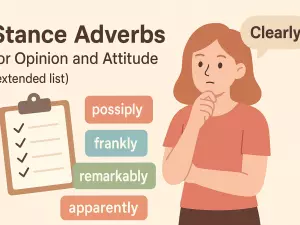
| possible | possibly |
| usual | usually |
| sad | sadly |
| brave | bravely |
Usage notes
These adverbs are typically used to describe how something is done: “She spoke softly,” or “He completed the task efficiently.” In most cases, the meaning is predictable from the adjective. However, some -ly adverbs can have idiomatic meanings, so it’s always worth checking examples in context.
Adjectives that do not take -ly
Many English adjectives do not form adverbs by simply adding the -ly suffix. In fact, for some words, the -ly ending either doesn’t exist or would produce a completely different word with a new meaning. Recognizing these adjectives is important for building natural, accurate sentences. Some adjectives already end in -ly, but these are not adverbs. For example, "friendly," "lovely," and "lonely" are all descriptive words, but you wouldn’t say "friendlily" or "lovelily" in standard English. Other adjectives simply don’t have a standard -ly adverb form at all.
Common adjectives without -ly adverb forms
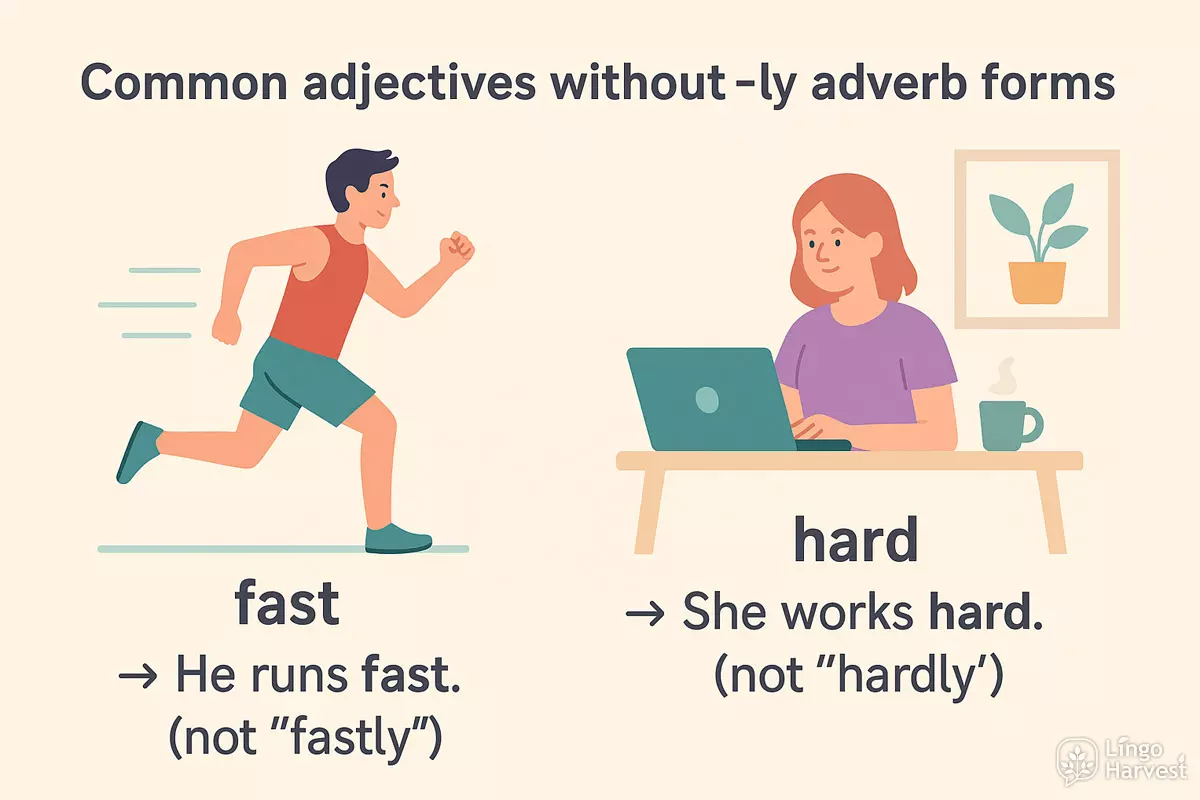
Here are several descriptive words that don’t take the -ly ending to make adverbs:
- fast → He runs fast. (not “fastly”)
- hard → She works hard. (not “hardly”)
- late → He arrived late. (not “lately”)
- early → They woke up early.
- straight → Go straight ahead.
- daily → The bus runs daily. (adverb already)
- friendly → She greeted us in a friendly way.
- lovely → She smiled in a lovely way.
- lively → The kids played in a lively manner.
- deadly → The snake struck in a deadly way.
- costly → They won, but at a costly price.
- holy → He acted in a holy manner.
- lonely → She looked at him in a lonely way.
- manly → He spoke in a manly tone.
- elderly → He walked in an elderly manner.
- orderly → The students left in an orderly way.
- cowardly → He behaved in a cowardly way.
- silly → She laughed in a silly way.
- ugly → He reacted in an ugly way.
- timely → The update arrived in a timely fashion.
- weekly → The newsletter is sent weekly.
- monthly → Rent is paid monthly.
- yearly → Membership renews yearly.
- mere → He stopped mere inches away. (adjective only)
- utter → That was utter nonsense.
- sheer → It was sheer luck.
- counterclockwise → Turn counterclockwise. (already adverb)
Adjectives ending in -ly: Not adverbs
It’s easy to mistake words like "friendly" or "orderly" for adverbs because of the -ly ending. However, these are strictly adjectives. If you want to modify a verb, you’ll need to use a different construction. For example, you can say "in a friendly way" but not "friendlily."
Adjectives and their related adverbs: When forms differ
Some adjectives have adverb forms that do not follow the standard -ly pattern, or the adverb looks the same as the adjective. Here’s a look at a few:
| Adjective | Adverb Form |
|---|---|
| fast | fast |
| hard | hard |
| late | late |
| early | early |
| straight | straight |
| daily | daily |
| long | long |
Notice that for words like "hard" or "fast," the adverb form is identical to the adjective. Using "hardly" or "fastly" would change the meaning or sound unnatural. Understanding these patterns helps prevent common mistakes and leads to clearer, more precise writing.
Words that change meaning with -ly
Some English adverbs are formed by simply adding -ly to an adjective, but this transformation can create a new word with a distinct meaning—not just a grammatical shift. Sometimes, the base word and its -ly form are both adverbs, yet they express different ideas. Recognizing these pairs helps avoid confusion and subtle errors in usage.
Common examples where -ly alters the meaning
Plenty of terms shift their sense once the suffix is added. Here are some frequent cases:
- Hard / Hardly — “Hard” means with force or effort (“work hard”), while “hardly” means barely or almost not (“hardly working”).
- Near / Nearly — “Near” describes proximity (“stand near”), but “nearly” means almost (“nearly finished”).
- Late / Lately — “Late” refers to time (“arrive late”), while “lately” means recently (“have you seen her lately?”).
- Close / Closely — “Close” is about distance or relationship (“stand close”), whereas “closely” means in a detailed manner (“closely examine”).
- Pretty / Prettily — “Pretty” can mean somewhat (“pretty easy”), but “prettily” means in a pretty way (“dressed prettily”).
- Short / Shortly — “Short” is about length or duration (“cut it short”), and “shortly” means soon (“will arrive shortly”).
- Most / Mostly — “Most” is the superlative (“the most important”), while “mostly” means mainly (“mostly sunny”).
- Direct / Directly — “Direct” can mean straight (“a direct route”), but “directly” means immediately (“leave directly after”).
- Fair / Fairly — “Fair” means just or light in color (“a fair decision”), while “fairly” means somewhat (“fairly difficult”).
- Wide / Widely — “Wide” is about extent (“eyes wide open”), and “widely” means by many or in many places (“widely known”).
- Right / Rightly — “Right” means correct or directly (“turn right”), but “rightly” means justifiably (“rightly praised”).
- Sharp / Sharply — “Sharp” is about precision or suddenness (“turn sharp left”), while “sharply” describes manner (“sharply criticized”).
- Free / Freely — “Free” is without cost or restriction (“speak free”), but “freely” means without hindrance (“speak freely”).
- Deep / Deeply — “Deep” relates to distance below the surface (“breathe deep”), while “deeply” expresses intensity (“deeply moved”).
- Loud / Loudly — “Loud” is about volume (“talk loud”), and “loudly” refers to manner (“talk loudly”).
- High / Highly — “High” is about position or degree (“jump high”), while “highly” means very or favorably (“highly recommended”).
- Wrong / Wrongly — “Wrong” means incorrectly (“spell wrong”), but “wrongly” is more formal for “in a wrong manner” (“wrongly accused”).
- Wide / Widely — “Wide” means broadly open (“spread wide”), while “widely” means extensively (“widely accepted”).
Comparing meanings at a glance
Some pairs are easier to grasp when you see their differences side by side. Here’s a quick reference:
| Base Word | With -ly | Meaning Difference |
|---|---|---|
| Hard | Hardly | With effort → Almost not |
| Late | Lately | After expected time → Recently |
| Near | Nearly | Close in space → Almost |
| Deep | Deeply | Far below surface → Intensely |
| Short | Shortly | Not long → Soon |
| Direct | Directly | Without deviation → Immediately |
| High | Highly | At a great height → Very, favorably |
| Free | Freely | Without cost → Without restriction |
Why these differences matter
Understanding these contrasts helps you avoid mistakes like saying “I can hardly wait” (which means you almost can’t wait, or you’re very eager) versus “I can wait hard” (which doesn’t make sense). Being aware of these shifts not only improves clarity but also polishes your English for both writing and conversation.
Spelling changes when adding -ly
When turning adjectives into adverbs by attaching -ly, English spelling sometimes shifts to keep pronunciation clear or to follow standard rules. Not every word follows the same pattern, so it helps to know the main types of adjustments that happen during this process.
Typical spelling modifications
Some adjectives require a spelling tweak before -ly is added. Here are the most frequent categories:
- Final -y change: If an adjective ends in -y (after a consonant), change -y to -i before adding -ly.
Example: happy → happily - Ending in -ic: For adjectives ending in -ic, add -ally instead of just -ly.
Example: basic → basically - Final -le: If the adjective ends in -le (after a consonant), replace -le with -ly.
Example: gentle → gently - Final -ll: Just add -y (no extra -l needed).
Example: full → fully - No change needed: For most adjectives not fitting these patterns, simply attach -ly.
Example: quick → quickly
Common words showing spelling shifts
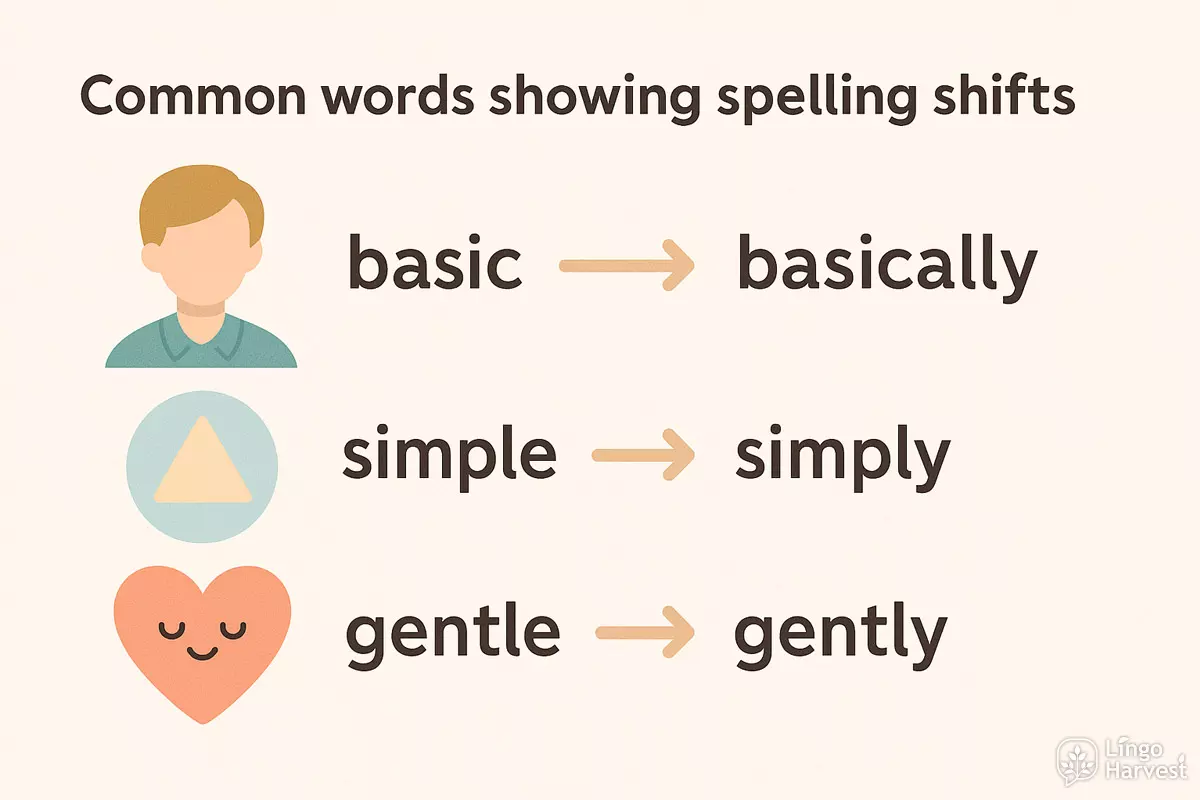
Below is a list of adjectives and their adverb forms, highlighting how the base word can change:
- happy → happily
- angry → angrily
- easy → easily
- tragic → tragically
- automatic → automatically
- basic → basically
- simple → simply
- gentle → gently
- terrible → terribly
- possible → possibly
- full → fully
- public → publicly
- specific → specifically
- real → really
- quick → quickly
- careful → carefully
- beautiful → beautifully
- normal → normally
- final → finally
- special → specially
Summary of spelling patterns
To make it easy to compare the most frequent spelling changes, here’s a quick overview:
| Adjective Ending | Rule for Adding -ly | Example |
|---|---|---|
| -y (after consonant) | Change -y to -i, add -ly | easy → easily |
| -ic | Add -ally | tragic → tragically |
| -le (after consonant) | Change -le to -ly | gentle → gently |
| -ll | Add -y (no extra -l) | full → fully |
| Most other endings | Just add -ly | quick → quickly |
These patterns cover the majority of spelling adjustments you’ll encounter when converting adjectives to their -ly adverb forms. Watch for exceptions, but these rules will help with most cases.
Avoiding double adverbs and wrong forms
Misusing adverbs, especially those with and without the -ly ending, is a common pitfall. One frequent error is doubling up on adverb markers, such as saying “fastly quickly” or “really happilyly”. This happens when speakers try to intensify or modify adverbs without considering if the form is correct or necessary.
Common Double Adverb Mistakes
Stacking two adverbs can sound awkward and is almost always grammatically wrong. Here are some patterns to watch out for:
- Wrong: She ran very fastly. ❌
- Right: She ran very fast. ✅
- Wrong: He finished his work quickly rapidly. ❌
- Right: He finished his work extremely quickly. ✅
- Wrong: The dog barked loudly noisily. ❌
- Right: The dog barked very loudly. ✅
Choosing the Correct Adverb Form
Many adverbs do not take -ly endings, even though it might seem logical. Using a non-existent -ly form is a typical error. Here’s a list of commonly misused adverbs and their proper forms:
- fast (not fastly)
- hard (not hardly, which means “almost not”)
- late (not lately, which means “recently”)
- early (not earlyly)
- well (not goodly)
- straight (not straightly)
- high (not highly when meaning “in the air”)
- right (not rightly except in rare senses)
- wide (not widely for physical width)
- long (not longly)
- far (not farly)
- short (not shortly when referring to length)
- near (not nearly for distance)
- wrong (not wrongly unless meaning “incorrectly”)
Different Meanings: -ly vs Non-ly Adverbs
Some adverbs change meaning depending on whether they have the -ly ending or not. Here’s a comparison for clarity:
| Adverb | Meaning | Example |
|---|---|---|
| Hard | With effort, intensely | He works hard every day. |
| Hardly | Almost not, barely | He hardly works at all. |
| Late | After the expected time | She arrived late. |
| Lately | Recently | She has been busy lately. |
| Near | Close in distance | He stood near the door. |
| Nearly | Almost | He nearly missed the bus. |
| High | At a great height | The plane flew high. |
| Highly | Very, extremely | She is highly skilled. |
Tips for Correct Usage
- Check if an adverb exists in both -ly and non-ly forms; meanings may differ.
- Don’t add -ly to adverbs that already function without it.
- Use intensifiers like very, quite, or extremely instead of doubling adverbs.
- When in doubt, consult a dictionary to confirm if an -ly form is valid.
Being aware of these patterns helps maintain clear and natural-sounding English.
Practice: turn adjectives into adverbs where possible
Transforming adjectives into adverbs is a common task in English grammar, especially when you want to describe how an action is performed. Most adverbs are formed by adding -ly to the adjective, but there are notable exceptions and irregular forms. Let’s explore how these transformations work and then try some practice exercises.
Common Patterns for Forming Adverbs
- Add -ly to most adjectives: quick → quickly.
- If the adjective ends in -y, change y to i and add -ly: happy → happily.
- Adjectives ending in -le: replace -le with -ly: gentle → gently.
- Some adjectives don’t form adverbs with -ly and use different forms: good → well.
- There are adjectives that don’t have standard adverb forms (e.g., friendly).
Examples: Adjectives and Their Adverb Forms
| Adjective | Adverb | Example |
|---|---|---|
| quick | quickly | She finished the task quickly. |
| careful | carefully | He checked the document carefully. |
| loud | loudly | The dog barked loudly. |
| bad | badly | He played badly today. |
| good | well | She sings very well. |
| hard | hard | They worked hard all day. |
| late | late | He arrived late. |
| fast | fast | The car moves fast. |
| friendly | in a friendly way | She welcomed us in a friendly way. |
| slow | slowly | The turtle moves slowly. |
| quiet | quietly | The students worked quietly. |
| serious | seriously | He takes his job seriously. |
| polite | politely | She asked politely. |
| angry | furiously | He stormed out furiously. |
| happy | joyfully | The children played joyfully. |
| gentle | softly | She spoke softly to the baby. |
| beautiful | gracefully | She danced gracefully. |
| simple | plainly | He explained the rules plainly. |
| easy | effortlessly | She solved the puzzle effortlessly. |
| real | genuinely | He seemed genuinely surprised. |
Practice Task: Change the Adjective to an Adverb
Rewrite the adjectives below as adverbs where possible. If a standard adverb form does not exist, note it.
- angry
- polite
- good
- late
- happy
- hard
- friendly
- simple
- beautiful
- real
Show answers
- angrily
- politely
- well
- late
- happily
- hard
- (no standard adverb; use "in a friendly way")
- simply
- beautifully
- really
Notice that some words, like hard and late, are the same in both adjective and adverb forms, while others, such as good, become irregular (well). For adjectives like friendly, English typically uses a phrase instead of a single adverb.