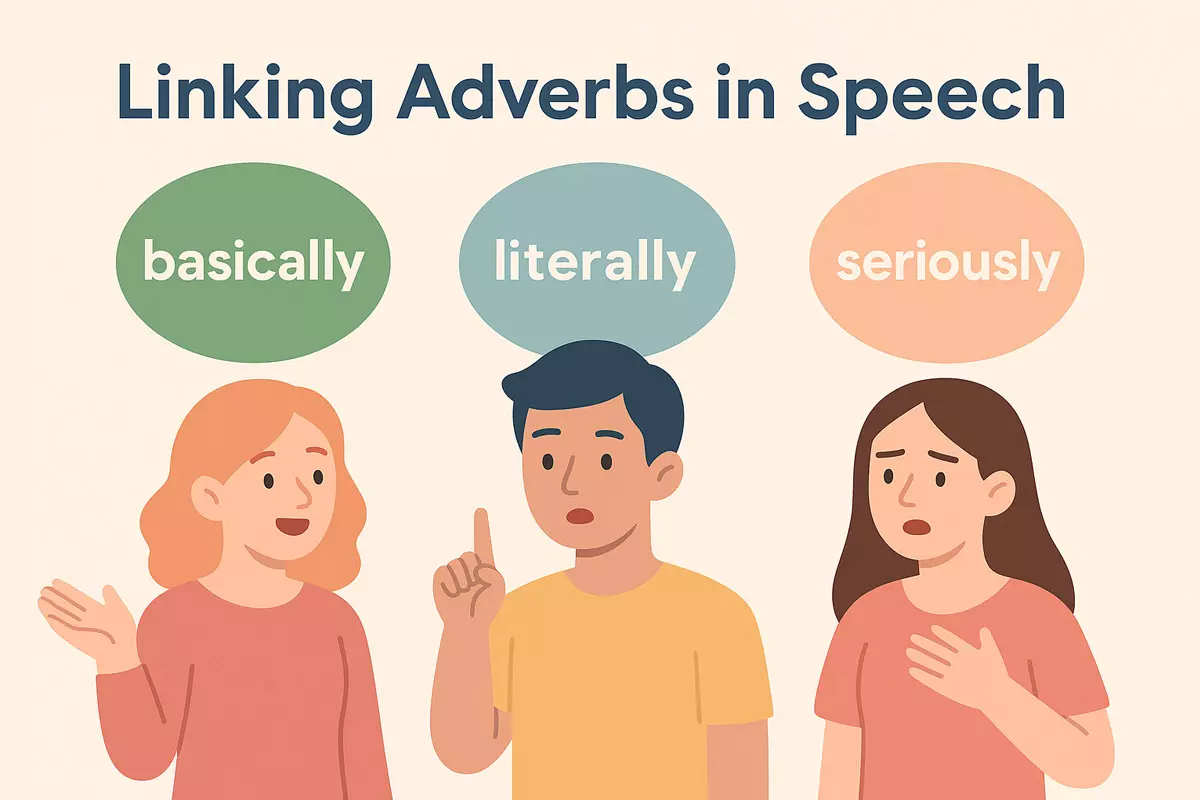
Linking Adverbs in Speech: basically, literally, seriously

 Here we how linking adverbs differ from fillers, how to use them to organize speech, when words like basically or literally sound natural, tips for avoiding overuse, real-life examples, and a practice dialogue for choosing linking adverbs.
Have you ever noticed how words such as essentially, actually, or honestly frequently appear in everyday conversation, subtly influencing the flow and tone of our speech? These seemingly small connectors serve an important purpose in spoken English by helping to guide listeners through our thoughts and intentions. They can add emphasis, introduce clarification, or signal a shift in perspective, making our communication more engaging and easier to follow. By using these words thoughtfully, we can enhance the clarity and nuance of our conversations.
Difference between linking adverbs and fillers
Understanding how linking adverbs and fillers function in speech can help clarify why words like "basically," "literally," and "seriously" often get confused with conversational padding. Both types of words appear frequently in spoken English, but they serve distinct purposes.
Core Functions
Linking adverbs play a role in connecting ideas, clarifying relationships between statements, or transitioning smoothly between thoughts. For example, "basically" can summarize or simplify a point, while "seriously" may signal emphasis. In contrast, fillers such as "um," "uh," "like," or "you know" don't add meaning to the content; instead, they give speakers time to think or soften statements.
- Linking adverbs: Show logical connections (e.g., "however," "therefore," "meanwhile").
- Fillers: Mark hesitation, uncertainty, or conversational pauses (e.g., "uh," "well," "so").
Usage in Speech
While linking adverbs organize and structure spoken language, fillers tend to appear when someone is searching for words or needs a moment to gather their thoughts. Overuse of fillers can make speech seem less confident or less fluent, but well-placed linking adverbs make communication clearer and more persuasive.
Examples of Common Linking Adverbs and Fillers
- Linking adverbs: basically, literally, seriously, however, therefore, moreover, furthermore, nevertheless, consequently, instead, otherwise, meanwhile, similarly, incidentally, certainly, undoubtedly, frankly, clearly, additionally, thus
- Fillers: um, uh, er, like, you know, well, so, actually, I mean, sort of, kind of, right, okay, hmm, ah, hmm, basically (as a filler), literally (as a filler)
Quick Comparison
| Feature | Linking Adverbs | Fillers |
|---|---|---|
| Purpose | Connect ideas, clarify relationships | Fill pauses, indicate hesitation |
| Adds Meaning? | ✅ Yes | ❌ No |
| Examples | basically, literally, seriously, however | um, uh, like, you know |
| Position in Sentence | Usually at the start or before the main clause | Anywhere in the sentence, often mid-thought |
In summary, linking adverbs improve the flow and logic of speech, while fillers are mainly used to buy time or ease transitions. Recognizing their differences can lead to more effective and confident communication.
How to use linking adverbs to structure speech
Linking adverbs like basically, literally, and seriously help to organize spoken language, making ideas clearer and transitions smoother. These words often signal emphasis, clarification, or a shift in tone, guiding listeners through your message. Using them thoughtfully can make your speech feel more natural and engaging.
Common ways to use linking adverbs in conversation
- Introducing a summary: Basically is often used to sum up or simplify information. Example: "Basically, we need to finish by Friday."
- Emphasizing facts: Literally can stress that something is true or not exaggerated. Example: "I literally ran five kilometers this morning."
- Expressing sincerity or intensity: Seriously shows that you mean what you say. Example: "Seriously, you should try this dessert."
- Clarifying or correcting: Linking adverbs can introduce corrections. Example: "Actually, I meant next week, not this week."
- Changing topics: Words like anyway or so help steer the conversation. Example: "Anyway, let’s move on to the next topic."
- Adding contrast: However and on the other hand signal a different point of view. Example: "However, not everyone agrees."
- Giving examples: For instance or for example introduce supporting details. Example: "For example, some people prefer tea."
- Showing cause and effect: Therefore or as a result connect reasons and outcomes. Example: "It was raining, so we stayed inside."
- Highlighting importance: Importantly draws attention to a key idea. Example: "Importantly, all documents must be submitted."
- Softening statements: Actually or to be honest can make corrections sound gentler. Example: "To be honest, I didn’t enjoy the movie."
Position in a sentence
These adverbs usually come at the beginning or between clauses for emphasis. For a more conversational feel, place them at the start: "Basically, what happened was..." Sometimes, they can be used mid-sentence: "The solution, basically, is to try again."
Practical examples of linking adverbs in speech
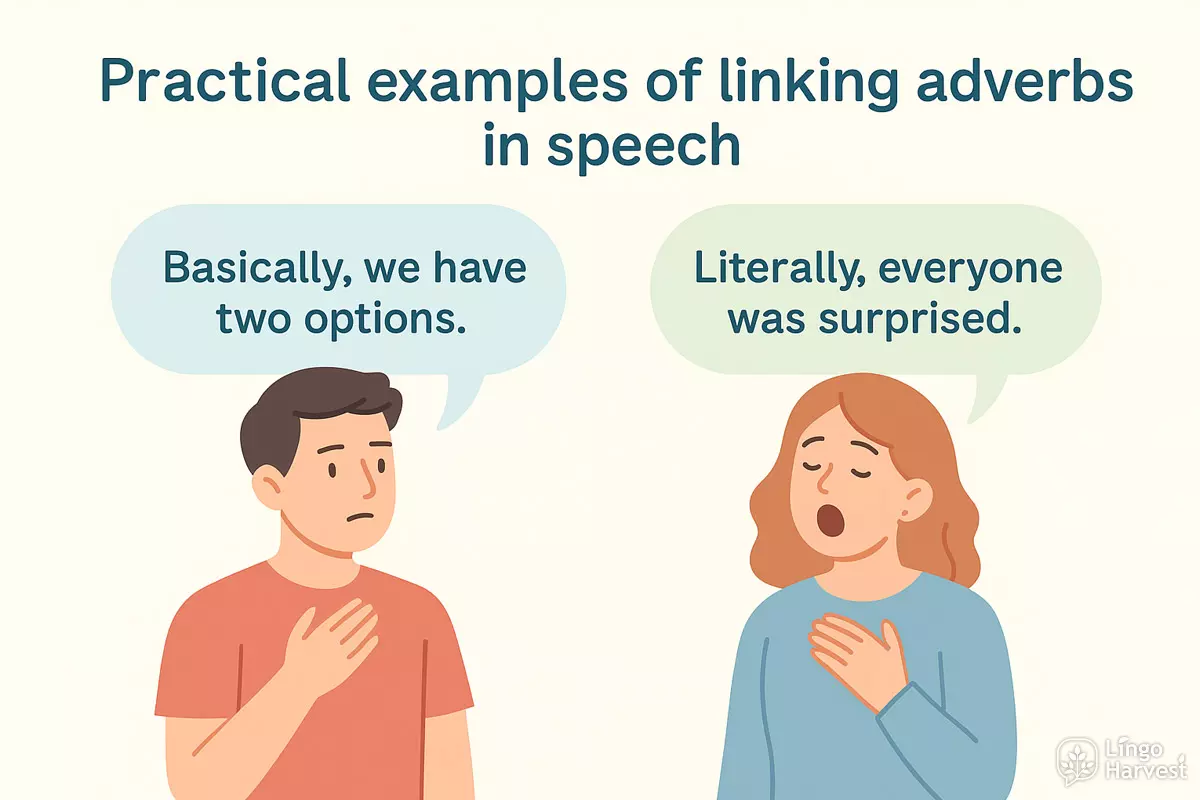
- "Basically, we have two options."
- "Literally, everyone was surprised."
- "Seriously, I can help you with that."
- "Actually, I have a different idea."
- "Anyway, let's get back to the point."
- "However, there’s another side to the story."
- "For example, you might see this in presentations."
- "Therefore, we decided to change plans."
- "Importantly, don’t forget your ID."
- "To be honest, I’m not sure."
- "On the other hand, some people disagree."
- "So, what do you think?"
- "In fact, it’s easier than it looks."
- "After all, we’re only human."
- "Overall, the results were positive."
Tips for using linking adverbs effectively
- Use them to clarify your main point or to make transitions smoother.
- Avoid overusing the same adverb; variety keeps your speech interesting.
- Pay attention to tone: some adverbs sound more formal than others.
- Practice using these words in everyday conversation for fluency.
When basically/literally/seriously sound natural
Using adverbs like "basically," "literally," and "seriously" in conversation can make your speech sound more fluent and relatable—when they're chosen for the right context. These words typically act as linking adverbs, helping to clarify, emphasize, or express attitude. However, their naturalness depends on the situation, tone, and the speaker's intent.
Situations Where These Adverbs Fit Naturally
- Explaining a simplified version: "Basically" works when you want to summarize or give the gist of something.
- Expressing factual accuracy: "Literally" is appropriate when you mean something in a direct, non-figurative sense.
- Showing genuine emotion or urgency: "Seriously" is used to stress importance or sincerity.
- Reacting to surprising news: All three can be used for emphasis in conversational reactions.
- Clarifying a misunderstanding: "Literally" and "seriously" help correct false assumptions.
- Summing up after details: "Basically" wraps up complex points.
- Making requests or warnings stronger: "Seriously, you need to try this."
- During storytelling: To add color or clarify the tone.
- Contrasting with exaggeration: "Literally" counters hyperbole.
- Softening criticism: "Basically, I think we could do better."
Common Pitfalls and What Sounds Unnatural
Overusing these adverbs can make speech sound insincere or exaggerated. "Literally" is often misused for emphasis, even when the situation is not literal. "Basically" can sound redundant if the explanation is already simple, and "seriously" may come off as sarcastic if the tone doesn't match the context.
Examples in Everyday Speech
- "Basically, we need to finish this by Friday."
- "I literally ran into my old teacher at the store."
- "Seriously, that was the best movie I've seen all year."
- "I was so tired I could barely stand—literally."
- "Basically, it's like this: you pay monthly, and you get unlimited access."
- "You seriously have to try this dessert."
- "He was literally shaking with excitement."
- "Basically, we just need to follow these three steps."
- "Are you seriously going to wear that?"
- "I literally can't believe it worked!"
Quick Reference: Natural vs. Unnatural Usage
| Natural Example | Unnatural Example |
|---|---|
| Basically, the meeting is just to update everyone. | Basically, I like pizza. (Too simple, redundant) |
| I literally jumped when I saw the spider. | I literally died laughing. (Not literal, exaggeration) |
| Seriously, let me know if you need help. | Seriously, I went to the store. (Unnecessary emphasis) |
| She was basically in charge of the whole project. | Basically, basically, basically… (Overuse) |
In short, these linking adverbs sound most natural when they truly add meaning—summarizing, emphasizing accuracy, or expressing a real attitude. Consider your audience and the context to make your speech both clear and authentic.
Avoiding overuse and informal overload
Relying too much on words like "basically," "literally," or "seriously" can make speech sound repetitive or overly casual. These linking adverbs are useful for emphasizing points or clarifying intent, but frequent repetition may weaken your message and distract listeners. To keep your language engaging and precise, it’s important to balance these expressions with more varied transitions and to consider your audience.
Recognizing when to limit these adverbs
Speakers often fall into the habit of inserting familiar adverbs out of comfort or to fill pauses. Monitoring your own speech for patterns can help you spot unnecessary reliance. For example, beginning every explanation with "basically" can make your contributions seem oversimplified or dismissive.
- Mix adverbs with other connectors like "however," "therefore," or "meanwhile."
- Reserve emphatic words such as "literally" for moments that truly require emphasis.
- Read or listen to diverse speakers to notice alternatives in action.
- Practice paraphrasing statements to reduce dependence on a single adverb.
Alternatives to common linking adverbs
Instead of defaulting to the same few words, consider using a broader range of transitions and qualifiers. This not only prevents informal overload but also adds nuance to your speech.
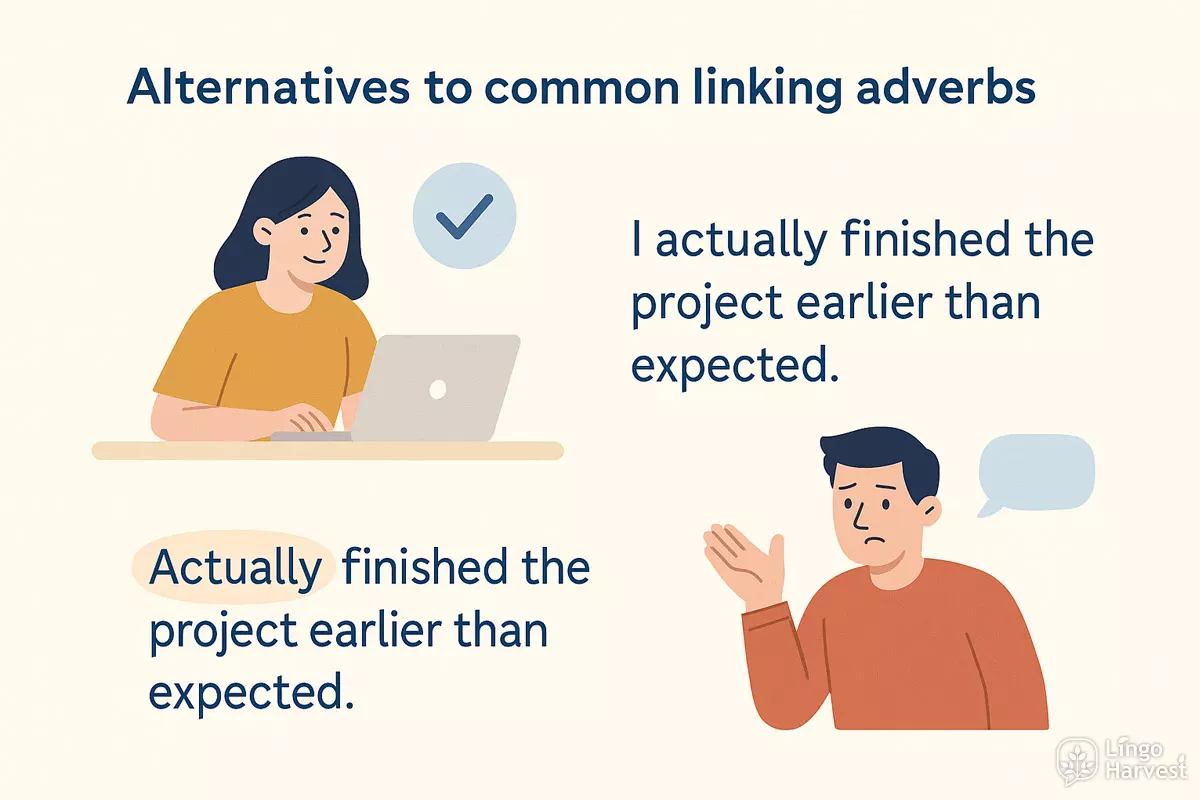
- actually → I actually finished the project earlier than expected.
- honestly → Honestly, I don’t think this plan will work.
- frankly → Frankly, the results were disappointing.
- in fact → In fact, they achieved even more than they planned.
- to be clear → To be clear, this rule applies to everyone.
- essentially → Essentially, the system needs a complete update.
- to put it simply → To put it simply, we need more time.
- in other words → In other words, the solution wasn’t effective.
- as a matter of fact → As a matter of fact, she already knows about it.
- to sum up → To sum up, the strategy worked well overall.
- incidentally → Incidentally, I met your colleague yesterday.
- for example → Some animals migrate long distances; for example, monarch butterflies travel thousands of miles.
- to illustrate → To illustrate, here is a chart showing the growth rate.
- additionally → Additionally, we will need more staff for the project.
- consequently → The data was incorrect; consequently, the findings were revised.
- nevertheless → The task was difficult; nevertheless, they succeeded.
- furthermore → The proposal is cost-effective; furthermore, it reduces risks.
- on the other hand → The hotel is expensive; on the other hand, the location is perfect.
Context and formality
The impact of linking adverbs often depends on setting. In formal discussions or writing, too many casual connectors can undermine your authority. In relaxed conversation, they may help build rapport, but risk sounding insincere if overdone.
| Adverb | Best Used In | Effect When Overused | Suggested Alternative |
|---|---|---|---|
| basically | Explaining core points | Oversimplifies, sounds dismissive | essentially, to put it simply |
| literally | Clarifying facts | Appears exaggerated or insincere | actually, in fact |
| seriously | Expressing sincerity | May seem dramatic or forced | honestly, to be frank |
| honestly | Sharing opinions | Can sound defensive if repeated | frankly, in my view |
Tips for mindful use
- Pause briefly before using a linking adverb and decide whether it adds clarity or simply fills space.
- Vary your language by using synonyms or restructuring your sentences.
- Listen for feedback — if others start repeating your preferred adverbs, it may be a sign to diversify.
- Read your writing aloud to identify patterns of overuse or overly informal transitions.
- Make conscious choices about transitions to maintain clarity and keep your language fresh.
Examples from everyday English
Linking adverbs such as "basically," "literally," and "seriously" often appear in spoken English to connect ideas, add emphasis, or clarify meaning. These words are especially common in casual conversation, where speakers want to express attitude or highlight the truth of their statements.
How people use linking adverbs in conversation
Native speakers naturally drop these adverbs into sentences for different reasons. Sometimes, they soften a statement, while other times, they add humor or stress the speaker's feelings. Here are some typical ways these adverbs show up in speech:
- Basically: to summarize or simplify ("Basically, we missed the train, so we had to walk.")
- Literally: to stress that something is true or to exaggerate ("I was literally about to fall asleep in class!")
- Seriously: to show sincerity or disbelief ("Seriously, you have to try this cake.")
Sample sentences with context
To illustrate their role, here are more everyday sentences using these linking adverbs:
- "Basically, it's just a matter of time before they find out."
- "She literally ran across town to catch the bus."
- "Seriously, how did you finish that project so quickly?"
- "I was basically done when they asked for more work."
- "He literally jumped out of his seat."
- "Seriously, I can't believe this is happening again."
- "Basically, you mix the ingredients and bake for 20 minutes."
- "I'm literally starving right now."
- "Seriously, thanks for your help."
- "Basically, that's all you need to know."
- "She was literally shaking with excitement."
- "Seriously, don't worry about it."
Comparing meaning and function
You can see how these words differ in use and intent. Here’s a structured comparison:
| Adverb | Common Function in Speech | Example |
|---|---|---|
| Basically | Summarizing, simplifying | "Basically, it's over." |
| Literally | Stressing truth or exaggeration | "I'm literally freezing." |
| Seriously | Showing sincerity or disbelief | "Seriously, are you okay?" |
These expressions are flexible and highly context-dependent. They help speakers manage tone, signal attitude, or simply keep the listener engaged. Noticing how and when people use them can make your own speaking style more natural and fluent.
Practice dialogue: choose linking adverbs
When speaking English, words like "basically," "literally," and "seriously" help clarify meaning, add emphasis, or show the speaker’s attitude. Practicing with dialogues can make it easier to use these adverbs fluently in conversation. Below is a short exercise where you need to select the most natural adverb for each blank. Think about the tone and context as you choose.
Task: Fill in the blanks with the correct linking adverb
Read the conversation and decide which adverb fits best in each blank: basically, literally, or seriously.
- A: Did you see how late Mark arrived to the meeting?
B: Yes, he was _______ the last person to walk in! - A: I can't believe how much food you ordered.
B: I was _______ starving after that long hike. - A: We need to finish this project by tomorrow.
B: _______? I thought we had until next week! - A: What’s your job like?
B: Well, _______ I just answer emails all day. - A: The movie was so scary!
B: _______? I thought it was more funny than frightening. - A: Why are you cleaning everything again?
B: I'm _______ trying to stay organized this week. - A: The meeting got canceled again.
B: _______? That’s the third time this month. - A: I finally fixed the printer.
B: _______? It broke again yesterday! - A: He finished the whole task in 20 minutes.
B: He was _______ working faster than usual. - A: I didn’t expect them to agree so quickly.
B: _______? They usually take forever.
Show answers
- literally
- literally
- Seriously
- Basically
- Seriously
- literally
- Honestly
- Seriously
- literally
- Honestly
Common uses of "basically," "literally," and "seriously" in conversation
- basically: to summarize, simplify, or generalize information.
- literally: to stress that something is true in the exact sense, not figurative.
- seriously: to show disbelief, emphasize importance, or express concern.
Quick reference: Example sentences
- She was literally jumping for joy when she heard the news.
- I’m basically done with my homework—just need to check it.
- Are you seriously going to eat all that pizza?
- He literally ran five miles to get here.
- This is basically how it works: you sign up and start learning.
- Seriously, you should try this dessert.
- I literally can’t believe it.
- We’re basically finished with the project.
- Seriously, that was an amazing performance.
- He literally forgot his own birthday.
Choosing the right adverb: quick comparison
| Adverb | Typical Meaning/Use | Example |
|---|---|---|
| Basically | To simplify or summarize | Basically, it’s just a matter of practice. |
| Literally | Exact, not exaggerated | I was literally shaking with excitement. |
| Seriously | Emphasize importance or disbelief | Seriously, you need to rest. |