Order of Adjectives: The Simple Pattern for A1-A2

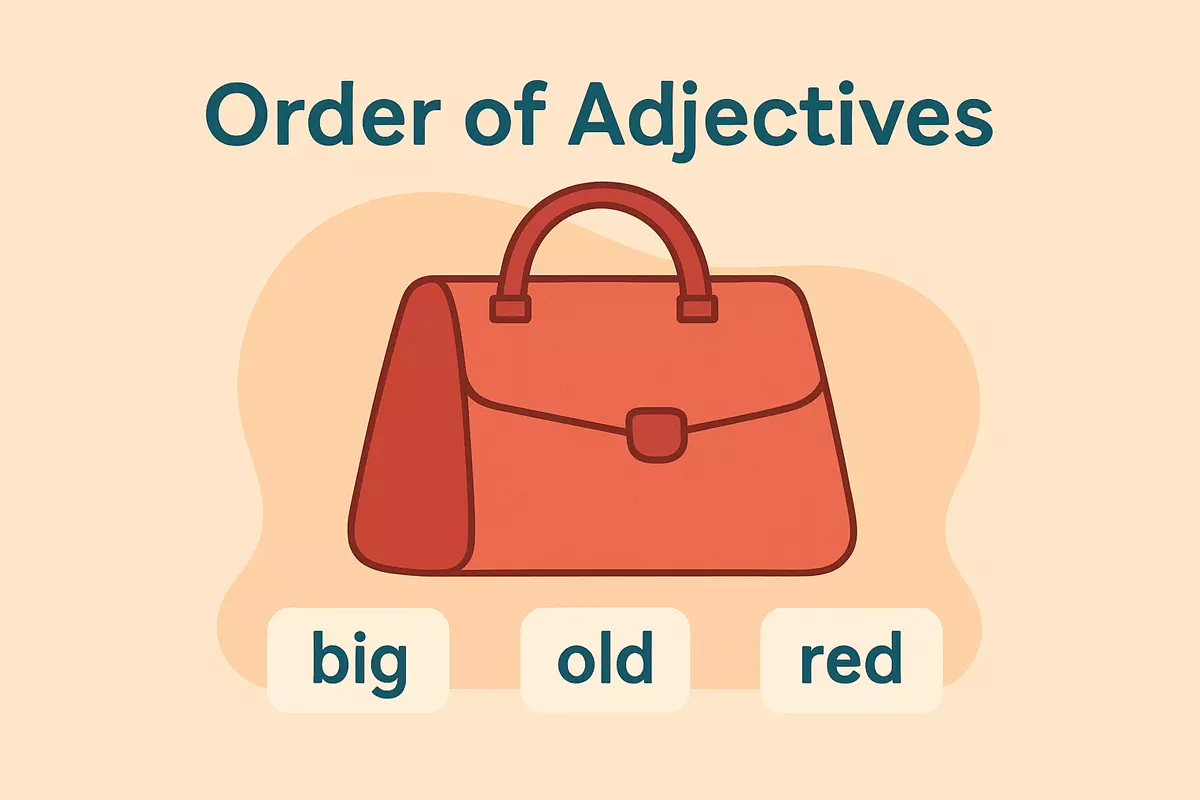 The article explains why word order is important for adjectives in English, details the main opinion–size–age–color–material pattern, shows how to combine adjectives, covers hyphens and commas, gives examples, points out errors, and provides practice sentences.
Have you ever wondered why we say a big red ball instead of a red big ball? For those learning English, getting the order of descriptive words right is important for making sentences sound natural and fluent. Adjectives in English typically follow a specific sequence, such as opinion, size, age, shape, color, origin, material, and purpose. By learning this pattern, you can quickly improve your sentence structure and communicate more clearly from the very beginning.
Why Order Matters in English
Adjectives in English generally follow a specific sequence before a noun. This order helps listeners and readers understand exactly what is being described, and in what way. When we put adjectives in the right order, our sentences sound natural and clear. If we mix up the order, the meaning can become confusing or sound unnatural to native speakers.
Clarity and Natural Flow
Putting adjectives in the correct sequence gives your speech and writing a smooth, native-like rhythm. For example, saying “a small red car” sounds right, but “a red small car” feels awkward. This isn’t just about style; it helps others quickly visualize what you mean. The usual pattern is: opinion, size, age, shape, color, origin, material, purpose + noun.
Communication and Understanding
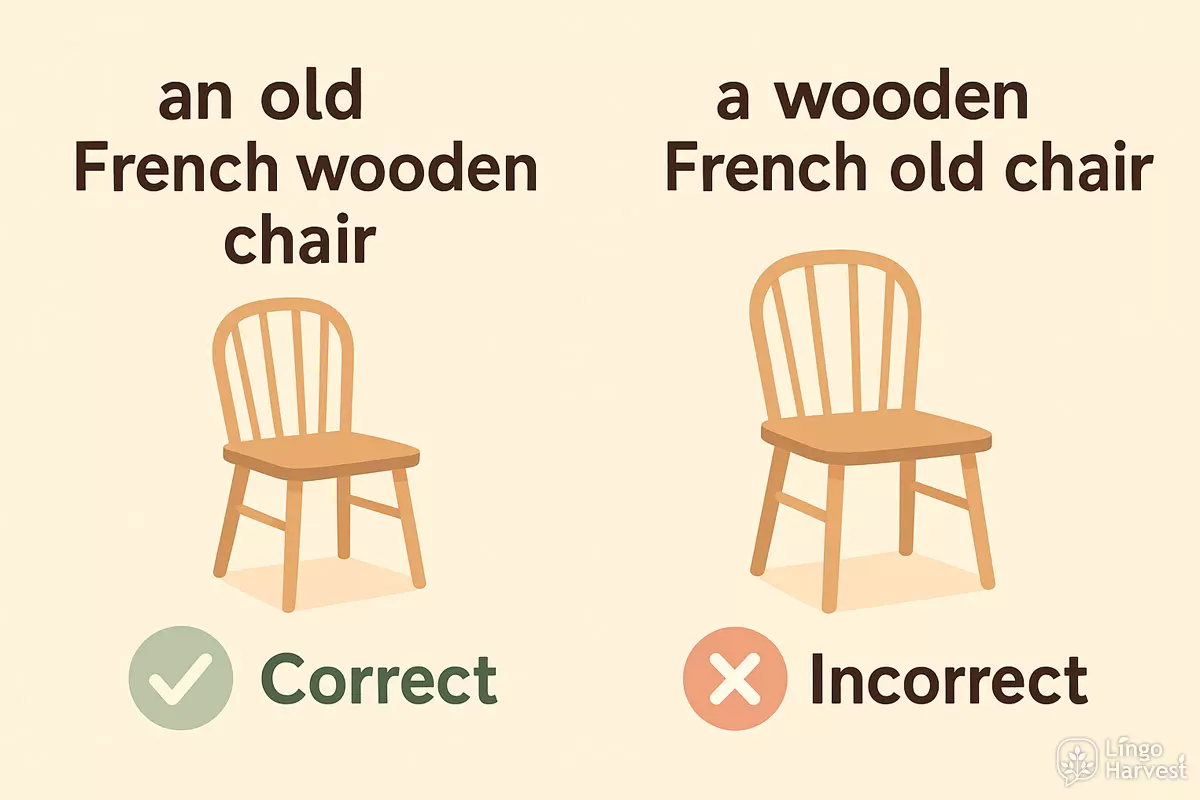
Getting the order wrong can lead to misunderstandings. For instance, if you say “a wooden French old chair,” your listener may pause to figure out what you mean. In contrast, “an old French wooden chair” is instantly clear. The sequence helps listeners focus on the most important or subjective qualities first (like “beautiful” or “ugly”), then move to more factual details (like color or material).
Examples of Correct and Incorrect Adjective Order
- ✅ a beautiful small old round white Italian wooden dining table
- ❌ a wooden Italian round small dining white old beautiful table
- ✅ an interesting big new red Chinese book
- ❌ a Chinese new big interesting red book
- ✅ a comfortable long blue cotton scarf
- ❌ a cotton blue comfortable long scarf
- ✅ a delicious large hot cheese pizza
- ❌ a cheese hot large delicious pizza
- ✅ a lovely tiny young brown puppy
- ❌ a brown lovely young tiny puppy
Why This Order Exists
This pattern isn’t just a rule for the sake of a rule. It’s based on how information is processed in English. We usually start with what we feel or think (opinion), then move from general (size, age) to more specific (color, origin, material). This helps the listener build a picture step by step, from the most subjective to the most objective details.
Common Adjective Categories and Their Sequence
| Category | Typical Example |
|---|---|
| Opinion | beautiful, ugly, nice |
| Size | big, small, tiny |
| Age | old, young, new |
| Shape | round, square, flat |
| Color | red, blue, green |
| Origin | Italian, Chinese, French |
| Material | wooden, plastic, metal |
| Purpose | sleeping (as in “sleeping bag”), dining (as in “dining table”) |
Mastering this order makes your descriptions much clearer and helps you sound more natural in English conversations and writing. With practice, using the correct sequence will become automatic.
Main Pattern: Opinion–Size–Age–Color–Material
Understanding how to order adjectives in English makes your descriptions clearer and more natural. Native speakers usually follow a standard sequence: first say what you think about the object (opinion), then describe its size, how old it is, its color, and finally, what it’s made of. This order helps the listener or reader understand your meaning with less confusion.
What Do These Categories Mean?
- Opinion: Words expressing what you or others think (e.g., beautiful, ugly, nice, tasty).
- Size: How big or small something is (e.g., big, small, tiny, huge, tall).
- Age: How old or new something is (e.g., old, young, new, ancient, modern).
- Color: The color or shade (e.g., red, blue, green, black, white).
- Material: What it is made from (e.g., wooden, plastic, metal, cotton, glass).
Pattern in Action: Example Phrases
You can combine these types of adjectives to give a rich description. Notice how the order makes the phrase sound more natural:
- a beautiful big old red brick house
- an ugly small new green plastic chair
- a delicious tiny fresh yellow lemon tart
- a nice tall young black metal lamp
- a funny little old white wooden puppet
- a comfortable large modern blue cotton sofa
- a scary huge ancient gray stone statue
- a lovely medium old pink silk dress
- a boring long old brown wooden table
- a strange short new orange plastic toy
Quick Reference Table
| Adjective Type | Examples |
|---|---|
| Opinion | nice, terrible, interesting, lovely, boring |
| Size | big, small, tall, short, tiny, huge |
| Age | old, young, new, ancient, modern, fresh |
| Color | red, blue, green, black, white, yellow, gray |
| Material | wooden, plastic, metal, cotton, glass, silk, stone |
Why This Sequence?
Placing adjectives in this order is not just a rule but a habit of native speakers. If you change the order, the phrase can sound odd or confusing. For example, “a wooden old small chair” feels unnatural compared to “a small old wooden chair.” Following this simple structure will help your English sound more fluent and clear.
Tip for Beginners
You do not always need to use all five types every time. Usually, two or three adjectives are enough. If you’re unsure, try using just one or two, and slowly add more as you practice. Over time, this sequence will become automatic.
One or Two Adjectives: When to Combine
When describing something, you often want to use more than one adjective. For example, you might say “a big, red apple” instead of just “a big apple.” But how do you know when to use one adjective or combine two? The answer depends on what you want to express and the natural flow of English.
When to Use a Single Adjective
A single adjective works best when only one characteristic is important or relevant. This keeps your sentence simple and clear, which is helpful for A1–A2 learners. For instance:
- a cold drink
- an old book
- a happy child
- the blue car
Combining Two Adjectives
If you want to give more detail, use two adjectives. Remember, English has a preferred order for adjectives, usually: opinion before fact. This means we say “a beautiful old house,” not “an old beautiful house.” Combining is common when you want to be more specific or give a fuller picture.
| Adjective 1 (Opinion/Size/Other) | Adjective 2 (Color/Origin/Other) |
|---|---|
| big | yellow |
| beautiful | old |
| small | round |
| long | French |
| soft | cotton |
| delicious | Italian |
| funny | little |
| new | red |
| old | wooden |
| tall | German |
Tips for Beginners
- Use two adjectives only if both are important to your meaning.
- Put adjectives in the natural order: opinion/size, then color/origin/material.
- Do not add too many adjectives at once—this can sound unnatural.
- Practice with common combinations to build confidence.
Combining adjectives is a simple way to make your English more descriptive. With just a little practice, you’ll know when to use one word or two to express your ideas clearly.
Hyphens and Commas
Understanding how to connect and separate adjectives is just as important as knowing their order. In English, punctuation marks like the hyphen and the comma help clarify meaning and avoid confusion, especially when multiple describing words come before a noun.
When to Use Hyphens
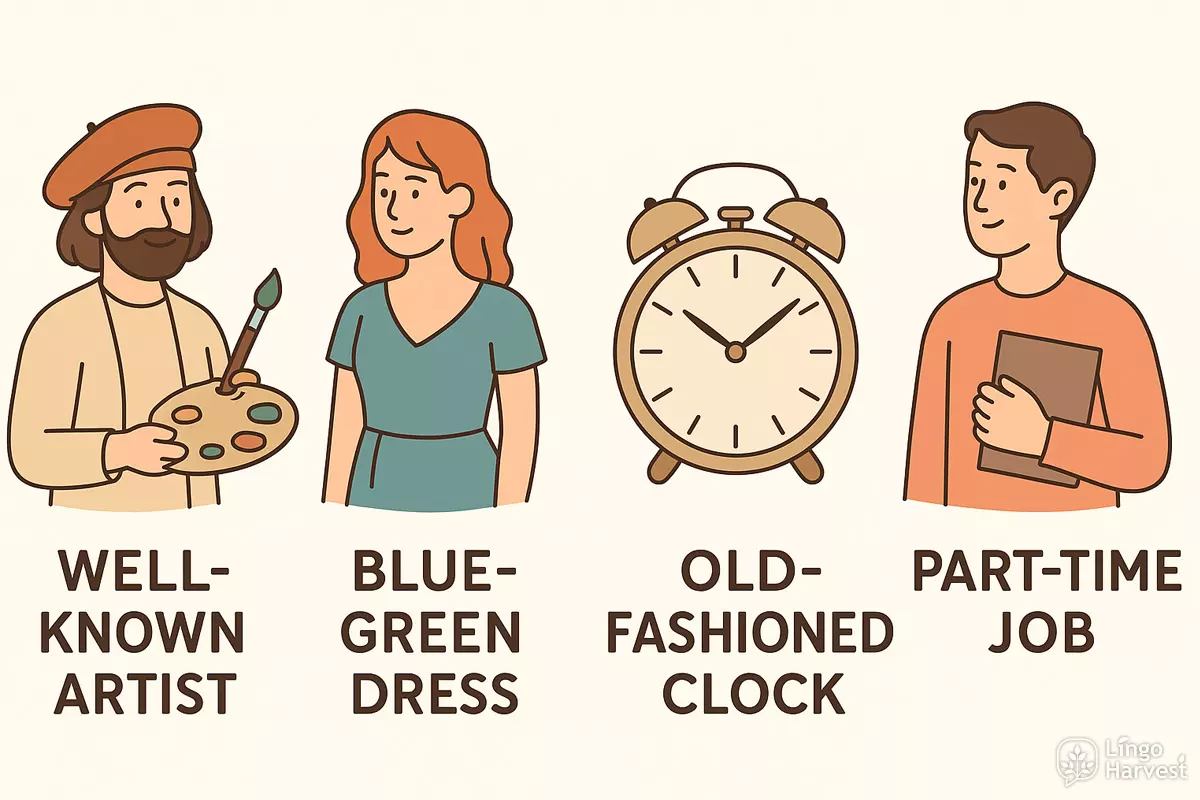
Hyphens are used to join two or more words that function together as a single idea before a noun. These are called compound adjectives. This makes the meaning clear and prevents misreading. For example:
- well-known artist
- blue-green dress
- old-fashioned clock
- part-time job
- high-quality camera
- open-minded person
- full-length mirror
- cold-hearted villain
- two-week holiday
- four-door car
- long-term plan
- ten-minute break
- low-cost solution
- user-friendly app
- middle-aged man
- English-speaking guide
- all-inclusive resort
- bright-red apple
Notice that hyphens are not needed if the compound comes after the noun: “The artist is well known.”
Using Commas Between Adjectives
Commas are used to separate two or more adjectives that independently describe the same noun and are of equal importance. If you can put "and" between the adjectives and the sentence still makes sense, use a comma.
- It was a long, boring movie. (long and boring)
- She has a small, fluffy cat.
- They bought a cheap, plastic toy.
- He wore a bright, colorful shirt.
- We saw a dark, stormy sky.
However, do not use a comma between adjectives that must appear in a specific order or do not equally describe the noun. For example: "a small red car" (no comma).
Quick Comparison: Hyphen or Comma?
| Hyphenated Compound | Comma-Separated Adjectives |
|---|---|
| fast-growing company | fast, successful company |
| five-star hotel | luxurious, comfortable hotel |
| state-of-the-art equipment | modern, efficient equipment |
| easy-to-use tool | simple, handy tool |
| well-written article | interesting, useful article |
| last-minute decision | quick, unexpected decision |
Mastering the use of connecting marks helps your sentences look natural and clear. When in doubt, check if your adjectives form a single idea (hyphen) or if they are separate qualities (comma). This small detail can make a big difference in how your writing is understood.
Examples in Real Phrases
Understanding how to put adjectives in the correct order can make your English sound much more natural. Let’s look at how different describing words are used together before a noun, following the basic A1–A2 level pattern: opinion, size, age, shape, color, origin, material, and purpose.
Common Patterns in Simple Sentences
When you use more than one adjective, English usually puts them in a certain order. Here are several sample phrases showing this order in action:
- a beautiful small old house
- an interesting big new museum
- a delicious round red apple
- a comfortable blue chair
- an expensive French car
- a funny young teacher
- a long wooden table
- a tiny black cat
- a large old wooden door
- a cute little brown dog
- a modern Japanese phone
- a big round metal clock
- a small green plastic bottle
- a lovely white cotton shirt
- an ugly heavy box
Comparing Different Orders
Mixing up the order of adjectives can sound odd or unnatural. Here’s a comparison to illustrate the difference:
| Correct order | Incorrect order |
|---|---|
| a big old black dog ✅ | a black big old dog ❌ |
| an interesting small red book ✅ | a red interesting small book ❌ |
| a beautiful new Italian dress ✅ | an Italian beautiful new dress ❌ |
| a comfortable old wooden chair ✅ | a wooden comfortable old chair ❌ |
Key Takeaways
Notice how these examples use simple vocabulary and real-life objects. When you put adjectives in the usual order—opinion, size, age, shape, color, origin, material—your English will sound more fluent and clear. Try making your own phrases by following this pattern, using everyday nouns and a mix of describing words. Practice helps these combinations feel natural!
Common Errors
Placing descriptive words in the wrong sequence is a frequent challenge for beginners. This often leads to sentences that sound unusual or confusing to native speakers. Learners sometimes group adjectives by meaning rather than by the accepted pattern in English, which can result in awkward expressions.
Typical Mistakes with Adjective Order
- Saying “a red big ball” instead of “a big red ball”.
- Using “a silk beautiful scarf” instead of “a beautiful silk scarf”.
- Mixing up opinion and fact adjectives, such as “an Italian delicious pizza” instead of “a delicious Italian pizza”.
- Forgetting that adjectives describing size usually come before those describing color (e.g., “a blue small car” should be “a small blue car”).
- Placing material before age: “an old wooden chair” is correct, not “a wooden old chair”.
- Stacking too many adjectives: “a small old round wooden table” is fine, but “a round small table old wooden” is not.
- Using the wrong sequence for nationality: “a French old painting” should be “an old French painting”.
- Placing adjectives after the noun, as in some languages: “a car red” instead of “a red car”.
- Repeating adjectives of the same type: “a big large house” (use only one size adjective).
- Forgetting to use commas when adjectives are equal: “a long, difficult exam”.
Confusing Adjective Types
Learners may not recognize which category a word belongs to (opinion, size, age, shape, color, origin, material, purpose). This confusion can lead to misplaced descriptions. For instance, “plastic” (material) should come after “red” (color), not before.
Comparison Table: Typical Incorrect vs. Correct Adjective Order
| Incorrect Order | Correct Order |
|---|---|
| a red big balloon | a big red balloon |
| a leather nice bag | a nice leather bag |
| a Spanish delicious dish | a delicious Spanish dish |
| an old blue beautiful dress | a beautiful old blue dress |
| a round metal small coin | a small round metal coin |
How to Avoid These Issues
To sidestep these errors, remember the general pattern: opinion, size, age, shape, color, origin, material, purpose, then noun. Practice with common examples and listen to native speakers for reinforcement. If you are unsure, try using fewer adjectives until the order feels more natural.
Practice: Fix and Rewrite Sentences
Understanding how to arrange descriptive words before a noun is essential for clear English. In this section, you’ll practice correcting sentences where adjectives are in the wrong order. This exercise will help you become more confident in using multiple adjectives together, following the standard English pattern.
Instructions
Read each sentence below. If the adjectives are not in the correct order, rewrite the sentence so it follows the typical sequence: Opinion → Size → Age → Shape → Color → Origin → Material → Noun. If the sentence is already correct, just write "Correct".
- She wore a red beautiful dress.
- They have an old small wooden table.
- It is a Italian big car.
- He wants a round new blue rug.
- I saw a metal strange sculpture.
- We bought a cotton white shirt.
- He gave me a leather black small wallet.
- The museum has an antique French painting.
- You have an interesting old book.
- They found a green little frog.
- She lives in a brick large house.
- He adopted a cute young brown dog.
- We visited a modern huge German building.
- I want a plastic new red bottle.
- He drew a square yellow big poster.
Show answers
- She wore a beautiful red dress.
- They have a small old wooden table.
- It is a big Italian car.
- He wants a new round blue rug.
- I saw a strange metal sculpture.
- We bought a white cotton shirt.
- He gave me a small black leather wallet.
- Correct
- Correct
- They found a little green frog.
- She lives in a large brick house.
- Correct
- We visited a huge modern German building.
- I want a new red plastic bottle.
- He drew a big square yellow poster.
Common Adjective Order Examples
Here are some more examples showing the typical arrangement of descriptive words before a noun. Use these as a reference when you write your own sentences:
- a beautiful small old French clock
- an interesting big blue glass vase
- a delicious round Italian pizza
- a comfortable new cotton sofa
- a heavy dark metal door
- an expensive red sports car
- a cute little brown puppy
- a long white silk dress
- a strong old wooden bridge
- a bright yellow plastic toy
- a large ancient Egyptian statue
- a warm soft woolen scarf
- a noisy crowded city street
- a tall modern glass building
- a sweet small green apple
Practicing with these examples will help you remember the standard order and avoid common mistakes.