Mini Test: Adjectives & Adverbs in Short Paragraphs

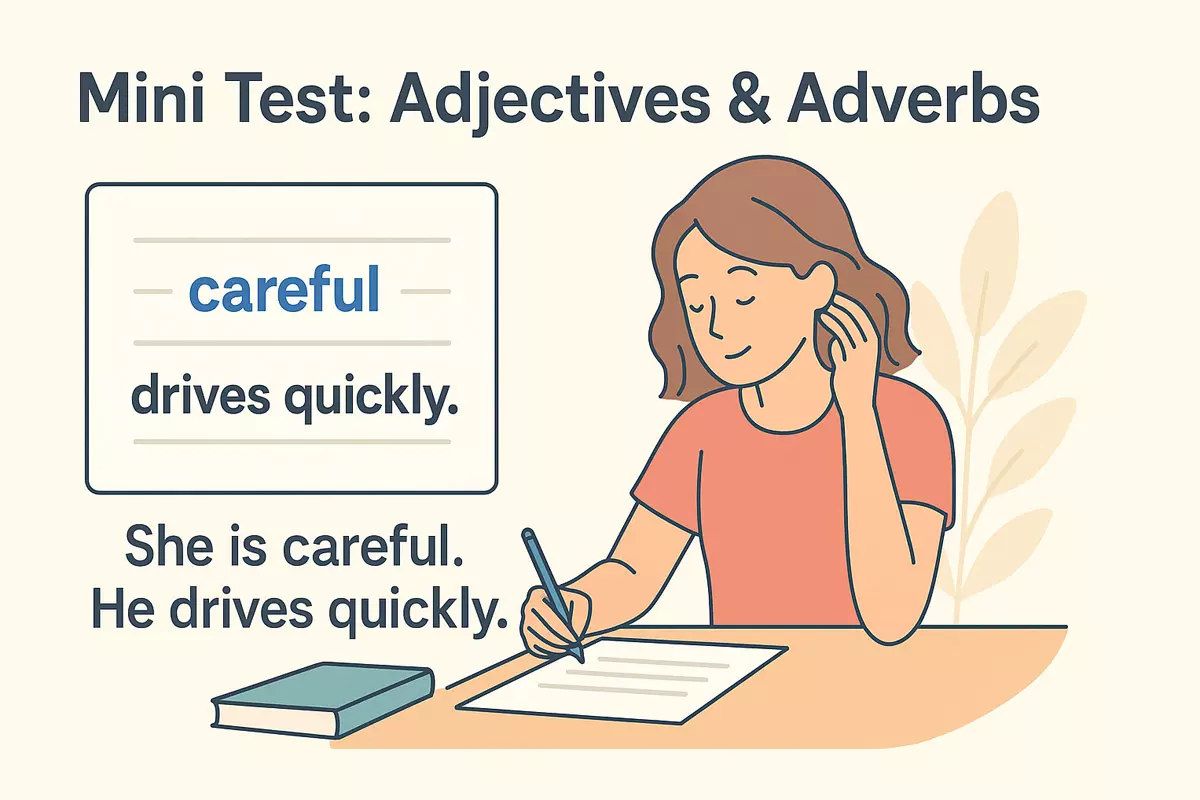 Here we strategies for approaching short grammar tests, practicing with adjective and adverb tasks, and using gap-fill and error-spotting exercises. It also explains how to score yourself, reviews key beginner rules, and suggests next study steps.
Test your grammar skills by identifying the differences between words that describe qualities, such as adjectives, and those that explain how actions happen, like adverbs. This brief quiz is designed to challenge your understanding of descriptive language in context, helping you recognize subtle distinctions and improve your overall language proficiency. Are you prepared to put your knowledge to the test and enhance your ability to use adjectives and adverbs correctly? Dive in and see how well you can spot these important differences.
How to approach short grammar tests
When tackling a brief grammar quiz, it helps to have a practical strategy. Focus on reading each question carefully, paying attention to context and the role of each word in the sentence. Short tests often target common errors, so knowing what to look for can save time and improve accuracy.
Key tips for mini grammar assessments
- Scan for clues: Identify whether the blank or underlined word is describing a noun (adjective) or a verb (adverb).
- Watch for signal words: Words like "how," "when," and "where" often introduce adverbs, while words describing "what kind" or "how many" point to adjectives.
- Remember common adjective–adverb pairs: For example, "quick" (adjective) vs. "quickly" (adverb).
- Check endings: Many adverbs end in -ly, but not all; exceptions like "fast" and "hard" are common in tests.
- Note exceptions: Some words have irregular forms or share forms (e.g., "late" can be both an adjective and an adverb depending on context).
- Don’t rush: Even if the paragraph is short, take time to double-check your choice.
Common adjective and adverb forms to recognize
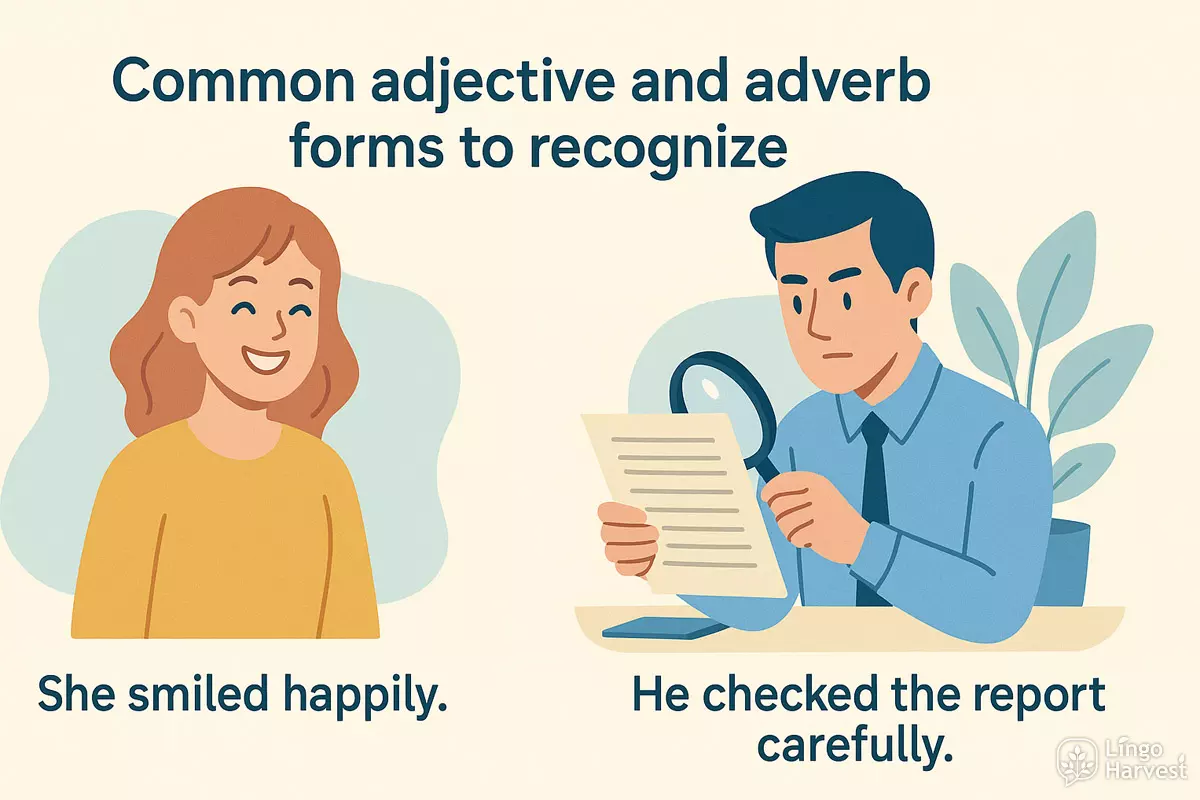
Here are some frequent adjective–adverb pairs and forms you might encounter. Recognizing these can help you choose the right word quickly:
- happy / happily — She smiled happily.
- careful / carefully — He checked the report carefully.
- easy / easily — I can fix this easily.
- good / well — She plays the piano well.
- loud / loudly — The children laughed loudly.
- slow / slowly — The turtle moved slowly.
- hard / hard — He worked hard.
- fast / fast — The car moved fast.
- late / late — They arrived late.
- high / highly — He is highly respected.
- direct / directly — Please contact me directly.
- quiet / quietly — She spoke quietly.
- angry / angrily — He shouted angrily.
- bad / badly — She slept badly.
- quick / quickly — He finished the task quickly.
- soft / softly — She whispered softly.
- safe / safely — They arrived safely.
- beautiful / beautifully — The birds sang beautifully.
Spotting differences: adjectives vs. adverbs
| Adjective | Adverb |
|---|---|
| She is a quick runner. | She runs quickly. |
| That was a hard question. | He worked hard on the test. |
| This is a fast car. | The car moves fast. |
| She gave a good answer. | She answered well. |
| He is a late guest. | He arrived late. |
| They had a happy moment together. | They smiled happily. |
| She is a careful student. | She checks her work carefully. |
| This is an easy task. | She completed it easily. |
| He is a quiet boy. | He speaks quietly. |
| It was a beautiful performance. | She danced beautifully. |
| They had a bad experience. | The machine worked badly today. |
| He is a strong swimmer. | He swam strongly toward the shore. |
| She has a soft voice. | She sings softly. |
| This is a safe neighborhood. | They walked home safely. |
| He made a direct request. | She replied directly. |
Practice: Identify the correct form
- The dog barked (loud / loudly) last night.
- She is a very (careful / carefully) driver.
- He answered the questions (easy / easily).
- The children were (happy / happily) playing outside.
- Please speak (quiet / quietly) in the library.
- He ran (quick / quickly) to catch the bus.
- This is a very (important / importantly) meeting.
- She sings (beautiful / beautifully) on stage.
- The students listened (careful / carefully) to the teacher.
- It was a (bad / badly) idea.
- They walked (slow / slowly) in the park.
- He felt (terrible / terribly) after the exam.
Show answers
- loudly
- careful
- easily
- happy
- quietly
- quickly
- important
- beautifully
- carefully
- bad
- slowly
- terrible
Final reminders
- Always reread the sentence after choosing your answer to check if it sounds correct.
- If unsure, try replacing the word with another adjective or adverb you know to see if it fits better.
- Use process of elimination for tricky options.
With regular practice and an eye for context, you’ll find that mini grammar quizzes become less intimidating and more straightforward.
Mixed tasks with adjectives and adverbs in paragraphs
Using adjectives and adverbs together in short texts requires attention to how they modify nouns and verbs. In everyday writing, these parts of speech bring clarity and detail to descriptions, actions, and feelings. Below, you'll find a mix of exercises and explanations designed to test your understanding and help reinforce correct usage.
Identify and Choose: Fill-in-the-Blank Practice
Read each short paragraph. Decide whether the blank should be filled by an adjective or an adverb. Write your answer in the blank.
- The dog ran ______ across the yard, chasing its favorite ball. (quick/quickly)
- She wore a ______ dress to the party, which everyone admired. (beautiful/beautifully)
- They solved the puzzle ______ after thinking for hours. (easy/easily)
- It was a ______ morning, perfect for a walk in the park. (peaceful/peacefully)
- He answered the question ______ and impressed the teacher. (confident/confidently)
- The children laughed ______ at the clown’s jokes. (loud/loudly)
- She is a very ______ driver, especially at night. (careful/carefully)
- He completed the project ______ despite the tight deadline. (quick/quickly)
- The baby slept ______ throughout the afternoon. (quiet/quietly)
- It was a ______ idea that helped the team succeed. (smart/smartly)
Show answers
- quickly
- beautiful
- easily
- peaceful
- confidently
- loudly
- careful
- quickly
- quietly
- smart
Spot the Errors: Editing Paragraphs
Some sentences below contain mistakes in the use of adjectives and adverbs. Read each paragraph and identify the error.
- The children played happy in the garden while the sun shined brightly.
- He spoke clear during the presentation, making his points easy to understand.
- Maria is a careful driver and always drives slow in the city.
- The soup tasted deliciously after adding some spices.
- He answered the questions very easy in the exam.
- The music played very loud late at night.
- She sings beautiful on stage during the concert.
- They walked quiet through the forest not to wake the animals.
- The train arrived late, and everyone was angrily.
- I felt nervously before the job interview.
Show answers
- happy → happily
- clear → clearly
- slow → slowly
- deliciously → delicious
- easy → easily
- loud → loudly
- beautiful → beautifully
- quiet → quietly
- angrily → angry
- nervously → nervous
Common Patterns: Adjective and Adverb Placement
Understanding where to place modifiers can help you write more natural sentences. Consider these patterns:
- Adjective + noun: a noisy room, an old book
- Verb + adverb: speaks softly, drives carefully
- Linking verb + adjective: She feels tired, The soup smells wonderful
- Action verb + adverb: He runs quickly, They worked quietly
- Comparisons: faster (adverb), more interesting (adjective)
Expanded Examples: Adjectives vs. Adverbs in Context
The table below provides structured examples showing how the form and meaning change depending on whether you use an adjective or an adverb. Notice how the sentence meaning shifts with each choice.
| Adjective Example | Adverb Example |
|---|---|
| The loud music kept me awake. | The music played loudly all night. |
| She is a quick learner. | She learns quickly. |
| He gave a clear explanation. | He explained everything clearly. |
| It was a bad idea. | He performed badly in the test. |
| They had a happy ending. | They lived happily ever after. |
| That's an easy question. | He answered easily. |
| We had a safe journey. | We arrived safely. |
| It's a hard task. | She works hard every day. |
Quick Review: Adjective and Adverb Checklist
- Adjectives describe nouns: green apple, noisy classroom, careful student
- Adverbs modify verbs, adjectives, or other adverbs: runs fast, very tall, speaks politely
- Some words have the same form for both: fast, hard
- Be cautious with irregular forms: good → well, bad → badly
Gap-fill and error-spotting activities
Understanding how adjectives and adverbs function in context is essential for accurate and fluent writing. This section offers interactive tasks to help you identify and correct common mistakes, as well as practice choosing the right form in short paragraphs.
Fill in the gaps: Choose adjective or adverb
Complete each sentence with the correct form of the word in brackets.
- She sings __________ (beautiful / beautifully) in the choir every Sunday.
- The soup tasted __________ (delicious / deliciously) and everyone asked for seconds.
- He drives __________ (careful / carefully) on icy roads.
- The exam was __________ (easy / easily), so most students finished early.
- The children played __________ (happy / happily) in the garden.
- The dog barked __________ (loud / loudly) during the night.
- She completed the task __________ (quick / quickly) before lunchtime.
- They walked __________ (quiet / quietly) down the hallway.
- It was a __________ (terrible / terribly) mistake.
- He spoke __________ (clear / clearly) during the meeting.
Show answers
- beautifully
- delicious
- carefully
- easy
- happily
- loudly
- quickly
- quietly
- terrible
- clearly
Spot the mistakes
Each paragraph below contains at least one error with adjectives or adverbs. Underline and correct the mistakes.
- The cat moved quick across the yard and caught the mouse silent.
- Maria felt badly about forgetting her friend's birthday, but she tried to make up for it generous.
- Tom speaks English very good, but he writes it slow.
- The weather was extremely coldly, so we stayed inside.
- She answered the question easy and surprised the whole class.
- The children laughed loud during the movie and annoyed the others.
- He opened the door quiet so he wouldn’t wake the baby.
- The soup smelled wonderfully, but it tasted blandly.
- Jack reacted angry when he heard the news.
- They finished the project quick, but they worked carelessly.
Show answers
- quick → quickly; silent → silently
- badly → bad; generous → generously
- good → well; slow → slowly
- coldly → cold
- easy → easily
- loud → loudly
- quiet → quietly
- wonderfully → wonderful; blandly → bland
- angry → angrily
- quick → quickly; carelessly → careful
Common adjective and adverb pairs
Some words are commonly confused. Compare these forms:
| Adjective | Adverb |
|---|---|
| easy | easily |
| careful | carefully |
| happy | happily |
| quiet | quietly |
| loud | loudly |
| slow | slowly |
| bad | badly |
| good | well |
| quick | quickly |
| generous | generously |
Quick check: Which is correct?
Choose the correct option in each sentence:
- She answered the question (correct / correctly).
- It was a (dangerous / dangerously) journey.
- He laughed (loud / loudly) at the joke.
- The children played (happy / happily) in the yard.
- He drove (careful / carefully) during the storm.
- The movie was (exciting / excitingly) from start to finish.
- She spoke (soft / softly) to avoid waking the baby.
- Tom ran (fast / fastly) to catch the bus.
- This cake tastes (sweet / sweetly) today.
- They solved the problem (easy / easily).
Show answers
- correctly
- dangerous
- loudly
- happily
- carefully
- exciting
- softly
- fast
- sweet
- easily
These targeted exercises help you practice and internalize the difference between descriptive and manner words, making your writing both accurate and expressive.
Scoring your own performance
When reviewing your answers to the mini test, it's helpful to use a consistent method to check both your understanding and accuracy. Start by comparing your responses with the answer key, but go beyond simply counting correct or incorrect items. Look for patterns in your mistakes to identify whether you struggle more with adjectives, adverbs, or their placement in sentences.
Steps to evaluate your answers
- Read each sentence you wrote and underline the adjectives and adverbs.
- Check if each modifier is used correctly (e.g., "quick" vs. "quickly").
- Mark where you confused adjective and adverb forms.
- Note if you placed adverbs in awkward or incorrect spots in the sentence.
- Identify any repetitive mistakes, such as always using "good" instead of "well."
Common errors and what they reveal
- Using adjectives instead of adverbs after action verbs ("She sings beautiful" instead of "She sings beautifully").
- Confusing "good" and "well" in context.
- Placing adverbs too far from the verbs they modify.
- Overusing certain modifiers, making your writing less precise.
- Forgetting irregular forms (e.g., "fast" stays the same as adjective and adverb).
Self-assessment score guide
To help you get a clearer picture of your progress, use the table below to match your number of correct answers with a suggested proficiency level. This approach can make your review more meaningful and help you set realistic goals for improvement.
| Correct Answers | Suggested Level | Feedback |
|---|---|---|
| 9–10 | Excellent | You have a strong grasp of adjectives and adverbs in context. Pay attention to subtleties for full mastery. |
| 7–8 | Good | Solid understanding, but review specific mistakes to avoid recurring issues. |
| 5–6 | Developing | Some confusion remains. Focus on identifying key differences between adjectives and adverbs. |
| 0–4 | Needs Improvement | Revisit the rules and practice with more examples before retesting yourself. |
Tips for further progress
- Review typical adjective/adverb pairs and their correct usage.
- Write your own sentences and check them with grammar tools.
- Read short stories or articles, highlighting modifiers as you go.
- Ask a peer or teacher to review your writing for feedback.
- Keep a list of tricky words (like "hard" vs. "hardly") for quick reference.
By carefully analyzing your test results and focusing on areas that need attention, you'll steadily improve your ability to use adjectives and adverbs accurately in your writing.
Review of the most important beginner rules
Understanding the difference between adjectives and adverbs is essential for writing clear and accurate short paragraphs. Here’s a breakdown of the fundamental points every beginner should master when working with these parts of speech.
How to Recognize Adjectives and Adverbs
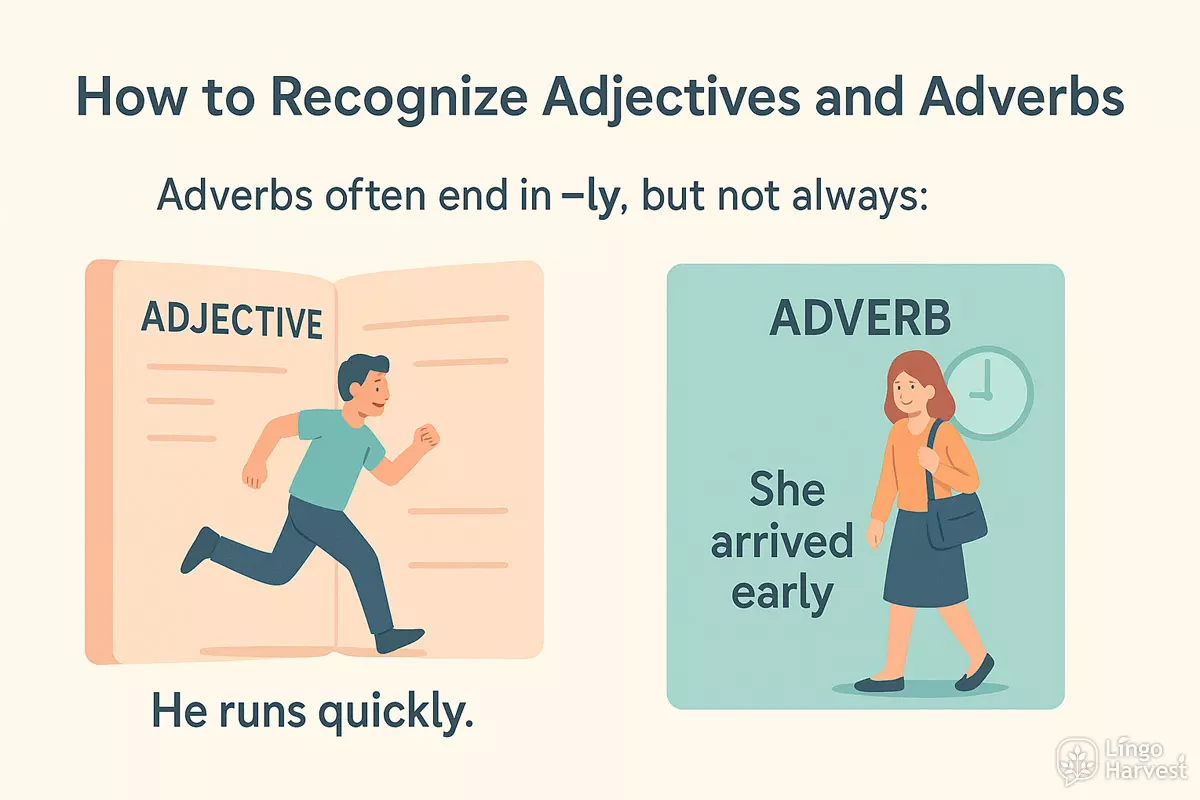
- Adjectives describe nouns or pronouns. They answer questions like “What kind?”, “Which one?”, or “How many?”
- Adverbs modify verbs, adjectives, or other adverbs. They answer questions such as “How?”, “When?”, “Where?”, or “To what extent?”
- Adjectives usually come before the noun they describe: a fast car.
- Adverbs often end in -ly, but not always: He runs quickly, She arrived early.
Common Mistakes to Avoid
- Using an adjective when an adverb is required: He runs quick ❌ → He runs quickly ✅
- Using an adverb with a linking verb (like be, seem, feel): She feels happily ❌ → She feels happy ✅
- Not all words ending in -ly are adverbs (friendly is an adjective!)
Quick Reference: Adjective vs. Adverb Usage
| Function | Example |
|---|---|
| Describes a noun (Adjective) | She has a beautiful voice. |
| Describes a verb (Adverb) | She sings beautifully. |
| Describes an adjective (Adverb) | Her voice is extremely beautiful. |
| Describes another adverb (Adverb) | She sings very beautifully. |
Tips for Correct Usage
- If you are describing how someone does something, use an adverb: He writes neatly.
- If you are describing what kind of thing, use an adjective: neat handwriting.
- Some adjectives and adverbs have irregular forms: good (adj) → well (adv), fast (adj/adv).
- Remember, adverbs can also modify adjectives (very cold) and other adverbs (quite quickly).
Practice: Identify the Correct Form
- She speaks (soft/softly).
- They had a (happy/happily) day.
- He runs (fast/fastly).
- This test is (easy/easily).
- She answered the question (correct/correctly).
- The children laughed (loud/loudly) during the show.
- He drove (careful/carefully) in the rain.
- The soup tastes (delicious/deliciously).
- They walked (quiet/quietly) through the hall.
- The movie was (boring/boringly).
Show answers
- softly
- happy
- fast
- easy
- correctly
- loudly
- carefully
- delicious
- quietly
- boring
Suggestions for what to study next
After working with adjectives and adverbs in short texts, it’s a good idea to look at related grammar points that build on your current skills. This way, you’ll deepen your understanding and gain more confidence when reading or writing in English.
Explore comparatives and superlatives
Learning how to compare things is a natural next step. Practice forming and using comparatives (e.g., "faster," "more interesting") and superlatives (e.g., "fastest," "most interesting") correctly. Pay attention to spelling rules and irregular forms.
Practice adjective order in sentences
Sometimes, more than one describing word appears before a noun. Knowing the typical order (opinion, size, age, shape, color, origin, material, purpose) will help your sentences sound more natural.
- Lovely old wooden chair
- Big round red balloon
- Delicious Italian cheese pizza
- Useful metal cooking pot
- Expensive new French perfume
Distinguish between confusing pairs
Some words can be both adjectives and adverbs, or have forms that look similar but are used differently. Here’s a helpful comparison of common pairs:
| Adjective | Adverb |
|---|---|
| quick | quickly |
| hard | hard (means "with effort") / hardly (means "almost not") |
| late | late (time) / lately (recently) |
| good | well |
| near | near / nearly (almost) |
Apply modifiers and intensifiers
Adding words like "very," "quite," "really," or "fairly" changes the strength of an adjective or adverb. Experiment with sentences such as:
- She is very happy.
- This exam is quite difficult.
- He runs really fast.
- The movie was fairly interesting.
Try more advanced paragraph writing
Challenge yourself by writing longer paragraphs or short stories. Focus on varying your descriptive language and using both adjectives and adverbs naturally within context. By following these study directions, you’ll develop a stronger command of descriptive language and prepare for more complex writing and comprehension tasks.