Conjunctive Adverbs: however, therefore, moreover

 Here we what conjunctive adverbs do in sentences, how they differ from other linking words, punctuation rules for however, therefore, and moreover, connecting ideas in academic writing, common placement mistakes, and includes practical examples and a quiz.
- What conjunctive adverbs do in a sentence
- Difference between linking words and conjunctive adverbs
- Punctuation rules with however, therefore, moreover
- Connecting ideas in academic and formal writing
- Common placement mistakes and how to fix them
- Examples in short paragraphs
- Mini-quiz: choose the correct adverb
Using transitional words such as however, therefore, and moreover is essential for connecting ideas smoothly in writing. These linking adverbs help guide readers through your arguments, clarifying relationships between points and enhancing overall coherence. Mastering their use not only improves the logical flow of your writing but also ensures that your communication is clear and persuasive. By selecting appropriate transitions, writers can emphasize contrasts, show cause and effect, or add supporting information, making their ideas more accessible and compelling.
What conjunctive adverbs do in a sentence
Conjunctive adverbs play a unique role in connecting ideas between two independent clauses. Unlike coordinating conjunctions (like "and" or "but"), these words or phrases—such as "however," "therefore," and "moreover"—act as bridges, showing relationships like contrast, cause and effect, or addition. They help writers clarify how two thoughts relate and guide readers through the flow of an argument or explanation.
How conjunctive adverbs link ideas
When you use a conjunctive adverb, you signal the reader to expect a specific relationship between the clauses. For instance, "however" introduces a contrast, "therefore" signals a result, and "moreover" adds information. These transitions make writing smoother and more logical.
- Contrast: "however," "nevertheless," "on the other hand"
- Cause and effect: "therefore," "thus," "consequently"
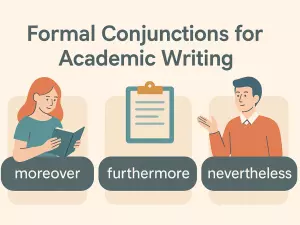
- Addition: "moreover," "furthermore," "also"
- Comparison: "similarly," "likewise"
- Emphasis: "indeed," "certainly"
- Time/order: "meanwhile," "subsequently," "then"
- Summary: "finally," "in conclusion"
- Example: "for example," "for instance"
- Condition: "otherwise"
- Concession: "still," "nonetheless"
Punctuation patterns with conjunctive adverbs
These linking words usually appear after a semicolon and are followed by a comma when joining two independent clauses. For example: "She wanted to go for a walk; however, it was raining." Placing them correctly helps avoid run-on sentences and keeps your writing clear.
Common conjunctive adverbs and their uses
Below is a comparison of some frequently used conjunctive adverbs, their function, and sample sentences:
| Conjunctive Adverb | Relationship | Example Sentence |
|---|---|---|
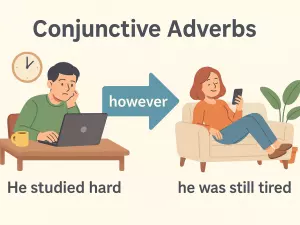
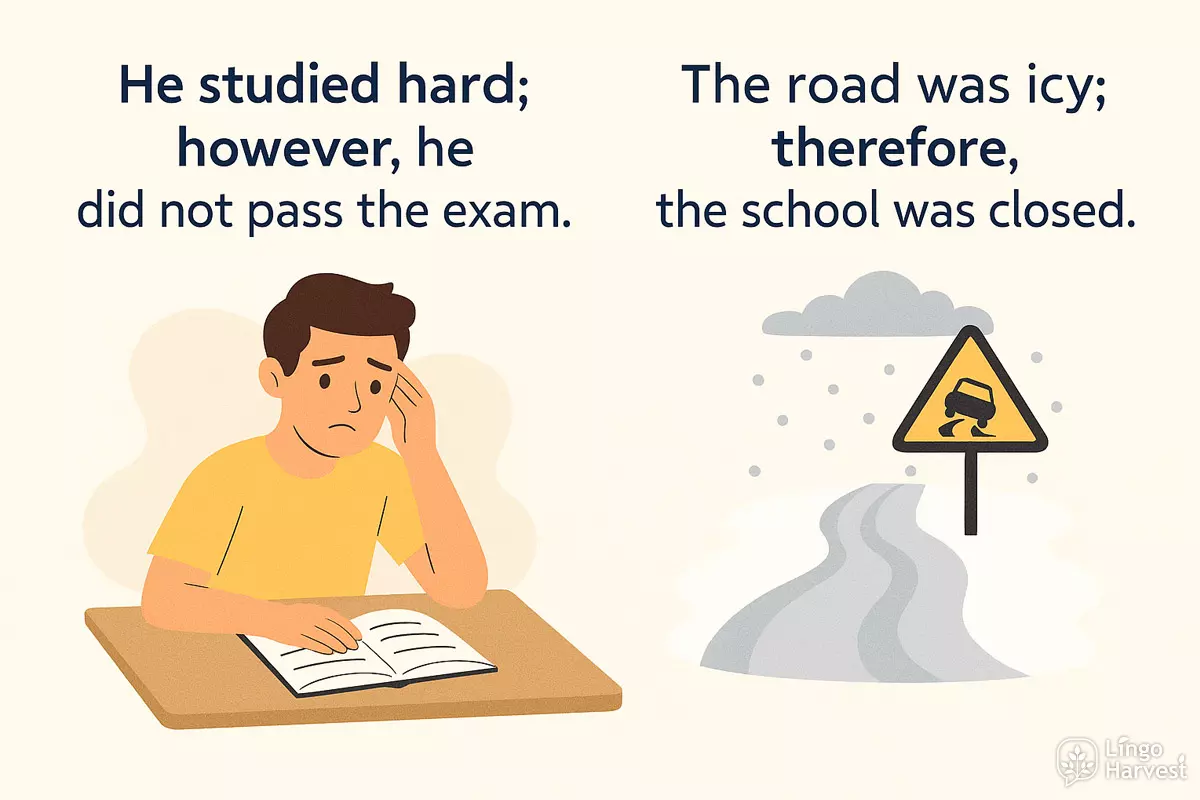
| however | Contrast | He studied hard; however, he did not pass the exam. |
| therefore | Result | The road was icy; therefore, the school was closed. |
| moreover | Addition | The movie was exciting; moreover, the soundtrack was excellent. |
| consequently | Result | She forgot her umbrella; consequently, she got wet. |
| nevertheless | Contrast | It was cold; nevertheless, they went swimming. |
| furthermore | Addition | The test was difficult; furthermore, it was very long. |
| meanwhile | Time | I was cooking; meanwhile, he set the table. |
| similarly | Comparison | She enjoys hiking; similarly, her brother likes outdoor sports. |
| thus | Result | The evidence was strong; thus, the jury reached a quick verdict. |
| still | Concession | He was tired; still, he finished his project. |
Summary
In writing, conjunctive adverbs help organize thoughts and clarify relationships between complex ideas. Using them effectively can make arguments more persuasive and narratives easier to follow. Remember to punctuate them correctly and choose the word that best fits the relationship you want to express.
Difference between linking words and conjunctive adverbs
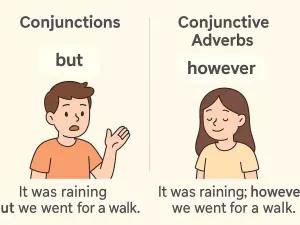
While both linking words and conjunctive adverbs help to connect ideas in writing, they do so in different ways and follow distinct grammatical rules. Understanding how each functions can make your writing clearer and more precise.
What are linking words?
Linking words, sometimes called transition words or connectors, are a broad category that includes conjunctions (such as and, but, or), prepositions (because of, due to), and even certain phrases (in addition to, as a result). They can connect words, phrases, or clauses, and are often used to show relationships like contrast, cause, addition, or sequence.
What are conjunctive adverbs?
Conjunctive adverbs are a specific type of connector that join two independent clauses and indicate relationships such as contrast, result, or addition. Examples include however, therefore, moreover, nevertheless, consequently, furthermore, otherwise, meanwhile, similarly, thus, instead, and hence. They usually require punctuation, such as a semicolon or period before them and a comma after.
Main distinctions
- Grammatical role: Linking words include conjunctions and prepositions, which can connect words or phrases within a sentence, while conjunctive adverbs connect two complete sentences or independent clauses.
- Punctuation: Conjunctive adverbs are typically preceded by a semicolon or period and followed by a comma. Linking words like and or but do not require this punctuation.
- Position: Conjunctive adverbs usually appear at the beginning of the second clause, while linking words can be found between words, phrases, or clauses.
- Variety: Linking words cover a wider range, including conjunctions, prepositions, and even phrases, whereas conjunctive adverbs are a more specific group.
Examples for comparison
- Linking word: She was tired but finished her work.
- Conjunctive adverb: She was tired; however, she finished her work.
- Linking word: We went home because it was raining.
- Conjunctive adverb: It was raining; therefore, we went home.
Common conjunctive adverbs
- however → The plan was good; however, the timing was terrible.
- therefore → She missed the bus; therefore, she arrived late.
- moreover → The hotel was clean; moreover, it was affordable.
- nevertheless → It was raining; nevertheless, they continued playing.
- consequently → He didn’t study; consequently, he failed the test.
- furthermore → The book is informative; furthermore, it’s enjoyable to read.
- otherwise → Hurry up; otherwise, we’ll miss the movie.
- meanwhile → She cooked dinner; meanwhile, he set the table.
- similarly → The first experiment failed; similarly, the second one showed errors.
- thus → He trained hard; thus, he improved quickly.
- instead → We didn’t go out; instead, we watched a movie at home.
- hence → The roads were icy; hence, the delay.
- accordingly → The forecast was bad; accordingly, the event was postponed.
- besides → I don’t like the idea; besides, it’s too expensive.
- indeed → The task was difficult; indeed, almost no one completed it.
- still → She was tired; still, she kept working.
- subsequently → He broke the rule; subsequently, he was fined.
- likewise → She loves traveling; likewise, her brother enjoys exploring new places.
Punctuation rules with however, therefore, moreover
When connecting ideas with words like "however," "therefore," and "moreover," precise punctuation is essential for clarity. These words are conjunctive adverbs and follow specific rules depending on their position in a sentence. Misplacing punctuation can lead to confusion or even grammatical errors.
Using conjunctive adverbs between independent clauses
If you’re joining two complete sentences, use a semicolon before the conjunctive adverb and a comma after it. This signals a close relationship between the ideas.
- I wanted to go for a walk; however, it started to rain.
- She didn't study for the test; therefore, she didn't pass.
- The trip was exhausting; moreover, it was expensive.
Starting a sentence with a conjunctive adverb
When these adverbs begin a sentence, follow them with a comma. This sets them off from the main clause and makes the sentence easier to read.
- However, we managed to finish on time.
- Therefore, the results were unexpected.
- Moreover, the team exceeded all expectations.
Interrupting a sentence with a conjunctive adverb
If "however," "therefore," or "moreover" appear mid-sentence, set them off with commas on both sides. This interruption signals a shift or addition in thought.
- The solution, however, was not practical.
- We decided, therefore, to postpone the meeting.
- He is, moreover, an excellent communicator.
Common punctuation mistakes to avoid
Writers often confuse the punctuation or overuse commas. Here are some patterns to watch out for:
- ❌ I wanted to go for a walk, however it started to rain.
✅ I wanted to go for a walk; however, it started to rain. - ❌ She didn't study for the test therefore she didn't pass.
✅ She didn't study for the test; therefore, she didn't pass. - ❌ The trip was exhausting, moreover it was expensive.
✅ The trip was exhausting; moreover, it was expensive.
Quick reference: punctuation placement
| Position of Adverb | Correct Punctuation |
|---|---|
| Between two sentences | Semicolon before, comma after (e.g., ...; however, ...) |
| At the beginning of a sentence | Comma after (e.g., However, ...) |
| In the middle/interrupting | Commas before and after (e.g., ..., however, ...) |
| Incorrect: just a comma before | Avoid using only a comma to join clauses! (e.g., ..., however ... ❌) |
Summary tips
- Use a semicolon, not just a comma, to connect two sentences with these adverbs.
- Always set off "however," "therefore," and "moreover" with a comma when they start a sentence.
- When interrupting, use commas on both sides.
- Check your sentences for run-on errors and correct punctuation.
Connecting ideas in academic and formal writing
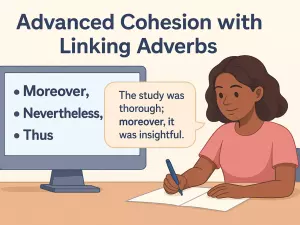
Effective academic and formal writing depends on clear and logical connections between sentences and paragraphs. Conjunctive adverbs such as however, therefore, and moreover play a crucial role in signaling relationships between ideas, guiding readers through the flow of arguments or explanations. These linking words help to clarify contrast, cause and effect, or addition, making the text more coherent and easier to follow.
Functions of common conjunctive adverbs
- However: introduces contrast or exception
- Therefore: shows a result or consequence
- Moreover: adds supporting information or emphasis
- Nevertheless: presents a surprising contrast
- Furthermore: gives an additional point
- Consequently: expresses a logical result
- Meanwhile: indicates simultaneous events
- Hence: provides a reason or result
- In addition: introduces further information
- On the other hand: signals an alternative perspective
- Subsequently: shows something happening after another event
- Nonetheless: acknowledges a point but introduces a limitation
Placement and punctuation
When using conjunctive adverbs, pay attention to punctuation. Typically, they appear at the beginning of a sentence or after a semicolon, followed by a comma. Correct placement improves readability and ensures the intended relationship between clauses is clear.
| Conjunctive Adverb | Example in a Formal Sentence |
|---|---|
| However | The hypothesis was plausible; however, the experimental data did not support it. |
| Therefore | All variables were controlled; therefore, the results are reliable. |
| Moreover | The study confirms previous findings. Moreover, it introduces a new methodology. |
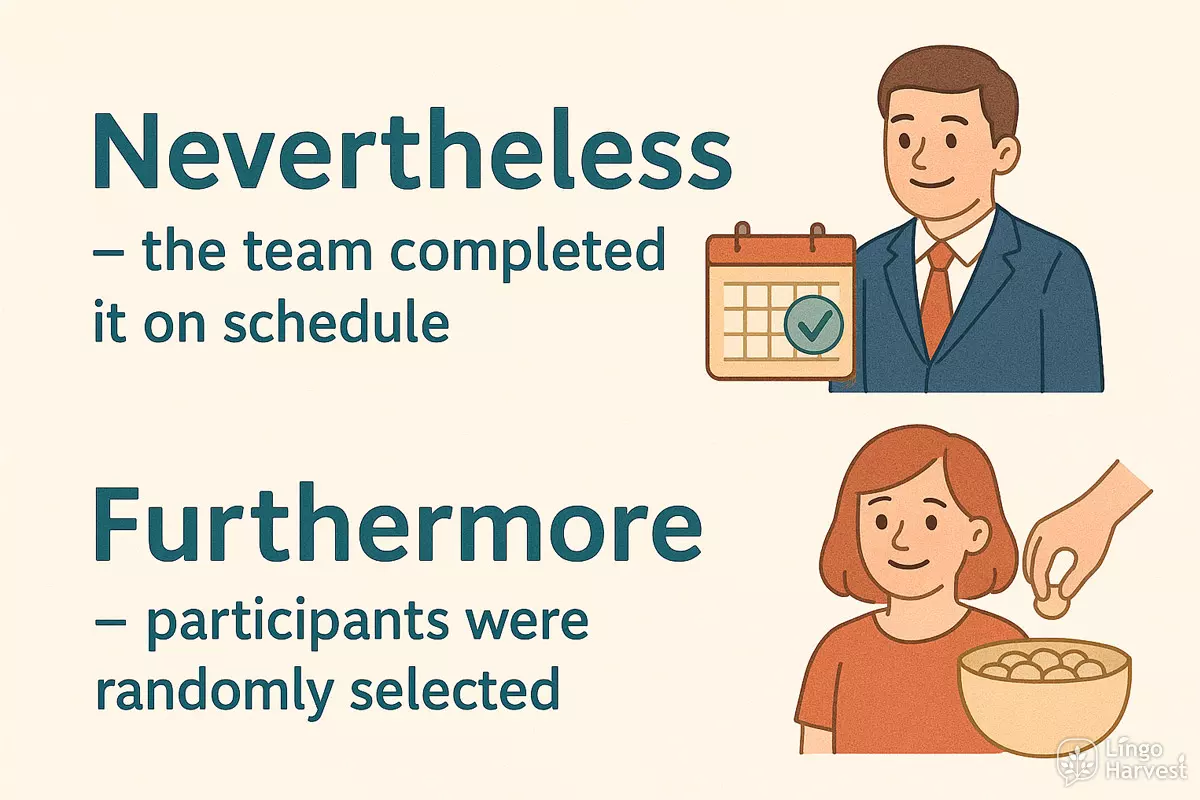
| Nevertheless | The procedure was complex. Nevertheless, the team completed it on schedule. |
| Furthermore | The sample size was large. Furthermore, participants were randomly selected. |
| Consequently | The equipment malfunctioned; consequently, the test was postponed. |
| Hence | The theory lacks empirical support. Hence, it remains controversial. |
| Nonetheless | The data were incomplete. Nonetheless, preliminary conclusions were drawn. |
Tips for using conjunctive adverbs effectively
- Choose a connector that precisely matches the relationship between your ideas.
- Avoid overusing the same adverb; vary your transitions for smoother reading.
- Revise sentences to check clarity and coherence after adding linking words.
Mastering conjunctive adverbs enhances the logical structure and persuasiveness of formal texts, allowing writers to present complex arguments with clarity and precision.
Common placement mistakes and how to fix them
When using conjunctive adverbs like however, therefore, and moreover, word order and punctuation often cause confusion. Misplacing these connectors can lead to awkward or incorrect sentences. Understanding where to put them—and how to punctuate—makes your writing clearer and more professional.
Typical Placement Errors
Writers often make these mistakes:
- Putting the adverb at the start of a sentence without proper punctuation
- Inserting it between clauses without a semicolon or period
- Omitting the comma after the adverb
- Using it as a simple conjunction (like and or but)
- Placing it mid-sentence in a way that interrupts flow
- Doubling up with other connectors (e.g., "But however, ...")
- Using it where a simple conjunction would be better
How to Correct These Issues
To fix these common errors, follow these guidelines:
- Use a semicolon or period before the conjunctive adverb when it joins two independent clauses
- Add a comma after the adverb when it starts a clause
- Don’t treat however, therefore, or moreover as if they’re basic coordinating conjunctions
- If the adverb is in the middle or end of a sentence, separate it with commas for clarity
- Avoid combining conjunctive adverbs with other linking words
Correct vs. Incorrect Usage Patterns
| Incorrect | Correct |
|---|---|
| He was tired, however he finished the work. | He was tired; however, he finished the work. |
| She forgot her umbrella, therefore she got wet. | She forgot her umbrella; therefore, she got wet. |
| Moreover the results were surprising. | Moreover, the results were surprising. |
| He is smart and, however, lazy. | He is smart; however, he is lazy. |
| But however, we continued. | However, we continued. |
| She loves math therefore she studies a lot. | She loves math; therefore, she studies a lot. |
Quick Placement Tips
- Start a new sentence or use a semicolon before the adverb: It rained; therefore, the match was canceled.
- Place a comma after the adverb at the start of a clause: Moreover, this solution is cost-effective.
- Don’t use however or therefore as a replacement for but or so in compound sentences.
- When in doubt, read the sentence aloud to check for natural pauses—these often signal where punctuation is needed.
Mastering these placement rules for conjunctive adverbs helps your writing flow and prevents misunderstandings. If you keep these guidelines in mind, your sentences will be both accurate and easy to read.
Examples in short paragraphs
Understanding how to use linking adverbs like "however," "therefore," and "moreover" is easier with context. Below are short sample paragraphs that demonstrate each transition in action.
Using "however"
"However" signals a contrast or exception. For instance: The weather forecast predicted sunshine all weekend. However, it rained heavily on Saturday, ruining our picnic plans. In this example, "however" introduces unexpected information that opposes the previous statement.
Applying "therefore"
"Therefor" expresses a result or logical consequence. For example: Maria forgot to set her alarm last night; therefore, she was late for her morning meeting. Here, "therefore" connects the cause (forgetting the alarm) and the effect (being late).
Adding information with "moreover"
"Moreover" is used to introduce additional points that strengthen the previous argument. For example: The new smartphone has a larger screen and a faster processor. Moreover, it offers improved battery life compared to previous models. This sentence uses "moreover" to add further positive features.
- Jack studied hard for the exam; however, he found the questions quite challenging.
- The restaurant was closed when we arrived; therefore, we had to find another place to eat.
- She volunteers at the animal shelter every weekend. Moreover, she donates supplies regularly.
- The project deadline was tight. However, the team managed to finish on time.
- It was snowing outside; therefore, the school canceled all classes for the day.
- The book received excellent reviews. Moreover, it became a bestseller within weeks.
- He wanted to buy the jacket. However, it was too expensive.
- They missed their bus; therefore, they walked home.
- The museum offers free admission on Sundays. Moreover, there are guided tours available.
- Lena practiced every day. However, she still felt nervous before the competition.
These examples show how conjunctive adverbs help create smooth, logical connections between ideas, making writing clearer and more persuasive.
Mini-quiz: choose the correct adverb
Test your understanding of conjunctive adverbs—such as "however," "therefore," and "moreover"—by selecting the most appropriate one for each sentence. Pay attention to the context and the relationship between the ideas. Sometimes, more than one answer might seem possible, but only one fits best logically and stylistically.
Fill in the blanks
- She was tired; ______, she finished her work on time.
- The new policy was confusing; ______, several employees asked for clarification.
- His argument was well-structured; ______, it lacked supporting evidence.
- The project was delayed; ______, the team delivered excellent results.
- The conference covers climate change. ______, it includes sessions on renewable energy.
- The weather was terrible. ______, the event continued as planned.
- The instructions were unclear; ______, mistakes were made.
- The museum is closed on Mondays; ______, you can visit any other day.
Show answers
- however
- consequently
- however
- nevertheless
- moreover
- nevertheless
- therefore
- however
Choose the best conjunctive adverb
- She forgot her umbrella; ______, she got wet on the way home.
- He is an expert in physics. ______, he has published several papers on quantum theory.
- The store was out of bread; ______, I bought some at the bakery next door.
- The movie received poor reviews; ______, it attracted a large audience.
- The team worked all weekend; ______, they met the deadline.
- The instructions were clear; ______, no one had any questions.
- The restaurant was full; ______, we decided to eat somewhere else.
- The software update was announced yesterday; ______, it will roll out next week.
- The first solution was expensive; ______, the second option was more affordable.
- The road was icy; ______, drivers were urged to slow down.
Show answers
- consequently
- moreover
- instead
- nevertheless
- therefore
- consequently
- therefore
- subsequently
- however
- accordingly
Quick reference: functions of common conjunctive adverbs
- however: shows contrast or exception
- therefore: indicates a result or consequence
- moreover: adds extra information or emphasis
- nevertheless: contrasts but keeps the previous point valid
- consequently: highlights a direct logical outcome