Conjunctions vs Conjunctive Adverbs

 This article explains how conjunctions and conjunctive adverbs differ in function, form, and punctuation. It covers their impact on meaning and flow, provides clear examples, and includes a short practice section to reinforce learning.
Improving your understanding of the subtle differences between words that connect ideas can significantly enhance the clarity and engagement of your writing. By learning how these linking terms function, you enable yourself to create smoother transitions and construct stronger sentences, regardless of the context. Mastering the use of connectors not only helps your ideas flow more logically but also makes your work more persuasive and easier for readers to follow, ultimately elevating the overall quality of your communication.
What Conjunctions Do
Conjunctions serve as connectors in sentences, joining words, phrases, or clauses to clarify relationships and create smoother communication. These linking words help organize ideas and show how different parts of a sentence relate to each other, whether by adding, contrasting, or showing cause and effect.
Types of Conjunctions
There are three main categories that these linking words fall into, each with its own function:
- Coordinating conjunctions (such as and, but, or) join items of equal grammatical status.
- Subordinating conjunctions (like because, although, unless) link dependent clauses to main clauses, indicating relationships like time, reason, or contrast.
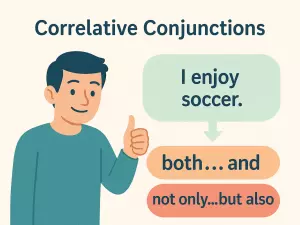
- Correlative conjunctions (pairs such as either...or, neither...nor, both...and) work together to join parallel elements.
How Linking Words Function in Sentences
These connectors allow writers and speakers to:
- Combine short sentences into more complex ones for clarity
- Show relationships like addition, contrast, choice, or cause
- Avoid repetition by joining similar ideas
- Clarify meaning by indicating how one idea depends on another
Common Examples and Their Uses
Below are some frequently used connectors and their primary functions:
- And → adds information (We went to the park and had a picnic.)
- But → shows contrast (She is tired but happy.)
- Or → presents alternatives (Would you like tea or coffee?)
- Nor → connects negative alternatives (He didn’t call, nor did he write.)
- For → gives a reason (He was late, for the train was delayed.)
- So → shows a result (It rained, so we stayed inside.)
- Yet → introduces something unexpected (She is young, yet very wise.)
- Because → explains a cause (They left because it was late.)
- Although → introduces a concession (Although it was cold, they went swimming.)
- Unless → sets a condition (You can’t go unless you finish your homework.)
- While → shows simultaneous actions or contrast (She read while he cooked.)
- Since → gives a reason or time frame (Since you’re here, let’s start.)
- Either...or → presents two choices (You can either stay or leave.)
- Neither...nor → presents two negative options (He likes neither apples nor oranges.)
- Both...and → connects two positive options (She is both smart and kind.)
Summary of Conjunction Functions
In summary, these connecting words are essential tools in English. They help writers and speakers organize information, clarify meaning, and create more engaging, coherent sentences. By choosing the appropriate type, you can guide your reader through your ideas with clarity and precision.
What Conjunctive Adverbs Do
Conjunctive adverbs play a unique role in connecting ideas between independent clauses or sentences. Unlike coordinating conjunctions, which typically link words or phrases within the same sentence, these adverbs provide transitions that show relationships such as contrast, cause and effect, sequence, or comparison. They help guide readers through the logic of your writing, signaling how one thought relates to the next.
How They Function in Sentences
When you use a conjunctive adverb, it often appears at the start of a second independent clause and is separated by a semicolon and a comma. This structure allows you to join two closely related but complete thoughts while highlighting their connection. For example: "She was tired; however, she finished her homework."
Common Purposes
- Contrast: Show differences or unexpected results (e.g., however, nevertheless, on the other hand).
- Addition: Add information (e.g., moreover, furthermore, besides).
- Cause and Effect: Indicate results or consequences (e.g., therefore, consequently, thus, hence).
- Sequence or Time: Show order or timing (e.g., meanwhile, subsequently, then, finally, afterward).
- Comparison: Express similarities (e.g., likewise, similarly).
- Emphasis: Highlight a point (e.g., indeed, certainly).
Examples of Conjunctive Adverbs in Use
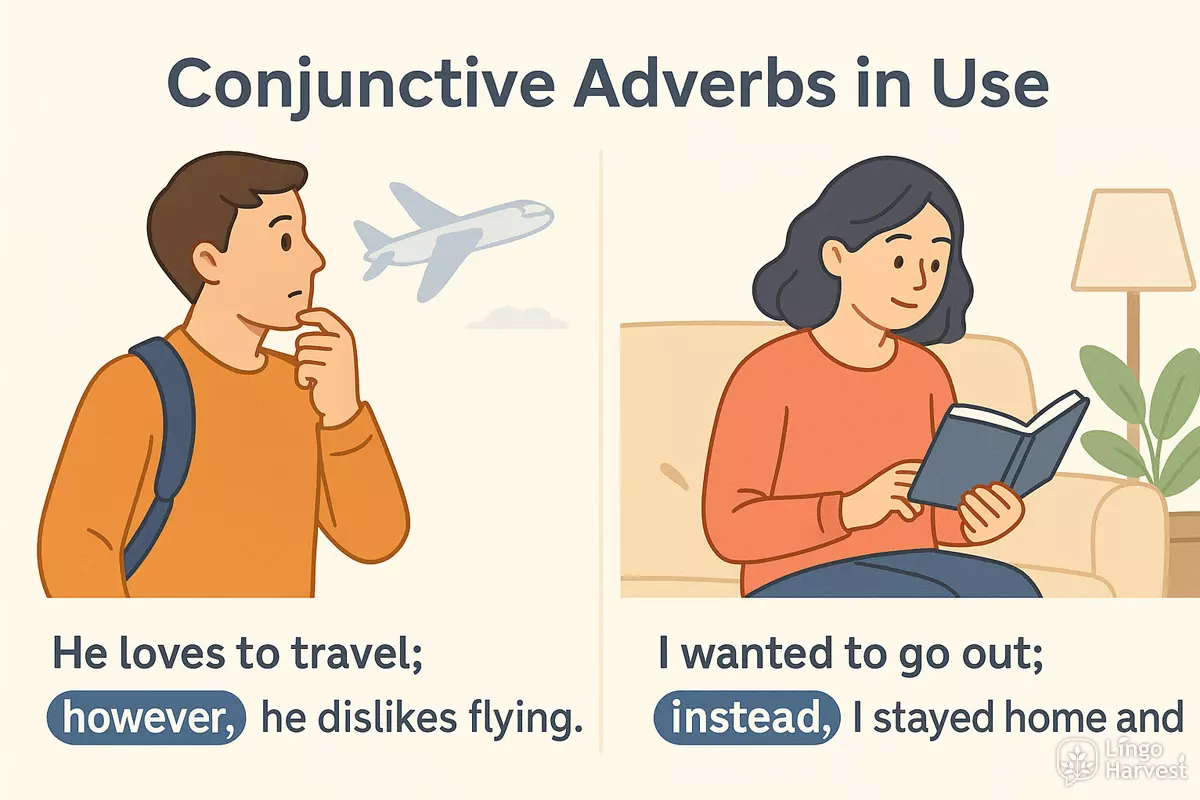
- She didn’t study; therefore, she didn’t pass the test.
- He loves to travel; however, he dislikes flying.
- The meeting ran long; consequently, lunch was delayed.
- I wanted to go out; instead, I stayed home and read.
- The solution worked; moreover, it saved time.
- They finished their project early; thus, they earned extra credit.
- She was running late; nevertheless, she arrived before the others.
- The weather was terrible; meanwhile, we stayed indoors.
- He didn’t call; similarly, she didn’t send a message.
- She didn’t agree; instead, she suggested another plan.
- He missed the bus; therefore, he was late to class.
- We had several options; ultimately, we chose the simplest one.
Summary Table: Roles of Conjunctive Adverbs
| Function | Typical Conjunctive Adverbs |
|---|---|
| Contrast | however, nevertheless, on the other hand, instead, still |
| Addition | moreover, furthermore, besides, also, additionally |
| Cause & Effect | therefore, thus, consequently, hence, accordingly |
| Sequence/Time | meanwhile, then, subsequently, afterward, finally |
| Comparison | likewise, similarly |
| Emphasis | indeed, certainly |
Form Differences
Understanding how coordinating words and conjunctive adverbs appear in sentences sheds light on their unique roles. While both connect ideas, their structures and punctuation requirements set them apart.
Single Words vs. Multi-Word Phrases
Coordinating connectors are usually single words—think "and," "but," or "or." In contrast, conjunctive adverbs often come as single words, but some take the form of short phrases, such as "for example" or "as a result." This subtle difference can affect how smoothly your writing flows.
Position in the Sentence
Conjunctions typically sit directly between the two elements they link, with no need for extra punctuation. On the other hand, conjunctive adverbs often appear at the start of a clause and require a comma following them. Sometimes, they're even set off by semicolons.
Punctuation Patterns
The way these connectors interact with punctuation is a key distinction. Here’s a quick overview:
- Conjunctions: No comma needed unless joining two independent clauses.
- Conjunctive adverbs: Usually preceded by a semicolon and followed by a comma when joining independent clauses.
| Coordinating Conjunctions | Conjunctive Adverbs & Phrases |
|---|---|
| and | however |
| but | therefore |
| or | meanwhile |
| nor | nevertheless |
| for | otherwise |
| so | consequently |
| yet | furthermore |
| More conjunctive adverbs and phrases: for example, in addition, on the other hand, as a result | |
Summary
In summary, you’ll notice that coordinating connectors are compact and straightforward, while conjunctive adverbs and phrases are more varied in length and require careful punctuation. Recognizing these patterns can help you choose the right tool for joining your ideas smoothly and clearly.
Punctuation Rules
Understanding how to properly punctuate sentences that use connectors is essential for clear writing. While both types of linking words join ideas, they follow different conventions when it comes to commas and periods.
Coordinating Conjunctions: Comma Usage
When you use a coordinating conjunction (such as "and," "but," "or," "nor," "for," "so," "yet") to join two independent clauses, a comma is typically placed before the conjunction. However, if you're connecting two shorter phrases or single words, a comma is not necessary.
- I wanted to go for a walk, but it started raining.
- She can sing and dance.
- Will you have tea or coffee?
- He is tired, so he will rest.
Conjunctive Adverbs: Punctuation Patterns
Conjunctive adverbs (such as "however," "therefore," "moreover," "consequently," "nevertheless," "meanwhile," "furthermore," "otherwise," "instead," "likewise") link independent clauses and require more specific punctuation. Usually, when a conjunctive adverb connects two sentences, a period or semicolon comes before it, and a comma follows.
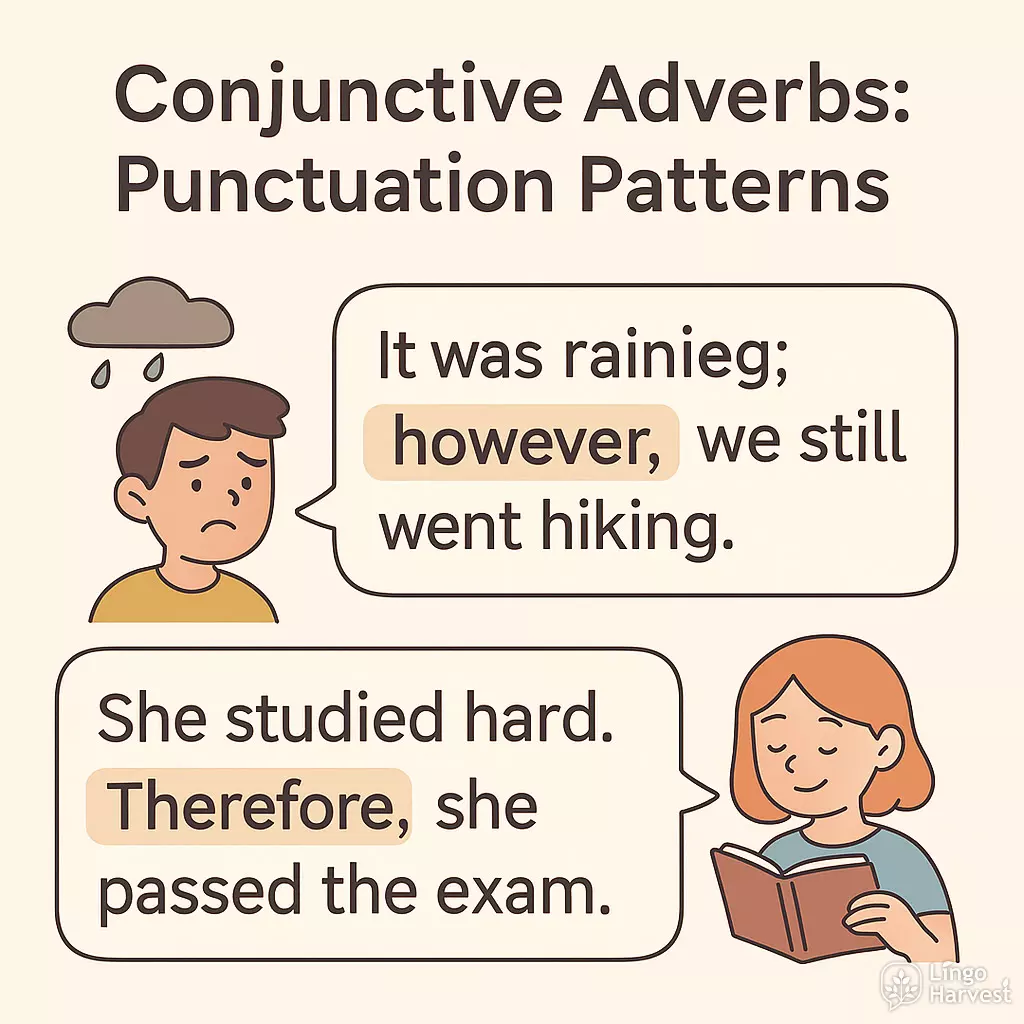
- It was raining; however, we still went hiking.
- She studied hard. Therefore, she passed the exam.
- He didn’t call; instead, he sent a message.
- The project is late; consequently, the team will work overtime.
Comparing Punctuation with Coordinators and Conjunctive Adverbs
The main difference lies in how clauses are joined and what punctuation marks are required. The following table summarizes the typical usage patterns:
| Connector Type | Typical Punctuation Pattern |
|---|---|
| Coordinating Conjunction | Comma before the conjunction when joining independent clauses Example: She was late, but she apologized. |
| Conjunctive Adverb | Semicolon or period before the adverb; comma after Example: She was late; however, she apologized. |
| Short Phrases/Words | No comma needed with coordinating conjunctions Example: Apples and oranges |
| Mid-sentence Conjunctive Adverb | Set off with commas Example: He is, however, very punctual. |
Common Pitfalls and Tips
- ❌ Don’t use a comma before a conjunctive adverb to join two sentences. Use a period or semicolon.
- ✅ Always place a comma after a conjunctive adverb when it introduces or interrupts a clause.
- ❌ Avoid comma splices by not using only a comma between two independent clauses joined by a conjunctive adverb.
- ✅ Remember: only coordinating conjunctions (for, and, nor, but, or, yet, so) can join two independent clauses with just a comma and the conjunction.
With these guidelines, your writing will be clearer, and your sentences will flow more smoothly. The right punctuation helps readers understand the relationship between your ideas.
Meaning and Flow
Understanding the difference between conjunctions and conjunctive adverbs is essential to constructing sentences that are both clear and logically connected. These two types of connectors help readers follow the progression of ideas, but they each serve unique roles in building relationships between clauses and sentences.
How Conjunctions Connect Ideas
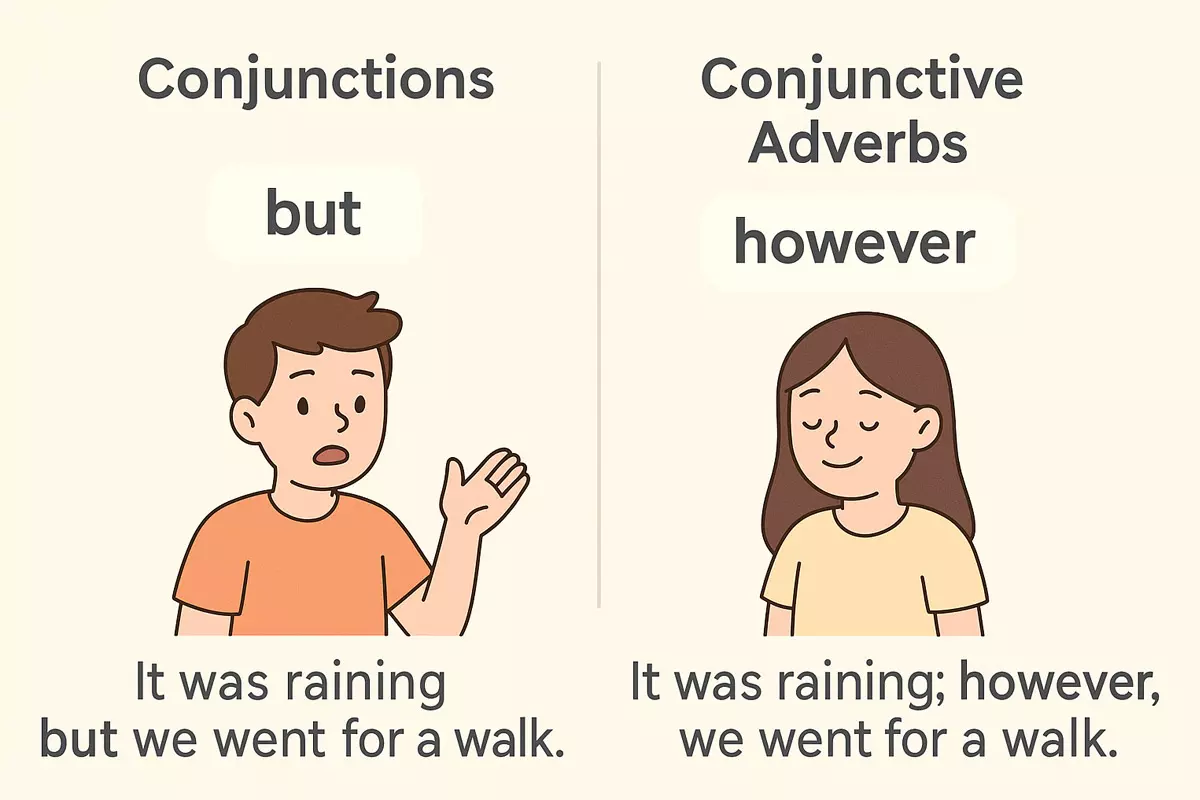
Conjunctions are words like and, but, and or that join words, phrases, or independent clauses within a single sentence. They create a direct link, often without the need for extra punctuation. For example, in the sentence “She wanted to go for a walk, but it was raining,” the conjunction but joins two complete thoughts, showing contrast in a smooth, uninterrupted flow.
- and – adds information or ideas
- but – shows contrast or exception
- or – presents alternatives
- yet – introduces a surprising contrast
- so – indicates result or effect
- nor – presents a negative alternative
- for – explains reason or purpose
Role of Conjunctive Adverbs in Linking Sentences
Conjunctive adverbs, such as however, therefore, and meanwhile, typically connect independent clauses or even entire sentences. They signal relationships like cause and effect, contrast, or sequence, but require punctuation—usually a semicolon or period followed by a comma. For example: “It was raining; however, she went for a walk.” This structure creates a pause, emphasizing the transition or relationship.
- however – contrasts or contradicts
- therefore – shows result or conclusion
- meanwhile – indicates simultaneous actions
- nevertheless – signals a surprising outcome
- consequently – introduces a logical result
- moreover – adds emphasis or detail
- otherwise – presents a possible alternative
- thus – expresses consequence
- furthermore – adds supporting information
- instead – offers an alternative action
Comparing How Each Affects Sentence Flow
| Connector Type | Effect on Flow | Example |
|---|---|---|
| Conjunction | Smoothly joins clauses within a single sentence; minimal pause | She was tired but kept working. |
| Conjunctive Adverb | Links separate clauses or sentences; creates a pause or shift | She was tired; however, she kept working. |
Examples
Understanding how to use both types of connectors can make your writing clearer and more precise. Below, you'll find a range of sample sentences and structures that highlight the typical roles and differences between coordinating conjunctions and conjunctive adverbs. These will help you spot the patterns and decide which one best fits your sentence.
Sample Sentences Using Each Type
- She wanted to go for a walk, but it was raining. (coordinating conjunction)
- He finished his homework; however, he forgot to bring it to class. (conjunctive adverb)
- You can have tea or coffee. (coordinating conjunction)
- The team played well; therefore, they won the match. (conjunctive adverb)
- I tried calling you, yet you didn’t answer. (coordinating conjunction)
- She loves reading; nevertheless, she rarely visits the library. (conjunctive adverb)
- We can go now, or we can wait until later. (coordinating conjunction)
- He was tired; still, he finished the marathon. (conjunctive adverb)
- It was late, so we decided to leave. (coordinating conjunction)
- She studied hard; consequently, she passed the exam. (conjunctive adverb)
- We wanted pizza, and we ordered extra cheese. (coordinating conjunction)
- He didn’t study; thus, he failed the test. (conjunctive adverb)
Side-by-Side Comparison
Here’s a structured look at how each group functions, making it easier to compare their usage and punctuation:
| Connector Type | Example & Typical Punctuation |
|---|---|
| Coordinating Conjunction (for, and, nor, but, or, yet, so) |
He was hungry, so he made a sandwich. [comma before the conjunction] |
| Conjunctive Adverb (however, therefore, moreover, etc.) |
He was hungry; therefore, he made a sandwich. [semicolon before, comma after] |
| Coordinating Conjunction | We wanted to swim, but the pool was closed. |
| Conjunctive Adverb | We wanted to swim; however, the pool was closed. |
Common Patterns and Pitfalls
Notice that coordinating conjunctions join two independent clauses with a comma, while conjunctive adverbs usually require a semicolon before and a comma after. Using these connectors correctly helps your sentences flow smoothly and avoids run-ons or fragments.
- ❌ Incorrect: He was tired, however he kept working.
- ✅ Correct: He was tired; however, he kept working.
- ❌ Incorrect: She likes tea, but, she also drinks coffee.
- ✅ Correct: She likes tea, but she also drinks coffee.
By comparing these structures and practicing with your own sentences, you can strengthen your grasp of how each type of connector works in context.
Quick Practice
Test your understanding of how conjunctions and conjunctive adverbs work in English sentences. Try these practical exercises to reinforce the differences in how these words connect ideas.
Identify the Connector
For each sentence, decide if the highlighted word is a coordinating conjunction or a conjunctive adverb.
- I wanted to go for a walk, but it started raining.
- She loves chocolate; however, she avoids eating it often.
- You can have tea or coffee.
- He missed the bus; therefore, he was late.
- The movie was long, so we left early.
- They studied hard; consequently, they passed the exam.
Show answers
- but – coordinating conjunction
- however – conjunctive adverb
- or – coordinating conjunction
- therefore – conjunctive adverb
- so – coordinating conjunction
- consequently – conjunctive adverb
Choose the Right Connector
Fill in each blank with a suitable word from the list: and, but, or, so, however, therefore, moreover, nevertheless.
- I was tired, _______ I finished my homework.
- She wanted to watch TV; _______, her brother preferred to read.
- We can go by train _______ by bus.
- The food was spicy; _______, I enjoyed it.
- He was late, _______ he apologized.
- She speaks French; _______, she also knows Spanish.
Show answers
- but
- however
- or
- nevertheless
- so
- moreover
Common Connectors: Functions and Examples
| Connector | Type | Example |
|---|---|---|
| and | Coordinating conjunction | She plays piano and sings. |
| but | Coordinating conjunction | He is tall, but he cannot play basketball. |
| or | Coordinating conjunction | Would you like tea or coffee? |
| so | Coordinating conjunction | It was raining, so we stayed inside. |
| however | Conjunctive adverb | He tried hard; however, he did not succeed. |
| therefore | Conjunctive adverb | She was hungry; therefore, she made a sandwich. |
| moreover | Conjunctive adverb | The exam was difficult; moreover, it was very long. |
| nevertheless | Conjunctive adverb | It was cold; nevertheless, we went swimming. |
| consequently | Conjunctive adverb | The team trained hard; consequently, they won the match. |
| yet | Coordinating conjunction | The task was difficult, yet she completed it. |
Spot the Error
Some sentences below contain a mistake in using connectors. Find any errors and correct them.
- He wanted to buy a car, however he didn’t have enough money.
- It was raining; so, we stayed home.
- I studied hard, therefore I passed the test.
- You can come early or you can come late.
Show answers
- Error: "however" is a conjunctive adverb and should not directly follow a comma. Correct: He wanted to buy a car; however, he didn’t have enough money.
- Error: "so" is a coordinating conjunction and should not follow a semicolon. Correct: It was raining, so we stayed home.
- Error: "therefore" is a conjunctive adverb and should not directly follow a comma. Correct: I studied hard; therefore, I passed the test.
- No error.