Mid-position Adverbs: always, often, never

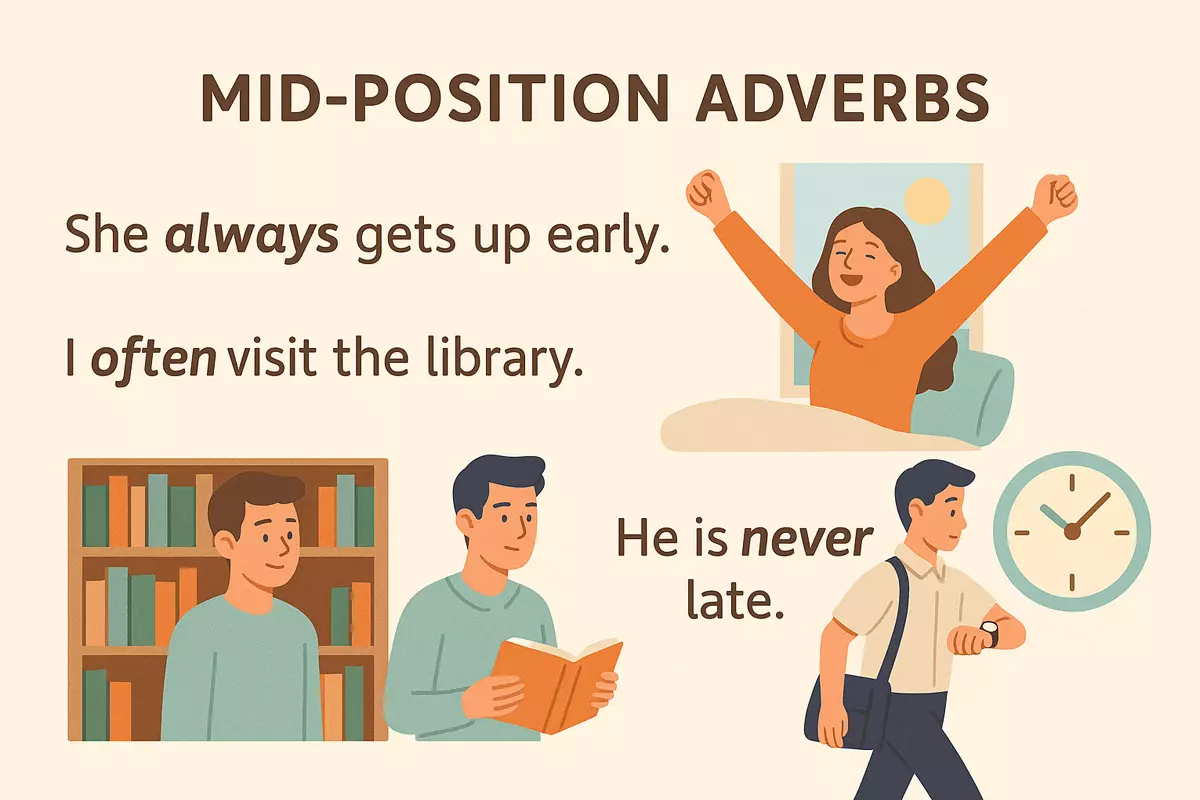 This article explains mid-position adverbs, their placement in simple and continuous tenses, and with modal or auxiliary verbs. It highlights common mistakes, contrasts natural and unnatural examples, and provides short exercises for practice.
Are you wondering where to place words like always, never, or often in English sentences? Learning the correct position for these adverbs of frequency helps your speech and writing sound more natural and fluent. Typically, such adverbs are placed before the main verb but after the verb to be. For example, you would say, She always arrives early, or He is never late. Mastering this word order will improve both your understanding and use of English, making your communication clearer and more effective.
Definition of mid-position adverbs
Mid-position adverbs are words that typically appear in the middle of a sentence, usually before the main verb or after the first auxiliary verb. These adverbs often describe frequency, certainty, or manner. Common examples include always, often, and never. Their placement helps clarify exactly how, when, or how often something happens, and they naturally fit into the sentence structure without interrupting its flow.
Typical Placement in Sentences
In English, these adverbs usually come:
- Before the main verb: She always drinks coffee in the morning.
- Between the auxiliary and main verb: They have never seen snow.
- After the verb to be: He is often late.
Some verbs, like be, are an exception; with them, the adverb follows directly after the verb.
Common Mid-position Adverbs
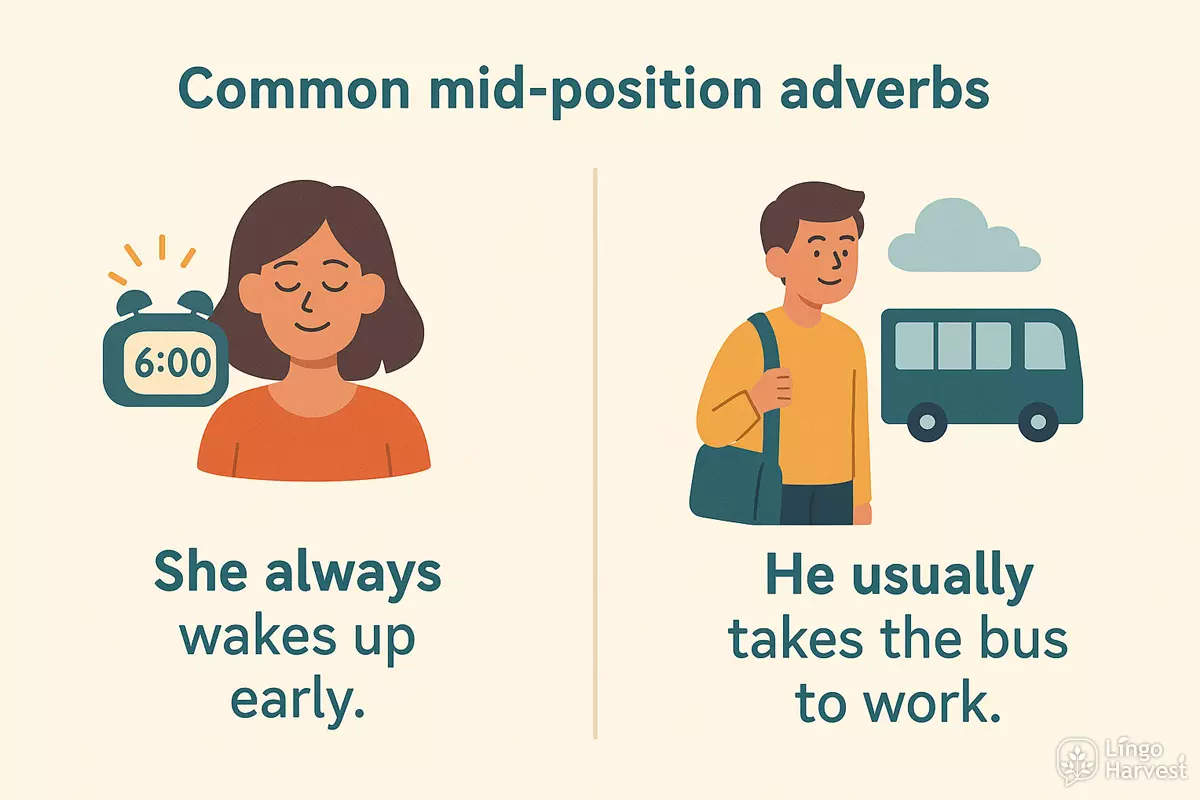
These words are frequently used to talk about frequency, certainty, or attitude. Here are some of the most common:
- always → She always wakes up early.
- usually → He usually takes the bus to work.
- often → They often eat dinner together.
- sometimes → I sometimes forget my keys.
- never → She never drinks coffee at night.
- rarely → We rarely watch TV.
- seldom → He seldom makes mistakes.
- hardly ever → They hardly ever travel in winter.
- just → I just finished my homework.
- already → She has already seen that movie.
- still → He still lives with his parents.
- almost → We almost missed the train.
- nearly → She nearly dropped her phone.
- quite → The presentation was quite impressive.
- really → I really like this idea.
- simply → He simply refused to help.
- probably → They will probably arrive late.
- certainly → She will certainly pass the exam.
Examples and Patterns
Placement of these adverbs changes slightly depending on the verb tense and the presence of auxiliary verbs. For clarity, here are some patterns:
- Present simple: I never eat meat.
- Present continuous: She is always singing.
- Present perfect: We have just finished.
- Modal verbs: You should never lie.
| Sentence Pattern | Example |
|---|---|
| Subject + adverb + main verb | He often visits his grandmother. |
| Subject + auxiliary + adverb + main verb | They have never traveled abroad. |
| Be verb + adverb | She is always cheerful. |
| Modal + adverb + main verb | You can always ask for help. |
Choosing the right place for these adverbs makes your sentences clearer and more natural. When in doubt, remember that most frequency adverbs fit best just before the main verb or right after the first auxiliary.
Where mid-position is in simple and continuous tenses
Mid-position adverbs such as always, often, and never have specific spots in sentences, depending on whether you’re dealing with simple or continuous verb forms. In simple tenses, these adverbs usually appear between the subject and the main verb. However, with continuous (progressive) tenses, the adverb is normally placed after the first auxiliary (helping) verb but before the main verb ending in -ing.
Placement in Simple Tenses
For present simple and past simple, adverbs like always or never go directly before the main verb, but after the verb to be:
- She always drinks coffee in the morning.
- I never eat meat.
- They often visit their grandparents.
- He is always late. (after is)
- We are never bored in class.
Placement in Continuous Tenses
When you use present continuous or past continuous, place mid-position adverbs after the auxiliary verb (am, is, are, was, were) and before the verb in its -ing form:
- She is always running late.
- They are often studying together.
- I am never watching TV at this hour.
- We were always hoping for good weather.
Comparing Adverb Placement
Here’s a side-by-side comparison of where these adverbs fit in simple and continuous tenses:
| Verb Form | Example Sentence | Adverb Position |
|---|---|---|
| Present Simple | She always works hard. | Before the main verb |
| Past Simple | They never called back. | Before the main verb |
| Present Continuous | He is often complaining. | After the auxiliary (is), before -ing verb |
| Past Continuous | I was always forgetting my keys. | After the auxiliary (was), before -ing verb |
| Be verb (simple) | We are never late. | After be verb |
Quick Reference: More Examples
- You always help me. (present simple)
- He never forgets birthdays. (present simple)
- She often arrives early. (present simple)
- They always smiled. (past simple)
- I am never working at night. (present continuous)
- We are often meeting new people. (present continuous)
- He was always making jokes. (past continuous)
- You were never listening. (past continuous)
- She is always cheerful. (be verb simple)
- They are often tired. (be verb simple)
Remember, the precise position of adverbs like always, often, and never helps your sentences sound natural and clear. The structure depends on whether you use a simple or continuous tense, as shown above.
Mid-position with modal verbs and auxiliaries
When using adverbs like always, often, and never, their placement with modal verbs (such as can, must, should) and auxiliary verbs (like have, be, do) follows a clear pattern. Typically, these frequency adverbs are inserted directly after the modal or auxiliary and before the main verb. This helps keep the sentence natural and easy to understand.
Standard patterns with modal and auxiliary verbs
The basic structure is:
Subject + modal/auxiliary + adverb + main verb
For example:
- She can always find a solution.
- They must never be late.
- We have often eaten here.
- I would never say that.
- You should always check your work.
- He has never visited France.
- The children are often noisy.
- It will never happen again.
- She could always rely on him.
- We had never heard that story.
- He is always busy.
- I do often wonder about that.
Multiple auxiliaries and adverb position
When more than one auxiliary verb is present, the adverb still typically comes after the first auxiliary:
- You will never have enough time.
- She might always be working late.
- They could often have helped us.
Comparison: Placement with main verb only
To help visualize the difference, see the contrast below:
| With Modal/Auxiliary | With Main Verb Only |
|---|---|
| She can never remember names. | She never remembers names. |
| They will always help us. | They always help us. |
| I have often wondered about this. | I often wonder about this. |
| We are never late. | We never are late. (❌ unnatural) |
Common mistakes to avoid
Placing the adverb before the modal or auxiliary, or after the main verb, usually sounds awkward or changes the meaning. For example:
- ❌ She can remembers always names.
- ❌ They will help always us.
Keep adverbs of frequency immediately after the modal or auxiliary for natural, correct English.
Quick reference: Typical mid-position adverbs
Some of the most frequent adverbs that follow this pattern include:
- occasionally → She occasionally joins us for lunch.
- frequently → He frequently checks the weather forecast.
- regularly → They regularly attend yoga classes.
- generally → I generally prefer quiet places.
- completely → The room was completely silent.
- fully → She fully supports the decision.
- partly → The delay was partly my fault.
- barely → He barely passed the test.
- entirely → The idea is entirely new to me.
- ultimately → They ultimately chose the safer option.
- clearly → You clearly misunderstood the question.
- similarly → She similarly agreed with the plan.
- roughly → The project will roughly take two months.
- simply → They simply ignored the warning.
- seriously → He seriously considered changing careers.
- naturally → She naturally assumed he would come.
- genuinely → I genuinely appreciate your help.
- occasionally → He occasionally forgets his wallet.
- randomly → The printer randomly stopped working.
- officially → The results were officially announced today.
Understanding this structure helps you use adverbs naturally with modals and auxiliaries, making your sentences clearer and more fluent.
Common mistakes in adverb placement
Placing adverbs like "always," "often," and "never" in the wrong part of a sentence is a frequent error for English learners. These adverbs usually belong in the mid-position, which is after the first auxiliary verb or before the main verb. However, confusion often arises because of interference from native language structure or uncertainty about English word order.
Typical errors with mid-position adverbs
Learners sometimes put these adverbs at the start or end of a sentence, which can make the sentence sound unnatural or even change its meaning. Here are some of the most frequent slip-ups:

| Rule | ❌ Incorrect | ✅ Correct |
|---|---|---|
| Placing the adverb at the beginning | Always I go to school by bus. | I always go to school by bus. |
| Putting the adverb at the end | I go to school by bus always. | I always go to school by bus. |
| Incorrectly splitting the verb | I have always been liked dogs. | I have always liked dogs. |
| Forgetting the auxiliary verb | She always go to the gym. | She always goes to the gym. |
| Adverb before the subject | Never John eats vegetables. | John never eats vegetables. |
| Double adverbs | I always never eat fish. | I never eat fish. |
| Incorrect order with negatives | I don't never eat meat. | I never eat meat. |
| Using adverbs in imperatives | Always eat you your lunch. | Always eat your lunch. |
| Adverb after the object | She drinks coffee always in the morning. | She always drinks coffee in the morning. |
| Incorrect with modal verbs | He can sometimes plays guitar. | He can sometimes play guitar. |
Correct placement patterns
It helps to see how mid-position adverbs fit into different sentence structures. Here are some general patterns:
- With one verb: Subject + adverb + main verb
He always forgets his keys. - With auxiliary verbs: Subject + auxiliary + adverb + main verb
She has never seen snow. - With modal verbs: Subject + modal + adverb + main verb
I can often help you. - With "be" as the main verb: Subject + be + adverb
They are always late.
Quick reference: Mistakes vs. Correct Usage
| Incorrect | Correct |
|---|---|
| I never am late. | I am never late. |
| He often goes to the gym always. | He often goes to the gym. |
| She is late always. | She is always late. |
| Always I finish my homework. | I always finish my homework. |
| They go never to the cinema. | They never go to the cinema. |
| We have seen often that movie. | We have often seen that movie. |
Tips for avoiding mistakes
- Place "always," "often," and "never" just before the main verb, or after the first auxiliary/modal verb.
- With "be" as the main verb, put the adverb after "am/are/is/was/were."
- Don’t use these adverbs at the beginning or end of a sentence unless for special emphasis.
- Avoid double negatives with "never." Say "I never eat meat," not "I don't never eat meat."
- Practice with different verb forms to build confidence in word order.
A little attention to sentence structure goes a long way in making your English sound more natural and fluent.
Natural vs unnatural sounding examples
When using mid-position adverbs like always, often, and never, word order can make a sentence sound smooth or awkward to native speakers. The most common, natural placement is between the subject and the main verb, or after the first auxiliary verb. Placing these adverbs incorrectly can result in sentences that sound odd or are difficult to understand.
Common placement patterns
- She always drinks coffee in the morning. ✅
- They never arrive on time. ✅
- We often go hiking on weekends. ✅
- I never have breakfast before work. ✅
- He always forgets his keys. ✅
- My friends often call me in the evening. ✅
- Lucy never eats meat. ✅
- The train always leaves at six. ✅
- You often find good deals online. ✅
- We never watch TV after dinner. ✅
Unnatural or incorrect placement
Unusual word order usually stands out immediately. Here are some examples that sound unnatural to native speakers:
- She drinks always coffee in the morning. ❌
- They arrive never on time. ❌
- We go often hiking on weekends. ❌
- I have never breakfast before work. ❌
- He forgets always his keys. ❌
- My friends call often me in the evening. ❌
- Lucy eats never meat. ❌
- The train leaves always at six. ❌
- You find often good deals online. ❌
- We watch never TV after dinner. ❌
Quick comparison
| Natural sounding | Unnatural sounding |
|---|---|
| She always drinks coffee in the morning. | She drinks always coffee in the morning. |
| They never arrive on time. | They arrive never on time. |
| He often forgets his keys. | He forgets often his keys. |
| We never watch TV after dinner. | We watch never TV after dinner. |
Summary tips
For mid-position adverbs, place them before the main verb or after the first auxiliary verb. Avoid putting them directly before the object or at the end of the sentence. This helps your English sound natural and fluent.
Short exercises for accurate placement
Placing adverbs such as "always," "often," and "never" correctly in sentences is key for natural-sounding English. Below, you'll find focused practice designed to help you master their typical mid-position—usually between the subject and the main verb, but after auxiliary verbs.
Choose the right spot
Insert the given adverb in the correct place in each sentence. Write out the full sentence.
- She (never) drinks coffee in the evening.
- We (always) go for a walk after dinner.
- They (often) play tennis at the weekend.
- He (never) eats meat.
- I (often) forget my keys at home.
- She (usually) gets up at 7 a.m.
- They (rarely) watch TV in the morning.
- He is (sometimes) late for work.
- We (seldom) eat out on weekdays.
- I (hardly ever) go to the cinema.
Show answers
- She never drinks coffee in the evening.
- We always go for a walk after dinner.
- They often play tennis at the weekend.
- He never eats meat.
- I often forget my keys at home.
- She usually gets up at 7 a.m.
- They rarely watch TV in the morning.
- He is sometimes late for work.
- We seldom eat out on weekdays.
- I hardly ever go to the cinema.
Spot the mistake
Each sentence below has an adverb in the wrong position. Rewrite the sentence with the correct placement.
- He drinks always tea in the morning.
- We are late never for class.
- They watch often TV at night.
- I am hungry often in the afternoon.
- She goes usually to bed early.
- You are tired always on Mondays.
- They are sometimes busy in the evening.
- He eats rarely breakfast at home.
- We visit often our grandparents.
- I am late hardly ever for work.
Show answers
- He always drinks tea in the morning.
- We are never late for class.
- They often watch TV at night.
- I am often hungry in the afternoon.
- She usually goes to bed early.
- You are always tired on Mondays.
- They are sometimes busy in the evening.
- He rarely eats breakfast at home.
- We often visit our grandparents.
- I am hardly ever late for work.
Comparing adverb placement
The table below shows correct placement of "always," "often," and "never" in different sentence types. Notice how the adverb comes after auxiliary verbs (like "am," "have," "will") but before the main verb in simple tenses.
| Sentence type | Example with adverb | Adverb position |
|---|---|---|
| Present simple | I always read before bed. | After subject, before main verb |
| Present continuous | She is often working late. | After auxiliary ("is"), before main verb |
| Modal verb | They will never agree. | After modal ("will"), before main verb |
| Present perfect | We have always wanted a dog. | After auxiliary ("have"), before main verb |
Make your own sentences
Create sentences using the following prompts and the adverbs "always," "often," or "never." Try to use a variety of subjects and verbs.
- (you / be / late for work)
- (she / eat / breakfast)
- (they / forget / birthdays)
- (we / travel / by train)
- (I / feel / tired on Mondays)
Show answers
- You are never late for work.
- She always eats breakfast.
- They often forget birthdays.
- We always travel by train.
- I often feel tired on Mondays.
Practicing these patterns regularly will help you internalize natural adverb placement and avoid common mistakes.