Verb Patterns Overview: How Verbs Control Sentence Structure

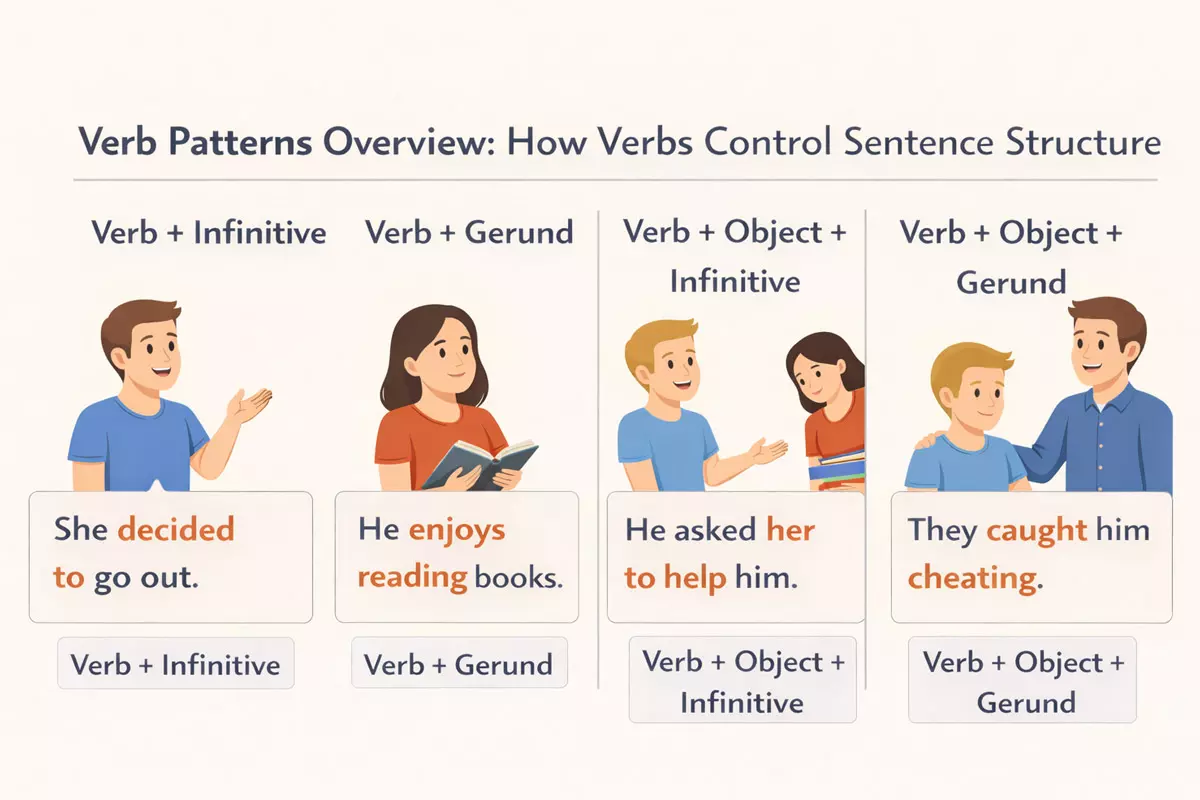 The article defines verb patterns in grammar, describes main English types, and explains how verbs determine sentence structure. It covers objects, complements, common errors, pattern selection, and includes practice exercises.
Have you ever noticed how some sentences feel awkward while others flow smoothly? This often comes down to how verbs interact with the words surrounding them. By understanding these patterns, you can communicate more clearly and effectively. Recognizing how verbs fit with their subjects and objects helps you avoid confusion and create sentences that are easy to read and understand. Paying attention to these details not only improves your writing but also enhances your overall ability to express ideas with precision and confidence.
What verb patterns mean in grammar
Verb patterns describe the specific ways verbs interact with other elements in a sentence, such as objects, complements, or additional verbs. Understanding these patterns is essential for constructing clear and accurate sentences in English. Each verb can control which structures are possible after it, and this determines what follows: a noun, a gerund, an infinitive, or even a clause.
Why verb patterns matter
Not all verbs behave the same way. Some require an object, others need a second verb, and some stand alone. If you use the wrong structure after a verb, the sentence may become ungrammatical or change meaning. For example, "enjoy" is followed by a gerund ("I enjoy swimming"), but "want" is followed by an infinitive ("I want to swim").
Common verb pattern types
Here are some frequent verb structures you’ll encounter in English:
- Verb + object (e.g., "She reads books.")
- Verb + to-infinitive (e.g., "He hopes to win.")
- Verb + -ing (gerund) (e.g., "They enjoy hiking.")
- Verb + object + to-infinitive (e.g., "I want you to help.")
- Verb + object + bare infinitive (e.g., "Let him go.")
- Verb + that clause (e.g., "She said that she was tired.")
- Verb + wh- clause (e.g., "He asked where we were going.")
- Verb only (intransitive) (e.g., "She smiled.")
- Verb + object + past participle (e.g., "Had the report finished.")
- Verb + object + adjective (e.g., "Paint the wall red.")
Patterns and verb meaning
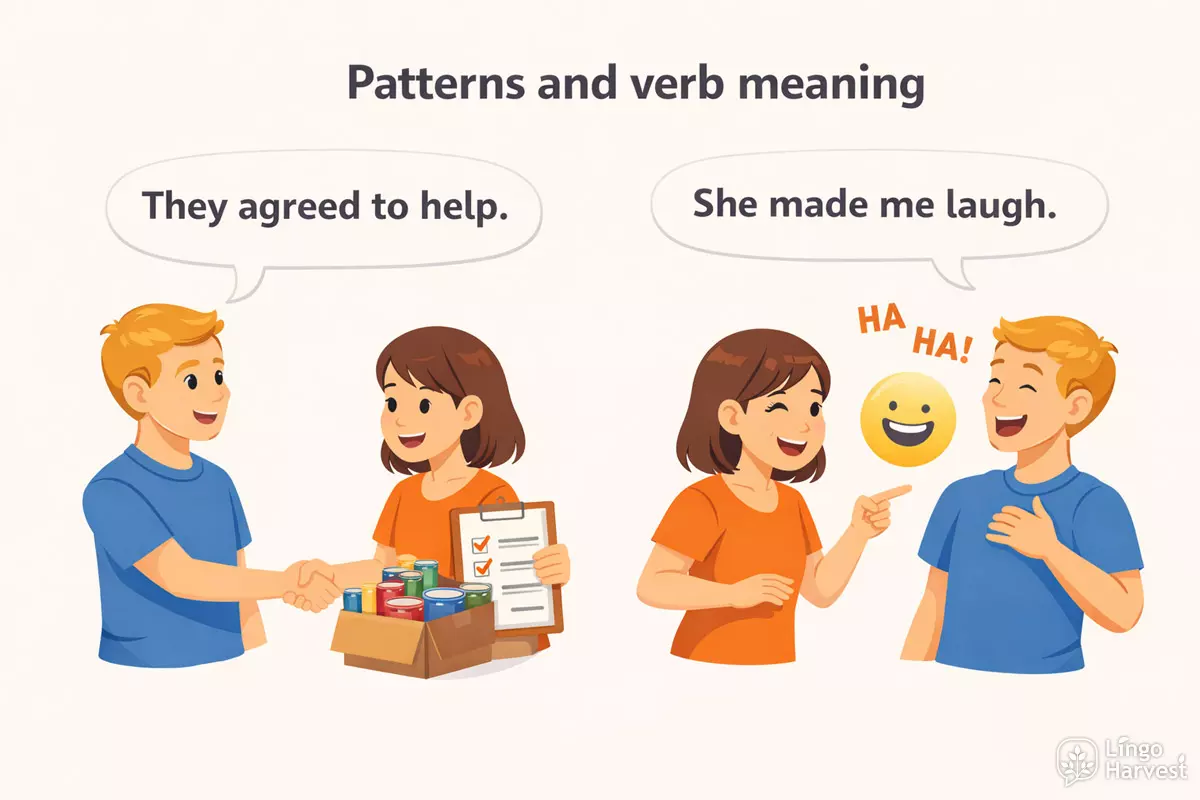
The structure after a verb can affect its meaning or whether the sentence is correct. For instance, "remember doing" and "remember to do" have different uses. Some verbs can take more than one pattern, but the meaning changes. Others are restricted to just one.
| Verb | Allowed Pattern | Example | ❌ Incorrect Example |
|---|---|---|---|
| enjoy | Verb + -ing | I enjoy reading. | I enjoy to read. |
| decide | Verb + to-infinitive | She decided to leave. | She decided leaving. |
| let | Verb + object + bare infinitive | Let him speak. | Let him to speak. |
| suggest | Verb + -ing / that clause | I suggest going. / I suggest that we go. | I suggest to go. |
| agree | Verb + to-infinitive | They agreed to help. | They agreed helping. |
| make | Verb + object + bare infinitive | She made me laugh. | She made me to laugh. |
| advise | Verb + object + to-infinitive / -ing | I advise you to rest. / I advise resting. | I advise you rest. |
Recognizing patterns in use
Paying attention to how verbs are used in context helps you internalize which structures are natural and correct. Reading widely and practicing sentence construction with different verbs will build your awareness of these important grammar patterns.
Main types of verb patterns in English
Verbs in English often determine which words can come next, shaping the structure and meaning of a sentence. Understanding these typical patterns helps learners use verbs more accurately and fluently. Each verb has its own “rules” about what can follow, such as whether it’s followed by an object, another verb, or a preposition. Let’s look at the most common structures and how they work.
1. Verb + Object
Many verbs are followed directly by an object—usually a noun or pronoun. This is often called the “transitive” pattern. For example:
- She reads books.
- They built a house.
2. Verb + to-Infinitive
Some verbs are followed by the “to” form of another verb (the infinitive). This pattern is common with verbs expressing plans, intentions, or preferences:
- He wants to leave.
- We hope to win.
- I decided to stay.
3. Verb + -ing Form (Gerund)
Certain verbs are followed by another verb in the -ing form (gerund). This pattern is typical after verbs about likes, dislikes, and activities:
- She enjoys swimming.
- They avoided driving at night.
- He suggested meeting later.
4. Verb + Object + Infinitive/-ing
Some verbs require both an object and another verb, either in the infinitive or -ing form. The choice depends on the verb:
- She told him to wait.
- We watched them playing.
- I let her go.
5. Verb + Preposition + Object/-ing
A number of verbs need a preposition before the following noun, pronoun, or -ing form:
- He apologized for being late.
- They believe in working hard.
- She looks after the children.
6. Verb + Bare Infinitive
A bare infinitive is the infinitive without “to.” This pattern appears after some verbs, especially modal verbs and certain causative or perception verbs:
- She can swim.
- We heard him sing.
- Let me help.
Comparison of Common Verb Patterns
| Pattern | Example |
|---|---|
| Verb + Object | She wrote a letter. |
| Verb + to-Infinitive | They plan to travel. |
| Verb + -ing | He enjoys reading. |
| Verb + Object + Infinitive | I told her to call. |
| Verb + Preposition + -ing | She insisted on leaving. |
| Verb + Bare Infinitive | We watched them dance. |
Other Patterns to Notice
- Verb + that-clause: I think that he’s right.
- Verb + question word + infinitive: She explained how to do it.
- Verb + object + past participle: We had the car repaired.
- Verb + object + adjective: The news made him happy.
Recognizing these patterns helps you choose the right structure after a verb. Some verbs can fit more than one type, but the meaning may change. Practice noticing which verbs use which pattern to build more natural sentences.
How verbs determine sentence structure
Verbs play a central role in shaping the way sentences are formed. Each verb comes with its own requirements for what must (or can) accompany it, such as objects, complements, or additional clauses. This is why understanding verb patterns is crucial for constructing clear and correct sentences in English.
Verb Valency: What Does the Verb Need?
The concept of valency refers to how many elements a verb requires to complete its meaning. Some verbs can stand alone, while others need one or more objects. Here are some common patterns:
- Intransitive verbs (no object): The dog barked.
- Transitive verbs (one object): She reads books.
- Ditransitive verbs (two objects): He gave her a gift.
- Linking verbs (subject + complement): The soup tastes delicious.
Common Verb Patterns
Different verbs follow specific structures, which can include gerunds, infinitives, or clauses. Here are some frequent patterns found in English:
- Verb + to-infinitive: They decided to leave.
- Verb + gerund: She enjoys swimming.
- Verb + object + bare infinitive: We let him go.
- Verb + object + to-infinitive: I want you to help.
- Verb + object + past participle: They got the car fixed.
- Verb + that-clause: He believes that she is right.
- Verb + wh-clause: She asked where he was going.
- Verb + object + adjective: The joke made him happy.
- Verb + prepositional phrase: They agreed on a plan.
- Verb + adverb: She smiled warmly.
- Verb + object + complement: We elected her president.
- Verb + reflexive pronoun: He blamed himself.
Comparing Verb Patterns
Some verbs change meaning depending on their pattern. The table below illustrates how sentence structure shifts with different verb patterns:
| Verb | Pattern Example |
|---|---|
| Stop |
|
| Remember |
|
| Try |
|
| See |
|
Why Verb Patterns Matter
Choosing the correct pattern for each verb ensures your meaning is clear and natural. Errors in verb structure can lead to confusion or awkward phrasing. Mastering these patterns is essential for anyone aiming to write or speak English fluently.
Objects, complements, and clauses after verbs
After a verb, the next part of the sentence often depends on the verb’s requirements. Some verbs need an object, others require a complement, and many can be followed by a whole clause. Understanding these differences helps you build clear and natural sentences in English.
Direct and Indirect Objects
A direct object receives the action of the verb, while an indirect object shows to whom or for whom the action is done. For example, in “She gave her friend a gift,” “a gift” is the direct object, and “her friend” is the indirect object. Some verbs only take a direct object, while others allow both.
- Direct object: He ate the sandwich.
- Indirect object: She sent him a letter.
- Both: They offered the guests some coffee.
Complements: Subject and Object
Complements provide more information about the subject or object. Subject complements typically follow linking verbs like “be,” “seem,” or “become,” describing or renaming the subject. Object complements appear after the object, giving more details about it. Not all verbs allow complements, so it’s useful to know which ones do.
- Subject complement: The sky is blue.
- Object complement: They elected her president.
- With adjectives: The soup tastes delicious.
- With nouns: We consider him a genius.
Clauses After Verbs
Many verbs are followed by clauses that give extra information, usually starting with “that,” “if,” “whether,” or a question word. Some verbs require a “to-infinitive” or “-ing” form instead of a full clause. Choosing the right pattern depends on the verb.
| Verb Pattern | Example |
|---|---|
| Verb + direct object | She reads books. |
| Verb + indirect + direct object | He gave her a present. |
| Verb + object + object complement | They named the puppy Max. |
| Verb + to-infinitive clause | We want to leave early. |
| Verb + -ing clause | She enjoys swimming. |
| Verb + that-clause | I think that he’s right. |
| Verb + if/whether-clause | They asked if we were coming. |
| Linking verb + subject complement | The food smells delicious. |
Common Patterns After Verbs
- Verb + noun: She found a wallet.
- Verb + pronoun: I saw him.
- Verb + -ing: He suggested waiting.
- Verb + to-infinitive: They hope to win.
- Verb + preposition + noun: She depends on her team.
- Verb + that-clause: We believe that she will succeed.
- Verb + question word + clause: She explained how it works.
- Verb + adjective: The news made her happy.
- Verb + object + to-infinitive: I want you to come.
- Verb + object + bare infinitive: They let us go.
Knowing which structures follow specific verbs helps you avoid common mistakes and makes your sentences more precise. Always check if a verb needs an object, a complement, or a particular type of clause for correct usage.
Common verb pattern groups
Understanding how different verbs interact with objects, complements, or other verbs is essential for constructing clear sentences. English verbs typically follow recognizable patterns, which tell us what type of words (like nouns, gerunds, or infinitives) can come after them. Recognizing these groups helps you avoid common mistakes and expand your sentence-building skills.
Basic verb pattern types
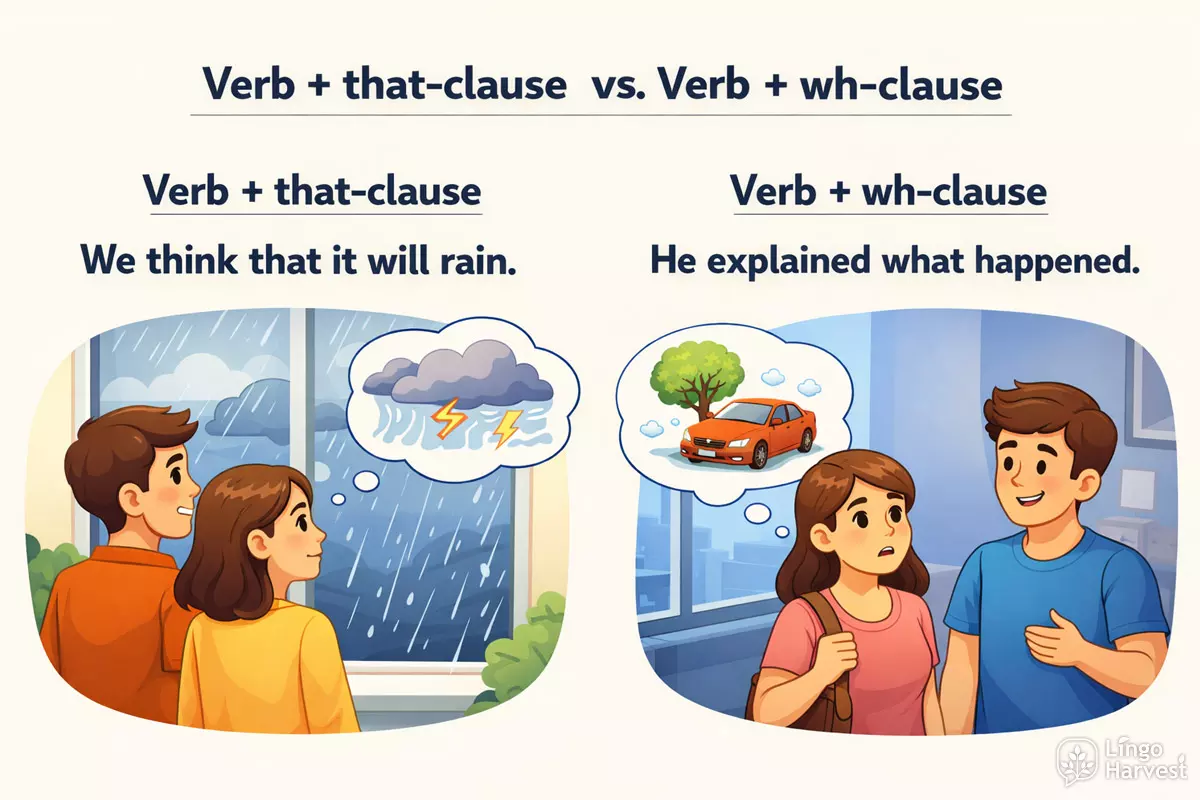
Below are some of the most widely used verb patterns in English. Each pattern is defined by the elements that follow the main verb:
- Verb + object (e.g., "She reads books.")
- Verb + to-infinitive (e.g., "They decided to leave early.")
- Verb + -ing form (gerund) (e.g., "He enjoys swimming.")
- Verb + object + bare infinitive (e.g., "She made him laugh.")
- Verb + object + to-infinitive (e.g., "I asked her to help.")
- Verb + that-clause (e.g., "We think that it will rain.")
- Verb + wh-clause (e.g., "He explained what happened.")
- Verb + preposition + -ing (e.g., "She insisted on coming.")
- Verb + object + adjective (e.g., "The news made him happy.")
- Verb + object + past participle (e.g., "They had the car repaired.")
- Verb + object + present participle (e.g., "I saw her running.")
- Verb + noun complement (e.g., "She became a teacher.")
Comparing verb pattern requirements
Some verbs can fit into more than one group, and choosing the correct pattern can change the meaning. Here’s a comparison of how certain verbs behave across different structures:
| Verb | Pattern Example | Notes |
|---|---|---|
| stop | stop doing / stop to do | "Stop smoking" (quit the action); "Stop to smoke" (pause to start another action) |
| remember | remember doing / remember to do | "Remember meeting" (recall a memory); "Remember to meet" (not forget a task) |
| advise | advise doing / advise someone to do | Both patterns are correct, but meaning and focus shift |
| make | make someone do | Always followed by object + bare infinitive |
| suggest | suggest doing / suggest that | Never followed by "to-infinitive" |
| let | let someone do | Followed by object + bare infinitive only |
Tips for mastering verb patterns
- Check dictionaries for verb-specific structures if you’re unsure.
- Pay attention to verbs that change meaning with different patterns (like "stop" or "remember").
- Practice with authentic examples to build intuition for natural usage.
- Not all verbs allow objects or complements; some are strictly intransitive.
As you become familiar with these structures, you'll find it easier to express complex ideas and avoid common grammatical errors.
Typical errors with verb patterns
Many English learners run into trouble when using verbs that require specific structures. These mistakes often come from trying to translate directly from another language, or from not remembering which verbs need an infinitive, which take a gerund, and which require an object in between. Misusing these patterns can make sentences sound awkward or even change their meaning.
Common mistakes with verb + infinitive and verb + gerund patterns
Some verbs are followed by the infinitive (to + base form), while others are followed by the gerund (-ing form). Mixing these up is a frequent source of confusion. Here are some examples of mistakes and the correct forms:
- Incorrect: I enjoy to swim. ❌
Correct: I enjoy swimming. ✅ - Incorrect: She decided going home. ❌
Correct: She decided to go home. ✅ - Incorrect: He suggested to take a taxi. ❌
Correct: He suggested taking a taxi. ✅ - Incorrect: They agreed going together. ❌
Correct: They agreed to go together. ✅
Forgetting the object with certain verbs
Some verbs require an object before the next verb, while others do not. Missing the object can make the sentence incomplete or confusing. For example:
- Incorrect: She reminded go to the meeting. ❌
Correct: She reminded me to go to the meeting. ✅ - Incorrect: I told finish the work. ❌
Correct: I told him to finish the work. ✅ - Incorrect: He advised study harder. ❌
Correct: He advised her to study harder. ✅ - Incorrect: They asked come earlier. ❌
Correct: They asked us to come earlier. ✅
Confusing verbs with similar meanings but different patterns
Some verbs that look or sound similar actually use different structures. This can cause confusion, especially with verbs like "stop," "remember," and "forget," which change meaning depending on the pattern:
| Verb + Gerund | Verb + Infinitive |
|---|---|
| Stop smoking (quit the habit) | Stop to smoke (pause in order to smoke) |
| Remember locking the door (memory of a past action) | Remember to lock the door (reminder to do something) |
| Forget meeting her (memory about the past) | Forget to meet her (fail to do a planned action) |
| Try climbing the tree (experiment to see the result) | Try to climb the tree (attempt to do it) |
Other frequent pitfalls
- Using “make” and “let” with “to” (Correct: She made me cry, not to cry)
- Mixing up “want” and “would like” (Correct: I want to go; I would like to go)
- Using “help” with or without “to” inconsistently (Both: She helped me do it / to do it)
- Forgetting to change the subject in verb + object + infinitive patterns (Incorrect: She asked to leave. Correct: She asked him to leave.)
- Using infinitive after “enjoy,” “avoid,” or “consider” (Correct: enjoy/avoid/consider doing something)
- Adding “to” after modal verbs (Incorrect: He can to swim. Correct: He can swim.)
- Using gerund after “want” or “hope” (Correct: want/hope to do something)
- Using “advise” without the object when it is needed (Correct: Advise her to wait.)
- Using “suggest” with an object + infinitive (Correct: suggest doing / suggest that she do)
- Using “allow” without an object (Correct: allow someone to do something)
Mastering these verb constructions takes practice and close attention. When in doubt, check a reliable grammar guide or dictionary to confirm which pattern a verb uses.
How to choose the correct pattern
Selecting the right verb structure depends on a mix of verb meaning, grammar rules, and the context of your sentence. While some verbs follow predictable models, others are exceptions and must be memorized. Here’s how you can approach this decision logically.
Check the verb type first
Some verbs can only be followed by certain forms (like to + infinitive or gerund). Look up the verb if you’re unsure, as usage varies between verbs such as enjoy (which takes a gerund: “enjoy swimming”) and want (which takes an infinitive: “want to go”).
Consider meaning and context
A single verb may allow multiple patterns, but the intended meaning changes. For example, “remember to lock the door” (recall before an action) versus “remember locking the door” (recall after an action). The right form depends on what you want to say.
Common verb pattern examples
- enjoy + -ing (enjoy reading)
- decide + to (decide to leave)
- let + object + base verb (let her go)
- make + object + base verb (make him laugh)
- suggest + -ing (suggest going)
- hope + to (hope to win)
- help + (to) base verb (help carry / help to carry)
- ask + object + to (ask him to help)
- advise + -ing or + object + to (advise taking / advise him to take)
- stop + -ing or + to (stop smoking / stop to smoke)
- promise + to (promise to return)
- avoid + -ing (avoid making mistakes)
- begin + -ing or + to (begin studying / begin to study)
- prefer + -ing or + to (prefer swimming / prefer to swim)
- remind + object + to (remind me to call)
- allow + object + to (allow her to enter)
- try + -ing or + to (try restarting / try to restart)
- need + to (need to finish)
- love + -ing or + to (love dancing / love to dance)
- continue + -ing or + to (continue learning / continue to learn)
Quick comparison of common verb patterns
| Verb | Pattern | Example | Notes |
|---|---|---|---|
| enjoy | verb + -ing | I enjoy reading. | ✅ Only -ing form |
| want | verb + to + infinitive | She wants to leave. | ✅ Only to-infinitive |
| make | verb + object + base verb | They made him cry. | ✅ No “to” before verb |
| suggest | verb + -ing | We suggest waiting. | ✅ Only -ing form |
| help | verb + (to) base verb | He helped me (to) find it. | ✅ Both forms correct |
| stop | verb + -ing / verb + to + infinitive | Stop smoking. Stop to smoke. |
Meaning changes with pattern |
| advise | verb + -ing / verb + object + to + infinitive | I advise taking breaks. I advise you to take breaks. |
Object needed for to-infinitive |
| allow | verb + object + to + infinitive | They allowed us to enter. | ✅ Needs object |
Tips for remembering patterns
- Group verbs with similar patterns together and review them regularly.
- Notice how native speakers use these forms in real sentences.
- If you’re unsure, check a reliable dictionary or grammar guide.
- Practice by making your own examples for each pattern.
- Pay attention to verbs that change meaning with different patterns (like stop or remember).
Getting comfortable with verb structures takes time and exposure, so keep noticing which verbs go with which forms as you read, listen, and write in English.
Practice exercises on verb patterns
Understanding how verbs interact with the words that follow them is essential for constructing natural English sentences. The following tasks will help you recognize and practice common structures, such as verbs followed by infinitives, gerunds, or direct objects. Try each exercise before checking the explanations and answers.
Identify the correct verb pattern
For each sentence below, choose the form that fits best. Think about whether the verb is followed by a gerund (-ing), an infinitive (to + base verb), or a direct object.
- She agreed (to help / helping) with the project.
- They enjoy (to swim / swimming) in the lake.
- He suggested (to take / taking) a break.
- I want (leaving / to leave) early today.
- We decided (going / to go) by train.
- She promised (to call / calling) me later.
- He avoided (to answer / answering) the question.
- They offered (to pay / paying) for dinner.
- I finished (to write / writing) the email.
- We managed (to find / finding) a better solution.
Show answers
- to help
- swimming
- taking
- to leave
- to go
- to call
- answering
- to pay
- writing
- to find
Match verbs with their typical patterns
Many verbs are followed by specific forms. Match each verb to the pattern it usually takes.
| Verb | Common Pattern |
|---|---|
| promise | to + base verb |
| enjoy | verb + -ing |
| suggest | verb + -ing |
| ask | to + base verb |
| stop | verb + -ing |
| want | to + base verb |
| finish | verb + -ing |
| decide | to + base verb |
| plan | to + base verb |
| admit | verb + -ing |
Build sentences with the correct verb patterns
Write sentences using the verbs below with their typical following forms. For example, with "prefer," you might write: "I prefer drinking tea to coffee."
- offer
- keep
- plan
- admit
- refuse
- imagine
- hope
- miss
- agree
- avoid
Show answers
- I offer to help whenever I can.
- She keeps forgetting her keys.
- We plan to travel next year.
- He admitted cheating on the test.
- They refused to participate.
- Can you imagine living in another country?
- I hope to see you soon.
- She misses talking to her friends.
- We agreed to share the costs.
- He avoids eating late at night.
Spot the error
Each of the following sentences contains a mistake with verb patterns. Identify and correct the error.
- He suggested to meet at 8 o'clock.
- They want leaving now.
- I enjoy to read mystery novels.
- She promised helping us tomorrow.
- We finished to eat before noon.
- He avoided to answer the question.
- They decided going by bus.
- I hope seeing you again soon.
- She refused helping him.
- We agreed sharing the work.
Show answers
- He suggested meeting at 8 o'clock.
- They want to leave now.
- I enjoy reading mystery novels.
- She promised to help us tomorrow.
- We finished eating before noon.
- He avoided answering the question.
- They decided to go by bus.
- I hope to see you again soon.
- She refused to help him.
- We agreed to share the work.
Practicing with varied examples like these helps reinforce how different verbs control the structure of the clauses that follow. Notice the patterns and try to use them in your own writing and speaking for more natural English.