Present Simple with Verbs: Meaning, Form, and Real Usage

 Here we the uses of the present simple tense, forming positive and negative sentences, making questions, using adverbs of frequency, stative verbs, common mistakes, and offers practice tasks for homework. It follows the topics in the TOC.
When learning English, one of the first and most important skills is being able to talk about everyday actions and routines. These are the things we do regularly — work, study, eat, travel — and they form a large part of daily communication. Understanding how English expresses these ideas helps learners speak more clearly, follow conversations more easily, and sound more natural when describing their own habits or asking about others.
What present simple expresses
The present simple tense is the main tense used to talk about facts, habits, and situations that are generally true. We use it for actions that happen regularly, for routines that do not change from day to day, and for things we consider permanent or always true. This tense is also common when giving instructions, talking about schedules and timetables, and expressing likes, dislikes, and opinions. Because of this wide range of uses, mastering the present simple is essential for clear and confident communication in everyday English.
Common meanings and uses
- Habits and routines: Describes actions that happen regularly (e.g., She walks to work every day.).
- General facts: States things that are always true (e.g., Water boils at 100°C.).
- Permanent situations: Talks about situations that do not change easily (e.g., He lives in London.).
- Scheduled events: Used for timetables and events fixed by a schedule (e.g., The train leaves at 8 a.m.).
- Instructions and directions: Gives orders or step-by-step guidance (e.g., First, add the eggs. Then stir.).
- Feelings and opinions: Expresses likes, dislikes, and beliefs (e.g., I think this is a great idea.).
- Stories and commentaries: Sometimes used in narratives for dramatic effect (e.g., So he goes to the door and opens it.).
- Newspaper headlines: Presents news in a concise, immediate style (e.g., Mayor announces new policy.).
- Proverbs and sayings: Used in traditional expressions (e.g., Practice makes perfect.).
- Scientific facts: States laws or rules in science (e.g., Plants need sunlight to grow.).
Examples in context
To clarify how the present simple is used, here are some sample sentences showing its variety:
- They study English on Mondays.
- The sun rises in the east.
- Dogs bark when they are excited.
- The store opens at 9 o'clock.
- I prefer tea to coffee.
- He never eats breakfast.
- We believe honesty is important.
- First, you mix the flour and sugar.
- The bus arrives every 15 minutes.
- She tells the story and everyone listens.
- Ice melts at 0°C.
- Time flies when you’re having fun.
Quick comparison: Present simple vs. continuous
It’s useful to see how present simple differs from the present continuous. The table below highlights the contrasts:
| Present Simple | Present Continuous |
|---|---|
| Describes habits and routines (She drinks coffee every morning.) |
Describes actions happening right now (She is drinking coffee now.) |
| Expresses general truths (Birds fly.) |
Expresses temporary actions (I am staying with friends this week.) |
| States permanent situations (He works at a bank.) |
Describes changing situations (He is looking for a new job.) |
| Used for timetables/schedules (The movie starts at 8.) |
Used for actions around now (We are meeting them tonight.) |
In summary, this tense captures what is regular, factual, or generally true, making it essential for everyday English communication.
Positive forms and third-person -s
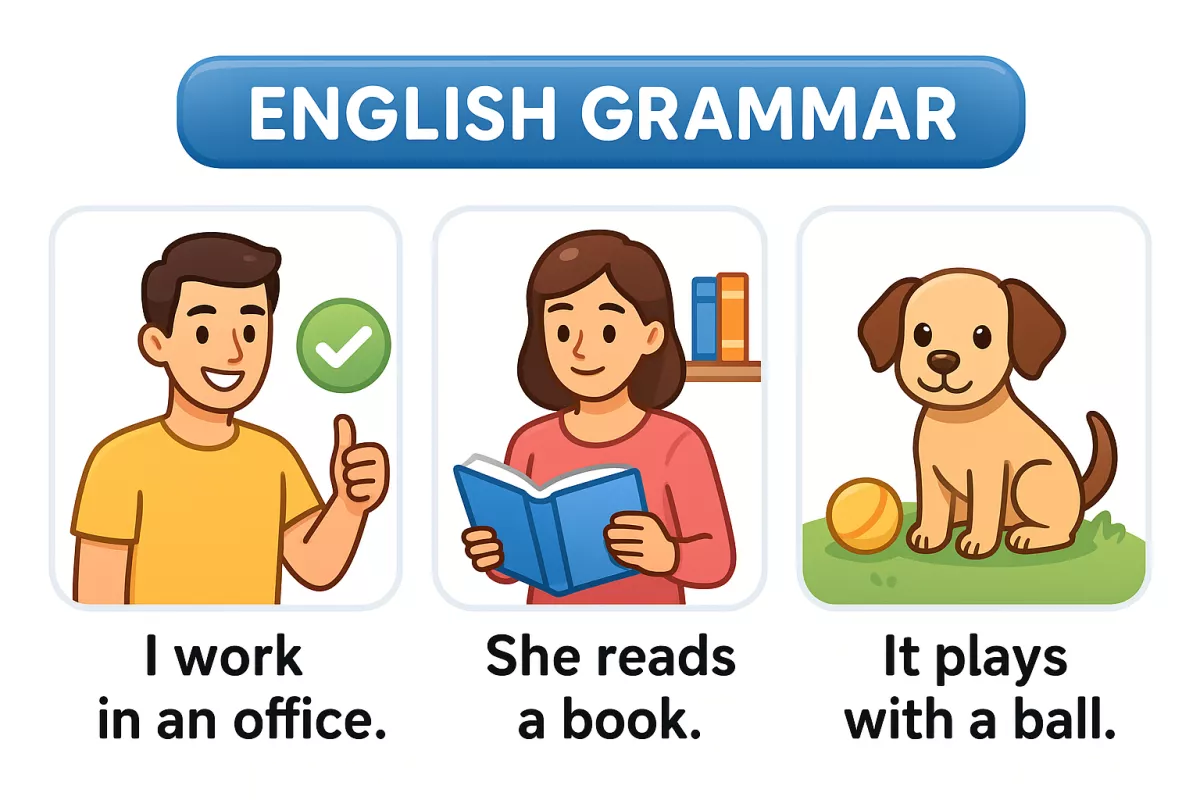
In the present simple tense, affirmative sentences are formed in a very straightforward way. For most subjects, we use the base form of the verb without any changes. The only exception appears with third-person singular subjects — he, she, and it. In these cases, the verb takes an extra ending, usually -s. This small change plays a big role in English grammar, as it signals subject–verb agreement and helps listeners immediately understand who is performing the action.
Regular patterns and typical endings
While the rule “add -s” works in many cases, English spelling follows a few predictable patterns that learners need to recognize. Paying attention to the final letters of the verb will help you choose the correct form confidently.
- Verbs ending in -ss, -sh, -ch, -x, or -o → add -es
miss → misses, wash → washes, teach → teaches, fix → fixes, go → goes - Verbs ending in a consonant + y → change -y to -ies
study → studies, try → tries, carry → carries, fly → flies - Verbs ending in a vowel + y → simply add -s
play → plays, enjoy → enjoys, stay → stays - Most other verbs → add -s to the base form
work → works, run → runs, want → wants, live → lives - Irregular but very common verbs → remember their special forms
do → does, have → has
A helpful habit is to always pause when you see he, she, or it as the subject and ask yourself: “Do I need the -s here?” With practice, this check becomes automatic and greatly reduces one of the most common mistakes learners make in the present simple.
Examples of base and third-person forms
The table below shows how verbs change in the present simple when the subject is he, she, or it. Notice how the spelling follows clear patterns that you can learn and apply to new verbs.
| Base Form (I / you / we / they) | Third Person (he / she / it) | Example Sentence |
|---|---|---|
| work | works | She works in an office. |
| study | studies | He studies English every day. |
| go | goes | It goes well most of the time. |
| fix | fixes | She fixes computers. |
| play | plays | He plays tennis on weekends. |
| wash | washes | She washes the dishes after dinner. |
| try | tries | He tries to be polite. |
| carry | carries | She carries her bag everywhere. |
| teach | teaches | He teaches math at school. |
| enjoy | enjoys | She enjoys reading in the evening. |
| have | has | He has a busy schedule. |
| do | does | She does her homework carefully. |
Common mistakes and tips
The third-person -s is small, but it causes many errors. Paying attention to a few typical mistakes will help you avoid them.
- Forgetting the -s: “She read every day.” ❌ → “She reads every day.” ✅
- Adding -s to the wrong subjects: “We likes pizza.” ❌ → “We like pizza.” ✅
- Confusing irregular forms: have → has, not “haves”.
- Forgetting spelling rules: “He studys hard.” ❌ → “He studies hard.” ✅
- Helpful check: If the subject is he, she, or it, ask yourself: “Do I need -s or -es?”
Real-life usage
You will hear third-person present simple forms constantly in real English. Native speakers use them when talking about daily routines, habits, and facts: “He walks to work,” “She likes coffee,” “It rains a lot here.” Because these forms appear so often, using them correctly makes your speech sound natural and confident. With regular exposure and practice, the third-person -s quickly becomes automatic.
Negatives with do/does
In the present simple tense, negative sentences are formed with the auxiliary verbs do or does plus not. This structure allows us to say that an action does not happen, is not true, or is not part of a routine. Choosing the correct auxiliary depends on the subject, not on the main verb.
How to Form Negative Sentences
With I, you, we, and they, English uses do not (most often shortened to don’t). With he, she, and it, the form changes to does not (usually doesn’t). An important rule to remember is that the main verb always stays in its base form after do or does. In negative sentences, the -s ending moves to the auxiliary, so it must never appear on the main verb.
For example, we say “She doesn’t work on Sundays,” not “doesn’t works.” Once learners understand that do/does carries the grammatical information, forming negatives in the present simple becomes much easier and more reliable.
| Subject | Negative Form |
|---|---|
| I / you / we / they | do not (don't) + base verb Example: We don't play chess. |
| he / she / it | does not (doesn't) + base verb Example: She doesn't eat meat. |
Common Patterns and Examples
- I don't like coffee.
- You don't understand the question.
- We don't watch TV in the morning.
- They don't have a car.
- He doesn't speak French.
- She doesn't work on Sundays.
- It doesn't rain much here.
- My friends don't live nearby.
- The dog doesn't bark at night.
- Children don't always listen.
- He doesn't remember my name.
- We don't agree with that idea.
- She doesn't know the answer.
- You don't need to hurry.
- It doesn't look easy.
Points to Remember
- Never add -s or -es to the main verb after doesn't. ❌ She doesn't likes music. ✅ She doesn't like music.
- Use contractions (don't, doesn't) in informal speech and writing.
- In questions, do or does moves to the front, but in negatives, it stays after the subject.
Using these negative forms is essential for daily communication, whether you're discussing habits, routines, or facts that are not true in the present.
Questions and short answers
In everyday communication, we often ask about habits, routines, and facts — what people usually do, what is generally true, or how often something happens. For these purposes, English normally uses the present simple. Knowing how to form questions correctly and how to give short, natural answers is an essential skill for fluent conversation.
How to form present simple questions
To ask questions about actions and routines, English uses the auxiliary verbs do and does. These auxiliaries come before the subject. Use do with I, you, we, and they, and does with he, she, and it. After the subject, the main verb always stays in its base form. When the main verb is be (am, is, are), no auxiliary is needed — simply switch the order of the subject and the verb.
- Do you like coffee?
- Does she play the piano?
- Do they work here?
- Does it rain a lot in April?
- Are you a student?
- Is he at home?
Short answers: when and how to use them
In real conversations, people rarely answer questions with long, complete sentences. Instead, they use short answers, which sound natural, polite, and efficient. A short answer begins with Yes or No, followed by the subject and the correct auxiliary verb. The main verb is not repeated, because it is already understood from the question.
For example, to the question “Do you work here?”, a natural answer is “Yes, I do,” or “No, I don’t.” In the same way, “Is she ready?” becomes “Yes, she is,” or “No, she isn’t.” Mastering short answers makes your English sound smoother and helps conversations flow more easily.
| Question | Short Answer (Yes/No) |
|---|---|
| Do you drive? | Yes, I do. / No, I don’t. |
| Does he like pizza? | Yes, he does. / No, he doesn’t. |
| Are they ready? | Yes, they are. / No, they aren’t. |
| Is it cold outside? | Yes, it is. / No, it isn’t. |
| Do we have time? | Yes, we do. / No, we don’t. |
| Does she speak French? | Yes, she does. / No, she doesn’t. |
Typical mistakes to avoid
- Using “does” with “I” or “you” (Incorrect: Does you work here?)
- Forgetting the auxiliary verb (Incorrect: You like tea?)
- Repeating the main verb in short answers (Incorrect: Yes, I like.)
- Mixing up “do/does” and “am/is/are” with “be” questions
Practice: more examples of present simple questions
- Do cats sleep a lot?
- Does your brother live nearby?
- Do you need any help?
- Does it snow here in winter?
- Are you hungry?
- Is this your bag?
- Do your friends play football?
- Does the shop open early?
- Are we late?
- Is she your teacher?
- Do birds sing in the morning?
- Does your phone work?
Mastering these patterns makes conversations smoother and helps you sound more natural in English.
Adverbs of frequency and time expressions
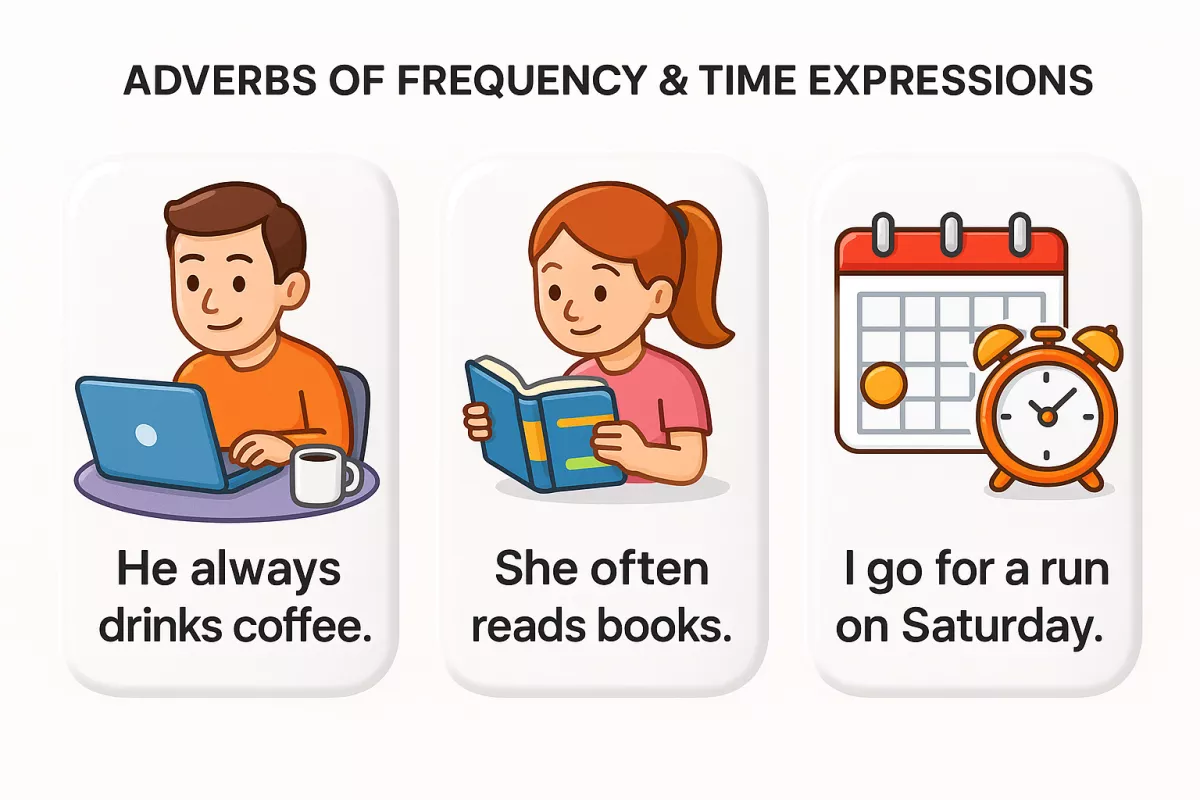
When we use the present simple tense, it is very common to add words or phrases that show how often or when something happens. These time and frequency markers make sentences clearer and more precise. They help the listener understand whether an action is a daily habit, a regular routine, or something that happens only occasionally.
Common frequency adverbs
Adverbs of frequency answer the question “How often?”. In present simple sentences, they usually appear before the main verb, but after the verb “be”. Using them correctly allows you to describe habits in a natural and accurate way.
- always → She always wakes up early.
- usually → I usually take the bus to work.
- often → They often eat out on Fridays.
- frequently → He frequently checks his email.
- sometimes → We sometimes watch movies at home.
- occasionally → She occasionally works late.
- rarely → I rarely drink soda.
- seldom → They seldom travel in winter.
- hardly ever → He hardly ever uses social media.
- never → She never skips breakfast.
Notice the position of these adverbs: She always drinks coffee in the morning, but She is always on time. This small difference is important for correct word order.
Typical time expressions
Time expressions answer the question “When?”. In the present simple, they often describe routines, schedules, or repeated actions. These expressions usually appear at the end of the sentence, although they can sometimes come at the beginning for emphasis.
- every day → I practice English every day.
- every week → We meet every week.
- on Mondays → She works from home on Mondays.
- in the morning → He reads the news in the morning.
- at night → I study best at night.
- once a week → They go jogging once a week.
- twice a month → We visit our grandparents twice a month.
- at weekends → She relaxes at weekends.
- after work → He goes to the gym after work.
- before breakfast → I check my phone before breakfast.
- each summer → They travel abroad each summer.
- all year round → The shop is open all year round.
Combining frequency adverbs with time expressions makes your English especially clear: We usually go swimming every Saturday or He often reads the newspaper in the evening. This is exactly how native speakers talk about habits and routines in everyday life.
Position in the sentence
The placement of these words and phrases is important for natural-sounding English. Frequency adverbs come just before the main verb, but after "be":
- She always arrives early. (before main verb)
- They are usually quiet. (after "be" verb)
Time expressions usually go at the end or the beginning of the sentence:
- We meet on Fridays.
- In the morning, I check my emails.
| Frequency Adverb | Example Sentence |
|---|---|
| always | I always take the bus to work. |
| usually | He is usually very polite. |
| often | We often visit our grandparents. |
| sometimes | She sometimes forgets her keys. |
| rarely | They rarely eat out. |
| never | He never smokes. |
These words and phrases make your sentences more precise and natural. Try combining them to describe routines, habits, or schedules in everyday English.
Stative verbs in the present simple
Not all verbs in English describe actions. Some verbs express states — what someone feels, thinks, owns, or perceives. These are called stative verbs. Because they describe conditions that are generally true or stable over time, they are most commonly used in the present simple, not to show activity, but to state facts, opinions, or long-term situations.
Common stative verb categories
Stative verbs usually fall into a few clear groups. Learning these categories makes it much easier to recognize stative verbs and avoid common mistakes.
- Verbs of emotion → express feelings and preferences
love → I love this song.
hate → He hates loud noise.
prefer → She prefers tea to coffee.
like / dislike → They like quiet places.
want / need → I need more time. - Verbs of thinking → express mental states or opinions
know → She knows the answer.
believe → I believe you.
understand → We understand the rule now.
remember / forget → He remembers her name.
mean / realize → This means a lot to me. - Verbs of possession → show ownership or belonging
have → They have a small house.
own → She owns a car.
belong → This book belongs to me.
possess → He possesses rare skills. - Verbs of perception → describe how things appear or are sensed
see → I see what you mean.
hear → I hear music upstairs.
smell / taste → The soup smells good.
sound → That sounds strange.
appear / seem → She seems tired. - Other states → describe conditions or relationships
contain → This box contains tools.
consist → The team consists of five people.
depend → It depends on the weather.
matter → Details matter.
resemble → He resembles his father.
How stative verbs behave in the present simple
Unlike action verbs, stative verbs are rarely used in continuous forms. Since they describe states rather than actions in progress, English normally uses the present simple to express their meaning. This is true even when the state is happening now.
- She knows the answer. ✅
- They own two cats. ✅
- I believe you. ✅
- He likes chocolate. ✅
- This situation depends on timing. ✅
Using these verbs in continuous forms usually sounds incorrect or unnatural:
- She is knowing the answer. ❌
- They are owning two cats. ❌
- I am believing you. ❌
A helpful rule is to ask yourself: Is this verb describing an action, or a state? If it describes a state, the present simple is almost always the correct choice.
Examples of stative verbs vs. action verbs
Some verbs can be both stative and dynamic (action) depending on meaning. Here’s how the present simple is used with stative meanings:
| Verb | Stative Use (Present Simple) | Action Use (Present Continuous) |
|---|---|---|
| think | I think it’s a good idea. (opinion) | I am thinking about the problem. (mental process) |
| have | She has a car. (possession) | She is having lunch. (activity) |
| see | We see the mountains from here. (perception) | I am seeing the doctor. (arranged meeting) |
| taste | This soup tastes salty. (sense) | She is tasting the soup. (action of trying food) |
Usage tips and common mistakes
- Avoid using stative verbs in continuous tenses unless the verb clearly has an action meaning.
- Remember that some verbs (like think or have) can be stative or dynamic, so context matters.
- Stative verbs are often used to express opinions, beliefs, and conditions that don’t change quickly.
Understanding how these verbs function will help you sound more natural and accurate in English conversations and writing.
Common learner mistakes and fixes
Students often face recurring difficulties when using the present simple tense with verbs. Paying attention to these pitfalls can help learners communicate more clearly and accurately in everyday English. Below, we look at frequent errors and practical solutions.
Subject-Verb Agreement Confusion
One of the most widespread issues is forgetting to match the verb form with the subject, especially in the third person singular. Many learners use the base verb after "he," "she," or "it," which leads to mistakes like "She walk to school" instead of "She walks to school." To avoid this, always add -s or -es to the verb for third person singular subjects.
| Incorrect | Correct |
|---|---|
| He go to work. | He goes to work. |
| She play tennis. | She plays tennis. |
| It rain a lot. | It rains a lot. |
| My brother like pizza. | My brother likes pizza. |
Negatives and Questions: Using “Do/Does”
Another common trap is forming negatives and questions. Learners sometimes forget to use "do" or "does," or they use the wrong form. Remember, in negatives and questions, the main verb stays in its base form, and "do/does" shows the tense and subject.
- Don’t say: "She don’t like coffee." ❌ Say: "She doesn’t like coffee." ✅
- Don’t say: "Does he plays football?" ❌ Say: "Does he play football?" ✅
- Don’t say: "You likes chocolate?" ❌ Say: "Do you like chocolate?" ✅
Time Expressions and Usage
Mixing up time expressions is also frequent. The present simple is used for routines, habits, and facts, often with words like "always," "never," "every day," or "usually." Avoid using it for actions happening now—use the present continuous instead.
- Correct: "I go to the gym every Monday."
- Incorrect: "I go to the gym now." (should be "I am going to the gym now.")
- Correct: "She usually eats breakfast at 7."
Pronunciation and Spelling of Third Person Singular
Spelling mistakes often appear with verbs ending in -y, -o, -ch, -sh, -ss, or -x. For example, "study" becomes "studies," not "studys." Watch for these endings:
- study – studies
- go – goes
- watch – watches
- wash – washes
- fix – fixes
- kiss – kisses
- try – tries
- pass – passes
- do – does
- miss – misses
- teach – teaches
- mix – mixes
Using Stative Verbs Incorrectly
Some verbs, like "know," "like," or "hate," are rarely used in continuous forms. Learners sometimes say "I am knowing" or "She is liking"—these are incorrect in standard English. Use the present simple with stative verbs: "I know the answer," "She likes music."
Summary of Key Points
- Check subject-verb agreement, especially with "he/she/it."
- Use "do/does" for negatives and questions.
- Choose the present simple for habits, routines, and facts—not ongoing actions.
- Watch out for spelling changes in third person singular verbs.
- Use present simple, not continuous, with stative verbs.
By focusing on these areas, learners can avoid typical errors and build a more natural grasp of the present simple tense in real-life communication.
Homework: present simple practice tasks
These practice tasks will help you become confident with the present simple in real sentences. Pay attention to subject–verb agreement, especially the third-person singular -s, and remember how negatives and questions use do/does. Work through each activity slowly, then check your answers to see what you need to review.
1. Fill in the blanks
Complete each sentence with the correct form of the verb in brackets.
- She ____ (work) in a hospital.
- We ____ (not like) spicy food.
- My brother ____ (play) football every Saturday.
- They ____ (go) to school by bus.
- I ____ (study) English every day.
- He ____ (watch) the news in the evening.
- My parents ____ (not drink) coffee.
- It ____ (rain) a lot in April.
- We ____ (finish) work at 6 PM.
- She ____ (not do) homework on Sundays.
Show answers
- works
- do not like / don't like
- plays
- go
- study
- watches
- do not drink / don't drink
- rains
- finish
- does not do / doesn't do
2. Make questions
Rewrite each sentence as a question in the present simple. Use do or does where needed.
- You live near the park.
- He drinks coffee in the morning.
- They speak Spanish at home.
- She drives to work.
- We play tennis on Fridays.
- It snow in winter here.
- Your friend study every day.
- He work late on Mondays.
- They go to the gym after work.
- She like this song.
Show answers
- Do you live near the park?
- Does he drink coffee in the morning?
- Do they speak Spanish at home?
- Does she drive to work?
- Do we play tennis on Fridays?
- Does it snow in winter here?
- Does your friend study every day?
- Does he work late on Mondays?
- Do they go to the gym after work?
- Does she like this song?
3. Present simple form table
Use this table to compare affirmative, negative, and question forms for regular and irregular verbs.
| Subject | Affirmative | Negative | Question |
|---|---|---|---|
| I/You/We/They | work | do not work | Do you work? |
| He/She/It | works | does not work | Does she work? |
| I/You/We/They | go | do not go | Do they go? |
| He/She/It | goes | does not go | Does he go? |
4. Real-life usage: match the sentence with its use
Match each sentence to the correct meaning: (a) daily routine, (b) general truth, (c) scheduled event, (d) permanent situation.
- Water boils at 100°C.
- My train leaves at 9:00 am.
- She teaches math at the university.
- I brush my teeth every morning.
- The sun rises in the east.
- Our class starts at 10:30.
- He works in an IT company.
- We usually eat dinner at home.
- The shop opens at 8:00 am.
- They live near the city center.
Show answers
- Water boils at 100°C. → general truth
- My train leaves at 9:00 am. → scheduled event
- She teaches math at the university. → permanent situation
- I brush my teeth every morning. → daily routine
- The sun rises in the east. → general truth
- Our class starts at 10:30. → scheduled event
- He works in an IT company. → permanent situation
- We usually eat dinner at home. → habit
- The shop opens at 8:00 am. → fixed schedule
- They live near the city center. → permanent situation
5. Error correction
Each sentence contains a mistake in the present simple. Rewrite each sentence correctly.
- He go to the gym every day.
- Do she likes pizza?
- I doesn't understand.
- We watches TV after dinner.
- She don't work on Sundays.
- Does they live here?
- He have a car.
- My brother play tennis.
- Do he know the answer?
- She walk to work every morning.
Show answers
- He goes to the gym every day.
- Does she like pizza?
- I don't understand.
- We watch TV after dinner.
- She doesn't work on Sundays.
- Do they live here?
- He has a car.
- My brother plays tennis.
- Does he know the answer?
- She walks to work every morning.