End-position Adverbs: clarity and constraints

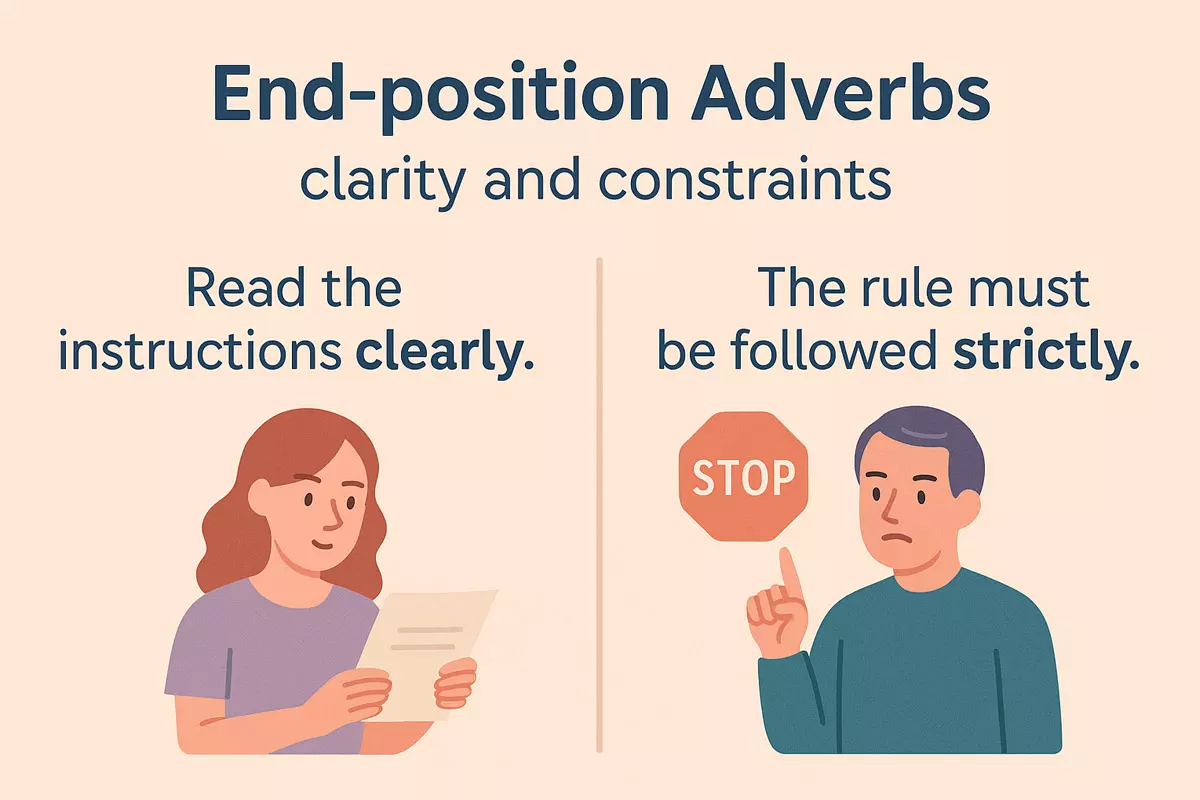 This article explains which adverbs typically go at the end of sentences, with rules for time, manner, and degree adverbs. It covers exceptions such as frequency adverbs, shows when end-position is awkward, and gives practical examples and fixes.
Adverbs can add precision to sentences, especially when placed at the end, as this position often clarifies or emphasizes the action being described. However, relying solely on end placement can sometimes limit variety and nuance in writing, potentially leading to repetitive sentence structures or ambiguity if the adverb could modify more than one element. To communicate clearly and effectively, it is important to understand both the strengths and the limitations of positioning adverbs at the end, and to adjust placement as needed for clarity.
What types of adverbs prefer end-position
In English, certain adverbs typically appear at the end of a sentence to provide clarity or avoid awkward phrasing. These end-position adverbs most often describe manner, place, time, and frequency (when indefinite). Placing them after the verb or object helps the sentence flow naturally and makes the intended meaning more transparent.
Manner adverbs
Adverbs that explain how an action is performed, such as "quickly," "carefully," or "loudly," are frequently found at the sentence’s end. This allows the reader or listener to process the action before understanding the manner in which it was performed.
- She answered politely.
- They worked silently.
- He spoke clearly.
- The dog barked loudly.
Adverbs of place
Words and phrases indicating location or direction, such as "here," "there," "everywhere," or "in the garden," usually follow the verb or the object. This positioning helps anchor the action in a specific setting.
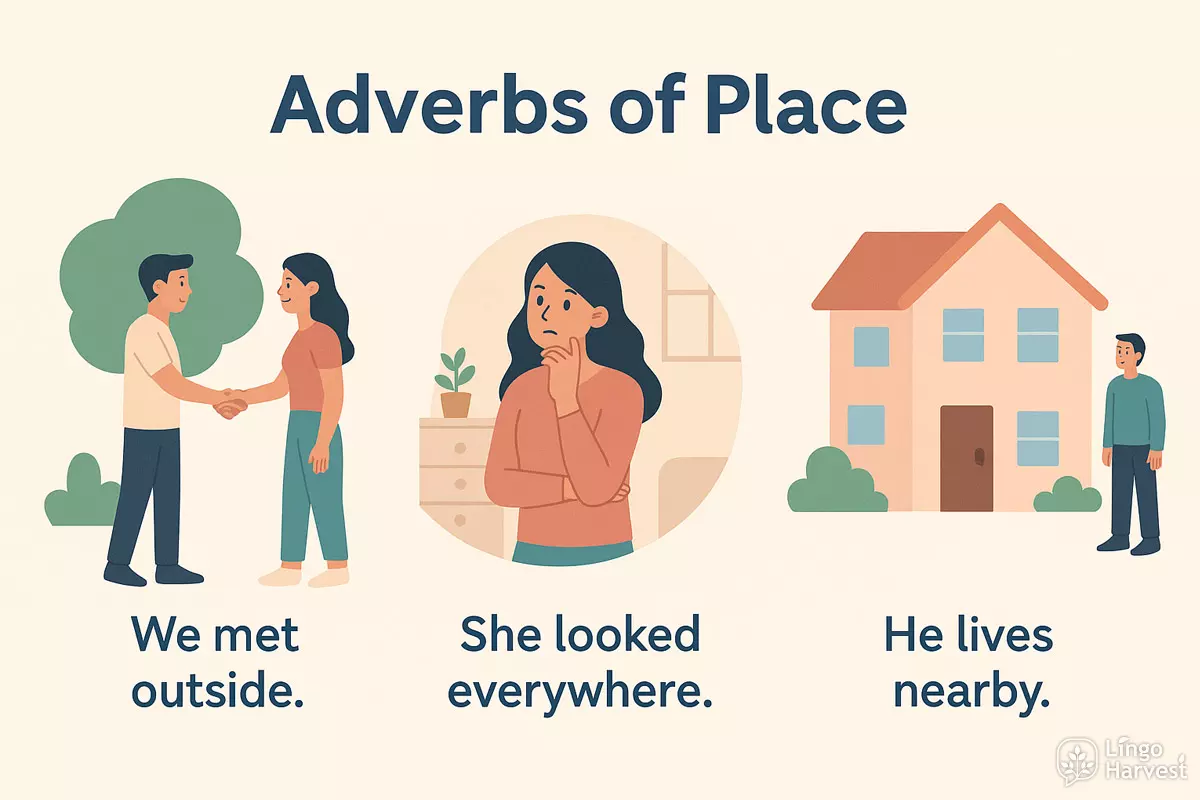
- We met outside.
- She looked everywhere.
- He lives nearby.
- They walked home.
Time adverbs
Adverbs expressing when something happens—like "yesterday," "today," "soon," "later," or "last night"—generally fit best at the end to provide a clear sense of timing.
- I’ll call you tomorrow.
- He arrived late.
- They left early.
- We finished yesterday.
Indefinite frequency adverbs
Unlike definite frequency adverbs (such as "always" or "never," which often come before the main verb), indefinite ones like "occasionally," "sometimes," "usually," and "often" can appear at the end for emphasis or stylistic variation.
- She travels occasionally.
- We eat out sometimes.
- He visits frequently.
- I go jogging usually.
Summary: Common end-position adverbs
Below is a broader selection of adverbs and adverbial phrases that naturally fit at the end of sentences:
- quickly → She finished the assignment quickly.
- slowly → He walked slowly across the street.
- well → She speaks English well.
- badly → He performed badly on the test.
- abroad → They plan to study abroad next year.
- indoors → The kids played indoors because it was raining.
- outside → We waited outside for the taxi.
- soon → The results will be announced soon.
- already → She has already completed her homework.
- tonight → We are meeting for dinner tonight.
- everywhere → His songs are popular everywhere.
- tomorrow → The conference starts tomorrow.
- late → He arrived late to the meeting.
- early → She woke up early today.
- sometimes → I sometimes forget my phone at home.
- occasionally → They occasionally eat out on weekends.
- frequently → She frequently checks her messages.
- yesterday → We visited the museum yesterday.
- here → Please leave your bags here.
- there → He parked his car there.
These patterns help maintain clarity and natural rhythm. While there are exceptions, especially for emphasis, most adverbs of manner, place, time, and certain frequency types sound most idiomatic when placed at the end of a sentence.
Rules for time, manner, and degree at the end
Placing adverbs at the end of a sentence can affect clarity and emphasis. English speakers often use adverbs of time, manner, and degree in final position, but the order and compatibility of these elements follow certain patterns. Understanding how to combine them helps avoid confusion and awkward phrasing.
Preferred Order and Combinations
Generally, when more than one adverb appears at the end, the typical sequence is: manner → place → time. Degree adverbs (like "a lot" or "completely") usually go before the main verb or after the object, but some can appear at the end for emphasis.
- I finished the report quickly (manner).
- She went home yesterday (time).
- He spoke very clearly (degree + manner).
- They worked late last night (time).
- We enjoyed the show immensely (degree).
- He replied politely (manner).
- She completed the task on time (time).
- The children laughed loudly (manner).
- They improved significantly (degree).
- I will call you tomorrow (time).
- He recovered completely (degree).
- She answered immediately (time/manner blend).
- We met outside (place, sometimes grouped with manner/time).
- The dog barked all night (time).
- They agreed reluctantly (manner).
Common Constraints and Pitfalls
Some adverbs cannot be used together naturally at the end, or their order must be adjusted for the sentence to sound idiomatic. For instance, stacking too many end-position adverbs can create ambiguity or awkwardness.
| Correct Usage ✅ | Problematic Usage ❌ |
|---|---|
| He finished his work quickly yesterday. | He finished his work yesterday quickly. |
| They left the party happily at midnight. | They left the party at midnight happily. |
| She explained the rules clearly to everyone last week. | She explained the rules last week to everyone clearly. |
| I will see you there tomorrow. | I will see you tomorrow there. |
Tips for Natural End-Position Use
- Use only one or two adverbs at the end for clarity.
- Follow the order: manner → place → time when combining.
- Degree adverbs like "completely," "entirely," or "a lot" fit best before the verb or after the object, but can be used at the end for emphasis.
- Rearrange or omit adverbs if a sentence feels crowded.
- If unsure, read the sentence aloud to check for natural flow.
In summary, mastering the placement of adverbs of time, manner, and degree at the end of sentences ensures sentences are both clear and natural. Paying attention to order and avoiding overload is key to effective communication.
When end-position sounds unnatural or ambiguous
Sometimes, placing an adverb at the end of a sentence can lead to awkward phrasing or confusion. This often happens when the adverb could logically modify more than one element, or when English idiom simply favors a different adverb position. Choosing the right spot for an adverb is about more than just grammar rules—it's about natural, clear communication.
Common pitfalls with sentence-final adverbs
Placing an adverb at the end can sometimes result in ambiguity. For instance, the sentence "He only spoke to John yesterday" is clear, but "He spoke to John yesterday only" can sound odd or unclear—does "only" refer to the action, the person, or the time? In such cases, rearranging the adverb is essential for clarity.
Ambiguity in end position: Examples
- She read the letter quickly. (Did she read quickly, or did she finish quickly?)
- He explained the issue clearly. (Is the explanation clear, or is the issue clear?)
- They met in the park accidentally. (Did the meeting happen by accident, or was their location accidental?)
- I found the answer easily. (Is it the finding or the answer that was easy?)
- She called her friend unexpectedly. (Was the call or the friend unexpected?)
- We finished the project yesterday. (Is "yesterday" best at the end, or would it be clearer elsewhere?)
- He left the party early. (Did he leave early, or was the party early?)
- The team won the match convincingly. (Did the team win convincingly, or was the match convincing?)
- She answered the question honestly. (Is her answer honest, or is the question honest?)
- He painted the wall beautifully. (Is the painting beautiful, or the wall?)
- They arrived at the airport late. (Did they arrive late, or is the airport late?)
- He completed the task successfully. (Is the task successful, or the completion?)
When naturalness overrides grammar
Native speakers often move adverbs to avoid stilted or unnatural-sounding sentences. For example, "He always forgets his keys" sounds more idiomatic than "He forgets his keys always." In some cases, strict end-position placement may even change the intended meaning.
| Adverb Position | Effect on Meaning/Naturalness |
|---|---|
| He almost finished the race. | ✅ Standard: He did not finish, but got close. |
| He finished the race almost. | ❌ Unnatural/ambiguous: Odd in English, unclear meaning. |
| She barely passed the test. | ✅ Clear: She passed with difficulty. |
| She passed the test barely. | ❌ Awkward/less common: Sounds forced. |
Tips for clear adverb placement
- Move adverbs to mid-position when end-placement causes confusion.
- Check if the adverb could modify more than one element in the sentence.
- Read the sentence aloud—if it sounds awkward, try another position.
- Remember that some adverbs (like "always," "never," "often") are rarely used in end-position.
- Prioritize clarity and naturalness over rigid placement rules.
In summary, while end-position is possible for many adverbs, it is not always the best choice. Consider the intended meaning and how your sentence will sound to others.
Exceptions with frequency adverbs
While most adverbs of frequency (like always, often, never) typically appear before the main verb or after the verb to be, some exceptions arise when these words appear at the end of a sentence. These rare placements can subtly shift the emphasis or sound unnatural, yet they do occur in certain structures or for stylistic reasons.
Unusual end positions for adverbs of frequency
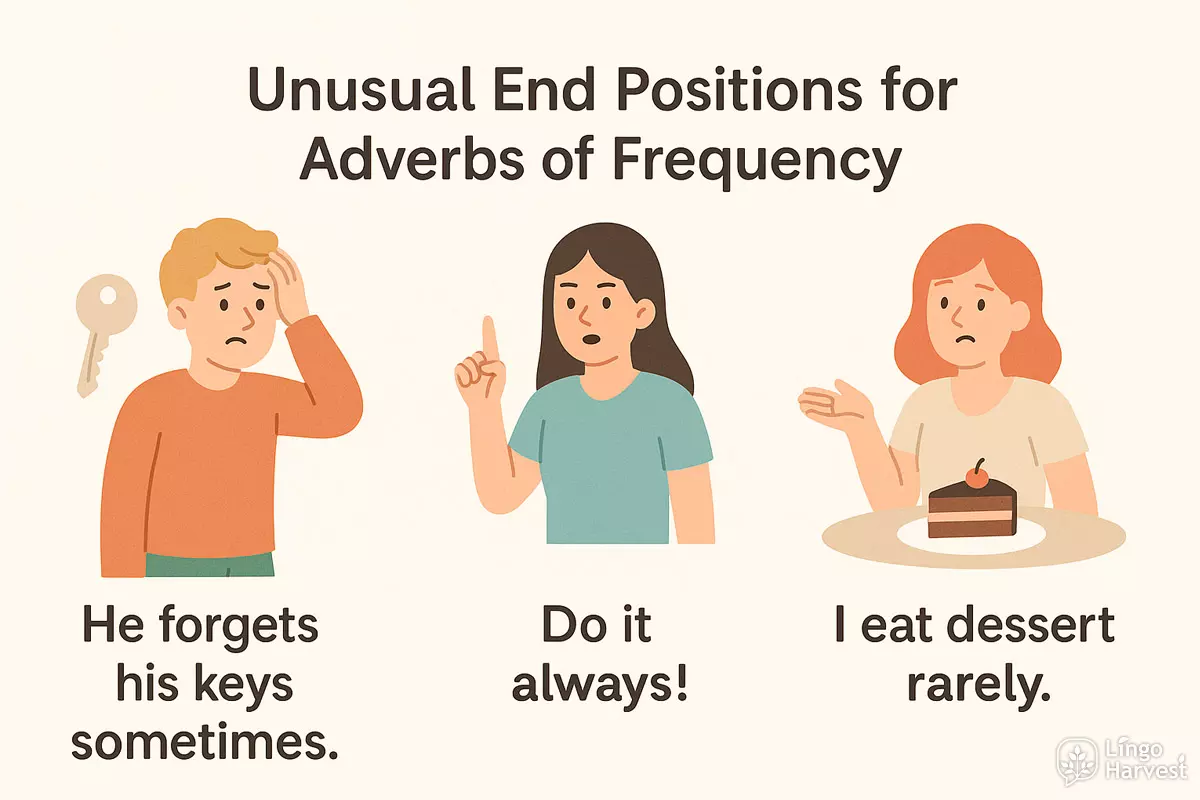
Normally, frequency words do not come at the end of a sentence. However, in everyday speech or for dramatic effect, you might encounter them after the verb or even at the end. This is especially true in short answers, imperatives, or for contrast.
- He forgets his keys sometimes.
- Do it always!
- I eat dessert rarely.
- You can come along anytime.
- She is late never.
- They visit us frequently.
- We go hiking occasionally.
- He calls hardly ever.
- I see them often.
- We have meetings weekly.
Special cases: idiomatic and fixed phrases
A few expressions allow frequency words at the end, especially in idiomatic language. Phrases like once in a while or from time to time are naturally placed after the verb or at the end. These forms are widely accepted and sound natural:
- I travel to the coast every now and then.
- They eat out from time to time.
- We meet up once in a while.
- He visits every so often.
Comparing typical and exceptional positions
To clarify the differences, compare standard and nonstandard placements of these adverbs. Notice the shift in emphasis or naturalness:
| Standard Position | End Position (Exception) |
|---|---|
| I usually take the bus. | I take the bus usually. |
| She never eats meat. | She eats meat never. |
| They often work late. | They work late often. |
| We rarely go out on weekdays. | We go out on weekdays rarely. |
| He sometimes forgets his wallet. | He forgets his wallet sometimes. |
In summary, frequency adverbs normally avoid the end of the sentence, but exceptions can occur for stylistic, idiomatic, or conversational reasons. Being aware of these patterns can help you sound more natural and nuanced when choosing adverb placement.
Clear examples in conversation and writing
Understanding how to use adverbs at the end of sentences is crucial for both spoken and written English. End-position adverbs often clarify when, how, or where an action takes place, but not every adverb fits naturally at the end. Exploring real exchanges and written statements helps reveal both the clarity and the limitations of this placement.
Common End-Position Adverbs in Context
Many adverbs describing time, manner, or place are most natural at the sentence’s end. See how different adverb types function in authentic situations:
- She finished her homework quickly.
- We met yesterday.
- They laughed loudly.
- He travels abroad every year.
- I will call you soon.
- We waited patiently for the bus.
- The children played outside.
- She explained the rules clearly.
- He left early this morning.
- We will discuss this later.
- He answered honestly.
- The train arrived late.
- They walked together.
- She smiled happily.
- We will decide tomorrow.
- The meeting ended on time.
Constraints: When End-Position Doesn’t Work
Not all adverbs can be placed at the end without causing confusion or sounding unnatural. Frequency adverbs (like "always" or "never") rarely appear at the end. Compare:
- He always forgets his keys. ✅
- He forgets his keys always. ❌
Similarly, viewpoint adverbs (such as "fortunately" or "hopefully") typically go at the start or before the main verb, not at the end.
Comparing Acceptable and Unacceptable Patterns
To illustrate which adverbs fit naturally at the end and which do not, see the structured comparison below.
| Natural End-Position | Unnatural/Incorrect End-Position |
|---|---|
| She responded immediately. | She responded always. |
| We will meet tomorrow. | We will meet hopefully. |
| He finished the project successfully. | He finished the project never. |
| They arrived late. | They arrived usually. |
Conversation and Writing: Subtle Differences
In casual speech, speakers may sometimes place adverbs in nonstandard positions for emphasis or style, but this is less accepted in formal writing. Clarity is usually best maintained by following standard patterns, especially with end-position adverbs. For learners and writers, practicing with real sentences and noting where native speakers place adverbs will help internalize these norms.
Practice sentences to fix awkward endings
Polishing sentence endings is essential for clear, natural English. End-position adverbs—words like "quickly," "always," or "yesterday"—can sometimes make sentences sound odd or ambiguous if they're misplaced. In this section, you’ll find exercises and examples that focus on improving sentence flow and fixing awkward adverb placement.
Identify and Improve Awkward Endings
Start by reading each sentence and consider whether the final adverb disrupts clarity or rhythm. Revise as needed to ensure the adverb’s position sounds natural and precise.
- She finished her homework completely.
- We will meet at the station probably.
- He forgot his keys at home accidentally.
- The dog barked loudly last night.
- I have seen that movie before already.
- They arrived to the party late unexpectedly.
- She will call you back soon definitely.
- He solved the puzzle easily yesterday.
- The teacher explained the solution clearly just now.
- We enjoyed the concert thoroughly tonight.
Show answers
- She completely finished her homework.
- We will probably meet at the station.
- He accidentally forgot his keys at home.
- Last night, the dog barked loudly.
- I have already seen that movie before.
- They unexpectedly arrived late to the party.
- She will definitely call you back soon.
- Yesterday, he easily solved the puzzle.
- Just now, the teacher clearly explained the solution.
- Tonight, we thoroughly enjoyed the concert.
Common Adverbs That Cause Awkward Endings
Some adverbs frequently lead to unnatural sentence endings. Here’s a list of common culprits. Try revising sentences with these words by moving them or using alternatives:
- Always → She always wakes up early.
- Already → They have already finished the report.
- Probably → He will probably join us later.
- Completely → The room was completely silent.
- Suddenly → Suddenly, the lights went out.
- Definitely → I will definitely call you tomorrow.
- Accidentally → He accidentally deleted the file.
- Clearly → You can clearly see the difference.
- Thoroughly → She thoroughly cleaned the kitchen.
- Finally → We finally arrived at the hotel.
- Quickly → She quickly grabbed her keys and left.
- Easily → He easily solved the puzzle.
- Unexpectedly → Unexpectedly, the meeting was canceled.
- Usually → They usually eat dinner at 7 p.m.
- Recently → I recently started a new hobby.
- Just now → She left just now.
- Tonight → We are meeting tonight.
- Yesterday → They moved into their new house yesterday.
- Before → I’ve heard this story before.
Rewriting Practice: Move or Replace the Adverb
Challenge yourself to adjust the adverb’s position for each sentence below so it reads more smoothly.
- We finished the project before.
- He called me back just now.
- She answered the question easily.
- The cat jumped on the table suddenly.
- They left the party quickly.
- I saw him outside earlier.
- She cleaned the room carefully.
- The dogs barked loudly all night.
- He finished his homework already.
- We will meet there tomorrow.
Show answers
- We finished the project earlier.
- Just now, he called me back.
- She easily answered the question.
- Suddenly, the cat jumped on the table.
- They quickly left the party.
- I saw him outside earlier today.
- She carefully cleaned the room.
- The dogs barked loudly all night. (Correct as given.)
- He has already finished his homework.
- We will meet there tomorrow. (Correct as given.)
Comparing Natural and Awkward Endings
Below, compare sentences with adverbs in awkward and improved positions. Notice how placement affects clarity.
| Awkward Ending | Improved Version |
|---|---|
| He explained the rules clearly yesterday. | Yesterday, he clearly explained the rules. |
| The report was submitted late unexpectedly. | The report was unexpectedly submitted late. |
| We will finish the work definitely today. | We will definitely finish the work today. |
| She left the meeting early probably. | She probably left the meeting early. |
| The solution was found quickly last week. | Last week, the solution was found quickly. |
| I saw the announcement already. | I have already seen the announcement. |
| They made their decision finally. | Finally, they made their decision. |
| She cleaned her room thoroughly this morning. | This morning, she thoroughly cleaned her room. |
| The team celebrated their win enthusiastically yesterday. | Yesterday, the team enthusiastically celebrated their win. |
| He completed his assignment carefully last night. | Last night, he carefully completed his assignment. |
With regular practice, you’ll develop an instinct for smoother, more effective adverb placement. Use these exercises as a reference whenever you’re unsure about sentence endings.