Adverb Placement in Complex Sentences

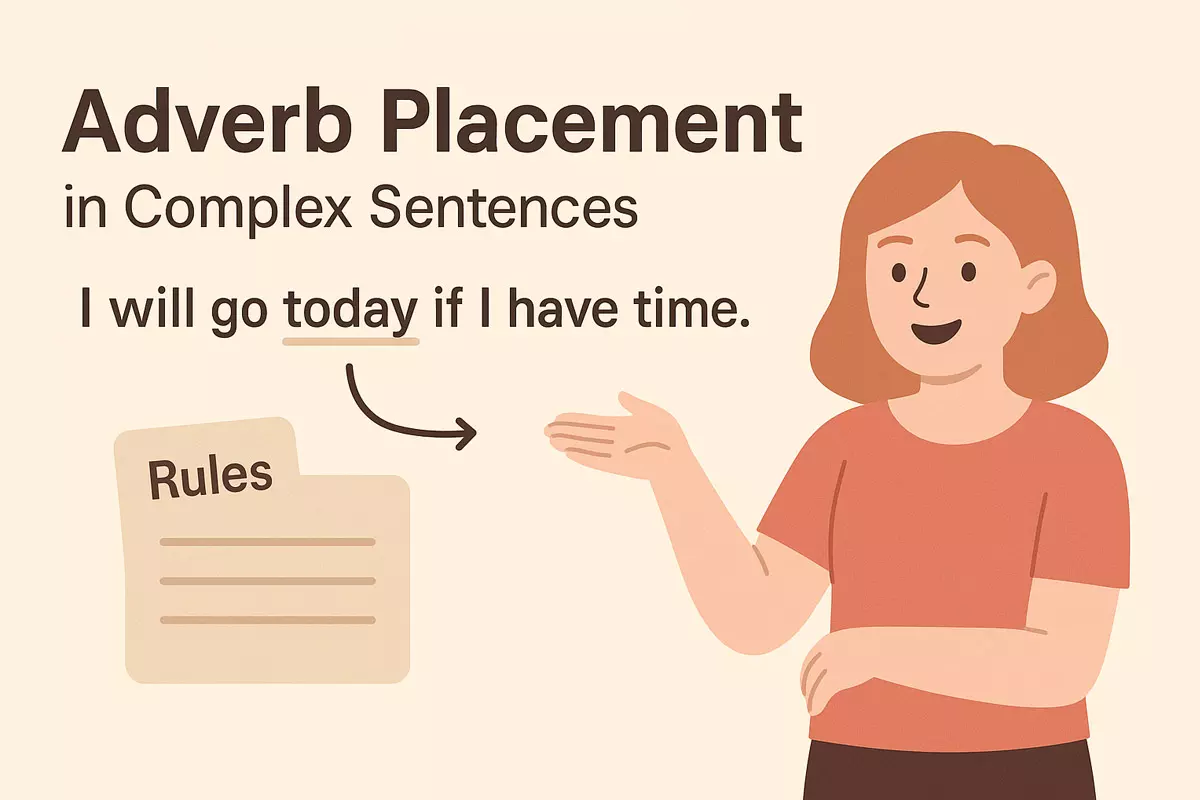 This article explains how adverb placement affects clause meaning, especially in multi-clause sentences. It discusses rules, restrictions with subordinate clauses, ways to avoid ambiguity, and provides examples and short word order exercises.
Mastering the placement of modifying words within complex sentence structures can be challenging, but doing so significantly enhances both clarity and style in your writing. Subtle adjustments in word order often influence the overall meaning and rhythm of a sentence, sometimes even altering the reader’s interpretation. By paying careful attention to where modifiers are positioned, writers can ensure their ideas are communicated precisely and elegantly, resulting in writing that is both effective and engaging for the audience.
How adverb placement affects clause meaning
Placing an adverb in different parts of a complex sentence can subtly or dramatically change what the sentence communicates. In English, the exact position of an adverb often determines which action, verb, or clause it modifies. This is especially true when a sentence contains more than one clause, as the adverb can apply to the main clause, the subordinate clause, or sometimes both.
Shifting focus between main and subordinate clauses
When you move an adverb around, you might be shifting the focus from the action in the main clause to the supporting information in a subordinate clause. For example, “She said that she honestly didn’t know” is different from “She honestly said that she didn’t know.” In the first, “honestly” modifies “didn’t know”; in the second, it modifies “said.”
Common adverb positions and their implications
Writers and speakers use adverbs at various points in a sentence. Here’s how the meaning can change depending on where you put the adverb:
- Before the main verb: “He quickly admitted that he was wrong.” (emphasizes the speed of admitting)
- After the main verb: “He admitted quickly that he was wrong.” (also about speed, but slightly less emphatic)
- Before the subordinate clause: “He admitted that, quickly, he was wrong.” (the speed refers to the realization of being wrong)
- At the beginning of the sentence: “Quickly, he admitted that he was wrong.” (overall emphasis on the swiftness)
- Within the subordinate clause: “He admitted that he was quickly wrong.” (modifies “was wrong,” suggesting rapid error)
- Between clauses: “He admitted, quickly, that he was wrong.” (adds a parenthetical pause, can signal a more reflective tone)
Comparing adverb position and clause meaning
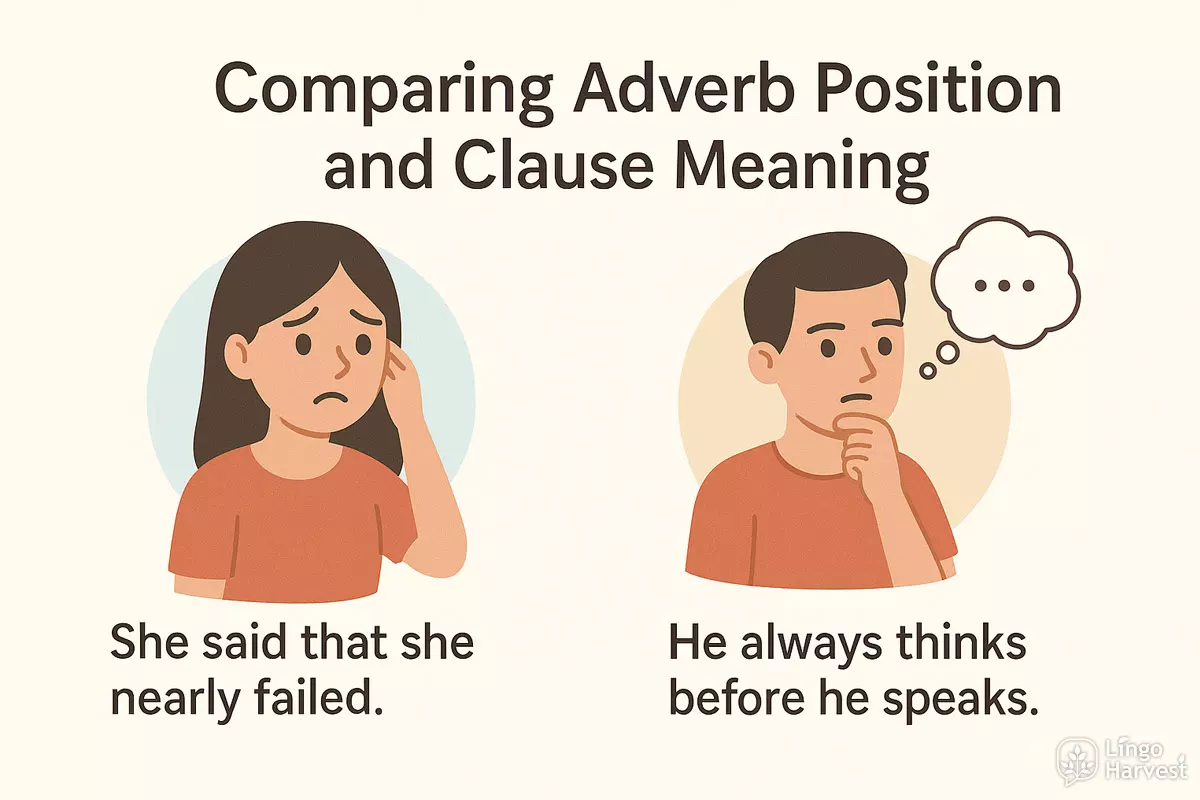
In sentences with more than one verb or clause, the placement of an adverb can determine which action is being described. Notice how the following examples create different interpretations:
| Sentence | Interpretation |
|---|---|
| “She nearly said that she failed.” | She didn’t say it, but almost did. |
| “She said that she nearly failed.” | She said she almost failed (but didn’t). |
| “He always thinks before he speaks.” | He consistently thinks first, every time he’s about to speak. |
| “He thinks before he always speaks.” | He thinks first, but only before the times he always speaks (odd or less common meaning). |
| “They actually believed that she could win.” | It was surprising or unexpected that they believed this. |
| “They believed that she could actually win.” | The possibility of her winning seemed real or possible. |
Tips for clear adverb placement
If your sentence contains more than one clause or verb, try these strategies to avoid ambiguity:
- Place the adverb as close as possible to the word or clause you want it to modify.
- Read the sentence aloud to check for unintended meanings.
- Use commas to signal parenthetical or sentence adverbs when needed.
- When in doubt, rephrase for clarity: “He admitted quickly” vs. “He quickly admitted.”
- Be aware that some adverbs (like “only,” “almost,” “even”) are especially sensitive to placement and can drastically change meaning.
Understanding how adverb position interacts with sentence structure helps avoid misunderstandings and makes your writing more precise. In complex sentences, even a small shift can lead to a big difference in interpretation.
Placement in multi-clause sentences
When dealing with sentences that contain more than one clause—such as those joined by conjunctions like "and," "but," "because," or "although"—the position of adverbs often depends on which clause they modify and the intended emphasis. Adverbs can appear in the main clause, the subordinate clause, or both, and their placement can subtly shift the meaning or focus.
Guidelines for positioning adverbs in complex sentences
- If an adverb modifies only one clause, place it as close as possible to the verb or idea it affects.
- For adverbs commenting on the entire sentence (like "fortunately," "sadly"), it’s common to put them at the start of the sentence or clause.
- Mid-position adverbs (such as "always," "never," "often") usually go before the main verb but after auxiliary verbs.
- When an adverb modifies both clauses or the sentence as a whole, initial or final position is often clearest.
Examples of adverb placement in multi-clause contexts
- He quickly finished his dinner because he was very hungry. (Adverb "quickly" modifies the verb in the main clause.)
- Because she usually works late, she rarely joins us for dinner. ("Usually" modifies the subordinate clause; "rarely" modifies the main clause.)
- Honestly, I didn’t expect him to apologize, but surprisingly, he did. ("Honestly" shows speaker attitude; "surprisingly" modifies the second clause.)
- She will call you immediately when she arrives. ("Immediately" modifies when the action of calling will happen.)
- They left early although the meeting had hardly started. ("Hardly" modifies the subordinate clause.)
- Even though he completely disagreed, he remained polite. ("Completely" modifies the verb phrase "disagreed".)
- She has already finished her project, but he hasn’t even started yet. ("Already" and "even" modify different actions in different clauses.)
- If you ever need help, just ask. ("Ever" modifies the condition clause.)
- He always says he’ll be on time, but he never is. ("Always" modifies the first clause; "never" modifies the second.)
- She usually brings a camera whenever she travels. ("Usually" modifies the main clause; "whenever" introduces the condition.)
- Unless you quickly respond, the offer may expire. ("Quickly" modifies the verb "respond".)
- As soon as they arrived, the show finally began. ("Finally" modifies the verb "began".)
Comparing adverb positions in different clauses
| Adverb in Main Clause | Adverb in Subordinate Clause | Adverb Modifying Whole Sentence |
|---|---|---|
| She quickly closed the window when it started to rain. | She closed the window when it suddenly started to rain. | Thankfully, she closed the window when it started to rain. |
| He rarely eats dessert unless it’s chocolate. | He eats dessert unless it’s absolutely chocolate. | Honestly, he eats dessert unless it’s chocolate. |
| We never go out after dark if we’re tired. | We go out after dark if we’re especially energetic. | Fortunately, we go out after dark if we’re energetic. |
| I always remember to call when I travel. | I remember to call when I finally arrive. | Regrettably, I remember to call when I travel. |
Understanding how adverbs interact with multiple clauses ensures your meaning is clear and your writing feels natural. Proper placement can emphasize the right action or idea, clarify timing, and help readers follow complex thoughts without confusion.
Restrictions with subordinate clauses
When dealing with complex sentences, the position of adverbs can be more limited than in simple statements. Subordinate clauses—those introduced by words like "because," "although," "if," or "when"—often require adverbs to be placed in specific spots to avoid ambiguity or ungrammatical constructions.
Typical Placement Patterns
In most subordinate clauses, adverbs such as "always," "never," "usually," "often," and "already" are positioned before the main verb, but after the subject. Placing them elsewhere can sound awkward or even change the intended meaning. For example:
- She left because she really wanted to go. ✅
- She left because really she wanted to go. ❌
- If you never try, you won't know.
- When he finally arrived, the meeting was over.
Common Restrictions
Some adverbs cannot be fronted (placed at the beginning) in subordinate clauses, even though this is possible in main clauses. Additionally, certain adverbs (like "probably," "perhaps") are rarely used in subordinate clauses, especially those expressing condition or time.
- Although he often complains, he works hard. ✅
- Although often he complains, he works hard. ❌
- If you already know the answer, please share it.
- Because she never calls, I worry.
Comparison of Adverb Placement
Below is a comparison between adverb placement in main and subordinate clauses to illustrate these differences:
| Main Clause | Subordinate Clause |
|---|---|
| Usually, she finishes early. | ...because she usually finishes early. |
| Perhaps he will join us. | ...if he perhaps joins us. ❌ |
| He never forgets. | ...when he never forgets. |
| Already, we have started. | ...after we already started. |
Adverbs Commonly Used in Subordinate Clauses
Some adverbs are much more natural in dependent clauses than others. Here are several that typically fit well:
- always → She always wakes up early.
- never → He never eats breakfast.
- often → They often visit their grandparents.
- sometimes → I sometimes forget my keys.
- already → She has already finished her homework.
- still → He is still waiting for the bus.
- just → I just saw him outside.
- really → That movie was really good.
- finally → We finally reached the top of the hill.
- usually → She usually drinks tea in the morning.
- frequently → They frequently travel abroad.
- rarely → He rarely watches TV.
- hardly → I hardly know anything about this topic.
- almost → She almost missed the train.
- completely → The room was completely silent.
- soon → We will leave soon.
Exceptions and Stylistic Choices
While most adverbs follow these patterns, some exceptions occur in literary or poetic contexts, or for emphasis. However, in standard formal writing, it’s best to keep adverbs immediately before the verb within subordinate clauses, unless a specific stylistic effect is intended. Misplacing them can confuse readers or obscure the relationship between the clauses. Understanding these patterns is key to writing clear, natural complex sentences in English.
Avoiding ambiguity in long structures
Complex sentences often challenge writers and readers alike, especially when adverbs are involved. The placement of adverbs in extended clauses or multi-layered sentences can easily lead to confusion about what exactly is being modified. To maintain clarity, it’s essential to consider both the proximity of the adverb to its target and the overall sentence structure.
Common Sources of Confusion
- Multiple verbs: When a sentence contains more than one verb, an adverb placed in the middle may seem to modify either verb.
- Embedded clauses: Long subordinate clauses can make it unclear whether the adverb applies to the main action or a detail within the clause.
- Ambiguous subjects: If the sentence has several noun phrases, an adverb’s placement may make it uncertain which subject it refers to.
Strategies for Clear Adverb Placement
To minimize misunderstanding, try these techniques:
- Place adverbs immediately before or after the word or phrase they are intended to modify.
- In sentences with layered clauses, repeat the subject or verb if needed to reinforce the connection.
- Use punctuation, such as commas, to separate adverbs that refer to the entire sentence from those modifying specific actions.
- Consider rephrasing: breaking long sentences into shorter ones can eliminate uncertainty.
- Choose more precise adverbs when possible, reducing reliance on context.
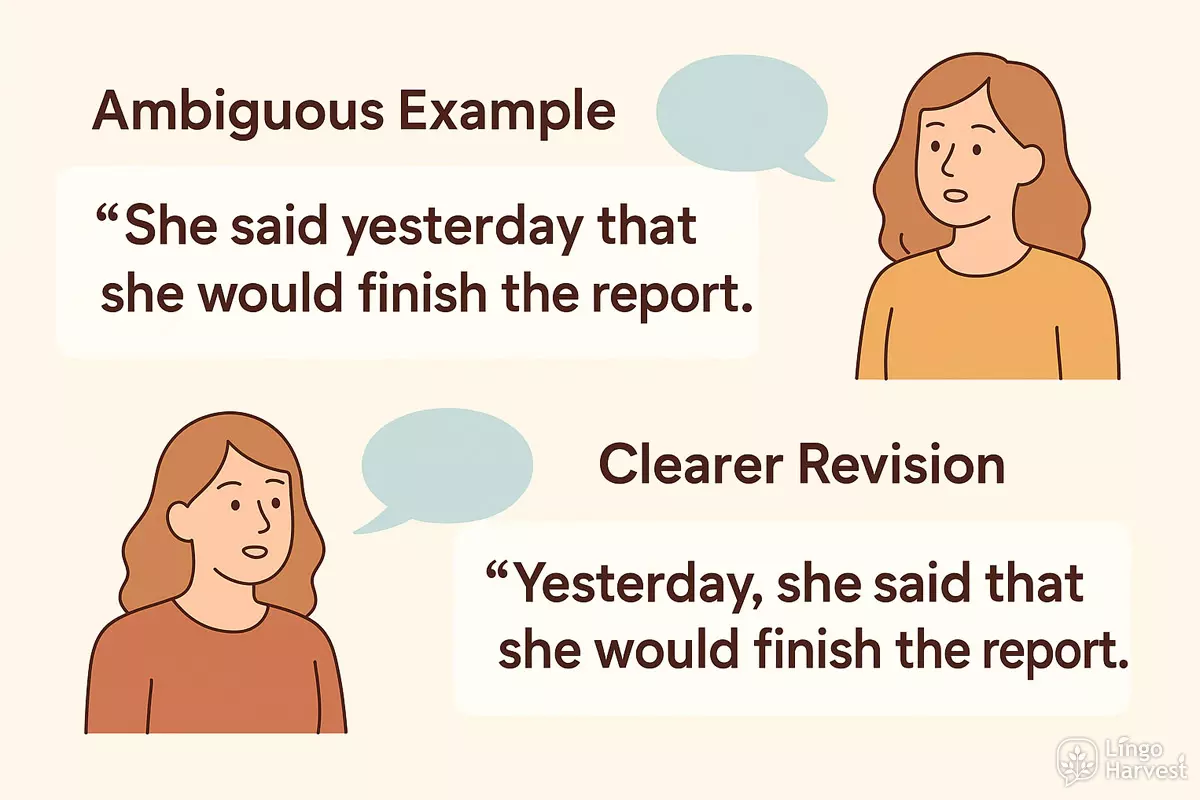
Comparison of Ambiguous and Clear Adverb Placement
| Ambiguous Example | Clearer Revision |
|---|---|
| She said yesterday that she would finish the report. | Yesterday, she said that she would finish the report. → Does "yesterday" modify "said" or "would finish"? |
| He almost drove his friends crazy with his jokes. | He drove his friends almost crazy with his jokes. → "Almost" now clearly modifies "crazy." |
| The manager agreed quickly to review the proposal. | The manager quickly agreed to review the proposal. → "Quickly" clearly modifies "agreed." |
| They promised to always help their neighbors. | They always promised to help their neighbors. → "Always" now modifies "promised." |
| John said he would definitely call if he was late. | John said that, if he was late, he would definitely call. → "Definitely" unambiguously modifies "call." |
Checklist for Clarity
- Is it clear what the adverb modifies?
- Could the sentence be interpreted in more than one way?
- Would moving the adverb closer to the verb or clause help?
- Is rephrasing the sentence an option for better clarity?
- Have you used punctuation to guide the reader?
Thoughtful adverb placement is especially important in sentences with several clauses or actions. By reviewing and revising sentence structure, writers can ensure their intended meaning comes through without unnecessary confusion.
Examples with although, because, when, if
Understanding where to place adverbs in sentences with conjunctions like "although," "because," "when," and "if" can make your writing clearer and more natural. The position of adverbs often depends on whether they describe the main clause or the subordinate clause, and whether the adverb modifies the verb, the whole clause, or adds nuance to the meaning.
Let’s look at how adverbs fit into complex sentences with these conjunctions. Notice how the placement can subtly change the focus or emphasis:
Common placement patterns
- Although she quickly finished her work, she stayed late. → The adverb "quickly" modifies "finished."
- She stayed late although she quickly finished her work. → The adverb remains in the subordinate clause.
- Because he always arrives early, meetings start on time.
- The class was cancelled because it suddenly started snowing.
- When she nervously presented, the audience listened carefully.
- The kids were laughing when the teacher unexpectedly entered.
- If you really want to help, let me know.
- You can join us if you honestly promise to be on time.
- Although he rarely complains, today he was upset.
- When you always interrupt, it's hard to finish the story.
- They succeed because they consistently practice.
- We’ll leave if it actually starts raining.
- Although she barely knew him, she helped immediately.
- He smiled when she unexpectedly called.
- She was promoted because she truly deserved it.
- If you ever visit Paris, try the pastries.
- Although I usually agree, this time I disagree.
- We can start when everyone finally arrives.
- He got the job because he confidently answered every question.
Comparison: Adverb position in main vs. subordinate clauses
| Adverb in Main Clause | Adverb in Subordinate Clause |
|---|---|
| She quickly left because she was tired. | She left because she was really tired. |
| He always helps when he can. | He helps when he really can. |
| They rarely argue if they agree. | They argue if they truly agree. |
| We immediately left although it was raining. | We left although it was still raining. |
Placing the adverb in different parts of the sentence can shift emphasis, so choose the position that best matches your intended meaning. Practice with various adverbs and conjunctions to develop a more intuitive sense of natural word order.
Short paragraph practice: fix word order
Practicing word order with adverbs in complex sentences helps you internalize correct patterns. Below, you’ll find a short paragraph with errors in adverb placement. Your task is to rewrite each sentence so the adverb appears in its natural position—pay attention to clauses, verbs, and where the adverb best fits for clarity and emphasis.
Practice: Rearranging Adverbs in Complex Sentences
Read the following paragraph. The adverbs are misplaced. Rewrite each sentence, putting the adverb in the correct spot according to English conventions.
- Because he had finished quickly his homework, he could watch TV.
- She rarely when she is tired goes out with friends.
- Although usually I enjoy reading, today I didn’t feel like it.
- They have in the past always visited their grandparents during holidays.
- We can after dinner sometimes play board games if everyone wants to.
- He had before the meeting already prepared the documents.
- While she was very carefully painting, her brother was making a mess.
- Even though he had never before tried skiing, he managed surprisingly well.
- If you want to succeed really, you must work hard.
- I have since last year not seen them at all.
Show answers
- Because he had finished his homework quickly, he could watch TV.
- She rarely goes out with friends when she is tired.
- Although I usually enjoy reading, today I didn’t feel like it.
- They have always visited their grandparents during holidays in the past.
- We can sometimes play board games after dinner if everyone wants to.
- He had already prepared the documents before the meeting.
- While she was painting very carefully, her brother was making a mess.
- Even though he had never tried skiing before, he managed surprisingly well.
- If you really want to succeed, you must work hard.
- I have not seen them at all since last year.
Tips for Placing Adverbs in Complex Sentences
- Adverbs of frequency (always, never, often) usually go before the main verb but after the verb "to be".
- Adverbs of manner (quickly, carefully) often follow the main verb or the object.
- Adverbs modifying the whole sentence (fortunately, surprisingly) often go at the beginning.
- In subordinate clauses, place the adverb after the subject or before the main verb.
- Time adverbs (already, yet, still) typically go before the main verb or after "have/has/had".
- Place adverbs of degree (really, very) directly before the word they modify.
- When in doubt, read the sentence aloud and choose the position that sounds most natural.