Adverb Placement with Modal Verbs: Clear Rules for Correct Position

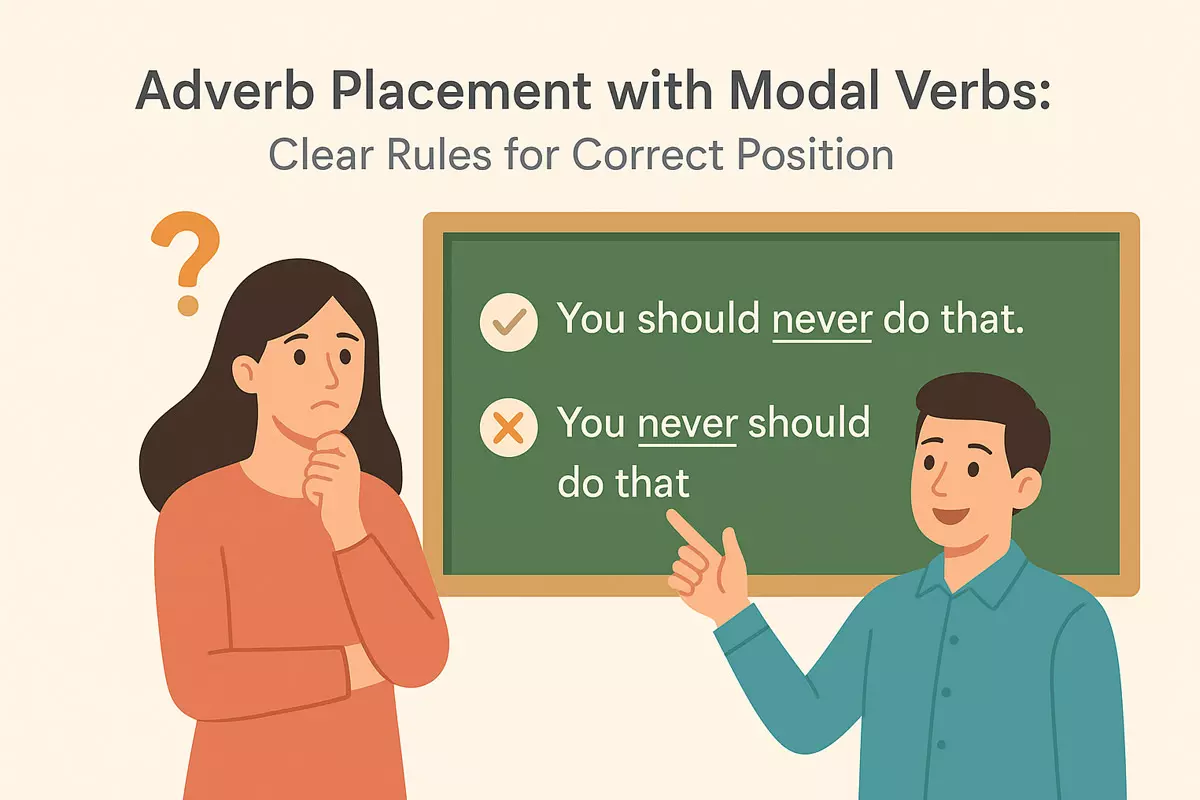 This article explains how adverbs are used with modal verbs, including their typical mid-position, exceptions, and stylistic alternatives. It also covers position differences in negatives and questions, with examples and sentence-reordering practice.
Using words like can, should, or might together with adverbs often confuses even confident English speakers, but understanding the correct order is important for clear communication. In English, adverbs such as always, often, or never typically come after the modal verb and before the main verb. For example, you would say, "You can always ask for help," rather than "You always can ask for help." Mastering this structure not only helps your speech sound more natural but also ensures your meaning is easily understood by others.
How modal verbs interact with adverbs
Modal verbs (such as can, must, should, may, and might) have a unique relationship with adverbs in English sentences. The placement of adverbs in relation to modal verbs can subtly change emphasis or meaning. Generally, adverbs that describe manner, frequency, or degree are placed between the modal verb and the main verb. For instance, in "She can easily finish the project," the adverb easily comes right after the modal.
Common placement patterns
- Modal + adverb + main verb: He must quickly respond.
- Modal + main verb + adverb: She could see clearly.
- Adverb + modal + main verb: Sometimes she can forget.
The most standard and natural-sounding position for most adverbs is directly after the modal verb, but some adverbs (especially of frequency) can also come at the beginning or end of the sentence for stylistic variation.
Types of adverbs and their impact
Certain adverbs are more commonly used with modals. Here are typical examples, showing how each fits in a sentence:
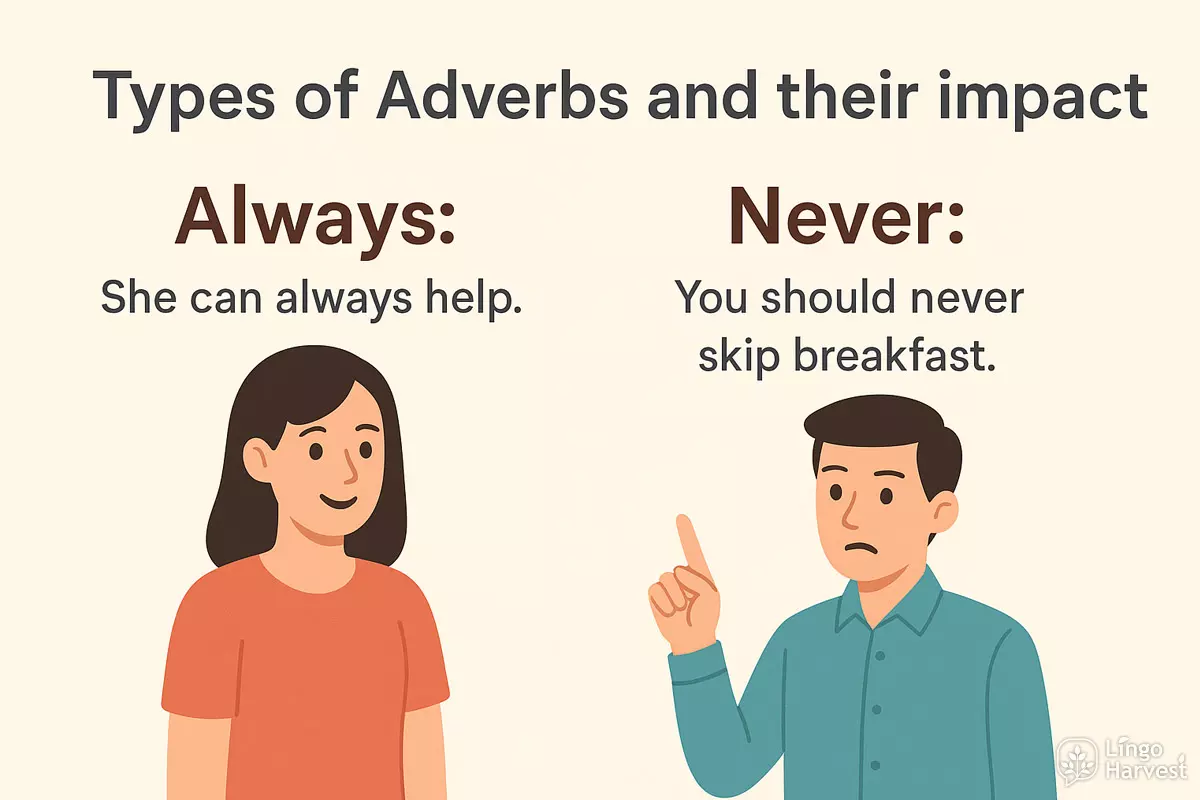
- Always: She can always help.
- Never: You should never skip breakfast.
- Often: He might often call in the evenings.
- Sometimes: They may sometimes forget.
- Already: She must already know.
- Probably: He will probably agree.
- Definitely: We should definitely try.
- Clearly: You can clearly see the difference.
- Simply: They could simply ask.
- Really: I might really enjoy this.
- Still: She may still come.
- Just: He might just win.
- Almost: You could almost hear a pin drop.
- Exactly: She can't exactly say why.
- Completely: They must completely agree.
Exceptions and flexibility
Some adverbs, especially those that modify the whole sentence (like fortunately, unfortunately, or perhaps), can appear before the modal verb or at the start of the sentence. For example: "Perhaps we should wait." However, adverbs of manner (e.g., quickly, carefully) rarely appear before the modal; "He quickly can finish" sounds awkward compared to "He can quickly finish."
| Modal + Adverb + Verb | Modal + Verb + Adverb |
|---|---|
| She must always check. | She must check always. ❌ |
| They can probably help. | They can help probably. ❌ |
| He might never know. | He might know never. ❌ |
| You should definitely try. | You should try definitely. ❌ |
In summary, adverbs typically fit best immediately after the modal and before the main verb. Deviating from this can make sentences sound unnatural or even incorrect. Pay attention to the type of adverb and the emphasis you want to create, and when in doubt, place the adverb right after the modal for clarity and correctness.
Typical mid-position in modal structures
In English sentences with modal verbs, certain adverbs usually appear between the modal and the main verb. This central spot, often called the "mid-position," is where you’ll find words like always, never, often, and probably. Placing an adverb here is the most natural and widely accepted word order, especially in statements and questions.
What does “mid-position” mean with modals?
The mid-position refers to the slot directly after the modal verb (such as can, should, might) and before the main verb. For example:
- She must always remember her keys.
- They can probably help us tomorrow.
- We should never ignore safety rules.
Notice how the adverb fits neatly between the modal and the verb. This pattern is standard in both spoken and written English, and it helps the sentence flow naturally.
Common adverbs used in this position
Most frequency adverbs and some degree adverbs are suited for this slot. Here are typical examples:
- always
- never
- usually
- often
- sometimes
- rarely
- hardly ever
- just
- already
- still
- probably
- certainly
- really
- simply
- surely
- possibly
- clearly
- definitely
- almost
- completely
Sentence patterns
To help visualize the structure, here’s a simple formula:
- Subject + Modal + Adverb + Main Verb + …
- Example: I might just call her tonight.
Comparison of mid-position with other placements
Some adverbs can occur in different places, but mid-position is usually preferred with modals. Let’s compare:
| Adverb Placement | Example Sentence |
|---|---|
| ✅ After modal (mid-position) | You should definitely try this. |
| ❌ Before modal | Definitely you should try this. (awkward/marked) |
| ❌ After main verb | You should try definitely this. (incorrect) |
| ✅ End position (sometimes possible, but less natural) | You should try this definitely. (acceptable for emphasis) |
In summary, placing an adverb immediately after the modal is the standard and most idiomatic choice. This pattern keeps your meaning clear and your sentences smooth.
Exceptions and stylistic alternatives
Some adverbs do not follow the usual pattern when combined with modal verbs. While most adverbs of manner, frequency, or degree typically appear between the modal and the main verb, there are notable deviations. Writers and speakers sometimes shift adverb placement for emphasis, clarity, or stylistic effect. These alternatives are especially common in creative writing, formal speech, or when the adverb modifies the entire sentence rather than just the verb.
Adverbs at the beginning or end of a sentence
Placing an adverb at the beginning or end of a sentence can highlight or soften a statement. This is often used for adverbs such as “certainly,” “probably,” “occasionally,” and “undoubtedly.” Compare:
- Usually, she can finish the project on time.
- He will arrive on time, definitely.
Split placement for emphasis
Sometimes, splitting the adverb from its typical position adds nuance or drama. For instance:
- She really must see this.
- You must absolutely try this cake.
Notice that “really” and “absolutely” do not always slot neatly after the modal; flexibility is possible for emphasis.
Common exceptions: negative and restrictive adverbs
Negative adverbs (such as “never,” “rarely,” “hardly”) and restrictive adverbs (such as “only,” “just”) may appear directly before the main verb or, for stylistic effect, at the start of the sentence. For example:
- He can never remember names.
- Only then would she agree.
- Just might be possible.
Variation with modal verb phrases and colloquial speech
In informal contexts, adverb placement can be even more flexible, especially in spoken English. Some examples include:
- He might just win the race.
- She could maybe help us out.
- I can probably make it.
- You should definitely see this film.
- We could possibly go tomorrow.
- Might as well try.
- They must surely know by now.
- He will always be welcome here.
- She can still change her mind.
- You mustn’t ever do that again.
Comparing standard and alternative adverb placement
Below is a table showing standard and stylistic alternatives for common adverbs with modal verbs:
| Standard Position | Stylistic or Emphatic Alternative |
|---|---|
| She can usually solve the problem. | Usually, she can solve the problem. |
| He might never return. | Never might he return. (formal/inverted) |
| We must always be careful. | We must be careful, always. |
| You could just ask for help. | You could ask for help, just. |
| I should probably call him. | Probably, I should call him. |
Summary of flexible adverb placement
While the standard position for adverbs with modal verbs is between the modal and the main verb, exceptions often arise for stylistic reasons, emphasis, or when using certain adverbs. Recognizing these patterns can help you achieve more natural and expressive English, especially in varied contexts and registers.
Position differences with negatives and questions
When using adverbs with modal verbs, word order can shift depending on whether the sentence is negative or interrogative. In statements, the adverb typically appears between the modal and the main verb. However, negatives and questions introduce subtle changes in placement that are important for clarity and correctness.
Negatives: Where does the adverb go?
In negative sentences, the adverb usually comes before the main verb but after the modal and the word "not." This structure keeps the meaning clear and natural. For example:
- She cannot always attend the meetings. (✅ Correct)
- He should not really be upset. (✅ Correct)
- They may not ever understand. (✅ Correct)
Placing the adverb before "not" (e.g., "should always not") is generally awkward and rarely used.
Questions: Typical adverb placement
In questions, the modal verb comes first, followed by the subject, then the adverb, and finally the main verb. This order helps avoid confusion and maintains natural flow. Common patterns include:
- Can you really do it?
- Should we always check?
- Will she ever arrive on time?
- Could they possibly help?
Comparison: Affirmative, Negative, and Question Forms
| Sentence Type | Example with Modal + Adverb |
|---|---|
| Affirmative | She can usually solve it. |
| Negative | She cannot usually solve it. |
| Question | Can she usually solve it? |
| Negative Question | Can she not usually solve it? |
Quick tips for correct placement
- In negatives, place the adverb after "not" and before the main verb.
- In questions, insert the adverb after the subject and before the main verb.
- Avoid separating the modal and "not" with an adverb—this is rarely idiomatic.
- Some adverbs (e.g., "never," "always," "usually") are especially common in these patterns.
Mastering these differences ensures your sentences sound natural and clear, whether you're stating, denying, or asking.
Examples with can, might, should, must
Understanding where to place adverbs with modal verbs can make your English clearer and more natural. The typical rule is that adverbs such as “always,” “often,” “never,” and “probably” are placed directly after the modal verb. Let’s look at how this works with common modals like can, might, should, and must.
Standard adverb position: modal + adverb + verb
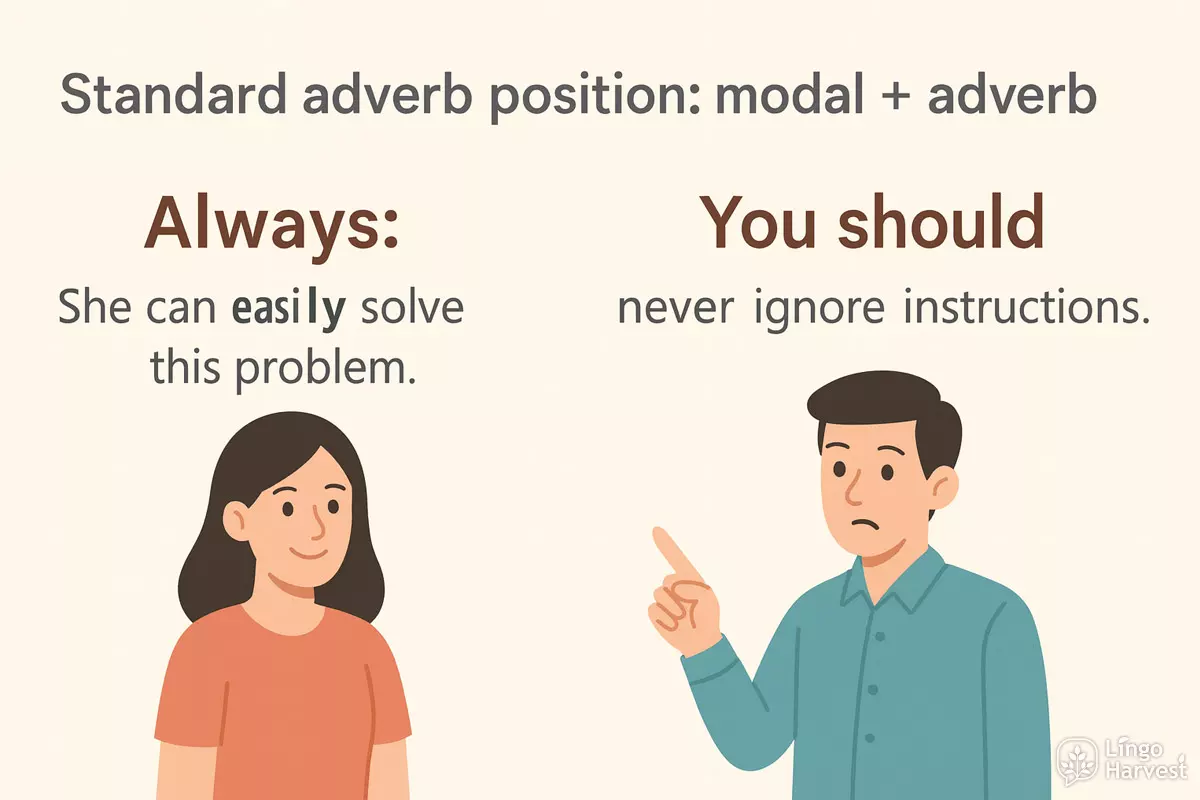
Placing the adverb right after the modal is the most common and accepted structure in both spoken and written English. Here are several examples to illustrate:
- She can easily solve this problem.
- You should never ignore instructions.
- He might already know the answer.
- They must seriously consider the risks.
- We can sometimes arrive early.
- I might just stay home tonight.
- He should always check his work.
- You must absolutely finish today.
- She can hardly believe her luck.
- They should probably call ahead.
- I might never see him again.
- He must already be here.
- We can definitely help you.
- You should certainly try again.
- She might possibly join us.
- They must surely understand.
- He can still win the race.
- You should perhaps reconsider.
Comparing adverb placement: right vs. wrong
It’s important to avoid placing the adverb in the wrong position. The following table shows a comparison of correct and incorrect adverb placement with modal verbs:
| ✅ Correct Placement | ❌ Incorrect Placement |
|---|---|
| She can always help you. | She always can help you. |
| You should never skip breakfast. | You never should skip breakfast. |
| He might often visit us. | He often might visit us. |
| They must already know. | They already must know. |
Special notes and exceptions
Some adverbs, especially those of frequency (like “sometimes” or “usually”), can also appear at the beginning or end of the sentence, but placing them after the modal is the clearest and most direct. For emphasis or style, native speakers may occasionally shift the adverb, but this is less common and can sound awkward if overused. By following these examples, you’ll ensure your adverb placement with modal verbs is accurate and idiomatic.
Practice: reorder sentences for correct placement
Understanding where to position adverbs in sentences with modal verbs is essential for clarity and correctness. In this section, you'll find interactive exercises to help you master the typical word order. The focus is on practical examples and real-life sentence structures, making it easier to spot and avoid common mistakes.
Task 1: Arrange the Words
Below are mixed-up sentences. Rearrange the parts to create correct sentences that use modals and adverbs. Pay attention to where the adverb naturally belongs.
- always / can / you / call / me / after 8 pm
- should / quickly / we / finish / the project
- may / sometimes / he / forget / his keys
- must / completely / you / fill / the form
- could / honestly / she / answer / your question
Show answers
- You can always call me after 8 pm.
- We should quickly finish the project.
- He may sometimes forget his keys.
- You must completely fill the form.
- She could honestly answer your question.
Task 2: Spot the Incorrect Placement
Read the sentences and decide if the adverb is in the correct position. If not, rewrite the sentence. (Some are correct as given.)
- She must finish her work always before lunch.
- You can easily understand this rule.
- He should carefully read the instructions.
- They might tomorrow arrive early.
- We could never have known the truth.
Show answers
- Incorrect. Correct: She must always finish her work before lunch.
- Correct as given.
- Correct as given.
- Incorrect. Correct: They might arrive early tomorrow.
- Correct as given.
Common Patterns for Reference
To help you internalize the standard patterns, here is a quick-reference list of typical adverb placements with modal verbs:
- Modal + adverb + main verb: can easily solve
- Modal + main verb + adverb (for adverbs of frequency): could see clearly
- Modal + adverb of certainty + main verb: might definitely help
- Modal + main verb + adverb (for time/place): should arrive tomorrow
- Modal + always/never/sometimes + main verb: must always check, should never forget
- Modal + main verb + adverb (for manner): would react calmly
- Modal + also + main verb: can also join
- Modal + main verb + already: might have already left
- Modal + main verb + soon: could finish soon
- Modal + main verb + together: should work together
Task 3: Correct the Order
Rewrite these sentences so the adverb is in the most natural position:
- They can finish it probably by Friday.
- He must submit quickly the report.
- We should never ignore important details.
- You might see rarely such a deal.
- She will call you possibly tomorrow.
- He can understand easily the instructions.
- They might arrive suddenly at any moment.
- You should check carefully the document.
- We can meet maybe after lunch.
- He must explain clearly the problem.
Show answers
- They can probably finish it by Friday.
- He must quickly submit the report.
- Correct as given.
- You might rarely see such a deal.
- She will possibly call you tomorrow.
- He can easily understand the instructions.
- They might suddenly arrive at any moment.
- You should carefully check the document.
- We can maybe meet after lunch. (More natural: “Maybe we can meet…”)
- He must clearly explain the problem.