Questions with Modal Verbs in English: Rules and Examples

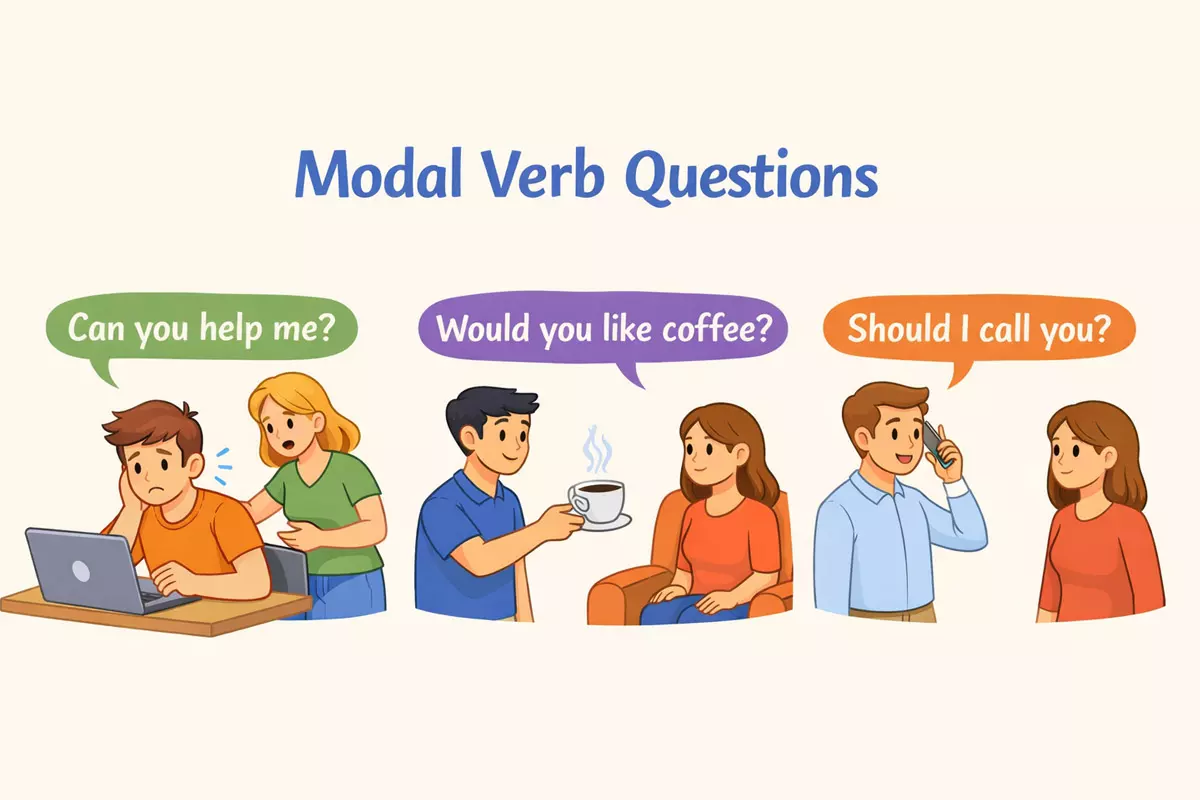 Here we how to form questions with modal verbs in English, including yes/no and WH-questions, their meanings, politeness, certainty, and negative forms. It also highlights common learner mistakes and provides practice exercises.
If you want to ask for permission, offer help, or make suggestions in English, it’s important to use auxiliary verbs such as can, could, should, or must. These words help form polite and clear questions or statements. For example, you might ask, Can I open the window? to request permission, or say, Can I help you? when offering assistance. To make a suggestion, you could use, Should we try a new restaurant? Mastering these structures will help you communicate more effectively and confidently in everyday situations.
If you want a quick way to recognize what kind of question you are building, see this guide on question types in English. It helps you spot patterns like yes/no questions, wh- questions, and indirect questions before you choose the best modal.
Modal Verbs in Questions Overview
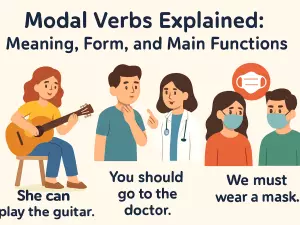
Understanding how to form questions with modal verbs is essential for clear and natural English. Modal verbs—such as can, could, may, might, must, shall, should, will, and would—help express possibility, permission, ability, advice, and more. When creating questions, these verbs follow specific patterns that differ from statements. The typical structure for questions with modals is: Modal + subject + base verb. For example, “Can you swim?” or “Should we leave now?” This direct word order makes modal questions straightforward, but each modal can carry different nuances depending on context.
Many modal questions also work with quantifiers, especially when you want to sound less direct. For practical patterns, see polite questions that use quantifiers to soften requests and suggestions.
Common Modal Verbs Used in Questions
Here are some of the most frequently used modals in interrogative sentences:
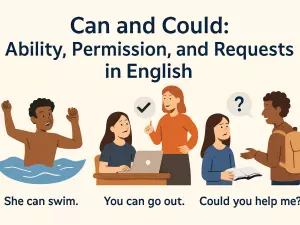
- Can – ability, permission (“Can you help me?”)
- Could – polite requests, possibility (“Could you open the window?”)
- May – formal permission, possibility (“May I ask a question?”)
- Might – weak possibility (“Might it rain today?”)
- Must – necessity, deduction (“Must we finish now?”)
- Shall – suggestions, offers (“Shall we dance?”)
- Should – advice, expectation (“Should I call her?”)
- Will – future, willingness (“Will you join us?”)
- Would – polite requests, hypothetical situations (“Would you like some tea?”)
Question Patterns with Modals
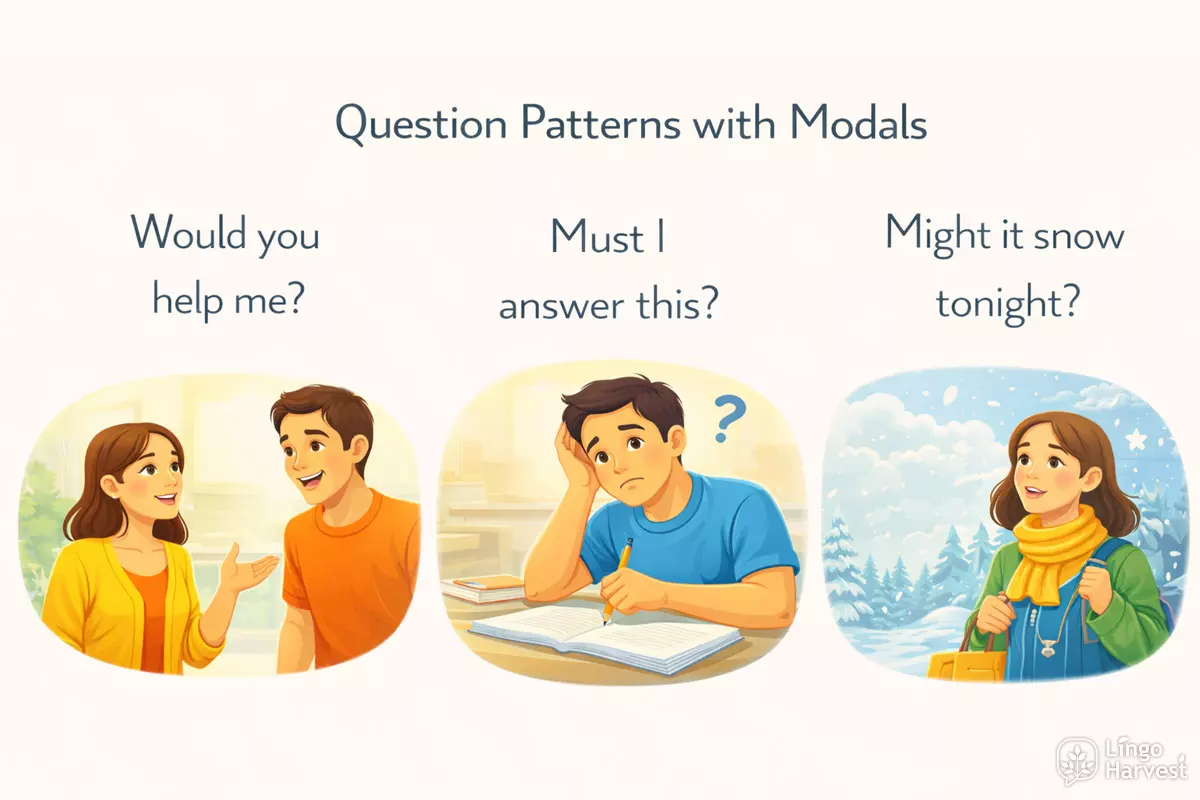
Questions with modal verbs are usually formed by placing the modal at the beginning, followed by the subject and the base form of the main verb. This structure is consistent across different modals and tenses.
| Modal | Example Question |
|---|---|
| Can | Can you speak French? |
| Could | Could she come earlier? |
| May | May I leave the table? |
| Should | Should we continue? |
| Will | Will they arrive soon? |
| Would | Would you help me? |
| Must | Must I answer this? |
| Might | Might it snow tonight? |
| Shall | Shall we start? |
Key Points to Remember
- The main verb after a modal is always in its base form (never “to” + verb or a past tense form).
- Negative questions use “not” after the subject (“Shouldn’t we go?”).
- Wh- questions (who, what, where, etc.) simply add the question word before the modal (“Where can I sit?”).
- Politeness often depends on which modal you choose—“could” and “would” are softer than “can” and “will”.
- Formality increases with modals like “may” and “shall”.
Mastering these patterns makes conversation more flexible and helps you ask for information, permission, or advice with the right tone.
Yes/No Questions with Modals
When forming questions that can be answered with "yes" or "no" in English, modal verbs play a central role in the structure. The modal verb (such as can, should, would, may) comes at the beginning of the question, followed by the subject and then the base form of the main verb. This pattern is consistent for all modal verbs, making it easier to construct such questions once you know the formula. The basic structure is:
- Modal + Subject + Base Verb + (Rest of Sentence)?
For example: "Can you swim?" or "Should we leave now?"
Common Modals Used in Yes/No Questions
Here are some modal verbs frequently used to ask for permission, ability, advice, or possibility:
- Can I use your phone? → Yes, you can.
- Could you open the window? → Yes, I could.
- Will you call me later? → Yes, I will.
- Would you like some coffee? → Yes, I would.
- Should I tell her the truth? → Yes, you should.
- May I leave early today? → Yes, you may.
- Might it rain tonight? → Yes, it might.
- Must we finish this today? → Yes, we must.
- Shall we start now? → Yes, we shall.
- Ought to I apologize? → Yes, you ought to.
Examples of Yes/No Questions with Modals
Notice how the modal always comes first, immediately followed by the subject:
- Can she come to the party? → Yes, she can.
- Could you help me with this? → Yes, I could.
- Will they join us for dinner? → Yes, they will.
- Would you like some tea? → Yes, I would.
- Should I call him now? → Yes, you should.
- May I open the window? → Yes, you may.
- Might we see some rain today? → Yes, we might.
- Must I finish this tonight? → Yes, you must.
- Shall we begin the meeting? → Yes, we shall.
- Ought he to apologize? → Yes, he ought to.
- Can it be true? → Yes, it can.
- Could this be a mistake? → Yes, it could.
- Will you be home by six? → Yes, I will.
- Would it be okay if I left early? → Yes, it would.
- Should we try again? → Yes, we should.
Short Answers to Modal Questions
Responding to these questions is straightforward. Short answers typically repeat the modal verb:
- Yes, she can. / No, she can't.
- Yes, I would. / No, I wouldn't.
- Yes, we should. / No, we shouldn't.
| Modal Question | Short Answer (Yes/No) |
|---|---|
| Can you drive? | Yes, I can. / No, I can't. |
| Should we start now? | Yes, we should. / No, we shouldn't. |
| Will they agree? | Yes, they will. / No, they won't. |
| May I leave early? | Yes, you may. / No, you may not. |
| Could it rain today? | Yes, it could. / No, it couldn't. |
The pattern for yes/no questions with modal verbs is reliable and simple to use. By placing the modal verb first, you create a clear and direct question. This format is used for asking about ability, permission, advice, possibility, and more, making it an essential part of English conversation.
WH-Questions with Modal Verbs
To form information-seeking questions using modal verbs, the question word (like what, where, or why) comes first, followed by the modal (such as can, should, or must), then the subject and the base form of the main verb. This structure helps you ask about possibilities, obligations, or abilities. For example, if you want to ask about location using can, you might say, "Where can we meet?"
In formal writing, the same ideas can be expressed with more impersonal structures, especially when you want to reduce “I/you” focus. See formal vs informal tone for style choices that change how direct your modal questions feel.
Common WH-Words Used with Modals
- What – to ask about things or actions
- Where – for places or directions
- When – for time or occasions
- Why – to ask for reasons
- Who – for people (subjects or objects)
- Whom – formal, for objects (rare in speech)
- Which – to ask about choices
- How – for manner, degree, or process
Word Order Pattern
The basic pattern is: WH-word + modal + subject + base verb + (rest of question)?
- Why should I worry?
- How could they know?
- When can we start?
Examples of WH-Questions with Different Modals
- What can you do to help? → I can explain the process.
- Where should we go for lunch? → We should go to a nearby café.
- When could I visit your office? → You could visit next week.
- Why must we finish this today? → Because the deadline is today.
- Who would join the meeting? → The project team would join.
- How might this affect our plans? → It might cause a short delay.
- Which car could we rent? → We could rent a compact car.
- How should I prepare? → You should review the documents.
- Whom could she ask for advice? → She could ask her manager.
- Why would anyone refuse? → Because they might disagree.
- What must I bring? → You must bring your ID.
- Who can answer the question? → The instructor can answer it.
- Where would you like to sit? → I would like to sit near the window.
- How can we solve this? → We can discuss it together.
- When should he call? → He should call this evening.
- Which document must I sign? → You must sign the contract.
Comparing Statement and WH-Question Forms
| Statement | WH-Question |
|---|---|
| You can leave now. | When can you leave? |
| She should bring her passport. | What should she bring? |
| They must finish the project. | Why must they finish the project? |
| We could meet at the café. | Where could we meet? |
| He would help if he could. | How would he help? |
Tips for Forming WH-Questions with Modals
- Always place the WH-word at the beginning.
- Keep the modal directly after the WH-word.
- Use the base form of the verb after the subject.
- Skip auxiliary verbs like do or does; modals replace them.
- Remember that the subject comes after the modal, not before.
Mastering these patterns makes it easier to gather information, clarify doubts, and participate actively in conversations. Practicing with a variety of WH-words and modal verbs will help you ask questions naturally and confidently.
Meaning and Function of Modal Questions
Modal verbs like can, could, may, might, should, would, will, and must play a key role in shaping questions in English. When used in questions, these verbs help express a range of ideas — from asking about ability or permission, to exploring possibilities, making requests, or offering suggestions. Understanding how modal verbs function in questions can make it easier to communicate with nuance and politeness.
What Modal Questions Express
Questions formed with modals allow speakers to do more than just seek facts. They help signal the speaker’s attitude, respect for social norms, and the degree of certainty or necessity. Here are some common functions:
- Requesting: "Could you help me?" (polite request)
- Asking for permission: "May I open the window?"
- Inquiring about ability: "Can you swim?"
- Exploring possibilities: "Might it rain tomorrow?"
- Offering suggestions: "Should we leave now?"
- Seeking advice: "What should I do?"
- Checking necessity or obligation: "Must we finish today?"
- Making invitations: "Would you like some coffee?"
- Proposing hypothetical situations: "What would you do if you won?"
- Clarifying expectations: "Should I call you later?"
How Modals Change the Tone of Questions
Using different modal verbs can soften or strengthen the tone of a question. For example, "Can you pass the salt?" is direct, while "Could you pass the salt?" sounds more polite. The choice of modal often depends on the relationship between speakers, the formality of the situation, and how much certainty or politeness is intended.
Examples of Modal Questions by Function
| Function | Modal Question Example |
|---|---|
| Ability | Can you drive a manual car? |
| Permission | May I leave early today? |
| Possibility | Might she know the answer? |
| Request | Could you send me the file? |
| Suggestion | Should we try a different approach? |
| Hypothetical | What would you do in my situation? |
| Obligation | Must I attend the meeting? |
| Offer | Would you like some tea? |
In short, modal questions are valuable tools for expressing intention, politeness, and subtle shades of meaning in English conversations. Mastering them helps you interact more naturally and effectively in a variety of situations.
Politeness and Degree of Certainty
When forming questions with modal verbs in English, your choice of modal often signals how polite your request sounds and how sure you are about something. The difference between “Can you help me?” and “Could you help me?” is more than just grammar—it's about being more or less formal, or expressing different levels of confidence. Understanding these subtleties helps you communicate more naturally and appropriately in various situations.
How Modal Verbs Affect Tone
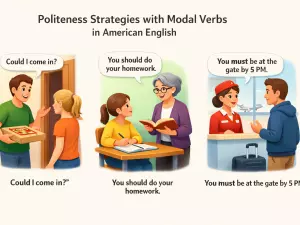
Some modal verbs are naturally softer or more indirect, making your questions sound friendlier or more considerate. Others are more direct, which can sound confident—or sometimes even abrupt—depending on context. For example, “May I ask a question?” is generally more formal than “Can I ask a question?”
Common Patterns and Examples
- Can: Used for ability or informal requests. (“Can you pass the salt?”)
- Could: Politer, more tentative than “can.” (“Could you open the window?”)
- May: Very formal, often used for permission. (“May I leave early?”)
- Might: Suggests possibility, often quite tentative. (“Might you know the answer?”)
- Will: Used for willingness or future actions. (“Will you join us?”)
- Would: More polite or hypothetical than “will.” (“Would you like some coffee?”)
- Shall: Formal, sometimes used for offers. (“Shall we begin?”)
- Should: Seeks advice or opinion. (“Should I call them now?”)
- Must: Strong necessity or obligation, rarely used for polite questions. (“Must I attend the meeting?”)
- Ought to: Similar to “should,” but less common. (“Ought I to apologize?”)
Comparing Politeness and Certainty

Below is a comparison of how different modal verbs express varying levels of formality and confidence in questions:
| Modal Verb | Typical Use in Questions | Politeness Level | Degree of Certainty |
|---|---|---|---|
| Can | Can you help me? | Neutral / Informal | Moderate |
| Could | Could you explain this? | Polite | Less certain |
| May | May I borrow your pen? | Very polite / Formal | High (for permission) |
| Might | Might I suggest something? | Very polite / Tentative | Low |
| Will | Will you be there? | Neutral / Direct | High |
| Would | Would you like to join? | Polite | Less certain |
| Shall | Shall we start? | Formal / Suggestive | Moderate |
| Should | Should I call her? | Neutral / Advice-seeking | Moderate |
| Must | Must I attend? | Direct / Formal | Very high |
| Ought to | Ought I to go? | Formal / Rare | Moderate |
Tips for Choosing the Right Modal
- Use “could” or “would” to make requests less direct and more polite, especially with strangers or in formal settings.
- Reserve “may” and “might” for very polite or tentative situations.
- “Can” and “will” are fine for everyday, informal questions among friends or colleagues.
- Match your modal choice to the social context and your relationship with the listener for natural communication.
Choosing the appropriate modal verb in your questions can make your English sound more fluent and considerate, helping you navigate both casual and formal conversations with ease.
Negative Modal Questions
Forming questions with modal verbs in the negative can help speakers express surprise, offer suggestions, or confirm expectations. These types of questions often start with the contracted form of the modal and the subject, such as “Can’t you…?” or “Shouldn’t we…?”. They are common in both spoken and written English, especially when the speaker assumes a certain answer or wants to prompt agreement.
How to Form Negative Questions with Modals
The structure is generally: Modal + not + subject + base verb, or more commonly, the contracted form: Modal + n’t + subject + base verb. For example, “Wouldn’t he help us?” or “Mustn’t we hurry?” In formal writing, the uncontracted form (“Can not you…?”) is rare and can sound awkward.
Negative modal questions become more complex when they appear inside passive and perfect forms in advanced writing. For deeper patterns, see advanced modal structures and how modals behave in multi-layered constructions.
- Can’t you see the sign? → Yes, I can.
- Shouldn’t we leave now? → Yes, we should.
- Won’t she be joining us? → Yes, she will.
- Couldn’t they try again? → Yes, they could.
- Wouldn’t it be better to wait? → Yes, it would.
- Mustn’t we finish this today? → Yes, we must.
- Mightn’t he know the answer? → Yes, he might.
- Oughtn’t you to apologize? → Yes, I ought to.
- Shan’t we go inside? → Yes, let’s.
- Needn’t you call them? → No, I needn’t.
- Can not you help me? (rare, overly formal) → Yes, I can.
- Should not we discuss this? (rare, overly formal) → Yes, we should.
When to Use Negative Modal Questions
These questions are used to:
- Express surprise or disbelief: “Can’t you remember his name?”
- Suggest or recommend: “Shouldn’t we ask for directions?”
- Seek confirmation or agreement: “Wouldn’t you prefer tea?”
- Challenge or criticize gently: “Couldn’t you have called earlier?”
Meaning and Tone
The tone of these questions can range from polite suggestion to mild criticism, depending on context and intonation. They often imply the speaker expects a positive answer or is surprised by the negative one. For example, “Won’t you join us?” expects the listener to say yes, while “Shouldn’t you be working?” may imply the listener is not doing what is expected.
| Modal | Negative Question Example | Typical Use |
|---|---|---|
| Can | Can’t you hear me? | Expressing surprise or concern |
| Should | Shouldn’t we start now? | Making suggestions |
| Would | Wouldn’t he know the answer? | Seeking confirmation |
| Could | Couldn’t you try again? | Offering alternatives or advice |
| Must | Mustn’t we be quiet here? | Stressing necessity or rules |
| Might | Mightn’t it rain later? | Expressing possibility |
| Ought | Oughtn’t you to help? | Giving moral advice |
| Need | Needn’t you tell them? | Questioning necessity |
Common Pitfalls
Some negative modal questions sound very formal or old-fashioned, especially with “oughtn’t” or “shan’t.” In American English, forms like “shan’t” and “oughtn’t” are rare. Always consider your audience and context before choosing these structures. Remember, the contracted negative form (can’t, shouldn’t, wouldn’t) is much more natural in everyday conversation.
Common Learner Mistakes
Learners often encounter predictable pitfalls when forming questions with modal verbs. These errors can make speech or writing unclear, or even change the intended meaning. Being aware of the most frequent issues can help you avoid them and communicate more confidently.
Typical Errors in Word Order
A major stumbling block is incorrect word order. In English, modal verbs like “can,” “should,” or “must” move to the front of the question. Forgetting this creates sentences that sound unnatural or confusing. For example, “You can go?” is understandable in conversation but isn’t standard question form.
Using the Wrong Auxiliary or Verb Form
Many learners mistakenly add “do/does/did” when forming questions with modals. Since modals already act as auxiliaries, adding another is incorrect. Additionally, the main verb after a modal should always be in its base form.
Confusing Modal Meanings
Modal verbs express possibility, ability, permission, or obligation. Mixing up these meanings leads to misunderstandings. For instance, using “must” instead of “may” can sound too strong.
Common Patterns of Mistakes
Below is a summary table of frequent missteps and their correct forms:
| Incorrect Example | Correct Example |
|---|---|
| Do you can swim? | Can you swim? |
| Can you to help me? | Can you help me? |
| He should goes now? | Should he go now? |
| You must to finish? | Must you finish? |
| May I am leave? | May I leave? |
Many “modal” errors also come from pronoun choices that sound fine at first, but create ambiguity or agreement problems. See common grammar mistakes that often appear in the same sentences learners build with modals.
Expanded List: Frequent Issues to Watch For
- Placing the subject before the modal (e.g., “She can come?” instead of “Can she come?”)
- Adding “do/does” with the modal (e.g., “Does she can play?”)
- Using “to” after the modal (e.g., “Can you to help?”)
- Using the -ing or -ed form after the modal (e.g., “Should he going?”)
- Mixing up modals (e.g., “Must I go?” when asking for permission, instead of “May I go?”)
- Omitting the subject (“Can help me?” instead of “Can you help me?”)
- Using double modals (“Can must you help?”)
- Forgetting inversion in yes/no questions (“You could help?” instead of “Could you help?”)
- Using past tense after a modal (“Could you went?” instead of “Could you go?”)
- Incorrect short answers (e.g., “Yes, I can do” instead of “Yes, I can”)
- Overusing modals in indirect questions (“Can you tell me can you swim?” instead of “Can you tell me if you can swim?”)
- Using modals with stative verbs incorrectly (“Can you be liking it?”)
Understanding these common missteps is the first step toward mastering modal verb questions in English. Practicing with the correct forms will help you avoid confusion and sound more natural in conversations and writing.
Practice Exercises and Self-Check
Now that you’ve reviewed the main rules for forming questions with modal verbs, it’s time to actively apply what you’ve learned. Try the following exercises to test your skills. These tasks cover both basic and more nuanced uses of modals in questions, with a focus on word order, meaning, and real-life context.
1. Rewrite Statements as Modal Questions
Transform the following statements into correct questions using the modal verb given in parentheses.
- You are allowed to leave early. (may)
- He can swim across the lake. (can)
- They should call the doctor. (should)
- We must finish the project today. (must)
- She will help us with the report. (will)
- You are allowed to take a seat here. (may)
- He is able to fix the computer. (can)
- They should arrive a bit earlier. (should)
- We must wear helmets on site. (must)
- She will send the files tonight. (will)
Show answers
- May you leave early?
- Can he swim across the lake?
- Should they call the doctor?
- Must we finish the project today?
- Will she help us with the report?
- May you take a seat here?
- Can he fix the computer?
- Should they arrive a bit earlier?
- Must we wear helmets on site?
- Will she send the files tonight?
2. Choose the Correct Modal for the Question
Select the best modal verb to complete each question.
- ______ you open the window, please? (can / must)
- ______ I borrow your dictionary? (could / should)
- ______ she be at the office now? (may / will)
- ______ they come to the meeting tomorrow? (could / must)
- ______ we park here? (may / should)
- ______ you help me carry this box? (can / must)
- ______ I sit here for a moment? (could / should)
- ______ he be late today? (may / will)
- ______ they join us after class? (could / must)
- ______ we leave now? (may / should)
Show answers
- Can you open the window, please?
- Could I borrow your dictionary?
- May she be at the office now?
- Could they come to the meeting tomorrow?
- May we park here?
- Can you help me carry this box?
- Could I sit here for a moment?
- May he be late today?
- Could they join us after class?
- Should we leave now?
4. Spot the Error
Each sentence below contains a mistake in the formation of a question with a modal verb. Identify and correct the error.
- Do can you help me?
- Should you to call her?
- Must he goes now?
- Will can she come?
- Do should we wait here?
- Can he to finish today?
- Must she to sign this form?
- Will he can join us later?
- Should they to leave early?
- Do may I ask a question?
Show answers
- Can you help me?
- Should you call her?
- Must he go now?
- Can she come? / Will she come? (Choose one modal only)
- Should we wait here?
- Can he finish today?
- Must she sign this form?
- Will he join us later? / Can he join us later? (Choose one modal only)
- Should they leave early?
- May I ask a question?
5. Create Your Own Modal Questions
Write three original questions using different modal verbs. Try to use a variety of contexts: permission, ability, and suggestion.
Show answers
- May I join your group?
- Can you speak Spanish?
- Should we order dessert?
Review your answers, and revisit any areas where you had difficulty. Practicing with these exercises will strengthen your understanding of how to form and use questions with modal verbs naturally in English conversations.