Common Word Order Errors with Adverbs (Intermediate+)

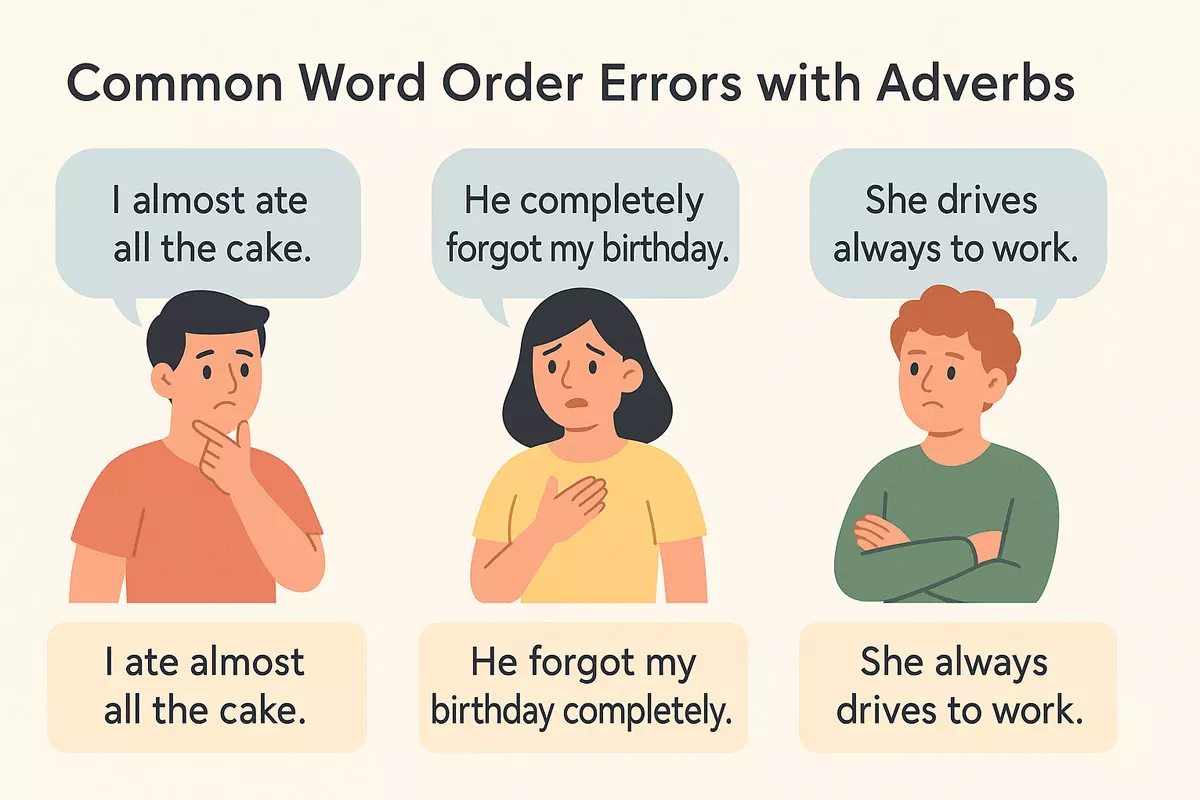 This article explains typical mistakes with frequency and manner adverbs, such as incorrect mid, front, or end placement. It shows how placement changes meaning, gives real student examples, and offers practice to correct these errors.
Even confident English learners sometimes struggle with placing adverbs correctly in sentences, which can result in speech that sounds unnatural or confusing. Adverbs often need to be positioned carefully to convey the intended meaning, and common mistakes include putting them too far from the verb or at the wrong point in the sentence. To improve your English, pay attention to where native speakers place adverbs and practice by reading and listening to well-constructed sentences. This attention to detail will help your communication sound more fluent and clear.
Typical mistakes with frequency and manner adverbs
Many English learners struggle with the correct placement of adverbs like often, rarely, quickly, and carefully. These words can subtly change the meaning of a sentence if they’re not in the right spot. Let’s look at the most common word order issues and how to avoid them.
Mixing up positions: frequency vs. manner
Frequency adverbs (such as always, usually, never) generally go before the main verb but after the verb to be. Manner adverbs (like slowly, clearly, well) usually come after the main verb or at the end of the sentence. Confusing these positions is a typical source of awkward or incorrect sentences.
| Adverb Type | Correct Example |
|---|---|
| Frequency (before main verb) | I usually eat breakfast at 7. |
| Frequency (after be) | He is always late. |
| Manner (end of sentence) | She sings beautifully. |
| Manner (after object) | They solved the problem quickly. |
Common word order mistakes to avoid
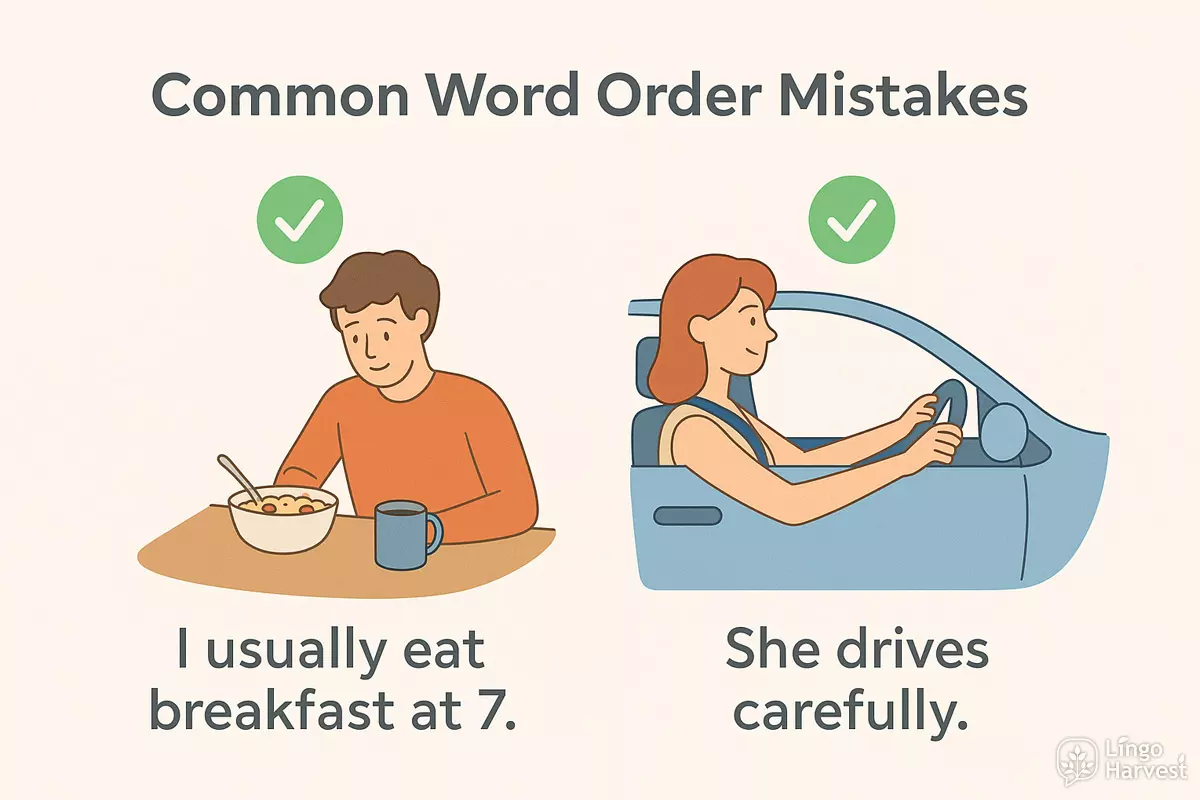
- Incorrect: I eat usually breakfast at 7. ❌
Correct: I usually eat breakfast at 7. ✅ - Incorrect: She carefully drives. ❌
Correct: She drives carefully. ✅ - Incorrect: He is never late always. ❌
Correct: He is always late. ✅ - Incorrect: They quickly finished their homework. (acceptable, but "finished their homework quickly" is clearer for manner) ❌
Correct: They finished their homework quickly. ✅ - Incorrect: I have seen never that movie. ❌
Correct: I have never seen that movie. ✅ - Incorrect: She rarely does not eat meat. ❌
Correct: She rarely eats meat. ✅ - Incorrect: He speaks English very good. ❌
Correct: He speaks English very well. ✅ - Incorrect: They are always arguing never. ❌
Correct: They are always arguing. ✅
Tips for mastering adverb placement
- Put frequency adverbs before the main verb, but after forms of be.
- Place manner adverbs at the end, or just after the verb (if there’s no object).
- Don’t split verb phrases (e.g., have never seen, not have seen never).
- Remember that some adverbs can go in more than one place, but the meaning may change.
- Avoid putting both types of adverbs together unless the order is clear: frequency first, then manner (She always speaks politely).
Getting these patterns right becomes easier with practice. Pay attention to adverb position when you read or listen to English, and try to mimic the patterns you notice.
Incorrect mid-position placement
Adverbs in English often have a “mid-position” in sentences, typically after the first auxiliary verb or before the main verb. However, many learners mistakenly put them in the wrong spot, which can make sentences sound unnatural or even change the meaning. Understanding where to place adverbs like always, usually, often, already, and never is crucial for clear communication.
Common mistakes with adverb word order
It’s easy to misplace adverbs, especially in sentences with auxiliaries (like have, will, can, etc.), negatives, or questions. Here are some typical errors:
- Placing the adverb before the auxiliary verb: He always has been late. ❌ (Correct: He has always been late.)
- Putting the adverb after the main verb in simple tenses: She goes usually to the gym. ❌ (Correct: She usually goes to the gym.)
- Using adverbs between verb and object: I read often books at night. ❌ (Correct: I often read books at night.)
- Misplacing adverbs in questions: Do you often go there? ✅ but Do you go often there? ❌
Typical mid-position adverbs
Some adverbs almost always go in the mid-position—between the subject and the main verb, or after the first auxiliary. Here's a list of common ones:
- always
- usually
- often
- never
- sometimes
- already
- just
- still
- hardly ever
- almost
- quite
- nearly
- barely
- rarely
- frequently
- occasionally
- probably
- certainly
- simply
- clearly
Comparing correct and incorrect placement
Notice how shifting the adverb changes the sentence. Compare these examples:
| Incorrect Placement | Correct Placement |
|---|---|
| She drinks always coffee in the morning. | She always drinks coffee in the morning. |
| They have never visited Paris. | They have never visited Paris. ✅ |
| I will probably go tomorrow. | I will probably go tomorrow. ✅ |
| He calls sometimes his mother. | He sometimes calls his mother. |
| You should never eat so late. | You should never eat so late. ✅ |
| John is still working here. | John is still working here. ✅ |
| We just finished the project. | We just finished the project. ✅ |
| She speaks rarely English at home. | She rarely speaks English at home. |
Tips for correct adverb placement
- With simple tenses: place the adverb before the main verb (He often visits).
- With auxiliary verbs: put the adverb after the first auxiliary (She has already left).
- Never put these adverbs between the verb and its object.
- In questions, the adverb usually comes after the subject (Do you usually eat breakfast?).
Careful placement helps your English sound natural and precise. Practice with different sentence patterns to build confidence.
Incorrect fronting and end-position issues
Adverbs often cause confusion for English learners, especially when it comes to where they should appear in a sentence. Placing an adverb at the start (fronting) or at the end can change the meaning, sound unnatural, or make the sentence grammatically incorrect. Understanding typical mistakes with these positions helps you communicate more clearly.
Common mistakes with adverb placement
- Fronting when not needed: "Quickly she finished her homework." (Unnatural for most contexts. Better: "She finished her homework quickly.")
- End-position errors: "He always forgets his keys at home." ("Always" should come before the verb: "He always forgets his keys at home.")
- Splitting verb and object: "She speaks fluently English." (Correct: "She speaks English fluently.")
- Misplacing frequency adverbs: "At night I go usually to bed early." (Correct: "I usually go to bed early at night.")
Which adverbs can be fronted?
Some adverbs, especially those of time or place (e.g., "Yesterday", "Here", "Outside"), naturally fit at the beginning of a sentence. However, frequency adverbs like "often", "always", or "never" rarely start a sentence in everyday English. Compare these patterns:
| Fronted: Acceptable | Fronted: Unnatural/Incorrect |
|---|---|
| Yesterday, I saw Jane at the park. | Always I forget my umbrella. |
| Outside, the birds were singing. | Often he is late to class. |
| Suddenly, the lights went out. | Never I eat breakfast. |
| Later, we can discuss this. | Usually she drinks coffee in the morning. |
Typical end-position mistakes
Learners often put adverbs at the end of the sentence, even when this changes the meaning or makes the word order awkward. For example:
- I eat pizza sometimes. ❌ → Sometimes I eat pizza. ✅
- They go to the gym rarely. ❌ → They rarely go to the gym. ✅
- He forgets his homework always. ❌ → He always forgets his homework. ✅
How to avoid these errors
To improve, remember these points:
- Place frequency adverbs (always, usually, often, sometimes, rarely, never) before the main verb but after the verb "to be".
- Adverbs of manner (quickly, carefully) usually go after the object or main verb.
- Adverbs of time or place can go at the beginning or end, but not in the middle.
- Fronting gives emphasis, but overusing it sounds unnatural.
Mastering adverb placement takes practice. By noticing these patterns and correcting mistakes, your sentences will sound more natural and clear.
How wrong placement changes meaning
Adverbs often move around in English sentences, but their position can completely shift the message. Placing an adverb in the wrong spot may create confusion, sound unnatural, or—most importantly—change what the sentence actually means. This is especially true with adverbs of frequency, manner, and degree.
Different meanings from different positions
Consider these sentences:
- She almost always eats breakfast. (She nearly always eats breakfast.)
- She always almost eats breakfast. (She always nearly eats breakfast, but maybe doesn’t finish.)
Here, moving "almost" changes whether she usually eats or just comes close to eating. This subtle shift can cause misunderstandings.
Common adverb placement errors and their effects
Some adverbs, like "only," "just," or "even," are especially sensitive to position. Where you put them decides what part of the sentence they modify. Look at the examples below:
| Adverb Placement | Meaning |
|---|---|
| I only called Maria. | I called Maria (and nobody else). |
| I called only Maria. | I called just Maria (not other people). |
| I called Maria only. | Maria was the only one I called. |
| Only I called Maria. | No one except me called Maria. |
Notice how the focus changes each time "only" moves. This can lead to major miscommunication, especially in written English where intonation can’t help clarify.
Frequent mistakes with adverb order
- He quickly finished his work. ✅ (Correct: the adverb describes how he finished.)
He finished quickly his work. ❌ (Incorrect: unnatural word order.) - She always forgets her keys. ✅ (Correct: frequency adverb before the main verb.)
She forgets always her keys. ❌ (Incorrect: adverb placed in an unnatural position.) - We just saw her. ✅ (Means: a moment ago.)
We saw just her. ❌ (Means: only her — different meaning.) - He even helped wash the dishes. ✅ (Correct emphasis: surprising action.)
He helped even wash the dishes. ❌ (Incorrect placement; sounds awkward.) - I nearly missed the train. ✅ (Correct: almost missed it.)
I missed nearly the train. ❌ (Incorrect structure.) - They often visit their grandparents. ✅ (Correct placement of frequency.)
They visit often their grandparents. ❌ (Unnatural and awkward.) - You can easily solve this problem. ✅ (Correct: adverb before the main verb.)
You can solve easily this problem. ❌ (Unnatural in standard English.) - He rarely makes mistakes. ✅ (Correct frequency placement.)
He makes rarely mistakes. ❌ (Incorrect: adverb should come before the verb.) - She almost dropped her phone. ✅ (Correct: describes how close the action was.)
She dropped almost her phone. ❌ (Incorrect: changes the meaning.) - We still don’t know the truth. ✅ (Correct: adverb before the verb.)
We don’t know still the truth. ❌ (Unnatural and confusing.)
In summary, the position of adverbs isn’t just about style—it can alter the actual information you give. Double-check adverb placement to ensure your meaning is clear and precise.
Real examples from student writing
Many English learners struggle with accurately placing adverbs in their sentences. Below are genuine sentences written by students, highlighting typical mistakes and corrected versions. Seeing these side by side can help you recognize patterns and avoid similar issues in your own writing.
Common word order issues with adverbs
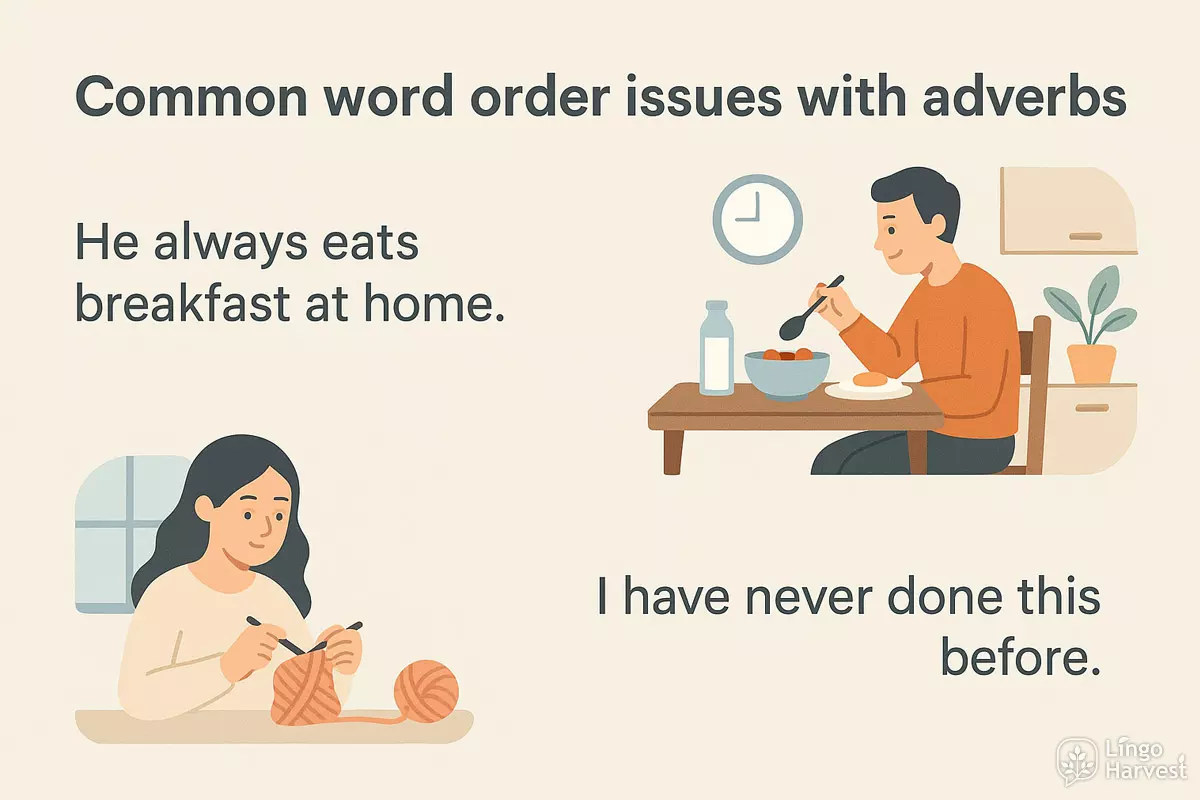
- ❌ He eats always breakfast at home. → ✅ He always eats breakfast at home.
- ❌ I have done never this before. → ✅ I have never done this before.
- ❌ She speaks English fluently always. → ✅ She always speaks English fluently.
- ❌ Usually I am going to work by bus. → ✅ I usually go to work by bus.
- ❌ They play at the park often. → ✅ They often play at the park.
- ❌ He does quickly his homework. → ✅ He does his homework quickly.
- ❌ I watch rarely TV at night. → ✅ I rarely watch TV at night.
- ❌ My sister is at home usually. → ✅ My sister is usually at home.
- ❌ She drives to work every day carefully. → ✅ She drives carefully to work every day.
- ❌ He has finished already his project. → ✅ He has already finished his project.
- ❌ We are meeting tomorrow probably. → ✅ We are probably meeting tomorrow.
Comparison of incorrect and correct word order
| Student Sentence | Corrected Version |
|---|---|
| She never is late. | She is never late. |
| I only not like pizza. | I do not like pizza only. |
| He reads sometimes books before bed. | He sometimes reads books before bed. |
| We have visited Paris just. | We have just visited Paris. |
| They go on holiday usually in July. | They usually go on holiday in July. |
| I am always tired Monday mornings. | I am always tired on Monday mornings. |
| He speaks very well English. | He speaks English very well. |
| My parents travel abroad often. | My parents often travel abroad. |
Notice how adverbs, especially of frequency (like always, never, usually, often), typically come before the main verb but after the verb to be. Adverbs of manner (such as quickly, fluently, carefully) usually follow the verb or the object. Reviewing authentic sentences and their corrections can make these rules more memorable and your own use more natural.
Correct the mistakes: practice section
Practicing the placement of adverbs in English sentences is crucial for mastering natural word order. Below, you'll find activities to help you spot and correct common mistakes, especially where adverbs are misplaced. Pay attention to position rules for frequency adverbs (always, usually), manner adverbs (quickly, carefully), and time adverbs (yesterday, soon).
Task 1: Identify the error
Each sentence below contains a mistake with adverb placement. Rewrite each sentence correctly.
- She drives always to work.
- We eat usually dinner at seven.
- He speaks English well very.
- They finished their homework quickly yesterday.
- My brother calls me never.
- Lisa late arrived at the meeting.
- I do my homework in the evening usually.
- He completely understood not the question.
- Tom forgot his keys almost.
- She reads every night quietly.
Show answers
- She always drives to work.
- We usually eat dinner at seven.
- He speaks English very well.
- They finished their homework yesterday quickly. (Better: They quickly finished their homework yesterday. OR: They finished their homework quickly yesterday.)
- My brother never calls me.
- Lisa arrived late at the meeting.
- I usually do my homework in the evening.
- He did not completely understand the question.
- Tom almost forgot his keys.
- She quietly reads every night.
Quick Reference: Common Adverb Positions
Check this overview for the usual placement of different types of adverbs in English sentences.
| Adverb Type | Typical Position | Example (Correct Order) |
|---|---|---|
| Frequency (always, never, often) | Before main verb; after 'be' | She always arrives early. They are never late. |
| Manner (quickly, well, carefully) | After main verb or object | He speaks well. She finished the test quickly. |
| Time (yesterday, soon, now) | Usually at the end | We'll call you soon. I saw him yesterday. |
| Degree (almost, completely, very) | Before adjective/adverb/verb | He almost missed the bus. She is very happy. |
Task 2: Correct or Incorrect?
Decide if the adverb placement is correct. If not, rewrite the sentence.
- He rarely is late for class.
- They completed the project successfully.
- I have seen never such a big dog.
- Usually we go shopping on Saturdays.
- The kids ate quickly their lunch.
- She already has finished her homework.
- We often are tired after work.
- You completely misunderstood the task.
- They have visited never that museum.
- He quickly can solve this problem.
Show answers
- Incorrect. He is rarely late for class.
- Correct.
- Incorrect. I have never seen such a big dog.
- Correct.
- Incorrect. The kids quickly ate their lunch. OR The kids ate their lunch quickly.
- Incorrect. She has already finished her homework.
- Incorrect. We are often tired after work.
- Correct.
- Incorrect. They have never visited that museum.
- Incorrect. He can quickly solve this problem.
Regular practice with these tasks will help you internalize natural word order with adverbs. Focus on patterns and review the table above when unsure.