Adverbs in Negative and Interrogative Sentences

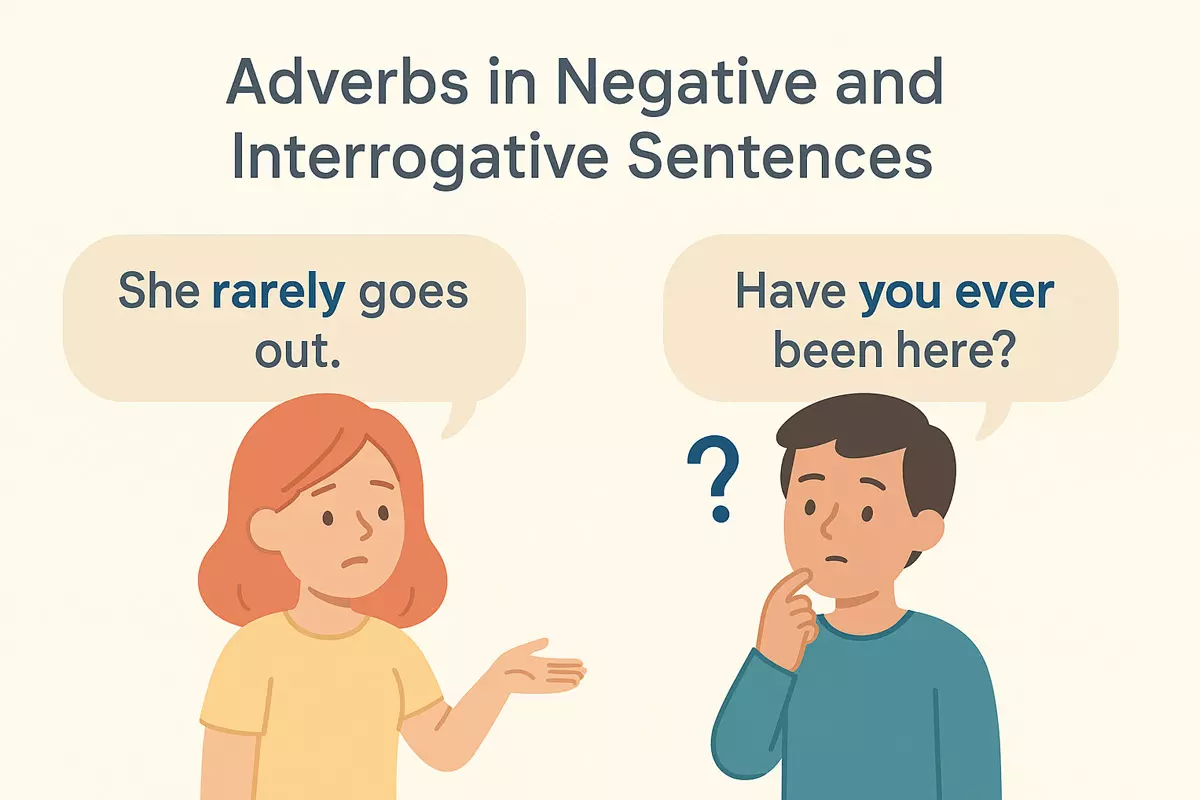 Here we how negative forms affect where adverbs go, including their placement before or after auxiliary verbs. It also discusses adverb movement in questions, common mistakes in negative questions, and provides real examples and practice exercises.
Understanding how adverbs, which are words that modify verbs, function in questions and negative statements can significantly improve your ability to communicate clearly in English. By learning where to place these words and how to use them correctly, you can add nuance to your sentences and convey your intended meaning more precisely. This knowledge not only helps you avoid common mistakes but also allows you to express yourself more naturally in both casual and formal conversations.
How negative forms affect adverb position
Negative sentences often change where adverbs naturally fit. In English, the presence of words like "not," "never," or "no" can shift the usual placement of adverbs, especially those of frequency or manner. In many cases, adverbs appear between the auxiliary verb and the main verb, but negative markers can force a different structure.
Basic rules with common negatives
When "not" is used, adverbs of frequency (such as "always," "often," "sometimes") usually come before the main verb but after the auxiliary or "be." For example, "She does not always agree" or "He is not usually late." However, with simple negatives, adverbs rarely go after the main verb in standard English.

- She has never visited Paris.
- Do you often travel abroad?
- He does not usually eat breakfast.
- Have they already finished?
- I will certainly call you.
- Did you just see that?
- We cannot always predict the weather.
- She is still waiting.
- Should I really go?
- He was not completely honest.
- They have not yet decided.
- Does she ever cook at home?
- Have you often heard this song before?
- He will not easily forget this day.
- Do they usually arrive early?
- You should not really worry about it.
- Can we possibly fix this today?
- She does not often make mistakes.
- Are you still working on the project?
- Did they already send the documents?
Comparing positive and negative adverb placement
The following table demonstrates how negative forms alter the position of adverbs relative to the verb:
| Positive Sentence | Negative Sentence |
|---|---|
| She always arrives early. | She doesn't always arrive early. |
| They often travel by train. | They don't often travel by train. |
| I completely understand. | I do not completely understand. |
| He already knows the answer. | He doesn't already know the answer. |
| We sometimes forget. | We don't sometimes forget. |
Special cases and exceptions
Some adverbs, such as "ever," are almost exclusive to negative or interrogative contexts: "I don't ever want to leave." Also, with modal verbs ("can," "will," "must"), the adverb typically follows the modal and precedes the negative: "He can never win," but with contracted forms, "He can't ever win." Double negatives are generally avoided in standard English unless used for emphasis in informal speech. In summary, negatives often push adverbs between the auxiliary and the main verb, and some adverbs are especially sensitive to this structure. This shift helps maintain clarity and natural rhythm in English sentences.
Placement before or after auxiliary verbs
Understanding how to position adverbs in sentences with auxiliary verbs is essential for clarity and correct emphasis. In English, the most common adverbs—such as "always," "never," "often," "just," and "already"—typically appear between the auxiliary and the main verb. This order is especially important in negative and interrogative constructions, as it can subtly change the meaning or focus of a statement.
Typical order with negative and interrogative sentences
When forming questions or negatives, the auxiliary verb (like "do," "have," "will," "can," etc.) comes before the subject or main verb, while the adverb usually fits snugly in between. For example:
- She has never visited Paris.
- Do you often travel abroad?
- He does not usually eat breakfast.
- Have they already finished?
- I will certainly call you.
- Did you just see that?
- We cannot always predict the weather.
- She is still waiting.
- Should I really go?
- He was not completely honest.
- You have not yet responded.
- Can she already drive?
- They do not often complain.
- Are they still working?
- He will not easily forget this.
- Has she ever tried sushi?
- We should never ignore safety rules.
- Did they frequently visit you?
- She might possibly join us later.
- You are always welcome here.
Exceptions and variations
While the mid-position (after the auxiliary and before the main verb) is standard, some adverbs—especially those that modify the whole sentence (sentence adverbs)—may appear at the beginning or end for emphasis. However, this is less common in questions and negatives.
- Honestly, I do not know the answer.
- I have not seen her, unfortunately.
Comparison of adverb placement in affirmative, negative, and interrogative forms
| Sentence Type | Example with Adverb |
|---|---|
| Affirmative | She has already left. |
| Negative | She has not yet left. |
| Interrogative | Has she already left? |
| Interrogative Negative | Has she not yet left? |
Quick guidelines for positioning
- Place frequency adverbs (always, never, often) between auxiliary and main verb.
- In negative sentences, adverbs usually follow the negative auxiliary ("does not usually").
- In questions, adverbs come after the subject if the auxiliary starts the sentence ("Do you often...").
- Sentence adverbs (fortunately, honestly) may appear at the start or end for stylistic reasons.
Correct placement of adverbs with auxiliaries is crucial for natural and precise English, especially in questions and negatives. With practice, these patterns become intuitive.
Adverb movement in questions
In English interrogative sentences, the placement of adverbs often shifts compared to statements. The position of adverbs like "always," "never," "often," or "already" depends on both the type of question and the verb tense. For simple yes/no questions, adverbs usually appear after the auxiliary verb but before the main verb. In wh-questions, the adverb's position can be more flexible, sometimes coming before or after the subject, depending on emphasis.
Common patterns for adverb placement in questions
- Auxiliary + subject + adverb + main verb: "Do you often travel?"
- Wh-word + auxiliary + subject + adverb + main verb: "Why did she never call?"
- Adverb at the end for emphasis: "Did you finish your homework quickly?"
- Adverb at the beginning for focus: "Usually, do you eat breakfast?"
Adverbs of frequency (such as "always," "rarely," "sometimes") most commonly appear between the auxiliary and the main verb in questions. However, adverbs of manner, place, and time (like "carefully," "outside," "yesterday") are more flexible but are often placed after the main verb or at the end of the question.
Examples of adverb positions in interrogative sentences
- Have you ever been to Paris?
- Will they really move abroad?
- Is she always late?
- Do you usually work from home?
- Did he finish the task quickly?
- Why did you never reply?
- When did they last call?
- Can you already speak Spanish?
- Where do you go often?
- How carefully did she check the report?
- Are they sometimes absent?
- Did you see him yesterday?
- Who usually cooks dinner?
Comparison: Statements vs. Questions
| Statement | Question |
|---|---|
| She always arrives early. | Does she always arrive early? |
| They have already finished. | Have they already finished? |
| He sometimes forgets his keys. | Does he sometimes forget his keys? |
| We never eat meat. | Do you never eat meat? |
| I often see her at the park. | Do you often see her at the park? |
Key points to remember
- Adverbs of frequency are rarely placed at the very beginning or end of a question.
- Auxiliary verbs help position adverbs naturally in English questions.
- Adverbs of manner, place, and time tend to appear after the main verb or at the end.
- Putting the adverb in the wrong place can sound awkward or change the meaning.
Understanding these patterns helps create more natural and clear interrogative sentences, especially when using adverbs.
Common errors in negative questions
Learners often face difficulties when using adverbs in negative interrogative forms. These mistakes can lead to confusion or unintended changes in meaning. Below, we explore typical pitfalls and ways to avoid them.
Misplacing adverbs in negative questions
A frequent issue is placing adverbs in the wrong spot. In English, adverbs like always, ever, and already should usually come after the auxiliary verb and before the main verb. Placing them elsewhere can make the question sound unnatural or even ambiguous.
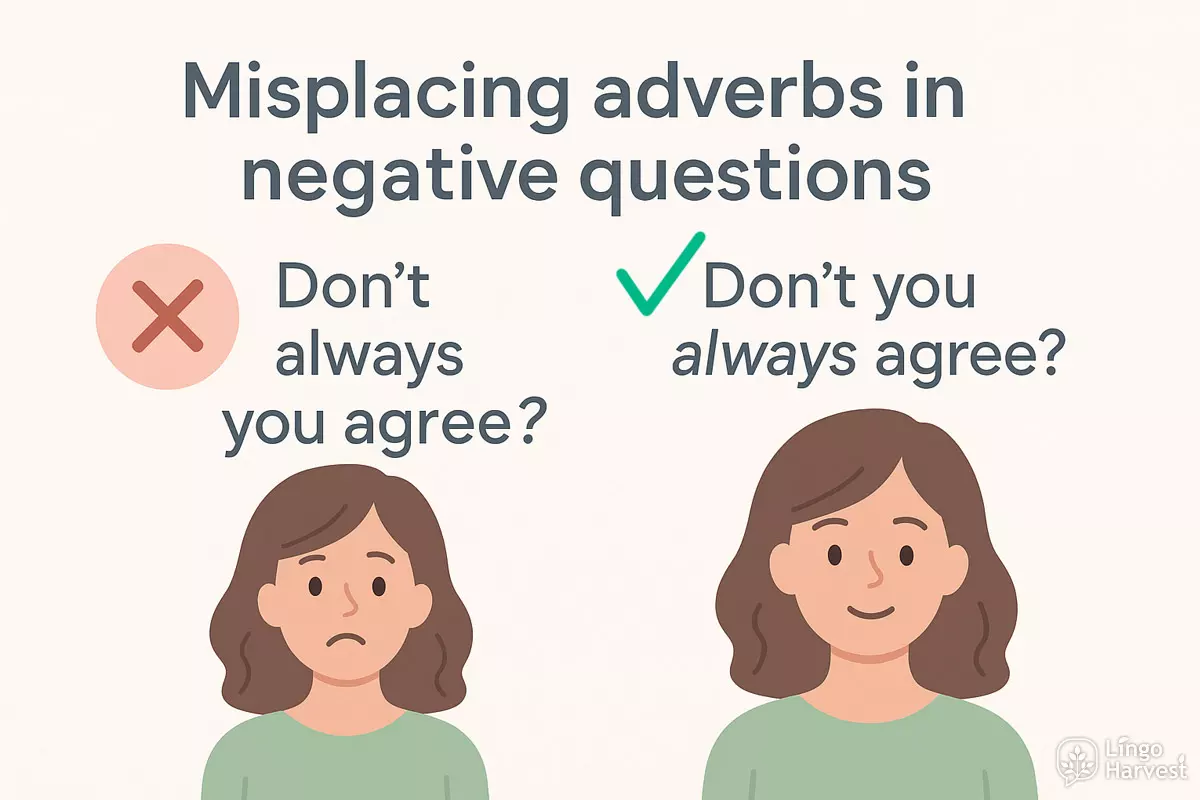
- ❌ Don't always you agree?
- ✅ Don't you always agree?
- ❌ Hasn't finished he yet?
- ✅ Hasn't he finished yet?
- ❌ Didn't already you know this?
- ✅ Didn't you already know this?
- ❌ Won't understand they ever?
- ✅ Won't they ever understand?
Confusing meaning with negative questions and adverbs
Negative questions can express surprise, confirmation, or disagreement. Adding adverbs sometimes intensifies or reverses the intended meaning. Misuse can make your question sound sarcastic or unclear.
- ❌ Don't you ever not like pizza? (double negatives cause confusion)
- ✅ Don't you ever like pizza?
- ❌ Haven't you already not finished?
- ✅ Haven't you finished already?
- ❌ Didn't you never see him before?
- ✅ Have you never seen him before?
- ❌ Isn't he hardly not working?
- ✅ Isn't he hardly working?
Incorrect auxiliary usage
Choosing the wrong auxiliary verb or omitting it is another common slip. In negative questions, the auxiliary should match the tense and subject.
- ❌ Not you have seen this movie?
- ✅ Haven't you seen this movie?
- ❌ Not she is coming today?
- ✅ Isn't she coming today?
- ❌ Didn't he is finish on time?
- ✅ Didn't he finish on time?
- ❌ Hasn't she goes to work yet?
- ✅ Hasn't she gone to work yet?
Summary of correct and incorrect patterns
| Incorrect Form | Correct Form |
|---|---|
| Doesn’t quickly she answer? | Doesn’t she answer quickly? |
| Isn’t already he here? | Isn’t he already here? |
| Didn’t you never go? | Didn’t you ever go? |
| Haven’t finished you yet? | Haven’t you finished yet? |
| Doesn’t she always not agree? | Doesn’t she ever agree? |
Tips to avoid mistakes
- Place adverbs between the auxiliary and main verb.
- Avoid double negatives unless intentional for emphasis or style.
- Check that your auxiliary verb matches subject and tense.
- Be clear about your intended meaning—confirmation, surprise, or doubt.
- Read your question aloud to check for clarity and natural flow.
Examples in real dialogues and texts
Understanding how adverbs function in negative and interrogative sentences is easier when you see them in authentic exchanges and written passages. Below are sample dialogues and excerpts that illustrate the placement and effect of adverbs such as always, never, often, already, yet, and still within questions and negatives. These examples highlight common patterns and subtle differences in meaning.
Sample lines from conversations
- ✅ Negative: "I don't usually eat breakfast before work."
- ✅ "She hasn’t ever tried sushi."
- ✅ "They haven’t yet finished their homework."
- ✅ "He doesn’t always remember my birthday."
- ✅ "You can’t really believe that, can you?"
- ✅ Interrogative: "Have you already seen this movie?"
- ✅ "Do you often travel for work?"
- ✅ "Didn’t you just call her?"
- ✅ "Is he still working at the same company?"
- ✅ "Have they ever been to Paris?"
- ✅ "Don’t you usually walk home?"
- ✅ "Why haven’t you already finished?"
Contrasting adverb placement
Adverbs sometimes shift position in questions versus negatives, affecting emphasis and clarity. Consider the following structured comparison:
| Negative Sentence | Interrogative Sentence |
|---|---|
| I don’t usually watch TV at night. | Do you usually watch TV at night? |
| She hasn’t ever visited London. | Has she ever visited London? |
| We haven’t yet received the package. | Have you yet received the package? |
| He doesn’t always agree with me. | Does he always agree with you? |
Extracts from texts and authentic messages
- ✅ "I haven’t really thought about that before."
- ✅ "Are you still interested in joining us?"
- ✅ "We don’t often go out during the week."
- ✅ "Has she never mentioned this to you?"
- ✅ "The train hasn’t left yet."
- ✅ "Do you ever feel nervous before a speech?"
By examining these real-world utterances and passages, you can see how the placement of adverbs subtly shapes the meaning and tone of both negative and interrogative forms. This awareness helps in both understanding and using such structures more naturally.
Practice: rewrite negative and interrogative forms
Working with adverbs in negative and interrogative sentences helps clarify meaning and avoid ambiguity. Below, you’ll find exercises to rewrite statements into their negative and question forms, paying close attention to the correct placement of adverbs such as “always,” “already,” “ever,” “never,” “still,” “yet,” “often,” and similar words.
Convert to Negative Sentences
Rewrite the following sentences in the negative, making sure to place the adverb in the natural position for negatives:
- She always arrives on time.
- They have already finished the project.
- He still remembers that day.
- We often visit our grandparents.
- You can easily solve this problem.
- She usually drinks coffee in the morning.
- They frequently travel abroad.
- He completely understands the instructions.
- We rarely see this kind of bird here.
- You definitely need to check the results.
Show answers
- She does not always arrive on time.
- They have not finished the project yet.
- He no longer remembers that day.
- We do not often visit our grandparents.
- You cannot easily solve this problem.
- She does not usually drink coffee in the morning.
- They do not frequently travel abroad.
- He does not completely understand the instructions.
- We do not often see this kind of bird here.
- You do not definitely need to check the results. (Better: You do not necessarily need to check the results.)
Change to Interrogative Sentences
Now, turn these statements into questions. Pay attention to how the adverb’s position can affect the meaning:
- She has never been to Paris.
- They are still working on the report.
- You usually drink coffee in the morning.
- He already knows the answer.
- The children often play outside.
- We rarely watch TV in the evening.
- He sometimes forgets his keys.
- You have just finished your homework.
- They frequently visit their cousins.
- She always remembers important dates.
Show answers
- Has she ever been to Paris?
- Are they still working on the report?
- Do you usually drink coffee in the morning?
- Does he already know the answer?
- Do the children often play outside?
- Do we rarely watch TV in the evening?
- Does he sometimes forget his keys?
- Have you just finished your homework?
- Do they frequently visit their cousins?
- Does she always remember important dates?
Compare Adverb Positions in Negative and Interrogative Forms
Notice how the placement of adverbs changes between negative and interrogative forms. Here’s a comparison:
| Affirmative | Negative | Interrogative |
|---|---|---|
| She is always late. | She is not always late. | Is she always late? |
| They have already eaten. | They have not eaten yet. | Have they already eaten? |
| He still works here. | He does not still work here. | Does he still work here? |
| You often forget your keys. | You do not often forget your keys. | Do you often forget your keys? |
| I can easily do this. | I cannot easily do this. | Can I easily do this? |
Practice: Identify Errors
Decide if the adverb is in the correct place in these negative or interrogative sentences. If not, rewrite it correctly:
- Do you ever have eaten sushi?
- She not usually goes to the gym.
- Have you finished your homework already?
- They don’t still live here.
- Does he often is late?
- Did you ever have seen this movie?
- You not always do your homework.
- Have they yet arrived?
- He doesn't ever listens to advice.
- Are you still not understand the task?
Show answers
- Have you ever eaten sushi?
- She does not usually go to the gym.
- Have you already finished your homework?
- They no longer live here. (Or: They do not still live here.)
- Is he often late?
- Have you ever seen this movie?
- You do not always do your homework.
- Have they arrived yet?
- He doesn't ever listen to advice.
- Do you still not understand the task?
Practicing these transformations helps you use adverbs naturally and accurately in both negative and interrogative sentences. Pay attention to word order, as it often changes depending on sentence type and the specific adverb in use.